REVIEW 4 major objections 6 minor 1 cited by
InsightEval: An Expert-Curated Benchmark for Assessing Insight Discovery in LLM-Driven Data Agents
T0 review · 4 major / 6 minor · reviewed 2026-08-03 · deepseek-v4-flash
Pith's one-line read This paper proposes InsightEval, a curated benchmark of 1,000 insights across six types, and an Insight F1 metric that claim to better measure how LLM-driven data-analysis agents discover insights.
desk verdict Useful error analysis and a plausible re-annotated benchmark, but the F1-superiority claim rests on a 30-instance human comparison and a metric that rewards duplicated insights. read the letter →
The pith
A machine-rendered reading of the paper's core claim, the machinery that carries it, and where it could break.
The reading
What carries the argument
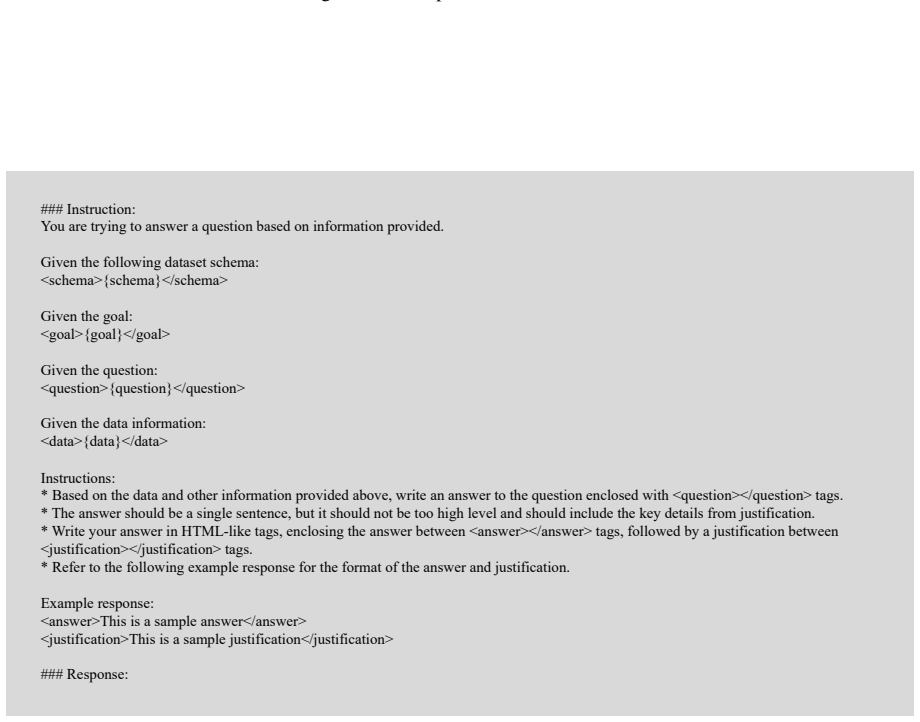
The central machinery is the data-curation pipeline and the evaluation metric. The pipeline (goal refinement, question validation and generation, answering and insight generation, summary synthesis) enforces three requirements: clearly defined goals, high-quality questions and insights, and multi-perspective automatic evaluation. The evaluation uses iterative matching between ground-truth and agent insights to compute recall and precision, combined into the Insight F1 Score, plus a novelty score that asks three LLMs to judge whether unmatched agent insights are correct and original.
What would settle it
If a second, independent expert annotation of a random sample of the same tables orders the agent configurations differently under Insight F1 than the published order, the benchmark's reliability is not established. Concretely, re-annotate 30 tables with a new expert team and check whether the agent F1 ranking matches; if it flips, the metric is measuring the annotation rather than the agents.
Extended reading notes
Core claim
The paper's central claim is that InsightEval is a higher-quality benchmark than the existing one it audits, and that its Insight F1 Score better reflects an agent's insight-discovery ability than the recall-only evaluation used previously. The audit identifies five error types in the prior benchmark—ambiguous goals, undefined data types, erroneous questions, irrational insights, and redundant insights—and the new dataset corrects them. On this dataset, the authors benchmark two agent frameworks built on three common large language models, finding that precision typically exceeds recall, meaning agents generate confident but repetitive insights rather than exploring broadly; that novelty sco
Load-bearing premise
The benchmark's scores assume the annotated ground-truth insights are a complete and unbiased gold set, and that LLM judges can reliably tell which agent outputs match those insights and which are genuinely novel.
Editorial extensions
If this is right
- The benchmark gives the field a shared testbed, making future comparisons of data-analysis agents reproducible.
- Because precision is included, an agent that dumps many shallow or duplicate insights is penalized, encouraging focused exploration.
- The two added insight types (Evaluative and Exploratory) expose capability gaps that the original four types miss.
- The finding that agents favor prescriptive and exploratory outputs while missing ground-truth recall suggests current agents need better exploration strategies.
- The novelty score rewards discoveries not in the gold set, pushing agents toward genuinely new findings.
Reading between the lines
- The paper's own limitation note says ground-truth annotations are incomplete; this implies the F1 score could reward agents that paraphrase the annotations rather than find truly better insights, so a stronger test would use multiple independent gold sets.
- Because novelty is judged by LLMs, the score is time- and context-dependent; re-scoring the same agent outputs months later could shift rankings as model knowledge evolves.
- The curation pipeline's criteria—clear goals, tight question-data alignment, multi-perspective evaluation—could transfer to other domains, like scientific data, but would need domain-expert involvement in annotation.
- A testable extension: compare Insight F1 against human rankings on a held-out set of fresh tables to see if the metric generalizes beyond the curated instances.
Signed reviews
Editorial analysis
A structured set of objections, weighed in public.
Referee Report
Summary. The paper argues that the existing InsightBench benchmark is flawed and introduces InsightEval, a new benchmark of 100 instances and 1,000 insights (10 per table) built through an LLM-assisted pipeline with human verification. It also proposes an evaluation framework with insight recall, precision, an Insight F1 Score, and a novelty metric, and it benchmarks two agent frameworks (Pandas Agent and Agent Poirot) on this dataset. The central claims are that the Insight F1 Score 'can better reflect the agent's insight discovery ability' and that InsightEval provides a 'more comprehensive and deeper assessment' than existing benchmarks.
Significance. If properly validated, the dataset and evaluation framework would be a useful community resource: the error analysis of InsightBench in Table 1 and Figure 1 is concrete and actionable, the six-type taxonomy is a reasonable extension, and the move from a single LLM evaluator to multiple evaluators plus recall/precision/novelty is a step in the right direction. However, the paper's headline comparative claims currently rest on a small human-evaluation sample with no reliability statistics, a metric with a structural duplicate-inflation problem, and an unvalidated novelty threshold. These issues do not disprove the value of the resource, but they do mean that the stated superiority claims are under-supported as written.
major comments (4)
- [§4.3.1–§4.3.3, Eqs. (1)–(3)] The Insight F1 metric is defined through expectations over max pairwise similarity without any one-to-one matching. If an agent emits many near-identical copies of one correct insight, Eq. (2) assigns each duplicate the same high precision score and Eq. (1) is unaffected, so F1 can be inflated while set-based precision would fall. Finding 1 in §6.2 explicitly reports that agents produce 'substantial redundancy,' so this is not a corner case. Since the paper's central claim is that Insight F1 'can better reflect the agent's insight discovery ability,' the metric should either enforce one-to-one matching (e.g., greedy or Hungarian matching) or be supplemented by a set-level precision that penalizes duplicates.
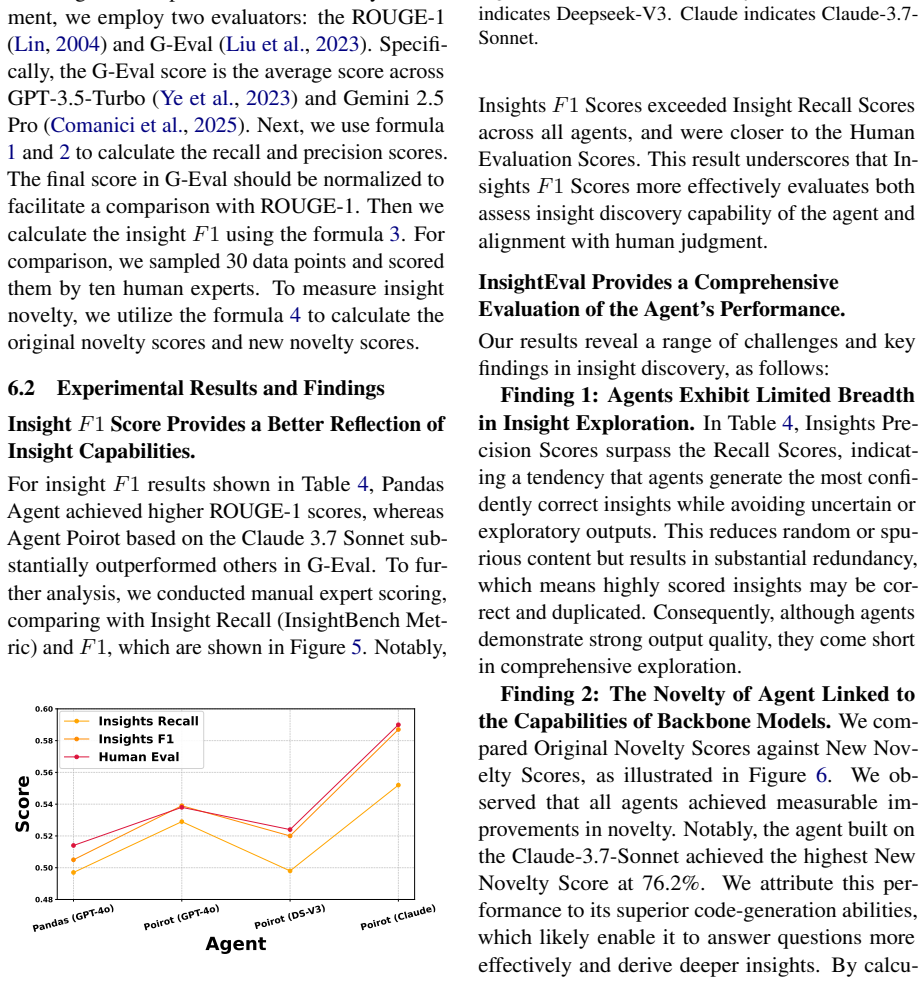
- [§6.2, Figure 5, Appendix C] The key evidence for the claim that Insight F1 aligns better with human judgment is a comparison on only 30 sampled data points. No inter-annotator agreement is reported, no per-instance correlation or confidence intervals are given, and Appendix C does not describe the rating scale, the number of raters per instance, or whether raters were blinded to the condition. The conclusion that F1 is 'closer to Human Evaluation Scores' is based on aggregate means and is not statistically supported. This needs a more rigorous human-evaluation protocol and analysis before the central claim can be accepted.
- [§4.3.4 and §6.1.3] The novelty metric depends on classifying insights as correct when their G-Eval score 'exceeding 5,' but §6.1.3 states that G-Eval scores are normalized to facilitate comparison with ROUGE-1. If the normalized range is [0,1], the threshold >5 is either impossible or trivially satisfied; if the raw 1–5/1–10 scale is used, the threshold is arbitrary and uncalibrated. In addition, the LLM-majority judgment of novelty is never validated against human novelty judgments. Since novelty is a stated contribution of the paper, this inconsistency and lack of validation are load-bearing.
- [§4.2, Table 2, Appendix D, §8] Ground-truth insights are generated with LLM assistance (o3-mini and GPT-4o) and evaluated by LLMs (GPT-3.5-Turbo, Gemini 2.5 Pro) plus ROUGE, while the quality audit in Table 2 covers only 40 randomly sampled instances and reports no inter-annotator agreement or confidence intervals. The comparison against InsightBench in Appendix D is reported without the annotation protocol. Section 8 concedes that 'ground-truth annotations are necessarily incomplete.' The paper should explicitly address the risk that its F1 and novelty scores partly measure stylistic similarity to LLM-generated reference text rather than true insight quality—for example, by validating on a fully human-curated subset, ablating evaluator choice, or measuring agreement with expert judgments of insight completeness.
minor comments (6)
- [Table 11] The example dataset contains near-duplicate insights: Insight 9 and Insight 10 both state that every caller submitted 125 incidents, with only a slight interpretative difference. This undercuts the de-duplication claim in §4.2.3; please replace the example or revisit the de-duplication procedure.
- [Eq. (4)] The variables M, N, and δ are introduced only in prose; define them directly in or below the equation to avoid ambiguity.
- [Figure 5] The bar chart shows only aggregate values. A per-agent scatter plot or error bars would help readers see variance across the 30 instances.
- [General] No dataset URL or code release is mentioned. For a benchmark paper, an artifact link is essential for reproducibility and community adoption.
- [Table 4] ROUGE-1 and G-Eval rank the agents differently (e.g., Pandas Agent (GPT-4o) has the highest ROUGE-1 F1 but is below Agent Poirot (GPT-4o) in G-Eval). A short discussion of what each metric captures would help readers interpret the divergence.
- [Figure 1] The reported error rates (57.0%, 20.8%, 14.5%, 32.8%, 18.3%) sum to more than 100%. A sentence clarifying that the error types are not mutually exclusive would prevent confusion.
Circularity Check
No significant circularity: the benchmark and metric claims rest on external human review and conceded limitations, not on a self-referential derivation.
full rationale
This paper is a benchmark construction and evaluation study rather than a derivation chain, and I find no step where an output is equivalent to an input by construction. The central metric (Insight F1, Eqs. 1-3) is an explicit function of recall and precision over the ground-truth set, and its claimed superiority is tested against ten human experts on 30 instances (Fig. 5), an external signal not used to fit the metric. Ground-truth insights are constructed with LLM assistance (o3-mini) but are manually verified and expert-annotated in the quality audit (Table 2, Sec. 5.2), and the paper explicitly concedes in Sec. 8 that annotations are 'necessarily incomplete' and that novelty is 'time- and context-dependent'—statements that acknowledge limits rather than disguising assumptions as results. No load-bearing self-citations appear: InsightBench and Agent Poirot are external prior work, and no uniqueness theorem or ansatz is imported from the authors' own earlier papers. The absence of inter-rater reliability, the small 30-point human sample, and the use of LLM evaluators are validity weaknesses that belong in a correctness-risk review, but they do not constitute a circular reduction under the definitions used here. Consequently the paper earns score 0.
Assumptions & free parameters
free parameters (4)
- G-Eval correctness threshold =
5
- Novelty majority threshold =
2 of 3 LLMs
- Per-instance question count =
10
- Agent Poirot experimental configuration =
4 rounds, 3 questions per round
assumptions (4)
- domain assumption The six-part taxonomy (Descriptive, Diagnostic, Predictive, Prescriptive, Evaluative, Exploratory) is a complete and mutually exclusive classification of insight-discovery questions.
- domain assumption G-Eval and ROUGE-1 scores are valid proxies for semantic equivalence of insights.
- domain assumption Human annotation on a random 40-instance subsample is representative of the full 100-instance dataset.
- domain assumption The 100 tables inherited from InsightBench are representative of real-world business analytics data.
Cite this review
Pith. "Pith review of InsightEval: An Expert-Curated Benchmark for Assessing Insight Discovery in LLM-Driven Data Agents." pith.science (2026). https://pith.science/paper/4HCFA4CY
@misc{pith2026251122884,
  author       = {Pith},
  title        = {Pith review of: InsightEval: An Expert-Curated Benchmark for Assessing Insight Discovery in LLM-Driven Data Agents},
  year         = {2026},
  howpublished = {\url{https://pith.science/paper/4HCFA4CY}},
  note         = {Machine review of arXiv:2511.22884}
}
read the original abstract
Data analysis has become an indispensable part of scientific research. To discover the latent knowledge and insights hidden within massive datasets, we need to perform deep exploratory analysis to realize their full value. With the advent of large language models (LLMs) and multi-agent systems, more and more researchers are making use of these technologies for insight discovery. However, there are few benchmarks for evaluating insight discovery capabilities. As one of the most comprehensive existing frameworks, InsightBench also suffers from many critical flaws: format inconsistencies, poorly conceived objectives, and redundant insights. These issues may significantly affect the quality of data and the evaluation of agents. To address these issues, we thoroughly investigate shortcomings in InsightBench and propose essential criteria for a high-quality insight benchmark. Regarding this, we develop a data-curation pipeline to construct a new dataset named InsightEval. We further introduce a novel metric to measure the exploratory performance of agents. Through extensive experiments on InsightEval, we highlight prevailing challenges in automated insight discovery and raise some key findings to guide future research in this promising direction.
Figures


Figures from the paper (14 more)






Forward citations
Cited by 1 Pith paper
-
AvalancheBench: Evaluating Enterprise Data Agents Through Latent World Recovery
AvalancheBench introduces a benchmark for data agents based on recovering a known latent world from observations, reporting that the best coding agent recovers only 26% on an e-commerce case.
Reference graph
Works this paper leans on
-
[2]
Dagent: A relational database-driven data analysis report generation agent.arXiv preprint arXiv:2503.13269. Zhiyu Yang, Zihan Zhou, Shuo Wang, Xin Cong, Xu Han, Yukun Yan, Zhenghao Liu, Zhixing Tan, Pengyuan Liu, Dong Yu, Zhiyuan Liu, Xiaodong Shi, and Maosong Sun. 2024. MatPlotAgent: Method and evaluation for LLM-based agentic scientific data visu- aliza...
arXiv 2024
-
[25]
{question}
suggests a potential management bottleneck for Ed Gompf, which could impact employee supervision quality and depart- mental efficiency if not addressed through workload rebalancing. Summary: The IT department shows a severe workload imbal- ance between its two managers, with Ed Gompf overseeing 76 employees (73.79% of IT staff) while Mariano Maury manages...
-
[2025]
In The Thirteenth International Conference on Learning Representations
Insightbench: Evaluating business analyt- ics agents through multi-step insight generation. In The Thirteenth International Conference on Learning Representations. Luoxuan Weng, Xingbo Wang, Junyu Lu, Yingchao- jie Feng, Yihan Liu, Haozhe Feng, Danqing Huang, and Wei Chen. 2025. Insightlens: Augmenting llm- powered data analysis with interactive insight m...
2025
Reviewed August 3, 2026 · model on record in the stance chip above.
Discussion (0). Continue with ORCID to comment.