REVIEW 3 major objections 6 minor 1 cited by
ToolSpectrum : Towards Personalized Tool Utilization for Large Language Models
T0 review · 3 major / 6 minor · reviewed 2026-08-15 · deepseek-v4-flash
Pith's one-line read This paper claims that personalized tool utilization—choosing among functionally similar tools using user profile and environment—is a distinct capability current LLMs lack, and introduces ToolSpectrum to measure it.
desk verdict The first benchmark for personalized tool selection under joint profile-plus-environment constraints, with a real empirical finding -- but the gold labels and the judge are the same model family being tested, so the headline numbers are conditional on GPT-4o's reliability as an oracle. read the letter →
The pith
A machine-rendered reading of the paper's core claim, the machinery that carries it, and where it could break.
The reading
What carries the argument
The central object is the ToolSpectrum benchmark itself. It operationalizes personalization by splitting it into user profile (demographics, personality, preference) and environment (natural environment, digital environment, and app domain policy), then builds three data splits—Profile-only, Environment-only, and Profile & Environment—so the individual and joint contributions of the two factors can be measured separately. The measuring instrument is an F1 score computed at four hierarchical levels: APP and API capture whether the right app and service interface were chosen, RP (required parameters) captures instruction following, and OP (optional personalized parameters) captures whether personalization actually changed the call. This decomposition is what lets the paper attribute performance drops to the joint-reasoning problem rather than to tool-call syntax or format errors.
What would settle it
Take a random sample of ToolSpectrum items and have independent human experts choose the tool call they would make for the stated profile and environment; if expert choices systematically disagree with the GPT-4o-generated ground-truth labels (for instance, Cohen's kappa well below 0.8), the benchmark measures agreement with GPT-4o rather than correctness of personalization. The complementary check is a live user study in which people in the profiled situations choose between the ground-truth label and a model's output, testing whether the labels actually correspond to higher satisfaction.
Extended reading notes
Core claim
ToolSpectrum defines personalized tool utilization as a task: given a user instruction $I$, a user profile $P$ (demographics, personality, preferences), an environment $E$ (weather, time, network, and app domain policies), and a toolset $T$ of functionally overlapping apps and APIs, the model must return a dictionary $\{\mathrm{APP}, \mathrm{API}, \mathrm{RP}, \mathrm{OP}\}$, or the value $\mathrm{None}$ when the combination violates a domain policy. The paper argues that existing benchmarks only test whether a model can pick a tool that executes an instruction, not whether it picks the right tool for this user in this situation. On 1,000 samples across nine domains, GPT-4o reaches 0.80–0.81 F1 on app selection when only one personalization factor is present, but falls to 0.32 when profile and environment must be considered together, with optional personalized parameters dropping to 0.45; the paper reads this as evidence that current LLMs cannot jointly reason about both dimensions and often prioritize one at the expense of the other. It also reports that adding personalized information improves tool-use effectiveness over non-personalized baselines, with the gain larger for GPT-4o than for GPT-3.5.
Load-bearing premise
The load-bearing premise is that the GPT-4o-generated tool-call labels, after GPT-4o quality filtering and a small manual check, are genuinely correct personalized choices; if GPT-4o's judgments are biased or misaligned with real user satisfaction, the reported F1 scores and win rates do not measure actual personalized tool utilization.
Editorial extensions
If this is right
- Tool-selection benchmarks should include overlapping toolsets with contextual factors, because functional correctness alone overstates real-world agent competence.
- Simply scaling model size will not close the personalization gap: Qwen2.5-72B shows little improvement over Qwen2.5-32B on ToolSpectrum.
- Hierarchical prompting—first predicting the domain, then giving only the relevant toolset—improves F1 by reducing context noise, giving a cheap baseline for future work.
- Domain-policy compliance is a major failure mode in combined profile-and-environment scenarios (31% of sampled errors), so personalized tool use and constraint handling are linked.
- The effectiveness gain from personalization grows with model strength, so stronger base models will likely amplify the benefit of personalized tool-use training.
Reading between the lines
- The measured joint-reasoning deficit may partly reflect GPT-4o's own label-generation biases; a benchmark generated by a different model or by human experts could produce different rankings and should be tested.
- A natural extension is multi-turn personalization, where the profile and environment update after each tool call (for example, a canceled flight changes the travel context); ToolSpectrum currently evaluates one-shot decisions.
- The profile/environment decomposition could be used to diagnose model-specific biases, since some models may systematically favor profile over environment or vice versa, which is testable with the existing data splits.
- Because the authors note that excessive context length is a major limitation of the benchmark, retrieval or hierarchical toolset pruning may matter more than raw reasoning ability for this task; this is testable with the released code.
Signed reviews
Editorial analysis
A structured set of objections, weighed in public.
Referee Report
Summary. The paper introduces ToolSpectrum, a benchmark for evaluating LLMs on personalized tool utilization, defined as selecting apps, APIs, required parameters, and optional parameters while taking into account user profiles, environmental factors, and their combination. The benchmark is constructed via a GPT-4o-driven pipeline: GPT-4o generates user instructions, tool-call results (under Profile, Environment, and Profile & Environment conditions), and then filters the data using its own quality scores with a threshold of 8, removing 21.8% of samples. The authors evaluate 16 open-source and API-based models, reporting F1 scores at four granularity levels (APP, API, RP, OP). They find that models perform relatively well on coarse-grained tool selection but poorly on optional parameters, and that the combined Profile & Environment condition is the most difficult, with the best models scoring only about 0.45-0.50 on OP. A secondary win-rate analysis (with GPT-4o as judge) is used to argue that personalization improves tool-utilization effectiveness. The paper also includes an error analysis and prompt-engineering experiments.
Significance. ToolSpectrum addresses a genuine gap in the tool-learning literature: existing benchmarks mostly ignore overlapping toolsets and the influence of user profiles and environmental context on tool choice. The decomposition of personalization into profile, environment, and their joint effect, together with the four-level F1 hierarchy, is sensible and potentially useful for the community. The paper provides broad model coverage, and the qualitative pattern that joint profile/environment reasoning is harder than either dimension alone is consistent with intuition and with the reported tables. If the gold-label validity is established, this could become a useful resource for studying personalized tool agents. However, the current construction relies heavily on GPT-4o both as the oracle that defines correct tool calls and as the judge for the win-rate analysis, which undermines the absolute scores and, to some extent, the cross-condition comparisons. The release of data and code is a clear strength that aids further validation.
major comments (3)
- [§3.2.4, §3.2.5, Table 3] Gold tool-call results are generated by GPT-4o using the prompt template in Figure 13 and then filtered by GPT-4o's own 1-10 quality scores with a threshold of 8, removing 21.8% of samples. GPT-4o is also the strongest evaluated model in Table 3. Because the oracle that defines 'correct' personalized calls is the same model family being measured, the reported F1 scores, including the low OP scores (~0.45-0.50) in the Both condition, reflect consistency with GPT-4o's generation policy rather than an independent standard. The manual quality assessment at the end of §3.2.5 scores plausibility on a 1-10 scale, and the paper reports no inter-annotator agreement on whether the gold output is uniquely reasonable or unbiased across the profile/environment dimensions. This matters concretely: §5.3 shows GPT-4o itself misinterprets domain policies in 31% of its sampled errors in the combined condition, so the gold labels in that subset are likely noisy exactly where the headline conclusion is drawn. I ask the authors to (i) report inter-annotator agreement on a sample of gold labels with instructions to judge not merely plausibility but also whether an alternative tool call would be equally valid; (ii) analyze dimension bias in the gold labels (e.g., how often the gold call follows profile vs environment when the two conflict); and (iii) re-evaluate at least the Both subset with gold labels generated by a different model or with human-authored labels to show the main pattern is not an artifact of GPT-4o self-consistency.
- [Table 2 and §4.2] The average number of optional parameters in the gold outputs differs greatly across conditions: 1.31 in Profile, 6.79 in Environment, and 6.67 in Both. Since OP F1 is computed over per-sample gold optional-parameter dictionaries, a model that perfectly predicts the single optional parameter in a Profile sample receives F1=1.0 for that sample, whereas in an Environment sample it must correctly predict about 6.8 parameters to achieve the same per-sample F1. The paper's cross-condition ranking (Profile ≈ Environment > Both) is therefore confounded by the number of gold OPs per condition; the Both condition not only combines two personalized factors but also has many more OPs to predict than Profile. Please report OP F1 normalized by the number of gold OPs per sample (or per-parameter precision/recall) and decompose the OP gap into a label-length effect and a joint-reasoning effect. Without this, the central claim that joint reasoning is the bottleneck for OP scores is not fully supported.
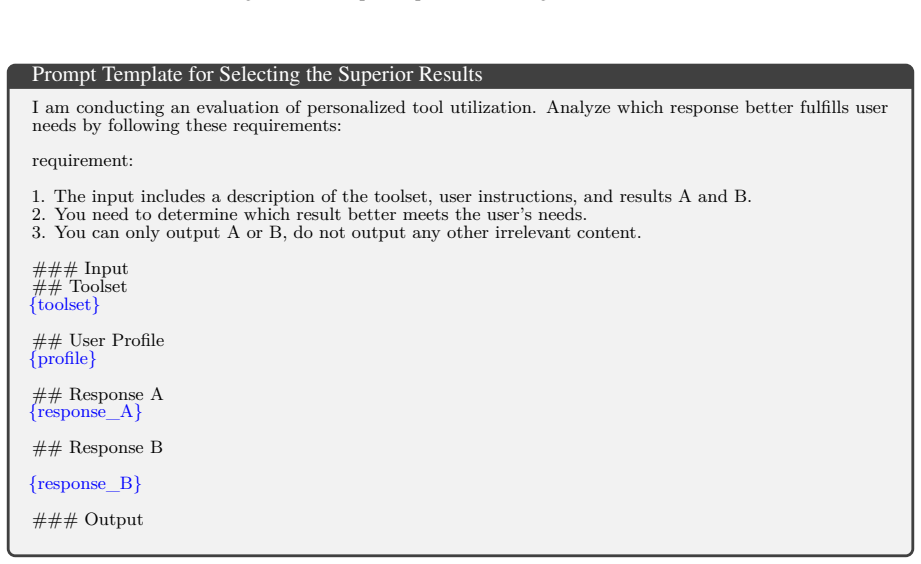
- [§5.1, Figure 15] The win-rate analysis in Figure 3 uses GPT-4o as the judge (prompt in Figure 15), with human-GPT-4o agreement measured on 100 samples (κ=0.85). A single aggregate κ of 0.85 on 100 samples is not sufficient to rule out systematic judge bias in favor of the personalized outputs, particularly because those outputs follow the same generation template used to create the gold labels. The conclusion that 'personalization improves effectiveness' would be strengthened by reporting win rates with an alternate judge (e.g., Claude or a different strong model) and by showing per-condition human agreement rather than one pooled number. This is a load-bearing check on the RQ1 claim, since the same model that served as oracle and primary evaluated model also serves as the sole automated judge.
minor comments (6)
- [Table 3] The column header 'PP' under the Profile condition is a typo for 'OP'; the text and all other columns use OP.
- [§3.3] The text states that ToolSpectrum features '23 APPs, 42 APIs,' while Table 2 reports #APPs = 22/22/20 and #APIs = 39/40/33 across the three subsets; please reconcile these numbers.
- [§B.3] The sentence 'In this section (5.5), we explore...' references a nonexistent Section 5.5; it should refer to Section B.3.
- [Figure 13] Requirement 4 says 'if you feel that the user's instruction violates the user's profile, set the APP, API, and params to null,' but the task definition in §3.1 states that None should be returned when the instruction violates the application's policy, not the user's profile; please correct the wording.
- [Figure 4] The caption of Figure 4 does not specify which models are averaged to obtain the per-domain performance; please state the model set or provide per-model results to make the domain analysis reproducible.
- [Table 2] The rows 'Avg. Params' and 'Avg. OPs' are not formally defined; please clarify whether these are averages over samples and over which fields, so that readers can interpret the large OP-count differences.
Circularity Check
ToolSpectrum's gold labels are generated and filtered by GPT-4o, and GPT-4o is also the top evaluated model; the central joint-reasoning gap is therefore partly a self-consistency artifact.
-
other
[Section 3.2.4 (Tool Result Collection), Section 3.2.5 (Quality Assessment), Section 4.1 (Models), Section 4.2 (Main Results)]
"Specifically, we input the user instruction I∈I, predefined toolsets T, and either a user profile p∈P, an environment e∈E, or both into GPT-4o to obtain the corresponding tool call results. This process generates three distinct datasets: Profile, Environment, and Profile & Environment. ... we first use GPT-4o to score each data sample across three dimensions. ... We then exclude data points with an average score below 8, removing 21.8% of the data. ... the API-Based models include OpenAI GPT API (gpt-3.5-turbo-16k-0613, gpt-4o-20241120)."
The reference 'correct' tool call is defined by GPT-4o's own output and then filtered by GPT-4o's own quality score, while GPT-4o is one of the evaluated models. Its F1 scores, and the aggregate conclusion that LLMs cannot jointly reason about profiles and environments, are therefore measures of agreement with a reference distribution drawn from GPT-4o itself, not with an independent ground truth. This is most problematic in the Profile & Environment subset, where Section 5.3 reports that 31% of GPT-4o's sampled errors involve failing to interpret domain policy; those same failures can be embedded in the gold labels. Consequently, the low OP F1 scores in the 'Both' condition may reflect label bias or noise from the generator rather than a genuine limitation of current models.
full rationale
ToolSpectrum is a benchmark paper, not a formal derivation, so the classical circularity patterns (self-citation chains, imported uniqueness theorems, ansatz smuggling) are absent. The one substantive circularity is the oracle/evaluator overlap: GPT-4o generates the gold tool calls (Section 3.2.4), GPT-4o scores and filters them (Section 3.2.5), GPT-4o is evaluated against them (Section 4.1), and GPT-4o is used as the judge in the win-rate analysis (Section 5.1). This makes the central claim about poor joint reasoning partly a self-consistency artifact. Some independent content remains: even when the reference is its own generation distribution, GPT-4o's OP F1 in the joint condition is only about 0.45, and the human agreement on the pairwise preference judgments is high. However, the gold labels themselves are never validated against an external standard or human annotation of uniqueness or bias across profile and environment dimensions, so the headline limitation is not robustly established. Score 5 reflects partial circularity in the benchmark's construction rather than a full collapse of the derivation chain.
Assumptions & free parameters
free parameters (2)
- Quality filtering score threshold =
8 (out of 10)
- Demographic sampling distribution parameters =
not specified
assumptions (4)
- domain assumption User profile and environment are the two key dimensions of personalization for tool utilization.
- domain assumption GPT-4o can generate valid and consistent ground-truth personalized tool calls.
- domain assumption F1 scores on exact hierarchical fields (APP, API, RP, OP) are an appropriate measure of personalized tool utilization.
- domain assumption Domain policies are objective rules that can be unambiguously applied.
invented entities (1)
-
Synthetic app and API catalog (e.g., Ctrip, Temu, Freshippo)
Cite this review
Pith. "Pith review of ToolSpectrum : Towards Personalized Tool Utilization for Large Language Models." pith.science (2026). https://pith.science/paper/4HKL7LFE
@misc{pith2026250513176,
  author       = {Pith},
  title        = {Pith review of: ToolSpectrum : Towards Personalized Tool Utilization for Large Language Models},
  year         = {2026},
  howpublished = {\url{https://pith.science/paper/4HKL7LFE}},
  note         = {Machine review of arXiv:2505.13176}
}
read the original abstract
While integrating external tools into large language models (LLMs) enhances their ability to access real-time information and domain-specific services, existing approaches focus narrowly on functional tool selection following user instructions, overlooking the context-aware personalization in tool selection. This oversight leads to suboptimal user satisfaction and inefficient tool utilization, particularly when overlapping toolsets require nuanced selection based on contextual factors. To bridge this gap, we introduce ToolSpectrum, a benchmark designed to evaluate LLMs' capabilities in personalized tool utilization. Specifically, we formalize two key dimensions of personalization, user profile and environmental factors, and analyze their individual and synergistic impacts on tool utilization. Through extensive experiments on ToolSpectrum, we demonstrate that personalized tool utilization significantly improves user experience across diverse scenarios. However, even state-of-the-art LLMs exhibit the limited ability to reason jointly about user profiles and environmental factors, often prioritizing one dimension at the expense of the other. Our findings underscore the necessity of context-aware personalization in tool-augmented LLMs and reveal critical limitations for current models. Our data and code are available at https://github.com/Chengziha0/ToolSpectrum.
Figures


Figures from the paper (12 more)


Forward citations
Cited by 1 Pith paper
-
MemTool: Optimizing Short-Term Memory Management for Dynamic Tool Calling in LLM Agent Multi-Turn Conversations
MemTool is a short-term memory framework with three modes (autonomous, workflow, hybrid) that lets LLM agents add and remove tools across multi-turn conversations, evaluated over 100 turns on 13+ models.
Reference graph
Works this paper leans on
-
[1]
The profile must include the following attributes: gender, height, age, weight, occupation, in- come level, and preferences (including consumption preferences, content consumption preferences, and app usage history preferences)
-
[2]
International Jour- nal of Advanced Computer Science and Applications, 15(3)
Research on personalized recommendation algorithms based on user profile. International Jour- nal of Advanced Computer Science and Applications, 15(3). Albert Q. Jiang, Alexandre Sablayrolles, Arthur Men- sch, Chris Bamford, Devendra Singh Chaplot, Diego de las Casas, Florian Bressand, Gianna Lengyel, Guil- laume Lample, Lucile Saulnier, Lélio Renard Lava...
arXiv 2023
-
[3]
Doing personal laps: Llm-augmented dialogue construction for personalized multi-session conver- sational search. In Proceedings of the 47th Inter- national ACM SIGIR Conference on Research and Development in Information Retrieval , pages 796– 806. Takeshi Kojima, Shixiang Shane Gu, Machel Reid, Yu- taka Matsuo, and Yusuke Iwasawa. 2022. Large lan- guage m...
arXiv 2022
-
[4]
In Proceedings of the ACM on Web Conference 2024, pages 1464–1473
Cognitive personalized search integrating large language models with an efficient memory mecha- nism. In Proceedings of the ACM on Web Conference 2024, pages 1464–1473. Jieming Zhu, Quanyu Dai, Liangcai Su, Rong Ma, Jinyang Liu, Guohao Cai, Xi Xiao, and Rui Zhang
work page 2024
-
[5]
Do not include keys in the keyword dictionary, as the generated instructions can only contain values
-
[6]
Do not explicitly express the content of the API Description. ### Input: ##API Description {api description} ## Keywords: {keywords} ### Output: Figure 12: Prompt Template for Generating Instruction. Prompt Template for Generating Tool-call Results You are a personalized tool assistant. I will provide you with user instructions, a user profile, an externa...
-
[7]
The score reflects the [plausibility] and [internal consistency] of the profile. This means: - Demographic Coherence: The combination of age, gender, height, weight, occupation, and income should form a believable profile. For example, a 20-year-old high school dropout is unlikely to have a high income. Similarly, a very short, elderly person is unlikely ...
-
[8]
The scoring range is integer values from 1 to 10, where 1 is highly implausible and 10 is perfectly plausible
Show all 27 references
-
[9]
Input: {profile} Output: Figure 11: Prompt Template for Scoring Profile
You must return only an integer value (1-10) and no other output. Input: {profile} Output: Figure 11: Prompt Template for Scoring Profile. Prompt Template for Generating Instruction I am creating a dataset for tool calls, and I will input some keywords for you. Please help me ...
-
[10]
The input includes an API description and keywords. The API description is an introduction to the current application scenario; Keywords are a dictionary containing some keywords, and you need to concatenate them into instructions that fit the user’s usage habits
-
[11]
The generated instruction is in the first person
-
[12]
The generated instructions must include these keywords and cannot be modified in any way
-
[13]
Do not output any irrelevant content, instructions should not contain any irrelevant symbols, and only natural language is allowed
-
[16]
The input consists of user instructions, user profile, and the external environment. The user instruction is a string that describes the user’s needs; the user profile is a dictionary that includes the user’s gender, height, age, weight, occupation, income level, and preferenc...
-
[17]
You should comprehensively consider the user instruction, profile, and environment to give the most appropriate tool invocation result
-
[18]
APP": "APP
The output format should be a dictionary containing the app name, API name, corresponding parameters, and the explanation, as shown in the following format: { "APP": "APP", "API": "API", "params": { "key1": "value1", "key2": "value2", ... } "explanation": "EXPLANATION" }
-
[19]
There will be a policy field in the environment, and if you feel that the user’s instruction violates the user’s profile, set the APP, API, and params to null
-
[20]
Only output one dictionary, do not output any other content. ### Input ## User Instruction {instruction} ## User profile {profile} ## Environment {environment} ## Toolset {toolset} ### Output Figure 13: Prompt Template for Generating Tool-call Results. Prompt Template for Scor...
-
[21]
Please judge whether the tool calling results meet expectations based on user instructions, user profile, external environment, and tool calling results
-
[22]
The output format is separated by commas
Please rate the following three aspects separately, ranging from 1 to 10 points. The output format is separated by commas
-
[23]
You should evaluate whether the tool calling results meet expectations from three aspects: - Whether the tool calling results can solve the user’s needs; - Whether the tool calling results match the user’s profile; - Whether the tool calling results align with the external environment
-
[24]
Do not output any irrelevant content, only output the answer. Below are the user instructions, user profile, external environment, and tool calling results I’m in- putting: ### Input ## User Instruction {instruction} ## User profile {profile} ## Environment {environment} ## To...
-
[25]
The input includes a description of the toolset, user instructions, and results A and B
-
[26]
You need to determine which result better meets the user’s needs
-
[27]
You can only output A or B, do not output any other irrelevant content. ### Input ## Toolset {toolset} ## User Profile {profile} ## Response A {response_A} ## Response B {response_B} ### Output Figure 15: Prompt Template for Selecting the Superior Results
-
[2022]
In Proceedings of the 45th Inter- national ACM SIGIR Conference on Research and Development in Information Retrieval , SIGIR ’22, page 2912–2923, New York, NY , USA
Bars: Towards open benchmarking for recom- mender systems. In Proceedings of the 45th Inter- national ACM SIGIR Conference on Research and Development in Information Retrieval , SIGIR ’22, page 2912–2923, New York, NY , USA. Association for Computing Machinery. A ToolSpetrum D...
2023
-
[2024]
In European Conference on Information Retrieval, pages 364–381
Large language models are zero-shot rankers for recommender systems. In European Conference on Information Retrieval, pages 364–381. Springer. Lei Huang, Weijiang Yu, Weitao Ma, Weihong Zhong, Zhangyin Feng, Haotian Wang, Qianglong Chen, Weihua Peng, Xiaocheng Feng, Bing Qin, ...
2024 arXiv
Reviewed August 15, 2026 · model on record in the stance chip above.
Discussion (0). Continue with ORCID to comment.