REVIEW 4 major objections 4 minor 30 references
Adaptive extended Kalman filter and laser link acquisition in the detection of gravitational waves in space
T0 review · 4 major / 4 minor · reviewed 2026-08-15 · deepseek-v4-flash
Pith's one-line read An adaptive extended Kalman filter built into the point-ahead angle mechanism can replace the CCD camera in space-based laser link acquisition, shrinking pointing error from about 9 microradians to below a nanoradian in simulation.
desk verdict A sensible acquisition concept undercut by a simulation that feeds the filter its own target; the scan-time gains are not yet supported. read the letter →
The pith
A machine-rendered reading of the paper's core claim, the machinery that carries it, and where it could break.
The reading
What carries the argument
The carrying object is an adaptive extended Kalman filter whose state vector stacks the three spacecraft positions and velocities together with their orbit-determination error states. Its measurement map combines yaw and pitch point-ahead angles between a pair of spacecraft with the uncertainty-cone angle $\theta_u$ computed from the navigation error, and its dynamics use Keplerian motion under the Sun and major planets. The filter treats measurement noise as colored, updates the measurement covariance in real time and the process covariance roughly monthly, and outputs the predicted pointing angle that drives the point-ahead steering mechanism. The time needed to spiral-scan the remaining uncertainty region is then computed from the filtered cone size, which is what produces the reported scan-time reduction.
What would settle it
Computing Eq. (16) with the stated 2 km and 0.2 cm/s navigation error over a $3\times10^6$ km arm gives $\theta_u\approx1~\mu$rad, about ten times smaller than the 9–10 $\mu$rad pre-filter noise in Section V. Re-running the simulation with one consistent input, or running the loop in hardware without feeding $\theta_u$ to the filter, would settle the source of that reduction.
Extended reading notes
Core claim
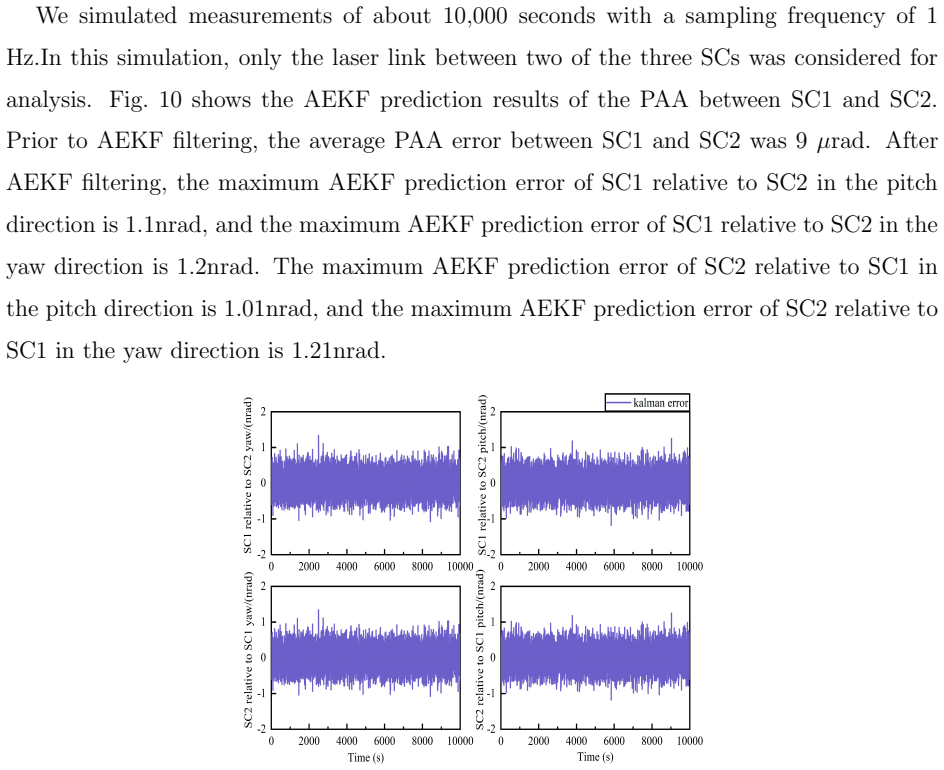
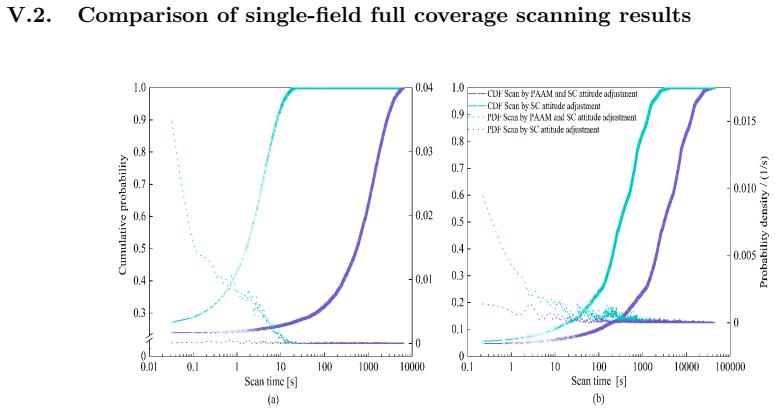
On its own terms, the paper's central claim is that an estimator, not a search, can close the laser link between spacecraft millions of kilometers apart. The adaptive extended Kalman filter tracks the three spacecraft positions and velocities together with their orbit-determination errors, and it uses a quadrant photodetector with differential power sensing as the beam readout. From that state, it predicts the point-ahead angle, the angle by which the outgoing beam must lead the receiving spacecraft, and the filtered prediction is what the steering mechanism follows. As a result the initial uncertainty cone the beam must cover collapses: average point-ahead angle prediction error falls to 0.67 to 0.76 nanoradians, the navigation-error contribution falls from about 9 to 10 microradians to 0.1 to 0.16 microradians, and the scan time for full coverage of a single field drops from 448.6 seconds to 8.6 seconds with point-ahead scanning plus attitude thrusts, or from 1601.7 seconds to 541.6 seconds with thrusters alone. The conventional coarse and fine acquisition stages are merged into a single AEKF-PAAM loop.
Load-bearing premise
The load-bearing premise is that during acquisition, before any laser link exists, the filter receives a usable measurement of $\theta_u$, the angular size of the cone of possible positions from tracking error, and that the simulated truth follows exactly the orbital model built into the filter.
Editorial extensions
If this is right
- If the central claim holds, the conventional two-stage CCD acquisition is replaced by one AEKF-PAAM loop, so the CCD camera and its heat-venting tube can be removed from the payload.
- The scientific phase can start sooner after link establishment, because there is no CCD-generated thermal transient waiting to decay before interferometric measurements begin.
- Single-field full-coverage scan time drops from 448.6 s to 8.6 s in the point-ahead-plus-thruster strategy and from 1601.7 s to 541.6 s in the thruster-only strategy.
- Even with only two hours per day of ground tracking, corresponding to a 2 km and 0.2 cm/s navigation error, the filtered beam can still attempt acquisition, and with a future star-tracker accuracy of $10^{-6}$ rad the PAAM alone could cover the uncertainty region without thruster stepping.
Reading between the lines
- Beyond the paper, the same per-spacecraft filter state extends naturally to all three arms at once, so a full-constellation version could attempt both links simultaneously rather than acquiring one pair before the next.
- Beyond the paper, the filtered point-ahead angle could double as the fine-pointing command after the link locks, removing the need for a separate estimator during the hand-over to interferometry.
- Beyond the paper, a hardware-in-the-loop test that feeds the filter only star-tracker and quadrant-photodetector signals, without a direct measurement of the uncertainty-cone angle, would show how much of the scan-time reduction survives outside the simulation.
Signed reviews
Editorial analysis
A structured set of objections, weighed in public.
Referee Report
Summary. This paper proposes replacing the wide-field CCD acquisition camera in space-based gravitational-wave laser link acquisition with an adaptive extended Kalman filter (AEKF) embedded in the point-ahead-angle mechanism (PAAM), using a quadrant photodetector with differential power sensing as the readout. The authors simulate the AEKF over roughly 10^4 seconds of data for two spacecraft, report that PAA errors fall from about 9 microradians to 0.6-0.8 nanoradians and that the navigation-error uncertainty cone falls from about 9-10 microradians to 0.1-0.16 microradians, and compute single-field full-coverage scan times under PAAM-plus-thruster and thruster-only strategies, with the PAAM-plus-thruster time dropping from 448.6 s to 8.6 s. The paper concludes that the conventional two-stage acquisition can be replaced by a single AEKF-PAAM control loop, avoiding the CCD heating problem.
Significance. If the reported numbers were valid, the proposal would be practically significant: removing the CCD camera and merging coarse and fine acquisition into a single loop would simplify the optical payload and thermal design of LISA/Taiji-type missions. The paper also contains useful background on the PAAM, star tracker, and scan-time formalism, and it is honest in stating that a tabletop experiment is still pending. However, the central quantitative evidence is compromised: the AEKF measurement vector contains the very uncertainty-cone angle the paper claims the filter reduces, and no physical sensor is described that could supply that quantity during acquisition. The headline 82 dB PAA reduction, the 35-39 dB theta_u reduction, and the scan-time gains in Table III are therefore artifacts of the simulation setup rather than demonstrated properties of the proposed hardware concept. No code or data are provided for independent verification.
major comments (4)
- [Section IV.3, Eq. (33)] The measurement vector is z_k = [PAA_yaw,12, PAA_pitch,12, theta_u,12, PAA_yaw,21, PAA_pitch,21, theta_u,21], where theta_u,ij is the uncertainty-cone angle defined from the navigation-error states in Eqs. (11)-(16) and Eq. (31). This is the quantity that Section V.1 and Table III report as reduced by the AEKF. No sensor described in Sections II.1-II.5 can measure theta_u during acquisition: the laser link is not yet established, and theta_u is an internal navigation-error quantity rather than a beam-pointing readout. Section IV.4.2.2 states that the theta_u measurement noise is added to the actual theta_u value provided by the orbital integrator. Feeding the filter a noisy observation of its own target makes the theta_u reductions and the resulting scan-time gains in Table III circular.
- [Section IV.3 and Section V.1] The simulated truth trajectory is generated with the same Keplerian-plus-planets integrator that is embedded in the AEKF as the state dynamics (Eqs. (27)-(30)). The simulation therefore contains no model-mismatch term between the filter model and the true dynamics, while a real acquisition would be dominated by unmodeled ephemeris propagation errors, small forces, and optical misalignments. The reported sub-nanoradian PAA errors and the 82 dB reduction are consequently not representative of on-orbit performance even setting aside the theta_u circularity.
- [Section II.6 versus Section V.1 and Table I] The manuscript states in Section II.6 that the input navigation error is 2 km in position and 0.2 cm/s in velocity. Over an arm length of roughly 3e6 km, a 2 km transverse position error corresponds to an angular uncertainty of about 0.7 microradians for one spacecraft and about 1 microradian when both spacecraft have independent errors, not the 9-10 microradians quoted before filtering in Table I and Section V.1. The larger values appear to correspond to the 50 km / 2 cm/s one-month prediction discussed in Section IV.4.2.2. The paper uses two different navigation-error inputs without reconciling them, so the stated 35-39 dB theta_u reduction is at least partly a comparison against an inflated baseline.
- [Section IV.3, Eq. (40)] The colored-noise transfer matrix is set to Psi_{k,k-1} = v_k / v_{k-1}, i.e. to the ratio of the actual measurement-noise realizations. In operation the measurement noise v_k is not directly observable, and using the true noise realization inside the filter gives the AEKF information that no physical sensor would provide. This is another respect in which the simulation's filter is privileged relative to any real implementation.
minor comments (4)
- [Sections II.3 and II.4] The telescope magnification is given as 40x in Section II.3 and 30x in Section II.4; these values change the effective PAAM range and pointing accuracy and should be reconciled.
- [Eqs. (16) and (31)] Equation (16) introduces delta w and delta v in the approximate equality without definitions, and Eq. (31) gives a different expression for theta_u from the one derived in Eqs. (11)-(16); the authors should state which definition is actually used in the simulations.
- [Section IV.3, Eqs. (26)-(30)] The state vector in Eq. (26) is called 20-dimensional and the dynamic matrix is called 30x30, but the listed variables total 36 components (positions, velocities, and error states for three spacecraft); similarly H_k is described as a 636-dimensional observation matrix. These dimensional statements should be corrected.
- [Table II] The caption 'Fitting result' does not specify what quantity is fitted, what model is used, or why an R-squared near 0.97 is relevant to the Kalman-filtering claim; the table as presented is not self-contained.
Circularity Check
The AEKF measurement vector includes θu, the uncertainty cone it claims to shrink, so the reported reduction and scan-time gains are produced by feeding the filter its own target.
-
self definitional
[Section IV.3, Eq. (33); Section IV.4.2.2; Eqs. (11)-(16)]
"The measurement equation which links up the positions and velocities of the three SCs and the yaw and pitch PAAs. In our scheme, the position error in the navigation may be written as zk =hk(xk,vk) = [PAAyaw,12, PAApitch,12, θu,12, PAAyaw,21, PAApitch,21, θu,21] ... θU,ij is the uncertainty cone caused by worst-case navigation error between SCi and SCj. ... The measurement noise of θu is added to the actual θu value provided by the orbital integrator in the form of white noise."
The paper's central quantitative claim is that the AEKF reduces the uncertainty cone θu from about 9-10 µrad to 0.1-0.16 µrad. But θu is defined from the navigation-error states δx, δv via Eqs. (11)-(16), and Eq. (33) places θu in the AEKF measurement vector. The simulation then adds white noise to the actual θu value from the orbital integrator and feeds this as a measurement. The filter therefore receives a noisy observation of its own target; the post-filter θu is a smoothed version of that input, not an independently predicted reduction. No sensor described in Sections II.1-II.5 can observe θu during acquisition, since the laser link has not yet been established.
-
fitted input called prediction
[Section III.1 and Section V.2, Table III]
"Based on the angular size of the uncertainty region after filtering by the AEKF, distinct acquisition strategies have been developed. ... To facilitate the calculation of scanning time, the AEKF-filtered results are converted into polar coordinates."
The headline scan-time gains in Table III are not independent results: they are computed from the post-filter θu values through the spiral-length formulas of Section III.2. Since those θu values are the filter's own measurements (see previous step), the 448.6 s to 8.6 s and 1601.7 s to 541.6 s reductions are forced by construction. The strategy selection also begins from the angular size of the uncertainty region after AEKF filtering, so the acquisition-time advantage is a restatement of the θu measurement feedback rather than a validated reduction.
full rationale
The derivation chain for the AEKF's headline benefit is circular at Eq. (33): θu, the quantity claimed to be reduced, is placed inside the measurement vector, and Section IV.4.2.2 states that the measurement is the actual θu value from the orbital integrator plus white noise. The filter is thus handed a noisy observation of its own target, so the 39 dB reduction in θu and the consequent scan-time improvement in Table III are not predictions but consequences of the measurement definition. The PAA-related parts of the filter use observable inputs (STR and QPD data with GRACE-FO-derived noise) and are not themselves circular, and self-citation of the AEKF framework in [11] is not the load-bearing circularity here. No independent validation is yet available: the paper states in Section VI that we are setting up a tabletop experiment to validate the AEKF. A separate numerical-consistency concern is that 2 km over a 3e6 km arm implies about 0.7 µrad, not the reported 9-10 µrad pre-filter θu; that is a correctness matter rather than the circularity identified above.
Assumptions & free parameters
free parameters (5)
- Colored-noise transfer coefficient Ψk,k−1 = vk/vk−1 =
Ratio of successive simulated noise amplitudes
- GRACE-FO STR noise amplitude scaling =
Scaled to ~1e-5 rad mean amplitude
- Post-telescope PAAM scan speed ωPAAM =
1 mrad/s
- Thruster scan overlap rate p =
0.8
- System-noise covariance update cadence =
'every month or so'
assumptions (6)
- domain assumption Keplerian N-body gravity with Sun plus eight planets (Eqs. 27-30) describes the SC motion exactly.
- ad hoc to paper The uncertainty cone θu is available as a real-time measurement during acquisition.
- domain assumption PAA measurement noise is dominated by STR readout noise of 1e-5 rad, represented by amplitude-scaled GRACE-FO attitude data.
- ad hoc to paper The colored measurement noise is described by the transfer matrix Ψk,k−1 = vk/vk−1.
- domain assumption The 2 km / 0.2 cm/s DSN navigation-error budget is the operative uncertainty for acquisition.
- domain assumption PAA varies slowly enough that 1 Hz sampling and a state model excluding relative acceleration are sufficient.
invented entities (1)
-
PAAM monitoring interferometer
Cite this review
Pith. "Pith review of Adaptive extended Kalman filter and laser link acquisition in the detection of gravitational waves in space." pith.science (2026). https://pith.science/paper/4HPGKT4W
@misc{pith2026250821538,
  author       = {Pith},
  title        = {Pith review of: Adaptive extended Kalman filter and laser link acquisition in the detection of gravitational waves in space},
  year         = {2026},
  howpublished = {\url{https://pith.science/paper/4HPGKT4W}},
  note         = {Machine review of arXiv:2508.21538}
}
read the original abstract
An alternative, new laser link acquisition scheme for the triangular constellation of spacecraft (SCs) in deep space in the detection of gravitational waves is considered. In place of a wide field CCD camera in the initial stage of laser link acquisition adopted in the conventional scheme, an extended Kalman filter based on precision orbit determination is incorporated in the point ahead angle mechanism (PAAM) to steer the laser beam in such a way to narrow the uncertainty cone and at the same time avoids the heating problem generated by the CCD camera.A quadrant photodetector (QPD) based on the Differential Power Sensing (DPS) technique, which offers a higher dynamic range than differential wavefront sensing (DWS), is employed as the readout of the laser beam spot. The conventional two stages (coarse acquisition and fine acquisition) are integrated into a single control loop. The payload structure of the ATP control loop is simplified and numerical simulations, based on a colored measurement noise model that closely mimics the prospective on-orbit conditions, demonstrate that the AEKF significantly reduces the initial uncertainty region by predicting the point ahead angle (PAA) even when the worst case scenario in SC position (navigation) error is considered.
Figures


Figures from the paper (11 more)




Reference graph
Works this paper leans on
-
[1]
Z. Luo, Z. Guo, G. Jin, Y. Wu, and W. Hu, A brief analysis to Taiji: Science and technology , Results in Physics 16, 102918 (2020)
2020
-
[2]
K. Danzmann, LISA Study Team, et al., Lisa: laser interferometer space antenna for gravita- tional wave measurements, Classical and Quantum Gravity 13, A247 (1996)
work page 1996
- [3]
-
[4]
T. di Laurea, Controller Design for the Acquisition Phase of the LISA Mission Using a Kalman Filter, Ph.d. thesis, University of Pisa, Pisa, Italy (2007)
work page 2007
-
[5]
F. Cirillo and P. F. Gath, Control system design for the constellation acquisition phase of the lisa mission, Journal of Physics: Conference Series 154, 012014 (2009)
work page 2009
- [6]
-
[7]
R. Gao, H. Liu, Y. Zhao, Z. Luo, J. Shen, and G. Jin, Laser acquisition experimental demon- stration for space gravitational wave detection missions , Optics Express 29, 6368 (2021)
work page 2021
-
[8]
R. Gao, H. Liu, Y. Zhao, Z. Luo, and G. Jin, Automatic, high-speed, high-precision acquisition scheme with QPD for the Taiji program , Optics Express 29, 821 (2021)
work page 2021
Show all 30 references
-
[9]
F. Ales, P. F. Gath, U. Johann, and C. Braxmaier, Modeling and simulation of a laser ranging interferometer acquisition and guidance algorithm , Journal of Spacecraft and Rockets 51, 226 (2014)
2014
-
[10]
Z. Luo, Q. Wang, C. Mahrdt, A. Goerth, and G. Heinzel, Possible alternative acquisition scheme for the gravity recovery and climate experiment follow-on-type mission, Applied Optics 56, 1495 (2017)
2017
-
[11]
J. Yang, Y. Xie, W. Tang, X. Liang, L. Zhang, Z. Cui, X. Wang, H. Li, J. Jia, and Y. K. Lau, Adaptive extended kalman filter and point ahead angle prediction in the detection of gravitational waves in space, Phys. Rev. D 110, 102007 (2024)
2024
-
[12]
Hechenblaikner, S
G. Hechenblaikner, S. Delchambre, and T. Ziegler, Optical link acquisition for the lisa mission with in-field pointing architecture, Optics & Laser Technology 161, 109213 (2023). 32
2023
-
[13]
Jian-cong, L
L. Jian-cong, L. Hong-an, L. Jia-xiong, W. Yan-xiong, and W. Zhi, Optical design of space gravitational wave detection telescope, Chinese Optics 15, 761 (2022)
2022
-
[14]
B. Cui, G. Zhao, Y. Xia, P. Wang, and Y. Zhang, A variable-bandwidth extended state observer for nonlinear systems with measurement noise, IEEE Transactions on Industrial Electronics (2024)
2024
-
[15]
Y. Miao, L. Jian-cong, L. Hong-an, H. Yao-zhang, L. Jia-xiong, W. Yan-xiong, and W. Zhi, Design of optical system for low-sensitivity space gravitational wave telescope , Chinese Optics 16, 1384 (2023)
2023
-
[16]
Vinet, N
J.-Y. Vinet, N. Christensen, N. Dinu-Jaeger, M. Lintz, N. Man, and M. Pichot, LISA telescope: phase noise due to pointing jitter , Classical and Quantum Gravity 36, 205003 (2019)
2019
-
[17]
H. Liu, X. Niu, M. Zeng, S. Wang, K. Cui, and D. Yu, Review of micro propulsion technology for space gravitational waves detection, Acta astronautica 193, 496 (2022)
2022
-
[18]
Henein, P
S. Henein, P. Spanoudakis, P. Schwab, Y. Kjelberg, L. Giriens, Y. Welte, L. Dassa, R. Greger, and U. Langer, Design and development of the point-ahead angle mechanism for the laser interferometer space antenna (lisa), Proceedings of the 13th European Space Mechanisms & Tribolo...
2009
-
[19]
Y. Wu, H. Hai, S. Fang, W. Fan, J. Song, K. Zhao, R. Zhang, B. He, H. Zhao, Z. Li, et al., A fast steering mirror with ultra-low geometric tilt-to-length coupling noise for space-borne gravitational wave detection, Measurement Science and Technology 35, 015407 (2023)
2023
-
[20]
W. Zhu, Y. Xie, Y. Qian, J. Jia, L. Zhang, and X. Wang, Development and analysis of two- dimensional point-ahead angle mechanism for space gravitational-wave detection, REVIEW OF SCIENTIFIC INSTRUMENTS 95, 10.1063/5.0186061 (2024)
2024 doi
-
[21]
X. Han, X. Peng, W. Tang, Z. Yang, X. Ma, C. Gao, L.-e. Qiang, Y. Zhang, M. Zhao, J. Zhang, and B. Liu, Effect of celestial body gravity on Taiji mission range and range acceleration noise, Physical Review D 106, 102005 (2022)
2022
-
[22]
Houba, S
N. Houba, S. Delchambre, T. Ziegler, G. Hechenblaikner, and W. Fichter, LISA Point-Ahead Angle Control for Optimal Tilt-to-Length Noise Estimation , arXiv preprint arXiv:2208.11033 (2022)
2022 arXiv
-
[23]
P. Yang, Y. Huang, P. Li, H. Wang, M. Fan, S. Liu, Q. Shan, S. Qin, and Q. Liu, Orbit determination of China’s first mars probe Tianwen-1 during interplanetary cruise , Advances in Space Research 69, 1060 (2022). 33
2022
-
[24]
Li and J
Z. Li and J. Zheng, Orbit determination for a space-based gravitational wave observatory, Acta Astronautica 185, 170 (2021)
2021
-
[25]
Y. Wang, G. Heinzel, and K. Danzmann, First stage of LISA data processing: Clock synchro- nization and arm-length determination via a hybrid-extended Kalman filter , Physical Review D 90, 064016 (2014)
2014
-
[26]
Y. Wang, G. Heinzel, and K. Danzmann, First stage of LISA data processing. II. Alternative filtering dynamic models for LISA , Physical Review D 92, 044037 (2015)
2015
-
[27]
Simon, Optimal state estimation: Kalman, H ∞, and nonlinear approaches
D. Simon, Optimal state estimation: Kalman, H ∞, and nonlinear approaches. Hoboken , NJ: John Wiley and Sons, Jg 10, 0470045345 (2006)
2006
-
[28]
Fattah, W.-P
S. Fattah, W.-P. Zhu, and M. Ahmad, Identification of autoregressive moving average systems based on noise compensation in the correlation domain , IET signal processing 5, 292 (2011)
2011
-
[29]
Mohamed and K
A. Mohamed and K. Schwarz, Adaptive Kalman filtering for INS/GPS , Journal of geodesy 73, 193 (1999)
1999
-
[30]
Vidano, C
S. Vidano, C. Novara, L. Colangelo, and J. Grzymisch, The lisa dfacs: A nonlinear model for the spacecraft dynamics, Aerospace Science and Technology 107, 106313 (2020). 34
2020
Reviewed August 15, 2026 · model on record in the stance chip above.
Discussion (0). Continue with ORCID to comment.