Application of Deep Learning to Jet Charge Discrimination
Pith reviewed 2026-06-25 23:24 UTC · model grok-4.3
The pith
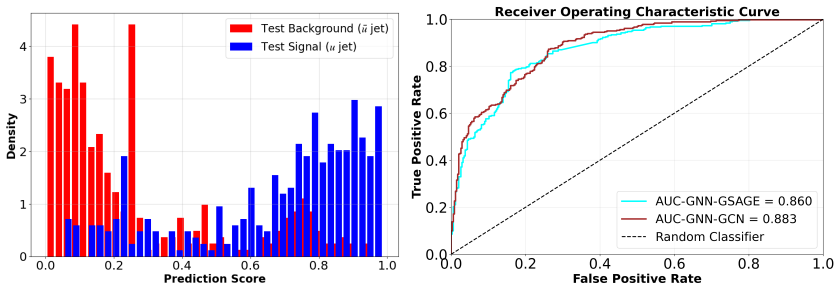
A graph neural network distinguishes up-quark jets from anti-up-quark jets with an AUC of 0.883 in QCD simulations.
A machine-rendered reading of the paper's core claim, the machinery that carries it, and where it could break.
Core claim
Among the machine learning models benchmarked for distinguishing up-quark from anti-up-quark jets in a controlled QCD environment, the graph neural network achieves the best performance with an AUC of 0.883.
What carries the argument
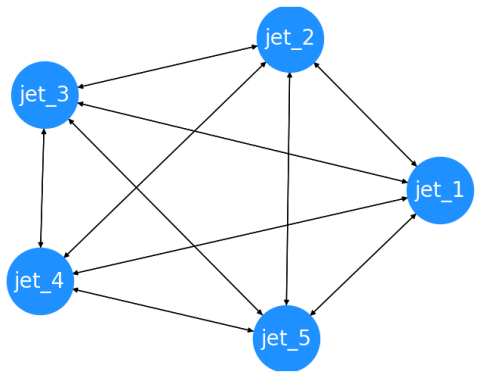
Graph neural network applied to jet constituents for electric charge discrimination.
If this is right
- Charge asymmetry measurements in hadron collisions gain precision when quark versus antiquark jets can be separated.
- Searches for new particles that rely on distinguishing quarks from antiquarks become more sensitive.
- Modern machine-learning methods gain a documented path into jet-charge studies at the LHC experiments.
Where Pith is reading between the lines
- If performance holds once detector effects are added, the network could be inserted into existing experimental pipelines without major redesign.
- The same graph-based approach may transfer to discrimination among other parton types or to multi-class jet tagging.
- Combining the network output with established jet taggers could produce a composite tagger whose performance exceeds either method alone.
Load-bearing premise
The controlled QCD environment used for the benchmark accurately represents real LHC detector conditions and jet charge discrimination performance.
What would settle it
Applying the same models to fully simulated collision events that include detector response and measuring whether the AUC remains near 0.883 would test the result.
Figures
read the original abstract
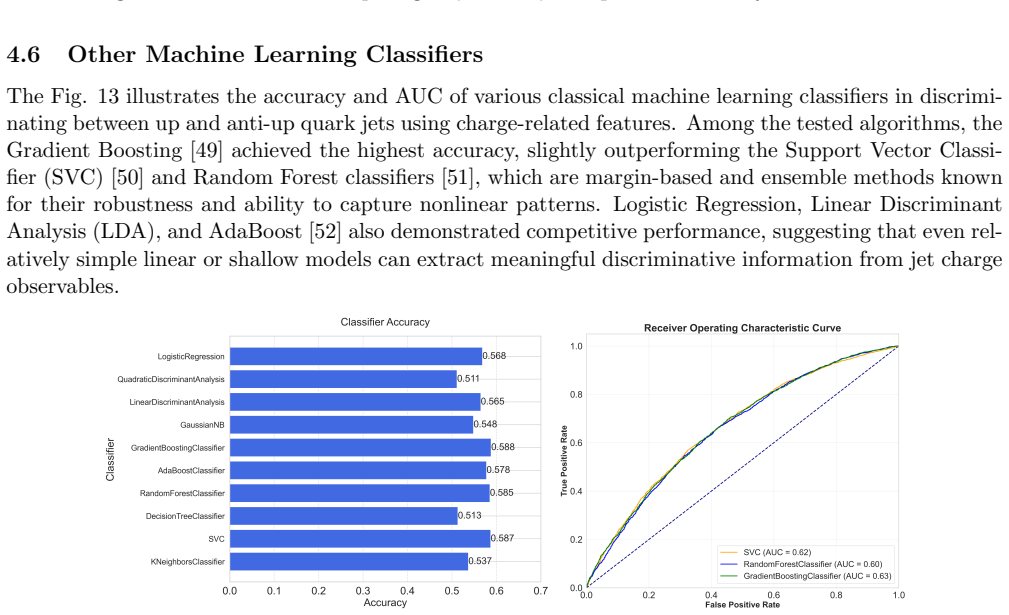
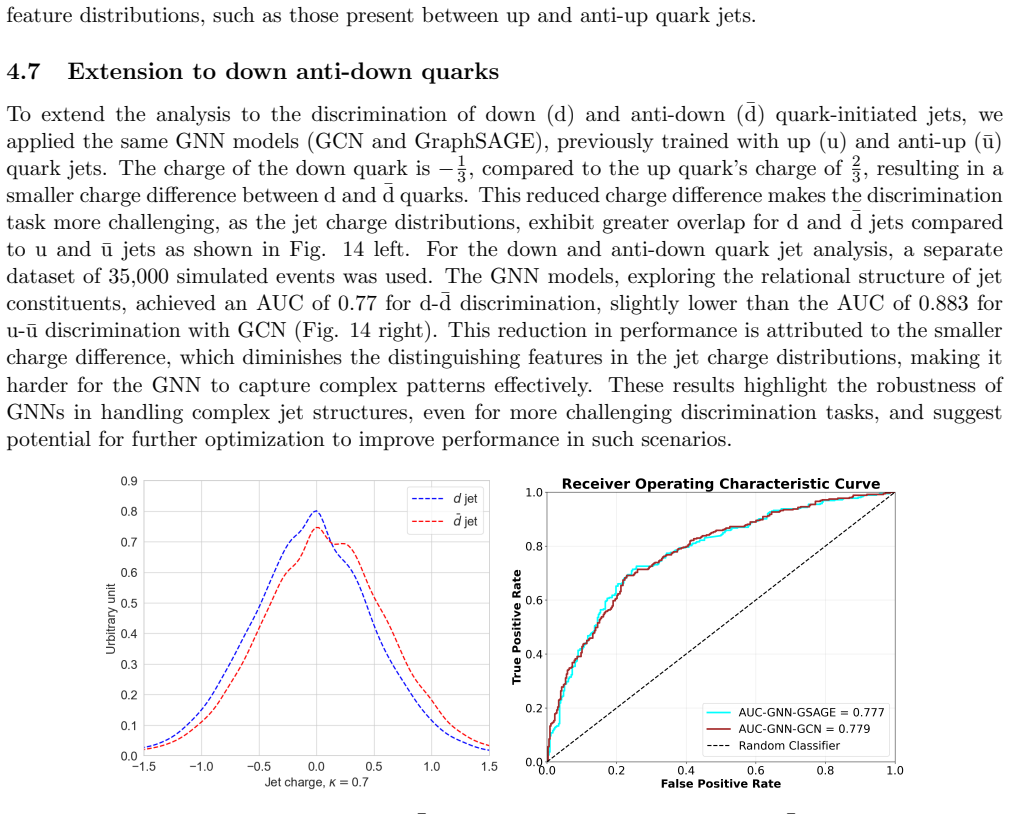
The Large Hadron Collider (LHC) produces an enormous volume of data in which the identification and characterization of hadronic jets is a central challenge. Determining the electric charge of the parton initiating a light-quark jet; a task known as jet-charge discrimination; is highly valuable for both precision tests of the Standard Model (SM) and searches for physics beyond it. In this work, we benchmark a range of classical and quantum machine-learning models for the task of distinguishing up-quark from anti-up-quark jets in a controlled QCD environment. Among the approaches tested, a Graph Neural Network achieved the best performance, with an AUC of 0.883. Jet-charge tagging of this kind has broad phenomenological applications, from improving measurements of charge asymmetries to enhancing sensitivity in searches for new particles from beyond the SM where quark versus antiquark discrimination is essential. Our study provides a methodological foundation for deploying modern machine-learning techniques in jet-charge analyses at the LHC experiments.
Editorial analysis
A structured set of objections, weighed in public.
Referee Report
Summary. The manuscript benchmarks a range of classical and quantum machine-learning models for distinguishing up-quark from anti-up-quark jets via jet charge in a controlled QCD environment. It reports that a Graph Neural Network achieves the best performance with an AUC of 0.883 and positions the study as a methodological foundation for jet-charge analyses at the LHC.
Significance. If the performance holds, the work supplies a benchmark comparison that includes quantum models and could serve as a starting point for ML-based jet charge tagging. The controlled-environment result itself is of limited direct phenomenological value given the absence of detector effects.
major comments (2)
- [Abstract] Abstract: The reported AUC of 0.883 is presented without any information on training data volume, feature definitions, baseline comparisons, cross-validation procedure, or statistical uncertainties. This absence prevents evaluation of whether the quoted performance supports the central claim.
- [Abstract] Abstract: The claim that the result provides a foundation for LHC analyses is undermined by the exclusive use of a controlled QCD environment that omits detector response, tracking efficiency, momentum smearing, and pile-up overlay, all of which directly alter the input features to any jet-charge tagger.
Simulated Author's Rebuttal
We thank the referee for their comments. We agree that the abstract should be expanded to provide more context on the reported performance and to clarify the scope of the study. We address each point below and will make the corresponding revisions.
read point-by-point responses
-
Referee: [Abstract] Abstract: The reported AUC of 0.883 is presented without any information on training data volume, feature definitions, baseline comparisons, cross-validation procedure, or statistical uncertainties. This absence prevents evaluation of whether the quoted performance supports the central claim.
Authors: We concur that the abstract would benefit from additional details to allow proper evaluation. Although these aspects are described in the body of the manuscript, we will revise the abstract to briefly include the training data volume, the definitions of the input features, the baseline models used for comparison, the cross-validation procedure employed, and the method for estimating statistical uncertainties on the AUC. This revision will strengthen the presentation of our results. revision: yes
-
Referee: [Abstract] Abstract: The claim that the result provides a foundation for LHC analyses is undermined by the exclusive use of a controlled QCD environment that omits detector response, tracking efficiency, momentum smearing, and pile-up overlay, all of which directly alter the input features to any jet-charge tagger.
Authors: The referee correctly notes that our simulations are performed in a controlled QCD environment without detector effects. We position the work as providing a methodological foundation precisely because it isolates the performance of the machine learning models in an idealized setting. This controlled benchmark is a necessary first step before incorporating more realistic effects. We will revise the abstract to explicitly mention the controlled nature of the environment and to frame the result as an initial benchmark for future studies that include detector simulation. revision: yes
Circularity Check
Empirical ML benchmarking on simulated QCD data exhibits no circularity
full rationale
The paper reports results from training and evaluating classical and quantum ML models (including a GNN) on parton- or hadron-level QCD simulations to discriminate u vs ū jets, with the central output being an empirical AUC metric of 0.883. No derivation chain, first-principles prediction, or mathematical reduction is claimed; the AUC is obtained directly from hold-out evaluation on the same simulation framework used for training. No self-citations, fitted inputs renamed as predictions, ansatzes, or uniqueness theorems appear in the abstract or described content that would reduce the reported performance to its own inputs by construction. The simulation-to-reality gap noted by the skeptic is a validity concern, not a circularity issue.
Axiom & Free-Parameter Ledger
Reference graph
Works this paper leans on
-
[1]
L. Evans and P. Bryant, “LHC Machine,”JINST3(2008) S08001, doi:10.1088/1748- 0221/3/08/S08001
-
[2]
D. Krohn, M. D. Schwartz, T. Lin and W. J. Waalewijn, “Jet Charge at the LHC,”Phys. Rev. Lett. 110, no.21, 212001 (2013) doi:10.1103/PhysRevLett.110.212001 [arXiv:1209.2421 [hep-ph]]
work page internal anchor Pith review Pith/arXiv arXiv doi:10.1103/physrevlett.110.212001 2013
-
[3]
Quark and Gluon Jet Substructure
J. Gallicchio and M. D. Schwartz, “Quark and gluon jet substructure,”JHEP04(2013) 090, doi:10.1007/JHEP04(2013)090, arXiv:1211.7038 [hep-ph]
work page internal anchor Pith review Pith/arXiv arXiv doi:10.1007/jhep04(2013)090 2013
-
[4]
A parametrization of the properties of quark jets,
R. D. Field and R. P. Feynman, “A parametrization of the properties of quark jets,”Nucl. Phys. B 136(1978) 1-76, doi:10.1016/0550-3213(78)90015-9
-
[5]
Measurement of the top quark charge inppcollisions at √s= 7 TeV with the ATLAS detector,
ATLAS Collaboration, “Measurement of the top quark charge inppcollisions at √s= 7 TeV with the ATLAS detector,”JHEP11(2013) 031, arXiv:1307.4568 [hep-ex]
Pith/arXiv arXiv 2013
-
[6]
Measurement of jet charge in dijet events at √s= 8 TeV,
CMS Collaboration, “Measurement of jet charge in dijet events at √s= 8 TeV,” CMS-PAS-JME- 13-002 (2013),https://cds.cern.ch/record/1599732
arXiv 2013
-
[7]
Observation of charge asymmetry in hadron jets frome +e− annihilation at √s= 29 GeV,
J. Bergeet al., “Observation of charge asymmetry in hadron jets frome +e− annihilation at √s= 29 GeV,”Nucl. Phys. B184(1981) 13-30, doi:10.1016/0550-3213(81)90163-X
-
[8]
W. J. Waalewijn, “Jet charge at the LHC,”Phys. Rev. D86(2012) 094030, doi:10.1103/PhysRevD.86.094030, arXiv:1209.2421 [hep-ph]
work page internal anchor Pith review Pith/arXiv arXiv doi:10.1103/physrevd.86.094030 2012
-
[9]
Measurement of charge asymmetry in hadronicZdecays,
ALEPH Collaboration, D. Decampet al., “Measurement of charge asymmetry in hadronicZdecays,” Phys. Lett. B259(1991) 377-387, doi:10.1016/0370-2693(91)90844-G. 19
-
[10]
Z. B. Kang, X. Liu, S. Mantry, M. C. Spraker and T. Wilson, “Dynamic Jet Charge,” Phys. Rev. D 103, no.7, 074028 (2021) doi:10.1103/PhysRevD.103.074028 [arXiv:2101.04304 [hep-ph]]
-
[11]
Measurement of the top quark charge usingt ¯tevents,
CMS Collaboration, “Measurement of the top quark charge usingt ¯tevents,” CMS-PAS-TOP-13-013 (2014),https://cds.cern.ch/record/1728249
arXiv 2014
-
[12]
M. Ghasemi Bostanabad and M. Mohammadi Najafabadi, “Machine Learning Approaches to Top Quark Flavor-Changing Four-Fermion Interactions in Trilepton Signals at the LHC,”Phys. Rev. D 111(2025) 112003,https://journals.aps.org/prd/abstract/10.1103/mk8x-nrpn
-
[13]
The CMS Particle Flow reconstruction and global event description with the Particle Flow algorithm,
CMS Collaboration, “The CMS Particle Flow reconstruction and global event description with the Particle Flow algorithm,” CMS-PAS-PFT-09-001 (2009),https://cds.cern.ch/record/1194487
arXiv 2009
-
[14]
Anomaly Detection for New Physics in LHC Events using Autoencoders,
ATLAS Collaboration, “Anomaly Detection for New Physics in LHC Events using Autoencoders,” ATL-PHYS-PUB-2020-018 (2020),https://cds.cern.ch/record/2725620
arXiv 2020
-
[15]
The CMS experiment at the CERN LHC
CMS Collaboration, “The CMS Experiment at the CERN LHC,”JINST3(2008) S08004, doi:10.1088/1748-0221/3/08/S08004
-
[17]
Machine learning at the energy and intensity frontiers of particle physics,
A. Radovic et al., “Machine learning at the energy and intensity frontiers of particle physics,” Nature 560 (2018) 41–48, arXiv:1806.11484 [hep-ex]
Pith/arXiv arXiv 2018
-
[18]
Anomaly Detection for Resonant New Physics with Machine Learning,
J. H. Collins, K. Howe and B. Nachman, “Anomaly Detection for Resonant New Physics with Machine Learning,” Phys. Rev. Lett. 121 (2018) 241803, arXiv:1805.02664 [hep-ph]
Pith/arXiv arXiv 2018
-
[19]
G. Aadet al.[ATLAS], “A new method to distinguish hadronically decaying boostedZbosons from Wbosons using the ATLAS detector,”Eur. Phys. J. C76, no.5, 238 (2016) doi:10.1140/epjc/s10052- 016-4065-1 [arXiv:1509.04939 [hep-ex]]
work page internal anchor Pith review Pith/arXiv arXiv doi:10.1140/epjc/s10052- 2016
-
[20]
Identification techniques for highly boosted W bosons that decay into hadrons
V. Khachatryanet al.[CMS], “Identification techniques for highly boosted W bosons that decay into hadrons,”JHEP12, 017 (2014) doi:10.1007/JHEP12(2014)017 [arXiv:1410.4227 [hep-ex]]
work page internal anchor Pith review Pith/arXiv arXiv doi:10.1007/jhep12(2014)017 2014
-
[21]
Theory and phenomenology of two-Higgs-doublet models
G. C. Branco, P. M. Ferreira, L. Lavoura, M. N. Rebelo, M. Sher and J. P. Silva, “Theory and phenomenology of two-Higgs-doublet models,”Phys. Rept.516, 1-102 (2012) doi:10.1016/j.physrep.2012.02.002 [arXiv:1106.0034 [hep-ph]]
work page internal anchor Pith review Pith/arXiv arXiv doi:10.1016/j.physrep.2012.02.002 2012
-
[22]
J. Alwallet al., “The automated computation of tree-level and next-to-leading order differential cross sections, and their matching to parton shower simulations,”JHEP07(2014) 079, arXiv:1405.0301 [hep-ph]
Pith/arXiv arXiv 2014
-
[23]
An introduction to PYTHIA 8.2,
T. Sjostrandet al., “An introduction to PYTHIA 8.2,”Comput. Phys. Commun.191(2015) 159-177, arXiv:1410.3012 [hep-ph]
Pith/arXiv arXiv 2015
-
[24]
The anti-k_t jet clustering algorithm
M. Cacciari, G. P. Salam and G. Soyez, “The anti-k t jet clustering algorithm,”JHEP04(2008) 063, doi:10.1088/1126-6708/2008/04/063, arXiv:0802.1189 [hep-ph]
work page internal anchor Pith review Pith/arXiv arXiv doi:10.1088/1126-6708/2008/04/063 2008
-
[25]
M. Cacciari, G. P. Salam and G. Soyez, “FastJet user manual,”Eur. Phys. J. C72(2012) 1896, doi:10.1140/epjc/s10052-012-1896-2, arXiv:1111.6097 [hep-ph]
work page internal anchor Pith review Pith/arXiv arXiv doi:10.1140/epjc/s10052-012-1896-2 2012
-
[26]
Dispelling the N^3 myth for the Kt jet-finder
M. Cacciari and G. P. Salam, “Dispelling theN 3 myth for thek t jet-finder,”Phys. Lett. B641 (2006) 57-61, doi:10.1016/j.physletb.2006.08.037, arXiv:hep-ph/0512210. 20
work page internal anchor Pith review Pith/arXiv arXiv doi:10.1016/j.physletb.2006.08.037 2006
-
[27]
Characterization of Jet Charge at the LHC,
T. D. Rueter and K. Soni, “Characterization of Jet Charge at the LHC,” (2015),https://cs229. stanford.edu/proj2015/352_report.pdf
2015
-
[28]
Searching for exotic particles in high-energy physics with deep learning,
P. Baldi, P. Sadowski and D. Whiteson, “Searching for exotic particles in high-energy physics with deep learning,”Nature Communications5(2014) 4308, arXiv:1402.4735 [hep-ph]
Pith/arXiv arXiv 2014
-
[29]
Scikit-learn: Machine Learning in Python,
F. Pedregosaet al., “Scikit-learn: Machine Learning in Python,”J. Mach. Learn. Res.12(2011) 2825-2830,https://jmlr.org/papers/volume12/pedregosalia/pedregosalia.pdf
2011
-
[30]
Keras: Deep Learning for humans,
F. Chollet, “Keras: Deep Learning for humans,” (2015),https://keras.io
2015
-
[31]
SciKeras: A Scikit-Learn API wrapper for Keras,
A. Nicolaou and P. Andre, “SciKeras: A Scikit-Learn API wrapper for Keras,” (2021),https: //github.com/adriangb/scikeras
2021
-
[32]
Gradient-based learning applied to document recognition.Proc
Y. LeCun, L. Bottou, Y. Bengio and P. Haffner, “Gradient-based learning applied to document recognition,”Proc. IEEE86(1998) 2278-2324, doi:10.1109/5.726791
-
[33]
Adam: A Method for Stochastic Optimization,
D. P. Kingma and J. Ba, “Adam: A Method for Stochastic Optimization,” ICLR (2015), arXiv:1412.6980 [cs.LG]
Pith/arXiv arXiv 2015
-
[34]
Keras Tuner,
T. O’Malleyet al., “Keras Tuner,” (2019),https://github.com/keras-team/keras-tuner
2019
-
[35]
Graph Neural Networks: A Review of Methods and Applications,
J. Zhouet al., “Graph Neural Networks: A Review of Methods and Applications,”AI Open1(2020) 57-81, doi:10.1016/j.aiopen.2021.01.001
-
[36]
Semi-Supervised Classification with Graph Convolutional Networks,
T. N. Kipf and M. Welling, “Semi-Supervised Classification with Graph Convolutional Networks,” ICLR (2017), arXiv:1609.02907 [cs.LG]
Pith/arXiv arXiv 2017
-
[37]
Inductive Representation Learning on Large Graphs,
W. L. Hamilton, R. Ying and J. Leskovec, “Inductive Representation Learning on Large Graphs,” NeurIPS (2017), arXiv:1706.02216 [cs.SI]
Pith/arXiv arXiv 2017
-
[38]
A. Vaswani, N. Shazeer, N. Parmar, J. Uszkoreit, L. Jones, A. N. Gomez, L. Kaiser and I. Polosukhin, “Attention Is All You Need,” NeurIPS (2017), arXiv:1706.03762 [cs.CL]
Pith/arXiv arXiv 2017
-
[39]
Particle Transformer for Jet Tagging,
H. Qu, C. Li and S. Qian, “Particle Transformer for Jet Tagging,” PoS ICHEP2022 (2022) 1152, arXiv:2202.03772 [hep-ph]
arXiv 2022
-
[40]
ParticleFormer: Learning Jet Structure with Transformers,
V. Mikuni and F. Canelli, “ParticleFormer: Learning Jet Structure with Transformers,” JHEP 05 (2021) 221, arXiv:2102.05073 [hep-ph]
arXiv 2021
-
[41]
An Image is Worth 16x16 Words: Transformers for Image Recognition at Scale,
A. Dosovitskiy et al., “An Image is Worth 16x16 Words: Transformers for Image Recognition at Scale,” ICLR (2021), arXiv:2010.11929 [cs.CV]
Pith/arXiv arXiv 2021
-
[42]
Supervised learning with quantum-enhanced feature spaces,
V. Havlicek, A. D. Corcoles, K. Temme, A. W. Harrow, A. Kandala, J. M. Chow and J. M. Gam- betta, “Supervised learning with quantum-enhanced feature spaces,”Nature567(2019) 209-212, doi:10.1038/s41586-019-0980-2
-
[43]
Qiskit: An Open-source Framework for Quantum Computing,
H. Abrahamet al., “Qiskit: An Open-source Framework for Quantum Computing,” (2020),https: //qiskit.org/documentation/stubs/qiskit.circuit.library.ZZFeatureMap.html
2020
-
[44]
I. T. Jolliffe,Principal Component Analysis, 2nd ed., Springer Series in Statistics (2002), doi:10.1007/b98835. 21
-
[45]
Barren plateaus in quantum neural network training landscapes,
J. R. McClean, S. Boixo, V. N. Smelyanskiy, R. Babbush and H. Neven, “Barren plateaus in quantum neural network training landscapes,”Nature Communications9(2018) 4812, doi:10.1038/s41467-018- 07090-4
-
[46]
Qiskit Aer: High performance simulators for quantum circuits,
H. Abrahamet al., “Qiskit Aer: High performance simulators for quantum circuits,” (2021),https: //qiskit.org/documentation/apidoc/aer.html
2021
-
[47]
Multivariate stochastic approximation using a simultaneous perturbation gradient ap- proximation,
J. C. Spall, “Multivariate stochastic approximation using a simultaneous perturbation gradient ap- proximation,”IEEE Trans. Automat. Control37(1992) 332-341,https://www.jhuapl.edu/spsa/ pdf-spsa/spall_tac92.pdf
1992
-
[48]
Evaluating analytic gradients on quantum hardware
M. Schuld, F. Petruccione, I. Sinayskiy and N. Killoran, “Evaluating analytic gradients on quantum hardware,”Phys. Rev. A99(2019) 032331, doi:10.1103/PhysRevA.99.032331
-
[49]
J. H. Friedman, “Greedy function approximation: A gradient boosting machine,”Annals of Statistics 29(2001) 1189-1232, doi:10.1214/aos/1013203451
-
[50]
C. Cortes and V. Vapnik, “Support-vector networks,”Machine Learning20(1995) 273-297, doi:10.1007/BF00994018
-
[51]
L. Breiman, “Random forests,”Machine Learning45(2001) 5-32, doi:10.1023/A:1010933404324
-
[52]
A decision-theoretic generalization of on-line learning and an appli- cation to boosting,
Y. Freund and R. E. Schapire, “A decision-theoretic generalization of on-line learning and an appli- cation to boosting,”J. Comput. Syst. Sci.55(1997) 119-139, doi:10.1006/jcss.1997.1504
-
[53]
Ghasemi Bostanabad, M. (2025). Light Flavor Jet Charge [Data set]. Zenodo. https://doi.org/10.5281/zenodo.15790634. 22
discussion (0)
Sign in with ORCID, Apple, or X to comment. Anyone can read and Pith papers without signing in.