REVIEW 4 major objections 2 minor 60 references
A handful of hidden states from a frozen LLM can act as a reusable memory signal, lifting long-context reasoning by 10–29 F1 points.
Reviewed by Pith at T0; open to challenge. T0 means a machine referee read the full paper against a public rubric. the ladder, T0–T4 →
T0 review · deepseek-v4-flash
2026-08-03 14:57 UTC pith:4I72H4X4
load-bearing objection A solid, clearly-written method paper with genuine cross-domain gains, but the central causal claim about hidden-state memory needs one control experiment and multi-seed reporting before I'd trust the headline numbers. the 4 major comments →
TransMem: Transforming Hidden States into Memory for Large Language Models
The pith
A machine-rendered reading of the paper's core claim, the machinery that carries it, and where it could break.
Core claim
The central claim is that sparse historical hidden states, specifically the final hidden state of each context segment, retain enough query-relevant information to recover the predictive distribution that would be obtained if the model saw only the gold evidence. TransMem learns to transform these segment-final states into a memory shift via a lightweight transformer block, a linear projection, and a learned gate, and applies this shift to the current hidden state during answer generation. The paper demonstrates this on LoCoMo, HotpotQA, and MemoryAgentBench, with F1 gains of 11.58–29.25, 10.20–13.03, and an average accuracy increase from 29.54% to 40.00% across Qwen3-4B, Qwen2.5-14B, and Ll
What carries the argument
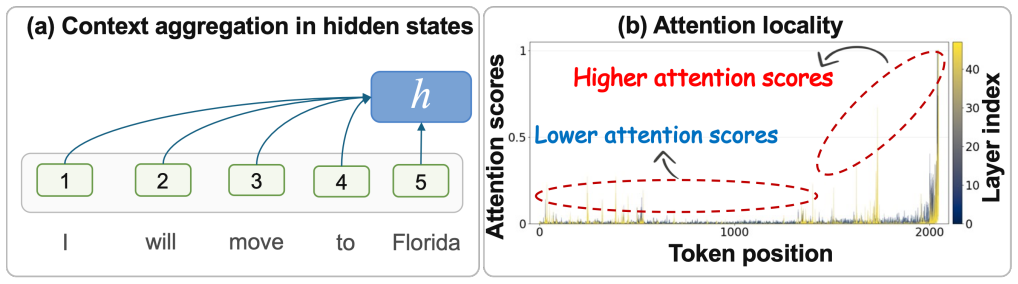
The central object is the TransMem module, consisting of a single transformer block, a learnable projection, and a gating network, inserted into the last four layers of a frozen backbone. At inference, the long context is divided into B segments (default B=4); the final hidden state of each segment is aggregated and passed through the module to produce a memory shift, which is scaled by a gate and added to the current generation hidden state. The gate learns a layer-specific amplification-to-suppression schedule (strong in the deepest layer, progressively weaker upward) that transfers across domains and backbones, enabling context-length-independent computation.
Load-bearing premise
The method assumes that the final hidden state of each of a few context segments retains enough query-relevant information from the entire segment that a learned memory shift can recover the evidence-conditioned prediction.
What would settle it
A controlled experiment on a long-context QA dataset where the evidence is deliberately placed at the beginning of each segment (far from the segment-final token), while keeping segment size fixed, should cause a sharp performance drop if the segment-final state is the only information source; alternatively, an ablation that replaces the segment-final state with a random-position hidden state or a mean-pooled representation would reveal whether the choice of summary is critical to the method's success.
If this is right
- Training the memory module on one long-context benchmark (HotpotQA) transfers to other benchmarks with different context distributions (LoCoMo, MemoryAgentBench), suggesting the module learns a generalizable memory capability.
- Since the module's computation depends only on the number of segments, not the context length, it can scale to contexts longer than the backbone's window by chunking the input and concatenating segment memories.
- The decoupling of memory capability from backbone reasoning capacity implies that future LLMs could allocate more parameters to reasoning while relying on lightweight memory modules for retention, potentially reducing the need for larger backbones.
- The evidence-conditioned self-distillation objective could serve as a template for training other latent memory designs, providing a softer, token-level supervision signal that outperforms answer-level reinforcement learning in this setup.
Where Pith is reading between the lines
- A direct testable consequence is that the method should be robust to evidence location within a segment; if placing the evidence near the start of a long segment (far from the segment-final token) causes a sharp performance drop, it would indicate the segment-final state is too lossy and performance is bounded by segment granularity.
- The layer-specific gate schedule hints that the memory shift may be functioning primarily as a re-weighting of deeper-layer representations; investigating the gradient of the gate with respect to evidence position could reveal which layers carry the most critical evidence and whether the schedule can be simplified.
- Because the teacher sees only the gold evidence, the student must reconstruct the evidence-conditioned prediction from a lossy summary; one could extend the method to iterative memory refinement, letting the module re-process its own output to recover more evidence than a single pass allows.
- The method's reliance on hidden states at segment boundaries suggests it may be complementary to positional-bias mitigation techniques, which could be combined to further improve long-context utilization.
Editorial analysis
A structured set of objections, weighed in public.
Referee Report
Summary. The paper proposes TransMem, a lightweight parametric memory module for frozen LLMs. During inference, TransMem selects segment-final hidden states from the prefill as a sparse memory H_M (Eqs. 4–5), processes them with a trainable transformer block, projection, and gating network, and adds the resulting residual to the hidden states of the last four layers during answer generation (Eqs. 7–8). The module is trained by evidence-conditioned self-distillation (Eq. 3): a student with full context matches the predictive distribution of a teacher that sees only gold evidence and the question, using the same frozen backbone. Experiments on LoCoMo, HotpotQA, and MemoryAgentBench report consistent gains over baseline backbones and prior memory methods, cross-domain transfer from HotpotQA-only training, and context-independent inference overhead. The paper includes ablations of module components, insertion depth, training objective, gate parameterization, and memory-segment sensitivity.
Significance. If the causal role of historical hidden states were established, this would be a useful contribution: it shows that a small trainable module can improve long-context utilization of a frozen LLM, with sparse memory representations and cross-domain transfer. The self-distillation setup is a genuine strength: the teacher signal is a behavior, not a fitted constant, and teacher and student share the same frozen backbone. The paper also ships code and provides several ablations and efficiency measurements. However, the current experiments do not isolate whether the gains are due to the content of the historical hidden states, and architecture decisions are made on a benchmark that is also used for the main claims. These gaps need to be closed for the paper's central claim to be supported.
major comments (4)
- [Inference with TransMem; Table 3] The central claim that sparse historical hidden states are the memory substrate is not separated from the effect of adding a trainable module. The only ablation that removes the memory content is 'w/o Transformer Block' (Table 3), which removes the entire module. A module that transforms H_A alone, or applies a generic correction, would give the same ablation pattern. A direct control is needed: replace H_M with random vectors of the same shape (or with hidden states from an unrelated context), keeping the module trainable. If performance does not collapse, the gains cannot be attributed to the content of H_M. Table 13 strengthens this concern: varying B from 4 to 32 changes scores by at most 1.0 point, suggesting low sensitivity to which segment-final states are used.
- [Insertion Depth and Gate Parameterization; Tables 4, 7] The final architecture (Last-4 layers; g=2σ(z) gate) is selected by LoCoMo F1, and LoCoMo is also one of the three main test benchmarks. This is test-set selection: the reported LoCoMo numbers are the best of several configurations tried on that benchmark, which inflates the cross-domain generalization claim. Please choose hyperparameters on a held-out set (e.g., LongMemEval or a HotpotQA validation split) and report LoCoMo only after that choice is fixed; otherwise the LoCoMo results should be presented as a model-selection table, not as an unbiased evaluation.
- [Experimental Setup] All experiments use a fixed random seed of 42, and the paper reports no variance or significance information. Because several ablated configurations differ by less than 0.5 F1 (e.g., Tables 7 and 10), single runs cannot distinguish real effects from training noise. The main tables (Tables 1, 2, and the key ablations) should report means and standard deviations over at least three seeds, or the fine-grained comparative claims should be softened.
- [Inference with TransMem; Further Study; Figure 3] The claim that TransMem's computational cost is independent of context length is stated without the qualification needed for chunked inputs. The method section describes chunk-wise extraction when C exceeds the backbone window, producing H_M = Concat(H^1_M,...,H^S_M). For such inputs |H_M| = S·B, so the TransMem overhead grows with the number of chunks S. The constant-overhead statement is valid only within a single chunk/context window; please add this caveat to Figure 3 and the efficiency discussion.
minor comments (2)
- [Inference with TransMem] The number of memory states is inconsistent. The text says 'the optimal value being only 5', but the default and the checkpoint used in the sensitivity experiments is B=4 (Table 13, 'retain B=4 as default'). Clarify whether the main results use B=4 or B=5.
- [Appendix, Table 8] Table 8 reports Exact Match/Contains on an archived 128-example split, while the main HotpotQA results use EM/F1 on the full test protocol. The relationship between these two evaluation settings should be explained in the main text so readers understand which numbers are directly comparable.
Circularity Check
No significant circularity: TransMem's empirical claims are supported by held-out benchmarks and standard distillation; the few self-citations are not load-bearing.
full rationale
The paper's central derivation is the evidence-conditioned self-distillation objective (Eq. 3): a memory-augmented student with full context C matches the predictive distribution of an evidence-only teacher with evidence E and query Q, both sharing the same frozen backbone. This is a standard privileged-information distillation setup. The teacher's distribution is not constructed from the student's parameters or from the evaluation metrics; the student is trained on HotpotQA and evaluated on held-out LoCoMo, HotpotQA, and MemoryAgentBench. The benchmark gains are therefore not forced by construction. The inference correction (Eqs. 4-7) is a learned function of historical hidden states HM; no parameter is fitted directly to a target that equals the reported prediction. The claim that sparse historical hidden states are an effective memory substrate is an empirical hypothesis supported by experiments, not an analytical consequence of the definitions. The absence of a control that randomizes HM is an experimental-validity concern (the module could in principle rely on generic corrections rather than content from HM), but this is not a circularity: the reported F1 values are not definitionally equal to the training loss or to a fitted parameter. Minor self-citations (MemCoT, MemVerse) appear only in related-work summaries and do not provide load-bearing justification; no uniqueness theorem or ansatz is imported from the authors' own prior work. The appendix candidly flags non-controlled comparisons and a small evaluation-overlap issue, which further indicates transparency rather than circular reasoning. Overall, the derivation chain is self-contained with respect to its empirical claims; the score reflects only the presence of minor non-load-bearing self-citations.
Axiom & Free-Parameter Ledger
free parameters (4)
- Number of memory segments B =
4 (default; main text says optimal is 5)
- Number of injected layers (Last-4) =
4 (last four layers)
- Gate temperature τ =
Not specified
- Gate scale α =
2
axioms (4)
- domain assumption Each hidden state in a causal transformer aggregates information from all preceding tokens, so the final hidden state of a segment can summarize that segment.
- ad hoc to paper The evidence-only teacher's predictive distribution is a reliable supervisory signal; minimizing forward KL to it teaches transferable memory utilization.
- domain assumption Chunk-wise memory extraction, where each chunk is encoded independently and memories are concatenated, preserves cross-chunk information.
- standard math The backbone LLM and its KV cache can provide access to arbitrary historical hidden states without additional forward passes.
invented entities (1)
-
TransMem memory module (learned projection W∆^K, transformer block f_m^K, and gating network f_g^K)
independent evidence
read the original abstract
Large language model (LLM) agents increasingly operate over long interaction histories, where effective reasoning requires identifying and exploiting task-relevant evidence distributed across past observations and actions. However, useful information encoded in previously computed representations is often underutilized during subsequent generation. We propose \textbf{TransMem}, a lightweight inference-time parametric memory module that transforms sparse historical hidden states from a frozen LLM backbone into reusable memory representations. TransMem uses a lightweight gating network to dynamically apply the latent intervention to the current hidden states, without repeatedly encoding the preceding context. To learn transferable memory utilization rather than task-specific knowledge, we introduce evidence-conditioned self-distillation. A memory-augmented student processes the full context and matches the predictive distribution of an evidence-only teacher that shares the same frozen backbone. Experiments on LoCoMo, HotpotQA, and MemoryAgentBench demonstrate consistent improvements across different model architectures and scales. TransMem yields gains of 11.58--29.25 $F_1$ on LoCoMo and 10.20--13.03 $F_1$ on HotpotQA, while improving the average MemoryAgentBench accuracy from 29.54\% to 40.00\%. These results establish sparse historical hidden states as an effective and efficient memory substrate for long-context LLM agents. Our code is available at https://github.com/Haodong-Lei-Ray/TransMem.
Figures


Reference graph
Works this paper leans on
-
[1]
Look Back to Reason Forward: Revisitable Memory for Long-Context
Yaorui Shi and Yuxin Chen and Siyuan Wang and Sihang Li and Hengxing Cai and Qi GU and Xiang Wang and An Zhang , booktitle=. Look Back to Reason Forward: Revisitable Memory for Long-Context
-
[2]
MemAgent: Reshaping Long-Context
Hongli Yu and Tinghong Chen and Jiangtao Feng and Jiangjie Chen and Weinan Dai and Qiying Yu and Ya-Qin Zhang and Wei-Ying Ma and Jingjing Liu and Mingxuan Wang and Hao Zhou , booktitle=. MemAgent: Reshaping Long-Context
-
[3]
and Wettig, Alexander and Lieret, Kilian and Yao, Shunyu and Narasimhan, Karthik and Press, Ofir , title =
Yang, John and Jimenez, Carlos E. and Wettig, Alexander and Lieret, Kilian and Yao, Shunyu and Narasimhan, Karthik and Press, Ofir , title =. 2024 , publisher =
2024
-
[4]
Second Conference on Language Modeling , year=
Agent S2: A Compositional Generalist-Specialist Framework for Computer Use Agents , author=. Second Conference on Language Modeling , year=
-
[5]
2025 , eprint=
Online Multi-LLM Selection via Contextual Bandits under Unstructured Context Evolution , author=. 2025 , eprint=
2025
-
[6]
International Conference on Learning Representations , year=
LongMemEval: Benchmarking Chat Assistants on Long-Term Interactive Memory , author=. International Conference on Learning Representations , year=
-
[7]
arXiv preprint arXiv:2203.15556 , year=
Training compute-optimal large language models , author=. arXiv preprint arXiv:2203.15556 , year=
-
[8]
arXiv preprint arXiv:2001.08361 , year=
Scaling laws for neural language models , author=. arXiv preprint arXiv:2001.08361 , year=
Pith/arXiv arXiv 2001
-
[9]
2025 , eprint=
Rethinking Memory in LLM based Agents: Representations, Operations, and Emerging Topics , author=. 2025 , eprint=
2025
-
[10]
2025 , eprint=
From Human Memory to AI Memory: A Survey on Memory Mechanisms in the Era of LLMs , author=. 2025 , eprint=
2025
-
[11]
Zhang, Zeyu and Dai, Quanyu and Bo, Xiaohe and Ma, Chen and Li, Rui and Chen, Xu and Zhu, Jieming and Dong, Zhenhua and Wen, Ji-Rong , title =. 2025 , issue_date =. doi:10.1145/3748302 , journal =
doi:10.1145/3748302 2025
-
[12]
2026 , eprint=
MemCoT: Test-Time Scaling through Memory-Driven Chain-of-Thought , author=. 2026 , eprint=
2026
-
[13]
2026 , eprint=
Coarse-to-Fine Grounded Memory for LLM Agent Planning , author=. 2026 , eprint=
2026
-
[14]
and Lin, Kevin and Hewitt, John and Paranjape, Ashwin and Bevilacqua, Michele and Petroni, Fabio and Liang, Percy
Liu, Nelson F. and Lin, Kevin and Hewitt, John and Paranjape, Ashwin and Bevilacqua, Michele and Petroni, Fabio and Liang, Percy. Lost in the Middle: How Language Models Use Long Contexts. Transactions of the Association for Computational Linguistics. 2024
2024
-
[15]
2026 , eprint=
Memory in the Age of AI Agents , author=. 2026 , eprint=
2026
-
[16]
2024 , eprint=
MemGPT: Towards LLMs as Operating Systems , author=. 2024 , eprint=
2024
-
[17]
Akari Asai and Zeqiu Wu and Yizhong Wang and Avirup Sil and Hannaneh Hajishirzi , booktitle=. Self-. 2024 , url=
2024
-
[18]
International Conference on Learning Representations , year=
ReasoningBank: Scaling Agent Self-Evolving with Reasoning Memory , author=. International Conference on Learning Representations , year=
-
[19]
2025 , eprint=
MemEvolve: Meta-Evolution of Agent Memory Systems , author=. 2025 , eprint=
2025
-
[20]
2026 , eprint=
SimpleMem: Efficient Lifelong Memory for LLM Agents , author=. 2026 , eprint=
2026
-
[21]
2026 , eprint=
MeMo: Memory as a Model , author=. 2026 , eprint=
2026
-
[22]
2025 , eprint=
MemVerse: Multimodal Memory for Lifelong Learning Agents , author=. 2025 , eprint=
2025
-
[23]
2026 , eprint=
HyMem: Hybrid Memory Architecture with Dynamic Retrieval Scheduling , author=. 2026 , eprint=
2026
-
[24]
Advances in Neural Information Processing Systems , year =
Memory Decoder: A Pretrained, Plug-and-Play Memory for Large Language Models , author =. Advances in Neural Information Processing Systems , year =
-
[25]
2026 , eprint=
MemSifter: Offloading LLM Memory Retrieval via Outcome-Driven Proxy Reasoning , author=. 2026 , eprint=
2026
-
[26]
2026 , eprint=
MEMTS: Internalizing Domain Knowledge via Parameterized Memory for Retrieval-Free Domain Adaptation of Time Series Foundation Models , author=. 2026 , eprint=
2026
-
[27]
2026 , eprint=
Mem- : Adaptive Memory through Learning When and What to Generate , author=. 2026 , eprint=
2026
-
[28]
2025 , eprint=
MemGen: Weaving Generative Latent Memory for Self-Evolving Agents , author=. 2025 , eprint=
2025
-
[29]
2026 , eprint=
Parametric Memory Decoding for Zero-Shot Routing in LoRA-Based External Parametric Memory , author=. 2026 , eprint=
2026
-
[30]
Decoupled Reasoning with Implicit Fact Tokens ( DRIFT ): A Dual-Model Framework for Efficient Long-Context Inference
Xie, Wenxuan and Wang, Xuhong. Decoupled Reasoning with Implicit Fact Tokens ( DRIFT ): A Dual-Model Framework for Efficient Long-Context Inference. Findings of the A ssociation for C omputational L inguistics: ACL. 2026
2026
-
[31]
International Conference on Learning Representations , year =
MLP Memory: A Retriever-Pretrained Memory for Large Language Models , author =. International Conference on Learning Representations , year =
-
[32]
2026 , eprint=
-mem: Efficient Online Memory for Large Language Models , author=. 2026 , eprint=
2026
-
[33]
2026 , eprint=
OPSDL: On-Policy Self-Distillation for Long-Context Language Models , author=. 2026 , eprint=
2026
-
[34]
and Salakhutdinov, Ruslan and Manning, Christopher D
Yang, Zhilin and Qi, Peng and Zhang, Saizheng and Bengio, Yoshua and Cohen, William W. and Salakhutdinov, Ruslan and Manning, Christopher D. , booktitle=
-
[35]
Evaluating Very Long-Term Conversational Memory of LLM Agents
Maharana, Adyasha and Lee, Dong-Ho and Tulyakov, Sergey and Bansal, Mohit and Barbieri, Francesco and Fang, Yuwei. Evaluating Very Long-Term Conversational Memory of LLM Agents. Proceedings of the 62nd Annual Meeting of the Association for Computational Linguistics (Long Papers). 2024. doi:10.18653/v1/2024.acl-long.747
-
[36]
Evaluating Memory in
Yuanzhe Hu and Yu Wang and Julian McAuley , booktitle=. Evaluating Memory in
-
[37]
2025 , eprint=
Mem0: Building Production-Ready AI Agents with Scalable Long-Term Memory , author=. 2025 , eprint=
2025
-
[38]
Vicky Zhao and Lili Qiu and Dongmei Zhang
Zhuoshi Pan and Qianhui Wu and Huiqiang Jiang and Menglin Xia and Xufang Luo and Jue Zhang and Qingwei Lin and Victor Ruhle and Yuqing Yang and Chin-Yew Lin and H. Vicky Zhao and Lili Qiu and Dongmei Zhang. LLML ingua-2: Data Distillation for Efficient and Faithful Task-Agnostic Prompt Compression. Findings of the Association for Computational Linguistics...
2024
-
[39]
Advances in neural information processing systems , volume=
Retrieval-augmented generation for knowledge-intensive nlp tasks , author=. Advances in neural information processing systems , volume=
-
[40]
Proceedings of the AAAI conference on artificial intelligence , volume=
Memorybank: Enhancing large language models with long-term memory , author=. Proceedings of the AAAI conference on artificial intelligence , volume=
-
[41]
, author=
Lora: Low-rank adaptation of large language models. , author=. International Conference on Learning Representations , volume=
-
[42]
2026 , eprint=
Understanding LoRA as Knowledge Memory: An Empirical Analysis , author=. 2026 , eprint=
2026
-
[43]
and Schuetze, Hinrich and Tresp, Volker and Ma, Yunpu
Yan, Sikuan and Yang, Xiufeng and Huang, Zuchao and Nie, Ercong and Ding, Zifeng and Li, Zonggen and Ma, Xiaowen and Bi, Jinhe and Kersting, Kristian and Pan, Jeff Z. and Schuetze, Hinrich and Tresp, Volker and Ma, Yunpu. Memory-R1: Enhancing Large Language Model Agents to Manage and Utilize Memories via Reinforcement Learning. Annual Meeting of the A sso...
-
[44]
arXiv preprint arXiv:2605.19952 , year =
Rethinking How to Remember: Beyond Atomic Facts in Lifelong LLM Agent Memory , author =. arXiv preprint arXiv:2605.19952 , year =
-
[45]
2025 , eprint=
Qwen3 Technical Report , author=. 2025 , eprint=
2025
-
[46]
Yu, Yi and Yao, Liuyi and Xie, Yuexiang and Tan, Qingquan and Feng, Jiaqi and Li, Yaliang and Wu, Libing. Agentic Memory: Learning Unified Long-Term and Short-Term Memory Management for Large Language Model Agents. Annual Meeting of the A ssociation for C omputational L inguistics (Long Papers). 2026. doi:10.18653/v1/2026.acl-long.981
-
[47]
2024 , eprint=
The Llama 3 Herd of Models , author=. 2024 , eprint=
2024
-
[48]
2025 , eprint=
Qwen2.5 Technical Report , author=. 2025 , eprint=
2025
-
[49]
Ouyang, Long and Wu, Jeff and Jiang, Xu and Almeida, Diogo and Wainwright, Carroll L. and Mishkin, Pamela and Zhang, Chong and Agarwal, Sandhini and Slama, Katarina and Ray, Alex and Schulman, John and Hilton, Jacob and Kelton, Fraser and Miller, Luke and Simens, Maddie and Askell, Amanda and Welinder, Peter and Christiano, Paul and Leike, Jan and Lowe, R...
2022
-
[50]
2024 , eprint=
DeepSeekMath: Pushing the Limits of Mathematical Reasoning in Open Language Models , author=. 2024 , eprint=
2024
-
[51]
2026 , eprint=
Rethinking On-Policy Distillation of Large Language Models: Phenomenology, Mechanism, and Recipe , author=. 2026 , eprint=
2026
-
[52]
International Conference on Machine Learning , year =
Yuhui Li and Fangyun Wei and Chao Zhang and Hongyang Zhang , title =. International Conference on Machine Learning , year =
-
[53]
2025 , eprint=
DeepSeek-V3.2: Pushing the Frontier of Open Large Language Models , author=. 2025 , eprint=
2025
-
[54]
2025 , eprint=
DeepSeek-V3 Technical Report , author=. 2025 , eprint=
2025
-
[55]
Found in the middle: Calibrating Positional Attention Bias Improves Long Context Utilization
Hsieh, Cheng-Yu and Chuang, Yung-Sung and Li, Chun-Liang and Wang, Zifeng and Le, Long and Kumar, Abhishek and Glass, James and Ratner, Alexander and Lee, Chen-Yu and Krishna, Ranjay and Pfister, Tomas. Found in the middle: Calibrating Positional Attention Bias Improves Long Context Utilization. Findings of the Association for Computational Linguistics: A...
-
[56]
2024 , editor =
Ding, Yiran and Zhang, Li Lyna and Zhang, Chengruidong and Xu, Yuanyuan and Shang, Ning and Xu, Jiahang and Yang, Fan and Yang, Mao , booktitle =. 2024 , editor =
2024
-
[57]
2025 , eprint=
Hindsight is 20/20: Building Agent Memory that Retains, Recalls, and Reflects , author=. 2025 , eprint=
2025
-
[58]
T hink SLM : Towards Reasoning in Small Language Models
Srivastava, Gaurav and Cao, Shuxiang and Wang, Xuan. T hink SLM : Towards Reasoning in Small Language Models. Proceedings of the 2025 Conference on Empirical Methods in Natural Language Processing. 2025. doi:10.18653/v1/2025.emnlp-main.1659
-
[59]
2026 , eprint=
effGen: Enabling Small Language Models as Capable Autonomous Agents , author=. 2026 , eprint=
2026
-
[60]
Zhao, Huaqin and Li, Jiaxi and Pan, Yi and Liang, Shizhe and Yang, Xiaofeng and Dou, Fei and Liu, Tianming and Lu, Jin. HELENE : Hessian Layer-wise Clipping and Gradient Annealing for Accelerating Fine-tuning LLM with Zeroth-order Optimization. Proceedings of the 2025 Conference on Empirical Methods in Natural Language Processing. 2025. doi:10.18653/v1/20...
discussion (0)
Sign in with ORCID, Apple, or X to comment. Anyone can read and Pith papers without signing in.