REVIEW 3 major objections 6 minor 37 references
Scattering Networks on Noncommutative Finite Groups
T0 review · 3 major / 6 minor · reviewed 2026-08-07 · deepseek-v4-flash
Pith's one-line read This paper introduces a scattering transform on arbitrary finite groups, including noncommutative ones, and proves it is stable, energy preserving, equivariant, and increasingly translation-insensitive at deeper layers.
desk verdict A clean theoretical extension of scattering to arbitrary finite groups; the main theorems hold under an admissibility condition, and the only real weakness is an unverified external lemma plus a thin experimental section. read the letter →
The pith
A machine-rendered reading of the paper's core claim, the machinery that carries it, and where it could break.
The reading
What carries the argument
The central object is the G-wavelet ψ_γ(x)=∑_{π∈Ĝ} d_π γ(π)χ_π(x), whose Fourier transform is the scalar matrix γ(π)Id_π; this makes convolution with ψ_γ a frequency-domain multiplication by the kernel γ. The Parseval-frame condition C(π)=∑_j |γ_j(π)|^2=1 makes the family of group translates a tight frame and yields the energy-splitting identity ‖U[p]f‖²=‖S[p]f‖²+∑_{j}‖U[p+j]f‖². The admissibility condition β=min_π |γ_0(π)|²>0 strengthens this into exponential decay of propagated energy and injectivity of the scattering map.
What would settle it
Choose a finite group and a kernel satisfying the Parseval condition with γ_0(π)=0 for every irreducible π, so φ=0; then for any nonzero f∈L²(G) the scattering transform outputs zero, while ‖f‖>0, directly contradicting energy preservation. For the relaxed theorem, construct a signed signal f where U[p]f becomes negative and check whether the claimed decay rate α(S)<1 still holds, which would test the necessity of the nonnegativity assumption.
Extended reading notes
Core claim
For any finite group G, a G-wavelet is a class function built from the irreducible characters as ψ(x)=∑_{π∈Ĝ} d_π γ(π) χ_π(x), and the scattering transform is a cascade of modulus-of-convolution operators with such wavelets, followed by averaging with a low-pass filter φ=ψ_0. The paper proves that if the kernel satisfies the Calderón condition ∑_{j=0}^J |γ_j(π)|^2=1 for every irreducible π, then the transform is nonexpansive and Lipschitz stable; if additionally β=min_π |γ_0(π)|^2>0, then it is injective, preserves energy exactly, and its sensitivity to group translations decays exponentially with depth. These properties hold for arbitrary finite groups, so the construction provides a finite, provably stable representation for data with noncommutative symmetries.
Load-bearing premise
The main energy-preservation, injectivity, and approximate-invariance theorems all rely on admissibility: the low-pass filter's Fourier coefficient must be nonzero on every irreducible representation, and if that fails the scattering transform can lose all signal energy.
Editorial extensions
If this is right
- Because nonexpansivity bounds total scattering energy by the input norm, truncating the transform at finite depth loses only a controlled amount of energy.
- The Lipschitz stability bound means small perturbations of the input signal cause only proportionally small changes in the resulting representation.
- Equivariance under left and right translations lets the same representation be used for signals whose labeling is insensitive to group action, while deeper layers become approximately invariant to translations.
- Energy preservation and injectivity for admissible kernels mean the scattering coefficients retain all information about the original signal, making the transform a lossless feature extractor.
- The classification experiments show the construction can be implemented for abelian groups, affine groups over finite fields, and symmetric groups, with accuracy gains over using raw signals.
Reading between the lines
- The relaxed admissibility theorem in Section 5 borrows a Fourier-coefficient lower bound from an external result and applies only to nonnegative propagated signals; testing whether the same exponential decay holds for signed signals would show how far the relaxation genuinely extends.
- Because the wavelet kernels are the only free parameters of the network, one could train those kernels end-to-end while keeping the proven stability and equivariance guarantees, a direction the paper does not explore.
- For abelian groups the G-wavelets coincide with spectral graph wavelets on the Cayley graph, so the theory directly connects to graph scattering and could be used to design provably stable features on graphs that are Cayley graphs of finite groups.
- The approximate-invariance result suggests a principled replacement for learned pooling layers in group-equivariant CNNs: deeper scattering layers give controlled translation insensitivity without explicit averaging or data augmentation.
Editorial analysis
A structured set of objections, weighed in public.
Referee Report
Summary. This paper constructs a scattering transform for functions on arbitrary finite groups, extending Mallat's Euclidean scattering to non-abelian groups. The authors define central G-wavelets as class functions whose Fourier multipliers are prescribed by kernels γ_j on the dual, and show (Theorem 2.6) that a Calderón-type condition is equivalent to the left translates forming a Parseval frame. They define a group scattering transform by cascading modulus-of-convolution propagators U[j] with a low-pass filter ϕ=ψ_0, and prove: the transform is non-expansive (Lemma 4.1), Lipschitz stable (Proposition 4.2), equivariant under left and right translations (Proposition 4.7), and, under the admissibility condition β = min_r |γ_0(r)|^2 > 0, it preserves energy and is injective (Theorem 4.6) and becomes approximately invariant to translations at exponential depth rate α^m (Theorem 4.8). A relaxation of admissibility is proposed in Section 5 using an external theorem of Kueh, Olson, Rockmore, and Tan [18], and numerical experiments on MNIST, meow/bark audio classification, and functions on symmetric groups are presented as illustrations.
Significance. If correct, the paper provides a finite, provably stable and equivariant scattering representation for signals on any finite group, a genuinely useful extension of the scattering framework to noncommutative group-structured data. The main theoretical contribution is valuable: the representation-theoretic derivation is largely self-contained, the frame equivalence in Theorem 2.6 is proven in full, the energy-splitting identity in Lemma 3.3 is clean, and the proofs of non-expansivity, stability, energy preservation, and approximate invariance are coherent and internally consistent. The paper also states an explicit parameter count and gives concrete design rules for Parseval frames via (27), which is practically useful. Its main weaknesses are that the relaxed-admissibility results in Section 5 rest entirely on an unverified and unproved quotation of an external theorem, and that the numerical section does not verify the admissibility hypotheses of the theorems for the kernels actually used; the experiments are best read as proof-of-concept illustrations rather than confirmations of the theoretical guarantees.
major comments (3)
- [Section 5, Theorems 5.1–5.2 and Remark 5.3] The entire relaxed-admissibility program is load-bearing on Theorem 5.1, quoted as "Theorem 5 in [18]". The paper neither proves this theorem nor reproduces its precise statement and normalization. Since Theorem 5.2 applies Theorem 5.1 to the nonnegative propagated signals U[p]f, any mismatch between the Fourier normalization used here (Plancherel in (12), with ̂f(π_r) = (1/|G|)∑_x f(x)π_r(x^{-1})) and the normalization used in [18] would change the constant deg(S)/|G| and, with it, β_γ(S), the decay rate α(S), and the energy preservation claimed in Remark 5.3. I request that the authors either prove the needed inequality, or state the exact version of [18, Theorem 5] with its constants and verify explicitly that the hypotheses and Fourier normalization agree with those of this paper.
- [Section 6.1 and Section 6.2] The numerical experiments do not verify the admissibility condition (36), or the relaxed condition β_γ(S)>0 of Theorem 5.2, for the kernels that are actually used. In Section 6.1 the kernels γ_j are normalized to satisfy (27) only; in Section 6.2 the kernel γ_0 is defined as the positive square root of 1 - (|γ_1|^2 + |γ_2|^2) without reporting min_k |γ_0(k)|^2 or checking the relaxed condition. Consequently, the experiments do not demonstrate the energy-preservation or exponential-invariance guarantees that are conditional on admissibility; they only illustrate the Parseval-frame properties and classification accuracy.
- [Section 6, Tables 1, 3, 6, 7, 9] The experimental section is not fully reproducible as reported: no code, data, or random seeds are provided, the test sets are small (e.g., Table 3 is based on only 56 test sounds; Tables 6 and 7 on 18 and 420 samples, respectively), and no variance or confidence intervals are reported for the accuracy numbers. This does not affect the mathematical claims, but it should be clearly labeled as indicative proof-of-concept experimentation rather than as a systematic benchmark.
minor comments (6)
- [Section 5, Theorem 5.2] The notation λ_m^J appears in the statement and proof of Theorem 5.2; it should be Λ_m^J, consistent with the rest of the paper.
- [Section 2.3] The author name "Givonval" should be "Gribonval" in both the text and reference [16].
- [Section 4.2, after Definition 4.3] The word "inyective" should be "injective".
- [Section 6.2] The phrase "Kaiser Fast transform" appears to refer to "Kaiser fast Fourier transform" or a Kaiser-window-based resampling; please use a standard name or define the term more precisely.
- [Equation (46) and Table 3] There are minor typos in the text around (46), e.g., "sucha as", and inconsistent decimal separators in Table 3 (41,61% vs 87.5%).
- [Section 6.2.4] The sentence "It may happen that the number of sounds is small" is imprecise; the 56-sample test set is indeed small, and stating the sample size explicitly would help.
Circularity Check
No significant circularity: the core theorems are self-contained derivations from stated admissibility and Parseval-frame hypotheses, and the one external bound cited in Section 5 is independent prior work.
full rationale
The paper's central claims—non-expansivity (Lemma 4.1), stability (Proposition 4.2), energy preservation and injectivity under admissibility (Theorem 4.6 and Section 4.2), equivariance (Proposition 4.7), and approximate invariance (Theorem 4.8)—are derived directly from the Parseval-frame condition (27), the admissibility condition βγ > 0 in Definition 4.3, and standard finite-group Fourier analysis. Admissibility is a stated hypothesis, not an output, and the proofs do not assume the conclusions. The Section 5 relaxation invokes Theorem 5.1 from Kueh–Olson–Rockmore–Tan ([18]), which is an external, non-overlapping prior result; its correctness is a matter of verification, not circularity, and the paper does not present it as its own contribution. The numerical sections fit kernels to training labels, but the reported accuracies are evaluated on held-out test sets, and the theoretical results do not depend on those fitted values. There are no load-bearing self-citations, no definitions that secretly encode the target result, and no fitted parameter renamed as a prediction. Any concern about the unverified external bound in Theorem 5.2 is a correctness risk, not a circularity risk.
Assumptions & free parameters
free parameters (4)
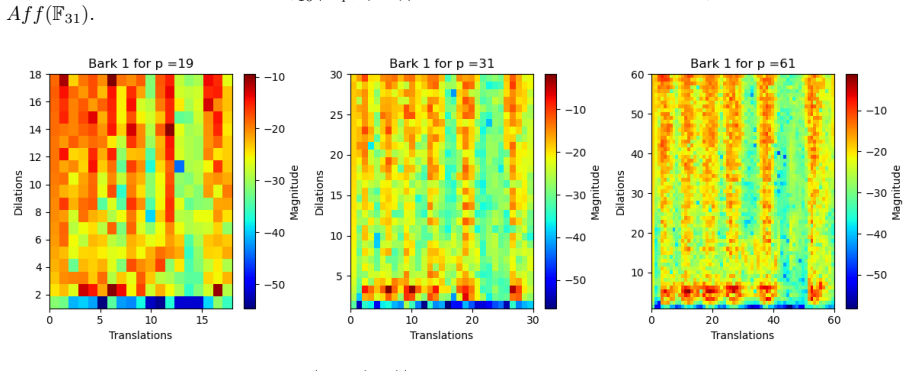
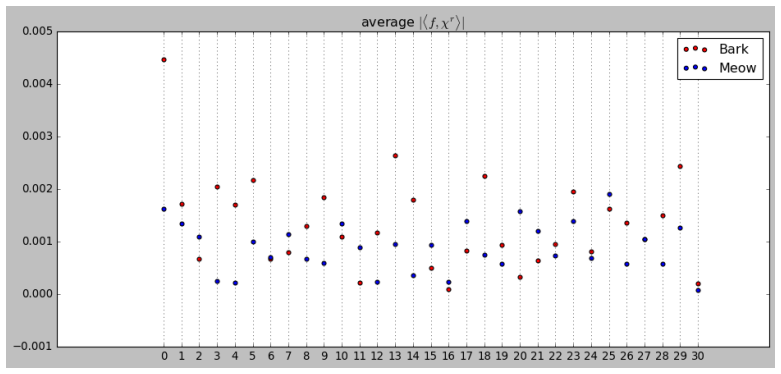
- Audio scattering kernel gamma0, gamma1, gamma2 on Aff(Fp) =
Computed from class-average coefficients CB(k) and CM(k) over 20 training sounds
- Symmetric-group kernels gamma_j(r) = |<d_j, chi_r>| / sqrt(J) and gamma0(r) =
Computed from training distance functions for S3 and S5
- S6 kernels gamma_j(r) = |<f_j, chi_r>| =
Fourier magnitudes of three random training functions on S6
- MNIST filter families, scales, and normalization =
Mexican hat sigma=2, Shannon, Daubechies db2, J=1,5,8, normalized to satisfy the Parseval condition
assumptions (2)
- standard math Standard finite-group Fourier analysis: Schur orthogonality, Plancherel theorem, and decomposition of the left regular representation into irreducibles.
- domain assumption Theorem 5 of Kueh, Olson, Rockmore and Tan [18]: a lower bound on Fourier coefficients of nonnegative functions over compact groups.
Cite this review
Pith. "Pith review of Scattering Networks on Noncommutative Finite Groups." pith.science (2026). https://pith.science/paper/4JVGA5TP
@misc{pith2026250520950,
  author       = {Pith},
  title        = {Pith review of: Scattering Networks on Noncommutative Finite Groups},
  year         = {2026},
  howpublished = {\url{https://pith.science/paper/4JVGA5TP}},
  note         = {Machine review of arXiv:2505.20950}
}
read the original abstract
Scattering Networks were initially designed to elucidate the behavior of early layers in Convolutional Neural Networks (CNNs) over Euclidean spaces and are grounded in wavelets. In this work, we introduce a scattering transform on an arbitrary finite group (not necessarily abelian) within the context of group-equivariant convolutional neural networks (G-CNNs). We present wavelets on finite groups and analyze their similarity to classical wavelets. We demonstrate that, under certain conditions in the wavelet coefficients, the scattering transform is non-expansive, stable under deformations, preserves energy, equivariant with respect to left and right group translations, and, as depth increases, the scattering coefficients are less sensitive to group translations of the signal, all desirable properties of convolutional neural networks. Furthermore, we provide examples illustrating the application of the scattering transform to classify data with domains involving abelian and nonabelian groups.
Figures


Figures from the paper (14 more)


Reference graph
Works this paper leans on
-
[18]
K. L. Kueh, T. Olson, D. Rockmore, and K. S. Tan. Nonlinear approximation theory on compact groups. The Journal of Fourier Analysis and Applications , 7(3):257–281, 2001
work page 2001
-
[1]
J. Anden and S. Mallat. Deep scattering spectrum. IEEE Transactions on Signal Processing , 62(16):4114–4128, 2014
work page 2014
-
[2]
J. Bruna and S. Mallat. Classification with scattering operators. In Proceedings of the IEEE Con- ference on Computer Vision and Pattern Recognition (CVPR) , pages 1561–1566, Colorado Springs, CO, USA, 2011. 31
work page 2011
- [3]
-
[4]
C. Buchheim, P. J. Cameron, and T. Wu. On the subgroup distance problem. Discrete Mathematics, 309(4):962–968, 2009
work page 2009
- [5]
-
[6]
J. Chew, M. Hirn, S. Krishnaswamy, D. Needell, M. Perlmutter, H. Steach, S. Viswanath, and H.- T. Wu. Geometric scattering on measure spaces. Applied and Computational Harmonic Analysis , 70:101635, 2024
work page 2024
-
[7]
R. R. Coifman and M. Maggioni. Diffusion wavelets. Applied and Computational Harmonic Analysis, 21(1):53–94, 2006. Special Issue: Diffusion Maps and Wavelets
work page 2006
Show all 37 references
-
[8]
Cotter and N
F. Cotter and N. Kingsbury. Visualizing and improving scattering networks. In 2017 IEEE 27th International Workshop on Machine Learning for Signal Processing (MLSP) , pages 1–6, 2017
2017
-
[9]
J. D. Dixon. High speed computation of group characters. Numerische Mathematik, 10(5):446–450, 1967
1967
-
[10]
J. D. Dixon. Computing irreducible representations of groups. Mathematics of Computation , 24(111):707–712, 1970
1970
-
[11]
G. B. Folland. A course in abstract harmonic analysis . CRC Press, 1995
1995
-
[12]
Gauthier, B
S. Gauthier, B. Th´ erien, L. Als` ene-Racicot, M. Chaudhary, I. Rish, E. Belilovsky, M. Eickenberg, and G. Wolf. Parametric scattering networks. In Proceedings of the IEEE/CVF Conference on Computer Vision and Pattern Recognition (CVPR) , pages 5749–5758, June 2022
2022
-
[13]
Geller and I
D. Geller and I. Pesenson. Band-limited localized Parseval frames and Besov spaces on compact homogeneous manifolds. Journal of Geometric Analysis , 21:334–371, 2011
2011
-
[14]
J. Gibson. Characters of the symmetric group. https://www.jgibson.id.au/articles/characters/
-
[15]
L. C. Grove. Groups and Characters . Wiley, 1997
1997
-
[16]
D. K. Hammond, P. Vandergheynst, and R. Gribonval. Wavelets on graphs via spectral graph theory. Applied and Computational Harmonic Analysis , 30(2):129–150, Mar. 2011
2011
-
[17]
Kondor and S
R. Kondor and S. Trivedi. On the generalization of equivariance and convolution in neural networks to the action of compact groups. In J. Dy and A. Krause, editors, Proceedings of the 35th Interna- tional Conference on Machine Learning , volume 80 of Proceedings of Machine Lea...
2018
-
[19]
LeCun, L
Y. LeCun, L. Bottou, Y. Bengio, and P. Haffner. Gradient-based learning applied to document recognition. In Proceedings of the IEEE, volume 86(11), pages 2278–2323, 1998
1998
-
[20]
Lov´ asz
L. Lov´ asz. Spectra of graphs with transitive groups. Period. Math. Hungar. , 6(2):191–195, 1975
1975
-
[21]
S. Mallat. Group invariant scattering. Communications on Pure and Applied Mathematics , 65(10):1331–1398, 2012
2012
-
[22]
McFee, C
B. McFee, C. Raffel, D. Liang, D. P. Ellis, M. McVicar, E. Battenberg, and O. Nieto. librosa: Audio and music signal analysis in python. In Proceedings of the 14th Python in Science Conference, pages 18–25, 2015
2015
-
[23]
Nicola and S
F. Nicola and S. I. Trapasso. Stability of the scattering transform for deformations with minimal regularity. Journal de Math´ ematiques Pures et Appliqu´ ees, 180:122–150, 2023
2023
-
[24]
Perlmutter, F
M. Perlmutter, F. Gao, G. Wolf, and M. Hirn. Geometric wavelet scattering networks on compact Riemannian manifolds. In J. Lu and R. Ward, editors, Proceedings of The First Mathematical and Scientific Machine Learning Conference , volume 107 of Proceedings of Machine Learning R...
2020
-
[25]
https://docs.pytorch.org/vision/stable/generated/torchvision.datasets.MNIST.html
PyTorch. https://docs.pytorch.org/vision/stable/generated/torchvision.datasets.MNIST.html
-
[26]
Rodriguez Salas, E
R. Rodriguez Salas, E. Dokladalova, and P. Dokl´ adal. Rotation invariant CNN using scattering transform for image classification. In IEEE International Conference on Image Processing (ICIP) , Taipei, Taiwan, Sept. 2019
2019
-
[27]
Saito and D
N. Saito and D. S. Weber. Underwater object classification using scattering transform of sonar signals. https://arxiv.org/abs/1707.03133, 2017
2017 arXiv
-
[28]
G. J. Schneider. Dixon’s character table algorithm revisited. Journal of Symbolic Computation , 9(5-6):601–606, 1990
1990
-
[29]
G. Seitz. Finite groups having only one irreducible representation of degree greater than one. Proceedings of the American Mathematical Society, 19(2):459–461, 1968
1968
-
[30]
Sifre and S
L. Sifre and S. Mallat. Rotation, scaling and deformation invariant scattering for texture discrim- ination. 2013 IEEE Conference on Computer Vision and Pattern Recognition , pages 1233–1240, 2013
2013
-
[31]
E. M. Stein. Topics in Harmonic Analysis Related to the Littlewood-Paley Theory. (AM-63), Volume
-
[32]
D. Suh. Barkmeowdb - wav files of dogs and cats. https://doi.org/10.5281/zenodo.3563990, dec 2019
2019 doi
-
[33]
A. Terras. Fourier Analysis on Finite Groups and Applications . London Mathematical Society Student Texts. Cambridge University Press, 1999
1999
-
[34]
Waldspurger
I. Waldspurger. Exponential decay of scattering coefficients. In 2017 International Conference on Sampling Theory and Applications (SampTA) , pages 143–146, 2017
2017
-
[35]
Wiatowski and H
T. Wiatowski and H. B¨ olcskei. A mathematical theory of deep convolutional neural networks for feature extraction. IEEE Transactions on Information Theory , 64:1845–1866, 2015
2015
-
[36]
Zou and G
D. Zou and G. Lerman. Graph convolutional neural networks via scattering. Applied and Compu- tational Harmonic Analysis , 49(3):1046–1074, 2020. 33
2020
-
[63]
Princeton University Press, Princeton, 1970
1970
Reviewed August 7, 2026 · model on record in the stance chip above.
Discussion (0). Continue with ORCID to comment.