REVIEW 4 major objections 4 minor 23 references
PCSD claims that weighting token-level teacher supervision by the local persistence of the teacher–student log-probability gap, not by isolated discrepancies, improves sparse-reward agent RL, and reports best ALFWorld results on two backbon
Reviewed by Pith at T0; open to challenge. T0 means a machine referee read the full paper against a public rubric. the ladder, T0–T4 →
T0 review · deepseek-v4-flash
2026-08-04 19:53 UTC pith:4KCCKS2E
load-bearing objection A plausible and novel token-level weighting scheme for on-policy self-distillation, but the headline ALFWorld victories are not statistically secured—the winning lambda was picked on the same eval set and the margins sit near noise. the 4 major comments →
PCSD: Persistent Consistency for Self-Distillation in Agentic Reinforcement Learning
The pith
A machine-rendered reading of the paper's core claim, the machinery that carries it, and where it could break.
Core claim
PCSD's central claim is that local persistence of teacher-favoring signals—measured by the teacher–student sampled log-probability gap aggregated over adaptive windows—is a better basis for token-level distillation weights than pointwise discrepancies or uniform step-level weights. The method computes for each token an exponentially weighted persistent-consistency estimate, interpolates between short and long windows according to local gap variance, multiplies by a one-sided trend factor that only attenuates declining support, and gates with a sigmoid. The resulting weights allocate dense teacher supervision in the auxiliary loss, optimized jointly with GRPO. The paper reports that this weig
What carries the argument
The central object is the teacher–student sampled log-probability gap δ_{k,i} = log π_T(y_{k,i} | h^T) − log π_θ(y_{k,i} | h^S), treated as a continuous measure of teacher relative support. PCSD's workhorse is an adaptive persistent-consistency estimator: it aggregates these gaps over forward windows with exponential decay (α=0.8), interpolates between a short window (N=1) and a long window (N=8) using a clipped local-variance coefficient, applies a one-sided OLS-slope trend factor that can only attenuate, and maps the result through a sigmoid with sharpness β_gate=5.0. The mechanism's job is to turn a noisy per-token signal into a smooth credibility weight that controls how much each studen
Load-bearing premise
The load-bearing assumption is that a teacher advantage which persists across neighboring tokens is genuinely more trustworthy than an isolated spike; if local persistence does not actually track the reliability of teacher supervision, then PCSD's windows, decay, and trend factor are just smoothing noise.
What would settle it
Take a trained PCSD checkpoint on ALFWorld and shuffle the teacher log-probability gaps within each response before computing the distillation weights, keeping the marginal distribution of gaps the same but destroying local persistence; if the reported success-rate gain over GRPO survives this shuffle, then persistent local structure is not what carries the improvement.
If this is right
- If token-level distillation weights are derived from persistent local support, then isolated teacher–student spikes get down-weighted, reducing sensitivity to sampling noise without losing positional specificity.
- The joint objective with GRPO means the student receives dense position-specific teacher guidance on top of sparse trajectory returns; the paper reports this consistently helps on ALFWorld and does not hurt WebShop.
- Because the weighting is computed from the student's own on-policy trajectory and a frozen teacher, no inference-time skill retrieval is needed; the reported gains come from the trained student policy alone.
- The ablation shows each component—adaptive windows, exponential decay, and trend modulation—contributes to the best overall result, and the distillation coefficient has a non-monotonic effect with the best performance at λ=0.01.
- On the unseen ALFWorld split, PCSD reports 86.7% overall versus 70.9% for GRPO and 72.7% for SDAR, suggesting the weighting transfers to new environment configurations.
Where Pith is reading between the lines
- Inference: A direct testable extension is to replace the hand-set variance thresholds, decay factor, and gating sharpness with learned or stage-adaptive parameters; the paper itself flags that fixed hyperparameters limit adaptation to evolving trajectory statistics.
- Inference: If the persistence heuristic is genuinely the operative mechanism, PCSD should transfer to other long-horizon agent benchmarks—tool use, GUI navigation, embodied tasks—that share the same sparse-reward, multi-turn structure, rather than only ALFWorld and WebShop.
- Inference: The reported negative mean teacher gap that gradually increases suggests the student never fully catches the teacher; annealing or adapting the sigmoid sharpness and trend strength as the student improves could be a natural extension.
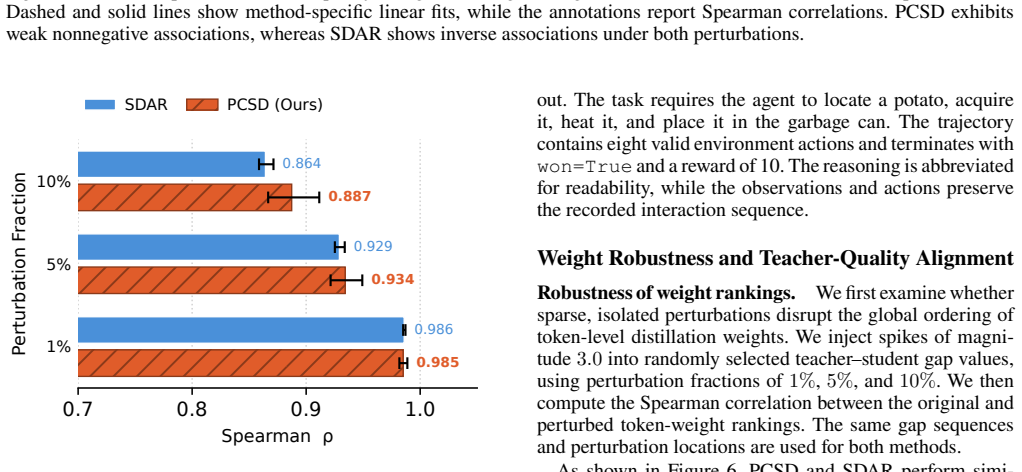
- Inference: The diagnostic showing that SDAR weights respond inversely to teacher-quality perturbations while PCSD does not suggests that normalized weighting schemes may create competition across tokens; unnormalized, persistence-based weighting may therefore be more robust to teacher-quality degradation.
Editorial analysis
A structured set of objections, weighed in public.
Referee Report
Summary. The paper proposes PCSD (Persistent Consistency Self-Distillation), a token-level weighting scheme for on-policy self-distillation in agentic RL. PCSD computes distillation weights from the local persistence of the teacher–student log-probability gap, using adaptive exponential-decay windows, a one-sided trend modulation, and sigmoid gating. The weighted distillation objective is added to GRPO. The paper reports ALFWorld and WebShop experiments on two backbones, claiming the best ALFWorld Overall results over GRPO and SDAR by 15.6/13.3 and 6.2/5.5 percentage points, respectively, plus a generalization result on the unseen ALFWorld split.
Significance. If the empirical claims are robust, the contribution is significant for agentic RL: it offers a concrete, well-specified way to turn a privileged teacher's token-level signal into dense training supervision without inference-time skills. The method is cleanly formulated (Eqs. 4–15, Algorithm 1), and the component ablations are internally consistent with the proposed mechanism. The appendix also contains a thoughtful—though explicitly partial—analysis of the local bias–variance trade-off. The main risk is not conceptual circularity: the method is evaluated on external benchmarks. The risk is statistical and selection-related: the headline gains are point estimates from 128-episode evaluations, the distillation coefficient is selected on the same ALFWorld evaluation set, and the strongest distillation baseline is reimplemented by the authors. These concerns need to be addressed before the central claim can be considered established.
major comments (4)
- [Experiments, Table 1; Appendix Benchmark Protocols] The headline ALFWorld advantage is not statistically secured. Each ALFWorld evaluation uses 128 episodes, and only point estimates are reported, with no repeated seeds, error bars, or confidence intervals. For Qwen2.5-3B, 90.6% vs. SDAR's 84.4% is about 6.2 percentage points, i.e., roughly 8 episodes in 128; the two-proportion standard error is about 4 percentage points, so the margin is near 1.5 SE. For Qwen3-1.7B the margin is 5.5 points with a standard error around 6 percentage points, i.e., under 1 SE. The same applies to the unseen-split comparison (Figure 4) and the component ablations (Table 2). I request repeated-seed runs, confidence intervals, or a clear statement that the empirical claims are exploratory rather than definitive.
- [Ablation Studies, Table 3] The winning distillation coefficient is selected on the same evaluation set that is headlined. λPCSD=0.01 is chosen because it gives the best ALFWorld Overall on valid_seen (90.6%), while 0.005 gives 87.5%, 0.05 gives 83.6%, and 0.0 gives 75.0%. At λ=0.05, PCSD (83.6%) is below SDAR (84.4%) in Table 1. Thus the reported superiority over the strongest distillation baseline rests on a single hyperparameter value selected from the evaluation distribution. The authors should either tune on a separate validation set, report the selection protocol, or treat the headline margin as conditional on selection and back it with variance estimates.
- [Experiments, Baselines and Table 4] The strongest baseline, SDAR, was reimplemented by the authors rather than taken from original public checkpoints or results, and no code is released. The claim that PCSD beats SDAR by 6.2/5.5 points therefore cannot be independently verified from the manuscript. Hyperparameters in Table 4 are helpful, but a reimplementation can differ in subtle implementation details (teacher construction, skill retrieval, reward processing, evaluation temperature). I request code release, use of the original authors' released results/checkpoints where available, or at minimum a detailed reproducibility package including the exact SDAR implementation and evaluation scripts. This is load-bearing because SDAR is the strongest competing distillation baseline and the paper's central comparison.
- [Method and Appendix: Weight Robustness and Teacher-Quality Alignment] The core assumption that 'persistent teacher-favoring signals are more informative than isolated spikes' is not directly validated. The method reweights tokens using the same teacher–student gaps that define persistence, and the appendix's robustness analyses are explicitly described by the authors as 'analyses of the weighting behavior rather than direct evidence of downstream task performance or causal attribution to an individual component.' The component ablations support the mechanism on one benchmark, but with single runs. A concrete test would be to measure whether persistent windows correlate with an external oracle of token-level teacher correctness (e.g., agreement with a gold action or with outcome-conditioned hindsight) on held-out trajectories, or to demonstrate the same improvement with a second teacher whose per-token noise characteristics differ. Without such a test, the
minor comments (4)
- [Table 4] The baseline 'Skill-SD' appears in Table 4 but is not defined or evaluated in the main text or tables. Please clarify what this method is and whether it is used anywhere.
- [Figure 4 and Table 6] The qualitative rollout in Table 6 is described as one successful trajectory from the unseen split. State whether this trajectory was selected as representative, best-case, or random; otherwise the reader cannot assess potential cherry-picking.
- [Experiments, Evaluation Metrics] The abstract says PCSD 'achieves the best ALFWorld Overall results among all baselines,' but on WebShop PCSD is not the best on every metric (e.g., Qwen3 Score is below Skill-GRPO*). The wording in the abstract is accurate for ALFWorld, but the 'consistently outperforms' phrasing in the Introduction is stronger than the point estimates support.
- [Appendix, Hyperparameters] Several PCSD hyperparameters (Nmin=1, Nmax=8, α=0.8, τlow=0.05, τhigh=0.5, γ=0.3, βgate=5.0) are fixed across tasks. The paper does not report how sensitive the results are to these values. A small sensitivity analysis or at least a statement of which parameters were most influential would improve reproducibility and interpretation.
Circularity Check
No significant circularity: PCSD's weighting is a heuristic defined on the teacher–student gap, and the claimed gains are tested on external benchmarks rather than derived from the method's definitions.
full rationale
The paper's central claim is empirical: PCSD outperforms GRPO and SDAR on ALFWorld and is competitive on WebShop, as measured on held-out validation/episode sets. The PCSD weighting rule (Eq. 13: w = sigmoid(beta * adaptive_delta) * trend) and the distillation objective (Eq. 14: L = (1/M) sum w*delta) are a deliberate reweighting of the same teacher–student gap signal, but this is the proposed algorithm, not a derivation of a conclusion from its own inputs. Nothing in the paper claims to 'predict' the gap from the weights; the weights are detached and used only to allocate supervision. The persistence heuristic ("informative teacher advantage should persist across a local neighborhood") is an assumption that is tested empirically through ablations and downstream task performance, not a tautology. The paper also does not rely on load-bearing self-citation: the only self-citation (Lv et al. 2026, PhysAgent) appears in a background list of tool-use RL work, while the teacher-strength premise is attributed to the external OPSD work of Zhao et al. (2026). The sensitivity analysis selecting lambda=0.01 on the same evaluation set is a statistical selection concern, not a circularity, and the appendix explicitly limits its theoretical claims ("This analysis characterizes the local estimator rather than establishing a global convergence guarantee"). Thus, the derivation chain is self-contained against external benchmarks, and no circular step can be exhibited from the paper's equations or citations.
Axiom & Free-Parameter Ledger
free parameters (6)
- alpha (decay factor) =
0.8
- Nmin, Nmax =
1, 8
- tau_low, tau_high =
0.05, 0.5
- gamma =
0.3
- beta_gate =
5.0
- lambda_PCSD =
0.01
axioms (3)
- domain assumption The token-level teacher-student log-probability gap delta is a meaningful continuous measure of teacher's relative support for student-sampled tokens.
- ad hoc to paper Persistent teacher-favoring signals are more informative than isolated spikes.
- domain assumption The privileged-context teacher is substantially stronger than the student at trajectory level.
Cite this review
Pith. "Pith review of PCSD: Persistent Consistency for Self-Distillation in Agentic Reinforcement Learning." pith.science (2026). https://pith.science/paper/4KCCKS2E
@misc{pith2026260801837,
  author       = {Pith},
  title        = {Pith review of: PCSD: Persistent Consistency for Self-Distillation in Agentic Reinforcement Learning},
  year         = {2026},
  howpublished = {\url{https://pith.science/paper/4KCCKS2E}},
  note         = {Machine review of arXiv:2608.01837}
}
read the original abstract
Large language model agents have shown strong potential in complex interactive tasks, yet their reinforcement learning (RL) is often hindered by sparse rewards, as a long multi-turn trajectory may receive only a single outcome-level signal. On-policy self-distillation (OPSD) provides dense token-level supervision from a privileged teacher, but the teacher may not be reliable at every position. Existing methods commonly rely on isolated token-level discrepancies, which can be sensitive to noise, or assign a shared step-level weight that may overlook positional variation. We propose Persistent Consistency Self-Distillation (PCSD), which derives token-level distillation weights from the local persistence of teacher-favoring signals. PCSD combines adaptive windows with exponentially decayed aggregation to capture persistent relative teacher support, applies trend-aware modulation to attenuate locally declining support, and produces continuous weights through sigmoid gating. The resulting objective is jointly optimized with GRPO, combining dense teacher guidance with sparse environmental feedback. Without inference-time skills, PCSD achieves the best ALFWorld Overall results among all baselines on both backbones, exceeding GRPO by 15.6 and 13.3 points and SDAR by 6.2 and 5.5 points, while remaining competitive on WebShop and gaining 15.8 points over GRPO on unseen ALFWorld split.
Figures


Reference graph
Works this paper leans on
-
[3]
arXiv preprint arXiv:2410.02089
Rlef: Grounding codellmsinexecutionfeedbackwithreinforcementlearning. arXiv preprint arXiv:2410.02089. Guo, D.; Yang, D.; Zhang, H.; Song, J.; Wang, P.; Zhu, Q.; Xu, R.; Zhang, R.; Ma, S.; Bi, X.; et al
-
[4]
Deepseek-r1: Incentivizing reasoning capability in llms via reinforcement learning.arXiv preprint arXiv:2501.12948. Hübotter,J.;Lübeck,F.;Behric,L.;Baumann,A.;Bagatella, M.; Marta, D.; Hakimi, I.; Shenfeld, I.; Buening, T. K.; Guestrin, C.; et al
-
[6]
Jin, B.; Zeng, H.; Yue, Z.; Yoon, J.; Arik, S.; Wang, D.; Zamani, H.; and Han, J
Swe-bench: Can lan- guage models resolve real-world github issues? InInter- national Conference on Learning Representations, volume 2024, 54107–54157. Jin, B.; Zeng, H.; Yue, Z.; Yoon, J.; Arik, S.; Wang, D.; Zamani, H.; and Han, J
2024
-
[7]
Search-r1: Training llms to reason and leverage search engines with reinforcement learning.arXiv preprint arXiv:2503.09516. Li,X.;Jin,J.;Dong,G.;Qian,H.;Wu,Y.;Wen,J.-R.;Zhu,Y.; andDou,Z.2026a.Webthinker:Empoweringlargereasoning models with deep research capability.Advances in Neural Information Processing Systems, 38: 120091–120131. Li,Y.; Zuo,Y.; He,B.; ...
-
[8]
2:Pushingthefrontierofopenlargelanguagemodels.arXiv preprint arXiv:2512.02556
Deepseek-v3. 2:Pushingthefrontierofopenlargelanguagemodels.arXiv preprint arXiv:2512.02556. Lu,Z.;Yao,Z.;Han,Z.;Wang,Z.-H.;Wu,J.;Gu,Q.;Cai,X.; Lu,W.;Xiao,J.;Zhuang,Y.;etal.2026a. Self-distilledagen- ticreinforcementlearning.arXiv preprint arXiv:2605.15155. Lu, Z.; Yao, Z.; Wu, J.; Han, C.; Gu, Q.; Cai, X.; Lu, W.; Xiao, J.; Zhuang, Y.; and Shen, Y. 2026b....
-
[9]
Mallen, A.; Asai, A.; Zhong, V.; Das, R.; Khashabi, D.; andHajishirzi,H.2023
PhysAgent: Automating Physics-Based 4D Synthesis via Trajectory-Grounded Multi-Agent Feedback.arXiv preprint arXiv:2606.08688. Mallen, A.; Asai, A.; Zhong, V.; Das, R.; Khashabi, D.; andHajishirzi,H.2023. Whennottotrustlanguagemodels: Investigatingeffectivenessofparametricandnon-parametric memories. InProceedings of the 61st annual meeting of the associat...
Pith/arXiv arXiv 2023
-
[10]
InInternational Conference on Learning Representations, volume 2025, 79791–79821
Webrl: Training llm web agents via self-evolving online curriculum reinforce- ment learning. InInternational Conference on Learning Representations, volume 2025, 79791–79821. Qian, C.; Acikgoz, E. C.; He, Q.; Wang, H.; Chen, X.; Hakkani-Tur, D.; Tur, G.; and Ji, H
2025
-
[11]
InInternational Conference on Learning Representations, volume 2025, 406–441
Androidworld: A dynamic benchmarking envi- ronmentforautonomousagents. InInternational Conference on Learning Representations, volume 2025, 406–441. Schulman, J.; Wolski, F.; Dhariwal, P.; Radford, A.; and Klimov, O
2025
-
[13]
Shinn, N.; Cassano, F.; Gopinath, A.; Narasimhan, K.; and Yao, S
Deepseekmath: Pushing the limits of mathematical reasoning in open lan- guage models.arXiv preprint arXiv:2402.03300. Shinn, N.; Cassano, F.; Gopinath, A.; Narasimhan, K.; and Yao, S
-
[15]
Tan, H.; Wang, Z.; Pan, J.; Lin, J.; Wang, H.; Wu, Y.; Chen, T.;Zheng,Z.;Tang,Z.;andYang,H.2025
Openai gpt-5 system card.arXiv preprint arXiv:2601.03267. Tan, H.; Wang, Z.; Pan, J.; Lin, J.; Wang, H.; Wu, Y.; Chen, T.;Zheng,Z.;Tang,Z.;andYang,H.2025. Gtpoandgrpo-s: Token and sequence-level reward shaping with policy en- tropy.arXiv preprint arXiv:2508.04349. Team,K.;Bai,T.;Bai,Y.;Bao,Y.;Cai,S.;Cao,Y.;Charles, Y.;Che,H.;Chen,C.;Chen,G.;etal.2026. Kim...
Pith/arXiv arXiv 2025
-
[16]
DOI:10.36227/techrxiv175459840.02185500/V1. Wu, J.; Yang, S.; Lu, Z.; Zhang, F.; Shen, Y.; Feng, L.; Luo, H.; Lian, Z.; Zhang, S.; Wen, Z.; et al
-
[17]
Yang,A.;Li,A.;Yang,B.;Zhang,B.;Hui,B.;Zheng,B.;Yu, B.;Gao,C.;Huang,C.;Lv,C.;etal.2025
SEED: Self- Evolving On-Policy Distillation for Agentic Reinforcement Learning.arXiv preprint arXiv:2607.14777. Yang,A.;Li,A.;Yang,B.;Zhang,B.;Hui,B.;Zheng,B.;Yu, B.;Gao,C.;Huang,C.;Lv,C.;etal.2025. Qwen3technical report.arXiv preprint arXiv:2505.09388. Yang,C.;Qin,C.;Si,Q.;Chen,M.;Gu,N.;Yao,D.;Lin,Z.; Wang, W.; Wang, J.; and Duan, N. 2026a. Self-distille...
Pith/arXiv arXiv 2025
-
[18]
Yao,S.;Zhao,J.;Yu,D.;Du,N.;Shafran,I.;Narasimhan,K.; andCao,Y.2022b
τ-bench: A Benchmark for Tool-Agent-User Interaction in Real-World Domains.arXiv preprint arXiv:2406.12045. Yao,S.;Zhao,J.;Yu,D.;Du,N.;Shafran,I.;Narasimhan,K.; andCao,Y.2022b. React:Synergizingreasoningandacting in language models.arXiv preprint arXiv:2210.03629. Ye,J.;Zhang,X.;Xu,H.;Liu,H.;Wang,J.;Zhu,Z.;Zheng, Z.; Gao, F.; Cao, J.; Lu, Z.; et al. 2025a...
-
[19]
Yu, Q.; Zhang, Z.; Zhu, R.; Yuan, Y.; Zuo, X.; Yue, Y.; Dai, W.; Fan, T.; Liu, G.; Liu, L.; et al
On-policy context distillation for language models.arXiv preprint arXiv:2602.12275. Yu, Q.; Zhang, Z.; Zhu, R.; Yuan, Y.; Zuo, X.; Yue, Y.; Dai, W.; Fan, T.; Liu, G.; Liu, L.; et al
-
[20]
arXiv preprint arXiv:2508.06471
Glm- 4.5:Agentic,reasoning,andcoding(arc)foundationmodels. arXiv preprint arXiv:2508.06471. Zhang, K.; Hong, Y.; Bao, J.; Jiang, H.; Song, Y.; Dingqian, H.; and Xiong, H
-
[21]
Zhao, S.; Xie, Z.; Liu, M.; Huang, J.; Pang, G.; Chen, F.; and Grover, A
StepOPSD: Step- Aware Online Preference Distillation for Agent Reinforce- ment Learning.arXiv preprint arXiv:2605.27140. Zhao, S.; Xie, Z.; Liu, M.; Huang, J.; Pang, G.; Chen, F.; and Grover, A
-
[22]
Zhong, Q.; Zheng, M.; Song, M.; Lin, X.; Sun, J.; Jiang, H.; Wang, X.; and Fang, J
Self-Distilled Reasoner: On-Policy Self-DistillationforLargeLanguageModels.arXiv preprint arXiv:2601.18734. Zhong, Q.; Zheng, M.; Song, M.; Lin, X.; Sun, J.; Jiang, H.; Wang, X.; and Fang, J
-
[23]
Sod: Step-wise on-policy distillation for small language model agents.arXiv preprint arXiv:2605.07725. Appendix Thisappendixprovidesadditionaldetailsontheformulation, implementation,andanalysisofPCSD.Wefirstdescribethe construction of the privileged teacher, skill retrieval, infor- mation isolation, and the prompt templates used in both en- vironments. We...
-
[2017]
arXiv preprint arXiv:1707.06347
Proximal policy optimization algorithms. arXiv preprint arXiv:1707.06347. Shao,Z.;Wang,P.;Zhu,Q.;Xu,R.;Song,J.;Bi,X.;Zhang, H.; Zhang, M.; Li, Y.; Wu, Y.; et al
-
[2020]
Alfworld: Aligning text and em- bodiedenvironmentsforinteractivelearning.arXiv preprint arXiv:2010.03768. Singh, A.; Fry, A.; Perelman, A.; Tart, A.; Ganesh, A.; El- Kishky, A.; McLaughlin, A.; Low, A.; Ostrow, A.; Anan- thram, A.; et al
Pith/arXiv arXiv 2010
-
[2024]
Comanici, G.; Bieber, E.; Schaekermann, M.; Pasupat, I.; Sachdeva, N.; Dhillon, I.; Blistein, M.; Ram, O.; Zhang, D.; Rosen, E.; et al
On- policy distillation of language models: Learning from self- generatedmistakes.InInternational Conference on Learning Representations, volume 2024, 21246–21263. Comanici, G.; Bieber, E.; Schaekermann, M.; Pasupat, I.; Sachdeva, N.; Dhillon, I.; Blistein, M.; Ram, O.; Zhang, D.; Rosen, E.; et al
2024
-
[2025]
DeepSeek-AI.2026.DeepSeek-V4:TowardsHighlyEfficient Million-Token Context Intelligence
Gemini 2.5: Pushing the fron- tier with advanced reasoning, multimodality, long context, and next generation agentic capabilities.arXiv preprint arXiv:2507.06261. DeepSeek-AI.2026.DeepSeek-V4:TowardsHighlyEfficient Million-Token Context Intelligence. Feng, L.; Xue, Z.; Liu, T.; and An, B
Pith/arXiv arXiv 2026
-
[2026]
Reinforcement Learning via Self- Distillation.arXiv preprint arXiv:2601.20802. Jimenez, C. E.; Yang, J.; Wettig, A.; Yao, S.; Pei, K.; Press, O.; and Narasimhan, K
discussion (0)
Sign in with ORCID, Apple, or X to comment. Anyone can read and Pith papers without signing in.