Curvature-induced scalarization of charged AdS black holes
Pith reviewed 2026-06-27 18:13 UTC · model grok-4.3
The pith
A negative cosmological constant restricts Gauss-Bonnet scalarization of charged AdS black holes to a single branch and forces second-order phase transitions back to the RN-AdS solution.
A machine-rendered reading of the paper's core claim, the machinery that carries it, and where it could break.
Core claim
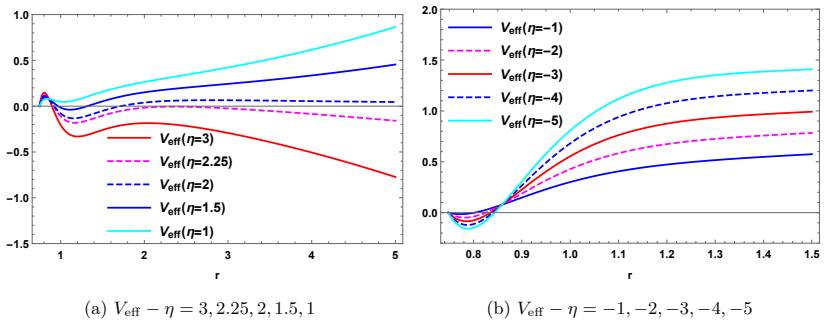
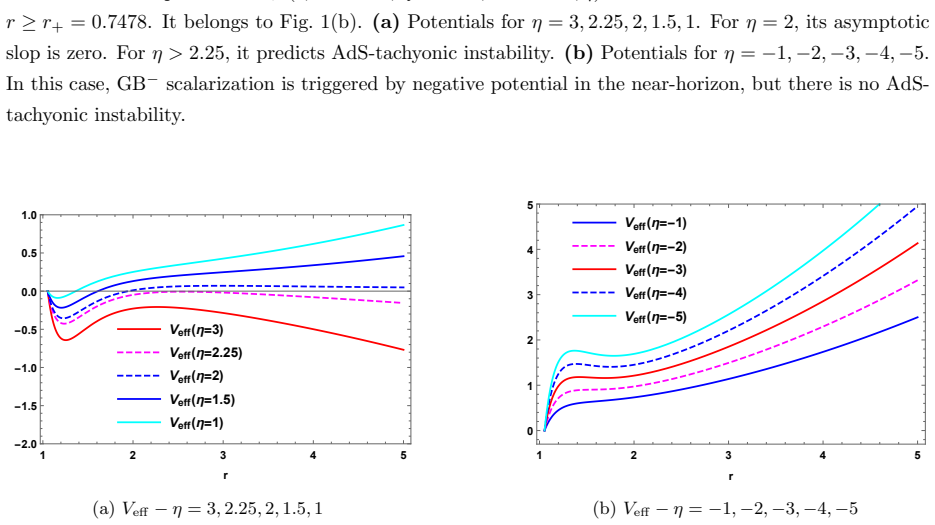
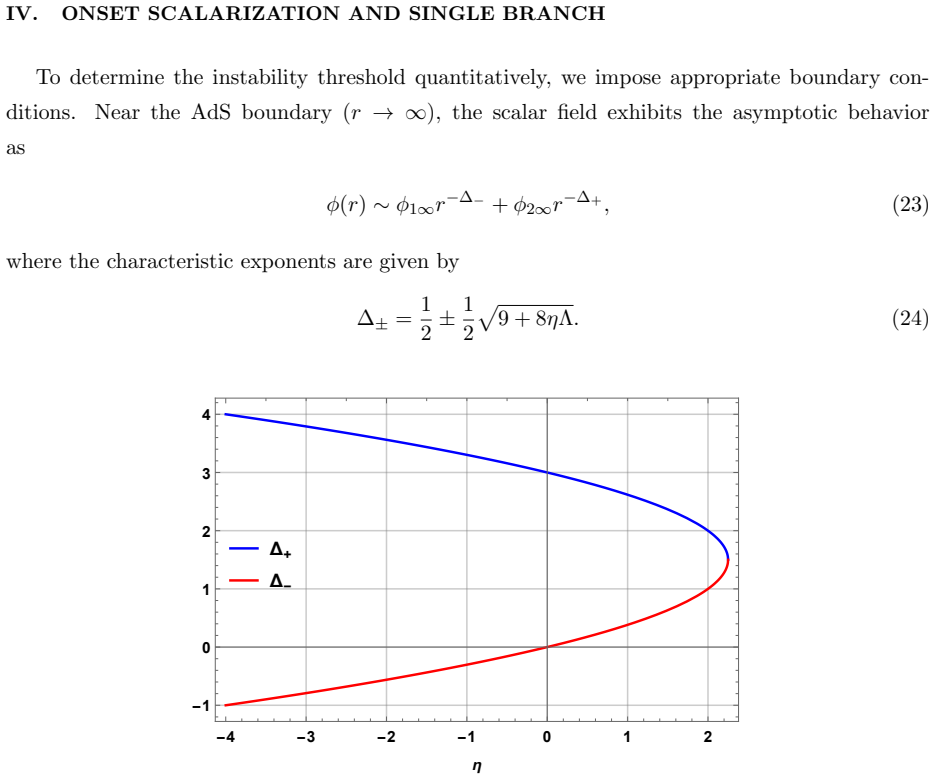
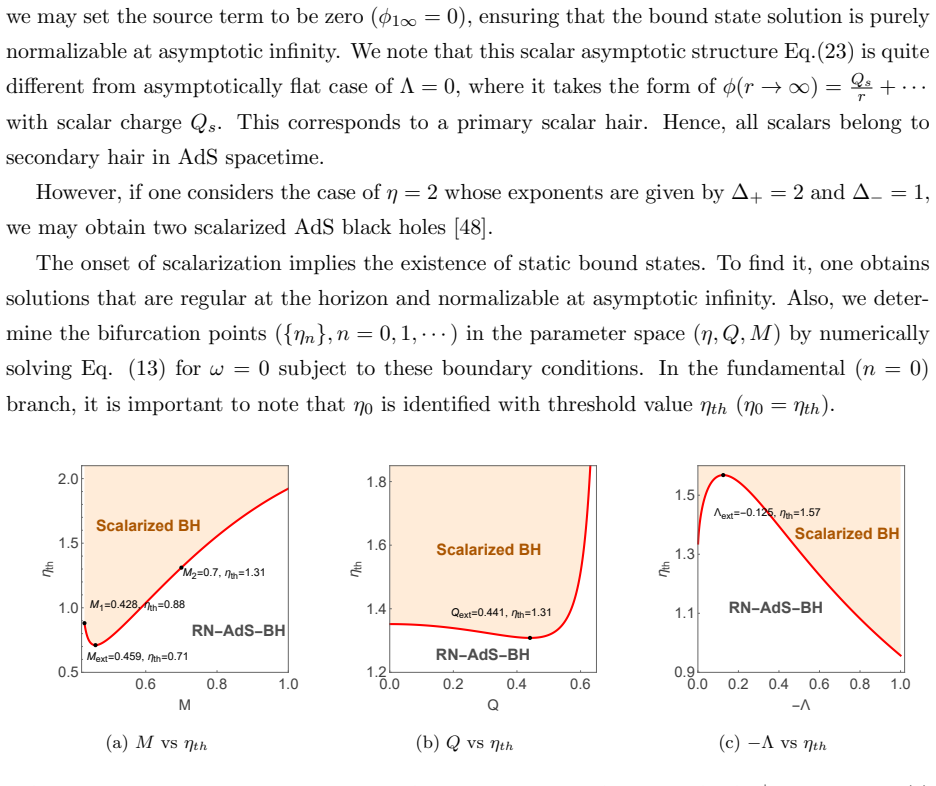
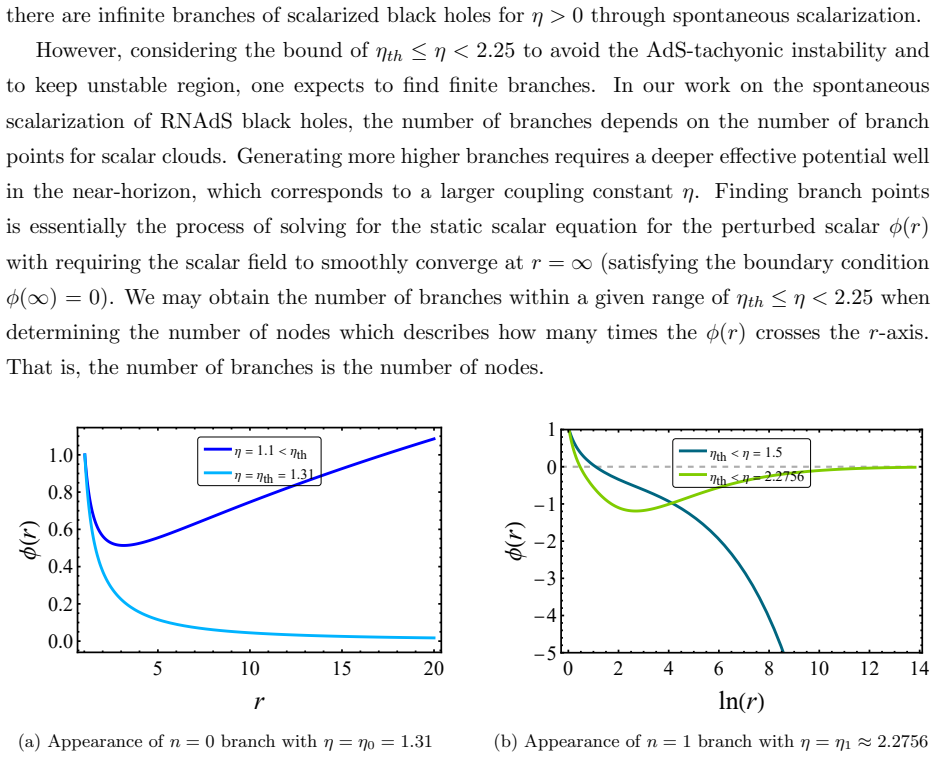
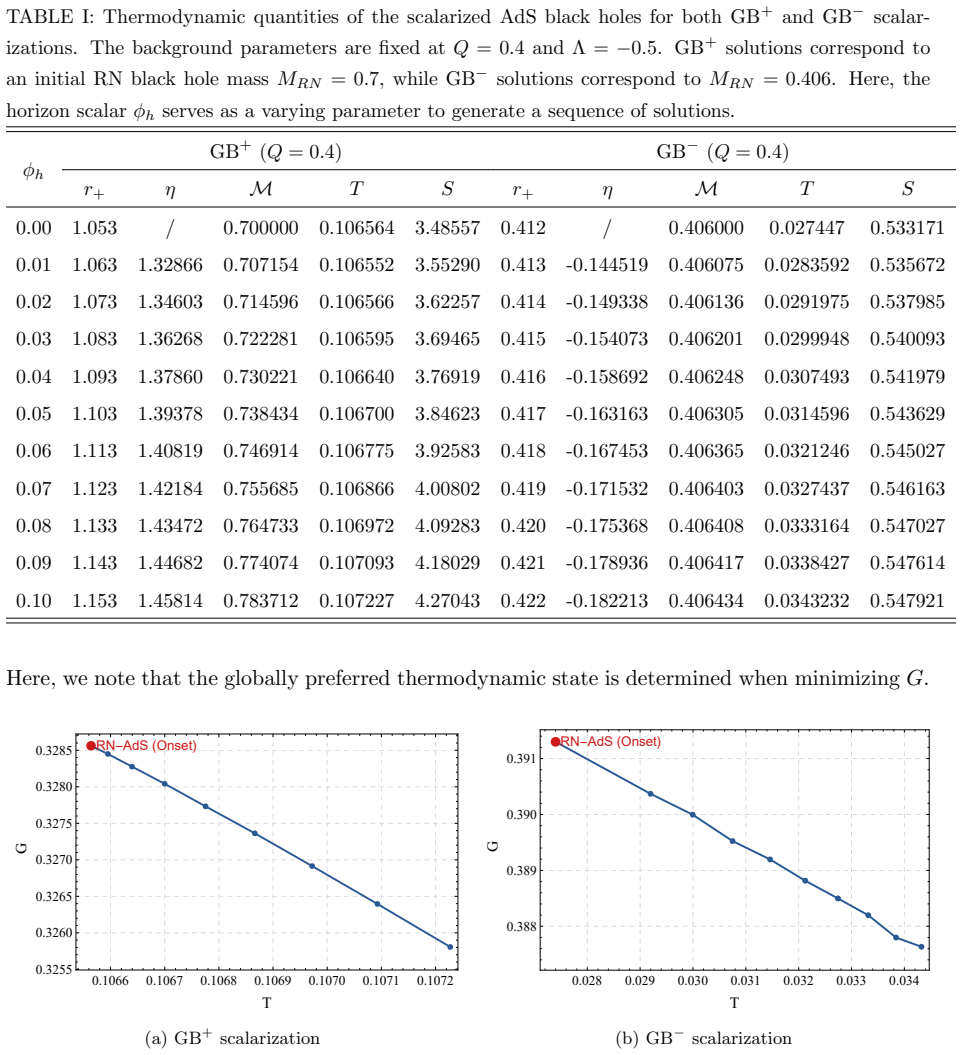
In the Einstein-Maxwell-scalar-Gauss-Bonnet theory with negative cosmological constant, the effective mass squared induced by the Gauss-Bonnet term must violate the Breitenlohner-Freedman bound before scalarization can occur. When this condition holds only in the interval from the threshold value up to 2.25, the scalarized AdS black holes appear exclusively on the n=0 fundamental branch. Gibbs free-energy comparisons confirm that the transition between these scalarized configurations and the RN-AdS black hole is second-order.
What carries the argument
The effective scalar mass squared sourced by the Gauss-Bonnet term, whose sign relative to the Breitenlohner-Freedman bound determines whether RN-AdS black holes become unstable to scalar hair.
If this is right
- Only the fundamental scalarized branch exists for couplings in the allowed window below the Breitenlohner-Freedman violation threshold.
- A second-order phase transition occurs between scalarized AdS black holes and RN-AdS black holes.
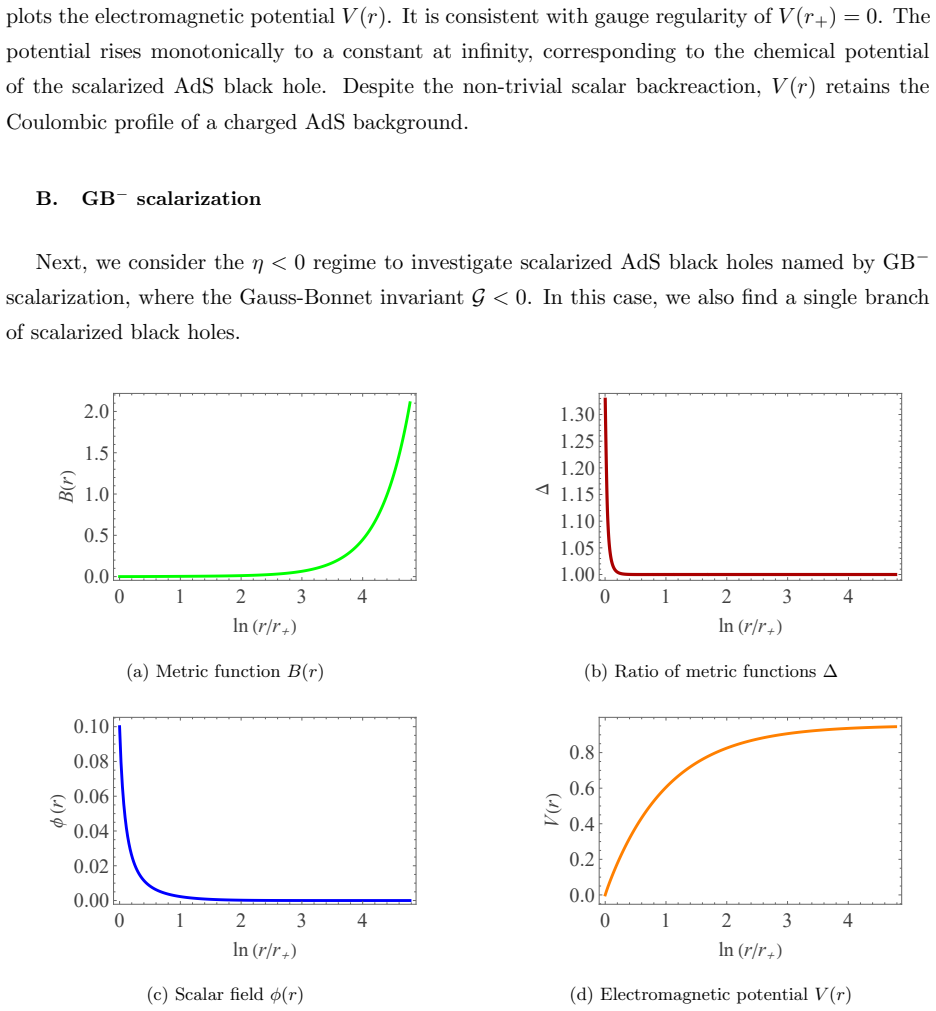
- For negative values of the coupling constant the scalarized solutions form a single branch under GB-minus scalarization.
Where Pith is reading between the lines
- The same bound-constrained mechanism may limit the number of branches in other asymptotically AdS black-hole families coupled to curvature invariants.
- Thermodynamic preference for the scalarized state at fixed charge and temperature could be tested by tracking horizon area or entropy across the transition.
- Extending the analysis to rotating or higher-dimensional AdS solutions would check whether the single-branch restriction survives.
Load-bearing premise
The onset of scalarization is fixed by whether the effective mass squared violates the Breitenlohner-Freedman bound at the specific threshold value of the coupling for a given cosmological constant.
What would settle it
Numerical construction of the scalarized solutions for a coupling value inside the interval from threshold to 2.25 that yields more than one branch, or computation of the Gibbs free energy that shows a discontinuous jump rather than a second-order transition.
Figures
read the original abstract
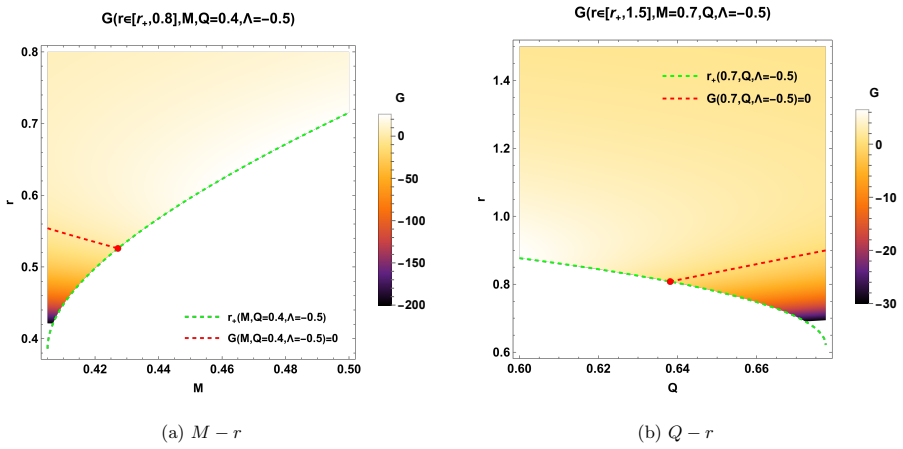
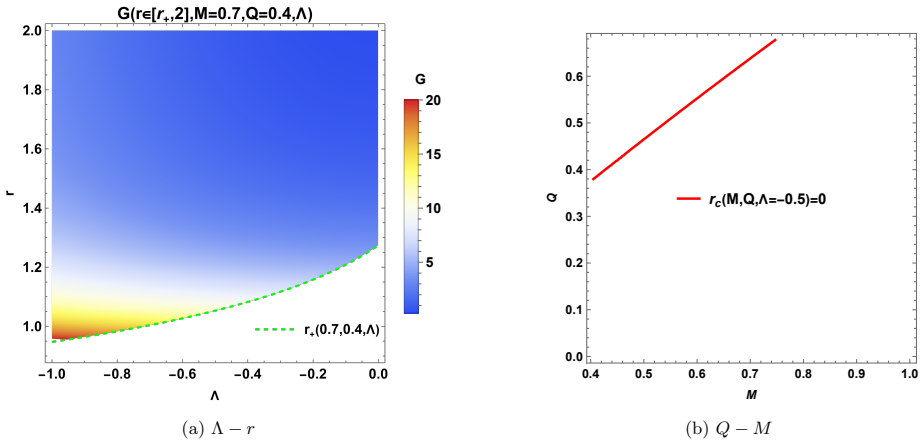
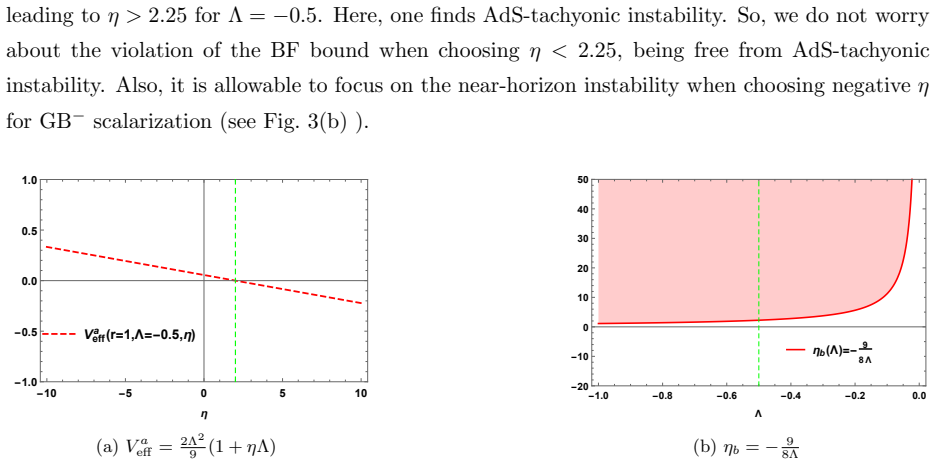
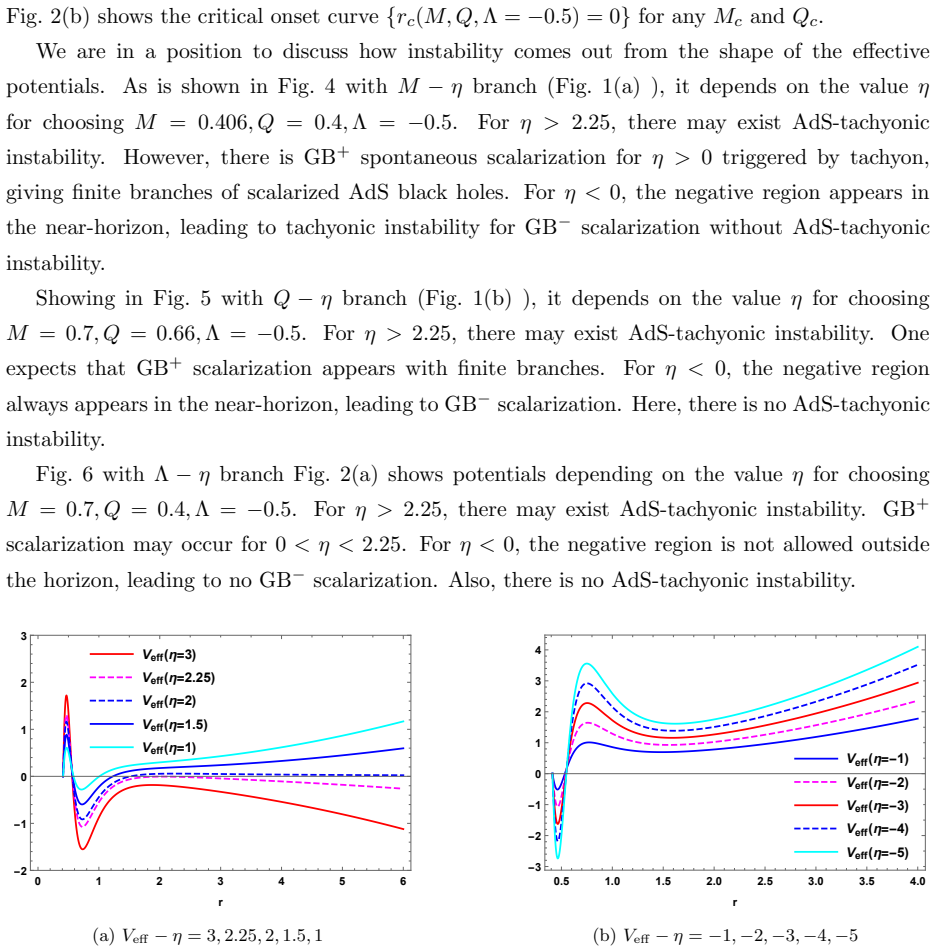
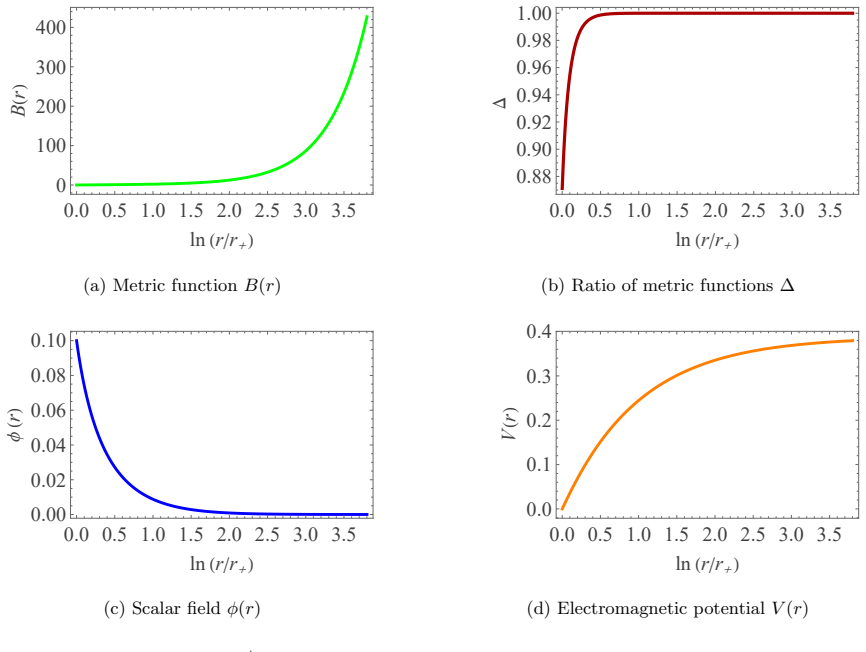
We investigate how a negative cosmological constant affects the Gauss-Bonnet (GB) scalarization in the Einstein-Maxwell-scalar-Gauss-Bonnet theory with a scalar coupling constant $\eta$ to GB term. We focus on the instability of Reissner-Nordstr\"om-AdS (RN-AdS) black holes under a scalar perturbation governed by an effective mass $\mu^2_{\text{eff}}$ sourced by the GB term. Unlike the asymptotically flat spacetime case, the onset of scalarization is not merely determined by $\mu^2_{\text{eff}} < 0$, but it is constrained by the Breitenlohner-Freedman (BF) bound. In case that the BF bound is violated ($\eta>2.25$ with $\Lambda=-0.5$), one may find AdS-tachyoinic instability. We find that for $0<\eta<2.25$, the GB$^+$ scalarization may be performed through spontaneous scalarization, while for $\eta<0$ the GB$^-$ scalarization is found to give the single branch of scalarized AdS black holes. For the GB$^+$ scalarization in $\eta_{th}\le\eta<2.25$ with $\eta_{th}$ threshold instability, we obtain the single branch ($n=0$ fundamental branch) of scalarized AdS black holes, contradicting to infinite branches. Finally, it is observed from Gibbs free energy that a phase transition from scalarized AdS black holes to RNAdS black hole occur natually and it is confirmed to be second-order.
Editorial analysis
A structured set of objections, weighed in public.
Referee Report
Summary. The manuscript studies curvature-induced scalarization of charged AdS black holes in Einstein-Maxwell-scalar-Gauss-Bonnet theory with coupling η. It claims that the onset of scalarization is governed by an effective mass μ_eff² from the GB term but is further constrained by the Breitenlohner-Freedman bound, yielding AdS-tachyonic instability only for η>2.25 (at Λ=-0.5). For GB+ scalarization in the window η_th ≤ η <2.25 the solutions consist solely of the n=0 fundamental branch (contradicting the infinite branches found in asymptotically flat spacetimes), while GB- scalarization (η<0) likewise produces a single branch; a second-order phase transition between the scalarized solutions and RNAdS black holes is inferred from the behavior of the Gibbs free energy.
Significance. If the single-branch result and the second-order transition are robust, the work would demonstrate how AdS asymptotics and the BF bound qualitatively restrict the scalarization spectrum relative to flat-space cases, providing a concrete example of how boundary conditions alter the number of bound states in the effective scalar equation.
major comments (3)
- [Numerical results / scalar equation section] The central claim that GB+ scalarization produces only the n=0 branch for η_th ≤ η <2.25 rests on the numerical construction of solutions to the scalar equation. The manuscript must demonstrate that the effective potential generated by μ_eff² (sourced by the GB term) does not admit additional nodal solutions; without an exhaustive scan of shooting parameters, initial guesses, or an analytic argument based on the Sturm-Liouville character of the radial equation, the absence of n>0 branches cannot be taken as established.
- [Instability analysis] The specific threshold η>2.25 for BF-bound violation at Λ=-0.5 is stated without derivation. The manuscript should show the explicit expression for μ_eff², the evaluation of the BF bound m_BF² = -9/4 (in AdS units), and the algebraic step that isolates η=2.25 as the critical value.
- [Thermodynamics / Gibbs free energy analysis] The assertion that the phase transition is second-order is based on Gibbs free energy comparison. The manuscript must exhibit the continuity of the first derivative and the discontinuity (or lack thereof) of the second derivative of the free energy across the critical η or charge, together with the corresponding thermodynamic quantities, to confirm the order.
minor comments (2)
- [Abstract] Typos: “natually” should be “naturally”; “tachyoinic” should be “tachyonic”.
- [Introduction / setup] The notation for the effective mass μ_eff² and the precise definition of the GB coupling term should be introduced with an equation number at first appearance.
Simulated Author's Rebuttal
We thank the referee for the careful reading and constructive comments, which will help improve the clarity and rigor of our manuscript. We address each major comment point by point below.
read point-by-point responses
-
Referee: [Numerical results / scalar equation section] The central claim that GB+ scalarization produces only the n=0 branch for η_th ≤ η <2.25 rests on the numerical construction of solutions to the scalar equation. The manuscript must demonstrate that the effective potential generated by μ_eff² (sourced by the GB term) does not admit additional nodal solutions; without an exhaustive scan of shooting parameters, initial guesses, or an analytic argument based on the Sturm-Liouville character of the radial equation, the absence of n>0 branches cannot be taken as established.
Authors: We agree that additional justification is required. In the revision we will add both an analytic argument based on the Sturm-Liouville properties of the radial equation (showing the effective potential supports only a nodeless ground state for the relevant η range) and a description of extended numerical scans over multiple initial conditions and shooting parameters that confirm the absence of n>0 solutions. These additions will appear in a new subsection of the numerical results section. revision: yes
-
Referee: [Instability analysis] The specific threshold η>2.25 for BF-bound violation at Λ=-0.5 is stated without derivation. The manuscript should show the explicit expression for μ_eff², the evaluation of the BF bound m_BF² = -9/4 (in AdS units), and the algebraic step that isolates η=2.25 as the critical value.
Authors: We will insert the full derivation in the instability analysis section. The effective mass takes the explicit form μ_eff² = −(η/r⁴)×(Gauss-Bonnet invariant evaluated on the RN-AdS background). Setting this below the BF bound m_BF² = −9/4 (for Λ = −0.5) and solving the resulting algebraic inequality directly yields the threshold η > 2.25. The intermediate steps will be shown explicitly. revision: yes
-
Referee: [Thermodynamics / Gibbs free energy analysis] The assertion that the phase transition is second-order is based on Gibbs free energy comparison. The manuscript must exhibit the continuity of the first derivative and the discontinuity (or lack thereof) of the second derivative of the free energy across the critical η or charge, together with the corresponding thermodynamic quantities, to confirm the order.
Authors: We will augment the thermodynamics section with explicit plots of the first and second derivatives of the Gibbs free energy versus the control parameter (η or charge). These will demonstrate continuity of the first derivative and a discontinuity in the second derivative at the critical point, together with tabulated values of the relevant thermodynamic quantities, thereby confirming the second-order character of the transition. revision: yes
Circularity Check
No significant circularity; numerical branch count is independent result
full rationale
The paper's central results (single n=0 branch for GB+ scalarization when η_th ≤ η <2.25, second-order phase transition via Gibbs free energy) are obtained by direct numerical integration of the coupled Einstein-scalar-Maxwell equations subject to AdS asymptotics and BF-bound boundary conditions. The effective mass μ_eff² is computed from the GB term but does not define the solution count by construction; the reported absence of higher-node solutions is a numerical outcome, not a re-labeling of the input threshold. No self-citation chain, ansatz smuggling, or fitted-input-as-prediction pattern appears in the derivation. The analysis is self-contained against external benchmarks such as the known RNAdS background and standard BF bound.
Axiom & Free-Parameter Ledger
free parameters (2)
- η
- Λ
axioms (2)
- domain assumption Scalar perturbation governed by effective mass μ_eff² sourced by the GB term.
- domain assumption Breitenlohner-Freedman bound constrains onset of scalarization in AdS.
Reference graph
Works this paper leans on
-
[1]
T. Clifton, P. G. Ferreira, A. Padilla, and C. Skordis, Phys. Rept.513, 1 (2012), 1106.2476
Pith/arXiv arXiv 2012
-
[2]
T. P. Sotiriou and V. Faraoni, Phys. Rev. Lett.108, 081103 (2012), 1109.6324
Pith/arXiv arXiv 2012
-
[3]
A. Joyce, B. Jain, J. Khoury, and M. Trodden, Phys. Rept.568, 1 (2015), 1407.0059
Pith/arXiv arXiv 2015
-
[4]
E. Berti et al., Class. Quant. Grav.32, 243001 (2015), 1501.07274
Pith/arXiv arXiv 2015
- [5]
-
[6]
L. Barack et al., Class. Quant. Grav.36, 143001 (2019), 1806.05195
Pith/arXiv arXiv 2019
-
[7]
B. P. Abbott et al. (LIGO Scientific, Virgo), Phys. Rev. Lett.116, 061102 (2016), 1602.03837
Pith/arXiv arXiv 2016
-
[8]
K. Akiyama et al. (Event Horizon Telescope), Astrophys. J. Lett.875, L1 (2019), 1906.11238
Pith/arXiv arXiv 2019
-
[9]
K. Akiyama et al. (Event Horizon Telescope), Astrophys. J. Lett.930, L12 (2022), 2311.08680. 30
Pith/arXiv arXiv 2022
-
[10]
Troja et al., Nature551, 71 (2017), 1710.05433
E. Troja et al., Nature551, 71 (2017), 1710.05433
Pith/arXiv arXiv 2017
-
[11]
B. P. Abbott et al. (LIGO Scientific, VIRGO), Phys. Rev. Lett.118, 221101 (2017), [Erratum: Phys.Rev.Lett. 121, 129901 (2018)], 1706.01812
Pith/arXiv arXiv 2017
-
[12]
B. P. Abbott et al. (LIGO Scientific, Virgo), Phys. Rev. Lett.119, 141101 (2017), 1709.09660
Pith/arXiv arXiv 2017
-
[13]
B. P. Abbott et al. (LIGO Scientific, Virgo), Phys. Rev. Lett.119, 161101 (2017), 1710.05832
Pith/arXiv arXiv 2017
-
[14]
Carter, Phys
B. Carter, Phys. Rev. Lett.26, 331 (1971)
1971
-
[15]
Ruffini and J
R. Ruffini and J. A. Wheeler, Phys. Today24, 30 (1971)
1971
-
[16]
J. D. Bekenstein, Phys. Rev. D51, R6608 (1995)
1995
-
[17]
Brans and R
C. Brans and R. H. Dicke, Phys. Rev.124, 925 (1961)
1961
-
[18]
G. W. Horndeski, Int. J. Theor. Phys.10, 363 (1974)
1974
-
[19]
T. Kobayashi, M. Yamaguchi, and J. Yokoyama, Prog. Theor. Phys.126, 511 (2011), 1105.5723
Pith/arXiv arXiv 2011
-
[20]
C. Deffayet and D. A. Steer, Class. Quant. Grav.30, 214006 (2013), 1307.2450
Pith/arXiv arXiv 2013
-
[21]
T. P. Sotiriou and S.-Y. Zhou, Phys. Rev. D90, 124063 (2014), 1408.1698
Pith/arXiv arXiv 2014
-
[22]
E. Babichev, C. Charmousis, and A. Leh´ ebel, JCAP04, 027 (2017), 1702.01938
Pith/arXiv arXiv 2017
-
[23]
Damour and G
T. Damour and G. Esposito-Farese, Phys. Rev. Lett.70, 2220 (1993)
1993
-
[24]
D. D. Doneva and S. S. Yazadjiev, Phys. Rev. Lett.120, 131103 (2018), 1711.01187
Pith/arXiv arXiv 2018
-
[25]
H. O. Silva, J. Sakstein, L. Gualtieri, T. P. Sotiriou, and E. Berti, Phys. Rev. Lett.120, 131104 (2018), 1711.02080
Pith/arXiv arXiv 2018
-
[26]
G. Antoniou, A. Bakopoulos, and P. Kanti, Phys. Rev. Lett.120, 131102 (2018), 1711.03390
Pith/arXiv arXiv 2018
-
[27]
C. A. R. Herdeiro, A. M. Pombo, and E. Radu, Universe7, 483 (2021), 2111.06442
arXiv 2021
-
[28]
D. D. Doneva, F. M. Ramazano˘ glu, H. O. Silva, T. P. Sotiriou, and S. S. Yazadjiev, Rev. Mod. Phys. 96, 015004 (2024), 2211.01766
arXiv 2024
-
[29]
A. Bakopoulos, G. Antoniou, and P. Kanti, Phys. Rev. D99, 064003 (2019), 1812.06941
Pith/arXiv arXiv 2019
-
[30]
H. Guo, S. Kiorpelidi, X.-M. Kuang, E. Papantonopoulos, B. Wang, and J.-P. Wu, Phys. Rev. D102, 084029 (2020), 2006.10659
arXiv 2020
-
[31]
Y. Brihaye, C. Herdeiro, and E. Radu, Phys. Lett. B802, 135269 (2020), 1910.05286
arXiv 2020
-
[32]
Y. Brihaye, B. Hartmann, N. P. Aprile, and J. Urrestilla, Phys. Rev. D101, 124016 (2020), 1911.01950
arXiv 2020
-
[33]
A. Dima, E. Barausse, N. Franchini, and T. P. Sotiriou, Phys. Rev. Lett.125, 231101 (2020), 2006.03095
arXiv 2020
-
[34]
C. A. R. Herdeiro, E. Radu, H. O. Silva, T. P. Sotiriou, and N. Yunes, Phys. Rev. Lett.126, 011103 (2021), 2009.03904
arXiv 2021
-
[35]
D. D. Doneva and S. S. Yazadjiev, Phys. Rev. D105, L041502 (2022), 2107.01738
arXiv 2022
-
[36]
A. M. Pombo and D. D. Doneva, Phys. Rev. D108, 124068 (2023), 2310.08638
arXiv 2023
-
[37]
Z. Belkhadria and A. M. Pombo, Phys. Rev. D110, 044014 (2024), 2311.15850
arXiv 2024
-
[38]
C. A. R. Herdeiro, E. Radu, N. Sanchis-Gual, and J. A. Font, Phys. Rev. Lett.121, 101102 (2018), 1806.05190
Pith/arXiv arXiv 2018
- [39]
- [40]
-
[41]
C. A. R. Herdeiro and E. Radu, Phys. Rev. D99, 084039 (2019), 1901.02953
Pith/arXiv arXiv 2019
- [42]
-
[43]
L. Zhang, D.-C. Zou, and Y. S. Myung, Eur. Phys. J. C85, 1463 (2025), 2510.07954
arXiv 2025
-
[44]
Z. Belkhadria and S. Mignemi, Phys. Rev. D112, 044015 (2025), 2506.12137
arXiv 2025
-
[45]
Breitenlohner and D
P. Breitenlohner and D. Z. Freedman, Annals Phys.144, 249 (1982)
1982
-
[46]
D.-C. Zou, B. Meng, M. Zhang, S.-Y. Li, M.-Y. Lai, and Y. S. Myung, Universe9, 26 (2023), 2301.04784
arXiv 2023
- [47]
-
[48]
H. Guo, H. Liu, and Y. S. Myung, Eur. Phys. J. C86, 204 (2026), 2512.22433
arXiv 2026
-
[49]
Y. S. Myung and D.-C. Zou, Eur. Phys. J. C79, 273 (2019), 1808.02609. 32
Pith/arXiv arXiv 2019
discussion (0)
Sign in with ORCID, Apple, or X to comment. Anyone can read and Pith papers without signing in.