Multi-year Ground-Based Survey Photometry of Active Comet 103P/Hartley 2 and Centaur (2060) Chiron: A Tale of Two Comets in the Pre-LSST Era
Pith reviewed 2026-06-30 03:49 UTC · model grok-4.3
The pith
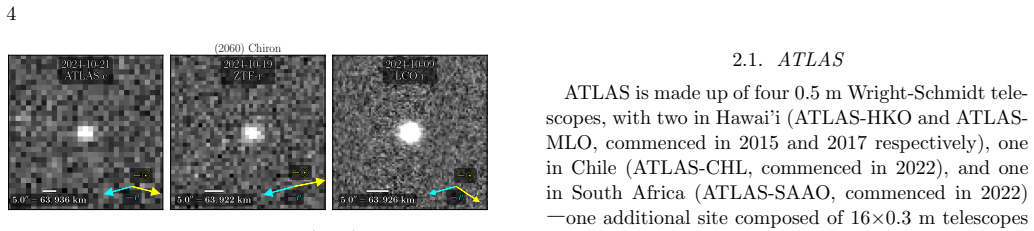
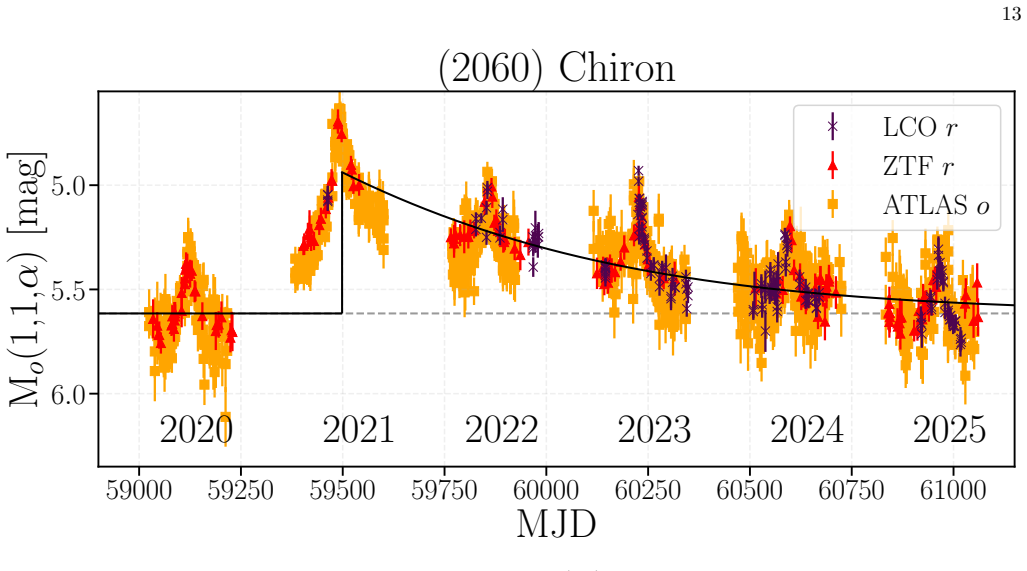
Comet 103P shows steeper inbound activity slopes than outbound while Chiron fades exponentially from its 2021 outburst over 1.4 years.
A machine-rendered reading of the paper's core claim, the machinery that carries it, and where it could break.
Core claim
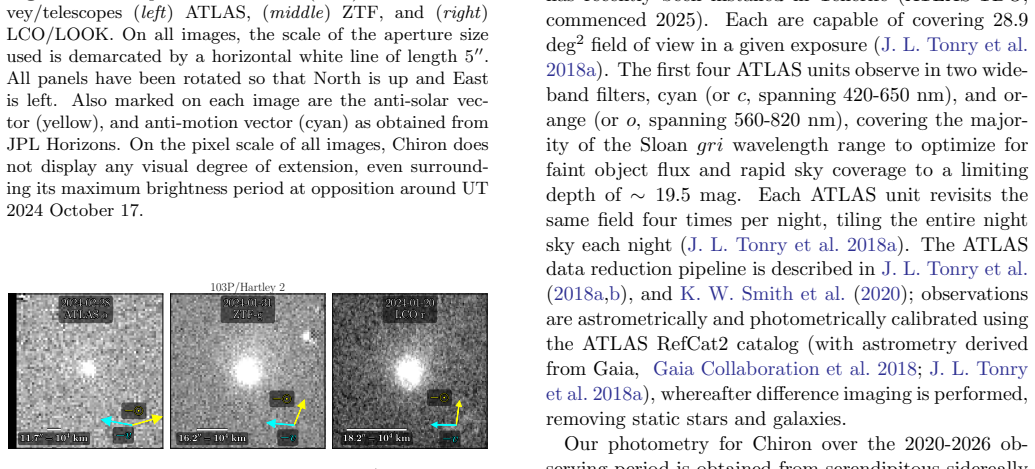
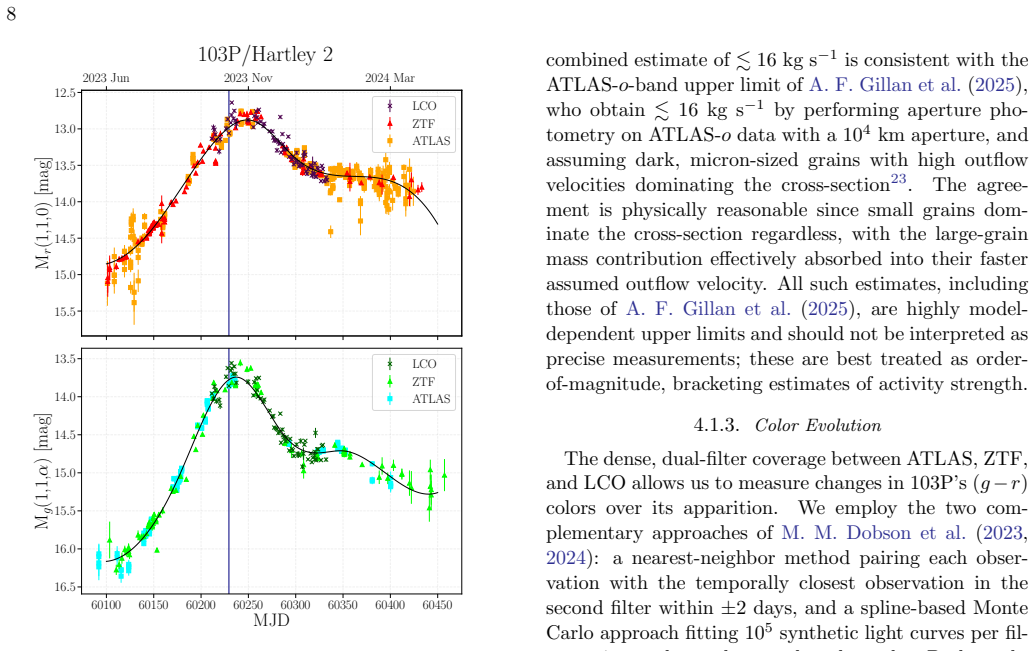
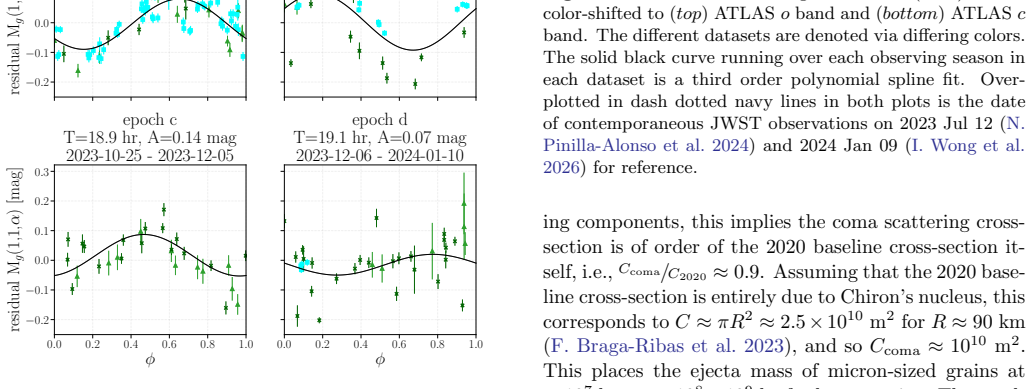
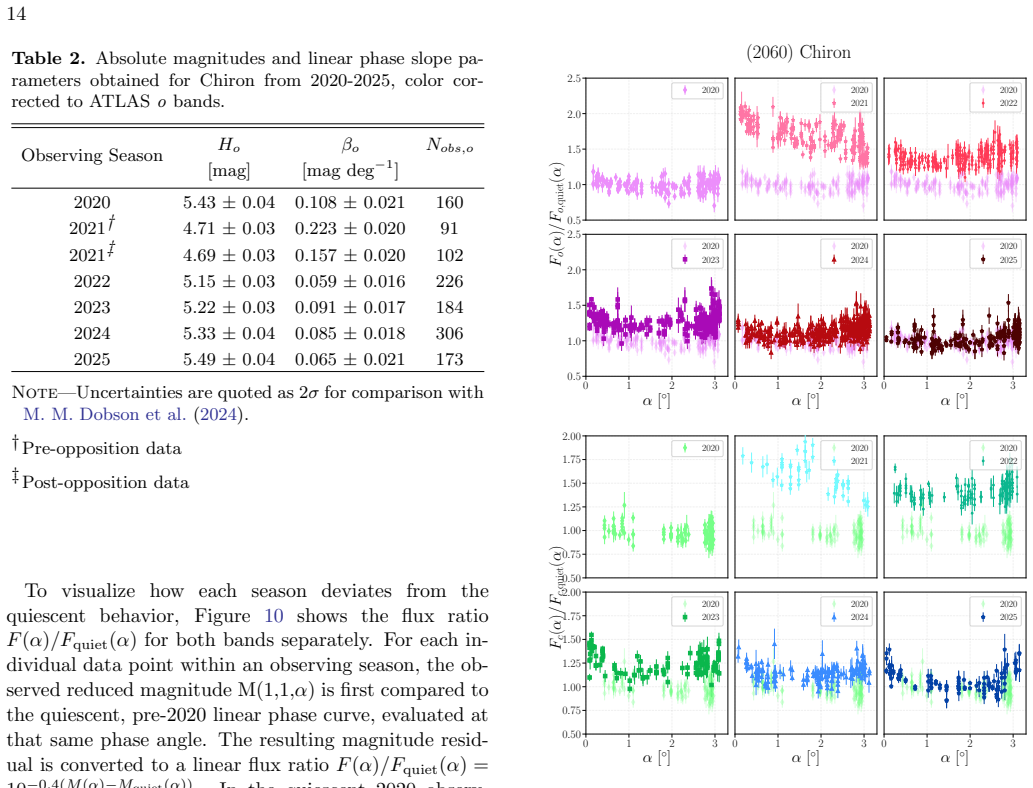
For 103P, heliocentric activity slopes are asymmetric about perihelion, with a steep inbound index (n_r,pre=-3.48±0.08) and flatter outbound value (n_r,post=-1.16±0.04), consistent with enhanced relative dust contribution post-perihelion. Reduced brightness versus prior apparitions matches reported secular fading trends. Dust mass-loss rates are ~4-16 kg s^{-1} for assumed grain properties. For Chiron, subtracting a quiescent baseline reveals exponential decay from the 2021 outburst on a ~1.4 yr timescale. Seasonal phase curves flatten from β_o=0.150±0.034 mag deg^{-1} in 2021 to ≲0.09 mag deg^{-1} by 2023-2025, converging with quiescent behavior.
What carries the argument
Heliocentric activity slopes (power-law indices of reduced magnitude versus distance to the Sun) and quiescent baseline subtraction to isolate outburst decay.
If this is right
- Dust production for 103P is estimated between 4 and 16 kg per second under the assumed grain sizes, density and albedo.
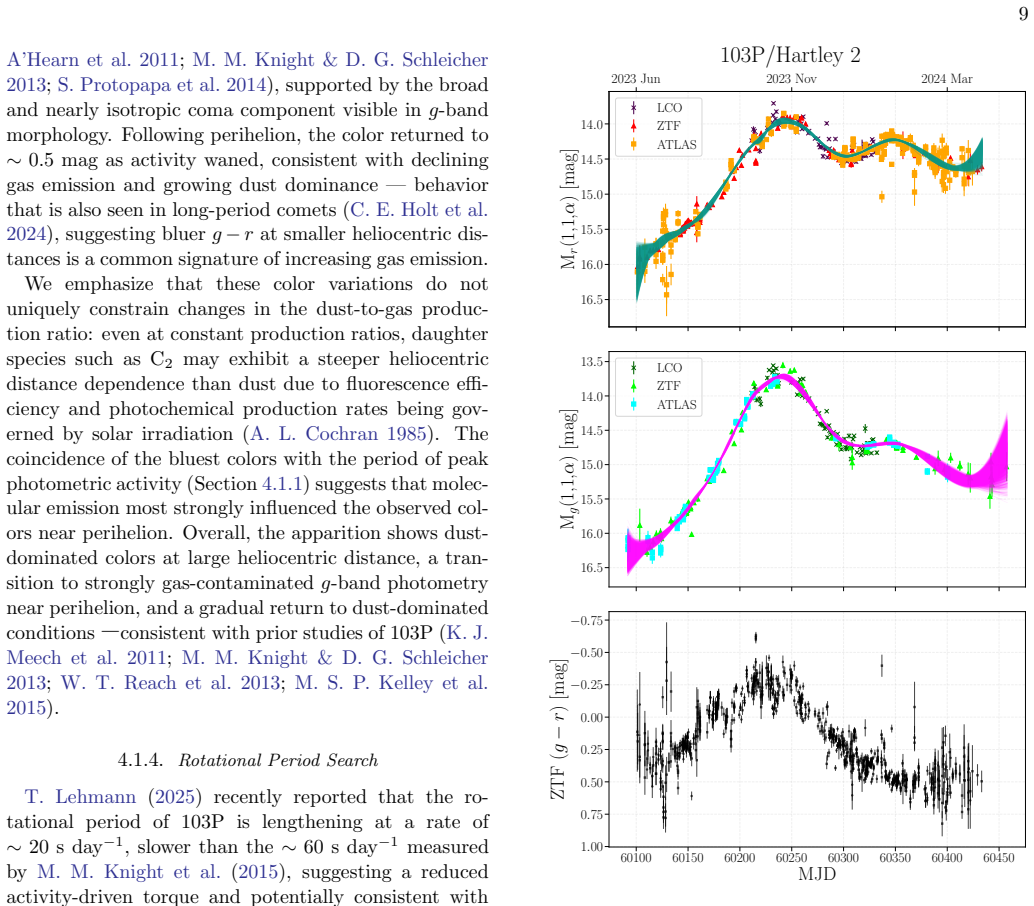
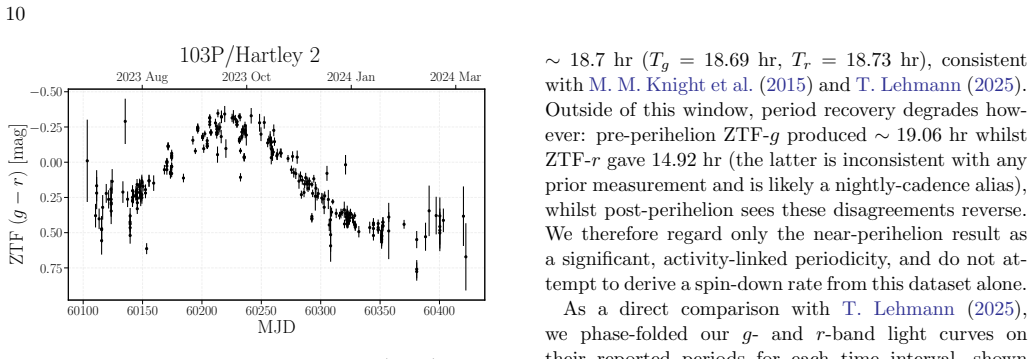
- A blueward color trend appears near perihelion for 103P, consistent with gas contamination in the g-band.
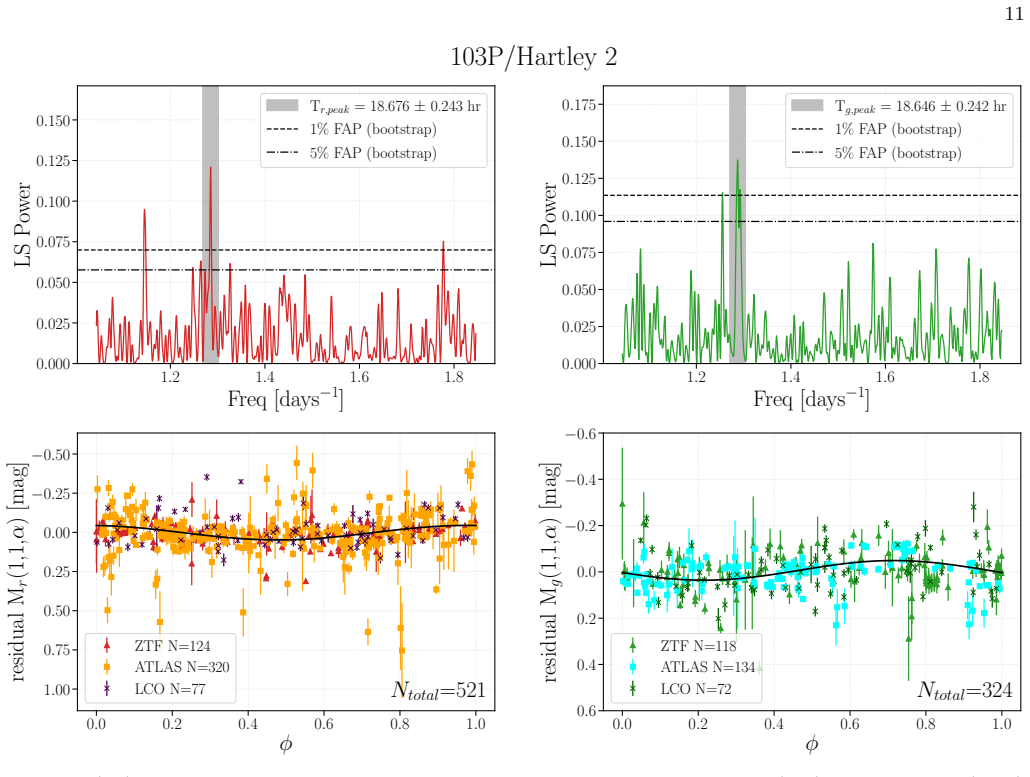
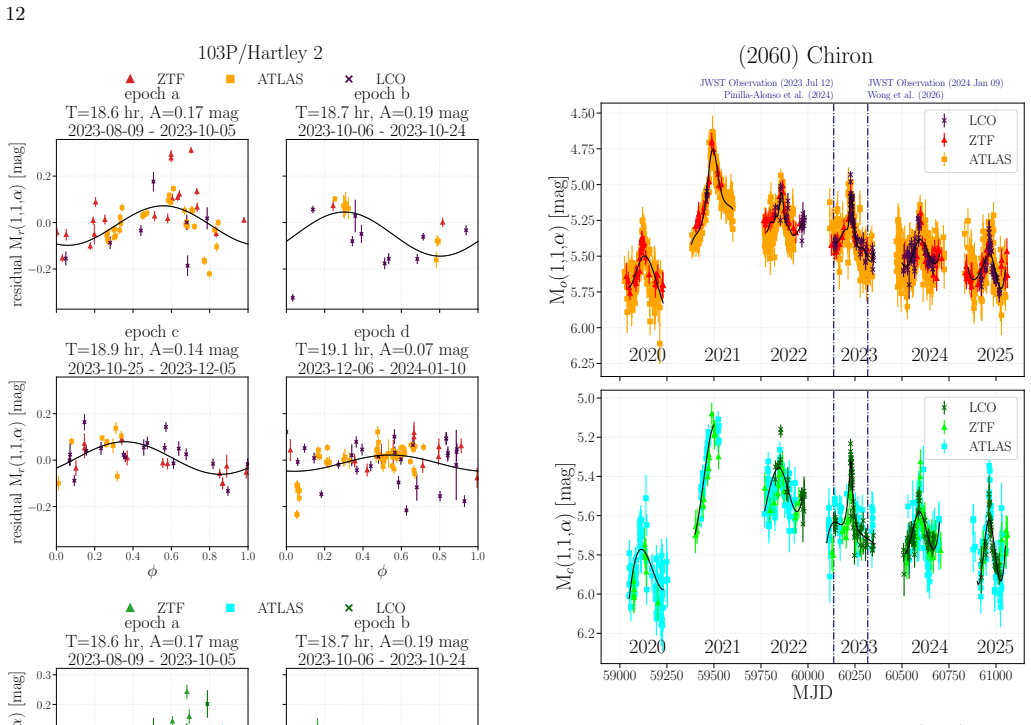
- A ~18.7 hour period is recovered in 103P data near perihelion and linked to activity.
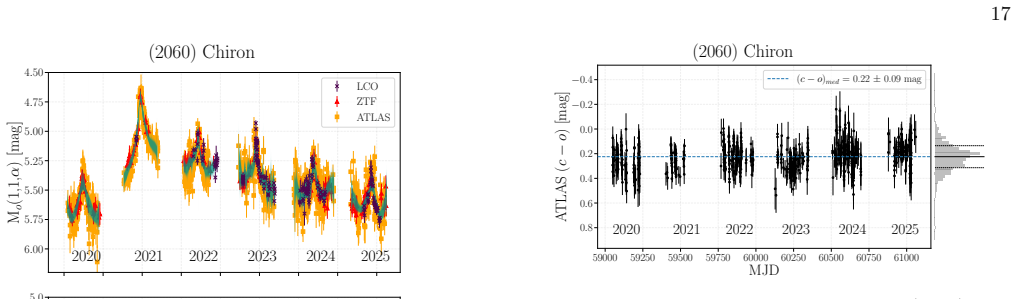
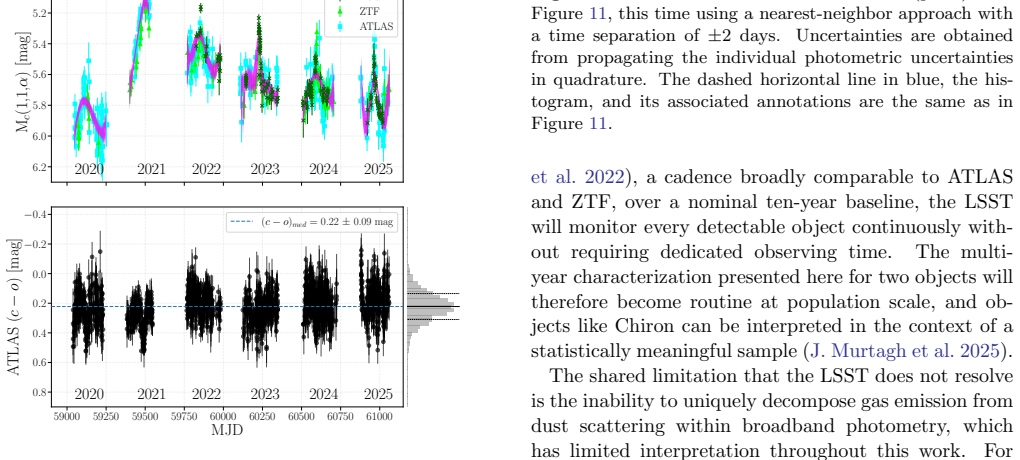
- Chiron's broad-band colors stay constant while its phase curve slope decreases toward quiescent values.
- The observations suggest Chiron has entered an epoch of persistent low-level activity after the outburst.
Where Pith is reading between the lines
- The inbound-outbound asymmetry could arise from seasonal illumination of different surface regions or changing dust-to-gas ratios.
- The measured decay timescale offers a way to estimate the size of the volatile reservoir driving the outburst.
- Objects like Chiron may commonly transition into sustained low-level activity after large outbursts, affecting population statistics.
- Longer baselines from future wide-field surveys would test whether these patterns hold across multiple apparitions.
Load-bearing premise
A single fixed set of grain properties converts observed brightness into dust mass-loss rates, and the chosen quiescent baseline accurately represents Chiron's non-outburst state across multiple years.
What would settle it
New photometry showing symmetric activity slopes for 103P around perihelion or Chiron brightness deviating from the fitted 1.4-year exponential decay after 2025.
Figures
read the original abstract
Comets and Centaurs trace the evolution of trans-Neptunian objects (TNOs) into the inner solar system. Their activity reflects the interplay between volatile sublimation, dust dynamics, and ring scattering. Yet the long-term behavior of individual objects is less constrained. To probe this evolutionary transition, we use wide-field survey photometry from the Asteroid Terrestrial-impact Last Alert System, Zwicky Transient Facility, and Las Cumbres Observatory observations of the Jupiter-family comet (JFC) 103P/Hartley 2 during its 2023/24 apparition, and the Centaur (2060) Chiron across 2020-2025, including its 2021 outburst. For 103P, heliocentric activity slopes are asymmetric about perihelion, with a steep inbound index ($n_{r,\rm pre}=-3.48\pm0.08$) and flatter outbound value ($n_{r,\rm post}=-1.16\pm0.04$), consistent with enhanced relative dust contribution post-perihelion. Reduced brightness versus prior apparitions matches reported secular fading trends. Dust mass-loss rates are $\sim4$-16 kg s$^{-1}$ for assumed grain properties. Colors exhibit a blueward trend near perihelion, consistent with enhanced gas contamination of the $g$-band, with possible phase-dependent scattering. A periodogram recovers a $\sim18.7$ hr activity-linked period near perihelion. For Chiron, subtracting a quiescent baseline reveals exponential decay from the 2021 outburst on a $\sim1.4$ yr timescale. Seasonal phase curves flatten from $\beta_o=0.150\pm0.034$ mag deg$^{-1}$ in 2021 to $\lesssim0.09$ mag deg$^{-1}$ by 2023-2025, converging with quiescent behavior. Broad-band colors remain unchanged at ATLAS ($c-o$)=0.22$\pm$0.09 mag. This extended activity suggests a new epoch of persistent, low-level activity and/or evolving ring-scattering. These objects bracket the TNO-to-JFC evolutionary sequence, with 103P near the volatile-depleted end, and Chiron still volatile-rich and capable of episodic activity.
Editorial analysis
A structured set of objections, weighed in public.
Referee Report
Summary. The manuscript reports multi-year ground-based photometry of Jupiter-family comet 103P/Hartley 2 during its 2023/24 apparition and Centaur (2060) Chiron from 2020-2025 using ATLAS, ZTF, and LCO data. Key results include asymmetric heliocentric activity slopes for 103P (n_r,pre = -3.48 ± 0.08 inbound; n_r,post = -1.16 ± 0.04 outbound), interpreted as enhanced post-perihelion dust contribution, dust mass-loss rates of ~4-16 kg s^{-1} under fixed grain assumptions, a blueward color trend near perihelion, and a ~18.7 hr activity-linked period; for Chiron, subtraction of a quiescent baseline reveals exponential decay from the 2021 outburst on a ~1.4 yr timescale, with seasonal phase curves flattening from β_o = 0.150 ± 0.034 mag deg^{-1} (2021) to ≲ 0.09 mag deg^{-1} (2023-2025) and unchanged broadband colors.
Significance. If the photometric measurements and derived timescales hold, the work supplies extended temporal coverage of activity in objects bracketing the TNO-to-JFC evolutionary sequence, yielding specific, falsifiable quantities (asymmetric slopes, outburst decay constant) for comparison against volatile sublimation and dust-dynamics models. The direct reporting of fitted indices with uncertainties and the use of survey photometry for long-baseline monitoring are strengths.
major comments (2)
- [103P dust mass-loss calculation (results section)] The dust mass-loss rates of 4-16 kg s^{-1} for 103P are obtained by converting observed brightness using a single fixed set of grain size, density, and albedo values; no sensitivity tests or alternative grain models are shown, which directly affects the robustness of the claim that the flatter outbound slope indicates enhanced relative dust contribution post-perihelion.
- [Chiron outburst decay analysis (results section)] The ~1.4 yr exponential decay timescale for Chiron is derived after subtracting a chosen quiescent baseline from the 2020-2025 photometry; the manuscript provides no explicit justification, validation across the full interval, or alternative baseline choices, rendering the decay constant sensitive to this step.
Simulated Author's Rebuttal
We thank the referee for their constructive comments, which help improve the clarity and robustness of our analysis. We address each major comment below and will incorporate revisions to strengthen the manuscript.
read point-by-point responses
-
Referee: [103P dust mass-loss calculation (results section)] The dust mass-loss rates of 4-16 kg s^{-1} for 103P are obtained by converting observed brightness using a single fixed set of grain size, density, and albedo values; no sensitivity tests or alternative grain models are shown, which directly affects the robustness of the claim that the flatter outbound slope indicates enhanced relative dust contribution post-perihelion.
Authors: The reported mass-loss rates are derived under fixed grain assumptions, as is standard when direct constraints on grain properties are unavailable from photometry alone. The 4-16 kg s^{-1} range primarily reflects the observed brightness variations across the apparition rather than grain parameter variations. Importantly, the asymmetric heliocentric slopes (n_r,pre = -3.48 ± 0.08; n_r,post = -1.16 ± 0.04) are measured directly from the photometry and are independent of absolute scaling by grain properties; the interpretation of enhanced relative dust contribution post-perihelion follows from this slope difference. To address the concern, we will add a sensitivity analysis in the revised results section, varying grain radius (1-100 μm), density (0.5-2 g cm^{-3}), and albedo (0.04-0.1) within cometary ranges, confirming that the inbound/outbound slope asymmetry and relative dust interpretation remain robust. revision: yes
-
Referee: [Chiron outburst decay analysis (results section)] The ~1.4 yr exponential decay timescale for Chiron is derived after subtracting a chosen quiescent baseline from the 2020-2025 photometry; the manuscript provides no explicit justification, validation across the full interval, or alternative baseline choices, rendering the decay constant sensitive to this step.
Authors: The quiescent baseline was chosen from the 2020 pre-outburst data and the apparent return to similar levels by 2024-2025, consistent with the object's long-term behavior outside outbursts. We agree that explicit justification and validation were not provided. In revision, we will expand the methods and results sections to detail the baseline selection criteria (matching pre- and late-post-outburst photometry within uncertainties), include a validation plot across the full interval, and add a sensitivity test varying the baseline by ±0.2 mag (the observed scatter) to show the decay timescale remains within 1.2-1.6 yr. This will demonstrate robustness while preserving the reported ~1.4 yr value. revision: yes
Circularity Check
No circularity; direct photometric fits to new survey data
full rationale
The paper presents new multi-year photometry from ATLAS, ZTF, and LCO for 103P and Chiron. The reported heliocentric slopes (n_r,pre and n_r,post) and the ~1.4 yr exponential decay timescale are obtained by direct least-squares fitting to the observed brightness measurements after baseline subtraction. Mass-loss rates use explicit external assumptions on grain size/density/albedo rather than any self-referential definition or fitted parameter renamed as a prediction. No equations reduce a claimed result to its own inputs by construction, and no load-bearing self-citations or uniqueness theorems are invoked to justify the central observational claims. The derivation chain is therefore self-contained against the new data.
Axiom & Free-Parameter Ledger
free parameters (1)
- grain size, density, and albedo
axioms (2)
- domain assumption Standard comet photometry reduction and phase-function corrections apply without significant systematic bias from the survey pipelines.
- domain assumption A single quiescent baseline can be subtracted to isolate the 2021 outburst decay for Chiron.
Reference graph
Works this paper leans on
-
[1]
, year = 1951, month = jan, volume =
On the Origin of the Solar System. , year = 1951, month = jan, volume =. doi:10.1073/pnas.37.1.1 , adsurl =
-
[2]
, year = 1949, month = jan, volume =
The origin and evolution of the Solar System. , year = 1949, month = jan, volume =. doi:10.1093/mnras/109.5.600 , adsurl =
-
[3]
The Outer Solar System Origins Survey. I. Design and First-quarter Discoveries. , keywords =. doi:10.3847/0004-6256/152/3/70 , archivePrefix =. 1511.02895 , primaryClass =
work page internal anchor Pith review Pith/arXiv arXiv doi:10.3847/0004-6256/152/3/70
-
[4]
OSSOS. VII. 800+ Trans-Neptunian Objects The Complete Data Release. , keywords =. doi:10.3847/1538-4365/aab77a , archivePrefix =. 1805.11740 , primaryClass =
work page internal anchor Pith review Pith/arXiv arXiv doi:10.3847/1538-4365/aab77a
-
[5]
Pluto and Charon with the Hubble Space Telescope. II. Resolving Changes on Pluto's Surface and a Map for Charon. , keywords =. doi:10.1088/0004-6256/139/3/1128 , adsurl =
-
[6]
, year = 1999, month = mar, volume =
Rotation rates of Kuiper-belt objects from their light curves. , year = 1999, month = mar, volume =. doi:10.1038/18168 , adsurl =
-
[7]
SM165: A large Kuiper belt object with an irregular shape. , keywords =. doi:10.1073/pnas.211147998 , adsurl =
-
[8]
The Solar System Beyond Neptune , year = 2008, editor =
Photometric Lightcurves of Transneptunian Objects and Centaurs: Rotations, Shapes, and Densities. The Solar System Beyond Neptune , year = 2008, editor =
2008
-
[9]
Time-Resolved Photometry of Kuiper Belt Objects: Rotations, Shapes and Phase Functions
Time-resolved Photometry of Kuiper Belt Objects: Rotations, Shapes, and Phase Functions. , keywords =. doi:10.1086/341954 , archivePrefix =. astro-ph/0205392 , primaryClass =
work page internal anchor Pith review Pith/arXiv arXiv doi:10.1086/341954
-
[10]
Short-term rotational variability of eight KBOs from Sierra Nevada Observatory. , keywords =. doi:10.1051/0004-6361:20053572 , adsurl =
-
[11]
The Deep Ecliptic Survey: A Search for Kuiper Belt Objects and Centaurs. I. Description of Methods and Initial Results. , keywords =. doi:10.1086/339481 , adsurl =
-
[12]
The Deep Ecliptic Survey: A Search for Kuiper Belt Objects and Centaurs. II. Dynamical Classification, the Kuiper Belt Plane, and the Core Population. , keywords =. doi:10.1086/427395 , adsurl =
-
[13]
Densities of Solar System Objects from their Rotational Lightcurves
Densities of Solar System Objects from Their Rotational Light Curves. , keywords =. doi:10.1086/511772 , archivePrefix =. astro-ph/0612237 , primaryClass =
work page internal anchor Pith review Pith/arXiv arXiv doi:10.1086/511772
-
[14]
Lightcurves of 20--100 kilometer Kuiper Belt Objects using the Hubble Space Telescope
Light Curves of 20-100 km Kuiper Belt Objects Using the Hubble Space Telescope. , keywords =. doi:10.1086/499228 , archivePrefix =. astro-ph/0510454 , primaryClass =
work page internal anchor Pith review Pith/arXiv arXiv doi:10.1086/499228
-
[15]
2004 EW95: A phyllosilicate bearing carbonaceous asteroid in the Kuiper Belt
2004 EW _ 95 : A Phyllosilicate-bearing Carbonaceous Asteroid in the Kuiper Belt. , keywords =. doi:10.3847/2041-8213/aab3dc , archivePrefix =. 1801.10163 , primaryClass =
work page internal anchor Pith review Pith/arXiv arXiv doi:10.3847/2041-8213/aab3dc 2004
-
[16]
Water Ice in the Kuiper Belt. , keywords =. doi:10.1088/0004-6256/143/6/146 , archivePrefix =. 1204.3638 , primaryClass =
work page internal anchor Pith review Pith/arXiv arXiv doi:10.1088/0004-6256/143/6/146
-
[17]
New insights on ices in Centaur and Transneptunian populations. , keywords =. doi:10.1016/j.icarus.2011.04.019 , adsurl =
-
[18]
LSST: from Science Drivers to Reference Design and Anticipated Data Products
LSST: From Science Drivers to Reference Design and Anticipated Data Products. , keywords =. doi:10.3847/1538-4357/ab042c , archivePrefix =. 0805.2366 , primaryClass =
work page internal anchor Pith review Pith/arXiv arXiv doi:10.3847/1538-4357/ab042c
-
[19]
Albedo maps of Pluto and Charon: Initial mutual event results. , keywords =. doi:10.1016/0019-1035(92)90129-U , adsurl =
-
[20]
Digging Into the Surface of the Icy Dwarf Planet Eris
Digging into the surface of the icy dwarf planet Eris. , keywords =. doi:10.1016/j.icarus.2008.10.016 , archivePrefix =. 0811.0825 , primaryClass =
work page internal anchor Pith review Pith/arXiv arXiv doi:10.1016/j.icarus.2008.10.016 2008
-
[21]
2009 , eprint=
LSST Science Book, Version 2.0 , author=. 2009 , eprint=
2009
-
[22]
The Scattered Disk as the source of the Jupiter Family comets
The Scattered Disk as the Source of the Jupiter Family Comets. , keywords =. doi:10.1086/591839 , archivePrefix =. 0802.3913 , primaryClass =
work page internal anchor Pith review Pith/arXiv arXiv doi:10.1086/591839
-
[23]
29P/Schwassmann-Wachmann 1, A Centaur in the Gateway to the Jupiter-family Comets. , keywords =. doi:10.3847/2041-8213/ab3fb3 , archivePrefix =. 1908.04185 , primaryClass =
-
[24]
Phase Curves of Kuiper Belt Objects, Centaurs, and Jupiter-family Comets from the ATLAS Survey. , keywords =. doi:10.3847/PSJ/acc463 , archivePrefix =. 2303.08643 , primaryClass =
-
[25]
The Trans-Neptunian Solar System , year = 2020, editor =
From Centaurs to Comets - 40 years. The Trans-Neptunian Solar System , year = 2020, editor =. doi:10.1016/B978-0-12-816490-7.00014-X , adsurl =
-
[26]
The Canada-France Ecliptic Plane Survey (CFEPS) - High Latitude Component
The Canada-France Ecliptic Plane Survey (CFEPS) High-latitude Component. , keywords =. doi:10.3847/1538-3881/aa6aa5 , archivePrefix =. 1608.02873 , primaryClass =
work page internal anchor Pith review Pith/arXiv arXiv doi:10.3847/1538-3881/aa6aa5
-
[27]
Schwamb, Megan E. and Brown, Michael E. and Rabinowitz, David L. and Darin Ragozzine. PROPERTIES OF THE DISTANT KUIPER BELT: RESULTS FROM THE PALOMAR DISTANT SOLAR SYSTEM SURVEY. ApJ. 2010. doi:10.1088/0004-637x/720/2/1691
-
[28]
A Carefully Characterized and Tracked Trans-Neptunian Survey: The Size distribution of the Plutinos and the Number of Neptunian Trojans. , keywords =. doi:10.3847/0004-6256/152/5/111 , archivePrefix =. 1411.7953 , primaryClass =
work page internal anchor Pith review Pith/arXiv arXiv doi:10.3847/0004-6256/152/5/111
-
[29]
The Spacewatch Wide-Area Survey for Bright Centaurs and Trans-Neptunian Objects. , keywords =. doi:10.1086/318022 , adsurl =
-
[30]
Earth Moon and Planets , year = 2003, month = jun, volume =
The Caltech Wide Area Sky Survey. Earth Moon and Planets , year = 2003, month = jun, volume =. doi:10.1023/B:MOON.0000031929.19729.a1 , adsurl =
-
[31]
Science , year = 1997, month = jun, volume =
A scattered comet disk and the origin of Jupiter family comets. Science , year = 1997, month = jun, volume =. doi:10.1126/science.276.5319.1670 , adsurl =
-
[32]
Chaotic Diffusion and the Origin of Comets from the 2/3 Resonance in the Kuiper Belt. , keywords =. doi:10.1006/icar.1997.5681 , adsurl =
-
[33]
The Solar System Beyond Neptune , year = 2008, editor =
Nomenclature in the Outer Solar System. The Solar System Beyond Neptune , year = 2008, editor =
2008
-
[34]
, year = 2021, month = sep, volume =
Transneptunian Space. , year = 2021, month = sep, volume =. doi:10.1146/annurev-astro-120920-010005 , adsurl =
-
[35]
Discovery of the candidate Kuiper belt object 1992 QB _ 1. , keywords =. doi:10.1038/362730a0 , adsurl =
-
[36]
The Trans-Neptunian Solar System , year = 2020, editor =
Kuiper belt: formation and evolution. The Trans-Neptunian Solar System , year = 2020, editor =. doi:10.1016/B978-0-12-816490-7.00002-3 , adsurl =
-
[37]
The Warped Plane of the Classical Kuiper Belt
The Warped Plane of the Classical Kuiper Belt. , keywords =. doi:10.1088/0004-6256/136/1/350 , archivePrefix =. 0804.4687 , primaryClass =
work page internal anchor Pith review Pith/arXiv arXiv doi:10.1088/0004-6256/136/1/350
-
[38]
Destruction of Binary Minor Planets During Neptune Scattering
Destruction of Binary Minor Planets During Neptune Scattering. , keywords =. doi:10.1088/2041-8205/722/2/L204 , archivePrefix =. 1009.3495 , primaryClass =
work page internal anchor Pith review Pith/arXiv arXiv doi:10.1088/2041-8205/722/2/l204 2041
-
[39]
On the Size-Dependence of the Inclination Distribution of the Main Kuiper Belt
On the Size Dependence of the Inclination Distribution of the Main Kuiper Belt. , keywords =. doi:10.1086/319420 , archivePrefix =. astro-ph/0011325 , primaryClass =
work page internal anchor Pith review Pith/arXiv arXiv doi:10.1086/319420
-
[40]
The Luminosity Function of the Hot and Cold Kuiper belt Populations
The luminosity function of the hot and cold Kuiper belt populations. , keywords =. doi:10.1016/j.icarus.2010.08.001 , archivePrefix =. 1008.1058 , primaryClass =
work page internal anchor Pith review Pith/arXiv arXiv doi:10.1016/j.icarus.2010.08.001 2010
-
[41]
The Size Distribution of Trans-Neptunian Bodies
The Size Distribution of Trans-Neptunian Bodies. , keywords =. doi:10.1086/422919 , archivePrefix =. astro-ph/0308467 , primaryClass =
work page internal anchor Pith review Pith/arXiv arXiv doi:10.1086/422919
-
[42]
Inclination Mixing in the Classical Kuiper Belt
Inclination Mixing in the Classical Kuiper Belt. , keywords =. doi:10.1088/0004-637X/736/1/11 , archivePrefix =. 1104.4967 , primaryClass =
work page internal anchor Pith review Pith/arXiv arXiv doi:10.1088/0004-637x/736/1/11
-
[43]
Retention of a Primordial Cold Classical Kuiper Belt in an Instability-Driven Model of Solar System Formation. , keywords =. doi:10.1088/0004-637X/738/1/13 , archivePrefix =. 1106.0937 , primaryClass =
work page internal anchor Pith review Pith/arXiv arXiv doi:10.1088/0004-637x/738/1/13
-
[44]
OSSOS Finds an Exponential Cutoff in the Size Distribution of the Cold Classical Kuiper Belt. , keywords =. doi:10.3847/2041-8213/ac2c72 , archivePrefix =. 2107.06120 , primaryClass =
-
[45]
Evidence for two populations of classical transneptunian objects: The strong inclination dependence of classical binaries. , keywords =. doi:10.1016/j.icarus.2007.10.022 , archivePrefix =. 0711.1545 , primaryClass =
work page internal anchor Pith review Pith/arXiv arXiv doi:10.1016/j.icarus.2007.10.022 2007
-
[46]
Trans-Neptunian binaries (2018). The Trans-Neptunian Solar System , year = 2020, editor =. doi:10.1016/B978-0-12-816490-7.00009-6 , adsurl =
-
[47]
The Color Distribution in the Edgeworth-Kuiper Belt
The Color Distribution in the Edgeworth-Kuiper Belt. , keywords =. doi:10.1086/342447 , archivePrefix =. astro-ph/0206468 , primaryClass =
work page internal anchor Pith review Pith/arXiv arXiv doi:10.1086/342447
-
[48]
, year = 2000, month = oct, volume =
Extremely red Kuiper-belt objects in near-circular orbits beyond 40 AU. , year = 2000, month = oct, volume =. doi:10.1038/35039572 , adsurl =
-
[49]
Neptune's Migration into a Stirred-Up Kuiper Belt: A Detailed Comparison of Simulations to Observations. , keywords =. doi:10.1086/452638 , archivePrefix =. astro-ph/0507319 , primaryClass =
work page internal anchor Pith review Pith/arXiv arXiv doi:10.1086/452638
-
[50]
The Evidence for Slow Migration of Neptune from the Inclination Distribution of Kuiper Belt Objects
Evidence for Slow Migration of Neptune from the Inclination Distribution of Kuiper Belt Objects. , keywords =. doi:10.1088/0004-6256/150/3/73 , archivePrefix =. 1504.06021 , primaryClass =
work page internal anchor Pith review Pith/arXiv arXiv doi:10.1088/0004-6256/150/3/73
-
[51]
The Absolute Magnitude Distribution of Kuiper Belt Objects
The Absolute Magnitude Distribution of Kuiper Belt Objects. , keywords =. doi:10.1088/0004-637X/782/2/100 , archivePrefix =. 1401.2157 , primaryClass =
work page internal anchor Pith review Pith/arXiv arXiv doi:10.1088/0004-637x/782/2/100
-
[52]
Col-OSSOS: The Colours of the Outer Solar System Origins Survey
Col-OSSOS: The Colors of the Outer Solar System Origins Survey. , keywords =. doi:10.3847/1538-4365/ab2194 , archivePrefix =. 1809.08501 , primaryClass =
work page internal anchor Pith review Pith/arXiv arXiv doi:10.3847/1538-4365/ab2194
-
[53]
The Hubble Wide Field Camera 3 Test of Surfaces in the Outer Solar System: Spectral Variation on Kuiper Belt Objects. , keywords =. doi:10.1088/0004-637X/804/1/31 , archivePrefix =. 1502.06612 , primaryClass =
work page internal anchor Pith review Pith/arXiv arXiv doi:10.1088/0004-637x/804/1/31
-
[54]
The Bimodal Colors of Centaurs and Small Kuiper Belt Objects
The bimodal colors of Centaurs and small Kuiper belt objects. , keywords =. doi:10.1051/0004-6361/201219057 , archivePrefix =. 1206.3153 , primaryClass =
work page internal anchor Pith review Pith/arXiv arXiv doi:10.1051/0004-6361/201219057
-
[55]
Chaotic Diffusion of Resonant Kuiper Belt Objects
Chaotic Diffusion of Resonant Kuiper Belt Objects. , keywords =. doi:10.1088/0004-6256/138/3/827 , archivePrefix =. 0807.2835 , primaryClass =
work page internal anchor Pith review Pith/arXiv arXiv doi:10.1088/0004-6256/138/3/827
-
[56]
The Compositions of Kuiper Belt Objects
The Compositions of Kuiper Belt Objects. Annual Review of Earth and Planetary Sciences , keywords =. doi:10.1146/annurev-earth-042711-105352 , archivePrefix =. 1112.2764 , primaryClass =
work page internal anchor Pith review Pith/arXiv arXiv doi:10.1146/annurev-earth-042711-105352
-
[57]
Binaries in the Kuiper Belt. The Solar System Beyond Neptune , year = 2008, editor =. doi:10.48550/arXiv.astro-ph/0703134 , adsurl =
work page internal anchor Pith review Pith/arXiv arXiv doi:10.48550/arxiv.astro-ph/0703134 2008
-
[58]
``TNOs are Cool'': A survey of the trans-Neptunian region. XV. Physical characteristics of 23 resonant trans-Neptunian and scattered disk objects. , keywords =. doi:10.1051/0004-6361/201936183 , archivePrefix =. 2002.12712 , primaryClass =
-
[59]
The Color Differences of Kuiper Belt Objects in Resonance with Neptune
The Color Differences of Kuiper Belt Objects in Resonance with Neptune. , keywords =. doi:10.1088/0004-6256/144/6/169 , archivePrefix =. 1210.0537 , primaryClass =
work page internal anchor Pith review Pith/arXiv arXiv doi:10.1088/0004-6256/144/6/169
-
[60]
Geoscience Letters , keywords =
Resonant Kuiper belt objects: a review. Geoscience Letters , keywords =. doi:10.1186/s40562-019-0142-2 , archivePrefix =. 1911.07897 , primaryClass =
-
[61]
Origin of the structure of the Kuiper belt during a dynamical instability in the orbits of Uranus and Neptune. , keywords =. doi:10.1016/j.icarus.2007.11.035 , archivePrefix =. 0712.0553 , primaryClass =
work page internal anchor Pith review Pith/arXiv arXiv doi:10.1016/j.icarus.2007.11.035 2007
-
[62]
The origin of the Kuiper Belt high-inclination population. , keywords =. doi:10.1016/S0019-1035(02)00056-8 , adsurl =
-
[63]
Origin and Evolution of the Cometary Reservoirs. , keywords =. doi:10.1007/s11214-015-0223-2 , adsurl =
-
[64]
Oort Cloud and Scattered Disc formation during a late dynamical instability in the Solar System
Oort cloud and Scattered Disc formation during a late dynamical instability in the Solar System. , keywords =. doi:10.1016/j.icarus.2013.03.012 , archivePrefix =. 1303.3098 , primaryClass =
work page internal anchor Pith review Pith/arXiv arXiv doi:10.1016/j.icarus.2013.03.012 2013
-
[65]
Neptune's Orbital Migration Was Grainy, Not Smooth
Neptune's Orbital Migration Was Grainy, Not Smooth. , keywords =. doi:10.3847/0004-637X/825/2/94 , archivePrefix =. 1602.06988 , primaryClass =
work page internal anchor Pith review Pith/arXiv arXiv doi:10.3847/0004-637x/825/2/94
-
[66]
174P/Echeclus and its Blue Coma Observed Post-outburst
174P/Echeclus and Its Blue Coma Observed Post-outburst. , keywords =. doi:10.3847/1538-3881/aafbe4 , archivePrefix =. 1811.11220 , primaryClass =
work page internal anchor Pith review Pith/arXiv arXiv doi:10.3847/1538-3881/aafbe4
-
[67]
AAS/Division for Planetary Sciences Meeting Abstracts \#38 , year = 2006, series =
Discovery of Cometary Activity for Centaur 174P/Echeclus (60558). AAS/Division for Planetary Sciences Meeting Abstracts \#38 , year = 2006, series =
2006
-
[68]
Outburst activity in comets - II. A multiband photometric monitoring of comet 29P/Schwassmann-Wachmann 1. , keywords =. doi:10.1111/j.1365-2966.2010.17425.x , archivePrefix =. 1009.2381 , primaryClass =
-
[69]
Centaurs and Scattered Disk Objects in the Thermal Infrared: Analysis of WISE/NEOWISE Observations
Centaurs and Scattered Disk Objects in the Thermal Infrared: Analysis of WISE/NEOWISE Observations. , keywords =. doi:10.1088/0004-637X/773/1/22 , archivePrefix =. 1306.1862 , primaryClass =
work page internal anchor Pith review Pith/arXiv arXiv doi:10.1088/0004-637x/773/1/22
-
[70]
Thermal Properties, Sizes, and Size Distribution of Jupiter-Family Cometary Nuclei
Thermal properties, sizes, and size distribution of Jupiter-family cometary nuclei. , keywords =. doi:10.1016/j.icarus.2013.07.021 , archivePrefix =. 1307.6191 , primaryClass =
work page internal anchor Pith review Pith/arXiv arXiv doi:10.1016/j.icarus.2013.07.021 2013
-
[71]
Resolution of the kuiper belt object color controversy: two distinct color populations. , keywords =. doi:10.1016/S0019-1035(02)00021-0 , adsurl =
-
[72]
Reopening the TNOs Color Controversy: Centaurs Bimodality and TNOs Unimodality
Reopening the TNOs color controversy: Centaurs bimodality and TNOs unimodality. , keywords =. doi:10.1051/0004-6361:20031420 , archivePrefix =. astro-ph/0309428 , primaryClass =
work page internal anchor Pith review Pith/arXiv arXiv doi:10.1051/0004-6361:20031420
-
[73]
The Solar System Beyond Neptune , year = 2008, editor =
Colors of Centaurs. The Solar System Beyond Neptune , year = 2008, editor =
2008
-
[74]
Two Dynamical Classes of Centaurs
Two dynamical classes of Centaurs. , keywords =. doi:10.1016/j.icarus.2009.03.044 , archivePrefix =. 0906.4795 , primaryClass =
work page internal anchor Pith review Pith/arXiv arXiv doi:10.1016/j.icarus.2009.03.044 2009
-
[75]
The origin and distribution of the Centaur population. , keywords =. doi:10.1016/j.icarus.2007.02.012 , adsurl =
-
[76]
The Dynamics of Known Centaurs
The Dynamics of Known Centaurs. , keywords =. doi:10.1086/379554 , archivePrefix =. astro-ph/0211076 , primaryClass =
work page internal anchor Pith review Pith/arXiv arXiv doi:10.1086/379554
-
[77]
Celestial Mechanics and Dynamical Astronomy , keywords =
Centaur and giant planet crossing populations: origin and distribution. Celestial Mechanics and Dynamical Astronomy , keywords =. doi:10.1007/s10569-020-09971-7 , archivePrefix =. 2006.09657 , primaryClass =
-
[78]
A Signature of Planetary Migration: The Origin of Asymmetric Capture in the 2:1 Resonance
A Signature of Planetary Migration: The Origin of Asymmetric Capture in the 2:1 Resonance. , keywords =. doi:10.1086/426425 , archivePrefix =. astro-ph/0410086 , primaryClass =
work page internal anchor Pith review Pith/arXiv arXiv doi:10.1086/426425
-
[79]
Tracking Neptune's Migration History through High-Perihelion Resonant Trans-Neptunian Objects
Tracking Neptune s Migration History through High-perihelion Resonant Trans-Neptunian Objects. , keywords =. doi:10.3847/0004-6256/152/5/133 , archivePrefix =. 1607.01777 , primaryClass =
work page internal anchor Pith review Pith/arXiv arXiv doi:10.3847/0004-6256/152/5/133
-
[80]
Details of Resonant Structures within a Nice Model Kuiper Belt: Predictions for High-perihelion TNO Detections. , keywords =. doi:10.3847/1538-3881/aa8b65 , archivePrefix =. 1709.03699 , primaryClass =
work page internal anchor Pith review Pith/arXiv arXiv doi:10.3847/1538-3881/aa8b65
discussion (0)
Sign in with ORCID, Apple, or X to comment. Anyone can read and Pith papers without signing in.