REVIEW 4 major objections 6 minor 85 references
Electronic properties and topological aspects of graphene nanohelicoids
T0 review · 4 major / 6 minor · reviewed 2026-08-02 · deepseek-v4-flash
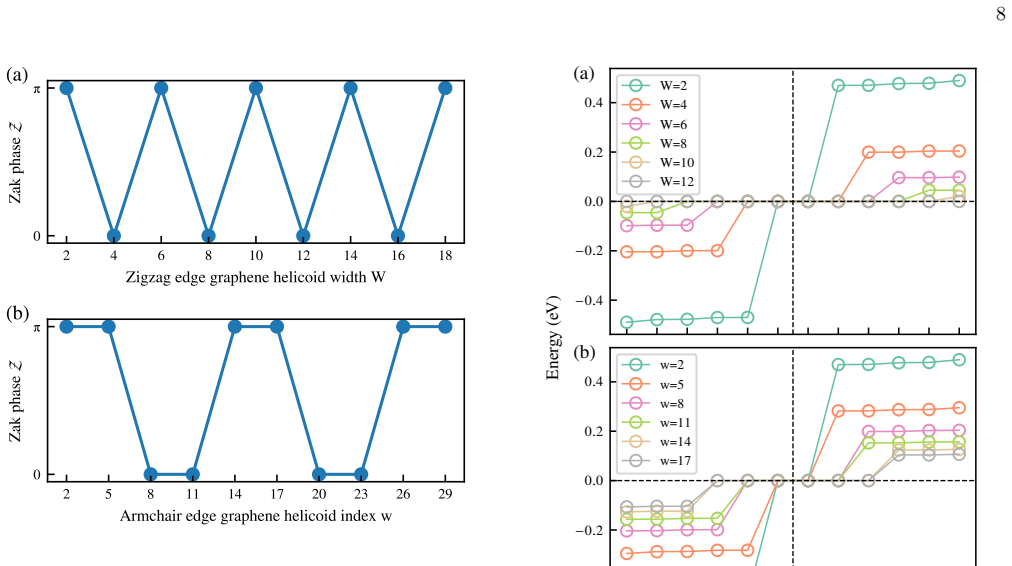
Pith's one-line read Graphene nanohelicoids are effective one-dimensional systems in which the helicoid width W alone determines the Zak phase, alternating between π and 0 as W runs through 4m−2 and 4m.
desk verdict Solid tight-binding analysis of graphene nanohelicoids with a genuinely new anti-chiral effective model, but the headline Zak-phase claim is explicitly tied to a chosen unit cell and is not shown to be a robust physical quantity. read the letter →
The pith
A machine-rendered reading of the paper's core claim, the machinery that carries it, and where it could break.
The reading
What carries the argument
The load-bearing object is the off-diagonal block Q(k) of the chiral-supercell tight-binding Hamiltonian H(k), whose determinant is a self-reciprocal polynomial in z = e^{ik} of degree W: detQ(z) = z^W detQ(1/z). This identity turns the winding-number integral into a count of zeros of detQ(z) inside the unit circle; since roots come in reciprocal pairs, the count is W/2 for even W. The companion device is the 'atomic limit' deformation η that splits hoppings inside each SSH-like chain; the paper argues that detQ(z, η) retains only real roots and avoids z = −1 for even W, so the gapped systems at η = 1 and η ≠ 1 are adiabatically connected and the diagrammatic half-charge counting in the atom
What would settle it
A single calculation settles it: for one fixed physical helicoid, compute the Zak phase and boundary-mode count in the paper's triangular-sector unit cell and in the π/6-rotated cell it describes; if the rotated cell yields ν'=0 and no boundary states while the atomistic structure is unchanged, then the width-driven topological alternation is an artifact of cell choice rather than a property of the helicoid.
Extended reading notes
Core claim
On the paper's own terms, the central discovery is that the effective 1D tight-binding model of a zigzag-edge graphene nanohelicoid has an anti-chiral (momentum-shifted) particle-hole symmetry, E_v(k) = −E_c(k+π), and its topological invariant is fixed by width alone: for even W the winding number is ν = W/2, so the Zak phase Z = π(W/2 mod 2) equals π for W = 4m−2 and 0 for W = 4m, with W/2 boundary modes per open boundary. The same machinery for armchair edges gives a gap only for type-II junctions, with winding number ⌊(w_II+4)/6⌋, while odd widths are gapless because one band cannot be paired under the momentum-shifted symmetry. The mechanism is traced analytically: detQ(z) is a self-reci
Load-bearing premise
The premise that carries the argument is that the particular unit-cell convention chosen for the chiral model faithfully represents the physical helicoid's polarization — the paper itself concedes that a π/6-rotated cell gives no boundary modes — together with the unproved claim that all roots of detQ(z, η) are real, which the adiabatic connection requires.
Editorial extensions
If this is right
- For zigzag-edge nanohelicoids, width W = 4m−2 carries a nontrivial Zak phase and exactly W/2 boundary states per edge; W = 4m is trivial with none — the bulk polarization alone changes when two carbon rows are added.
- Odd-width helicoids are gapless: the anti-chiral relation E_v(k) = −E_c(k+π) forces an unpaired band through the Fermi level, so every odd W is metallic.
- Armchair helicoids are semiconducting only for type-II junctions, with ⌊(w_II+4)/6⌋ boundary states; type-I and type-III remain gapless regardless of size.
- The gap of zigzag helicoids decays exponentially in W because of edge-state hybridization, while armchair helicoids show a 1/W Dirac-confinement gap; both scalings are quantitative predictions for spectroscopy.
- Boundary-state LDOS is predicted to localize on alternating atoms near the outer edge, forming one mode per two coupled SSH chains — a concrete signature for scanning tunneling microscopy.
Reading between the lines
- Inference: because the Zak phase and boundary-mode count depend on the unit-cell convention (the paper itself notes a π/6-rotated cell yields ν'=0), a physical helicoid's canonical unit cell must be justified by edge termination; experiments should compare predicted 'every-other-atom' localization with measured LDOS rather than rely on ν alone.
- Inference: the anti-chiral relation E(k) = −E(k+π) is a spectral fingerprint of screw/helical symmetry; analogous helicoidal embeddings of other bipartite lattices should show the same momentum-shifted particle-hole constraint.
- Inference: if the width-controlled polarization survives in transport, a junction between two widths should host domain-wall states, and the helicoid could act as a geometrically switchable polarization element alternating between e/2 and 0 charge-center displacement with two added rows.
Signed reviews
Editorial analysis
A structured set of objections, weighed in public.
Referee Report
Summary. The paper introduces graphene nanohelicoids (GNHs) as helicoidal analogues of graphene nanoribbons, constructs effective one-dimensional tight-binding models for zigzag- and armchair-edge geometries, and identifies a momentum-shifted spectral relation E_v(k) = -E_c(k+π) attributed to an anti-chiral (anti-bipartite) symmetry. The main topological claim is developed in Sec. IV: for the zigzag-edge GNH, an auxiliary chiral model obtained from a doubled triangular-sector unit cell has winding number ν = W/2 for even width W, leading to a Zak phase Z = π(W/2 mod 2) that alternates between π and 0, and to W/2 boundary states per boundary. The paper also reports exponential and power-law gap scaling for zigzag and armchair edges, respectively, and an armchair winding-number formula ν = floor((w_II+4)/6). An appendix derives self-reciprocal polynomial structure for det Q(z) and uses an adiabatic deformation to connect the system to an atomic limit.
Significance. If the central topological statement were fully established, the paper would be a valuable contribution: it extends graphene-nanoribbon topology to a curved, helicoidal geometry and proposes width as a geometric switch of bulk polarization. The analytic treatment is an asset: the construction of the Bloch Hamiltonian, the determinant-based winding-number calculation, and the recursive self-reciprocity proof in the Appendix are detailed and go beyond a purely numerical study. The paper also gives concrete, falsifiable predictions for band-gap scaling and boundary-state counts. However, the significance is currently contingent on resolving two load-bearing gaps: the computed winding number and Zak phase are not shown to be independent of the unit-cell convention (and the paper explicitly states that a rotated unit cell gives ν' = 0), and the root-reality assumption used for the adiabatic deformation is asserted rather than proved. These issues must be addressed before the main claim can be accepted as a property of the nanohelicoid itself rather than of a particular construction.
major comments (4)
- [Sec. IV, Eqs. (12)–(17); final paragraph of Sec. IV] The central result ν = W/2 and the alternating Zak phase in Eq. (17) are computed for the chiral model (4), which is a doubled supercell of the physical anti-chiral Hamiltonian (1). The final paragraph explicitly states that a π/6-rotated unit cell gives ν' = 0 and no boundary modes, attributing the result to 'this particular definition of the unit cell.' If the rotated cell is merely a different representation of the same infinite lattice, a genuine bulk invariant should not change; if it is a different physical termination, then the conclusion must be qualified as termination-dependent rather than a width-only switch of bulk polarization. In either case, the manuscript does not establish that W alone controls the bulk invariant of the GNH. Please compute the invariant directly from the original anti-chiral Hamiltonian or otherwise specify and justify the physical termination for which
- [Appendix, after Eq. (A21)] The proof of the adiabatic connection relies on the unproved assertion 'By construction ... all roots of det Q(z,η) are real' and on p_{2k}^{ (n) }(-1,η) ≠ 0 for all η ∈ R_+. The recurrences (A13)–(A14) and (A19)–(A20) do not by themselves imply real roots; self-reciprocity alone is insufficient. This assumption is load-bearing: if a zero crosses the unit circle during the deformation from η = 1 to the atomic limit, the winding number could change and the atomic-limit counting would not justify Eq. (17). A rigorous proof of the root-reality and nonzero-value assertions, or an explicit counterexample, is needed.
- [Sec. IV, Eqs. (4)–(12)] The topological index is defined through the chiral off-diagonal form H_k = [[0, Q†(k)], [Q(k), 0]] of the auxiliary model. The physical Hamiltonian (1) is anti-chiral, with the shifted relation E_v(k) = -E_c(k+π), and does not have this off-diagonal chiral grading. The manuscript does not prove that the winding number of the chiral supercell is equal to any invariant of the original anti-chiral Hamiltonian, nor does it map the computed boundary states back to the physical GNH. Without this connection, the Zak phase and boundary-state count are properties of the constructed supercell, not necessarily of the nanohelicoid.
- [Sec. IV, Eq. (19)] The armchair winding-number formula ν = floor((w_II+4)/6) is stated without derivation or proof. Given that the rest of the paper presents analytic derivations, this formula and the associated boundary-state sequence should either be derived explicitly or clearly labeled as a numerical conjecture. As written, the armchair part of the topological claim is unsupported.
minor comments (6)
- [Sec. II] Typo: 'nonsymmophic' should be 'nonsymmorphic' in the sentence describing the unit cell.
- [Sec. II, Eq. (1)] The notation 'on l 2(Z)' is unclear; presumably 'on ℓ²(Z)' is intended. Also the label {A_{m,l}, B_{m,l}} is not defined precisely before Eq. (1); a short definition would help.
- [Sec. II, Fig. 3] The band-structure panels for (8,1) and (9,1) show even/odd behavior, but the two lower panels (20,1) and (21,1) use a different energy scale. Please state clearly that the upper and lower rows have different vertical scales, or use the same scale for comparability.
- [Sec. II, Eq. (2) and Fig. 5] The armchair index w and its relation to the real-space width in Fig. 7 (where W = (w_II/2 + 1)a) should be defined in the main text, not only in the figure caption.
- [Sec. III] The effective SSH-type Hamiltonian H(k) = (t1+t2)cos k σ0 + (t1-t2)cos k σz + t' σx is introduced after the LDOS discussion, but its relation to the full GNH Hamiltonian is not derived or justified quantitatively. A reference to a derivation or a figure showing the correspondence would strengthen the presentation.
- [Appendix, Eq. (A15)] The proportionality in Eq. (A15) is asserted but not demonstrated. Since it is used in the recurrence derivation, a short explanation of why the combination is a multiple of p_k(z) would improve readability.
Circularity Check
Alternating Zak phase and W/2 boundary states are tied to the chosen unit cell (paper's own Sec. IV admission); the analytic derivation is genuine, but the topological claim is not established as an invariant of the physical nanohelicoid.
-
self definitional
[Sec. IV, Eqs. (4), (12)-(17); final paragraph of Sec. IV]
"Note that, the existence and such localization of the boundary modes is attributed to this particular definition of the unit cell. ... When S_A and S_B belong to the boundary of the unit cell, we obtain the winding number ν of the system as the number of elements in those sets or ν=♯S_A=♯S_B. With the redefinition of the unit cell ... ν′=♯S′_A=♯S′_B≤ν. For example, if one redefines the unit cell as a relative π/6-rotation compared to the unit cells defined in Fig. 1(c) and (d), the sets of atoms S_A and S_B are always in the bulk of the new unit cell for all system sizes, which results in ν′=0"
The central prediction — W/2 boundary states per boundary and the alternating Zak phase Z=π(W/2 mod 2) (Eqs. 16-17) — is computed for the auxiliary chiral model of Eq. (4), a doubled supercell whose chosen unit-cell boundary cuts exactly W/2 A-B pairs. The winding number counts ♯S_A=♯S_B=W/2 by construction; the self-reciprocal-polynomial argument fixes ν only as half the degree of det Q of that specific model. The paper explicitly concedes that a π/6-rotated unit cell gives ν′=0 and no boundary modes, so the 'width-controlled switching of bulk polarization' is a property of the chosen representation, not an invariant derived from the physical anti-chiral GNH Hamiltonian of Eq. (1).
-
other
[Appendix (last paragraph)]
"By construction of the polynomials p^(n)_k(z,η), we obtain that all roots of detQ(z,η) are real and p^(n)_{2k}(−1,η)≠0 for every k∈N and η∈R^+. ... Consequently, the topological invariant of these systems are the same and the atomic limit, considered in the Sec. IV, is valid."
The adiabatic connection from the actual zigzag model (η=1) to the atomic-limit counting used to establish boundary-mode count and polarization requires that no zero of det Q crosses the unit circle during the deformation. Both key premises — all roots real, and z=−1 never a root for even W along the path — are asserted 'by construction' without proof. This unproved assertion is load-bearing: if a pair of zeros left the real axis and crossed |z|=1, ν would change along the deformation and the atomic-limit result would not describe the η=1 system. This is an omitted proof rather than an identity reduction, but it closes the derivation chain on an assumption.
full rationale
The paper's band-structure content is substantial and independent: the anti-chiral spectral relation E_v(k)=−E_c(k+π) is derived from the explicitly written physical Hamiltonian (Eq. 1); the even/odd width gap parity follows from the anti-bipartite site count; the exponential gap decay (Fig. 7) is a fitted empirical trend; and the Appendix's telescoping determinant proof of self-reciprocality of det Q is genuine algebra. There is no load-bearing self-citation: the cited external results (Zak phase, SSH model, nonsymmorphic-symmetry theory, tenfold-way classification) are standard and the topological model is derived in the paper itself. However, the headline topological claim is a different matter. The winding number ν=W/2 is computed for a chiral auxiliary model constructed from the anti-chiral model by a specific doubling and unit-cell cut; the self-reciprocal determinant then gives ν as half the degree of that constructed Q-matrix, and the paper's own final paragraph equates ν with the number of atom pairs lying on the chosen unit-cell boundary. The same paragraph admits that a π/6-rotated unit cell yields ν′=0, making the 'prediction' of W/2 boundary states and the alternating Zak phase contingent on the representation chosen by the authors. Since the physical GNH Hamiltonian is anti-chiral (not chiral), no argument is given that the auxiliary chiral winding number equals a convention-independent property of the physical system; the finite-chain termination that realizes W/2 boundary modes is itself the termination of the constructed model. Thus the central result is partially circular: genuinely derived algebraically, but reduced by construction to the unit-cell/bookkeeping convention, with the paper's admission providing the explicit evidence. A secondary gap is the unproved 'all roots are real' assertion used to ensure the invariant is constant along the adiabatic deformation to the atomic limit. Overall: partial circularity, score 6.
Assumptions & free parameters
free parameters (2)
- k1 (exponential gap-decay constant, zigzag) =
not stated
- k2 (power-law gap prefactor, armchair) =
not stated
assumptions (6)
- domain assumption Nearest-neighbor tight-binding with a single uniform hopping t for all C–C bonds.
- ad hoc to paper The effective 1D unit cell built from one triangular sector faithfully encodes the nonsymmorphic symmetry of the 3D helicoid.
- domain assumption The anti-chiral relation E_v(k) = −E_c(k+π) holds for the nearest-neighbor model and forces gaplessness for odd-width cells.
- standard math The auxiliary doubled chiral Hamiltonian belongs to the BDI class and its winding number is a valid topological invariant.
- ad hoc to paper All roots of detQ(z,η) are real for η ∈ R₊ and p_{2k}(−1,η) ≠ 0 for even widths.
- standard math Bulk-boundary correspondence applies to the finite chain cut from the chiral supercell.
invented entities (2)
-
Graphene nanohelicoid (GNH) structure
-
Anti-chiral (anti-bipartite) symmetry
Cite this review
Pith. "Pith review of Electronic properties and topological aspects of graphene nanohelicoids." pith.science (2026). https://pith.science/paper/4L2TPWS3
@misc{pith2026260713294,
  author       = {Pith},
  title        = {Pith review of: Electronic properties and topological aspects of graphene nanohelicoids},
  year         = {2026},
  howpublished = {\url{https://pith.science/paper/4L2TPWS3}},
  note         = {Machine review of arXiv:2607.13294}
}
abstract
We introduce graphene nanohelicoids, geometric analogues of graphene nanoribbons, in which the honeycomb lattice is embedded on a helicoidal surface. Starting from the three-dimensional helical structure, we construct effective one-dimensional lattice models with band structures characterized by a momentum-shifted particle-hole relation $E_v(k)=-E_c(k+\pi)$ that reflects an anti-chiral symmetry arising from the nonsymmorphic symmetry. A systematic investigation of graphene nanohelicoids using the tight-binding approximation reveals a number of trends upon varying width and edge orientation, for instance, alternating transitions between semiconducting and metallic regimes. As the structure width varies, the band gap periodically closes and reopens, accompanied by an alternating Zak phase that switches between trivial and nontrivial. We derive an analytic tight-binding model and introduce a continuous deformation of the graphene nanohelicoids that explains the origin of width-dependent band inversion and alternating Zak phase.
Figures


Figures from the paper (6 more)



Reference graph
Works this paper leans on
-
[1]
Fujita, K
M. Fujita, K. Wakabayashi, K. Nakada, and K. Kusak- abe, Peculiar localized state at zigzag graphite edge, J. Phys. Soc. Jpn.65, 1920 (1996). 13
1920
-
[2]
Nakada, M
K. Nakada, M. Fujita, G. Dresselhaus, and M. S. Dressel- haus, Edge state in graphene ribbons: Nanometer size ef- fect and edge shape dependence, Phys. Rev. B54, 17954 (1996)
1996
-
[3]
Y.-W. Son, M. L. Cohen, and S. G. Louie, Energy gaps in graphene nanoribbons, Phys. Rev. Lett.97, 216803 (2006)
2006
-
[4]
Barone, O
V. Barone, O. Hod, and G. E. Scuseria, Electronic struc- ture and stability of semiconducting graphene nanorib- bons, Nano Lett.6, 2748 (2006)
2006
-
[5]
J. Cai, P. Ruffieux, R. Jaafar, M. Bieri, T. Braun, S. Blankenburg, M. Muoth, A. P. Seitsonen, M. Saleh, X. Feng, K. Mullen, and R. Fasel, Atomically precise bottom-up fabrication of graphene nanoribbons, Nature 466, 470 (2010)
2010
-
[6]
C. Tao, L. Jiao, O. V. Yazyev, Y.-C. Chen, J. Feng, X. Zhang, R. B. Capaz, J. M. Tour, A. Zettl, S. G. Louie, H. Dai, and M. F. Crommie, Spatially resolving edge states of chiral graphene nanoribbons, Nat. Phys.7, 616 (2011)
2011
-
[7]
H. Wang, H. S. Wang, C. Ma, L. Chen, C. Jiang, C. Chen, X. Xie, A.-P. Li, and X. Wang, Graphene nanoribbons for quantum electronics, Nat. Rev. Phys.3, 791 (2021)
2021
-
[8]
Zhang, B
J. Zhang, B. Ghawri, D. Dutta, R. Fasel, M. Calame, G. Borin Barin, and M. L. Perrin, Bottom–up- synthesized graphene nanoribbons for nanoelectronics, Nat. Rev. Mat.11, 194 (2026)
2026
Show all 85 references
-
[9]
D. J. Klein and L. Bytautas, Graphitic edges and un- paired pi-electron spins, J. Phys. Chem. A103, 5196 (1999)
1999
-
[10]
Ryu and Y
S. Ryu and Y. Hatsugai, Topological origin of zero-energy edge states in particle-hole symmetric systems, Phys. Rev. Lett.89, 077002 (2002)
2002
-
[11]
Wassmann, A
T. Wassmann, A. P. Seitsonen, A. M. Saitta, M. Lazzeri, and F. Mauri, Structure, stability, edge states, and aro- maticity of graphene ribbons, Phys. Rev. Lett.101, 096402 (2008)
2008
-
[12]
T. Cao, F. Zhao, and S. G. Louie, Topological phases in graphene nanoribbons: Junction states, spin centers, and quantum spin chains, Phys. Rev. Lett.119, 076401 (2017)
2017
-
[13]
A. R. Akhmerov and C. W. J. Beenakker, Boundary con- ditions for dirac fermions on a terminated honeycomb lattice, Phys. Rev. B77, 085423 (2008)
2008
-
[14]
Delplace, D
P. Delplace, D. Ullmo, and G. Montambaux, Zak phase and the existence of edge states in graphene, Physical Review B84, 195452 (2011)
2011
-
[15]
R. S. K. Mong and V. Shivamoggi, Edge states and the bulk-boundary correspondence in dirac hamiltonians, Phys. Rev. B83, 125109 (2011)
2011
-
[16]
O. V. Yazyev, R. B. Capaz, and S. G. Louie, Theory of magnetic edge states in chiral graphene nanoribbons, Phys. Rev. B84, 115406 (2011)
2011
-
[17]
D. J. Rizzo, G. Veber, T. Cao, C. Bronner, T. Chen, F. Zhao, H. Rodriguez, S. G. Louie, M. F. Crommie, and F. R. Fischer, Topological band engineering of graphene nanoribbons, Nature560, 204 (2018)
2018
-
[18]
M. J. J. Mangnus, F. R. Fischer, M. F. Crommie, I. Swart, and P. H. Jacobse, Charge transport in topolog- ical graphene nanoribbons and nanoribbon heterostruc- tures, Phys. Rev. B105, 115424 (2022)
2022
-
[19]
Sakaguchi, T
H. Sakaguchi, T. Kojima, Y. Cheng, S. Nobusue, and K. Fukami, Electrochemical on-surface synthesis of a strong electron-donating graphene nanoribbon catalyst, Nat. Commun.15, 5972 (2024)
2024
-
[20]
O. V. Yazyev, A guide to the design of electronic proper- ties of graphene nanoribbons, Acc. Chem. Res.46, 2319 (2013)
2013
-
[21]
Nakabayashi, D
J. Nakabayashi, D. Yamamoto, and S. Kurihara, Band- selective filter in a zigzag graphene nanoribbon, Phys. Rev. Lett.102, 066803 (2009)
2009
-
[22]
J. A. Verges, G. Chiappe, E. San-Fabian, and E. Louis, Conductance through the armchair graphene nanorib- bons 9-agnr: Strong dependence on contact to leads, Phys. Rev. B98, 155415 (2018)
2018
-
[23]
D. J. Rizzo, G. Veber, J. Jiang, R. McCurdy, T. Cao, C. Bronner, T. Chen, S. G. Louie, F. R. Fischer, and M. F. Crommie, Inducing metallicity in graphene nanoribbons via zero-mode superlattices, Science369, 1597 (2020)
2020
-
[24]
ˇCer¸ neviˇ cs, O
K. ˇCer¸ neviˇ cs, O. V. Yazyev, and M. Pizzochero, Elec- tronic transport across quantum dots in graphene nanoribbons: Toward built-in gap-tunable metal- semiconductor-metal heterojunctions, Phys. Rev. B102, 201406 (2020)
2020
-
[25]
V.-T. Tran, R. D’Agosta, and S. Volz, Tuning the par- ity selective transport effect in zigzag graphene ribbons, Phys. Rev. B110, L161410 (2024)
2024
-
[26]
ˇCer¸ neviˇ cs and O
K. ˇCer¸ neviˇ cs and O. V. Yazyev, Design rules for inter- connects based on graphene nanoribbon junctions (2024), arXiv:2402.17186 [cond-mat.mes-hall]
2024 arXiv
-
[27]
Leuenberger, K
J. Leuenberger, K. ˇCer¸ neviˇ cs, and O. V. Yazyev, Charge carrier flow through trimmed graphene nanoribbon junc- tions (2026), arXiv:2607.08471 [cond-mat.mes-hall]
2026 arXiv
-
[28]
Okada and A
S. Okada and A. Oshiyama, Magnetic ordering in hexag- onally bonded sheets with first-row elements, Phys. Rev. Lett.87, 146803 (2001)
2001
-
[29]
Y.-W. Son, M. L. Cohen, and S. G. Louie, Half-metallic graphene nanoribbons, Nature444, 347 (2006)
2006
-
[30]
Pisani, J
L. Pisani, J. A. Chan, B. Montanari, and N. M. Harrison, Electronic structure and magnetic properties of graphitic ribbons, Phys. Rev. B75, 064418 (2007)
2007
-
[31]
O. V. Yazyev and M. I. Katsnelson, Magnetic correlations at graphene edges: Basis for novel spintronics devices, Phys. Rev. Lett.100, 047209 (2008)
2008
-
[32]
Zhang, F
W. Zhang, F. Hajiheidari, and R. Mazzarello, Chiral magnetic interactions in graphene nanoribbons on topo- logical insulator substrates, Phys. Rev. B96, 245413 (2017)
2017
-
[33]
Slota, A
M. Slota, A. Keerthi, W. K. Myers, E. Tretyakov, M. Baumgarten, A. Ardavan, H. Sadeghi, C. J. Lambert, A. Narita, K. Muellen, and L. Bogani, Magnetic edge states and coherent manipulation of graphene nanorib- bons, Nature557, 691 (2018)
2018
-
[34]
Luo, Topological edge states of a graphene zigzag nanoribbon with spontaneous edge magnetism, Phys
M. Luo, Topological edge states of a graphene zigzag nanoribbon with spontaneous edge magnetism, Phys. Rev. B102, 075421 (2020)
2020
-
[35]
R. Ma, N. V. Tepliakov, A. A. Mostofi, and M. Piz- zochero, Electrically tunable ultraflat bands andπ- electron magnetism in graphene nanoribbons, The Jour- nal of Physical Chemistry Letters16, 1680 (2025)
2025
-
[36]
S. Song, Y. Teng, W. Tang, Z. Xu, Y. He, J. Ruan, T. Ko- jima, W. Hu, F. J. Giessibl, H. Sakaguchi, S. G. Louie, and J. Lu, Janus graphene nanoribbons with localized states on a single zigzag edge, Nature637, 580 (2025)
2025
-
[37]
O. V. Yazyev and S. G. Louie, Topological defects in graphene: Dislocations and grain boundaries, Physical Review B81, 195420 (2010). 14
2010
-
[38]
Liu and B
Y. Liu and B. I. Yakobson, Cones, pringles, and grain boundary landscapes in graphene topology, Nano Lett. 10, 2178 (2010)
2010
-
[39]
Banhart, J
F. Banhart, J. Kotakoski, and A. V. Krasheninnikov, Structural defects in graphene, ACS Nano5, 26 (2011)
2011
-
[40]
B. Butz, C. Dolle, F. Niekiel, K. Weber, D. Waldmann, H. B. Weber, B. Meyer, and E. Spiecker, Dislocations in bilayer graphene, Nature505, 533 (2014)
2014
-
[41]
S. Dai, Y. Xiang, and D. J. Srolovitz, Structure and ener- getics of interlayer dislocations in bilayer graphene, Phys- ical Review B93, 085410 (2016)
2016
-
[42]
Z.-K. Lin, Q. Wang, Y. Liu, H. Xue, B. Zhang, Y. Chong, and J.-H. Jiang, Topological phenomena at defects in acoustic, photonic and solid-state lattices, Nature Re- views Physics5, 483 (2023)
2023
-
[43]
Malola, H
S. Malola, H. H¨ akkinen, and P. Koskinen, Structural, chemical, and dynamical trends in graphene grain bound- aries, Phys. Rev. B81, 165447 (2010)
2010
-
[44]
J. S. Alden, A. W. Tsen, P. Y. Huang, R. Hov- den, L. Brown, J. Park, D. A. Muller, and P. L. McEuen, Strain solitons and topological defects in bi- layer graphene, Proceedings of the National Academy of Sciences110, 11256 (2013)
2013
-
[45]
D. E. Parker, T. Soejima, J. Hauschild, M. P. Zaletel, and N. Bultinck, Strain-induced quantum phase transitions in magic-angle graphene, Phys. Rev. Lett.127, 027601 (2021)
2021
-
[46]
A. H. Castro Neto, F. Guinea, N. M. R. Peres, K. S. Novoselov, and A. K. Geim, The electronic properties of graphene, Reviews of Modern Physics81, 109 (2009)
2009
-
[47]
Artyukhin, K
S. Artyukhin, K. T. Delaney, N. A. Spaldin, and M. Mostovoy, Landau theory of topological defects in multiferroic hexagonal manganites, Nature Materials13, 42 (2014)
2014
-
[48]
G. R. Hennig, Screw dislocations in graphite, Science 147, 733 (1965)
1965
-
[49]
A. R. Patel and O. P. Bahl, Evidence of screw disloca- tions in graphite, British Journal of Applied Physics16, 169 (1965)
1965
-
[50]
L. Chen, B. Liu, A. N. Abbas, Y. Ma, X. Fang, Y. Liu, and C. Zhou, Screw-dislocation-driven growth of two- dimensional few-layer and pyramid-like wse2, ACS Nano 8, 11543 (2014)
2014
-
[51]
M. J. Shearer, L. Samad, Y. Zhang, Y. Zhao, A. A. Puretzky, K. W. Eliceiri, J. C. Wright, R. J. Hamers, and S. Jin, Complex and noncentrosymmetric stacking of layered metal dichalcogenide materials created by screw dislocations, Journal of the American Chemical Society 139, 34...
2017
-
[52]
Zhao and S
Y. Zhao and S. Jin, Stacking and twisting of layered ma- terials enabled by screw dislocations and non-euclidean surfaces, Accounts of Materials Research3, 369 (2022)
2022
-
[53]
Slager, A
R.-J. Slager, A. Mesaros, V. Juriˇ ci´ c, and J. Zaanen, In- terplay between electronic topology and crystal symme- try: Dislocation-line modes in topological band insula- tors, Phys. Rev. B90, 241403 (2014)
2014
-
[54]
R. Y. Tay, H. J. Park, J. Lin, Z. K. Ng, L. Jing, H. Li, M. Zhu, S. H. Tsang, Z. Lee, and E. H. T. Teo, Con- centric and spiral few-layer graphene: growth driven by interfacial nucleation vs screw dislocation, Chemistry of Materials30, 6858 (2018)
2018
-
[55]
Y. Zhao, X. Kong, M. J. Shearer, F. Ding, and S. Jin, Chemical etching of screw dislocated transition metal dichalcogenides, Nano Letters21, 7815 (2021)
2021
-
[56]
Z.-J. Wang, X. Kong, Y. Huang, J. Li, L. Bao, K. Cao, Y. Hu, J. Cai, L. Wang, H. Chen,et al., Conversion of chirality to twisting via sequential one-dimensional and two-dimensional growth of graphene spirals, Nature Ma- terials23, 331 (2024)
2024
-
[57]
X. Lu, B. Xie, Y. Yang, Y. Zhang, X. Kong, J. Li, F. Ding, Z.-J. Wang, and J. Liu, Magic momenta and three-dimensional landau levels from a three-dimensional graphite moir´ e superlattice, Physical Review Letters 132, 056601 (2024)
2024
-
[58]
Zhang, B
Y. Zhang, B. Xie, Y. Yang, Y. Wu, X. Lu, Y. Hu, Y. Ding, J. He, P. Dong, J. Wang,et al., Extremely large magnetoresistance in twisted intertwined graphene spi- rals, Nature Communications15, 6120 (2024)
2024
-
[59]
Lustig, L
E. Lustig, L. J. Maczewsky, J. Beck, T. Biesenthal, M. Heinrich, Z. Yang, Y. Plotnik, A. Szameit, and M. Segev, Photonic topological insulator induced by a dislocation in three dimensions, Nature609, 931 (2022)
2022
-
[60]
J. Zhou, H. Hu, J. Yu, L. Xu, S.-g. Cheng, and H. Jiang, Topological layer-spin filter in screw dislocation, Physical Review B112, 075413 (2025)
2025
-
[61]
L. Ye, C. Qiu, M. Xiao, T. Li, J. Du, M. Ke, and Z. Liu, Topological dislocation modes in three- dimensional acoustic topological insulators, Nature Com- munications13, 508 (2022)
2022
-
[62]
H. Wang, Y. Cheng, M. Nomura, S. Volz, D. Dona- dio, X. Zhang, and S. Xiong, Synergistic impeding of phonon transport through resonances and screw dislo- cations, Physical Review B103, 085414 (2021)
2021
-
[63]
Y. Zhou, R. Davis, L. Chen, E. Wen, P. Bandaru, and D. Sievenpiper, Helical phononic modes induced by a screw dislocation, Advanced Functional Materials35, 2417313 (2025)
2025
-
[64]
A. D. Gueclue, M. Grabowski, and P. Hawrylak, Electron-electron interactions and topology in the elec- tronic properties of gated graphene nanoribbon rings in mobius and cylindrical configurations, Phys. Rev. B87, 035435 (2013)
2013
-
[65]
Z. Gong, F. Yang, and J. Yao, Mapping topological states with compacted dimensions, Phys. Rev. B107, L081404 (2023)
2023
-
[66]
Watanabe, H
M. Watanabe, H. Komatsu, N. Tsuji, and H. Aoki, Elec- tronic structure of helicoidal graphene: Massless Dirac particles on a curved surface with a screw symmetry, Phys. Rev. B92, 205425 (2015)
2015
-
[67]
Atanasov and A
V. Atanasov and A. Saxena, Helicoidal graphene nanorib- bons: Chiraltronics, Phys. Rev. B92, 035440 (2015)
2015
-
[68]
H. Zhan, Y. Zhang, C. Yang, G. Zhang, and Y. Gu, Graphene helicoid as novel nanospring, Carbon120, 258 (2017)
2017
-
[69]
H. Zhan, G. Zhang, C. Yang, and Y. Gu, Graphene heli- coid: distinct properties promote application of graphene related materials in thermal management, The Journal of Physical Chemistry C122, 7605 (2018)
2018
-
[70]
Balakrishnan, R
R. Balakrishnan, R. Dandoloff, V. Atanasov, and A. Sax- ena, Particle localization on helical nanoribbons: Quan- tum analog of the coriolis effect, Phys. Rev. B112, 165419 (2025)
2025
-
[71]
F. Xu, H. Yu, A. Sadrzadeh, and B. I. Yakobson, Rie- mann surfaces of carbon as graphene nanosolenoids, Nano Letters16, 34 (2016)
2016
-
[72]
Y. Liu, J. Wang, S. Kim, H. Sun, F. Yang, Z. Fang, N. Tamura, R. Zhang, X. Song, J. Wen, B. Z. Xu, M. Wang, S. Lin, Q. Yu, K. B. Tom, Y. Deng, J. Turner, 15 E. Chan, D. Jin, R. O. Ritchie, A. M. Minor, D. C. Chrzan, M. C. Scott, and J. Yao, Helical van der waals crystals with ...
2019
- [73]
-
[74]
Akbari-Sharbaf and M
A. Akbari-Sharbaf and M. G. Cottam, Finite-width ef- fects for the localized edge modes in zigzag graphene nanoribbons, Phys. Rev. B93, 235136 (2016)
2016
-
[75]
S. Li, Y. Liu, S.-S. Wang, Z.-M. Yu, S. Guan, X.- L. Sheng, Y. Yao, and S. A. Yang, Nonsymmorphic- symmetry-protected hourglass Dirac loop, nodal line, and Dirac point in bulk and monolayerX 3SiTe6 (X= Ta, Nb), Phys. Rev. B97, 045131 (2018)
2018
-
[76]
Zhang, R
Y.-L. Zhang, R. P. H. Wu, A. Kumar, T. Si, and K. H. Fung, Nonsymmorphic symmetry-protected topological modes in plasmonic nanoribbon lattices, Phys. Rev. B 97, 144203 (2018)
2018
-
[77]
Zhang, Z
C. Zhang, Z. Y. Chen, Z. Zhang, and Y. X. Zhao, General Theory of Momentum-Space Nonsymmorphic Symmetry, Phys. Rev. Lett.130, 256601 (2023)
2023
-
[78]
Zak, Berry’s phase for energy bands in solids, Phys
J. Zak, Berry’s phase for energy bands in solids, Phys. Rev. Lett.62, 2747 (1989)
1989
-
[79]
J. C. Slater and G. F. Koster, Simplified lcao method for the periodic potential problem, Phys. Rev.94, 1498 (1954)
1954
-
[80]
W. P. Su, J. R. Schrieffer, and A. J. Heeger, Solitons in polyacetylene, Phys. Rev. Lett.42, 1698 (1979)
1979
-
[81]
W. P. Su, J. R. Schrieffer, and A. J. Heeger, Soliton ex- citations in polyacetylene, Phys. Rev. B22, 2099 (1980)
-
[82]
Y. Han, S. Pan, and Z. Qiao, Topological junctions in high-chern-number quantum anomalous hall systems, Phys. Rev. B108, 115302 (2023)
2023
-
[83]
Ostmeyer, L
J. Ostmeyer, L. Razmadze, E. Berkowitz, T. Luu, and U.- G. Meißner, Effective theory for graphene nanoribbons with junctions, Phys. Rev. B109, 195135 (2024)
2024
-
[84]
S. Ryu, A. P. Schnyder, A. Furusaki, and A. W. W. Lud- wig, Topological insulators and superconductors: tenfold way and dimensional hierarchy, New Journal of Physics 12, 065010 (2010)
2010
-
[85]
C.-K. Chiu, J. C. Y. Teo, A. P. Schnyder, and S. Ryu, Classification of topological quantum matter with sym- metries, Rev. Mod. Phys.88, 035005 (2016)
2016
Reviewed August 2, 2026 · model on record in the stance chip above.
Discussion (0). Continue with ORCID to comment.