REVIEW 4 major objections 5 minor 45 references
End-to-End Multi-Speaker Speech Recognition using Speaker Embeddings and Transfer Learning
T0 review · 4 major / 5 minor · reviewed 2026-08-14 · deepseek-v4-flash
Pith's one-line read Speaker-conditioned end-to-end ASR can pick one voice out of an overlapping mixture.
desk verdict Clear gains from x-vector conditioning and transfer learning, but the headline comparison to prior work is not apples-to-apples because the proposed system gets speaker enrollment at test time. read the letter →
The pith
A machine-rendered reading of the paper's core claim, the machinery that carries it, and where it could break.
The reading
What carries the argument
The load-bearing machinery has three parts. A fixed pretrained x-vector speaker encoder converts reference speech into a 512-dimensional speaker embedding, and its L2-normalized vector is concatenated with every acoustic frame so the recognizer is told which voice to attend to. The recognizer itself is a hybrid CTC/attention encoder-decoder network trained with a weighted sum of CTC and cross-entropy losses. Transfer learning from clean speech is added either by initializing from a clean-trained model (parameters transfer) or by mixing clean and overlapped utterances in one training set (multi-condition training), with the latter helping slightly more. Vertical stacking of the embedding, rather than appending it once at the sequence start, is what makes the conditioning effective.
What would settle it
Decode wsj0-2mix evaluation utterances with the target speaker's embedding replaced by a random or wrong-speaker embedding: if word error rate jumps back toward the 85.7% no-conditioning baseline, the recognizer is genuinely selecting the requested voice rather than exploiting dataset artifacts. A fully blind test with no reference recording and an unknown number of speakers would also settle whether the method can work without the auxiliary identity information.
Extended reading notes
Core claim
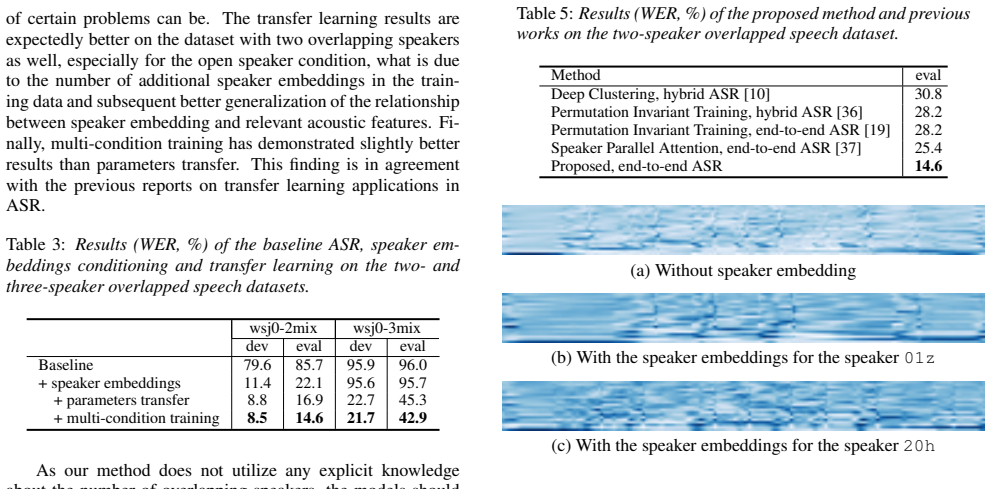
The central claim is that speaker-embedding conditioning and clean-speech transfer learning jointly turn a hybrid CTC/attention end-to-end ASR system into a functional multi-speaker recognizer without an explicit separation stage or any parallel clean-versus-overlapped data. Conditioning works best when the L2-normalized speaker embedding is concatenated to every acoustic feature vector (vertical stacking), which lowers wsj0-2mix evaluation word error rate from 85.7% to 22.1%; transfer learning from 100 hours of clean audio-book speech via multi-condition training lowers it further to 14.6%. The paper further claims the method does not depend on the number of overlapping speakers: models trained on two-speaker mixtures decode three-speaker mixtures, and vice versa, and training on combined two- and three-speaker data plus clean speech gives the best three-speaker result at 32.3% on the open test set.
Load-bearing premise
The whole method assumes that before decoding each target speaker is known and a clean, non-overlapped reference recording of that speaker is available to produce the embedding; the paper does not test fully blind recognition with unknown speakers or no references.
Editorial extensions
If this is right
- On wsj0-2mix evaluation, the proposed system reaches 14.6% word error rate, beating the best previously reported result of 25.4% by 42% relative.
- Because no parallel clean and overlapped training material is required, the recipe can be applied to overlapped-data collections where aligned single-speaker versions do not exist.
- The system is not tied to a fixed number of speakers: models decode mixtures with more or fewer voices than seen in training, and combining two- and three-speaker training data yields a single model that handles both.
- Even about ten seconds of reference speech per speaker yields most of the gain, so the practical cost of enrolling a target voice is low.
- Transfer learning from clean speech is decisive as the number of speakers grows: three-speaker training alone failed to converge, but with transferred clean speech it reached 21.7% development word error rate.
Reading between the lines
- Beyond the paper, the system could be made fully blind by feeding embeddings from a diarization front-end or from the mixture itself; whether this closes the gap to oracle-reference embeddings is a testable question.
- Beyond the paper, the paper only tests simulated mixtures; real recordings with reverberation, competing noise, and same-gender overlapping voices would stress whether the conditioning still selects the target voice.
- Beyond the paper, because out-of-domain clean audio-book speech transferred well, other clean-speech corpora may transfer too, potentially extending the recipe to languages that have no overlapped-speech training data.
Signed reviews
Editorial analysis
A structured set of objections, weighed in public.
Referee Report
Summary. The paper proposes an end-to-end ASR system for overlapped speech that is conditioned on speaker embeddings (x-vectors) extracted from reference speech, optionally combined with transfer learning from clean speech via parameter transfer or multi-condition training. Experiments on wsj0-2mix and wsj0-3mix show large WER reductions relative to a no-conditioning baseline, and the best wsj0-2mix evaluation result of 14.6% WER is claimed to outperform previous systems by 42% relative. The paper also demonstrates that the method can decode mixtures with a different number of speakers than seen in training, and that transfer learning is especially important for three-speaker mixtures.
Significance. If the results hold under controlled comparison, the paper would make a strong contribution: it shows that speaker-conditioned, separation-free end-to-end ASR can handle overlapped speech, and that transfer learning from clean speech is an effective strategy when the overlapped training data alone is insufficient. The internal ablations are encouraging, especially the very large gain from vertical stacking of speaker embeddings in Table 1 (79.6% to 11.4% on dev), and the use of public datasets and toolkits (ESPnet, Kaldi, WSJ0 mixtures, LibriSpeech) supports reproducibility. However, the headline comparison to prior work is confounded by the use of enrollment reference speech at test time, and the lack of variance estimates and the non-converged three-speaker baseline weaken the central claims as currently stated.
major comments (4)
- [Section 4.4, Table 5] The claimed 42% relative improvement over the best prior result is not an apples-to-apples comparison: the proposed system is given clean reference utterances of each target speaker at test time (Sections 2.2 and 3.3), whereas the compared systems in Table 5 are fully blind and must resolve speaker order and identity from the mixture alone. The WER gap may therefore reflect access to auxiliary enrollment information rather than an algorithmic advantage. The paper should either evaluate a blind variant of the proposed model (e.g., oracle speaker order but no enrollment) or explicitly reposition the result as a speaker-known condition and compare against similarly conditioned systems; otherwise the headline claim is overstated.
- [Sections 3.1 and 3.3] The paper does not state whether the reference utterances used to compute speaker embeddings for the evaluation speakers are disjoint from the clean utterances that were mixed to form the wsj0-2mix and wsj0-3mix test signals. If any of the enrollment utterances is the same utterance that appears in a test mixture, the speaker embedding can leak lexical content and artificially lower the reported WER. The authors should explicitly describe the utterance-level split between enrollment and mixture sources, and if the split is not disjoint, rerun the evaluation with held-out enrollment utterances.
- [Tables 1, 3, and 4] All WER results are reported as single numbers without variance, confidence intervals, or repeated-seed runs. Given that some differences are small (e.g., 8.8 vs. 8.5 in Table 3, and 7.8 vs. 8.5 in Table 4), the statement that improvements are 'significant' is not statistically supported. At minimum, the authors should provide bootstrap confidence intervals or repeated training runs with different seeds for the main conditions.
- [Table 3] The three-speaker baseline and the three-speaker condition with speaker embeddings alone are essentially degenerate (95.6-96.0% WER), and the paper explicitly notes that the training process did not converge. This means the transfer-learning gains for three-speaker mixtures are measured from a collapsed baseline, and it weakens the claim that the method is 'independent of the number of speakers.' The authors should discuss why the model fails to converge in this setting and whether the improvement from transfer learning reflects the added data or merely a different optimization trajectory.
minor comments (5)
- [Section 4.3] In the sentence 'Table 3 presents the results of the systems trained on training sets of wsj0-2mix and wsj-3mix datasets,' the dataset name should be wsj0-3mix, not wsj-3mix.
- [Table 2] The column header 'V oiced frames' contains an erroneous space; it should read 'Voiced frames'.
- [Section 3.2] The decoder is described as 'one LSTM layer with 300 units,' but the encoder description mentions linear projection layers; please specify whether the decoder also includes a projection or output layer, as this affects reproducibility.
- [Section 4.3] The phrase 'how crucial the role of the transfer learning approach for the solution of certain problems can be' is awkward and should be rephrased for clarity.
- [Figure 2] The PCA visualization is only qualitative; consider adding a quantitative measure of separation, such as the correlation between conditioned encoder outputs and the target-speaker transcripts, to strengthen the claim of learned separation.
Circularity Check
No significant circularity: the paper is an empirical evaluation against external baselines using a pretrained external speaker encoder and standard public datasets.
full rationale
The paper's central claim is that conditioning an end-to-end ASR system on x-vector speaker embeddings and adding transfer learning from clean speech improves WER on wsj0-2mix and wsj0-3mix. This claim is supported by measured results on held-out evaluation sets, not by a derivation that assumes the conclusion. The speaker embeddings come from a pretrained Kaldi x-vector model trained on VoxCeleb 1 and 2, which is an external, independently trained component; the paper does not fit any quantity on the evaluation set and then rename it a prediction. The baseline comparison within the paper, where adding speaker embeddings reduces WER from 85.7% to 22.1% on the two-speaker evaluation set, is a direct controlled ablation holding all other training choices fixed. The transfer-learning comparison similarly compares the same conditioning architecture with and without clean-speech data. The comparison with prior work in Table 5 is not apples-to-apples because the proposed method receives reference speech of the target speaker at test time while the cited systems do not, but that is a correctness or fairness concern about benchmark comparability, not circularity under the stated definitions. Dev-set choices such as the CTC weight and stacking strategy are standard model selection and are not presented as predictions. There are no self-citations used as load-bearing evidence, no uniqueness theorem imported from the authors' prior work, and no ansatz smuggled in through citation. The empirical result may be weaker than it appears due to the different task setup, but the derivation chain is self-contained and none of the claims reduces to its own inputs by construction.
Assumptions & free parameters
free parameters (3)
- CTC/attention loss weight lambda =
0.2 for training, 0.3 for decoding
- Number of reference utterances per speaker for embedding =
50 utterances in main experiments; sensitivity from 1 to 50 explored
- Speaker embedding insertion strategy =
Vertical stacking with unchanged vector sizes
assumptions (4)
- domain assumption A pretrained x-vector model trained on VoxCeleb 1 and 2 produces speaker embeddings that transfer to WSJ0 and LibriSpeech speakers.
- domain assumption At test time, a clean reference utterance for each target speaker is available to extract a speaker embedding.
- domain assumption Simulated wsj0-2mix and wsj0-3mix mixtures are representative of overlapped speech.
- domain assumption Multi-condition training with clean LibriSpeech plus overlapped WSJ data improves generalization.
Cite this review
Pith. "Pith review of End-to-End Multi-Speaker Speech Recognition using Speaker Embeddings and Transfer Learning." pith.science (2026). https://pith.science/paper/4LHSBNVP
@misc{pith2026190804737,
  author       = {Pith},
  title        = {Pith review of: End-to-End Multi-Speaker Speech Recognition using Speaker Embeddings and Transfer Learning},
  year         = {2026},
  howpublished = {\url{https://pith.science/paper/4LHSBNVP}},
  note         = {Machine review of arXiv:1908.04737}
}
read the original abstract
This paper presents our latest investigation on end-to-end automatic speech recognition (ASR) for overlapped speech. We propose to train an end-to-end system conditioned on speaker embeddings and further improved by transfer learning from clean speech. This proposed framework does not require any parallel non-overlapped speech materials and is independent of the number of speakers. Our experimental results on overlapped speech datasets show that joint conditioning on speaker embeddings and transfer learning significantly improves the ASR performance.
Figures

Reference graph
Works this paper leans on
-
[1]
Introduction Recently, deep learning technology has boosted automatic speech recognition (ASR) performance significantly [1, 2, 3, 4]. Overlapped speech – well known in a more general context as the cocktail party problem – remains, however, to be a largely unsolved problem. Its difficulty can be mainly explained by high similarity of acoustic characteristi...
-
[2]
End-to-End Multi-Speaker Speech Recognition using Speaker Embeddings and Transfer Learning
Method The outline of the proposed method is presented on Figure 1. It shows two separate neural network models, the speaker encoder and the end-to-end ASR, together with their inputs and outputs. The speaker encoder takes reference speech utterances on the input and produces speaker embedding vectors, as described in sections 2.2 and 3.3. The end-to-end ...
work page Pith review arXiv 1908
-
[3]
Experimental setup 3.1. Datasets We evaluate our models on the widely used mixed speech datasets wsj0-2mix and wsj0-3mix [9, 10]. The datasets contain two-speaker and three-speaker mixtures of randomly selected utterances from WSJ0 corpus. Training, development and eval- uation sets, named tr, cv and tt, are generated from WSJ0 training, development and e...
-
[4]
Results 4.1. Speaker embeddings inclusion strategies The first set of experiments aims to determine the best strat- egy for inclusion of speaker embeddings in the model’s in- put. While vertical stacking does not enforce same size of the speaker embedding and acoustic features, we perform two ex- periments with vertical stacking: the first one with unchange...
-
[5]
Conclusions In this paper, we proposed an effective end-to-end speech recog- nition framework for overlapped speech using speaker embed- dings and transfer learning techniques. Experimental results on simulated overlapped speech datasets revealed that using speaker embeddings our framework was able to automatically identify relevant information of the tar...
-
[6]
Single-channel speech sepa- ration using sparse non-negative matrix factorization,
M. N. Schmidt and R. K. Olsson, “Single-channel speech sepa- ration using sparse non-negative matrix factorization,” in Ninth International Conference on Spoken Language Processing , 2006
work page 2006
-
[7]
and spectral clustering [8]. Similarly to speech recognition, speech separation methods have also made major progress with the help of deep learning. The deep clustering method has been introduced in [9] and consequently improved in [10, 11] and has become one of the most remarkable speech separation methods in the recent years. Deep clustering operates o...
-
[8]
Learning spectral clustering, with application to speech separation,
F. R. Bach and M. I. Jordan, “Learning spectral clustering, with application to speech separation,” Journal of Machine Learning Research, vol. 7, no. Oct, pp. 1963–2001, 2006
1963
Show all 45 references
-
[9]
Deep Neural Networks for Acoustic Modeling in Speech Recognition,
G. Hinton, L. Deng, D. Yu, G. Dahl, A. rahman Mohamed, N. Jaitly, A. Senior, V . Vanhoucke, P. Nguyen, T. Sainath, and B. Kingsbury, “Deep Neural Networks for Acoustic Modeling in Speech Recognition,” Signal Processing Magazine, 2012
2012
-
[10]
Context-Dependent Pre-trained Deep Neural Networks for Large V ocabulary Speech Recognition,
G. Dahl, D. Yu, L. Deng, and A. Acero, “Context-Dependent Pre-trained Deep Neural Networks for Large V ocabulary Speech Recognition,” in IEEE Transactions on Audio, Speech, and Lan- guage Processing, vol. 20, 2012, pp. 30–42
2012
-
[11]
The Microsoft 2016 Conversational Speech Recognition System,
W. Xiong, J. Droppo, X. Huang, F. Seide, M. Seltzer, A. Stolcke, D. Yu, and G. Zweig, “The Microsoft 2016 Conversational Speech Recognition System,” CoRR, 2016
2016
-
[12]
We evaluate our proposed framework on overlapped speech datasets with two and three overlapped speakers, within and across set- tings
[18] and [20] of not requiring parallel clean speech material and over [19] of not depending on the number of speakers. We evaluate our proposed framework on overlapped speech datasets with two and three overlapped speakers, within and across set- tings. Overall, we observe si...
-
[13]
Purely Sequence-Trained Neural Networks for ASR Based on Lattice-Free MMI,
D. Povey, V . Peddinti, D. Galvez, P. Ghahremani, V . Manohar, X. Na, Y . Wang, and S. Khudanpur, “Purely Sequence-Trained Neural Networks for ASR Based on Lattice-Free MMI,” in Inter- speech, 2016, pp. 2751–2755
2016
-
[14]
Wang and G
D. Wang and G. J. Brown, Computational auditory scene analy- sis: Principles, algorithms, and applications . Wiley-IEEE press, 2006
2006
-
[15]
Super-human multi-talker speech recognition: A graphical mod- eling approach,
J. R. Hershey, S. J. Rennie, P. A. Olsen, and T. T. Kristjansson, “Super-human multi-talker speech recognition: A graphical mod- eling approach,” Computer Speech & Language , vol. 24, no. 1, pp. 45–66, 2010
2010
-
[16]
Listen, attend and spell: A neural network for large vocabulary conversational speech recognition,
W. Chan, N. Jaitly, Q. Le, and O. Vinyals, “Listen, attend and spell: A neural network for large vocabulary conversational speech recognition,” in Acoustics, Speech and Signal Processing (ICASSP), 2016 IEEE International Conference on. IEEE, 2016, pp. 4960–4964
2016
-
[17]
Deep clus- tering: Discriminative embeddings for segmentation and separa- tion,
J. R. Hershey, Z. Chen, J. Le Roux, and S. Watanabe, “Deep clus- tering: Discriminative embeddings for segmentation and separa- tion,” inAcoustics, Speech and Signal Processing (ICASSP), 2016 IEEE International Conference on. IEEE, 2016, pp. 31–35
2016
-
[18]
Single-Channel Multi-Speaker Separation Using Deep Cluster- ing,
Y . Isik, J. Le Roux, Z. Chen, S. Watanabe, and J. R. Hershey, “Single-Channel Multi-Speaker Separation Using Deep Cluster- ing,” Interspeech 2016, pp. 545–549, 2016
2016
-
[19]
Alternative Objective Functions for Deep Clustering,
Z.-Q. Wang, J. Le Roux, and J. R. Hershey, “Alternative Objective Functions for Deep Clustering,” inProc. IEEE International Con- ference on Acoustics, Speech and Signal Processing (ICASSP) , 2018
2018
-
[20]
V oice- Filter: Targeted Voice Separation by Speaker-Conditioned Spec- trogram Masking,
Q. Wang, H. Muckenhirn, K. Wilson, P. Sridhar, Z. Wu, J. Her- shey, R. A. Saurous, R. J. Weiss, Y . Jia, and I. L. Moreno, “V oice- Filter: Targeted Voice Separation by Speaker-Conditioned Spec- trogram Masking,” arXiv preprint arXiv:1810.04826, 2018
-
[21]
Deep speech: Scaling up end-to-end speech recognition,
A. Hannun, C. Case, J. Casper, B. Catanzaro, G. Diamos, E. Elsen, R. Prenger, S. Satheesh, S. Sengupta, A. Coates et al., “Deep speech: Scaling up end-to-end speech recognition,” arXiv preprint arXiv:1412.5567, 2014
2014 arXiv
-
[22]
EESEN: End-to-end speech recognition using deep RNN models and WFST-based decoding,
Y . Miao, M. Gowayyed, and F. Metze, “EESEN: End-to-end speech recognition using deep RNN models and WFST-based decoding,” in Automatic Speech Recognition and Understanding (ASRU), 2015 IEEE Workshop on. IEEE, 2015, pp. 167–174
2015
-
[23]
End-to-end attention-based large vocabulary speech recog- nition,
D. Bahdanau, J. Chorowski, D. Serdyuk, P. Brakel, and Y . Ben- gio, “End-to-end attention-based large vocabulary speech recog- nition,” in Acoustics, Speech and Signal Processing (ICASSP), 2016 IEEE International Conference on. IEEE, 2016, pp. 4945– 4949
2016
-
[24]
Transfer learning from speaker verification to multispeaker text-to-speech synthesis,
Y . Jia, Y . Zhang, R. Weiss, Q. Wang, J. Shen, F. Ren, P. Nguyen, R. Pang, I. L. Moreno, Y . Wu et al. , “Transfer learning from speaker verification to multispeaker text-to-speech synthesis,” in Advances in Neural Information Processing Systems , 2018, pp. 4485–4495
2018
-
[25]
Hybrid CTC/attention architecture for end-to-end speech recog- nition,
S. Watanabe, T. Hori, S. Kim, J. R. Hershey, and T. Hayashi, “Hybrid CTC/attention architecture for end-to-end speech recog- nition,” IEEE Journal of Selected Topics in Signal Processing , vol. 11, no. 8, pp. 1240–1253, 2017
2017
-
[26]
End-to-end multi-speaker speech recognition,
S. Settle, J. Le Roux, T. Hori, S. Watanabe, and J. R. Hershey, “End-to-end multi-speaker speech recognition,” in IEEE Interna- tional Conference on Acoustics, Speech and Signal Processing (ICASSP), 2018, pp. 4819–4823
2018
-
[27]
A Purely End-to-End System for Multi-speaker Speech Recog- nition,
H. Seki, T. Hori, S. Watanabe, J. Le Roux, and J. R. Hershey, “A Purely End-to-End System for Multi-speaker Speech Recog- nition,” in Proceedings of the 56th Annual Meeting of the Asso- ciation for Computational Linguistics (V olume 1: Long Papers) , vol. 1, 2018, pp. 2620–2630
2018
-
[28]
Progressive joint mod- eling in unsupervised single-channel overlapped speech recogni- tion,
Z. Chen, J. Droppo, J. Li, and W. Xiong, “Progressive joint mod- eling in unsupervised single-channel overlapped speech recogni- tion,” IEEE/ACM Transactions on Audio, Speech and Language Processing (TASLP), vol. 26, no. 1, pp. 184–196, 2018
2018
-
[29]
Speaker-Aware Neural Network Based Beam- former for Speaker Extraction in Speech Mixtures,
K. molkov, M. Delcroix, K. Kinoshita, T. Higuchi, A. Ogawa, and T. Nakatani, “Speaker-Aware Neural Network Based Beam- former for Speaker Extraction in Speech Mixtures,” 2017, pp. 2655–2659
2017
-
[30]
Deep Extractor Network for Target Speaker Recovery from Sin- gle Channel Speech Mixtures,
J. Wang, J. Chen, D. Su, L. Chen, M. Yu, Y . Qian, and D. Yu, “Deep Extractor Network for Target Speaker Recovery from Sin- gle Channel Speech Mixtures,” Proc. Interspeech 2018, pp. 307– 311, 2018
2018
-
[31]
Speaker diarization with LSTM,
Q. Wang, C. Downey, L. Wan, P. A. Mansfield, and I. L. Moreno, “Speaker diarization with LSTM,” in 2018 IEEE Inter- national Conference on Acoustics, Speech and Signal Processing (ICASSP). IEEE, 2018, pp. 5239–5243
2018
-
[32]
VoxCeleb: A Large- Scale Speaker Identification Dataset,
A. Nagrani, J. S. Chung, and A. Zisserman, “VoxCeleb: A Large- Scale Speaker Identification Dataset,”Proc. Interspeech 2017, pp. 2616–2620, 2017
2017
-
[33]
Multilingual acoustic models using dis- tributed deep neural networks,
G. Heigold, V . Vanhoucke, A. Senior, P. Nguyen, M. Ranzato, M. Devin, and J. Dean, “Multilingual acoustic models using dis- tributed deep neural networks,” in ICASSP. IEEE, 2013, pp. 8619–8623
2013
-
[34]
The input features of x-vector extractor are 30-dimensional MFCCs without cepstral truncation with a frame length of 25 ms and shift of 10 ms
and evaluated on Speakers in the Wild dataset [35] with 3.5% equal error rate. The input features of x-vector extractor are 30-dimensional MFCCs without cepstral truncation with a frame length of 25 ms and shift of 10 ms. Mean normalization with a sliding window of up to three...
-
[35]
Investigation of transfer learning for ASR using LF-MMI trained neural networks,
P. Ghahremani, V . Manohar, H. Hadian, D. Povey, and S. Khudan- pur, “Investigation of transfer learning for ASR using LF-MMI trained neural networks,” in Automatic Speech Recognition and Understanding Workshop (ASRU), 2017 IEEE. IEEE, 2017, pp. 279–286
2017
-
[36]
Lib- rispeech: an ASR corpus based on public domain audio books,
V . Panayotov, G. Chen, D. Povey, and S. Khudanpur, “Lib- rispeech: an ASR corpus based on public domain audio books,” in Acoustics, Speech and Signal Processing (ICASSP), 2015 IEEE International Conference on. IEEE, 2015, pp. 5206–5210
2015
-
[37]
ESP- net: End-to-End Speech Processing Toolkit,
S. Watanabe, T. Hori, S. Karita, T. Hayashi, J. Nishitoba, Y . Unno, N.-E. Y . Soplin, J. Heymann, M. Wiesner, N. Chen et al., “ESP- net: End-to-End Speech Processing Toolkit,” Proc. Interspeech 2018, pp. 2207–2211, 2018
2018
-
[38]
The Kaldi speech recognition toolkit,
D. Povey, A. Ghoshal, G. Boulianne, L. Burget, O. Glembek, N. Goel, M. Hannemann, P. Motlicek, Y . Qian, P. Schwarzet al., “The Kaldi speech recognition toolkit,” in ASRU, no. EPFL- CONF-192584. IEEE Signal Processing Society, 2011
2011
-
[39]
Adadelta: an adaptive learning rate method,
M. D. Zeiler, “Adadelta: an adaptive learning rate method,” arXiv preprint arXiv:1212.5701, 2012
2012 arXiv
-
[40]
End-to-end Speech Recog- nition with Word-based RNN Language Models,
T. Hori, J. Cho, and S. Watanabe, “End-to-end Speech Recog- nition with Word-based RNN Language Models,” arXiv preprint arXiv:1808.02608, 2018
2018 arXiv
-
[41]
VoxCeleb2: Deep Speaker Recognition,
J. S. Chung, A. Nagrani, and A. Zisserman, “VoxCeleb2: Deep Speaker Recognition,” Proc. Interspeech 2018 , pp. 1086–1090, 2018
2018
-
[42]
X-vectors: Robust DNN embeddings for speaker recogni- tion,
D. Snyder, D. Garcia-Romero, G. Sell, D. Povey, and S. Khudan- pur, “X-vectors: Robust DNN embeddings for speaker recogni- tion,” Submitted to ICASSP, 2018
2018
-
[43]
The Speak- ers in the Wild (SITW) Speaker Recognition Database,
M. McLaren, L. Ferrer, D. Castan, and A. Lawson, “The Speak- ers in the Wild (SITW) Speaker Recognition Database,” in Inter- speech, 2016, pp. 818–822
2016
-
[44]
Single-channel multi-talker speech recognition with permutation invariant training,
Y . Qian, X. Chang, and D. Yu, “Single-channel multi-talker speech recognition with permutation invariant training,” Speech Communication, vol. 104, pp. 1–11, 2018
2018
-
[45]
End-to-End Monaural Multi-speaker ASR System without Pretraining,
X. Chang, Y . Qian, K. Yu, and S. Watanabe, “End-to-End Monaural Multi-speaker ASR System without Pretraining,”arXiv preprint arXiv:1811.02062, 2018
2018 arXiv
Reviewed August 14, 2026 · model on record in the stance chip above.
Discussion (0). Continue with ORCID to comment.