REVIEW 1 major objections 5 minor 73 references
Active Gaussian Network Model: a non-equilibrium description of protein fluctuations and allosteric behavior
T0 review · 1 major / 5 minor · reviewed 2026-08-07 · deepseek-v4-flash
Pith's one-line read The paper claims that adding a simple colored-noise, non-equilibrium bath to the Gaussian Network Model preserves the model's solvability while changing the timescales and memory of protein fluctuations, and that causal indicators on this…
desk verdict The aGNM model and transfer entropy are worth keeping; the response function that drives the central causal claims is computed with a formula that fails when active variables are hidden. read the letter →
The pith
A machine-rendered reading of the paper's core claim, the machinery that carries it, and where it could break.
The reading
What carries the argument
The central object is the active Gaussian Network Model, a multivariate Ornstein-Uhlenbeck process coupling residue displacements $x_i$ to active velocities $w_i$ that relax on a memory timescale $\tau_a$; writing the dynamics in the eigenbasis of the Kirchhoff matrix $K$ reduces the problem to independent modes with effective relaxation rates $\mu_k$. From that solution the paper derives explicit formulas for the correlation matrix, the entropy production rate, the response function $R(t) = C(t)C^+(0)$, and the Gaussian transfer entropy. The response formula and the net entropy transfer are the two causal indicators that carry the allosteric conclusions, and their explicit modal expressions are what keep the model analytically tractable.
What would settle it
Simulate the aGNM equations with an explicit instantaneous displacement of residue 21 and measure the average response of each residue from the simulated ensemble, then compare with Eq. (19); if the simulated responses deviate systematically from the formula as $\tau_a$ increases, the response-based allosteric network is an artifact of the x-only formula.
Extended reading notes
Core claim
The central claim is that allostery can be read as a causal process in a non-equilibrium harmonic network: replacing the thermal bath of the GNM with active Ornstein-Uhlenbeck noise leaves the native-fold topology as the determinant of fluctuation patterns, but alters the statistical weight of the normal modes, slows relaxation, and adds memory. On the PDZ2 domain, the resulting response and transfer-entropy profiles indicate that a perturbation at the binding groove propagates mainly through the beta2 strand, that the beta2-H1-beta3 loop is the most sensitive relay, and that helix H3 is a comparatively marginal sender. The paper states this as the finding that deviations from purely thermal fluctuations can significantly influence allosteric communication by introducing distinct timescales and memory effects, particularly when the allosteric response occurs on timescales incompatible with equilibrium relaxation. If correct, the paper establishes that a simple, analytically solvable non-equilibrium elastic network can reproduce and explain known allosteric communication patterns in a protein.
Load-bearing premise
The causal-response analysis assumes that the response of residue displacements to an initial perturbation is completely determined by the displacement-only correlation matrix $C(t) C^+(0)$, ignoring the hidden active-noise variables that the model itself introduces.
Editorial extensions
If this is right
- Non-equilibrium fluctuations can change the ranking of which structural elements mediate allostery, so equilibrium elastic-network analyses may systematically undervalue roles like the beta2 strand.
- The aGNM offers a low-cost, analytically solvable route to identify candidate allosteric pathways in any protein with a known contact map, without molecular-dynamics sampling.
- Memory effects make self-response decay non-exponential, implying that allosteric propagation should be characterized by timescales rather than static correlation patterns alone.
- The causal indicators select specific secondary-structure elements, generating targeted predictions about which mutations should perturb PDZ2 allostery.
- Differences between active and thermal correlation patterns localize near native contacts and the binding groove, suggesting that activity amplifies already-coordinated motions rather than creating new ones.
Reading between the lines
- A natural next test is to apply the aGNM to other allosteric proteins and compare each predicted driver region against experimentally mapped allosteric sites; the model would predict that the dominant sender sits at the edge of the ligand-binding site rather than at the active site.
- Because the x-only response formula is used, a direct check on simulated aGNM trajectories with explicit perturbations would clarify whether the causal network survives when hidden active variables are accounted for.
- If the causal network holds, the analytic formulas make the aGNM a fast screening tool for ranking allosteric mutations in any protein with a known native contact map.
- The paper's reliance on native topology alone implicitly suggests that fold geometry, not sequence, sets the backbone of allosteric communication; testing this by randomizing sequences on the same fold would separate the two.
Editorial analysis
A structured set of objections, weighed in public.
Referee Report
Summary. The manuscript introduces the active Gaussian Network Model (aGNM), in which the standard GNM harmonic network for Cα fluctuations is supplemented by an Ornstein-Uhlenbeck 'active velocity' with persistence time τ_a and strength T_a. The authors derive exact stationary correlation functions, B-factors, and a positive entropy production rate, and they compare the predicted B-factors with experimental data for the PDZ2 domain (PDB 3LNX). They then use two causal indicators, response functions and transfer entropy, to infer allosteric communication pathways in PDZ2, concluding that the β2 strand acts as a driver, the β2-H1-β3 loop is a central hub, and helix H3 plays a marginal role. The central claim is that non-thermal, memory-carrying fluctuations can substantially modify allosteric communication by introducing distinct timescales and memory effects.
Significance. If the analysis were correct, the aGNM would be a valuable analytically solvable platform for studying nonequilibrium effects in protein allostery. The model is simple, and the correlation and entropy-production derivations in Appendices A and B are transparent and self-consistent; the transfer-entropy formulas are explicit, and the allosteric conclusions are not fitted to the experimental allosteric data, so the TE-based part is not circular. However, the response-function analysis, which is one of the two causal pillars and the source of the block-response network in Fig. 8(a), is invalid for the stated perturbation protocol. The allosteric conclusions are therefore only partially supported, and the significance of the paper is conditional on the response section being corrected or removed.
major comments (1)
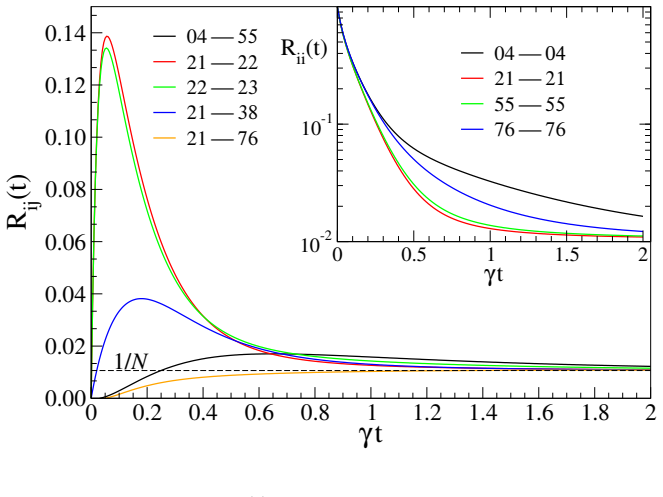
- [Sec. V B, Eq. (19)] The quantity computed in Eq. (19) is not the response defined in this section. The definition R_ij(t)=δ⟨x_j(t)⟩/δx_i(0) with the perturbed average taken over the unperturbed stationary distribution, and with the active variables w explicitly excluded from the response, is the physical response to an initial shift of x with w drawn from its stationary mean ⟨w⟩=0. For the linear mean dynamics γ d⟨x⟩/dt = -gK⟨x⟩ + γ⟨w⟩ and d⟨w⟩/dt = -⟨w⟩/τ_a, this gives ⟨w(t)⟩=0 and hence R_ij(t)=[exp(-(g/γ)K t)]_{ij} = Σ_k u_i(k) e^{-μ_k t} u_j(k), independent of T_a and τ_a. The formula R(t)=C(t)C^+(0) is the optimal linear predictor (regression) of x(t) from x(0), not the response under this protocol; it would become the response only if w(0) were prepared with its conditional distribution given the shifted x(0). Therefore the non-exponential 'memory' decay shown in the inset of Fig. 5, the response profiles of Fig. 6, and the block-response network of Fig. 8(a) are artifacts of applying the regression formula to a system with hidden active degrees of freedom. The correlation and transfer-entropy analyses are unaffected, but the response-based conclusion that β2 is a driver and H3 is marginal in allosteric communication is unsupported. The authors should either recompute the response under the stated protocol (which will remove the τ_a and T_a dependence) or clearly re-label the quantity and revise the abstract and conclusions accordingly.
minor comments (5)
- [Fig. 5 and Sec. V B] The pair 21–38 is described both as a direct native contact ('in direct harmonic links') and as a non-contact pair connected by a short path; the caption and the surrounding text should be made consistent.
- [Throughout] The PDB identifier appears as both '3LNX' (text) and '3NLX' (Fig. 1), and the protein name as both 'hPT1E' (abstract) and 'hPTP1E' (Section II); these should be standardized.
- [Eq. (18)] The small-τ_a expansion appears to set the harmonic scale g to unity, since the coefficients of the δ_ij and K^m terms differ from a direct expansion of Eq. (16) by powers of g; please state the value of g or the reduced units used in the numerics.
- [Sec. V C, Eq. (21)] The quantity in Eq. (21) conditions only on the single past values x_i(0) and x_j(0). Since the x-process of the aGNM is non-Markovian due to the hidden active variables, this is a lag-specific conditional mutual information rather than the full Schreiber transfer entropy with histories; the text should qualify the causal interpretation accordingly.
- [Sec. V C, Eq. (25)] The sentence following Eq. (25) contains a sign/logic typo: if δTE_i,j>0 and residue i gives entropy, then i is the driver, not j; please correct.
Circularity Check
The aGNM correlation and entropy-production derivations are self-contained and the allosteric conclusions are not fitted to target data, but the load-bearing response analysis (Eq. 19) is imported from self-authored references and reduces the claimed causal response to a correlation regression, so the response-based portion of the central claim is not independent.
-
self citation load bearing
[Section V B, Eq. (19) and the paragraph introducing R(t)=C(t)C+(0)]
"For linear stochastic systems like the aGNM, the response functions between residues can be obtained from the knowledge of correlations via the simplified formula [52, 64] R(t) = C(t)C +(0) with C(t) being the time-dependent covariance matrix restricted to residues only, C(t) = ⟨x(t)x⊤(0)⟩, and C +(0) is its pseudo-inverse at time, t= 0. It is important to note that this response is restricted to the residue displacements x(t), excluding the active-noise variables w(t) introduced in the aGNM dynamics (5)."
Response is defined as δ⟨x_j(t)⟩/δx_i(0) with unperturbed stationary initial conditions, but Eq. (19) is evaluated as C(t)C^+(0). For the full aGNM state, d⟨w⟩/dt = −⟨w⟩/τ_a, so with w unperturbed the exact response is exp(−(g/γ)K t), independent of T_a and τ_a. Eq. (19) is instead the optimal linear regression of x(t) on x(0). The non-exponential decay (Fig. 5 inset), the 'marginal H3' profile, and the Fig. 8(a) network are thus generated by a self-cited correlation formula, not by the defined perturbation protocol. This is load-bearing for the claim that β2 drives allostery while H3 is marginal.
full rationale
The mathematical core of the aGNM is not circular: Eqs. (4)-(5) define a solvable OU process, Appendix B derives the correlation functions from those dynamics, and the entropy production in Appendix A is a path-integral calculation. The B-factor comparison uses external PDB data and only a mean rescaling, with τ_a and T_a set by hand rather than optimized to the allosteric target, so no fitted parameter is being renamed as a prediction. The equal-time correlation and transfer-entropy analyses are also internally derived from the model's Gaussian statistics. The one load-bearing self-citation is the response formula R(t)=C(t)C^+(0), imported from Refs. [52,64] (with overlapping authorship). Under the response protocol stated in the paper, that formula does not give the physical response when the active variables w are hidden and unperturbed; it gives the correlation-based regression, so the non-equilibrium 'memory' response and the response-based causal network reduce to a re-expression of correlations. Because the transfer-entropy and correlation pillars remain independent, the circularity is partial rather than total.
Assumptions & free parameters
free parameters (6)
- T_a (active temperature strength) =
T_a = 20 T_0, with T_0 = 1
- tau_a (active persistence time) =
tau_a = 0.1 for main results; varied 0.01 to 1.0
- A0 (backbone spring strength) =
A0 = 10 A_ij, with A_ij = 1
- r_c (contact cutoff) =
r_c = 5 Å
- g (harmonic potential scale) =
unspecified; cancels in normalized B-factors
- gamma (friction coefficient) =
unspecified; sets the time unit
assumptions (6)
- domain assumption A protein's equilibrium fluctuations can be represented by a scalar Gaussian network of C-alpha beads connected by harmonic springs.
- domain assumption The heavy-atom contact map with cutoff 5 Å from PDB 3LNX captures the relevant allosteric connectivity.
- ad hoc to paper Non-equilibrium environmental fluctuations can be modeled by an Ornstein-Uhlenbeck active velocity with a single persistence time tau_a, independent of thermal noise.
- ad hoc to paper For a linear non-equilibrium system, the response of residue displacements to an initial perturbation is given by R(t)=C(t)C^+(0) using only the displacement correlation matrix.
- standard math The Gaussian transfer entropy formula (Eq. 22) is valid for the stationary aGNM process.
- domain assumption The active velocity w_i is odd under time reversal for the entropy production calculation.
invented entities (1)
-
Active velocity w_i
Cite this review
Pith. "Pith review of Active Gaussian Network Model: a non-equilibrium description of protein fluctuations and allosteric behavior." pith.science (2026). https://pith.science/paper/4LRLWWFL
@misc{pith2026250524855,
  author       = {Pith},
  title        = {Pith review of: Active Gaussian Network Model: a non-equilibrium description of protein fluctuations and allosteric behavior},
  year         = {2026},
  howpublished = {\url{https://pith.science/paper/4LRLWWFL}},
  note         = {Machine review of arXiv:2505.24855}
}
read the original abstract
Understanding the link between structure and function in proteins is fundamental in molecular biology and proteomics. A central question in this context is whether allostery - where the binding of a molecule at one site affects the activity of a distant site - emerges as a further manifestation of the intricate interplay between structure, function, and intrinsic dynamics. This study explores how allosteric regulation is modified when intrinsic protein dynamics operate under out-of-equilibrium conditions. To this purpose, we introduce a simple nonequilibrium model of protein dynamics, inspired by active matter systems, by generalizing the widely employed Gaussian Network Model (GNM) to incorporate non-thermal effects. Our approach underscores the advantage of framing allostery as a causal process by using, as a benchmark system, the second PDZ domain of the human phosphatase hPT1E that mediates protein-protein interactions. We employ causal indicators, such as response functions and transfer entropy, to identify the network of PDZ2 residues through which the allosteric signal propagates across the protein structure. These indicators reveal specific regions that align well with experimental observations. Furthermore, our results suggest that deviations from purely thermal fluctuations can significantly influence allosteric communication by introducing distinct timescales and memory effects. This influence is particularly relevant when the allosteric response unfolds on timescales incompatible with relaxation to equilibrium. Accordingly, non-thermal fluctuations may become essential for accurately describing protein responses to ligand binding and developing a comprehensive understanding of allosteric regulation.
Figures


Figures from the paper (5 more)



Reference graph
Works this paper leans on
- [1]
- [2]
-
[3]
M. Kubitzki, B. de Groot and D. Seeliger, inProtein Dynamics: From Structure to Function, Springer Netherlands, Dordrecht, 2017, pp. 393–425
work page 2017
-
[4]
A. Lesk,Introduction to protein science: architecture, function, and genomics, 3rd edition, Oxford University Press, USA, 2016
work page 2016
-
[5]
R. McLaughlin Jr, F. Poelwijk, A. Raman, W. Gosal and R. Ranganathan,Nature, 2012,491, 138–142
work page 2012
-
[6]
A. Kessel and N. Ben-Tal,Introduction to proteins: structure, function, and motion, Chapman and Hall/CRC, New York USA, 2018
work page 2018
- [7]
- [8]
Show all 73 references
-
[9]
Hub and B
J. Hub and B. de Groot,PLoS Comput. Biol., 2009,5, e1000480
2009
-
[10]
E. C. Dykeman and O. F. Sankey,J. Phys. Condens. Matter, 2010,22, 423202
2010
-
[11]
Frauenfelder, B
H. Frauenfelder, B. H. McMahon, R. H. Austin, K. Chu and J. T. Groves,Proc. Natl. Acad. Sci., 2001,98, 2370–2374
2001
-
[12]
Liu and R
J. Liu and R. Nussinov,PLoS Comput. Biol., 2016,12, e1004966
2016
-
[13]
Thirumalai, C
D. Thirumalai, C. Hyeon, P. Zhuravlev and G. Lorimer,Chem. Rev., 2019,119, 6788–6821
2019
-
[14]
Ribeiro and V
A.-A. Ribeiro and V. Ortiz,Chem. Rev., 2016,116, 6488–6502
2016
-
[15]
Monod and F
J. Monod and F. Jacob, Cold Spring Harbor symposia on quantitative biology, 1961, pp. 389–401
1961
-
[16]
Guarnera and I
E. Guarnera and I. N. Berezovsky,Curr. Opin. Struct. Biol., 2016,37, 1–8
2016
-
[17]
Cooper and D
A. Cooper and D. Dryden,Eur. Biophys. J., 1984,11, 103–109. [18]Allostery: Methods and Protocols, ed. A. Fenton, Humana Totowa, NJ, New York, NY, 2012, vol. 796
1984
-
[19]
Guarnera and I
E. Guarnera and I. N. Berezovsky,PLoS Comput. Biol., 2016,12, e1004678
2016
-
[20]
Tirion,Phys
M. Tirion,Phys. Rev. Lett., 1996,77, 1905
1996
-
[21]
Sanejouand, inElastic Network Models: Theoretical and Empirical Foundations, Hu- mana Press, Totowa, N.J., 2013, pp
Y.-H. Sanejouand, inElastic Network Models: Theoretical and Empirical Foundations, Hu- mana Press, Totowa, N.J., 2013, pp. 601–616
2013
-
[22]
Togashi and H
Y. Togashi and H. Flechsig,Int. J. Mol. Sci., 2018,19, 3899
2018
-
[23]
Micheletti, P
C. Micheletti, P. Carloni and A. Maritan,Proteins: Struct., Funct., Bioinf., 2004,55, 635– 645
2004
-
[24]
Micheletti, F
C. Micheletti, F. Cecconi, A. Flammini and A. Maritan,Protein Sci., 2002,11, 1878–1887. 33
2002
-
[25]
Haliloglu, I
T. Haliloglu, I. Bahar and B. Erman,Phys. Rev. Lett., 1997,79, 3090
1997
-
[26]
Austin, K
R. Austin, K. Beeson, L. Eisenstein, H. Frauenfelder and I. Gunsalus,Biochemistry, 1975,14, 5355–5373
1975
-
[27]
A.-A. Ali, A. Gulzar, S. Wolf and G. Stock,J. Phys. Chem. Lett., 2022,13, 9862–9868
2022
-
[28]
Stock and P
G. Stock and P. Hamm,Philos. Trans. R. Soc. B: Biol. Sci., 2018,373, 20170187
2018
-
[29]
Buchenberg, F
S. Buchenberg, F. Sittel and G. Stock,Proc. Natl. Acad. Sci., 2017,114, E6804–E6811
2017
-
[30]
Xing,Phys
J. Xing,Phys. Rev. Lett., 2007,99, 168103
2007
-
[31]
Hathcock, Q
D. Hathcock, Q. Yu, B. A. Mello, D. Amin, G. Hazelbauer and Y. Tu,Proc. Natl Acad. Sci. USA, 2023,120, e2303115120
2023
-
[32]
Goodey and S
N. Goodey and S. Benkovic,Nat. Chem. Biol., 2008,4, 474–482
2008
-
[33]
Motlagh, J
H. Motlagh, J. Wrabl, J. Li and V. Hilser,Nature, 2014,508, 331–339
2014
-
[34]
Cecconi, P
F. Cecconi, P. De Los Rios and F. Piazza,J. Phys. Chem. B, 2007,111, 11057–11063
2007
-
[35]
Barducci and P
A. Barducci and P. De Los Rios,Curr. Opin. Struct. Biol., 2015,30, 161–169
2015
-
[36]
Stevens and Y
A. Stevens and Y. He,Int. J. Mol. Sci., 2022,23, 1454
2022
-
[37]
Lockless and R
S. Lockless and R. Ranganathan,Science, 1999,286, 295–299
1999
-
[38]
Ashkinadze, H
D. Ashkinadze, H. Kadavath, A. Pokharna, C. Chi, M. Friedmann, D. Strotz, P. Kumari, M. Minges, R. Cadalbert, S. K¨ oniglet al.,Nat. Commum., 2022,13, 6232
2022
-
[39]
Amacher, P
J. Amacher, P. Cushing, C. Bahl, T. Beck and D. Madden,J. Biol. Chem., 2013,288, 5114– 5126
2013
-
[40]
Kozlov, D
G. Kozlov, D. Banville, K. Gehring and I. Ekiel,J. Mol. Biol., 2002,320, 813–820
2002
-
[41]
Ivarsson,FEBS Lett., 2012,586, 2638–2647
Y. Ivarsson,FEBS Lett., 2012,586, 2638–2647
2012
-
[42]
Bahar, A
I. Bahar, A. R. Atilgan and B. Erman,Folding & Design, 1997,2, 173–181
1997
-
[43]
Bechinger, R
C. Bechinger, R. Di Leonardo, H. L¨ owen, C. Reichhardt, G. Volpe and G. Volpe,Rev. Mod. Phys., 2016,88, 045006
2016
-
[44]
Digregorio, D
P. Digregorio, D. Levis, A. Suma, L. Cugliandolo, G. Gonnella and I. Pagonabarraga,Phys. Rev. Lett., 2018,121, 098003
2018
-
[45]
Caprini, U
L. Caprini, U. Marini Bettolo Marconi and A. Puglisi,Phys. Rev. Lett., 2020,124, 078001
2020
-
[46]
Szamel,Phys
G. Szamel,Phys. Rev. E, 2014,90, 012111
2014
-
[47]
Maggi, M
C. Maggi, M. Paoluzzi, N. Pellicciotta, A. Lepore, L. Angelani and R. Di Leonardo,Phys. Rev. Lett., 2014,113, 238303
2014
-
[48]
Caprini and U
L. Caprini and U. Marconi Marini Bettolo,Soft Matter, 2018,14, 9044–9054. 34
2018
-
[49]
Bahar, A
I. Bahar, A. R. Atilgan and B. Erman,Folding and Design, 1997,2, 173–181
1997
-
[50]
Burioni, D
R. Burioni, D. Cassi, F. Cecconi and A. Vulpiani,Proteins: Struct., Func., Bioinf., 2004,55, 529–535
2004
-
[51]
Kundu, J
S. Kundu, J. S. Melton, D. C. Sorensen and G. N. Phillips Jr,Biophys. J., 2002,83, 723–732
2002
-
[52]
Cecconi, G
F. Cecconi, G. Costantini, C. Guardiani, M. Baldovin and A. Vulpiani,Phys. Biol., 2023,20, 056002
2023
-
[53]
C. Yuan, H. Chen and D. Kihara,BMC Bioinform., 2012,13, 1–13
2012
-
[54]
Mandal, B
S. Mandal, B. Liebchen and H. L¨ owen,Phys. Rev. Lett., 2019,123, 228001
2019
-
[55]
Marconi Marini Bettolo and C
U. Marconi Marini Bettolo and C. Maggi,Soft Matter, 2015,11, 8768–8781
2015
-
[56]
Caprini and U
L. Caprini and U. Marconi Marini Bettolo,Phys. Rev. R, 2020,2, 033518
2020
-
[57]
Caprini, U
L. Caprini, U. Marini Bettolo Marconi, A. Puglisi and H. L¨ owen,J. Chem. Phys., 2023,159, year
2023
-
[58]
Ichiye and M
T. Ichiye and M. Karplus,Proteins: Struc, Func., Bioinf., 1991,11, 205–217
1991
-
[59]
Bozovic, C
O. Bozovic, C. Zanobini, A. Gulzar, B. Jankovic, D. Buhrke, M. Post, S. Wolf, G. Stock and P. Hamm,Proc. Natl. Acad. Sci. USA, 2020,117, 26031–26039
2020
-
[60]
Buchli, S
B. Buchli, S. Waldauer, R. Walser, M. L. Donten, R. Pfister, N. Bl¨ ochliger, S. Steiner, A. Caflisch, O. Zerbe and P. Hamm,Proc. Natl. Acad. Sci. USA, 2013,110, 11725–11730
2013
-
[61]
Buchenberg, V
S. Buchenberg, V. Knecht, R. Walser, P. Hamm and G. Stock,J. Physi. Chem. B, 2014,118, 13468–13476
2014
-
[62]
Pearl,Causality, Cambridge university press, 2009
J. Pearl,Causality, Cambridge university press, 2009
2009
-
[63]
Marini Bettolo Marconi, A
U. Marini Bettolo Marconi, A. Puglisi, L. Rondoni and A. Vulpiani,Phys. Rep., 2008,461, 111–195
2008
-
[64]
Baldovin, F
M. Baldovin, F. Cecconi and A. Vulpiani,Phys. Rev. Res., 2020,2, 043436
2020
-
[65]
Schreiber,Phys
T. Schreiber,Phys. Rev. Lett., 2000,85, 461
2000
-
[66]
Paluˇ s, V
M. Paluˇ s, V. Kom´ arek, Z. Hrnˇ c ´ ıˇ r and K.ˇStˇ erbov´ a,Phys. Rev. E, 2001,63, 046211
2001
-
[67]
Hacisuleyman and B
A. Hacisuleyman and B. Erman,Proteins: Struct. Func. Bioinf., 2017,85, 1056–1064
2017
-
[68]
Hacisuleyman and B
A. Hacisuleyman and B. Erman,PLoS Comput. Biol., 2017,13, e1005319
2017
-
[69]
J. Sun, D. Taylor and E. M. Bollt,SIAM J. Appl. Dyn., 2015,14, 73–106
2015
-
[70]
Caprini, U
L. Caprini, U. Marconi Marini Bettolo, A. Puglisi and A. Vulpiani,J. Stat. Mech.: Theory and Exp., 2019,2019, 053203
2019
-
[71]
Shankar and M
S. Shankar and M. Marchetti,Phys. Rev. E, 2018,98, 020604. 35
2018
-
[72]
Dabelow, S
L. Dabelow, S. Bo and R. Eichhorn,Phys. Rev. X, 2019,9, 021009
2019
-
[73]
Mandal, K
D. Mandal, K. Klymko and M. DeWeese,Phys. Rev. Lett., 2017,119, 258001
2017
-
[74]
Caprini, U
L. Caprini, U. M. B. M. Marconi, A. Puglisi and A. Vulpiani,Phys. Rev. Lett., 2018,121, 139801. 36
2018
Reviewed August 7, 2026 · model on record in the stance chip above.
Discussion (0). Continue with ORCID to comment.