REVIEW 4 major objections 6 minor 66 references
Rethinking Hate Speech Detection on Social Media: Can LLMs Replace Traditional Models?
T0 review · 4 major / 6 minor · reviewed 2026-08-07 · deepseek-v4-flash
Pith's one-line read LLaMA-3.1-8B, fine-tuned on just 10% of the data, outperforms full-data BERT models at hate speech detection, suggesting specialized small detectors may be obsolete.
desk verdict A useful new code-mixed hate speech dataset, but the headline LLM-vs-BERT result is likely confounded by pretraining contamination that the paper never checks. read the letter →
The pith
A machine-rendered reading of the paper's core claim, the machinery that carries it, and where it could break.
The reading
What carries the argument
The comparison is carried by a fixed evaluation protocol: the same simple classification prompt ("Return 1 for Hate and 0 for Non-Hate") and identical hyperparameters within each model family, applied to five LLMs (LLaMA-3.1-8B, Mistral-7B, InternLM2.5-7B, Qwen2.5-7B, GPT-4o-mini), two multilingual BERT models (mBERT, XLM-RoBERTa), and Perspective API. LLMs are fine-tuned with LoRA, a low-rank adapter that trains about 4 million extra parameters on top of frozen weights, which the paper contrasts with mBERT's 179 million trainable parameters. The new IndoHateMix dataset, curated from Koo via keyword search and manually annotated with Fleiss' kappa 0.685, supplies the code-mixed Hindi-English testbed that existing benchmarks lack. The transfer-learning and 10%-data experiments are the load-bearing evidence that the LLM advantage is not just scale but generalization.
What would settle it
Re-annotate a random sample of IndoHateMix under an identity-based hate definition that excludes political criticism of individual leaders and body-shaming without group targeting; if LLaMA-3.1-8B's margin over mBERT shrinks or reverses on this re-labeled set, the paper's generalization claim is specific to its label definition. Alternatively, run the same 10%-data comparison on an independently built code-mixed hate dataset from a different platform; a BERT model trained on full data matching or beating LLaMA-3.1-8B there would falsify the claimed universal advantage.
Extended reading notes
Core claim
The paper's central claim is that modern open-source LLMs, with LLaMA-3.1-8B as the leading instance, outperform multilingual BERT-based transformers on hate speech detection across diverse linguistic and cultural contexts. On HateXplain, ImplicitHate, and IndoHateMix, LLaMA-3.1-8B reaches F1 scores of 0.91, 0.81, and 0.82, beating mBERT's 0.87, 0.76, and 0.77; the accuracy gaps are roughly 4, 8, and 14 percentage points respectively. In transfer experiments, LLaMA-3.1-8B fine-tuned on one dataset and tested on all three beats mBERT in every configuration, with an average relative accuracy gain of 12.15% when trained on HateXplain. Fine-tuned with a rank-8 LoRA adapter on only 10% of the data, it still outperforms mBERT fine-tuned on the full dataset. The authors conclude that pursuing general LLMs with diverse, culturally grounded datasets may be more productive than building task-specific hate speech models.
Load-bearing premise
The claim rests on IndoHateMix's annotations being a valid sample of the same hate speech construct used by the other benchmarks and by content moderation, since the annotators counted political criticism, body-shaming, and defamation of individual leaders as hate speech, and the dataset was gathered by searching contentious political keywords.
Editorial extensions
If this is right
- Deploying hate detection in code-mixed, low-resource languages may require only a general LLM and a small labeled sample rather than a dedicated fine-tuned classifier.
- Fine-tuning LLaMA-3.1-8B on 10% of available labels outperforms full-data mBERT, so data scarcity alone need not block accurate moderation.
- LLMs transfer across datasets better than multilingual BERT models, meaning a model adapted in one language or platform can be applied more widely without retraining.
- The field's investment may shift from specialized small models toward richer, culturally diverse benchmarks such as IndoHateMix for LLM fine-tuning.
- Open-weights LLMs can outperform a proprietary API (GPT-4o-mini) and a dedicated toxicity API (Perspective) when fine-tuned for this task.
Reading between the lines
- If IndoHateMix's label definition is not the same as identity-based hate speech used in policy, part of the LLM advantage on that dataset may be proficiency at detecting political abuse rather than hate per se; a strict redefinition test would separate the two.
- The 10% result uses a random subset; an active-learning or diversity-aware selection of training posts could plausibly reduce the required labels even further, which would strengthen the practical case for LLM-based systems.
- The same protocol could be exported to other code-mixed language pairs such as Bengali-English or Tamil-English; if the LLaMA advantage persists there, the conclusion generalizes beyond the Indian context.
- Because the comparison uses a deliberately simple prompt, the paper's LLM numbers are a conservative floor; more elaborate prompting or reasoning steps would likely widen the gap rather than narrow it.
Editorial analysis
A structured set of objections, weighed in public.
Referee Report
Summary. This paper benchmarks a range of hate speech detection models—two multilingual BERT variants (mBERT, XLM-RoBERTa), the Perspective API, and five LLMs (LLaMA-3.1-8B, Mistral-7B, Qwen2.5-7B, InternLM2.5-7B, GPT-4o-mini)—on three datasets: HateXplain, ImplicitHate, and a new Hindi-English code-mixed dataset IndoHateMix. It reports that LLaMA-3.1-8B achieves the highest F1 on all three datasets, that open LLMs outperform the fine-tuned BERT baselines by 4–14% accuracy, and that LLaMA-3.1-8B retains this advantage when fine-tuned on only 10% of the data or transferred across datasets. The paper introduces IndoHateMix as a novel benchmark and includes error and target analyses, concluding that general-purpose LLMs may reduce the need for specialized hate speech models.
Significance. If the empirical claims are sound, the paper provides useful evidence for a trend in the field and introduces a potentially valuable resource for Hindi-English code-mixed hate speech. The study is clearly reported, uses a consistent prompt across LLMs, and averages five runs for the limited-data experiments, which is good practice. The main contributions are the new dataset and the cross-model benchmark. However, the central comparative claim is currently undermined by two unresolved threats: possible pretraining overlap between the 2023–2024 LLMs and the test sets, and an annotation construct for IndoHateMix that appears to diverge from the identity-based definition used in the other benchmarks. These issues need to be addressed before the conclusions can be accepted.
major comments (4)
- [Sec. 4.3, Table 2; Sec. 4.4, Fig. 2] The core claim that LLaMA-3.1-8B outperforms mBERT by 4–14% is open to a data-contamination confound. LLaMA-3.1's pretraining data extends into 2024 (ref [1]), while HateXplain and ImplicitHate are public 2021 datasets and IndoHateMix was collected between December 2023 and January 2024 (Section 3.3.1). The paper does not report any overlap or near-duplicate check, and Section 5.1 does not acknowledge this risk. Because mBERT was pretrained on data from before 2019, the comparison may systematically favor the LLM through memorization rather than generalization. Please report contamination checks (e.g., exact-match and near-duplicate overlap of test instances against pretraining corpora or, at minimum, a canary-style analysis) and discuss the implications.
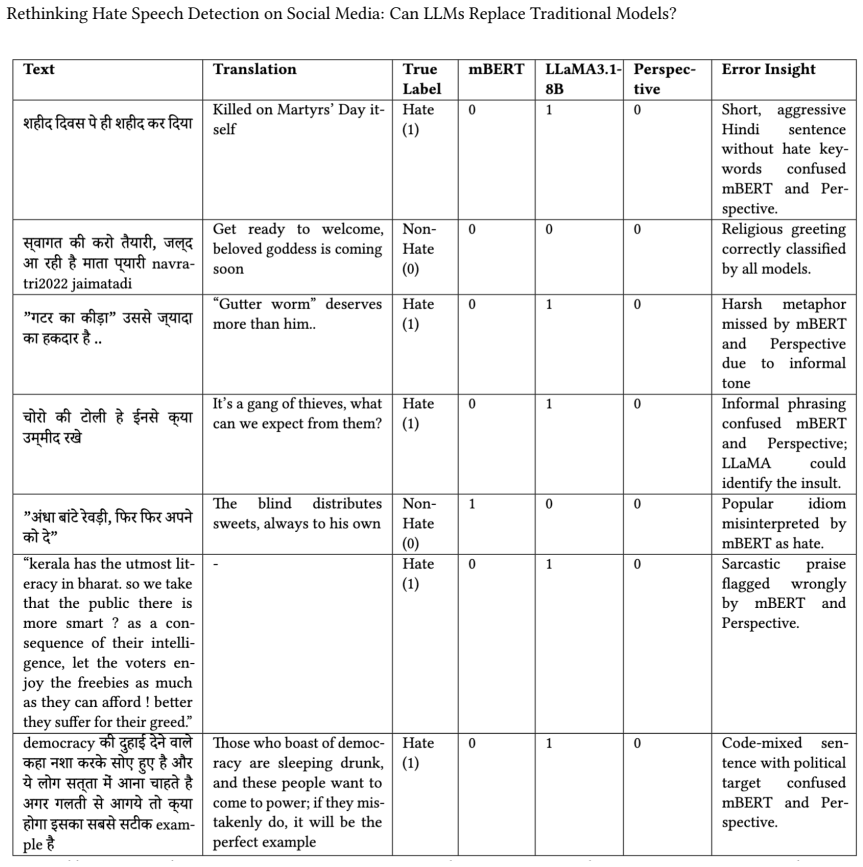
- [Sec. 3.3.3 and Sec. 3.4] The annotation definition for IndoHateMix labels political criticism, body-shaming, and defamation of individual leaders as hate speech (e.g., the "clever enemy" example and the body-shaming example). This is broader than the definition in Section 1 ("hostility ... based on characteristics such as race, religion, ethnicity, gender, or political beliefs") and differs from the target-based, group-directed hate in HateXplain and ImplicitHate. Consequently, the large LLM gains on IndoHateMix may reflect success at detecting political abuse rather than hate speech. The authors should either narrow the annotation guideline to match the stated construct, provide evidence that the two constructs yield the same model rankings, or clearly reframe the IndoHateMix task and qualify the conclusions accordingly.
- [Sec. 3.3.2] The dataset curation uses keyword-based selection of accounts likely to generate hate speech on topics such as Israel, Palestine, Ukraine, Khalistan, Pakistan, Trudeau, China, Election, and Protest. This selection procedure likely over-represents politically charged content and may not be representative of Indian social media hate speech more generally. Since IndoHateMix is not released (no URL or availability statement), external validation of the annotation quality and topic distribution is not possible. Please provide a topic/class distribution breakdown, discuss how the selection may affect the benchmark, and state the dataset's availability status.
- [Abstract and Sec. 4.3] The word "significantly" is used to describe the LLM advantage, but Table 2 appears to report single runs without variance, confidence intervals, or significance tests. Only Figure 2 is stated to be an average of five runs (Section 4.4 note). Please report variance across runs and, if appropriate, a paired significance test (e.g., bootstrap or Wilcoxon) for the main comparisons, or soften the language to "consistently higher" where tests are not available.
minor comments (6)
- [Table 2] In the IndoHateMix row for XLM-RoBERTa, the reported F1 (0.33) is inconsistent with the reported precision and recall (both 0.74); please correct the typo.
- [Sec. 4.1.3] The Note stating "All evaluated LLMs are open-source, with fully transparent architectures..." is immediately qualified by "except for the proprietary GPT-4o-mini"; please rephrase to avoid the contradiction.
- [Sec. 3.3.3] The example beginning "For example, in one post marked as hate speech, the user wrote:" is missing the quoted post text, making the annotation example unverifiable; please insert the missing text.
- [Sec. 5] The phrase "models that are and optimized for the critical task" contains a grammatical error; it should read "models that are optimized for the critical task."
- [Fig. 2] The caption states the results are the average of five runs, but no error bars or standard deviations are shown; please add error bars or report the standard deviations.
- [References] Reference [46] ("Summarization is (Almost) Dead") does not appear to support the claim about data efficiency for LLMs; please replace it with a more relevant citation.
Circularity Check
No circularity: the benchmark compares models on held-out test sets from two external datasets and one newly annotated dataset; self-citations are not load-bearing.
full rationale
This is an empirical benchmarking paper; it does not derive its headline result from fitted parameters or from a self-citation. The headline comparison (LLaMA-3.1-8B versus mBERT) is operationalized with held-out test metrics in Table 2 and Figures 1-2. Two of the three benchmarks (HateXplain, ImplicitHate) are external datasets with independently published labels; the third, IndoHateMix, is newly annotated by human annotators with reported Fleiss kappa, and the models are evaluated on a separate test split rather than on the labels used to fit anything. The 10%-data experiments use a random held-out subset with five runs, so the result is not a fitted parameter renamed as a prediction. The only self-citations are [9,10] in Section 5.1, used to note that different platforms have intrinsic biases; this observation is not load-bearing for the LLM-versus-BERT conclusion, and no claim in the paper depends on an unverified self-cited theorem. No equation-level reduction, ansatz smuggled by citation, or renaming of a known result was found. Concerns about possible pretraining contamination and about the broad IndoHateMix label definition are external validity threats, not circularity, and therefore do not raise the circularity score.
Assumptions & free parameters
free parameters (1)
- Perspective API classification threshold =
0.5
assumptions (4)
- domain assumption The three datasets used in the benchmark adequately represent the space of hate speech, including code-mixed and transliterated text.
- domain assumption The binary conversion of ImplicitHate, merging implicit_hate and explicit_hate into a single positive class, preserves the task difficulty.
- ad hoc to paper The IndoHateMix annotation definition, which includes body-shaming and political criticism as hate speech, matches the intended construct of hate speech.
- ad hoc to paper Keyword-based selection of accounts and posts from Koo yields a representative sample of Indian social media hate speech.
invented entities (1)
-
IndoHateMix dataset
Cite this review
Pith. "Pith review of Rethinking Hate Speech Detection on Social Media: Can LLMs Replace Traditional Models?." pith.science (2026). https://pith.science/paper/4M5SVKR5
@misc{pith2026250612744,
  author       = {Pith},
  title        = {Pith review of: Rethinking Hate Speech Detection on Social Media: Can LLMs Replace Traditional Models?},
  year         = {2026},
  howpublished = {\url{https://pith.science/paper/4M5SVKR5}},
  note         = {Machine review of arXiv:2506.12744}
}
read the original abstract
Hate speech detection across contemporary social media presents unique challenges due to linguistic diversity and the informal nature of online discourse. These challenges are further amplified in settings involving code-mixing, transliteration, and culturally nuanced expressions. While fine-tuned transformer models, such as BERT, have become standard for this task, we argue that recent large language models (LLMs) not only surpass them but also redefine the landscape of hate speech detection more broadly. To support this claim, we introduce IndoHateMix, a diverse, high-quality dataset capturing Hindi-English code-mixing and transliteration in the Indian context, providing a realistic benchmark to evaluate model robustness in complex multilingual scenarios where existing NLP methods often struggle. Our extensive experiments show that cutting-edge LLMs (such as LLaMA-3.1) consistently outperform task-specific BERT-based models, even when fine-tuned on significantly less data. With their superior generalization and adaptability, LLMs offer a transformative approach to mitigating online hate in diverse environments. This raises the question of whether future works should prioritize developing specialized models or focus on curating richer and more varied datasets to further enhance the effectiveness of LLMs.
Figures


Reference graph
Works this paper leans on
-
[1]
Dubey Abhimanyu et al. 2024. The Llama 3 Herd of Models. arXiv:2407.21783
arXiv 2024
-
[2]
Josh Achiam, Steven Adler, Sandhini Agarwal, Lama Ahmad, Ilge Akkaya, Florencia Leoni Aleman, Diogo Almeida, Janko Altenschmidt, Sam Altman, Shyamal Anadkat, et al. 2023. Gpt-4 technical report.arXiv preprint arXiv:2303.08774(2023)
arXiv 2023
-
[3]
Meta AI. 2023. Llama 3.1 8B: A Language Model. https://huggingface.co/meta-llama/Llama-3.1-8B Accessed: 2024-10-13
work page 2023
-
[4]
Mistral AI. 2023. Mistral 7B v0.3: An Open Weight Language Model. https://huggingface.co/mistralai/Mistral-7B-v0.3
work page 2023
-
[5]
Aditya Bohra, Deepanshu Vijay, Vinay Singh, Syed Sarfaraz Akhtar, and Manish Shrivastava. 2018. A dataset of Hindi-English code-mixed social media text for hate speech detection. InProceedings of the second workshop on computational modeling of people’s opinions, personality, and emotions in social media. 36–41
work page 2018
-
[6]
Martin Juan José Bucher and Marco Martini. 2024. Fine-Tuned ’Small’ LLMs (Still) Significantly Outperform Zero-Shot Generative AI Models in Text Classification.arXiv preprint arXiv:2406.08660(2024). https://arxiv.org/abs/2406.08660
arXiv 2024
-
[7]
Zheng Cai. 2024. InternLM2 Technical Report. arXiv:2403.17297 [cs.CL] https://arxiv.org/abs/2403.17297
arXiv 2024
-
[8]
Tommaso Caselli, Valerio Basile, Jelena Mitrović, and Michael Granitzer. 2020. Hatebert: Retraining bert for abusive language detection in english. arXiv preprint arXiv:2010.12472(2020)
arXiv 2020
Show all 66 references
-
[9]
Abhijnan Chakraborty, Saptarshi Ghosh, Niloy Ganguly, and Krishna P Gummadi. 2016. Dissemination biases of social media channels: On the topical coverage of socially shared news. InProceedings of the International AAAI Conference on Web and Social Media, Vol. 10. 559–562
2016
-
[10]
Abhijnan Chakraborty, Johnnatan Messias, Fabricio Benevenuto, Saptarshi Ghosh, Niloy Ganguly, and Krishna Gummadi. 2017. Who makes trends? understanding demographic biases in crowdsourced recommendations. InProceedings of the International AAAI Conference on Web and Social Med...
2017
-
[11]
Abhishek Chopra, Deepak Kumar Sharma, Aashna Jha, and Uttam Ghosh. 2023. A framework for online hate speech detection on code-mixed Hindi-English text and Hindi text in Devanagari.ACM Transactions on Asian and Low-Resource Language Information Processing22, 5 (2023), 1–21
2023
-
[12]
Yi-Ling Chung, Elizaveta Kuzmenko, Serra Sinem Tekiroglu, and Marco Guerini. 2019. CONAN–COunter NArratives through Nichesourcing: a multilingual dataset of responses to fight online hate speech.arXiv preprint arXiv:1910.03270(2019)
2019 arXiv
-
[13]
Alexis Conneau, Kartikay Khandelwal, Naman Goyal, Vishrav Chaudhary, Guillaume Wenzek, Francisco Guzmán, Edouard Grave, Myle Ott, Luke Zettlemoyer, and Veselin Stoyanov. 2020. Unsupervised Cross-lingual Representation Learning at Scale. InProceedings of the 58th Annual Meeting...
2020
-
[14]
Mithun Das, Saurabh Kumar Pandey, and Animesh Mukherjee. 2023. Evaluating ChatGPT’s performance for multilingual and emoji-based hate speech detection.arXiv preprint arXiv:2305.13276(2023)
2023 arXiv
-
[15]
Mithun Das, Punyajoy Saha, Binny Mathew, and Animesh Mukherjee. 2022. Hatecheckhin: Evaluating hindi hate speech detection models.arXiv preprint arXiv:2205.00328(2022)
2022 arXiv
-
[16]
Thomas Davidson, Dana Warmsley, Michael Macy, and Ingmar Weber. 2017. Automated hate speech detection and the problem of offensive language. InProceedings of the international AAAI conference on web and social media, Vol. 11. 512–515
2017
-
[17]
Ona De Gibert, Naiara Perez, Aitor García-Pablos, and Montse Cuadros. 2018. Hate speech dataset from a white supremacy forum.arXiv preprint arXiv:1809.04444(2018)
2018 arXiv
-
[18]
Jacob Devlin, Ming-Wei Chang, Kenton Lee, and Kristina Toutanova. 2018. BERT: Pre-training of Deep Bidirectional Transformers for Language Understanding. arXiv:1810.04805 [cs.CL] https://huggingface.co/google-bert/bert-base-multilingual-cased
2018 arXiv
-
[19]
Jacob Devlin, Ming-Wei Chang, Kenton Lee, and Kristina Toutanova. 2019. BERT: Pre-training of Deep Bidirectional Transformers for Language Understanding. InProceedings of the 2019 Conference of the North American Chapter of the Association for Computational Linguistics: Human ...
2019
-
[20]
Suman Dowlagar and Radhika Mamidi. 2022. Hate speech detection on code-mixed dataset using a fusion of custom and pre-trained models with profanity vector augmentation.SN Computer Science3, 4 (2022), 306
2022
-
[21]
Mai ElSherief, Caleb Ziems, David Muchlinski, Vaishnavi Anupindi, Jordyn Seybolt, Munmun De Choudhury, and Diyi Yang. 2021. Latent hatred: A benchmark for understanding implicit hate speech.arXiv preprint arXiv:2109.05322(2021)
2021 arXiv
-
[22]
Rosa Falotico and Piero Quatto. 2015. Fleiss’ kappa statistic without paradoxes.Quality & Quantity49 (2015), 463–470
2015
-
[23]
Google Jigsaw. [n. d.]. Perspective API. https://perspectiveapi.com/. Accessed: 2024-09-20
2024
-
[24]
Keyan Guo, Alexander Hu, Jaden Mu, Ziheng Shi, Ziming Zhao, Nishant Vishwamitra, and Hongxin Hu. 2023. An investigation of large language models for real-world hate speech detection. In2023 International Conference on Machine Learning and Applications (ICMLA). IEEE, 1568–1573
2023
-
[25]
Hu, Yelong Shen, Phillip Wallis, Zeyuan Allen-Zhu, Yuanzhi Li, Shean Wang, Lu Wang, and Weizhu Chen
Edward J. Hu, Yelong Shen, Phillip Wallis, Zeyuan Allen-Zhu, Yuanzhi Li, Shean Wang, Lu Wang, and Weizhu Chen. 2021. LoRA: Low-Rank Adaptation of Large Language Models.arXiv preprint arXiv:2106.09685(2021). https://arxiv.org/abs/2106.09685 Submitted June 17 2021; revised Octob...
2021 arXiv
-
[26]
InternLM. 2023. InternLM 2.5 7B: A Language Model. https://huggingface.co/internlm/internlm2_5-7b Accessed: 2024-10-13
2023
-
[27]
Albert Q. Jiang, Alexandre Sablayrolles, Arthur Mensch, Chris Bamford, Devendra Singh Chaplot, Diego de las Casas, Florian Bressand, Gianna Lengyel, Guillaume Lample, Lucile Saulnier, Lélio Renard Lavaud, Marie-Anne Lachaux, Pierre Stock, Teven Le Scao, Thibaut Lavril, Thomas ...
2023 arXiv
-
[28]
Nahid Afrose Kabir. 2020. Identity politics in India: Gujarat and Delhi riots.Journal of Muslim Minority Affairs40, 3 (2020), 395–409
2020
-
[29]
Koo. 2024. Koo: A Multilingual Microblogging Platform. https://www.kooapp.com/ Accessed: 2024-10-13
2024
-
[30]
Lingyao Li, Lizhou Fan, Shubham Atreja, and Libby Hemphill. 2024. “HOT” ChatGPT: The promise of ChatGPT in detecting and discriminating hateful, offensive, and toxic comments on social media.ACM Transactions on the Web18, 2 (2024), 1–36
2024
-
[31]
Rijul Magu and Jiebo Luo. 2018. Determining code words in euphemistic hate speech using word embedding networks. InProceedings of the 2nd workshop on abusive language online (ALW2). 93–100
2018
-
[32]
Binny Mathew, Ritam Dutt, Pawan Goyal, and Animesh Mukherjee. 2019. Spread of hate speech in online social media. InProceedings of the 10th ACM conference on web science. 173–182
2019
-
[33]
Binny Mathew, Punyajoy Saha, Hardik Tharad, Subham Rajgaria, Prajwal Singhania, Suman Kalyan Maity, Pawan Goyal, and Animesh Mukherjee
-
[34]
Binny Mathew, Punyajoy Saha, Seid Muhie Yimam, Chris Biemann, Pawan Goyal, and Animesh Mukherjee. 2021. Hatexplain: A benchmark dataset for explainable hate speech detection. InProceedings of the AAAI conference on artificial intelligence, Vol. 35. 14867–14875
2021
-
[35]
2025.Azure OpenAI GPT-4o-mini fine-tuning tutorial
Microsoft Azure OpenAI Service. 2025.Azure OpenAI GPT-4o-mini fine-tuning tutorial. https://learn.microsoft.com/en-us/azure/ai-services/openai/ tutorials/fine-tune?tabs=command-line Accessed: 2025-04-30
2025
-
[36]
Paul Mozur. 2018. A Genocide Incited on Facebook, With Posts From Myanmar’s Military.The New York Times(2018). https://www.nytimes.com/ 2018/10/15/technology/myanmar-facebook-genocide.html
2018
-
[37]
Karsten Müller and Carlo Schwarz. 2021. Fanning the flames of hate: Social media and hate crime.Journal of the European Economic Association19, 4 (2021), 2131–2167
2021
-
[38]
Mumo Nzau. 2023. Confronting terrorism and violent extremism in Eastern Africa. InState politics and public policy in Eastern Africa: A comparative perspective. Springer, 137–156. Rethinking Hate Speech Detection on Social Media: Can LLMs Replace Traditional Models?
2023
-
[39]
OpenAI. 2024. GPT-4o Mini: Advancing Cost-Efficient Intelligence. https://openai.com/index/gpt-4o-mini-advancing-cost-efficient-intelligence/ Accessed: 2024-10-13
2024
-
[40]
OpenAI. 2024. GPT-4o System Card. arXiv:2410.21276
2024 arXiv
-
[41]
Long Ouyang, Jeffrey Wu, Xu Jiang, Diogo Almeida, Carroll Wainwright, Pamela Mishkin, Chong Zhang, Sandhini Agarwal, Katarina Slama, Alex Ray, et al. 2022. Training language models to follow instructions with human feedback.Advances in neural information processing systems35 (...
2022
-
[42]
Jinlong Pang, Na Di, Zhaowei Zhu, Jiaheng Wei, Hao Cheng, Chen Qian, and Yang Liu. 2025. Token Cleaning: Fine-Grained Data Selection for LLM Supervised Fine-Tuning. arXiv:2502.01968 [cs.CL] https://arxiv.org/abs/2502.01968
2025
-
[43]
John Pavlopoulos, Leo Laugier, Alexandros Xenos, Jeffrey Sorensen, and Ion Androutsopoulos. 2022. From the detection of toxic spans in online discussions to the analysis of toxic-to-civil transfer. InProceedings of the 60th Annual Meeting of the Association for Computational L...
2022
-
[44]
Flor Miriam Plaza-del Arco, Debora Nozza, Dirk Hovy, et al. 2023. Respectful or toxic? using zero-shot learning with language models to detect hate speech. InThe 7th Workshop on Online Abuse and Harms (WOAH). Association for Computational Linguistics
2023
-
[45]
Ruba Priyadharshini, Bharathi Raja Chakravarthi, Mani Vegupatti, and John P McCrae. 2020. Named entity recognition for code-mixed Indian corpus using meta embedding. In2020 6th international conference on advanced computing and communication systems (ICACCS). IEEE, 68–72
2020
-
[46]
Xiao Pu, Mingqi Gao, and Xiaojun Wan. 2023. Summarization is (Almost) Dead.arXiv preprint arXiv:2309.09558(2023). https://arxiv.org/abs/2309. 09558
2023 arXiv
-
[47]
Qwen. 2023. Qwen 2.5 7B: A Language Model. https://huggingface.co/Qwen/Qwen2.5-7B Accessed: 2024-10-13
2023
-
[48]
Colin Raffel, Noam Shazeer, Adam Roberts, Katherine Lee, Sharan Narang, Michael Matena, Yanqi Zhou, Wei Li, and Peter J Liu. 2020. Exploring the limits of transfer learning with a unified text-to-text transformer.Journal of machine learning research21, 140 (2020), 1–67
2020
-
[49]
Md Nishat Raihan, Umma Hani Tanmoy, Anika Binte Islam, Kai North, Tharindu Ranasinghe, Antonios Anastasopoulos, and Marcos Zampieri. 2023. Offensive language identification in transliterated and code-mixed bangla.arXiv preprint arXiv:2311.15023(2023)
2023 arXiv
-
[50]
Benson Rajan and Shreya Venkatraman. 2021. Insta-hate: An exploration of Islamophobia and right-wing nationalism on Instagram amidst the COVID-19 pandemic in India.Journal of Arab & Muslim Media Research14, 1 (2021), 71–91
2021
-
[51]
Daniel Rothbart and David M Stebbins. 2023. The proud boys raging righteously at the US capitol on January 6, 2021: A hate group in action.Peace and Conflict: Journal of Peace Psychology29, 4 (2023), 426
2023
-
[52]
Sarthak Roy, Ashish Harshavardhan, Animesh Mukherjee, and Punyajoy Saha. 2023. Probing LLMs for hate speech detection: strengths and vulnerabilities.arXiv preprint arXiv:2310.12860(2023)
2023 arXiv
-
[53]
Anna Schmidt and Michael Wiegand. 2017. A survey on hate speech detection using natural language processing. InProceedings of the fifth international workshop on natural language processing for social media. 1–10
2017
-
[54]
Leandro Silva, Manish Mondal, Debora Correa, Fabrício Benevenuto, and Ingmar Weber. 2016. Analyzing the Targets of Hate in Online Social Media.Proceedings of ICWSM(2016)
2016
-
[55]
Daily Star. 2024. Stop spread of hate speech. https://www.thedailystar.net/news/hate-crime/news/stop-spread-hate-speech-3714341
2024
-
[56]
Alexandra Stevenson. 2018. Facebook admits it was used to incite violence in Myanmar.The New York Times6 (2018)
2018
-
[57]
Zeerak Talat and Dirk Hovy. 2016. Hateful symbols or hateful people? predictive features for hate speech detection on twitter. InProceedings of the NAACL student research workshop. 88–93
2016
-
[58]
Hugo Touvron, Thibaut Lavril, Gautier Izacard, Xavier Martinet, Marie-Anne Lachaux, Timothée Lacroix, Baptiste Rozière, Naman Goyal, Eric Hambro, Faisal Azhar, et al. 2023. Llama: Open and efficient foundation language models.arXiv preprint arXiv:2302.13971(2023)
2023 arXiv
-
[59]
William Warner and Julia Hirschberg. 2012. Detecting hate speech on the world wide web. InProceedings of the second workshop on language in social media. 19–26
2012
-
[60]
Jason Wei, Xuezhi Wang, Dale Schuurmans, Maarten Bosma, Fei Xia, Ed Chi, Quoc V Le, Denny Zhou, et al. 2022. Chain-of-thought prompting elicits reasoning in large language models.Advances in neural information processing systems35 (2022), 24824–24837
2022
-
[61]
Anjali Yadav, Tanya Garg, Matej Klemen, Matej Ulcar, Basant Agarwal, and Marko Robnik Sikonja. 2024. Code-mixed Sentiment and Hate-speech Prediction.arXiv preprint arXiv:2405.12929(2024)
2024 arXiv
-
[62]
Marcos Zampieri, Shervin Malmasi, Preslav Nakov, Sara Rosenthal, Noura Farra, and Ritesh Kumar. 2019. Predicting the type and target of offensive posts in social media.arXiv preprint arXiv:1902.09666(2019)
2019 arXiv
-
[63]
Ruochen Zhang, Samuel Cahyawijaya, Jan Christian Blaise Cruz, Genta Indra Winata, and Alham Fikri Aji. 2023. Multilingual large language models are not (yet) code-switchers.arXiv preprint arXiv:2305.14235(2023)
2023 arXiv
-
[64]
Ziqi Zhang and Lei Luo. 2019. Hate speech detection: A solved problem? the challenging case of long tail on twitter.Semantic Web10, 5 (2019), 925–945
2019
-
[65]
Yaowei Zheng, Richong Zhang, Junhao Zhang, Yanhan Ye, Zheyan Luo, Zhangchi Feng, and Yongqiang Ma. 2024. LlamaFactory: Unified Efficient Fine-Tuning of 100+ Language Models. arXiv:2403.13372 [cs.CL] https://arxiv.org/abs/2403.13372
2024 arXiv
-
[2019]
InProceedings of the international AAAI conference on web and social media, Vol
Thou shalt not hate: Countering online hate speech. InProceedings of the international AAAI conference on web and social media, Vol. 13. 369–380
Reviewed August 7, 2026 · model on record in the stance chip above.
Discussion (0). Sign in to comment.