REVIEW 4 major objections 6 minor 18 references
Generalized security analysis framework for continuous-variable quantum key distribution
T0 review · 4 major / 6 minor · reviewed 2026-08-14 · deepseek-v4-flash
Pith's one-line read The generalized purification method computes CV QKD key rates directly from measured data, without symmetrization assumptions.
desk verdict A plausible CV QKD security framework that gets the symmetrization story only half right: the mixed-state construction is useful, but the V_A=V_B fix and a factor-of-two inconsistency in the purification solution need harder proof. read the letter →
The pith
A machine-rendered reading of the paper's core claim, the machinery that carries it, and where it could break.
The reading
What carries the argument
The central object is the equivalent two-mode covariance matrix $\gamma_{AB}$ of Eq. (3), built from measured quadrature variances $V_B^{(x,p)}$, modulation variances $V_M^{(x,p)}$, and correlations $C_{MB}^{(x,p)}$, with the cross-correlations fixed by the equivalence condition $C_{MB}^2/V_M = C_{AB}^2/(V_A+1)$ and the free parameter resolved by $V_A=V_B$. The carrying mechanism is the Bloch-Messiah decomposition—the reduction of a Gaussian state to two-mode squeezers and single-mode squeezers—which turns this generally mixed two-mode state into an explicit four-mode pure state in modes $A,B,C,D$; the analytic solution (5) gives the source variances $V_1,V_2$ and squeezing parameters $s_1,s_2$. This purification is what lets the trusted parties attribute all additional noise to Eve and evaluate $\chi_{BE}$ from covariance-matrix entropies.
What would settle it
For one fixed set of measured variances and correlations, compute $\chi_{BE}$ across the admissible values of the free parameter left by condition (2), including $V_A=V_B$; if any admissible value gives a strictly larger $\chi_{BE}$, the symmetrized answer is not conservative.
Extended reading notes
Core claim
The paper's central claim is that, for arbitrary CV QKD parameters, one can replace the actual preparation by an equivalent generally mixed two-mode Gaussian state in modes $A$ (Alice) and $B$ (Bob) whose Bob-mode variances $V_B^{(x,p)}$ match the measured channel state and whose correlations reproduce the prepare-and-measure mutual information through the ratio $C_{MB}^2/V_M = C_{AB}^2/(V_A+1)$. To make this state definite, the author chooses $V_A=V_B$, giving the covariance matrix (3). Because this state is generally mixed, it is purified through a Bloch-Messiah optical network with two two-mode squeezed sources, two single-mode squeezers, and two couplers; the physical solution for the purification parameters is given analytically by (5). Eve's accessible information is then the Holevo quantity $\chi_{BE}=S(ABCD)-S(ACD|B)$ computed from the covariance matrices of the purified modes, and the asymptotic collective-attack key rate is $K=\max\{0,I_{AB}-\chi_{BE}\}$, with $I_{AB}$ taken from the measured data according to (6) or (7). This is claimed to establish security directly from measured data without symmetrization assumptions and to expose the role of asymmetries in preparation noise.
Load-bearing premise
The load-bearing premise is that setting Alice's variance equal to Bob's measured variance in the equivalent-state construction fixes the free parameter in a way that gives a conservative upper bound on Eve's information; the paper asserts this choice but does not prove it cannot understate Eve's knowledge.
Editorial extensions
If this is right
- For any practical CV QKD realization, the asymptotic secure key rate can be computed from measured variances and correlations alone, without first imposing symmetry between quadratures or between Alice's and Bob's states.
- In the coherent-state protocol with homodyne detection, trusted preparation noise in the measured quadrature limits the key rate regardless of whether the noise is symmetric; noise in the unmeasured quadrature does not.
- In the coherent-state protocol with heterodyne detection, phase-sensitive preparation noise in either quadrature degrades the key rate, and phase-insensitive symmetric noise degrades it further.
- The asymptotic analysis can be extended to the finite-size regime using existing confidence-interval techniques, since the framework's output is the standard pair $(I_{AB},\chi_{BE})$.
- Accounting for asymmetries may tighten the bound on Eve's information compared with symmetric analyses.
Reading between the lines
- Our inference: the same equivalent-state construction could be applied to entanglement-based or measurement-device-independent CV QKD, where asymmetric trusted noise is common, by using the measured two-mode covariance matrix directly.
- Our inference: because the construction only needs variances and correlations, it could be embedded in real-time monitoring, recomputing $K$ from tap-off or optical-switch data as channel parameters drift.
- Our inference: the free-parameter ambiguity noted for Eq. (2) suggests a numerical robustness test—scanning admissible $V_A$ values and checking that the computed key rate is not raised by the analyst's choice of symmetrization.
- Our inference: the framework's treatment of preparation noise as generally mixed could be extended to discrete-modulation CV QKD, replacing Gaussian equivalent states with their finite-dimensional counterparts.
Signed reviews
Editorial analysis
A structured set of objections, weighed in public.
Referee Report
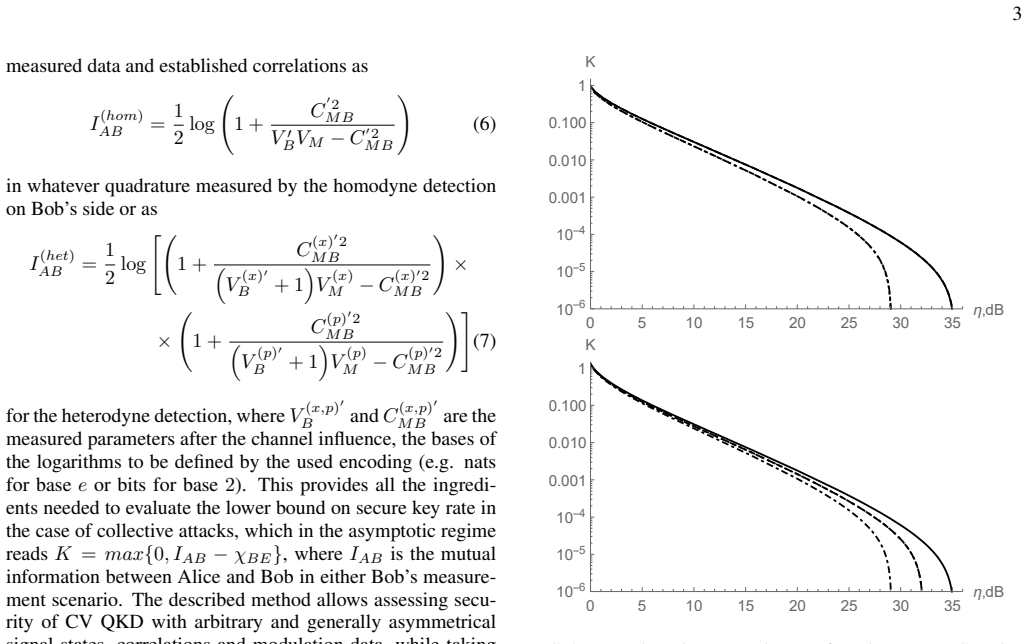
Summary. The paper proposes a security-analysis framework for continuous-variable QKD that constructs an equivalent generally mixed two-mode Gaussian state (Eq. 3) from the experimentally observed variances and correlations, then purifies that state via a four-mode Bloch-Messiah network (Fig. 1) and evaluates the Holevo bound as chi_BE = S(ABCD) - S(ACD|B). The key rate is then K = max{0, I_AB - chi_BE}. The author claims the method applies to arbitrary asymmetric signal states, modulations, and correlations without symmetrization assumptions, and illustrates it on coherent-state protocols with homodyne and heterodyne detection subject to phase-sensitive trusted preparation noise. The central claim is that the framework allows practical security analysis directly from measured data and can predict asymmetry effects.
Significance. If the construction is valid, the framework would fill a real gap: existing purification-based CV QKD security proofs rely on phase-space symmetries or on specific pure-state preparation models, while practical implementations exhibit asymmetric modulation, phase-sensitive trusted noise, and correlations that do not fit those templates. The proposed method would let one directly convert measured quadrature variances and correlations into a valid Holevo bound, without ad hoc symmetrization, and would provide a quantitative tool for studying how asymmetric trusted noise degrades security. The numerical illustration in Sec. III makes a concrete, falsifiable prediction that homodyne protocols are insensitive to preparation noise in the unmeasured quadrature while heterodyne protocols are degraded by asymmetric noise in either quadrature. The paper also benefits from being explicit about the purification construction via Bloch-Messiah decomposition, which is a principled and established tool. However, the construction's central step—the symmetrization choice V_A = V_B after Eq.
major comments (4)
- [Eq. (2) to Eq. (3)] The equation (2) fixes only the ratio C_AB^2/(V_A+1) = C_MB^2/V_M, leaving V_A as a free parameter. The paper then states 'we therefore symmetrize the covariance matrix by putting V_A = V_B in both x and p' without proving that this choice yields a valid or conservative bound. Since different choices of V_A produce different gamma_AB matrices, different four-mode purifications, and generally different entropies S(ABCD) and S(ACD|B), the final key rate K = max{0, I_AB - chi_BE} may depend on V_A. The abstract's claim of 'without any symmetrization assumptions' is therefore not supported by the derivation as written. The author should either prove that the Holevo bound is invariant under the residual freedom in Eq. (2), or show that V_A = V_B gives an upper bound on Eve's information (e.g., by a worst-case or extremality argument), or explicitly state that the framework is a heuristic whose conservativeness must be checked case-by-case.
- [Sec. II, Eqs. (4)-(5)] The purification network equations are internally inconsistent as written. Equation (4) has exponents e^{±s2} V2 + e^{±s1} V1, which would give V_B = (1/2)(e^{s2}V2 + e^{s1}V1) and C_AB = (1/2)(e^{s2}V2 - e^{s1}V1) for the 'plus' quadrature, but the stated solution (5) contains no exponential factors and instead solves V1 = sqrt((V_B^x - C_AB^x)(V_B^p - C_AB^p)), etc. It appears Eq. (4) is missing a factor of 2 in the exponents (or the logarithms in Eq. (5) should involve V1, V2 directly rather than the combination). This discrepancy means the claimed analytic solution does not follow from the displayed system, and the reader cannot verify that the network in Fig. 1 actually reproduces Eq. (3). The author must fix the equations and show the derivation of (5) from (4).
- [Sec. II, physicality of the constructed state] The manuscript does not check that the constructed four-mode state exists for arbitrary measured parameters. The Bloch-Messiah parameters in Eq. (5) are real only if (V_B^x - C_AB^x)(V_B^p - C_AB^p) >= 0 and (V_B^x + C_AB^x)(V_B^p + C_AB^p) >= 0, and the resulting covariance matrix must satisfy the Heisenberg uncertainty principle. For experimentally plausible parameters with strong correlations, C_AB can be close to V_B, so the first factor may be small but the product of the two may still be positive; however, for asymmetric cases with C_AB^x < V_B^x but C_AB^p > V_B^p, the product could become negative, giving imaginary V1. The paper does not state the validity conditions or discuss how the framework handles such data. If the constructed state can be non-physical for allowed input parameters, the framework is not generally applicable as claimed, and the numerical examples may have been selected to avoid this issue.
- [Sec. II, Holevo bound expression] The Holevo bound is written as chi_BE = S(ABCD) - S(ACD|B). This is the correct form for reverse reconciliation under collective attacks when Eve holds the purification of the state shared by Alice and Bob, but only if modes C and D are indeed not accessible to Eve and the state (ABCD) is the full purification. However, the paper does not specify how the channel's action on mode B is modeled after the purification: the channel is lossy and noisy, and the trusted parties' measured parameters V_B' and C_MB' are taken after the channel. The reader needs a clear statement of how the channel is included in gamma_ABCD and how the conditional entropy S(ACD|B) is computed after Bob's measurement (homodyne or heterodyne). Without this, the formalism is not self-contained, and the numerical results in Sec. III cannot be independently reproduced.
minor comments (6)
- [Abstract and Sec. I] The phrase 'without any symmetrization assumptions' in the abstract is too strong given the symmetrization step V_A = V_B in Eq. (3); the abstract should be worded to reflect the actual assumptions of the construction.
- [Sec. II, Eq. (1)] The notation V_A^{(x,p)} and C_AB^{(x,p)} is introduced but the 'x' and 'p' superscripts are dropped in Eq. (2) with the note that the expression is the same in both quadratures; it would be clearer to keep the superscripts throughout to avoid ambiguity when x and p parameters differ.
- [Fig. 1 caption] The caption says 'two variable couplers before and after the squeezers with transmittance values T1,2' but the text then sets T1 = 1, T2 = 1/2; the caption should specify which coupler is T1 and which is T2, and the values should be stated in the figure caption for clarity.
- [Sec. III, Fig. 2] The figure caption and the legend are dense and the line styles are described only in the caption text; labeling the curves directly in the figure or using a legend would improve readability.
- [Sec. II, mutual information formulas] Equations (6) and (7) use primed quantities without explicitly defining the prime notation at the point of first use; they are defined only parenthetically later in the text.
- [General] The paper is written as a 'framework' with a suggested construction, but the language sometimes slips into claiming proven security, e.g., 'the method can be used for security analysis'; the manuscript should consistently distinguish between a proposed method and a proven one, especially given the open points in the major comments.
Circularity Check
No significant circularity: the key-rate bound is a forward computation from measured moments using standard Gaussian-attack security tools, not a fit or a self-referential derivation.
full rationale
The paper's derivation chain is not circular. The key rate K = max{0, I_AB - chi_BE} combines the mutual information computed directly from measured variances and correlations with a Holevo bound chi_BE = S(ABCD) - S(ACD|B) obtained by purifying the equivalent two-mode state (3). The equivalence condition (2) is imposed to match the prepare-and-measure and entanglement-based mutual informations, and the remaining freedom in V_A is then fixed by the explicit choice V_A = V_B. This choice is an extra modeling or conservativeness assumption rather than a parameter fitted to force a desired key rate; the subsequent entropy calculation is a forward computation from the resulting covariance matrix. The numerical examples in Sec. III are parameter scans, not fits, and the conclusions about asymmetries are direct outputs of the assumed parameters, not hidden re-importations of those conclusions. The paper relies on standard, externally established results for optimality of Gaussian collective attacks and for Bloch-Messiah purification, and its self-citations provide background or prior applications of the purification method rather than load-bearing circular justifications. The main caveat is whether the symmetrization V_A = V_B yields a conservative upper bound on Eve's information; that is a validity and soundness concern, not a circularity of the derivation.
Assumptions & free parameters
free parameters (1)
- V_A (Alice equivalent mode variance) =
= V_B (chosen by symmetrization)
assumptions (4)
- domain assumption Optimality of Gaussian collective attacks.
- domain assumption Equivalence between prepare-and-measure and entanglement-based schemes when the reduced state on mode B and the conditional states match.
- standard math Bloch-Messiah decomposition can realize any two-mode Gaussian state with the four-mode network of Fig. 1.
- domain assumption All states and channel noise are Gaussian.
Cite this review
Pith. "Pith review of Generalized security analysis framework for continuous-variable quantum key distribution." pith.science (2026). https://pith.science/paper/4NFRI46X
@misc{pith2026190801127,
  author       = {Pith},
  title        = {Pith review of: Generalized security analysis framework for continuous-variable quantum key distribution},
  year         = {2026},
  howpublished = {\url{https://pith.science/paper/4NFRI46X}},
  note         = {Machine review of arXiv:1908.01127}
}
read the original abstract
Security of practical continuous-variable quantum key distribution is addressed and a security analysis framework, which does not rely on phase-space symmetries of signal states and correlations, is developed. In a general purification-based approach, following optimality of Gaussian collective attacks, it is suggested to find an equivalent generally mixed two-mode state shared between the trusted parties and then purifying it using Bloch-Messiah decomposition. This allows to assess security of the schemes with arbitrary parameters, which can be typically expected in experiments. It also allows to theoretically predict the role of asymmetries of signals and correlations on security of the protocols. The method can be used for security analysis of practical continuous-variable schemes directly from the measured data without any symmetrization assumptions.
Figures

Reference graph
Works this paper leans on
-
[1]
Pirandola, et al., arXiv preprint arXiv:1906.01645 (2019),
S. Pirandola, et al., arXiv preprint arXiv:1906.01645 (2019),
arXiv 2019
- [2]
-
[3]
N. J. Cerf, M. Levy, and G. Van Assche, Phys. Rev. A 63, 052311 (2001)
2001
-
[4]
Grosshans and P
F. Grosshans and P. Grangier, Phys. Rev. Lett. 88, 057902 (2002)
2002
-
[5]
M. Navascu ´es, F. Grosshans, and A. Acin, Phys. Rev. Lett. 97, 190502 (2006)
work page 2006
-
[6]
R. Garcia-Patron and N. J. Cerf, Phys. Rev. Lett. 97, 190503 (2006)
work page 2006
-
[7]
V . C. Usenko and R. Filip, Entropy18, 20 (2016)
work page 2016
-
[8]
F. Grosshans, N. J. Cerf, J. Wenger, R. Tualle-Brouri, and P. Grangier, Quantum Inf. Comput.3, 535 (2003)
work page 2003
Show all 18 references
-
[9]
V . C. Usenko and R. Filip, New J. Phys.13, 113007 (2011)
2011
-
[10]
Derkach, V
I. Derkach, V . C. Usenko, and R. Filip, Phys. Rev. A96, 062309 (2017)
2017
-
[11]
Lodewyck, et al., Phys
J. Lodewyck, et al., Phys. Rev. A 76, 042305 (2007)
2007
-
[12]
V . C. Usenko and R. Filip, Phys. Rev. A81, 022318 (2010)
2010
-
[13]
S. L. Braunstein, Phys. Rev. A 71, 055801 (2005)
2005
-
[14]
Leverrier, F
A. Leverrier, F. Grosshans, and P. Grangier, Phys. Rev. A 81, 062343 (2010)
2010
-
[15]
Ruppert, V
L. Ruppert, V . C. Usenko, and R. Filip, Phys. Rev. A90, 062310 (2014)
2014
-
[16]
In the case of the state (3), which consists of four unknown parameters, the scheme in Fig
to find purification of generally noisy two-mode entan- gled states. In the case of the state (3), which consists of four unknown parameters, the scheme in Fig. 1 can be simplified by settingT1 = 1,T 2 = 1/2. The parameters of the two-mode state (3) are then related to the purific...
-
[17]
L. S. Madsen, V . C. Usenko, M. Lassen, R. Filip, and U. L. Andersen, Nature Communications 3, 1083 (2012)
2012
-
[18]
Weedbrook, et al., Phys
C. Weedbrook, et al., Phys. Rev. Lett. 93, 170504 (2004)
2004
Reviewed August 14, 2026 · model on record in the stance chip above.
Discussion (0). Continue with ORCID to comment.