REVIEW 4 major objections 5 minor 6 references
Partition of Unity Neural Networks for Interpretable Classification with Explicit Class Regions
T0 review · 4 major / 5 minor · reviewed 2026-08-03 · deepseek-v4-flash
Pith's one-line read Softmax can be replaced by a hierarchical product of gates without losing expressive power, and the paper proves it.
desk verdict Correct but narrow density theorem for a hierarchical product-of-gates classifier; the bump-gate experiments are impossible as written because the bump's maximum is below 1/2. read the letter →
The pith
A machine-rendered reading of the paper's core claim, the machinery that carries it, and where it could break.
The reading
What carries the argument
The central object is the recursive partition-of-unity construction: h_1 = g_1, h_i = (product of (1-g_j) for j<i) times g_i, and h_k = product of (1-g_j) for all j<k. Each gate g_i is a function into [0,1] representing an acceptance score for class i, and the products ensure that the h_i sum to 1 by the identity S_m = 1 - product_{j=1}^m (1-g_j). The proof's load-bearing step is the exact factorization of any strictly positive probability map into conditional acceptance probabilities gamma_i = p_i / (p_i + ... + p_k); this reduces the approximation problem to universal approximation of continuous gate arguments, making the architecture's expressiveness inherit from classical neural-network
What would settle it
Take K = [0,1], k=2, and the continuous probability map p(x) = (x, 1-x), which has p_1(0) = 0. The theorem's construction defines gamma_1(x) = p_1(x)/(p_1(x)+p_2(x)) and then applies g^{-1}(gamma_1); at x=0 this argument is undefined, so the claimed density for all continuous probability maps would fail if no PUNN with a strictly monotone gate can uniformly approximate p within an arbitrarily small epsilon. More generally, checking whether uniform approximation still holds for maps with zero coordinates would settle whether the positivity restriction is essential.
Extended reading notes
Core claim
The core discovery is a density theorem for PUNN. For a compact domain K, any continuous probability map p taking values in the relative interior of the probability simplex, and any strictly monotone continuous gate activation g (such as the sigmoid), for every epsilon greater than zero there exist feedforward neural networks theta_1,...,theta_{k-1} such that the PUNN partition functions h_i approximate p_i uniformly within epsilon. The proof shows that any such p can be exactly factorized into conditional gate values gamma_i = p_i / (p_i + ... + p_k), then uses the inverse of g to convert these into continuous gate arguments, which universal approximators can fit; continuity of g then contr
Load-bearing premise
The load-bearing premise is that the target class probabilities are continuous and strictly positive at every point, and that the gate activation is strictly monotonic with a continuous inverse (like the sigmoid); if any class probability touches zero, or the gate is Gaussian or a bump function, the proof's inversion step fails even though the architecture still produces a valid partition.
Editorial extensions
If this is right
- Replacing softmax with a partition-of-unity construction does not restrict the space of representable class-probability distributions on compact domains.
- PUNN classifiers come with explicit class regions: each gate function gives a standalone accept/reject score for a class, enabling 'why not class X?' reasoning without post-hoc explanation tools.
- The architecture matches MLP accuracy to within 0.3-0.6 percentage points on tabular benchmarks and reaches 97.85% on MNIST versus 98.19% for an MLP, showing that interpretable-by-design models can be competitive in practice.
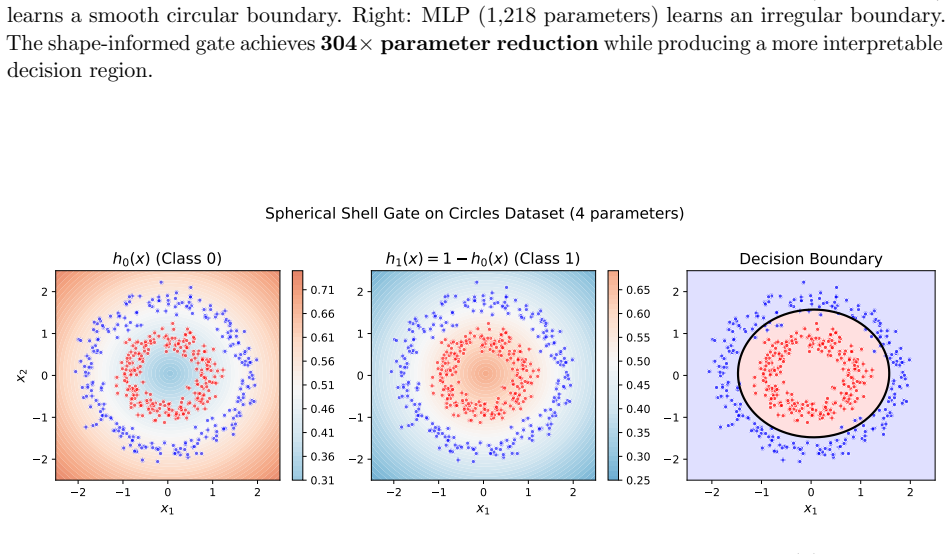
- Because the partition-of-unity property holds for any gate activation and any parameterization, gates can mix neural networks with geometric primitives, and using more partitions than classes allows modeling multi-modal classes.
- Class ordering does not affect the representational power established by the density theorem, though it may change optimization dynamics.
Reading between the lines
- The density proof requires the target probability map to be strictly positive in every class at every point; in settings where calibrated zero-probability regions matter, such as out-of-distribution detection, PUNN with sigmoid gates can only approximate those zeros, so explicit handling of zero-probability regions would be a natural extension beyond the paper's claims.
- The factorization gamma_i = p_i / (tail sum) suggests that approximation error can be decomposed into the error of each conditional gate, which may support concrete approximation-rate bounds in terms of the number of gates and their capacity; the paper lists this as future work, but the mechanism makes it a plausible next step.
- A direct testable consequence of the theorem is that permuting the class ordering should not change the best achievable uniform error for a given capacity; if experiments show ordering significantly affects the attainable accuracy, that would indicate an optimization-side limitation rather than a representational one.
- Shape-informed gates' dramatic parameter reductions on geometrically simple data suggest that combining PUNN with learned geometric priors could serve as a general tool for low-data regimes, although the paper only demonstrates this on small synthetic and tabular problems.
Editorial analysis
A structured set of objections, weighed in public.
Referee Report
Summary. The paper introduces Partition of Unity Neural Networks (PUNN), a classifier architecture that defines class probabilities h_i(x) through a recursive product of gate functions g_i(x), so that sum_i h_i(x)=1 by construction and no softmax layer is needed. The authors claim a density theorem: PUNN with MLP gates can approximate any continuous probability map p:K -> ri(Delta^{k-1}) on a compact set K to arbitrary accuracy, provided the gate activation is a strictly monotone continuous function. They also propose shape-informed gates (spherical shells, ellipsoids, Fourier/shell harmonics) for parameter-efficient classification, and report experiments on synthetic datasets, UCI benchmarks, and MNIST claiming accuracy within 0.3--0.6% of standard MLPs. The central theoretical proof is a standard epsilon-delta construction based on universal approximation, and the architecture is an interesting interpretable-by-design alternative to softmax. However, the empirical section contains a serious internal inconsistency for the PUNN-Bump variant, and several theoretical/abstract claims overstate the scope of the density result.
Significance. If corrected, the paper would make a useful contribution: it provides a clear architectural framework with a rigorous (if narrow) density theorem, a built-in hierarchical accept/reject interpretation, and a parameter-efficient geometric parameterization that is unusual in deep learning. The code is promised in the manuscript, which would help reproducibility. The density proof, though standard, is carefully written and appears correct for strictly monotone activations. The main obstacle is that the empirical results for the bump gate, as defined, are impossible, and the abstract/summary claims about Gaussian and bump activations contradict the theorem's hypotheses. These issues affect the paper's central claims of empirical competitiveness and general density, so they must be fixed before the paper can be considered sound.
major comments (4)
- [Section 3.1 / Section 5.2.2 / Tables 1 and 3] The bump gate is defined as g(t)=exp(-1/(1-t^2)) for |t|<1 and 0 otherwise, whose maximum is e^{-1}≈0.368 at t=0. In the binary classification setup (Section 5.2.2), h0=g0 and h1=1-g0, so h1(x)≥0.632 for every x. The argmax is therefore always class 1, making PUNN-Bump a constant classifier. On balanced synthetic datasets, such a classifier would achieve roughly 50% accuracy, yet Table 1 reports 99--100% for PUNN-Bump on Moons, Circles, XOR, and Helix; Table 3 reports 94--96% on UCI benchmarks. These results cannot have been produced by the architecture as defined. The same saturation constrains multiclass settings. This invalidates the paper's claim that all gate variants are competitive.
- [Section 4.1 / Abstract / Section 4.2] Theorem 5 assumes g:R->(0,1) is strictly monotone and continuous, so that g^{-1} is well-defined and continuous. Gaussian (g(t)=exp(-t^2)) is not monotone and attains 1 at t=0; the bump function is not monotone and has a flat zero region. Yet the abstract claims density for 'various activation functions (sigmoid, Gaussian, bump)' and Section 4.2 states that 'any activation can be combined with any parameterization.' These statements are unsupported by the theorem and, as stated, false. The density result should be explicitly restricted to strictly monotone activations, or separate density arguments for non-monotone activations must be supplied.
- [Table 1 / Section 5.2.2] The parameter counts in Table 1 are inconsistent with the text. Section 5.2.2 states that for Helix the bump gate uses a larger NN with 128 hidden units, giving 17,026 parameters, but Table 1 lists 1,186 parameters for PUNN-Bump. If the table reports a single architecture for all datasets, the Helix description is wrong; if different architectures are used, the table should report per-configuration parameter counts. This also affects the later discussion of parameter efficiency for multiple partitions.
- [Abstract / Theorem 5] The abstract and introduction state that PUNN is dense in the space of continuous probability maps on compact domains, without noting that Theorem 5 requires the target map to take values in the relative interior ri(Δ^{k-1}), i.e., all class probabilities strictly positive. Continuous maps touching the simplex boundary are excluded. This is a caveat worth stating in the main narrative, because a user of the architecture may reasonably expect approximation of degenerate probability maps as well.
minor comments (5)
- [Tables 1, 2, 3] No error bars or standard deviations are reported in Tables 1--3, despite the text saying results are averaged over 3--5 seeds. Tables 5 and 6 include variance, so the omission in the main comparison tables is conspicuous and should be fixed for reproducibility.
- [Figures 1--4] The figure numbering in the text is inconsistent: Section 5.2.5 refers to 'Figure 4' for the partition functions h0 and h1, while later text refers to 'Figure 2' for the same content. The paper should renumber and cross-reference carefully, especially in a camera-ready version.
- [Section 5.2.2] The notation h0/h1 appears only in the binary experiment section, while the architecture in Section 3.1 defines h1,...,hk. It is also slightly confusing that the class index starts at 0 here. A short remark aligning the notation would help.
- [References] The reference 'Plessis and Sugiyama, 2015' should be 'du Plessis and Sugiyama' to match the author name in the bibliography. Also, the paper cites its own companion work (Lee et al. 2021) but the relationship is described only briefly; a sentence clarifying differences would be useful.
- [Section 6.4] Table 4 reports a 304× parameter reduction for Circles but gives no error bars. Since Table 5 and 6 show substantial variance for the same kind of geometric gates, it would strengthen the parameter-efficiency claim to include mean±std for the shape-informed comparisons as well.
Circularity Check
No significant circularity; Theorem 5 is an external-UAT-based density proof.
full rationale
The density theorem (Theorem 5, Section 4.1) is a standard constructive density argument, not a circular prediction. For a target p, the proof defines continuous targets φ_i = g^{-1}(p_i / Σ_{j≥i} p_j), then invokes the classical universal approximation theorem (Cybenko 1989; Hornik et al. 1989) to approximate φ_i with feedforward networks; the identity h_i = p_i is then exact by the recursive partition formula. The only external input is the classical UAT, which is independent of this paper and not fitted to the paper's own outputs. There is no fitted parameter renamed as a prediction: the theorem states existence of approximators for any p, which is the standard meaning of density. The paper contains no self-citations, no author-imported uniqueness theorem, and no ansatz smuggled through citations. The abstract's omission of the relative-interior restriction and the inapplicability of Theorem 5 to Gaussian/bump gates is an overclaim (and the PUNN-Bump saturation, max g = e^{-1} ≈ 0.368, makes several reported binary accuracies internally inconsistent), but these are correctness issues, not equivalences by construction. No load-bearing step reduces to its own inputs.
Assumptions & free parameters
free parameters (5)
- Spherical shell gate parameters (center, radius, sharpness) =
4 on Circles; 10 on Concentric Rings
- Ellipsoid gate parameters (center, axis radii, sharpness) =
20 on Iris
- Fourier shell harmonic count K =
5 (Moons)
- Spherical harmonics degree L =
2 (Iris)
- Number of partitions in Circles ablation =
8
assumptions (4)
- standard math Universal Approximation Theorem for feedforward networks (Cybenko 1989; Hornik et al. 1989)
- domain assumption Strictly monotone continuous gate activation g with continuous inverse
- domain assumption Target probability map p takes values in the relative interior of the simplex (p_i > 0 everywhere)
- standard math Partition-of-unity arithmetic (product of gates sums to 1)
Cite this review
Pith. "Pith review of Partition of Unity Neural Networks for Interpretable Classification with Explicit Class Regions." pith.science (2026). https://pith.science/paper/4NRVQ5VF
@misc{pith2026260200511,
  author       = {Pith},
  title        = {Pith review of: Partition of Unity Neural Networks for Interpretable Classification with Explicit Class Regions},
  year         = {2026},
  howpublished = {\url{https://pith.science/paper/4NRVQ5VF}},
  note         = {Machine review of arXiv:2602.00511}
}
abstract
Despite their empirical success, neural network classifiers remain difficult to interpret. In softmax-based models, class regions are defined implicitly as solutions to systems of inequalities among logits, making them difficult to extract and visualize. We introduce Partition of Unity Neural Networks (PUNN), an architecture in which class probabilities arise directly from a learned partition of unity, without requiring a softmax layer. PUNN constructs $k$ nonnegative functions $h_1, \ldots, h_k$ satisfying $\sum_i h_i(x) = 1$, where each $h_i(x)$ directly represents $P(\text{class } i \mid x)$. Unlike softmax, where class regions are defined implicitly through coupled inequalities among logits, each PUNN partition function $h_i$ directly defines the probability of class $i$ as a standalone function of $x$. We prove that PUNN is dense in the space of continuous probability maps on compact domains. The gate functions $g_i$ that define the partition can use various activation functions (sigmoid, Gaussian, bump) and parameterizations ranging from flexible MLPs to parameter-efficient shape-informed designs (spherical shells, ellipsoids, spherical harmonics). Experiments on synthetic data, UCI benchmarks, and MNIST show that PUNN with MLP-based gates achieves accuracy within 0.3--0.6\% of standard multilayer perceptrons. When geometric priors match the data structure, shape-informed gates achieve comparable accuracy with up to 300$\times$ fewer parameters. These results demonstrate that interpretable-by-design architectures can be competitive with black-box models while providing transparent class probability assignments.
Figures


Figures from the paper (1 more)
Reference graph
Works this paper leans on
-
[1989]
Towards a rigorous science of interpretable machine learning
Finale Doshi-Velez and Been Kim. Towards a rigorous science of interpretable machine learning. arXiv preprint arXiv:1702.08608,
-
[1991]
Sarthak Jain and Byron C. Wallace. Attention is not explanation. InProceedings of the 2019 Conference of the North American Chapter of the Association for Computational Linguistics (NAACL),
2019
-
[1994]
Diederik P. Kingma and Jimmy Ba. Adam: A method for stochastic optimization.arXiv preprint arXiv:1412.6980,
-
[1998]
Yann LeCun, Yoshua Bengio, and Geoffrey Hinton
doi: 10.1109/5.726791. Yann LeCun, Yoshua Bengio, and Geoffrey Hinton. Deep learning.Nature, 521(7553):436–444,
-
[2015]
Kookjin Lee, Nathaniel A. Trask, Ravi G. Patel, Mamikon A. Gulian, and Eric C. Cyr. Partition of unity networks: Deep hp-approximation.arXiv preprint arXiv:2101.11256,
-
[2017]
Interpretable machine learning.arXiv preprint arXiv:2003.04237,
Christoph Molnar. Interpretable machine learning.arXiv preprint arXiv:2003.04237,
arXiv 2003
Reviewed August 3, 2026 · model on record in the stance chip above.
Discussion (0). Continue with ORCID to comment.