Jas: AI-Paired Engineering as a Revival of N-Version Programming
Pith reviewed 2026-06-27 21:06 UTC · model grok-4.3
The pith
AI-paired engineering with a YAML specification and parallel ports revives N-version programming for single-developer large projects.
A machine-rendered reading of the paper's core claim, the machinery that carries it, and where it could break.
Core claim
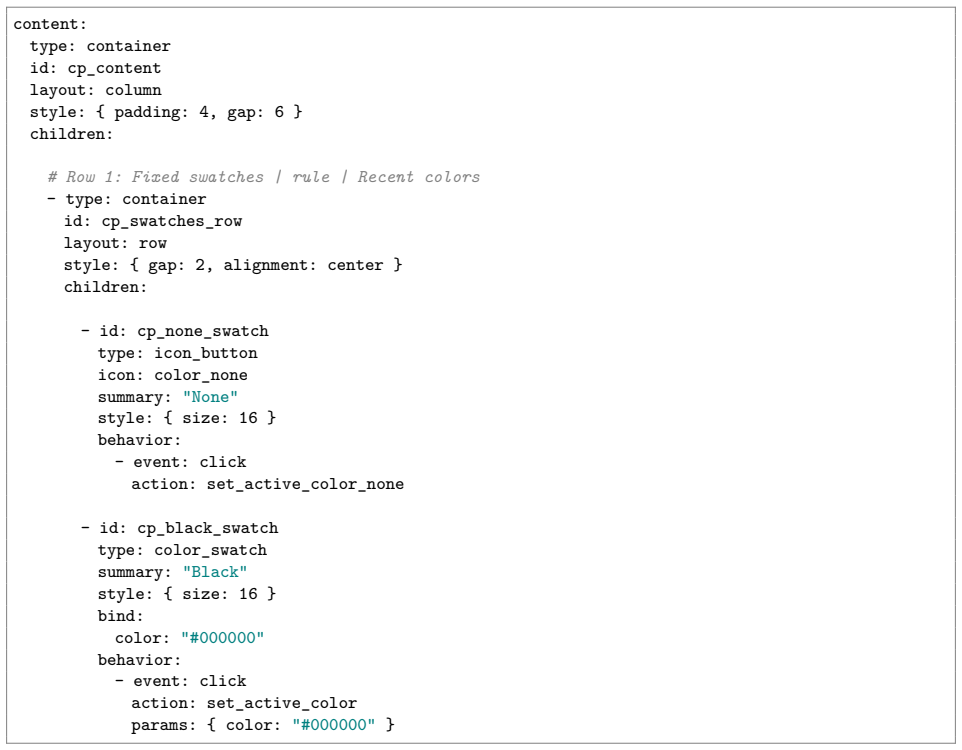
Pairing AI-assisted coding with an executable YAML specification as the single source of truth and with multiple independent implementations functioning as a built-in differential-testing layer allows a single developer to deliver five complete, working language ports of a complex application in 120 hours, where the shared 23,000-line specification keeps the native codebases manageable and the ports serve as mutual verification.
What carries the argument
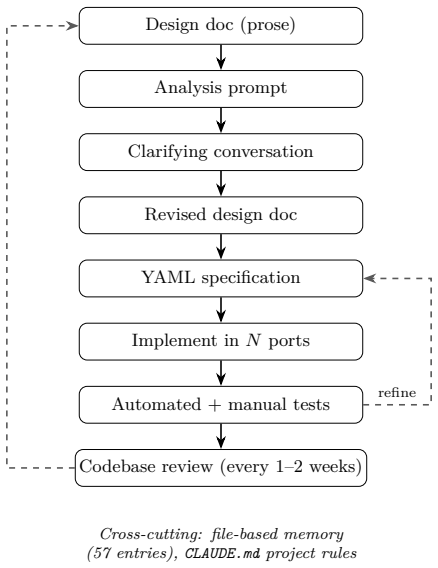
The two safeguards of an executable YAML specification serving as single source of truth together with parallel implementations providing differential testing, used in tandem with AI code generation.
If this is right
- Scope of work that conventionally requires multiple developer-years becomes feasible for a single developer.
- N-version programming regains practicality because AI reduces the cost of producing the independent versions.
- The YAML specification acts as an escape hatch that keeps native code volume from scaling with the full specification size.
- Portability across languages is achieved by treating each port as an independent verification of the shared specification.
Where Pith is reading between the lines
- If the safeguards remain lightweight, development teams could shift effort from writing code to maintaining the executable specification.
- The approach may extend to non-software engineering tasks that can be expressed as precise specifications with multiple realizations.
- Verification that the YAML specification itself is correct and complete could emerge as the new primary bottleneck.
- Cross-developer experiments would be needed to test whether the reported productivity holds when the initial specification author is not the only participant.
Load-bearing premise
The single 120-hour case study with one developer and one application will generalize to other developers, larger scopes, and different domains without the YAML specification or differential-testing layer turning into a comparable new bottleneck.
What would settle it
A replication attempt on a different application or by a different developer that requires total effort comparable to traditional multi-developer-year development despite using the same YAML specification and parallel-port safeguards.
Figures
read the original abstract
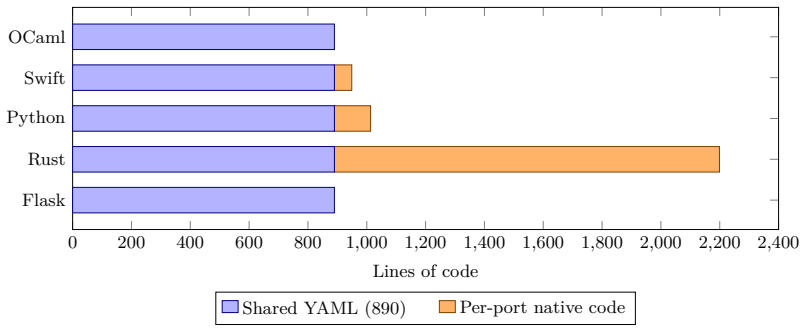
I report a case study in AI-paired software engineering: five working ports of a vector illustration application across Rust, Swift, OCaml, Python, and browser-based platforms, built by a single developer in approximately 120 evening hours. The methodology pairs AI-assisted implementation with two safeguards -- a precise executable YAML specification serving as the single source of truth, and parallel implementations functioning as a built-in differential-testing layer. The five ports share a 23{,}000-line specification; per-port native code ranges from 0 to roughly 95{,}000 lines, reflecting the specification's escape hatch. I argue that AI-paired engineering, conditional on these two safeguards, makes feasible scope of work that conventionally requires multiple developer-years, and frame the methodology as a revival of N-version programming, a 1980s approach abandoned on cost grounds that AI changes. The paper reports concrete artifacts and honest limitations of the single-developer case study.
Editorial analysis
A structured set of objections, weighed in public.
Referee Report
Summary. The manuscript reports a single-developer case study in which five working ports of a vector-illustration application were produced across Rust, Swift, OCaml, Python, and browser platforms in approximately 120 evening hours. The approach pairs AI-assisted coding with an executable 23,000-line YAML specification as the single source of truth and parallel implementations as a differential-testing layer; per-port native code ranges from 0 to ~95 k lines. The author argues that, conditional on these safeguards, AI-paired engineering revives N-version programming by rendering feasible scopes of work that conventionally require multiple developer-years.
Significance. The reported productivity (five distinct implementations in 120 hours) supplies a concrete, artifact-backed data point on AI-assisted development that could, if replicated, inform cost models for multi-version software. The explicit YAML spec and differential-testing mechanism are presented as reusable safeguards, and the paper is candid about its single-developer scope; these elements constitute modest but genuine strengths for a case-study contribution in software engineering.
major comments (2)
- [Abstract and concluding discussion] The central claim that the methodology 'makes feasible scope of work that conventionally requires multiple developer-years' (abstract and closing argument) rests solely on the reported 120-hour instance without any baseline estimate, historical effort data, or controlled comparison for equivalent functionality; the 23 k-line spec size and per-port line counts are given but do not substitute for such a comparison.
- [Methodology and results sections] The generalization that the YAML-spec-plus-differential-testing safeguards will remain sub-linear when developer, application, or domain changes is asserted without supporting measurements; the manuscript itself labels the work a single-developer case study, yet the revival-of-NVP framing treats the observed compression as indicative rather than provisional.
minor comments (2)
- [Abstract] The abstract states that the ports 'share a 23,000-line specification' but does not clarify whether the YAML is machine-executable for code generation or only for differential testing; a brief clarification would aid reproducibility.
- [Results] Line-count ranges (0–95 k) are reported per port; adding a short table or explicit mapping of which ports correspond to which counts would improve clarity.
Simulated Author's Rebuttal
We thank the referee for the constructive review and the recommendation for major revision. We agree that the central claims require more provisional framing to align with the single-developer case-study scope. We address each major comment below and will revise the manuscript to qualify the assertions accordingly.
read point-by-point responses
-
Referee: [Abstract and concluding discussion] The central claim that the methodology 'makes feasible scope of work that conventionally requires multiple developer-years' (abstract and closing argument) rests solely on the reported 120-hour instance without any baseline estimate, historical effort data, or controlled comparison for equivalent functionality; the 23 k-line spec size and per-port line counts are given but do not substitute for such a comparison.
Authors: We agree that the claim rests on the single reported instance without a baseline or controlled comparison. As this is a case study, we lack access to historical effort data for equivalent multi-platform functionality. The manuscript already states its single-developer scope and limitations. We will revise the abstract and concluding discussion to frame the claim more provisionally (e.g., 'this case suggests that AI-paired engineering may render feasible scopes of work that conventionally require multiple developer-years, subject to further validation'). We will also add an explicit note on the absence of baselines as a limitation. revision: yes
-
Referee: [Methodology and results sections] The generalization that the YAML-spec-plus-differential-testing safeguards will remain sub-linear when developer, application, or domain changes is asserted without supporting measurements; the manuscript itself labels the work a single-developer case study, yet the revival-of-NVP framing treats the observed compression as indicative rather than provisional.
Authors: We accept that no supporting measurements for generalization are provided and that the NVP-revival framing should not treat the compression as indicative. We will revise the methodology, results, and framing sections to state explicitly that sub-linear scaling and safeguard behavior are observations from this specific case study. The revival-of-NVP argument will be repositioned as a hypothesis motivated by the reported instance, with an explicit call for future replication across developers and domains. revision: yes
Circularity Check
No circularity: case study report grounds claims in reported experience without reduction to inputs by construction
full rationale
The manuscript is a single-developer case study reporting five ports completed in ~120 hours using a YAML specification and differential testing. The central argument extrapolates from these concrete artifacts and stated limitations to a broader feasibility claim and a historical framing as N-version programming revival. No equations, fitted parameters, or self-citations appear in the provided text; the generalization step is an explicit assumption rather than a definitional loop or renamed fit. The derivation chain therefore remains self-contained against external benchmarks and does not reduce any prediction to its own inputs.
Axiom & Free-Parameter Ledger
Reference graph
Works this paper leans on
-
[1]
IEEE Transactions on Software Engineering , volume =
Avizienis, Algirdas , title =. IEEE Transactions on Software Engineering , volume =. 1985 , doi =
1985
-
[2]
and Leveson, Nancy G
Knight, John C. and Leveson, Nancy G. , title =. IEEE Transactions on Software Engineering , volume =
-
[3]
, title =
McKeeman, William M. , title =. Digital Technical Journal , volume =
-
[4]
Proceedings of the 32nd ACM SIGPLAN Conference on Programming Language Design and Implementation , series =
Yang, Xuejun and Chen, Yang and Eide, Eric and Regehr, John , title =. Proceedings of the 32nd ACM SIGPLAN Conference on Programming Language Design and Implementation , series =. 2011 , doi =
2011
-
[5]
An Overview of the
Ro. An Overview of the. Journal of Logic and Algebraic Programming , volume =. 2010 , doi =
2010
-
[6]
and Titzer, Ben L
Haas, Andreas and Rossberg, Andreas and Schuff, Derek L. and Titzer, Ben L. and Holman, Michael and Gohman, Dan and Wagner, Luke and Zakai, Alon and Bastien, JF , title =. Proceedings of the 38th ACM SIGPLAN Conference on Programming Language Design and Implementation , series =. 2017 , doi =
2017
-
[7]
2023 , eprint =
Peng, Sida and Kalliamvakou, Eirini and Cihon, Peter and Demirer, Mert , title =. 2023 , eprint =
2023
-
[8]
Alice and Rice, Andrew and Rifkin, Devon and Simister, Shawn and Sittampalam, Ganesh and Aftandilian, Edward , title =
Ziegler, Albert and Kalliamvakou, Eirini and Li, X. Alice and Rice, Andrew and Rifkin, Devon and Simister, Shawn and Sittampalam, Ganesh and Aftandilian, Edward , title =. Communications of the ACM , volume =. 2024 , doi =
2024
-
[9]
2025 , eprint =
Measuring the Impact of Early-2025. 2025 , eprint =
2025
-
[10]
Inkscape: Free and Open-Source Vector Graphics Software , year =
-
[11]
2003 , isbn =
Pfiffner, Pamela , title =. 2003 , isbn =
2003
discussion (0)
Sign in with ORCID, Apple, or X to comment. Anyone can read and Pith papers without signing in.