Multistage dynamical modeling of heavy-ion collisions
Pith reviewed 2026-06-26 10:06 UTC · model grok-4.3
The pith
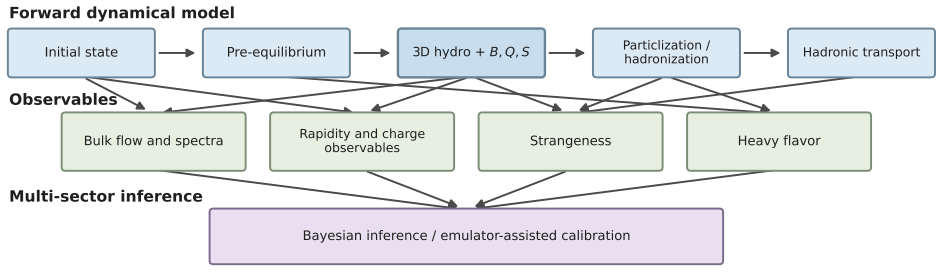
Multistage dynamical models connect heavy-ion observables to QCD matter properties at finite density via multi-sector inference.
A machine-rendered reading of the paper's core claim, the machinery that carries it, and where it could break.
Core claim
At RHIC Beam Energy Scan energies the breaking of longitudinal boost invariance requires multistage dynamical models to incorporate charge stopping and rapidity-dependent observables. Strange hadrons are sensitive to the local chemical environment and conserved-charge correlations while heavy flavor probes microscopic transport and hadronization. Combining these observables within multi-sector inference frameworks provides a path toward more robust constraints on the equation of state and transport properties of QCD matter.
What carries the argument
Multistage dynamical models that link bulk evolution to conserved charges, strangeness, and heavy-flavor observables for multi-sector inference.
If this is right
- Rapidity-dependent charge stopping becomes essential for constraining the finite-density QCD medium.
- Strange hadrons reveal local chemical environment and conserved-charge correlations.
- Heavy flavor observables constrain microscopic transport and hadronization mechanisms.
- Multi-sector inference frameworks reduce overall uncertainties on the equation of state and transport coefficients.
Where Pith is reading between the lines
- The framework could be tested for consistency by applying the same multistage models to multiple independent RHIC data sets simultaneously.
- Open modeling issues identified in the paper may indicate specific missing physics that future simulations must add.
- Success in this multi-sector approach would naturally extend to higher-energy collisions where boost invariance holds more closely.
Load-bearing premise
Multistage dynamical models can accurately map final-state observables back to the underlying properties of the deconfined QCD medium without large uncontrolled systematics from model choices or missing physics.
What would settle it
Different multistage models fitted to identical sets of rapidity-dependent charge stopping, strange hadron, and heavy-flavor data producing mutually inconsistent equation-of-state parameters that cannot be reconciled by parameter tuning.
Figures
read the original abstract
Relativistic heavy-ion collisions create deconfined QCD matter whose properties must be inferred from final-state observables through dynamical modeling. This contribution discusses recent progress and open issues in multistage simulations, with emphasis on the connection between bulk evolution, conserved charges, strangeness, and heavy flavor. At RHIC Beam Energy Scan energies, the breaking of longitudinal boost invariance makes charge stopping and rapidity-dependent observables essential for constraining the finite-density medium. Strange hadrons are sensitive to the local chemical environment and conserved-charge correlations, while heavy flavor probes microscopic transport and hadronization. Combining these observables within multi-sector inference frameworks provides a path toward more robust constraints on the equation of state and transport properties of QCD matter.
Editorial analysis
A structured set of objections, weighed in public.
Referee Report
Summary. The manuscript is a perspective/proceedings contribution summarizing recent progress and open issues in multistage dynamical modeling of relativistic heavy-ion collisions. It focuses on connecting bulk hydrodynamic evolution to conserved-charge dynamics, strangeness production, and heavy-flavor transport, with particular attention to the breaking of boost invariance at RHIC Beam Energy Scan energies. The central forward-looking claim is that integrating rapidity-dependent charge stopping, strange-hadron yields, and heavy-flavor observables within multi-sector inference frameworks offers a route to more robust constraints on the QCD equation of state and transport coefficients.
Significance. As a perspective piece that explicitly flags open issues rather than asserting that current models already achieve accurate mapping without large systematics, the work has value in guiding community efforts. Its strength lies in identifying the necessity of multi-sector approaches to address uncontrolled model dependencies; if pursued, such frameworks could improve the reliability of EOS and transport extractions. The manuscript does not contain new derivations, data, or quantitative validations, so its significance is primarily organizational and forward-looking.
minor comments (1)
- The abstract and text use the phrase 'multi-sector inference frameworks' without a brief definition or reference to prior literature on the term; adding one sentence of clarification would improve accessibility for readers outside the immediate subfield.
Simulated Author's Rebuttal
We thank the referee for the careful reading and positive assessment of our perspective contribution. The recommendation to accept is appreciated, and we agree that the manuscript's value lies in its forward-looking identification of open issues and the need for multi-sector approaches.
Circularity Check
No significant circularity
full rationale
The manuscript is a perspective/proceedings summary of recent progress and open issues in multistage heavy-ion modeling. It contains no new derivations, equations, fitting procedures, or load-bearing claims that reduce to self-citations or inputs by construction. The central forward-looking statement about multi-sector inference frameworks is presented as a path for future work rather than an asserted result, and the text explicitly flags uncontrolled systematics and the need for further development. No patterns from the enumerated list apply.
Axiom & Free-Parameter Ledger
Forward citations
Cited by 1 Pith paper
-
Rapidity-even directed flow splitting of protons and antiprotons as a probe of baryon stopping in relativistic heavy-ion collisions
The mid-rapidity curvature of Δv₁^even(p − p̄) is proposed as a robust discriminator of initial-state baryon rapidity profiles motivated by double-junction stopping.
Reference graph
Works this paper leans on
-
[1]
Arslandok, et al., Hot QCD White Paper (3 2023).arXiv:2303.17254
M. Arslandok, et al., Hot QCD White Paper (3 2023).arXiv:2303.17254
arXiv 2023
-
[2]
Sorensen, et al., Dense nuclear matter equation of state from heavy-ion collisions, Prog
A. Sorensen, et al., Dense nuclear matter equation of state from heavy-ion collisions, Prog. Part. Nucl. Phys. 134 (2024) 104080.arXiv:2301.13253,doi:10.1016/j.ppnp.2023.104080
-
[3]
Paquet, Applications of emulation and Bayesian methods in heavy-ion physics, J
J.-F. Paquet, Applications of emulation and Bayesian methods in heavy-ion physics, J. Phys. G 51 (10) (2024) 103001.arXiv:2310.17618,doi:10.1088/1361-6471/ad6a2b
-
[4]
L. Apolinário, Y .-J. Lee, M. Winn, Heavy quarks and jets as probes of the QGP, Prog. Part. Nucl. Phys. 127 (2022) 103990.arXiv:2203.16352,doi:10.1016/j.ppnp.2022.103990
-
[5]
Fan, et al., Multiscale evolution of charmed particles in a nuclear medium, Phys
W. Fan, et al., Multiscale evolution of charmed particles in a nuclear medium, Phys. Rev. C 107 (5) (2023) 054901.arXiv:2208.00983,doi:10.1103/PhysRevC.107.054901
-
[6]
L. Du, A. Sorensen, M. Stephanov, The QCD phase diagram and Beam Energy Scan physics: A theory overview, Int. J. Mod. Phys. E 33 (07) (2024) 2430008.arXiv:2402.10183,doi:10.1142/9789811294679_0007
- [7]
-
[8]
A. Gordeev, S. A. Bass, B. Mueller, J.-F. Paquet, Quark flavor equilibration of the quark-gluon plasma, Phys. Rev. C 113 (1) (2026) 014906.arXiv:2501.06433,doi:10.1103/w7tz-mlh7
-
[9]
L. Du, Bulk medium properties of heavy-ion collisions from the beam energy scan with a multistage hydro- dynamic model, Phys. Rev. C 110 (1) (2024) 014904.arXiv:2401.00596,doi:10.1103/PhysRevC.110. 014904
-
[10]
G. S. Denicol, C. Gale, S. Jeon, A. Monnai, B. Schenke, C. Shen, Net baryon diffusion in fluid dynamic simulations of relativistic heavy-ion collisions, Phys. Rev. C 98 (3) (2018) 034916.arXiv:1804.10557, doi:10.1103/PhysRevC.98.034916. 5
work page internal anchor Pith review Pith/arXiv arXiv doi:10.1103/physrevc.98.034916 2018
-
[11]
L. Du, H. Gao, S. Jeon, C. Gale, Rapidity scan with multistage hydrodynamic and statistical thermal models, Phys. Rev. C 109 (1) (2024) 014907.arXiv:2302.13852,doi:10.1103/PhysRevC.109.014907
-
[12]
L. Du, C. Shen, S. Jeon, C. Gale, Probing initial baryon stopping and equation of state with rapidity-dependent directed flow of identified particles, Phys. Rev. C 108 (4) (2023) L041901.arXiv:2211.16408,doi:10. 1103/PhysRevC.108.L041901
arXiv 2023
-
[13]
L. Du, U. Heinz, (3+1)-dimensional dissipative relativistic fluid dynamics at non-zero net baryon density, Com- put. Phys. Commun. 251 (2020) 107090.arXiv:1906.11181,doi:10.1016/j.cpc.2019.107090
-
[14]
Diffusion of conserved charges in relativistic heavy ion collisions
M. Greif, J. A. Fotakis, G. S. Denicol, C. Greiner, Diffusion of conserved charges in relativistic heavy ion collisions, Phys. Rev. Lett. 120 (24) (2018) 242301.arXiv:1711.08680,doi:10.1103/PhysRevLett.120. 242301
work page internal anchor Pith review Pith/arXiv arXiv doi:10.1103/physrevlett.120 2018
-
[15]
A. Monnai, B. Schenke, C. Shen, Equation of state at finite densities for QCD matter in nuclear collisions, Phys. Rev. C 100 (2) (2019) 024907.arXiv:1902.05095,doi:10.1103/PhysRevC.100.024907
-
[16]
A. Abuali, S. Borsányi, Z. Fodor, J. Jahan, M. Kahangirwe, P. Parotto, A. Pásztor, C. Ratti, H. Shah, S. A. Trabulsi, New 4D lattice QCD equation of state: Extended density coverage from a generalized T’ expansion, Phys. Rev. D 112 (5) (2025) 054502.arXiv:2504.01881,doi:10.1103/2dmh-26yh
-
[17]
M. A. Ross, Z.-W. Lin, Baryon and electric charge stoppings in nuclear collisions and the role of strangeness, Eur. Phys. J. C 86 (2) (2026) 143.arXiv:2510.22793,doi:10.1140/epjc/s10052-026-15368-x
-
[18]
M. Ciacco, S. Kundu, V . A. Kuznietsov, M. Puccio, V . V ovchenko, Canonical statistical hadronization with local baryon conservation for higher-order cumulants (5 2026).arXiv:2605.30710
Pith/arXiv arXiv 2026
-
[19]
L. Du, Characterizing radial flow fluctuations in relativistic heavy-ion collisions at top RHIC and LHC energies, Phys. Rev. C 113 (1) (2026) 014901.arXiv:2508.07184,doi:10.1103/9pvq-ph1c
-
[20]
M. L. Sambataro, S. Plumari, S. K. Das, V . Greco, Probing the Quark-Gluon Plasma through pT-Differential Radial Flow of Heavy Quarks, Phys. Rev. Lett. 136 (21) (2026) 212302.arXiv:2510.19448,doi:10.1103/ v4mq-n7vb
arXiv 2026
-
[21]
L. Du, P. M. Jacobs, Dynamical correlations across momentum scales in the Quark-Gluon Plasma (12 2025). arXiv:2512.10265
arXiv 2025
-
[22]
H. Roch, C. Shen, Learning informed prior distributions with normalizing flows for Bayesian analysis, Phys. Rev. C 113 (3) (2026) 034903.arXiv:2509.14911,doi:10.1103/wms4-m4cb
-
[23]
Du, Sequential Bayesian inference with correlated heavy-ion datasets (5 2026).arXiv:2605.17868
L. Du, Sequential Bayesian inference with correlated heavy-ion datasets (5 2026).arXiv:2605.17868
Pith/arXiv arXiv 2026
-
[24]
J. E. Bernhard, J. S. Moreland, S. A. Bass, Bayesian estimation of the specific shear and bulk viscosity of quark–gluon plasma, Nature Phys. 15 (11) (2019) 1113–1117.doi:10.1038/s41567-019-0611-8
-
[25]
D. Everett, et al., Phenomenological constraints on the transport properties of QCD matter with data- driven model averaging, Phys. Rev. Lett. 126 (24) (2021) 242301.arXiv:2010.03928,doi:10.1103/ PhysRevLett.126.242301
arXiv 2021
-
[26]
Everett, et al., Multisystem Bayesian constraints on the transport coefficients of QCD matter, Phys
D. Everett, et al., Multisystem Bayesian constraints on the transport coefficients of QCD matter, Phys. Rev. C 103 (5) (2021) 054904.arXiv:2011.01430,doi:10.1103/PhysRevC.103.054904
-
[27]
Du, Multi-observable analysis of jet quenching using Bayesian inference with JETSCAPE, Nucl
L. Du, Multi-observable analysis of jet quenching using Bayesian inference with JETSCAPE, Nucl. Phys. A 1060 (2025) 123100.doi:10.1016/j.nuclphysa.2025.123100. 6
discussion (0)
Sign in with ORCID, Apple, or X to comment. Anyone can read and Pith papers without signing in.