REVIEW 4 major objections 6 minor 1 cited by
Critical endpoint and universality class of neutron $^3P_2$ superfluids in neutron stars
T0 review · 4 major / 6 minor · reviewed 2026-08-14 · deepseek-v4-flash
Pith's one-line read The critical endpoint of neutron $^3P_2$ superfluidity belongs to a new universality class, with $(\alpha,\beta,\gamma,\delta)\approx(0.68,0.41,0.57,2.3)$.
desk verdict The paper has a solid mean-field computation of effective critical exponents at the 3P2 CEP, but the 'new universality class' claim is not supported without a fluctuation analysis, which the authors themselves leave to future work. read the letter →
The pith
A machine-rendered reading of the paper's core claim, the machinery that carries it, and where it could break.
The reading
What carries the argument
The central object is the rank-2 tensor order parameter $A_{\mu i}$ of the $^3P_2$ superfluid, whose biaxiality parameter $r\in[-1,-1/2]$ distinguishes the D2-BN phase (intermediate $r$) from the D4-BN phase ($r=-1$). The machinery is the quasiclassical superfluid Fermi liquid theory: self-consistent Bogoliubov--de Gennes equations derived from a Luttinger--Ward thermodynamic functional, with the Fermi-liquid parameter $G^{(n)}_0$ renormalizing the Zeeman field through the effective field $B_{\rm eff}=\{1+G^{(n)}_0(1-M/M_N)\}B$. The thermodynamic potential yields the heat capacity $C_V$, magnetization $M$, and spin susceptibility $\chi$, whose scaling around the CEP fixes $\alpha$, $\beta$, $\gamma$, and $\delta$. A complementary Ginzburg-Landau free energy expanded to eighth order in the condensate and to fourth/second order in the magnetic field reproduces the BdG exponents, and the 8th-order term is the one that creates the CEP in the GL description. The Rushbrooke ($\alpha+2\beta+\gamma=2$), Griffiths ($\alpha+\beta(1+\delta)=2$), and Widom ($\delta-\gamma/\beta=1$) equalities are the consistency relations used to test whether the extracted exponents form a valid universality class.
What would settle it
Compute the same exponents with a beyond-mean-field method, such as a functional renormalization group applied to the eighth-order Ginzburg-Landau free energy: if $\gamma$ moves to $\geq1$ or $\alpha$ drops below roughly $0.5$, the proposed universality class is not what the physical superfluid realizes. A less direct check would be a neutron-star cooling curve that shows no critical heat-capacity enhancement where the CEP is predicted.
Extended reading notes
Core claim
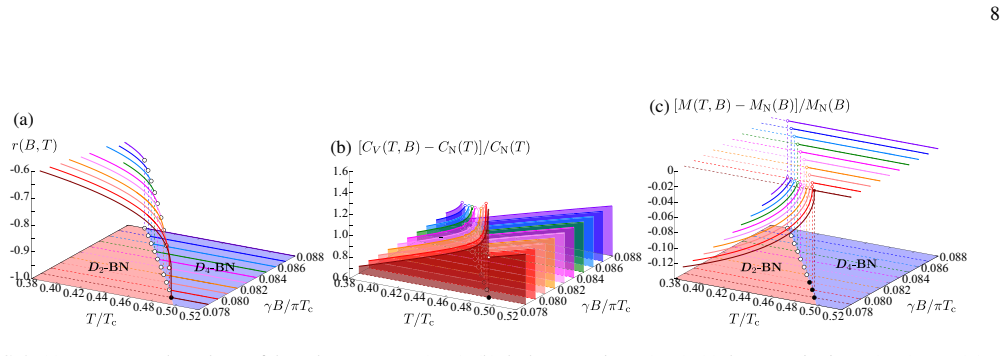
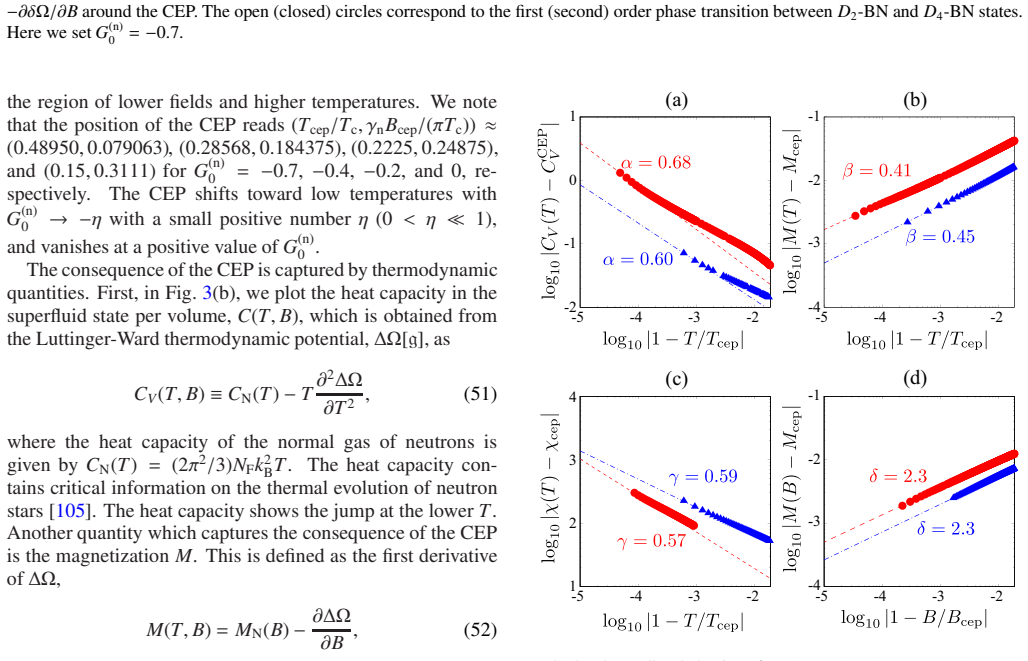
The paper's central claim is that the critical endpoint (CEP) in the temperature--magnetic-field phase diagram of neutron $^3P_2$ superfluids belongs to a new universality class. Solving the Bogoliubov--de Gennes equations as a superfluid Fermi liquid theory, with the spin-polarization feedback encoded through the Landau parameter $G^{(n)}_0$, the authors locate the CEP where the first-order transition between the D2-biaxial nematic and D4-biaxial nematic phases meets the second-order line. Reading the scaling of the superfluid contributions to the heat capacity $C_V$, magnetization $M$, and spin susceptibility $\chi$ around the CEP, they extract $(\alpha,\beta,\gamma,\delta)=(0.68,0.41,0.57,2.3)$ for $G^{(n)}_0=-0.7$ and $(0.60,0.45,0.59,2.3)$ for $G^{(n)}_0=-0.4$. These satisfy the Rushbrooke, Griffiths, and Widom equalities within $5\%$--$10\%$, with large $\alpha$ and sub-unity $\gamma$ as the authors' evidence for a new universality class distinct from standard Ising-type or mean-field critical points. The same conclusion emerges from the eighth-order Ginzburg-Landau functional, which yields $(\alpha,\beta,\gamma,\delta)=(0.60,0.49,0.52,1.95)$ and provides a tractable low-energy description of the critical behavior.
Load-bearing premise
The load-bearing premise is that omitting fluctuations of the superfluid order parameter does not change the critical exponents, and the authors themselves note that the effect of such fluctuations remains a future issue.
Editorial extensions
If this is right
- A neutron star whose core crosses the CEP would show a strong, non-mean-field anomaly in heat capacity, magnetization, and spin susceptibility, with the heat-capacity exponent $\alpha\approx0.6$ implying slow cooling.
- The extracted exponents are insensitive to the Landau parameter within the numerical errors, so the proposed universality class is robust to the strength of the spin-polarization screening of the magnetic field.
- The eighth-order Ginzburg-Landau free energy reproduces the BdG exponents even though the CEP location differs, making GL theory a valid low-energy tool for studying this critical behavior in dense neutron matter.
- The new class is characterized by large $\alpha$ and $\gamma<1$, which sets it apart from ordinary liquid-gas or Ising-type critical endpoints and would be the main observable fingerprint.
Reading between the lines
- A beyond-mean-field calculation, such as a renormalization-group treatment of the same eighth-order GL functional, would decide whether the quoted exponents survive fluctuations; if they do not, the physical superfluid belongs to a different class.
- The same order-parameter symmetry appears in other spin-triplet and spin-2 condensates, so a parallel analysis of helium-3 under a magnetic field or of spinor Bose-Einstein condensates could reveal whether this universality class is generic to multicomponent pairing.
- Observationally, a survey of isolated magnetar cooling curves might reveal the predicted heat-capacity enhancement if the CEP lies in the relevant density and field range, providing an indirect constraint on the Fermi-liquid parameter $G^{(n)}_0$.
Signed reviews
Editorial analysis
A structured set of objections, weighed in public.
Referee Report
Summary. The paper studies the thermodynamics and critical behavior of neutron 3P2 superfluids in neutron stars, focusing on the critical endpoint (CEP) where the first-order and second-order transition lines between the D2-biaxial nematic and D4-biaxial nematic phases meet in the temperature–magnetic-field plane. Using the quasiclassical BdG (superfluid Fermi liquid) theory with spin-polarization feedback, the authors compute the specific heat, magnetization, and spin susceptibility near the CEP and extract critical exponents (α, β, γ, δ) ≈ (0.68, 0.41, 0.57, 2.3) for G0 = -0.7, with similar values for other Landau parameters. They also construct a Ginzburg-Landau free energy up to eighth order in the order parameter and obtain exponents (0.60, 0.49, 0.52, 1.95) at the GL CEP. The reported exponents approximately satisfy the Rushbrooke, Griffiths, and Widom equalities, and the authors interpret this as evidence for a new universality class with large α and small γ.
Significance. If established, the claim of a new universality class at the CEP of neutron 3P2 superfluids would be significant not only for condensed-matter-like critical phenomena in neutron-star matter but also for astrophysical cooling models, since a strongly divergent specific heat could alter neutron-star thermal evolution. The paper provides a detailed derivation of the quasiclassical formalism and the eighth-order GL expansion, and the fact that two independent approximations yield non-classical exponents in rough mutual agreement is a nontrivial internal consistency check. The approximate satisfaction of the three scaling equalities is also a useful check of the numerical analysis. However, the calculation is mean-field in character—order-parameter fluctuations are not included—so the claimed universality class is not actually demonstrated; the significance of the paper therefore depends on a careful reframing of the claim and a quantitative assessment of the extracted exponents.
major comments (4)
- [Section II E and Section IV] The central claim that the CEP belongs to a new universality class is not established by this calculation. Both the BdG/quasiclassical theory and the GL free energy are mean-field treatments: the order parameter is determined by self-consistent stationary-point equations, and order-parameter fluctuations are not included. Universality classes are defined by the long-wavelength fluctuation fixed points of the renormalization group, not by the saddle-point equations. The paper itself states in Section IV that the impact of order-parameter fluctuations on the critical exponents 'remains as a future issue.' The exponents reported here are effective exponents of a mean-field-like approximation; calling them a new universality class is an overreach. I recommend reframing the conclusion as effective exponents within the quasiclassical/GL approximation and discussing how fluctuations could alter them, or adding an RG/epsilon-expansion analysis to substantiate a true universality class.
- [Section II E and Table I] The numerical extraction of the critical exponents lacks the detail needed to support the claimed 10% accuracy. The text says the exponents are 'read' from the log-log plots in Figs. 4 and 5 without specifying the fitting ranges, the fitted functional form (pure power law with or without corrections), or any statistical or systematic uncertainties. The spread between the BdG result for G0 = -0.7 and the GL result is sizable: β = 0.41 vs 0.49 (about 20% difference) and δ = 2.3 vs 1.95 (about 18% difference). With no quoted errors, the statement that the BdG and GL exponents are 'properly regarded to be the same' is not quantified, and the apparent non-universality of the extracted set is a concern for the claim that a single universal set has been found. Please provide the full fitting details and error estimates, and assess whether the two formalisms are actually consistent within uncertainties.
- [Section III A and III B] The GL expansion is derived under the assumption |1 - T/Tc| ≪ 1, but the GL CEP is located at T/Tc = 0.7746, i.e., |1 - T/Tc| = 0.225, which is not small. The paper explicitly states the GL equation's applicable region is limited to |1 - T/Tc| ≪ 1 and then uses it to extract critical exponents at this CEP. The convergence of the eighth-order GL series at this temperature is not demonstrated, and the fact that the BdG CEP occurs at a much lower temperature (T/Tc ≈ 0.49 for G0 = -0.7) means the two calculations probe very different regimes. The claimed agreement between the BdG and GL exponents could therefore be coincidental. Please justify the use of the GL functional at this temperature (e.g., by examining the convergence of the series in the order-parameter expansion) or qualify the claim that the GL theory 'properly captures' the CEP physics.
- [Abstract and Section II E] The Rushbrooke, Griffiths, and Widom equalities in Eqs. (1)–(3) are consistency conditions that hold for any scaling form, including analytic mean-field free energies; their approximate satisfaction is a necessary but not sufficient test for a new universality class. The abstract's phrase 'indicating a new universality class' is therefore not a direct consequence of the equalities. The inference rests entirely on the numerical values of the exponents, which are subject to the limitations in the two preceding comments. The abstract and conclusion should be revised to separate the internal-consistency check from the much stronger claim of a new universality class.
minor comments (6)
- [Introduction] There is a typo: 'cerntainly' should be 'certainly' in the sentence 'The existence of the CEP is cerntainly important...'.
- [Table I] The table lists critical exponents but gives no error bars, although the text states the exponents are determined 'within 10% numerical errors'. Please add error estimates to the table or specify the source and meaning of the 10% figure.
- [Eqs. (57)–(60)] The definitions of the critical exponents assume extraction on the low-temperature/low-field side (T < Tcep, B < Bcep). Please state explicitly whether the exponents were also checked on the other side of the transition, and whether they are symmetric.
- [Fig. 1 caption] The caption says the CEP is marked in (a, b) but the text discusses the CEP position in the GL theory for (c, d); the GL panels do not appear to show a CEP marker. Please indicate the CEP in the GL panels or adjust the caption for clarity.
- [Section III B] The phrase 'as shown in Fig. 1(d)' referring to the different positions of the BdG and GL CEPs is confusing, because Fig. 1(d) appears to show only the GL phase diagram. Please clarify the comparison, e.g., by referring to both (a,b) and (c,d).
- [Eq. (65)] The notation O(B^m A^n) with m+n ≥ 7 is unusual; please specify the ranges of m and n (e.g., m, n ≥ 0) and clarify which terms are omitted.
Circularity Check
No significant circularity: the critical exponents are computed from self-consistent BdG and GL free energies and checked against external scaling relations, not fitted or assumed.
full rationale
The paper's central claim is that the CEP of neutron 3P2 superfluids has critical exponents satisfying the Rushbrooke, Griffiths, and Widom equalities and belonging to a new universality class. The exponents are read from numerical scaling behavior of CV, M, and chi computed from self-consistent BdG/quasiclassical solutions (Eqs. (57)-(60) and Fig. 4) and from the GL free energy with coefficients written out in Eqs. (65)-(69). No exponent is used as an input or fitted to a target; the scaling equalities are external independent consistency conditions. The self-citations [62, 90, 92] provide the quasiclassical phase diagram and the GL expansion coefficients, but the current paper displays the equations and performs the CEP and exponent computation itself; these citations are inputs, not conclusions that are assumed to justify the universality-class claim. The BdG and GL calculations being both mean-field and sharing the quasiclassical approximation means their agreement is not fully independent confirmation, and the absence of order-parameter fluctuations is a validity limitation explicitly acknowledged in Section IV. These are correctness concerns, not circularity. No step in the derivation reduces by construction to its own inputs.
Assumptions & free parameters
free parameters (1)
- Critical exponents α, β, γ, δ =
α=0.68, β=0.41, γ=0.57, δ=2.3 (BdG, G0=-0.7); α=0.60, β=0.45, γ=0.59, δ=2.3 (BdG, G0=-0.4); α=0.60, β=0.49, γ=0.52…
assumptions (5)
- domain assumption The quasiclassical approximation is valid for neutron 3P2 superfluids in neutron star cores (T/TF and B/εF small).
- domain assumption Mean-field (BdG and GL) theory captures the thermodynamics of the CEP, i.e., order-parameter fluctuations do not alter the critical exponents.
- domain assumption The interaction in the 3P2 channel can be represented by the separable zero-range potential of Eq. (38), and J=0 and J=1 components are negligible.
- ad hoc to paper The GL expansion up to 8th order in the order parameter is sufficient to describe the CEP even at T/Tc = 0.775, outside the stated validity |1-T/Tc|<<1.
- standard math The scaling hypothesis holds, so the system near the CEP is characterized by critical exponents satisfying the Rushbrooke, Griffiths, and Widom equalities.
Cite this review
Pith. "Pith review of Critical endpoint and universality class of neutron $^3P_2$ superfluids in neutron stars." pith.science (2026). https://pith.science/paper/4P5FEF5J
@misc{pith2026190807944,
  author       = {Pith},
  title        = {Pith review of: Critical endpoint and universality class of neutron $^3P_2$ superfluids in neutron stars},
  year         = {2026},
  howpublished = {\url{https://pith.science/paper/4P5FEF5J}},
  note         = {Machine review of arXiv:1908.07944}
}
abstract
We study the thermodynamics and critical behavior of neutron $^3P_2$ superfluids in the inner cores of neutron stars. $^3P_2$ superfluids offer a rich phase diagram including uniaxial/biaxial nematic phases, the ferromagnetic phase, and the cyclic phase. Using the Bogoliubov-de Gennes (BdG) equation as superfluid Fermi liquid theory, we show that a strong (weak) magnetic field drives the first (second) order transition from the dihedral-two biaxial nematic phase to dihedral-four biaxial nematic phase in low (high) temperatures, and their phase boundaries are divided by the critical endpoint (CEP). We demonstrate that the set of critical exponents at the CEP satisfies the Rushbrooke, Griffiths, and Widom equalities, indicating a new universality class. At the CEP, the $^3P_2$ superfluid exhibits critical behavior with nontrivial critical exponents, indicating a new universality class. Furthermore, we find that the Ginzburg-Landau (GL) equation up to the 8th-order expansion satisfies three equalities and properly captures the physics of the CEP. This implies that the GL theory can provide a tractable way for understanding critical phenomena which may be realized in the dense core of realistic magnetars.
Figures

Figures from the paper (2 more)

Forward citations
Cited by 1 Pith paper
-
Microscopic description of axisymmetric vortices in $^{3}P_{2}$ superfluids
Microscopic calculations show the o vortex is the most stable axisymmetric vortex in 3P2 superfluids under strong magnetic fields and hosts two zero-energy Majorana fermions in its core.
Reference graph
Works this paper leans on
- [1]
-
[2]
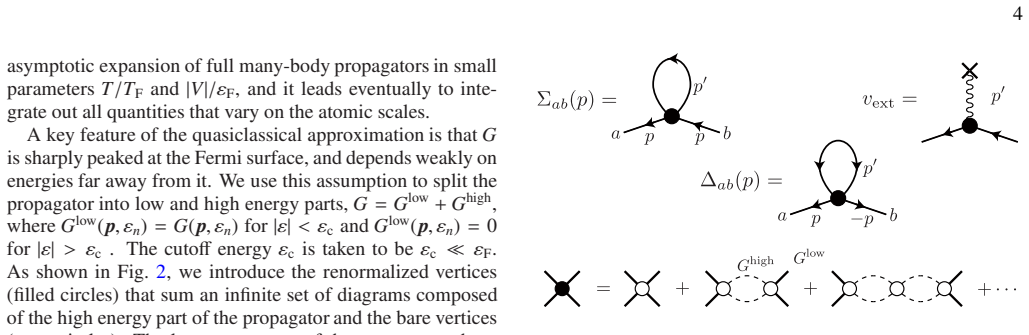
( 47) we set Sp′{· · · } ≡ NFT ∑ n ⟨· · · ⟩
In Eq. ( 47) we set Sp′{· · · } ≡ NFT ∑ n ⟨· · · ⟩. (48) The quasiclassical auxiliary function gλ is given by replacing σMF →λσMF in Eq. ( 18). Here we determine the quasiclassi- cal Φ-functional so as to consistently generate the self-energy through the functional derivative, σMF = 2δ∆Φ[g]/δgT. It is found that the Φ-functional is constructed as ∆Φ[g] = ...
-
[3]
P . Demorest, T. Pennucci, S. Ransom, M. Roberts, and J. Hessels, Shapiro Delay Measurement of A Two Solar Mass Neutron Star, Nature 467, 1081 (2010) , arXiv:1010.5788 [astro-ph.HE]
arXiv 2010
-
[4]
J. Antoniadis, P . C. C. Freire, N. Wex, T. M. Tau- ris, R. S. Lynch, M. H. van Kerkwijk, M. Kramer, C. Bassa, V . S. Dhillon, T. Driebe, J. W. T. Hessels, V . M. Kaspi, V . I. Kondratiev, N. Langer, T. R. Marsh, M. A. McLaughlin, T. T. Pennucci, S. M. Ransom, I. H. Stairs, J. van Leeuwen, J. P . W. V erbiest, and D. G. Whe- lan, A Massive Pulsar in a Com...
-
[5]
B. Abbott et al. (Virgo, LIGO Scientific), GW170817: Observation of Gravitational W aves from a Binary Neu- tron Star Inspiral, Phys. Rev. Lett. 119, 161101 (2017) , arXiv:1710.05832 [gr-qc]
arXiv 2017
-
[6]
Chamel, Superfluidity and Superconductivity in Neutron Stars, Journal of Astrophysics and Astronomy 38, 43 (2017)
N. Chamel, Superfluidity and Superconductivity in Neutron Stars, Journal of Astrophysics and Astronomy 38, 43 (2017)
2017
-
[7]
B. Haskell and A. Sedrakian, Superfluid- ity and Superconductivity in Neutron Stars, Astrophys. Space Sci. Libr. 457, 401 (2018) , arXiv:1709.10340 [astro-ph.HE]
arXiv 2018
-
[8]
G. Baym, T. Hatsuda, T. Kojo, P . D. Powell, Y . Song, and T. Takatsuka, From hadrons to quarks in neu- tron stars: a review, Rept. Prog. Phys. 81, 056902 (2018) , arXiv:1707.04966 [astro-ph.HE]
arXiv 2018
Show all 117 references
-
[9]
G. Baym, C. Pethick, D. Pines, and M. Ruderman, Spin Up in Neutron Stars : The Future of the V ela Pulsar , Nature 224, 872 (1969)
1969
-
[10]
Pines, J
D. Pines, J. Shaham, and M. Ruderman, Corequakes and the V ela Pulsar,Nature Phys. Sci. 237, 83 (1972)
1972
-
[11]
Takatsuka and R
T. Takatsuka and R. Tamagaki, Corequake Model of Pul- sar Glitches for Neutron Stars With Pion Condensed Core, Prog. Theor. Phys. 79, 274 (1988)
1988
-
[12]
D. G. Yakovlev, A. D. Kaminker, O. Y . Gnedin, and P . Haensel, Neutrino emission from neutron stars, Phys. Rept. 354, 1 (2001) , arXiv:astro-ph/0012122 [astro-ph]
2001 arXiv
-
[13]
A. Y . Potekhin, J. A. Pons, and D. Page, Neutron stars - cooling and transport, Space Sci. Rev. 191, 239 (2015) , arXiv:1507.06186 [astro-ph.HE]
2015 arXiv
-
[14]
Sedrakian and J
A. Sedrakian and J. W. Clark, Superfluidity in nuclear systems and neutron stars, (2018), arXiv:1802.00017 [nucl-th]
2018 arXiv
-
[15]
C. O. Heinke and W. C. G. Ho, Direct Ob- servation of the Cooling of the Cassiopeia A Neutron Star, Astrophys. J. 719, L167 (2010) , arXiv:1007.4719 [astro-ph.HE]
2010 arXiv
-
[16]
P . S. Shternin, D. G. Yakovlev, C. O. Heinke, W. C. G. Ho, and D. J. Patnaude, Cooling neutron star in the Cassiopeia A supernova remnant: evidence for superfluidity in the core, Mon. Notices Royal Astron. Soc. 412, L108 (2011)
2011
-
[17]
D. Page, M. Prakash, J. M. Lattimer, and A. W. Steiner, Rapid Cooling of the Neutron Star in Cas- siopeia A Triggered by Neutron Superfluidity in Dense Matter , Phys. Rev. Lett. 106, 081101 (2011) , arXiv:1011.6142 [astro-ph.HE]
2011 arXiv
-
[18]
P . E. Reichley and G. S. Downs, Second Decrease in the Pe- riod of the V ela Pulsar ,Nature Phys. Sci. 234, 48 (1971)
1971
-
[19]
P . W. Anderson and N. Itoh, Pulsar glitches and restlessness as a hard superfluidity phenomenon, Nature 256, 25 (1975)
1975
-
[20]
D. G. Yakovlev, K. P . Levenfish, and Y u. A. Shibanov, Cooling neutron stars and superfluid- ity in their interiors, Phys. Usp. 42, 737 (1999) , arXiv:astro-ph/9906456 [astro-ph]
1999 arXiv
-
[21]
R. A. Wolf, Some E ffects of the Strong Interac- tions on the Properties of Neutron-Star Matter , Astrophys. J. 145, 834 (1966)
1966
-
[22]
Tabakin,Single Separable Potential with Attraction and Re- pulsion, Phys
F. Tabakin,Single Separable Potential with Attraction and Re- pulsion, Phys. Rev. 174, 1208 (1968)
1968
-
[23]
Hoffberg, A
M. Hoffberg, A. E. Glassgold, R. W. Richardson, and M. Ru- derman, Anisotropic Superfluidity in Neutron Star Matter , Phys. Rev. Lett. 24, 775 (1970)
1970
-
[24]
Tamagaki, Superfluid State in Neutron Star Matter
R. Tamagaki, Superfluid State in Neutron Star Matter . I: Generalized Bogoliubov Transforma- tion and Existence of 3P2 Gap at High Density*), Progress of Theoretical Physics 44, 905 (1970)
1970
-
[25]
Takatsuka and R
T. Takatsuka and R. Tamagaki, Superfluid State in Neutron 13 Star Matter . IIProperties of Anisotropic Energy Gap of 3P2 Pairing, Progress of Theoretical Physics 46, 114 (1971)
1971
-
[26]
A. B. Migdal, Superfluidity and the Moments of Inertia of Nuclei, Zh. Eksp. Teor. Fiz. 37, 249 (1960), [Sov. Phys. JETP10,no.1,176(1960)]
1960
-
[27]
Fujita and T
T. Fujita and T. Tsuneto, The Ginzburg-Landau Equa- tion for 3P2 PairingSuperfluidity in Neutron Stars, Progress of Theoretical Physics 48, 766 (1972)
1972
-
[28]
R. W. Richardson, Ginzburg-landau theory of anisotropic su- perfluid neutron-star matter , Phys. Rev. D5, 1883 (1972)
1972
-
[29]
Topological Materials Science
may be negligible. This result stems from the short-range prope rty of the ρ-meson exchange interaction. It will be important to more carefully study the short-range behavior of the nucleo n- nucleon interaction, which will be attributed by the quark- exchange contributions at...
-
[30]
Takatsuka and R
T. Takatsuka and R. Tamagaki, Superfluidity in neu- tron star matter and symmetric nuclear matter , Prog. Theor. Phys. Suppl. 112, 27 (1993)
1993
-
[31]
J. A. Sauls, Superfluidity in the Interiors of Neutron Stars, in Timing Neutron Stars, edited by H. ¨Ogelman and E. P . J. van den Heuvel (Springer Netherlands, Dordrecht, 1989) pp. 457–490
1989
-
[32]
Takatsuka, Superfluid State in Neutron Star Mat- ter
T. Takatsuka, Superfluid State in Neutron Star Mat- ter . III: Tensor Coupling E ffect in 3P2 Energy Gap, Progress of Theoretical Physics 47, 1062 (1972)
1972
-
[33]
Elgaroy, L
O. Elgaroy, L. Engvik, M. Hjorth-Jensen, and E. Osnes, Triplet pairing of neutrons in beta sta- ble neutron star matter , Nucl. Phys. A607, 425 (1996) , arXiv:nucl-th/9604032 [nucl-th]
1996 arXiv
-
[34]
V . A. Khodel, V . V . Khodel, and J. W. Clark, Universalities of triplet pairing in neu- tron matter , Phys. Rev. Lett. 81, 3828 (1998) , arXiv:nucl-th/9807034 [nucl-th]
1998 arXiv
-
[35]
Amundsen and E
L. Amundsen and E. Ostgaard, Superfluidity of neutron matter (II). triplet pairing, Nucl. Phys. A442, 163 (1985)
1985
-
[36]
V . V . Khodel, V . A. Khodel, and J. W. Clark, Triplet pairing in neutron matter , Nucl. Phys. A679, 827 (2001) , arXiv:nucl-th/0001006 [nucl-th]
2001 arXiv
-
[37]
M. V . Zverev, J. W. Clark, and V . A. Khodel, (3)p(2) - (3)F(2) pairing in dense neutron matter: The Spectrum of solutions, Nucl. Phys. A720, 20 (2003) , arXiv:nucl-th/0301028 [nucl-th]
2003 arXiv
-
[38]
is recast into V (o) ab;cd( pF, p′ F) = −v 3∑ µ,ν=1 Tµν,ab( pF)T ∗ µν,dc( p′ F), (39) with the traceless and symmetric tensor Tµν,ab( pF) = ( i ( 1 2 √ 2 ( σµ pF,ν +σν pF,µ ) − 1 3 √ 2 δµνσ· pF ) σy ) ab , (40) which obeys Tµν( pF) = Tνµ( pF) and tr( T ( pF)) ≡ ∑ µ Tµµ( pF) = ...
-
[39]
Baldo, J
M. Baldo, J. Cugnon, A. Lejeune, and U. Lombardo, Proton and neutron superfluidity in neutron star matter , Nucl. Phys. A536, 349 (1992)
1992
-
[40]
Srinivas and S
S. Srinivas and S. Ramanan, Triplet Pairing in pure neutron matter , Phys. Rev. C94, 064303 (2016) , arXiv:1606.09053 [nucl-th]
2016 arXiv
-
[41]
Baldo, O
M. Baldo, O. Elgaroey, L. Engvik, M. Hjorth- Jensen, and H. J. Schulze, Triplet P-3(2) to F-3(2) pairing in neutron matter with modern nucleon- nucleon potentials, Phys. Rev. C58, 1921 (1998) , arXiv:nucl-th/9806097 [nucl-th]
1998 arXiv
-
[42]
D. H. Brownell and J. Callaway, Ferromagnetic transition in superdense matter and neutron stars, Il Nuovo Cimento B (1965-1970) 60, 169 (1969)
1969
-
[43]
Rice, The hard-sphere Fermi gas and ferromagnetism in neutron stars, Physics Letters A 29, 637 (1969)
M. Rice, The hard-sphere Fermi gas and ferromagnetism in neutron stars, Physics Letters A 29, 637 (1969)
1969
-
[44]
Maurizio, J
S. Maurizio, J. W. Holt, and P . Finelli, Nuclear pair- ing from microscopic forces: singlet channels and higher-partial waves, Phys. Rev. C90, 044003 (2014) , arXiv:1408.6281 [nucl-th]
2014 arXiv
-
[45]
S. K. Bogner, R. J. Furnstahl, and A. Schwenk, From low-momentum interactions to nuclear structure, Prog. Part. Nucl. Phys. 65, 94 (2010) , arXiv:0912.3688 [nucl-th]
2010 arXiv
-
[46]
M. Eto, K. Hashimoto, and T. Hatsuda, Ferromag- netic neutron stars: axial anomaly, dense neutron matter , and pionic wall, Phys. Rev. D88, 081701 (2013) , arXiv:1209.4814 [hep-ph]
2013 arXiv
-
[47]
D. J. Dean and M. Hjorth-Jensen, Pairing in nuclear systems: From neutron stars to fi- nite nuclei, Rev. Mod. Phys. 75, 607 (2003) , arXiv:nucl-th/0210033 [nucl-th]
2003 arXiv
-
[48]
Tatsumi, Ferromagnetism of quark liquid, Phys
T. Tatsumi, Ferromagnetism of quark liquid, Phys. Lett. B489, 280 (2000) , arXiv:hep-ph/9910470 [hep-ph]
2000 arXiv
-
[49]
Nakano, T
E. Nakano, T. Maruyama, and T. Tatsumi, Spin polarization and color superconductivity in quark matter , Phys. Rev. D68, 105001 (2003) , arXiv:hep-ph/0304223 [hep-ph]
2003 arXiv
-
[50]
S. D. Silverstein, Criteria for Ferromagnetism in Dense Neutron Fermi Liquids-Neutron Stars, Phys. Rev. Lett. 23, 139 (1969)
1969
-
[51]
and ( 52), CN(T ) and MN(B), are negligible in the vicinity of the CEP , and the critical behaviors of the hea t capacity CV , the magnetization M, and the spin susceptibility (b) (d) 1 0 -1 -2 -5 -4 -3 -2 -1 -3 -5 -4 -3 -2 -2 -4 -1 -3 -2 -4 (a) 1 2 3 4 -5 -4 -3 -2 (c) -5 -4 -...
-
[52]
Haensel and S
P . Haensel and S. Bonazzola,Ferromagnetism of dense matter and magnetic properties of neutron stars, Astron. Astrophys. 314, 1017 (1996), arXiv:astro-ph/9605149 [astro-ph]
1996 arXiv
-
[53]
Hashimoto, Possibility of ferromagnetic neutron matter , Phys
K. Hashimoto, Possibility of ferromagnetic neutron matter , Phys. Rev. D91, 085013 (2015) , arXiv:1412.6960 [hep-ph]
2015 arXiv
-
[54]
Blaschke, H
D. Blaschke, H. Grigorian, and D. N. V oskresensky, Nu- clear medium cooling scenario in the light of new Cas A cooling data and the 2M ⊙ pulsar mass measurements, Phys. Rev. C88, 065805 (2013) , arXiv:1308.4093 [nucl-th]
2013 arXiv
-
[55]
Grigorian, D
H. Grigorian, D. N. V oskresensky, and D. Blaschke, Influence of the sti ffness of the equation of state and in-medium e ffects on the cooling of compact stars, Pro- ceedings, Compact Stars in the QCD Phase Diagram IV (CSQCD IV): Prerow, Germany, September 26-30, 2014, (2016), 10...
2016 arXiv
-
[56]
Ohnishi, M
K. Ohnishi, M. Oka, and S. Yasui, Possible fer- romagnetism in the large N(c) and N(f) limit of quark matter , Phys. Rev. D76, 097501 (2007) , arXiv:hep-ph/0609060 [hep-ph]
2007 arXiv
-
[57]
G. H. Bordbar and M. Bigdeli, Spin polarized asym- metric nuclear matter and neutron star matter within the lowest order constrained variational method, Phys. Rev. C77, 015805 (2008) , arXiv:0809.3498 [nucl-th]
2008 arXiv
-
[58]
C. O. Heinke and W. C. G. Ho, Direct Observa- tion of the Cooling of the Cassiopeia A Neutron Star , The Astrophysical Journal Letters 719, L167 (2010)
2010
-
[59]
Blaschke, H
D. Blaschke, H. Grigorian, D. N. V oskresensky, and F. We- ber, On the Cooling of the Neutron Star in Cassiopeia A, Phys. Rev. C85, 022802 (2012) , arXiv:1108.4125 [nucl-th]
2012 arXiv
-
[60]
Masuda and M
K. Masuda and M. Nitta, Magnetic Properties of Quan- tized V ortices in Neutron 3P2 Superfluids in Neutron Stars, Phys. Rev. C93, 035804 (2016) , arXiv:1512.01946 [nucl-th]
2016 arXiv
-
[61]
First of all, one may notice the large value of α (α ∼ 0.6)
belongs to a new type of university class. First of all, one may notice the large value of α (α ∼ 0.6). It is known that the value of α is usually much smaller than one in the phase transitions accompanied with a continuous symme- try breaking at least in known models thus far...
-
[62]
J. A. Sauls and J. Serene, 3P2 pairing near the transition tem- perature in neutron-star matter ,Phys. Rev. D17, 1524 (1978)
1978
-
[63]
Muzikar, J
P . Muzikar, J. A. Sauls, and J. W. Serene, 3P2 pairing in neutron star matter: magnetic field e ffects and vortices, Phys. Rev. D21, 1494 (1980)
1980
-
[64]
J. A. Sauls, D. L. Stein, and J. W. Serene, magnetic vortices in a rotating 3P2 neutron superfluid, Phys. Rev. D25, 967 (1982)
1982
-
[65]
is explained as follows. Ω(0) 8 [A] includes Aµi up to the 8th order with no mag- netic field, Ω(≤4) 2 [A] includes Aµi up to the 2nd order with the magnetic field up to |B|4, and Ω(≤2) 4 [A] includes Aµi up to the 4th order with the magnetic field up to |B|2. Their explicit form...
-
[66]
V . Z. Vulovic and J. A. Sauls,influence of strong-coupling cor- rections on the equilibrium phase for 3P2 superfluid neutron star matter ,Phys. Rev. D29, 2705 (1984)
1984
-
[67]
Masuda and M
K. Masuda and M. Nitta, Half-quantized Non-Abelian V ortices in Neutron 3P2 Superfluids inside Magnetars, arXiv:1602.07050 [nucl-th]
-
[68]
Mizushima, K
T. Mizushima, K. Masuda, and M. Nitta, 3P2 su- perfluids are topological, Phys. Rev. B95, 140503 (2017) , arXiv:1607.07266 [cond-mat.supr-con]
2017 arXiv
-
[69]
Mizushima and M
T. Mizushima and M. Nitta, Topology and sym- metry of surface Majorana arcs in cyclic su- perconductors, Phys. Rev. B97, 024506 (2018) , 14 arXiv:1710.07403 [cond-mat.supr-con]
2018 arXiv
-
[70]
P . F. Bedaque, G. Rupak, and M. J. Savage, Gold- stone bosons in the 3P(Z) superfluid phase of neutron mat- ter and neutrino emission, Phys. Rev. C68, 065802 (2003) , arXiv:nucl-th/0305032 [nucl-th]
2003 arXiv
-
[71]
L. B. Leinson, New eigen-mode of spin oscillations in the triplet superfluid condensate in neutron stars, Phys. Lett. B702, 422 (2011) , arXiv:1107.4025 [nucl-th]
2011 arXiv
-
[72]
L. B. Leinson, Collective modes of the order pa- rameter in a triplet superfluid neutron liquid, Phys. Rev. C85, 065502 (2012) , arXiv:1206.3648 [nucl-th]
2012 arXiv
-
[73]
L. B. Leinson, Neutrino emissivity of anisotropic neutron superfluids, Phys. Rev. C87, 025501 (2013) , arXiv:1301.5439 [nucl-th]
2013 arXiv
-
[74]
P . F. Bedaque and A. N. Nicholson, Low lying modes of triplet-condensed neutron matter and their e ffective theory, Phys. Rev. C87, 055807 (2013) , [Erratum: Phys. Rev.C89,no.2,029902(2014)], arXiv:1212.1122 [nucl-th]
2013 arXiv
-
[75]
Bedaque and S
P . Bedaque and S. Sen, Neutrino emissivity from Goldstone boson decay in magnetized neutron matter , Phys. Rev. C89, 035808 (2014) , arXiv:1312.6632 [nucl-th]
2014 arXiv
-
[76]
P . F. Bedaque and S. Reddy, Goldstone modes in the neutron star core, Phys. Lett. B735, 340 (2014) , arXiv:1307.8183 [nucl-th]
2014 arXiv
-
[77]
P . F. Bedaque, A. N. Nicholson, and S. Sen, Massive and massless modes of the triplet phase of neutron matter , Phys. Rev. C92, 035809 (2015) , arXiv:1408.5145 [nucl-th]
2015 arXiv
-
[78]
L. B. Leinson, Neutrino emission from triplet pairing of neutrons in neutron stars, Phys. Rev. C81, 025501 (2010) , arXiv:0912.2164 [astro-ph.SR]
2010 arXiv
-
[79]
L. B. Leinson, Neutrino emission from spin waves in neutron spin-triplet superfluid, Phys. Lett. B689, 60 (2010) , arXiv:1001.2617 [astro-ph.SR]
2010 arXiv
-
[80]
L. B. Leinson, Superfluid phases of triplet pair- ing and neutrino emission from neutron stars, Phys. Rev. C82, 065503 (2010) , [Erratum: Phys. Rev.C84,049901(2011)], arXiv:1012.5387 [hep-ph]
2010 arXiv
-
[81]
L. B. Leinson, Zero sound in triplet-correlated super- fluid neutron matter , Phys. Rev. C83, 055803 (2011) , arXiv:1007.2803 [hep-ph]
2011 arXiv
-
[82]
L. B. Leinson, Neutrino emissivity of 3P2-3F2 super- fluid cores in neutron stars, Phys. Rev. C84, 045501 (2011) , arXiv:1110.2145 [nucl-th]
2011 arXiv
-
[83]
K. M. Shahabasyan and M. K. Shahabasyan, V ortex struc- ture of neutron stars with triplet neutron superfluidity, Astrophysics 54, 429 (2011) , [Astrofiz.54,483(2011)]
2011
-
[84]
Masaki, T
Y . Masaki, T. Mizushima, and M. Nitta, Microscopic description of axisymmetric vortices in 3P2 superfluids, Phys. Rev. Research 2, 013193 (2020) , 1908.06215
2020 arXiv
-
[85]
Chatterjee, M
C. Chatterjee, M. Haberichter, and M. Nitta, Collective excita- tions of a quantized vortex in 3P2 superfluids in neutron stars, Phys. Rev. C96, 055807 (2017) , arXiv:1612.05588 [nucl-th]
2017 arXiv
-
[86]
Yasui and M
S. Yasui and M. Nitta, Domain walls in neutron 3P2 superflu- ids in neutron stars, (2019), arXiv:1907.12843 [nucl-th]
2019 arXiv
-
[87]
Yasui, C
S. Yasui, C. Chatterjee, and M. Nitta, Symmetry and topology of the boundary of neutron 3P2 superfluids in neutron stars: boojums as surface topological defects, (2019), phys. Rev. C (to be published), arXiv:1905.13666 [nucl-th]
2019 arXiv
-
[88]
N. D. Mermin, d-wave pairing near the transition tempera- ture, Phys. Rev. A9, 868 (1974)
1974
-
[89]
V ollhardt and P
D. V ollhardt and P . W¨ olfle, The Superfluid Phases of Helium 3 , Dover Books on Physics Series (Dover Publications, New Y ork, 2013)
2013
-
[90]
G. E. V olovik,The Universe in a Helium Droplet (Clarendon, Oxford, 2003)
2003
-
[91]
Mizushima, Y
T. Mizushima, Y . Tsutsumi, T. Kawakami, M. Sato, M. Ichioka, and K. Machida, Symmetry-Protected Topo- logical Superfluids and Superconductors —From the Basics to 3He—, J. Phys. Soc. Jap. 85, 022001 (2016) , arXiv:1508.00787 [cond-mat.supr-con]
2016 arXiv
-
[92]
A. P . Mackenzie and Y . Maeno, The superconductiv- ity of Sr2RuO4 and the physics of spin-triplet pairing, Rev. Mod. Phys. 75, 657 (2003)
2003
-
[93]
Maeno, S
Y . Maeno, S. Kittaka, T. Nomura, S. Y onezawa, and K. Ishida, Evaluation of Spin-Triplet Superconductivity in Sr 2RuO4, J. Phys. Soc. Jpn. 81, 011009 (2012)
2012
-
[94]
D. Aoki, K. Ishida, and J. Flouquet, Review of U-based Ferromagnetic Superconductors: Comparison between UGe2, URhGe, and UCoGe, J. Phys. Soc. Jpn. 88, 022001 (2019)
2019
-
[95]
Kawaguchi and M
Y . Kawaguchi and M. Ueda, Spinor Bose- Einstein condensates, Phys. Rep. 520, 253 (2012) , arXiv:1001.2072 [cond-mat.quant-gas]
2012 arXiv
-
[96]
Yasui, C
S. Yasui, C. Chatterjee, and M. Nitta, Phase structure of neu- tron 3P2 superfluids in strong magnetic fields in neutron stars, Phys. Rev. C99, 035213 (2019) , arXiv:1810.04901 [nucl-th]
2019 arXiv
-
[97]
Yasui, C
S. Yasui, C. Chatterjee, and M. Nitta, Effects of strong mag- netic fields on neutron 3P2 superfluidity in spin-orbit interac- tions, in 8th International Conference on Quarks and Nuclear Physics (QNP2018) Tsukuba, Japan, November 13-17, 2018 (2019) arXiv:1902.00674 [nucl-th]
2019 arXiv
-
[98]
Yasui, C
S. Yasui, C. Chatterjee, M. Kobayashi, and M. Nitta, Revis- iting Ginzburg-Landau theory for neutron 3P2 superfluidity in neutron stars, (2019), arXiv:1904.11399 [nucl-th]
2019 arXiv
-
[99]
Uchino, M
S. Uchino, M. Kobayashi, M. Nitta, and M. Ueda, Quasi-Nambu-Goldstone Modes in Bose-Einstein Condensates, Phys. Rev. Lett. 105, 230406 (2010) , arXiv:1010.2864 [cond-mat.quant-gas]
2010 arXiv
-
[100]
Principles of Condensed Matter Physics
P . M. Chaikin and T. C. Lubensky, “Principles of Condensed Matter Physics” (Cambridge Univ. Press, Cambridge, 1995)
1995
-
[101]
Zinn-Justin, Quantum Field Theory and Critical Phenomena , International series of monographs on physics (Clarendon Press, 2002)
J. Zinn-Justin, Quantum Field Theory and Critical Phenomena , International series of monographs on physics (Clarendon Press, 2002)
2002
-
[102]
Guida and J
R. Guida and J. Zinn-Justin, 3D Ising model: the scaling equa- tion of state, Nuclear Physics B 489, 626 (1997)
1997
-
[103]
Yin, S.-K
S. Yin, S.-K. Jian, and H. Yao, Chiral Tricritical Point: A New Universality Class in Dirac Systems, Phys. Rev. Lett. 120, 215702 (2018)
2018
-
[104]
Serene and D
J. Serene and D. Rainer, The quasiclassical approach to su- perfluid 3He, Phys. Rep. 101, 221 (1983)
1983
-
[105]
J. A. Sauls, Fermi-Liquid Theory for Unconventional Super- conductors, in Strongly Correlated Electronic Materials - The Los Alamos Symposium 1993 , edited by K. Bedell, Z. Wang, D. Meltzer, A. Balatsky, and E. Abrahams (Addison-Wesley, New Y ork, 1994)
1993
-
[106]
R. W. Richardson, Ginzburg-Landau Theory of Anisotropic Superfluid Neutron-Star Matter , Phys. Rev. D 5, 1883 (1972)
1972
-
[107]
A. B. V orontsov and J. A. Sauls, Thermodynamic properties of thin films of superfluid 3He − A, Phys. Rev. B 68, 064508 (2003)
2003
-
[108]
Mizushima, Superfluid 3He in a restricted geometry with a perpendicular magnetic field, Phys
T. Mizushima, Superfluid 3He in a restricted geometry with a perpendicular magnetic field, Phys. Rev. B 86, 094518 (2012)
2012
-
[109]
N. D. Mermin, d-wave pairing near the transition tempera- ture, Phys. Rev. A 9, 868 (1974)
1974
-
[110]
J. A. Sauls and J. W. Serene, 3P2 pairing near the transition temperature in neutron-star matter , Phys. Rev. D 17, 1524 (1978)
1978
-
[111]
D. G. Yakovlev, A. D. Kaminker, O. Y . Gnedin, and 15 P . Haensel, Neutrino emission from neutron stars, Phys. Rep. 354, 1 (2001)
2001
-
[112]
B¨ ackman, G
S.-O. B¨ ackman, G. E. Brown, and J. A. Niskanen, The nucleon-nucleon interaction and the nuclear many-body prob- lem, Phys. Rep. 124, 1 (1985)
1985
-
[113]
Ashida and K
M. Ashida and K. Nagai, A-B Transition of Super- fluid 3He under Magnetic Field at Low Pressures, Prog. Theor. Phys. 74, 949 (1985)
1985
-
[114]
Machida, T
K. Machida, T. Mizushima, and M. Ichioka, Generic Phase Diagram of Fermion Superfluids with Population Imbalance, Phys. Rev. Lett. 97, 120407 (2006)
2006
-
[115]
Mizushima, M
T. Mizushima, M. Takahashi, and K. Machida, Fulde- Ferrell-Larkin-Ovchinnikov States in Two-Band Superconduc- tors, J. Phys. Soc. Jpn. 83, 023703 (2014)
2014
-
[116]
Radzihovsky and D
L. Radzihovsky and D. E. Sheehy, Imbalanced Feshbach- resonant Fermi gases, Rep. Prog. Phys. 73, 076501 (2010)
2010
-
[117]
J. J. Kinnunen, J. E. Baarsma, J.-P . Martikainen, and P . T¨ orm¨ a,The Fulde–Ferrell–Larkin–Ovchinnikov state for ul- tracold fermions in lattice and harmonic potentials: a revi ew, Rep. Prog. Phys. 81, 046401 (2018)
2018
Reviewed August 14, 2026 · model on record in the stance chip above.
Discussion (0). Continue with ORCID to comment.