REVIEW 4 major objections 4 minor 97 references
A novel view of the flavor-singlet spectrum from multi-flavor QCD on the lattice
T0 review · 4 major / 4 minor · reviewed 2026-08-15 · deepseek-v4-flash
Pith's one-line read Lattice simulations of SU(3) gauge theory with 4, 8, and 12 light fermions find that the flavor-singlet pseudoscalar mass obeys $M_{\eta'}^2\cdot 8t_0\simeq (2.5)^2, (5.0)^2, (7.5)^2$, matching the anti-Veneziano prediction…
desk verdict The eta-prime n_f^2 scaling is a genuine and useful observation, but the quoted numbers lack uncertainties and the single-pole extraction in the conformal Nf=12 theory needs scrutiny. read the letter →
The pith
A machine-rendered reading of the paper's core claim, the machinery that carries it, and where it could break.
The reading
What carries the argument
The object that carries the argument is the two-point correlator of the topological charge density, $q(x)=\frac{1}{32\pi^2}\epsilon_{\mu\nu\rho\sigma}\mathrm{Tr}\,G_{\mu\nu}G_{\rho\sigma}$, averaged over all point pairs at each separation $r=|x-y|$ and smeared by the gradient flow. Because this purely gluonic operator does not couple to pions, the correlator is dominated by the flavor-singlet pseudoscalar, and the mass is extracted by fitting to the single-particle form $C(r)=\frac{A}{r^{3/2}}\left(1+\frac{3}{8r}\right)e^{-M_{\eta'}r}$ over a plateau in both the distance window and the smearing scale. The theoretical template is the Ward–Takahashi identity for the flavor-singlet axial current: in the anti-Veneziano limit, the regime $N_c\to\infty$ with $N_c\alpha$ and $n_f=N_f/N_c$ fixed and large, the fermion-loop diagram dominates the anomaly correlator and yields $M_{\eta'}^2/\Lambda_{\rm IR}^2\sim n_f^2$, the law the data confirm. For the scalar channel, the corresponding machinery is the scale-symmetry Ward–Takahashi identity condensed into the fit form $M_\sigma^2 = d_0 + d_1 M_\pi^2$, whose slope $d_1$ is linked to the mass anomalous dimension through $d_1=(1+\gamma_m)/(3-\gamma_m)$ and to the dilaton decay constant through $F_\sigma/(F_\pi/\sqrt2)=C_{\gamma_m}/\sqrt{d_1}$.
What would settle it
Fit the same correlators with a spectral function that includes a continuum or a second state and check whether the quoted $M_{\eta'}$ values and the $1:4:9$ pattern survive; or extract $M_{\eta'}$ on the same ensembles from the disconnected fermionic axial-current correlator and require agreement with the gluonic-operator result.
Extended reading notes
Core claim
The authors' central claim, in their own terms, is that the anomalous part of the $\eta'$ mass in large-$N_f$ SU(3) gauge theory obeys the anti-Veneziano scaling law $M_{\eta'}^2/\Lambda_{\rm IR}^2\sim n_f^2$, and that the lattice data realize this law when the infrared scale is chosen to be the gradient-flow scale, $\Lambda_{\rm IR}=1/\sqrt{8t_0}$. Concretely, they find $M_{\eta'}^2\cdot 8t_0\simeq (2.5)^2$ for $N_f=4$, $(5.0)^2$ for $N_f=8$, and $(7.5)^2$ for $N_f=12$, with no significant fermion-mass dependence within each theory, so the ratios of the three values are $1:4:9$, matching $(N_f/N_c)^2$. The same normalized quantity is flat and ordered only in this scale: using $M_\rho$ as the reference scale destroys the pattern, which the authors read as evidence that the $\eta'$ mass is anchored to a gluonic infrared scale that tracks the number of flavors, rather than to the chiral-symmetry-breaking scale.
Load-bearing premise
The load-bearing premise is that the topological charge density correlator is dominated by a single $\eta'$ pole over the fitted distance and smearing windows; if a continuum or unparticle component contributes, the extracted exponential mass is a window-dependent effective quantity and the $n_f^2$ scaling could be an artifact of the fitting procedure rather than a property of the theory.
Editorial extensions
If this is right
- The $\eta'$ mass in multi-flavor SU(3) theories is fixed by the flavor content: $M_{\eta'}^2\cdot 8t_0\simeq 2.5^2\,(N_f/4)^2$, a parameter-free target for any theory with a given $N_f/N_c$.
- The scaling is invisible when hadronic reference scales such as $M_\rho$ are used, so comparisons of many-flavor spectra must be anchored to a gluonic scale like $1/\sqrt{8t_0}$ rather than to hadron masses.
- The eight-flavor walking scenario survives the new lightest-mass ensemble: $M_\sigma\lesssim M_\pi$, $d_1\simeq 1$, and $F_\sigma/(F_\pi/\sqrt2)\simeq 4$, keeping $\sigma$ viable as a composite-Higgs dilaton.
- The twelve-flavor theory shows $M_\sigma<M_\pi$ with $d_1\simeq 0.71$, consistent with a pseudo-dilaton picture inside the conformal window, where $\sigma$ is a pseudo-Nambu–Goldstone boson of scale symmetry but $\pi$ is not.
Reading between the lines
- If the $n_f^2$ pattern survives the continuum limit, it gives model builders a sharp diagnostic: near-conformal composite-Higgs candidates with $N_f/N_c\simeq 3$ should carry an anomalously heavy flavor-singlet pseudoscalar, about three times heavier (nine times in squared mass) than the four-flavor case in units of $1/\sqrt{8t_0}$.
- The single-pole fit implies a definite value of the topological susceptibility in each theory; measuring $\chi_{\rm top}$ directly from the flowed gauge configurations and checking $\chi_{\rm top}\sim n_f^2$ would independently test the assumption that underlies the mass extraction.
- The contrast between $M_\rho$-normalization, which fails, and $1/\sqrt{8t_0}$, which succeeds, suggests the $\eta'$ mass is tied to a glueball-like scale that responds to flavor count differently from chiral-breaking scales; testing the same scaling against the string tension or glueball masses would clarify which gluonic scale the $\eta'$ actually tracks.
Signed reviews
Editorial analysis
A structured set of objections, weighed in public.
Referee Report
Summary. The manuscript reports a lattice study of SU(3) gauge theory with Nf = 4, 8, and 12 flavors of HISQ fermions, focusing on the flavor-singlet scalar and pseudoscalar channels. It presents an updated Nf = 8 ensemble at mf = 0.009, new Nf = 4 scalar data, chiral extrapolations of the Nf = 8 spectrum, a comparison of the scalar mass against the WT-identity form M_sigma^2 = d0 + d1 M_pi^2, and the flavor-singlet pseudoscalar mass extracted from the topological-charge correlator. The central new result is Eq. (5.10), restated as Eq. (6.2): M_eta'^2 * 8t0 is reported to be approximately (2.5)^2, (5.0)^2, and (7.5)^2 for Nf = 4, 8, and 12, respectively, independent of the fermion mass, and this is interpreted as evidence for anti-Veneziano n_f^2 scaling. The paper also interprets the Nf = 8 scalar as a walking-technicolor dilaton candidate and compares the Nf = 12 scalar with the conformal-phase expectation M_sigma < M_pi.
Significance. If the n_f^2 scaling of M_eta'^2 * 8t0 is robust, the paper provides a new nonperturbative scaling law connecting the flavor-singlet pseudoscalar mass to the gradient-flow scale across theories with different fermion content, which would be valuable for composite-Higgs model building and for benchmarks of near-conformal gauge theories. The paper's strengths include the use of a common lattice setup for all three theories, high-statistics ensembles, a gluonic operator that avoids pion contamination in the eta-prime channel, public data and workflow release (Ref. [73]), and detailed comparisons with LSD collaboration data. However, the flagship scaling claim currently rests on a single-lattice-spacing determination with an unvalidated single-pole spectral ansatz, and it is quoted without uncertainties; the sigma/dilaton interpretation also relies on a model-dependent relation that is partly circular in the gamma_m comparison.
major comments (4)
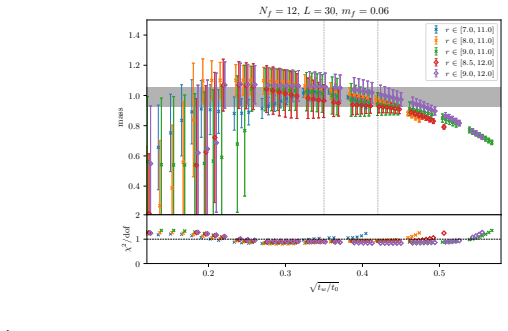
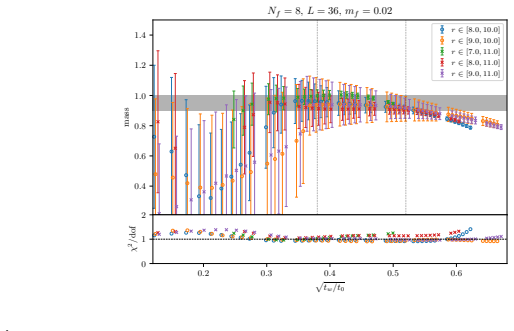
- [Sec. V, Eq. (5.8) and Appendix D] The extraction of M_eta' is based entirely on fitting the topological-charge correlator to the single free-propagator form C(r) = (A/r^1.5)(1+3/8r)e^{-M r}. In the Nf = 12 theory the paper itself states in Secs. I and II C that all bound states are non-relativistic 'unparticles' and that no bound states exist in the chiral limit, so the spectral function is not guaranteed to be a single delta function. The plateau checks in Fig. 17 and Appendix D cover only the limited distance window r in [7, 12] lattice units and a narrow smearing interval; a continuum or unparticle component can produce a slowly varying effective mass that looks flat over this range without implying a pole. The authors should provide a spectral-function reconstruction or an alternative multi-component/continuum fit, and show explicitly that the fitted exponential corresponds to a pole mass rather than a window-dependent effective mass.
- [Sec. V, Eq. (5.10), and Sec. VI] The values (2.5)^2, (5.0)^2, and (7.5)^2 in Eq. (5.10) and Eq. (6.2) are quoted without statistical or systematic uncertainties, so the claimed 1:4:9 ratios cannot be quantitatively assessed. In addition, the eta-prime data are taken at a single lattice spacing for each Nf, with no continuum extrapolation; the paper itself states in Sec. VI that continuum and chiral extrapolations are needed. As written, Eq. (5.10) describes a finite-lattice-spacing, fixed-smearing-window result, not a continuum scaling law. The authors should quote uncertainties and explicitly qualify the result as a single-spacing observation pending continuum and chiral extrapolations.
- [Sec. IV C, Eq. (2.42), and Table VIII] The values of gamma_m inferred from the d1 fits in Table VIII are obtained by inverting Eq. (2.42), which follows from the holographic/linear-sigma-model relation F_sigma^2 = (3-gamma_m)^2 (Nf/2)(F_pi/sqrt2)^2. Comparing those gamma_m values with the hyperscaling values is therefore not an independent check of the model relation; it only tests consistency under that model assumption. For Nf = 12 the agreement between gamma_m = 0.66(31) and the hyperscaling interval 0.4-0.5 is acceptable, but the text should state that this comparison is contingent on Eq. (2.42), not a derivation of it.
- [Sec. V, Eq. (5.10) vs. Fig. 21] Eq. (5.10) writes M_eta'^2 * 8t0, while Fig. 21 and definition (2.23) plot (M_eta'^2 - M_pi^2) * 8t0. At the simulated pion masses for Nf = 4 and Nf = 8, M_pi^2 * 8t0 is not negligible, so the constants (2.5)^2, (5.0)^2 and (7.5)^2 cannot simultaneously describe both quantities unless M_eta'^2(anomalous) is explicitly identified with the difference. The text and the figure must be made consistent.
minor comments (4)
- [Sec. II C, before Eq. (2.41)] The sentence 'For Nf = 8, this gives a result consistent with Eq. (2.40), as remarked on in Ref. [16].' is repeated verbatim twice in the same paragraph and should be reduced to a single occurrence.
- [Sec. II C, before Eq. (2.58)] The phrase 'loop expansion expansion parameter' contains a duplicated word and should read 'loop expansion parameter'.
- [Appendix D heading] The heading 'Fits of the flavor-singlet psudoscalar' contains a typo; 'psudoscalar' should be 'pseudoscalar'.
- [Fig. 17 caption] The caption quotes sqrt(8t0) = 7.2680(99) without stating the units; if this is in lattice units the text should say so explicitly, as is done for other quantities.
Circularity Check
No significant circularity: the n_f^2 scaling is an independently measured lattice ratio compared with an analytic large-N_c expectation, not a fitted-input restatement.
full rationale
The central claim, Eq. (5.10) and Eq. (6.2), is an observed lattice ratio: M_eta' is extracted by fitting the topological-charge-density correlator to the single-particle form Eq. (5.8), while t0 is an independently measured gluonic gradient-flow scale. Neither M_eta' nor t0 is adjusted to enforce the n_f^2 pattern, and the paper explicitly shows that the scaling fails when M_rho is used as the IR scale (Fig. 19), so the choice of 1/sqrt(8t0) is not a tautological rescaling. The n_f^2 expectation in Eq. (2.23) is an analytic large-N_c 'anti-Veneziano' counting result from Ref. [12]; although one author of the present paper is a coauthor of that reference, the paper restates the WT-identity derivation in Sec. II, and the lattice data are external to that derivation, making the citation independent support rather than a self-citation that supplies the conclusion. The d1-gamma_m comparison in Sec. IV and Table VIII is also a cross-check, not a derivation: d1 is fitted from M_sigma^2 versus M_pi^2, gamma_m is obtained from finite-size hyperscaling, and Eq. (2.42) is an assumed model relation from linear sigma/holographic calculations; the consistency of the two estimates does not feed back into the eta' claim. The paper's own caveats about the absence of continuum extrapolations, the single lattice spacing per N_f, and the single-pole ansatz in the conformal N_f=12 theory are correctness and systematics risks, not circular reductions, because they do not make the fitted quantities equal to the claimed prediction by construction.
Assumptions & free parameters
free parameters (5)
- d1 (slope in M_sigma^2 = d0 + d1 M_pi^2) =
Nf=4: 3.5(1.1); Nf=8: 1.01(20); Nf=12: 0.712(229)
- d0 (intercept in M_sigma^2 = d0 + d1 M_pi^2) =
Nf=4: -0.039(54); Nf=8: -0.0066(62); Nf=12: 0.0030(202)
- gamma_m from finite-size hyperscaling fit =
Nf=8: 1.0830(11); Nf=12: 0.4395(20)
- c0, c1 in M_sigma = c0 + c1 mf (Nf=8) =
c0=0.0526(184), c1=7.35(96)
- M_eta' fit parameters A and M in Eq. (5.8) =
per ensemble, not tabulated globally
assumptions (5)
- domain assumption Anti-Veneziano limit (Nc -> infinity, nf fixed) and fermion-loop dominance in the axial anomaly correlator.
- domain assumption Single-pole dominance in the axial and scale WT identities, Eqs. (2.17), (2.33), and (2.35).
- domain assumption The gradient flow scale 1/sqrt(8t0) at E = 0.3 provides a common IR scale across phases and Nf values.
- domain assumption HISQ staggered fermion simulations have small enough taste breaking that fourth-root and taste artifacts do not distort the flavor-singlet spectrum.
- domain assumption The topological charge density correlator is saturated by the eta-prime single-particle pole in the fitted windows, Eq. (5.8), including in the conformal Nf = 12 theory.
Cite this review
Pith. "Pith review of A novel view of the flavor-singlet spectrum from multi-flavor QCD on the lattice." pith.science (2026). https://pith.science/paper/4PA4PVE5
@misc{pith2026250508658,
  author       = {Pith},
  title        = {Pith review of: A novel view of the flavor-singlet spectrum from multi-flavor QCD on the lattice},
  year         = {2026},
  howpublished = {\url{https://pith.science/paper/4PA4PVE5}},
  note         = {Machine review of arXiv:2505.08658}
}
abstract
SU(3) gauge theories with increasing number of light fermions are the templates of strongly interacting sectors and studying their low-energy dynamics and spectrum is important, both for understanding the strong dynamics of QCD itself, but also for discovering viable UV completions of beyond the Standard Model physics. In order to contrast many-flavors strongly interacting theories with QCD on a quantitative footing, we use Lattice Field Theory simulations. We focus on the study of the flavor-singlet spectrum in the scalar and pseudoscalar channels: this is an interesting probe of the dynamics of the strongly interacting sector, as reminded by the QCD case with the $f_0(500)$ ($\sigma$) and $\eta^\prime$ mesons. The hierarchy of the spectrum of a strongly coupled new gauge sector of the Standard Model defines the potential reach of future colliders for new physics discoveries. In addition to a novel hierarchy with light scalars, introducing many light flavors at fixed number of colors can influence the dynamics of the lightest flavor-singlet pseudoscalar. We present a complete lattice study of both these flavor-singlet channels on high-statistics gauge ensembles generated by the LatKMI collaboration with 4, 8, and 12 copies of light mass-degenerate fermions. We also present other hadron masses on the lightest ensemble for $N_f=8$ generated by the LatKMI collaboration and discuss the chiral extrapolation of the spectrum in this particular theory. We contrast the results to $N_f=4$ simulations and previous results of $N_f=12$ simulations.
Figures


Figures from the paper (41 more)






Reference graph
Works this paper leans on
-
[73]
S. M. Bhattacharjee and F. Seno, A measure of data collapse for scaling, Journal of Physics A: Mathematical and General 34, 6375 (2001)
work page 2001
-
[1]
Having a new lightest mass point at mf = 0.009 allows us to shift our fitting ranges towards the chiral limit while keeping the same number of fit degrees of freedom
Fπ and Mπ The decay constant Fπ is fitted by a quadratic fit with the fitting range amf ∈ [0.009, 0.03], because including larger masses results in large fit residuals ( χ2/dof). Having a new lightest mass point at mf = 0.009 allows us to shift our fitting ranges towards the chiral limit while keeping the same number of fit degrees of freedom. The chiral ...
-
[2]
The first is a direct measurement of the chiral condensate ⟨ψψ⟩ = Tr[D−1 HISQ] 4
Chiral condensate We estimate the chiral condensate in the chiral limit with two analyses. The first is a direct measurement of the chiral condensate ⟨ψψ⟩ = Tr[D−1 HISQ] 4 . (3.4) The chiral extrapolation of ⟨ψψ⟩ using a quadratic fit in the range mf ∈ [0.009, 0.03] is presented in Appendix B. 21 The second analysis is based on the Gell-Mann–Oakes–Renner ...
-
[3]
Linear” and “Quadratic
Masses of mesons and baryons We extrapolate the masses of the ρ,a0,a1,b1,N, and N∗ 1 states to the chiral limit using a linear fit of the data for mf∈ [0.009, 0.03]. The ρ and N states show a curvature in this range, and so are also extrapolated using a quadratic fitting form, for the same fit range, as shown in Fig. 7. The results of these fits are tabul...
-
[4]
K. Yamawaki, M. Bando, and K.-i. Matumoto, Scale Invariant Technicolor Model and a Tech- nidilaton, Phys. Rev. Lett. 56, 1335 (1986)
work page 1986
-
[5]
This is slightly smaller than, but consistent within uncertainties, with our previous result omitting the new lightest point [17], Mσ/(F/ √
= 3.51(1.25)(17 5.27). This is slightly smaller than, but consistent within uncertainties, with our previous result omitting the new lightest point [17], Mσ/(F/ √
-
[6]
= 4.2(2.0)(1.4 9.5). The new value would give Mσ/vEW = (Mσ/F ) p 2/ND∼ 1.75 forND = 4 (the one-family model), which remains consistent (within uncertainties, which remain large) with the possibility to identify σ with the Higgs, with Mσ/vEW≃ 1 2. 26 0 5 10 15 20 25 30 t/a 0.0 0.1 0.2 0.3 0.4 aMeff mπ 2D(t) 2D+(t) − C+(t) −C− (t) FIG. 8. The effectiveσ mass...
-
[7]
T. Akiba and T. Yanagida, Hierarchic Chiral Condensate, Phys. Lett. B 169, 432 (1986)
work page 1986
Show all 97 references
-
[8]
T. W. Appelquist, D. Karabali, and L. C. R. Wijewardhana, Chiral Hierarchies and the Flavor Changing Neutral Current Problem in Technicolor, Phys. Rev. Lett. 57, 957 (1986)
1986
-
[9]
Appelquist, J
T. Appelquist, J. Terning, and L. C. R. Wijewardhana, The Zero temperature chiral phase transition in SU(N) gauge theories, Phys. Rev. Lett. 77, 1214 (1996), arXiv:hep-ph/9602385
1996 arXiv
-
[10]
28 0 2 4 6 8 10 12 14 t/a 0.0 0.1 0.2 0.3 0.4 0.5 aMeff mπ D(t) D+(t) − C+(t) FIG
slightly smaller than ours. 28 0 2 4 6 8 10 12 14 t/a 0.0 0.1 0.2 0.3 0.4 0.5 aMeff mπ D(t) D+(t) − C+(t) FIG. 11. Effective masses for the D+(t)−C+(t) andD(t) correlators at mf = 0.01 andβ = 3.8 for Nf = 4. The dot-dashed line represents Mπ. The solid lines express the fit res...
-
[11]
1 .01(20) ≃ 1 [14, 17, 23] 12 0 .0030(202)(41
-
[12]
Matsuzaki and K
S. Matsuzaki and K. Yamawaki, Walking on the ladder: 125 GeV technidilaton, or Conformal Higgs, JHEP 12, 053, [Erratum: JHEP11,158(2016)], arXiv:1508.07688 [hep-ph]
2016 arXiv
-
[13]
In addition to the result of a hyperscaling fit for Nf = 8 and 12, we also present in Ta- ble VIII the value ofγm obtained by solving Eq
may be identified with that in the chiral limit, which is of direct relevance to the comparison with the anticipated properties of a composite Higgs. In addition to the result of a hyperscaling fit for Nf = 8 and 12, we also present in Ta- ble VIII the value ofγm obtained by s...
-
[14]
A similar observation has already been reported in [29, 67, 68], where lattice numerical results confirm that the ratioMρ/Fπ remains insensitive to Nf up to Nf≤ 10
in the broken phase, which would then also be universal— independent both of mf and nf(<n cr f ). A similar observation has already been reported in [29, 67, 68], where lattice numerical results confirm that the ratioMρ/Fπ remains insensitive to Nf up to Nf≤ 10. We will furthe...
-
[15]
Eq. (5.8) can only be assumed to be valid in a specific region of large r, where the ground state dominates: in other words we should make sure that the extracted mass does not depend on the value of rmin
-
[16]
We estimate the systematic uncertanity on Mη′ by looking for a plateau in the fitting range [rmin,r max], and for a plateau in the smearing range sw = √8tw
The correlator at large distances suffers from larger statistical fluctuations and can be extracted only at large values of the smearing scale sw, where smearing artifacts [72] are larger: in other words we should check that the extracted mass does not depend on rmax. We estim...
-
[17]
Owing to the updated data, the lower systematic errors are improved by more than a factor of two. Eq. (2.36) may also be derived by the dilaton chiral perturbation theory (dChPT) in the broken phase, up to chiral log effects that are irrelevant to our data points, lying as the...
-
[18]
(2.39), which is most relevant to the Higgs phenomenology
as in Eq. (2.39), which is most relevant to the Higgs phenomenology. It was obtained from the observed value of d1 for Nf = 8 to give Eq. (4.3): Fσ/(Fπ/ √
-
[19]
for γm = 1, (6.1) which is consistent with the previous results Fσ/(Fπ/ √
-
[20]
≃ 4 [16, 17]. This implies vEW/(Fσ|mf =0)≃√ND/4 to be compared with vEW/Fσ|mf =0≃ 0.27, the value from the LHC data when σ identified with the Higgs [12], where vEW = 250 GeV and ND is the number of weak doublets of the WTC model. More importantly, the WT identity formula Eq. ...
-
[21]
Y. Aoki, T. Aoyama, M. Kurachi, T. Maskawa, K.-i. Nagai, H. Ohki, A. Shibata, K. Yamawaki, and T. Yamazaki, Study of the conformal hyperscaling relation through the Schwinger-Dyson equation, Phys. Rev. D 85, 074502 (2012), arXiv:1201.4157 [hep-lat]
2012 arXiv
-
[22]
Aad et al
G. Aad et al. (ATLAS), Observation of a new particle in the search for the Standard Model Higgs boson with the ATLAS detector at the LHC, Phys. Lett. B 716, 1 (2012), arXiv:1207.7214 [hep-ex]
2012 arXiv
-
[23]
Chatrchyan et al
S. Chatrchyan et al. (CMS), Observation of a New Boson at a Mass of 125 GeV with the CMS Experiment at the LHC, Phys. Lett. B 716, 30 (2012), arXiv:1207.7235 [hep-ex]. 43
2012 arXiv
-
[24]
Craig, Naturalness: A Snowmass White Paper, in 2022 Snowmass Summer Study (2022) arXiv:2205.05708 [hep-ph]
N. Craig, Naturalness: A Snowmass White Paper, in 2022 Snowmass Summer Study (2022) arXiv:2205.05708 [hep-ph]
2022 arXiv
-
[25]
Appelquist, R
T. Appelquist, R. C. Brower, G. T. Fleming, J. Kiskis, M. F. Lin, E. T. Neil, J. C. Osborn, C. Rebbi, E. Rinaldi, D. Schaich, C. Schroeder, S. Syritsyn, G. Voronov, P. Vranas, E. Wein- berg, and O. Witzel (LSD), Lattice simulations with eight flavors of domain wall fermions in...
2014 arXiv
-
[26]
Bando, K.-i
M. Bando, K.-i. Matumoto, and K. Yamawaki, TECHNIDILATON, Phys. Lett. B 178, 308 (1986)
1986
-
[27]
Holdom, Techniodor, Phys
B. Holdom, Techniodor, Phys. Lett. B 150, 301 (1985)
1985
-
[28]
Appelquist, R
T. Appelquist, R. C. Brower, G. T. Fleming, A. Hasenfratz, X. Y. Jin, J. Kiskis, E. T. Neil, J. C. Osborn, C. Rebbi, E. Rinaldi, D. Schaich, P. Vranas, E. Weinberg, and O. Witzel (LSD), Strongly interacting dynamics and the search for new physics at the LHC, Phys. Rev. D93, 11...
2016 arXiv
-
[29]
Appelquist et al
T. Appelquist et al. (Lattice Strong Dynamics), Nonperturbative investigations of SU(3) gauge theory with eight dynamical flavors, Phys. Rev. D99, 014509 (2019), arXiv:1807.08411 [hep- lat]
2019 arXiv
-
[30]
Witzel, Review on Composite Higgs Models, PoS LATTICE2018, 006 (2019), arXiv:1901.08216 [hep-lat]
O. Witzel, Review on Composite Higgs Models, PoS LATTICE2018, 006 (2019), arXiv:1901.08216 [hep-lat]
2019 arXiv
-
[31]
W. E. Caswell, Asymptotic Behavior of Nonabelian Gauge Theories to Two Loop Order, Phys. Rev. Lett. 33, 244 (1974)
1974
-
[32]
Banks and A
T. Banks and A. Zaks, On the Phase Structure of Vector-Like Gauge Theories with Massless Fermions, Nucl. Phys. B 196, 189 (1982)
1982
-
[33]
The central value is determined from the result with the fit range at smaller t
as shown in Table XI. The central value is determined from the result with the fit range at smaller t. The result from the larger- t fit range is used to estimate the systematic error, as in our previous work [15–17]. At this mf, finite volume effects are expected to be small,...
-
[34]
Y. Aoki, T. Aoyama, M. Kurachi, T. Maskawa, K.-i. Nagai, H. Ohki, A. Shibata, K. Yamawaki, and T. Yamazaki (LatKMI), Lattice study of conformality in twelve-flavor QCD, Phys. Rev. D86, 054506 (2012), arXiv:1207.3060 [hep-lat]
2012 arXiv
-
[35]
Y. Aoki, T. Aoyama, M. Kurachi, T. Maskawa, K.-i. Nagai, H. Ohki, A. Shibata, K. Yamawaki, and T. Yamazaki (LatKMI), Walking signals in Nf = 8 QCD on the lattice, Phys. Rev. D87, 094511 (2013), arXiv:1302.6859 [hep-lat]
2013 arXiv
-
[36]
Y. Aoki, T. Aoyama, M. Kurachi, T. Maskawa, K.-i. Nagai, H. Ohki, E. Rinaldi, A. Shibata, K. Yamawaki, and T. Yamazaki (LatKMI), Light composite scalar in twelve-flavor QCD on the lattice, Phys. Rev. Lett. 111, 162001 (2013), arXiv:1305.6006 [hep-lat]
2013 arXiv
-
[37]
Y. Aoki, T. Aoyama, E. Bennett, M. Kurachi, T. Maskawa, M. Kohtaroh, K.-i. Nagai, H. Ohki, E. Rinaldi, A. Shibata, K. Yamawaki, and T. Yamazaki (LatKMI), Light composite scalar in eight-flavor QCD on the lattice, Phys. Rev. D89, 111502 (2014), arXiv:1403.5000 [hep-lat]
2014 arXiv
-
[38]
Y. Aoki, T. Aoyama, E. Bennett, M. Kurachi, T. Maskawa, M. Kohtaroh, K.-i. Nagai, H. Ohki, E. Rinaldi, A. Shibata, K. Yamawaki, and T. Yamazaki (LatKMI), Light flavor- singlet scalars and walking signals in Nf = 8 QCD on the lattice, Phys. Rev. D96, 014508 (2017), arXiv:1610.0...
2017 arXiv
-
[39]
V. A. Miransky, Dynamics in the conformal window in QCD like theories, Phys. Rev. D 59, 105003 (1999), arXiv:hep-ph/9812350
1999 arXiv
-
[40]
(4.1), which is obtained from the WT identity, and so is valid for the present lattice data with χ≫ 1
0 .66(31) 0.4–0.5 [13, 17] The fit result d0≃ 0 within (large) uncertainties, both for Nf = 4 and Nf = 8, arises from Eq. (4.1), which is obtained from the WT identity, and so is valid for the present lattice data with χ≫ 1. However, in the region of the chiral limit we would ...
-
[41]
Del Debbio and R
L. Del Debbio and R. Zwicky, Hyperscaling relations in mass-deformed conformal gauge the- ories, Phys. Rev. D 82, 014502 (2010), arXiv:1005.2371 [hep-ph]
2010 arXiv
-
[42]
Del Debbio and R
L. Del Debbio and R. Zwicky, Scaling relations for the entire spectrum in mass-deformed conformal gauge theories, Phys. Lett. B 700, 217 (2011), arXiv:1009.2894 [hep-ph]
2011 arXiv
-
[43]
V. A. Miransky and K. Yamawaki, Conformal phase transition in gauge theories, Phys. Rev. D 55, 5051 (1997), [Erratum: Phys.Rev.D 56, 3768 (1997)], arXiv:hep-th/9611142. 44
1997 arXiv
-
[44]
Y. Aoki, T. Aoyama, M. Kurachi, T. Maskawa, K.-i. Nagai, H. Ohki, A. Shibata, K. Yamawaki, and T. Yamazaki, Exploring walking behavior in SU(3) gauge theory with 4 and 8 HISQ quarks, PoS LATTICE2012, 035 (2012), arXiv:1301.3367 [hep-lat]
2012 arXiv
-
[45]
Cheng, A
A. Cheng, A. Hasenfratz, G. Petropoulos, and D. Schaich, Scale-dependent mass anomalous dimension from Dirac eigenmodes, JHEP 07, 061, arXiv:1301.1355 [hep-lat]
-
[46]
Hashimoto and K
M. Hashimoto and K. Yamawaki, Techni-dilaton at Conformal Edge, Phys. Rev. D 83, 015008 (2011), arXiv:1009.5482 [hep-ph]
2011 arXiv
-
[47]
Matsuzaki and K
S. Matsuzaki and K. Yamawaki, Dilaton Chiral Perturbation Theory: Determining the Mass and Decay Constant of the Technidilaton on the Lattice, Phys. Rev. Lett.113, 082002 (2014), arXiv:1311.3784 [hep-lat]
2014 arXiv
-
[48]
Aoki et al
Y. Aoki et al. (LatKmi), Lattice study of the scalar and baryon spectra in many-flavor QCD, Int. J. Mod. Phys. A 32, 1747010 (2017), arXiv:1510.07373 [hep-lat]
2017 arXiv
-
[49]
Results for Nf = 4 QCD The σ mass in Nf = 4 at β = 3.8 on L3×T = 20 3× 30 is calculated using the same action as in Nf = 8
c1 = 7.35(96)(2.95 39 ) χ2/dof 0.21 0.34 dof 3 3 B. Results for Nf = 4 QCD The σ mass in Nf = 4 at β = 3.8 on L3×T = 20 3× 30 is calculated using the same action as in Nf = 8. Fermion masses are chosen to be mf = 0.01, 0.02, and 0.03 in lattice units. In contrast to Nf = 8, th...
-
[50]
Y. Aoki, T. Aoyama, E. Bennett, M. Kurachi, T. Maskawa, M. Kohtaroh, K.-i. Nagai, H. Ohki, E. Rinaldi, A. Shibata, K. Yamawaki, and T. Yamazaki (LatKMI), Topological observables in many-flavour QCD, PoS LATTICE2015, 214 (2016), arXiv:1601.04687 [hep-lat]
2016 arXiv
-
[51]
Sommer, A New way to set the energy scale in lattice gauge theories and its applications to the static force and alpha-s in SU(2) Yang-Mills theory, Nucl
R. Sommer, A New way to set the energy scale in lattice gauge theories and its applications to the static force and alpha-s in SU(2) Yang-Mills theory, Nucl. Phys. B 411, 839 (1994), arXiv:hep-lat/9310022
1994 arXiv
-
[52]
Svetitsky, Looking behind the Standard Model with lattice gauge theory, EPJ Web Conf
B. Svetitsky, Looking behind the Standard Model with lattice gauge theory, EPJ Web Conf. 175, 01017 (2018), arXiv:1708.04840 [hep-lat]
2018 arXiv
-
[53]
Pica, Beyond the Standard Model: Charting Fundamental Interactions via Lattice Simu- lations, PoS LATTICE2016, 015 (2016), arXiv:1701.07782 [hep-lat]
C. Pica, Beyond the Standard Model: Charting Fundamental Interactions via Lattice Simu- lations, PoS LATTICE2016, 015 (2016), arXiv:1701.07782 [hep-lat]
2016 arXiv
-
[54]
Appelquist, J
T. Appelquist, J. Ingoldby, and M. Piai, Analysis of a Dilaton EFT for Lattice Data, JHEP 03, 039, arXiv:1711.00067 [hep-ph]
-
[55]
Appelquist, J
T. Appelquist, J. Ingoldby, and M. Piai, Dilaton potential and lattice data, Phys. Rev. D 101, 075025 (2020), arXiv:1908.00895 [hep-ph]
2020 arXiv
-
[56]
Fodor, K
Z. Fodor, K. Holland, J. Kuti, and C. H. Wong, Tantalizing dilaton tests from a near-conformal EFT, PoS LATTICE2018, 196 (2019), arXiv:1901.06324 [hep-lat]
2019 arXiv
-
[57]
Golterman, E
M. Golterman, E. T. Neil, and Y. Shamir, Application of dilaton chiral perturbation theory toNf = 8, SU(3) spectral data, Phys. Rev. D 102, 034515 (2020), arXiv:2003.00114 [hep-ph]
2020 arXiv
-
[58]
Y. Aoki, T. Aoyama, E. Bennett, M. Kurachi, T. Maskawa, M. Kohtaroh, K.-i. Nagai, H. Ohki, E. Rinaldi, A. Shibata, K. Yamawaki, and T. Yamazaki (LatKMI), Walking and conformal dynamics in many-flavor QCD, PoS LATTICE2015, 213 (2016), arXiv:1601.02287 [hep-lat]
2016 arXiv
-
[59]
Y. Aoki, T. Aoyama, E. Bennett, M. Kurachi, T. Maskawa, M. Kohtaroh, K.-i. Nagai, H. Ohki, E. Rinaldi, A. Shibata, K. Yamawaki, and T. Yamazaki (LatKMI), Flavor-singlet spectrum in multi-flavor QCD, EPJ Web Conf. 175, 08023 (2018), arXiv:1710.06549 [hep-lat]
2018 arXiv
-
[60]
Investissements d’Avenir
and the A*MIDEX project (ANR-11-IDEX-0001-02), funded by the “Investissements d’Avenir” French government program and managed by the ANR. H.O. is supported in part by the JSPS KAKENHI (Nos. 21K03554, 22H00138). T.Y. is supported in part by Grants-in-Aid for Scientific Research...
-
[61]
Witten, Current Algebra Theorems for the U(1) Goldstone Boson, Nucl
E. Witten, Current Algebra Theorems for the U(1) Goldstone Boson, Nucl. Phys. B156, 269 (1979)
1979
-
[62]
Veneziano, U(1) Without Instantons, Nucl
G. Veneziano, U(1) Without Instantons, Nucl. Phys. B 159, 213 (1979)
1979
-
[63]
(4.3) d0 is consistent (up to a large uncertainty, and the possible chiral log effects discussed in Sec
for Cγm = 4. (4.3) d0 is consistent (up to a large uncertainty, and the possible chiral log effects discussed in Sec. II) with the value d0 =M 2 σ|mf =0≃ v2 EW 4 = ND 4 · F 2 2 ≃ ND 4 · 0.0002247(270)(377 22 ) (4.4) that would be required for σ to be identified with the Higgs ...
-
[64]
L¨ uscher, Properties and uses of the Wilson flow in lattice QCD, JHEP 08, 071, [Erratum: JHEP03,092(2014)], arXiv:1006.4518 [hep-lat]
M. L¨ uscher, Properties and uses of the Wilson flow in lattice QCD, JHEP 08, 071, [Erratum: JHEP03,092(2014)], arXiv:1006.4518 [hep-lat]. 45
2014 arXiv
-
[65]
Yamawaki, Dynamical Gauge Boson of Hidden Local Symmetry within the Standard Model, (2018), arXiv:1803.07271 [hep-ph]
K. Yamawaki, Dynamical Gauge Boson of Hidden Local Symmetry within the Standard Model, (2018), arXiv:1803.07271 [hep-ph]
2018 arXiv
-
[66]
Appelquist and Y
T. Appelquist and Y. Bai, A Light Dilaton in Walking Gauge Theories, Phys. Rev. D 82, 071701 (2010), arXiv:1006.4375 [hep-ph]
2010 arXiv
-
[67]
Golterman and Y
M. Golterman and Y. Shamir, Low-energy effective action for pions and a dilatonic meson, Phys. Rev. D 94, 054502 (2016), arXiv:1603.04575 [hep-ph]
2016 arXiv
-
[68]
Del Debbio and R
L. Del Debbio and R. Zwicky, Dilaton and massive hadrons in a conformal phase, JHEP 08, 007, arXiv:2112.11363 [hep-ph]
-
[69]
Matsuzaki and K
S. Matsuzaki and K. Yamawaki, Holographic techni-dilaton at 125 GeV, Phys. Rev. D 86, 115004 (2012), arXiv:1209.2017 [hep-ph]
2012 arXiv
-
[70]
Follana, Q
E. Follana, Q. Mason, C. Davies, K. Hornbostel, G. P. Lepage, J. Shigemitsu, H. Trottier, and K. Wong (HPQCD, UKQCD), Highly improved staggered quarks on the lattice, with applications to charm physics, Phys. Rev. D 75, 054502 (2007), arXiv:hep-lat/0610092
2007 arXiv
-
[71]
Symanzik, Continuum Limit and Improved Action in Lattice Theories
K. Symanzik, Continuum Limit and Improved Action in Lattice Theories. 1. Principles and ϕ4 Theory, Nucl. Phys. B 226, 187 (1983)
1983
-
[72]
Bruno, S
M. Bruno, S. Schaefer, and R. Sommer (ALPHA), Topological susceptibility and the sampling of field space in Nf = 2 lattice QCD simulations, JHEP 08, 150, arXiv:1406.5363 [hep-lat]
-
[74]
DeGrand, Finite-size scaling tests for SU(3) lattice gauge theory with color sextet fermions, Phys
T. DeGrand, Finite-size scaling tests for SU(3) lattice gauge theory with color sextet fermions, Phys. Rev. D 80, 114507 (2009), arXiv:0910.3072 [hep-lat]
2009 arXiv
-
[75]
Athenodorou, E
A. Athenodorou, E. Bennett, G. Bergner, and B. Lucini, Investigating the conformal behavior of SU(2) with one adjoint Dirac flavor, Phys. Rev. D 104, 074519 (2021), arXiv:2103.10485 [hep-lat]
2021 arXiv
-
[76]
Soldate and R
M. Soldate and R. Sundrum, Z couplings to pseudo-Goldstone bosons within extended tech- nicolor, Nucl. Phys. B340, 1 (1990)
1990
-
[77]
R. S. Chivukula, M. J. Dugan, and M. Golden, Analyticity, crossing symmetry and the limits of chiral perturbation theory, Phys. Rev. D 47, 2930 (1993)
1993
-
[78]
Harada and K
M. Harada and K. Yamawaki, Hidden local symmetry at loop: A New perspective of composite gauge boson and chiral phase transition, Phys. Rept. 381, 1 (2003)
2003
-
[79]
P. A. Zyla et al. (Particle Data Group), Review of Particle Physics, PTEP 2020, 083C01 (2020)
2020
-
[80]
Y. Aoki, T. Aoyama, E. Bennett, M. Kurachi, T. Maskawa, M. Kohtaroh, K.-i. Nagai, H. Ohki, E. Rinaldi, A. Shibata, K. Yamawaki, and T. Yamazaki (LatKMI), The Peskin-Takeuchi S parameter and vector meson decay constants in Nf = 8 QCD, In preparation (2022)
2022
-
[81]
Fu, Preliminary lattice study of σ meson decay width, JHEP 1207, 142, arXiv:1202.5834 [hep-lat]
Z. Fu, Preliminary lattice study of σ meson decay width, JHEP 1207, 142, arXiv:1202.5834 [hep-lat]
-
[82]
Kunihiro, S
T. Kunihiro, S. Muroya, A. Nakamura, C. Nonaka, M. Sekiguchi, and H. Wada (SCALAR), Scalar mesons in lattice QCD, Phys. Rev. D70, 034504 (2004), arXiv:hep-ph/0310312 [hep- ph]. 46
2004 arXiv
-
[83]
R. A. Briceno, J. J. Dudek, R. G. Edwards, and D. J. Wilson, Isoscalar ππ scattering and the σ meson resonance from QCD, Phys. Rev. Lett. 118, 022002 (2017), arXiv:1607.05900 [hep-ph]
2017 arXiv
-
[84]
R. A. Briceno, J. J. Dudek, R. G. Edwards, and D. J. Wilson, Isoscalar ππ,KK,ηη scattering and the σ,f 0,f 2 mesons from QCD, Phys. Rev. D97, 054513 (2018), arXiv:1708.06667 [hep- lat]
2018 arXiv
-
[85]
V. A. Miransky and K. Yamawaki, On Gauge Theories with Additional Four Fermion Inter- action, Mod. Phys. Lett. A 4, 129 (1989)
1989
-
[86]
Kawarabayashi and M
K. Kawarabayashi and M. Suzuki, Partially conserved axial vector current and the decays of vector mesons, Phys. Rev. Lett. 16, 255 (1966)
1966
-
[87]
Riazuddin and Fayyazuddin, Algebra of current components and decay widths of ρ and K∗ mesons, Phys. Rev. 147, 1071 (1966)
1966
-
[88]
Nogradi and L
D. Nogradi and L. Szikszai, The flavor dependence of mϱ/fπ, JHEP 05, 197, [Erratum: JHEP 06, 031 (2022)], arXiv:1905.01909 [hep-lat]
2022 arXiv
-
[89]
A. Y. Kotov, D. Nogradi, K. K. Szabo, and L. Szikszai, More on the flavor dependence of mρ/fπ, JHEP 07, 202, [Erratum: JHEP 06, 032 (2022)], arXiv:2107.05996 [hep-lat]
2022 arXiv
-
[90]
Veneziano, Goldstone Mechanism From Gluon Dynamics, Phys
G. Veneziano, Goldstone Mechanism From Gluon Dynamics, Phys. Lett. 95B, 90 (1980)
1980
-
[91]
Fukaya, S
H. Fukaya, S. Aoki, G. Cossu, S. Hashimoto, T. Kaneko, and J. Noaki (JLQCD), η′ meson mass from topological charge density correlator in QCD, Phys. Rev. D92, 111501 (2015), arXiv:1509.00944 [hep-lat]
2015 arXiv
-
[92]
Lepage and C
P. Lepage and C. Gohlke, gplepage/lsqfit: lsqfit version 11.8 (2021)
2021
-
[94]
Y. Aoki, T. Aoyama, E. Bennett, M. Kurachi, T. Maskawa, M. Kohtaroh, K.-i. Nagai, H. Ohki, E. Rinaldi, A. Shibata, K. Yamawaki, and T. Yamazaki, A novel view of the flavor-singlet spectrum from multi-flavor qcd on the lattice — data and workflow release (2025). Appendix A: Det...
2025
-
[95]
Nf = 4 0.4 0.6 0.8 1.0 1.2 1.4 mass Nf = 4, L = 20, mf = 0.01 r ∈ [7.0, 10.0] r ∈ [7.5, 10.0] r ∈ [8.0, 10.0] r ∈ [8.5, 10.0] 0.7 0.8 0.9 1.0 1.1√ tw/t0 0 1 2χ2/dof FIG. 31. The η′ mass fitted for different distance regions and smearings, for a specific ensemble of Nf = 4 QCD ...
-
[96]
Nf = 8 0.4 0.6 0.8 1.0 1.2 1.4 mass Nf = 8, L = 30, mf = 0.03 r ∈ [7.0, 11.0] r ∈ [8.0, 11.0] r ∈ [7.0, 12.0] r ∈ [8.0, 12.0] 0.2 0.3 0.4 0.5 0.6√ tw/t0 0 1 2χ2/dof FIG. 36. The η′ mass fitted for different distance regions and smearings, for a specific ensemble of Nf = 8 QCD ...
-
[97]
Nf = 12 0.4 0.6 0.8 1.0 1.2 1.4 mass Nf = 12, L = 30, mf = 0.06 r ∈ [7.0, 11.0] r ∈ [8.0, 11.0] r ∈ [8.5, 11.0] r ∈ [9.0, 11.0] 0.2 0.3 0.4 0.5√ tw/t0 0 1 2χ2/dof FIG. 42. The η′ mass fitted for different distance regions and smearings, for a specific ensemble of Nf = 12 QCD w...
-
[144]
c0 = 0.0526(184)(26 787) d1 = 1.01(20)(32
Reviewed August 15, 2026 · model on record in the stance chip above.
Discussion (0). Continue with ORCID to comment.