REVIEW 5 major objections 5 minor 2 cited by
Three-Field String Inflation with Perturbative Corrections: Dynamics and Implications
T0 review · 5 major / 5 minor · reviewed 2026-08-08 · deepseek-v4-flash
Pith's one-line read Purely perturbative string corrections can stabilize the vacuum and drive three-field inflation within CMB bounds.
desk verdict A genuinely new perturbative three-field inflation construction whose benchmark example fails two internal consistency checks, so the headline Planck-alignment claim is not yet demonstrated. read the letter →
The pith
A machine-rendered reading of the paper's core claim, the machinery that carries it, and where it could break.
The reading
What carries the argument
The load-bearing object is the effective scalar potential in the canonical field basis, assembled from the weak-Swiss-cheese volume $\mathcal{V}=\frac{1}{\sqrt{2\alpha}}\sqrt{\tau_7}\,\tau_6-\frac{1}{3}\tau_1^{3/2}$, the $\alpha'^3$ term $\hat{\xi}/(2\mathcal{V})$, log-loop terms $\hat{\eta}\log\tau_i$, the $F^4$ correction $c\,\mathcal{V}^{-4}(t_1+t_6+t_7)$, and a constant uplift $V_{\mathrm{up}}$. The mechanism that makes inflation two-staged is the field-dependent ridge along $\phi_3$: while $(\phi_1,\phi_2)$ are displaced from their minima, the minimum along $\phi_3$ disappears and $\phi_3$ settles into an oscillating false vacuum; only when the other two fields approach their minima does the true minimum reappear, switching the trajectory into a two-field phase. The canonical reparametrization and the small-$y$ expansion around $\phi_3^2=4/3$ turn the moduli potential into the form used for the numerical evolution.
What would settle it
Compute the logarithmic loop correction on an explicit K3-fibred Calabi-Yau threefold with the volume form used here, determine the $F^4$ coefficient $\lambda$, and check whether the resulting potential still has a large-volume minimum with the ridge along $\phi_3$; if the minimum or the two-stage trajectory disappears, the central claim is refuted.
Extended reading notes
Core claim
On the paper's own terms, the central discovery is that the interplay of three perturbative corrections—the $\alpha'^3$ BBHL shift, the logarithmic loop terms proportional to $\hat{\eta}\log\tau_i$, and the higher-derivative $F^4$ term—stabilizes a K3-fibred, weak-Swiss-cheese Calabi-Yau at large volume without non-perturbative effects, and turns that stabilized geometry into a three-field inflationary model. The potential has a global minimum at large values of the moduli with volume of order $10^4$ to $10^8$; from displaced initial conditions the fields follow a two-stage attractor in which $\phi_3$ first rolls down the steepest direction, falls into a ridge that acts as a false vacuum, oscillates, and then hands over to $\phi_1,\phi_2$ in a genuinely multi-field second stage. At horizon crossing the model gives $n_s\simeq0.96$, $r\sim10^{-7}$, and $\Delta_s^2\simeq2\times10^{-9}$, consistent with CMB bounds, while the second Hubble slow-roll parameter exceeds the first by orders of magnitude throughout, with a transient violation around $N\simeq55$.
Load-bearing premise
The whole mechanism rests on the conjectured logarithmic loop correction, which is taken from torus calculations and applied to a K3-fibred Calabi-Yau, and on the unknown coefficient $\lambda$ of the $F^4$ correction being large enough to lift the flat directions without destroying the large-volume minimum.
Editorial extensions
If this is right
- If the central claim is right, large-volume string inflation no longer needs non-perturbative superpotentials: all Kähler moduli are fixed by the balance of $\alpha'^3$, logarithmic loop, and $F^4$ terms, sidestepping constraints such as the unit arithmetic genus condition.
- The model yields roughly 55 efolds of nearly single-field inflation along the steep $\phi_3$ direction followed by a short multi-field stage, so observations at horizon crossing probe the first stage while small-scale probes can test the second.
- Horizon-crossing observables fall in the CMB-allowed region with $n_s\approx0.96$, $r\sim10^{-7}$, and $\Delta_s^2\sim2\times10^{-9}$, making the model a candidate string-derived explanation of the cosmic microwave background.
- The hierarchy $\eta_H\gg\epsilon_H$ with a transient slow-roll violation near $N\simeq55$ implies possible small-scale features and primordial black hole production, although the enhancement is not computed in this paper.
- The benchmark model satisfies $m_{3/2}<M_{KK}<M_s$ and $m_{\phi_i}<H$, keeping the effective field theory under parametric control despite the closeness of $M_{KK}$ and $M_s$.
Reading between the lines
- Editorial inference: if the conjectured log-loop formula is confirmed on a concrete K3-fibred Calabi-Yau, the same perturbative-only stabilization template could transfer to other fibred geometries with different intersection numbers, making this route to large volume and inflation a general construction rather than a single tuned example.
- Editorial inference: the $\eta_H\gg\epsilon_H$ episode with transient slow-roll violation near $N\simeq55$ is a concrete small-scale feature generator; following the phenomenology of multi-field models, one would expect an enhanced scalar power spectrum and a bump in scalar-induced gravitational waves at scales leaving the horizon in that window—a quantitative prediction the paper leaves to future
- Editorial inference: because the perturbative stabilization preserves the axionic shift symmetry, the corresponding axions remain massless; evolving them alongside the saxions is a direct extension that could change the two-stage trajectory and the final efold count.
Editorial analysis
A structured set of objections, weighed in public.
Referee Report
Summary. This paper constructs a type-IIB flux compactification model on a K3-fibred weak-Swiss-cheese Calabi-Yau, with a Kähler potential containing the BBHL α'^3 term, logarithmic loop corrections, and an F^4 higher-derivative term, and no non-perturbative superpotential. It claims perturbative stabilization of all Kähler moduli, a two-stage three-field inflation trajectory in a canonical field basis, and cosmological observables consistent with Planck. The paper also analyzes turning and torsion and argues that the hierarchy between slow-roll parameters and a transient slow-roll violation can lead to small-scale features and possible primordial black hole production.
Significance. If the construction were fully under control, it would be a useful proof-of-principle that perturbative corrections alone can stabilize the Kähler moduli while supporting multifield inflation, complementing the pLVS program. The paper is explicit about its volume form, derives the scalar potential and mass scales, and studies multifield dynamics with kinematic-basis diagnostics. However, the benchmark numerics currently fail the paper's own internal consistency conditions and Planck-amplitude comparison, so the central claims are not yet demonstrated.
major comments (5)
- [§4.1, Table 4, Eq. (4.3)] The benchmark violates the light-field condition m_{φi} < H that the text claims. Table 4 gives Hessian eigenvalues m^2_{φ1}=1.54×10^{-6}, m^2_{φ2}=2.51×10^{-14}, m^2_{φ3}=5.33×10^{-15} at the minimum, with H≈6.95×10^{-8}; hence m_{φ1}≈1.24×10^{-3}, m_{φ2}≈1.58×10^{-7}, and m_{φ3}≈7.30×10^{-8}, all exceeding H, with φ1 exceeding it by four orders of magnitude. The sentence 'M_{φi} ≡ M_inf < H' is therefore unsupported by the table, and the EFT treatment of these fields as light during inflation is not justified.
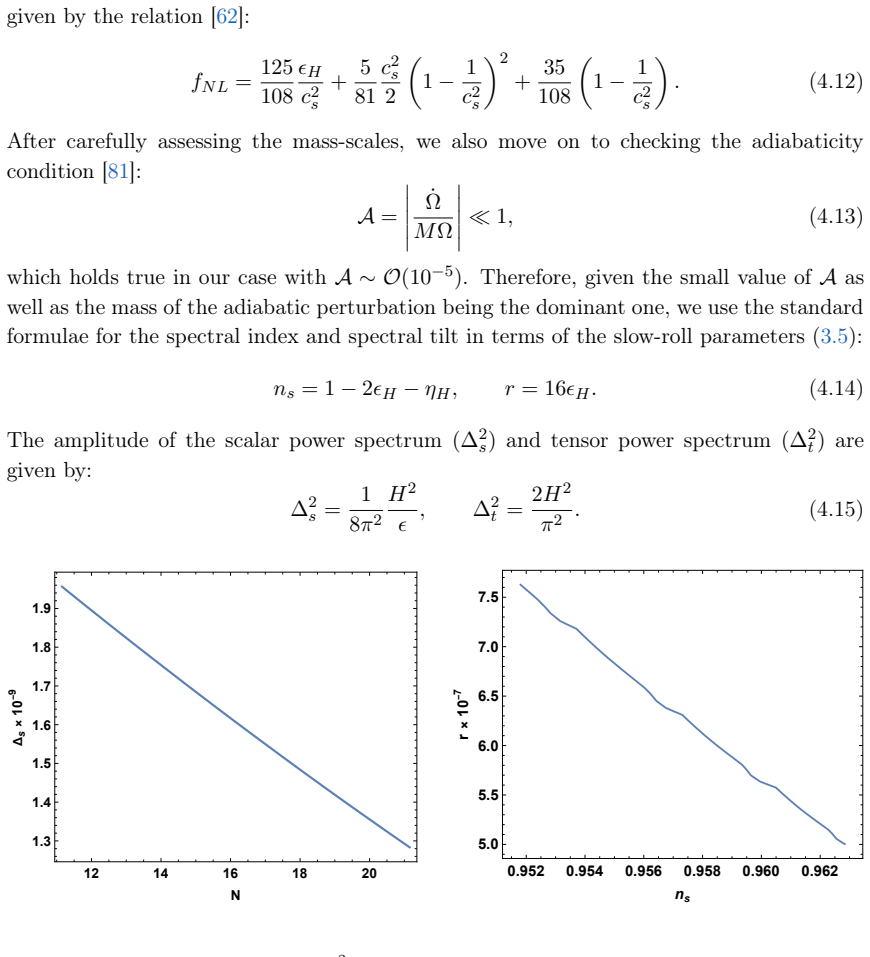
- [§4.2, Fig. 9, Eq. (4.4)] The reported scalar amplitude does not match the stated Planck constraint. Figure 9 plots Δ_s between 1.3×10^{-9} and 1.9×10^{-9}, whereas Eq. (4.4) fixes P_s=2.105±0.03×10^{-9}; even the upper end is about 10% below the central value and outside the quoted uncertainty. The plotted n_s range also extends below the Planck 1σ lower bound n_s=0.9607. The abstract's claim that the observables align with Planck is therefore contradicted by the presented benchmark.
- [§2.2, Eqs. (2.27), (2.28), and Conclusions] The stabilization of the flat directions and the existence of the inflationary ridge rely on the F^4 correction (2.27) with an unknown coefficient λ, and on the logarithmic loop term δ=η_hat log τ_i in (2.7), which the Conclusions state is conjectured for the K3-fibred CY from torus calculations. Because these terms select the vacuum and the ridge, the model is currently a conditional proof of principle; a geometry-specific computation of λ, χ, and the loop coefficient is needed before the example is 'string motivated' in the strong sense claimed.
- [§2.2, Eqs. (2.31)–(2.35)] The canonical basis is obtained by ignoring off-diagonal entries of the Kähler metric, stated to be small for φ∼O(1). Since the subsequent slow-roll equations (4.5), the turning-rate formulas (3.8)–(3.9), and the perturbation equations (3.11)–(3.12) all assume an exactly canonical field-space metric, the paper should quantify the dropped off-diagonal terms along the actual trajectory; otherwise the reported torsion and non-planarity could be partly an artifact of the truncation.
- [§4.2, Eq. (4.15), Table 3] The claimed Planck normalization is partly an input: Δ_s ∝ H^2, and H is set by the hand-added constant uplift Vup and W0. Because Vup is a free parameter chosen for the benchmark, an amplitude close to 2.1×10^{-9} would not by itself be a prediction of the stringy potential; the present benchmark misses that amplitude anyway.
minor comments (5)
- [General] Throughout the text there are typographical errors, e.g., 'occured', 'disucss', 'quassi-single field', 'piculiar', and 'constructued'; a careful proofread is needed.
- [Table 4] Table 4 reports squared masses m^2 while the text compares M_{φi} to H; the units and the distinction between m^2 and m should be stated explicitly so the reader can verify Eq. (4.3).
- [§4.1 and Conclusions] The volume quoted for the inflationary benchmark is inconsistent: §4.1 states V∼O(10^4) while the Conclusions state O(10^5); since the benchmark is the only inflationary example, this should be corrected.
- [Fig. 9] Figure 9 is labeled 'Δ_s × 10^{-9}' but the text sometimes calls this quantity Δ_s^2; please align the notation with the definition in Eq. (4.15).
- [Tables 2 and 3] The free parameters in Tables 2 and 3 are not discussed as a set; in particular, the sign and magnitude of λ are constrained only by the inequality V_{α'^3} > V_{F^4}, and a quantitative scan over λ would strengthen the stabilization claim.
Circularity Check
No circular reduction in the derivation chain: the two-stage trajectory, the eta_H much greater than epsilon_H hierarchy, and the late-time turns are genuine numerical outputs; however, two internal consistency failures undercut the Planck-alignment claim and are correctness risks, not circularity.
full rationale
The scalar potential (2.35) is assembled from stated alpha-prime^3, log-loop, and F^4 corrections plus the hand-set uplift Vup. The amplitude formula Delta_s = H^2/(8 pi^2 epsilon) is sensitive to Vup and to the chosen benchmark parameters, but Vup is introduced to make the vacuum nearly Minkowski/dS and epsilon is obtained by solving the equations of motion; the paper does not enforce Delta_s equal to the Planck value by construction, and Figure 9 in fact shows Delta_s around 1.3-1.9e-9, below the paper's own Planck bound 2.105e-9. The log-loop term is cited from the authors' earlier work and is explicitly acknowledged as conjectural for a K3-fibred CY, and the F^4 coefficient lambda is admitted to be unknown; these are unverified model inputs that raise verification risk but are not circular because they are not derived from the target observables. The central claims (two-stage quasi-single-field then quasi-double-field inflation, eta_H exceeding epsilon_H by orders of magnitude, growth of torsion after N about 55) are nontrivial outputs of the numerical evolution. Two internal inconsistencies should be flagged as correctness checks: Table 4 lists squared Hessian eigenvalues such as m^2_phi1 = 1.54e-6, giving m_phi1 about 1.24e-3, which violates the paper's own condition m_phi_i < H in (4.3); and Figure 9's amplitude does not match the Planck constraint quoted in (4.4). These failures are not circularity, but they contradict the headline that the observables align with Planck data. Because the only circularity-adjacent issue is the normalization sensitivity of the amplitude and the reliance on conjectured self-cited corrections, the score is a low 2 rather than 0.
Assumptions & free parameters
free parameters (8)
- gs =
1e-4 to 1e-3
- W0 =
30 to 50
- xi_hat =
11.5, 13.5, 19.5, 16
- eta_hat =
0.5
- alpha =
2e-5, 5e-5, 1e-6, 1e-4
- lambda / c =
lambda = 0.09, 0.04, 0.078, 0.008; c derived
- Vup =
1.2e-14, 2.23e-20, 2.86e-26, 2.45e-14
- Initial conditions (phi0_1, phi0_2, phi0_3) =
(4.9, 10.0, 1.1)
assumptions (6)
- standard math N=1 supergravity scalar potential formula (2.17) with W=W0 is valid after integrating out complex-structure moduli and the dilaton.
- domain assumption The weak Swiss-cheese volume form V = tau7^{1/2} tau6 / sqrt(2 alpha) - tau1^{3/2}/3 is assumed without a global Calabi-Yau embedding.
- ad hoc to paper The logarithmic loop correction delta = eta_hat log(tau_i) is conjectured to hold for the K3-fibred Calabi-Yau, based on torus calculations.
- ad hoc to paper The F^4 correction (2.27) with unknown coefficient lambda is sufficient to lift the remaining flat directions and does not destabilize the volume.
- domain assumption Non-perturbative superpotential effects are absent because world-volume fluxes can lift the relevant fermionic zero modes.
- domain assumption Off-diagonal entries of the Kähler metric are small in the phi ~ O(1) limit and can be ignored when passing to the canonical basis (2.33)-(2.34).
invented entities (1)
-
Constant uplift Vup
Cite this review
Pith. "Pith review of Three-Field String Inflation with Perturbative Corrections: Dynamics and Implications." pith.science (2026). https://pith.science/paper/4PJHOHGT
@misc{pith2026250206958,
  author       = {Pith},
  title        = {Pith review of: Three-Field String Inflation with Perturbative Corrections: Dynamics and Implications},
  year         = {2026},
  howpublished = {\url{https://pith.science/paper/4PJHOHGT}},
  note         = {Machine review of arXiv:2502.06958}
}
abstract
In this work, we construct an explicit string motivated example of three-field inflation in a related, yet distinct from, the recently discovered perturbative large volume scenario (pLVS). Contrary to the usual constructions, in this set up, large volume is ensured by the interplay between the effects of $\alpha^{\prime 3}$, logarithmic loop and higher derivative $F^4$ corrections. After addressing a full moduli stabilization scenario, we move on to a detailed analysis of three-field model of inflation in a canonical basis. We conduct multiple consistency checks to establish a solid foundation for our model within the framework of the underlying 4D effective field theory (EFT). Our model differs from previous setups in three key aspects: first, the interaction between subleading corrections that drive full moduli stabilization follows a different pattern, second, the volume form of the underlying Calabi-Yau is different, and third, in our three-field inflation scenario, the second slow-roll parameter consistently dominates over the first by several orders of magnitude. The latter signals the possible presence of primordial features which can be verified by forthcoming ground and space based experiments. We can roughly distinguish two stages of inflation: the first stage mostly occurs in the steepest direction during horizon crossing giving us almost $55$ efolds of inflation -- once one of the inflatons falls off the ridge and then to its true minimum, the other two fields become active, giving us a truly multi-field behavior in the second stage -- adding few more efolds of inflation. We also confirm our claim by introducing the non-planar torsion in the inflationary trajectory -- this quantity becomes non-trivial in the second stage of inflation. Finally, we calculate the cosmological observables, which align with Planck data, and discuss potential directions for future research.
Figures


Figures from the paper (5 more)


Forward citations
Cited by 2 Pith papers
-
Perturbative K\"ahler Moduli Inflation
Two classes of slow-roll inflation potentials, V0(1+C1 φ^(2/3)) and V0(1-C2 φ^(-2/3)), are derived from perturbative Kähler moduli stabilization and give r below 10^-2 and 10^-8.
-
Fibre Inflation Meets Quintessence: Implications of Perturbative Stabilisation
Adding a base-modulus redefinition to fibre inflation in perturbative LVS shifts (ns, r) into ACT-allowed territory and yields an axion quintessence companion.
Reference graph
Works this paper leans on
-
[1]
The Inflationary Universe: A Possible Solution to the Horizon and Flatness Problems
A. H. Guth, “The Inflationary Universe: A Possible Solution to the Horizon and Flatness Problems”, Phys.Rev. D23 (1981) 347–356
1981
-
[2]
A New Inflationary Universe Scenario: A Possible Solution of the Horizon, Flatness, Homogeneity, Isotropy and Primordial Monopole Problems
A. D. Linde, “A New Inflationary Universe Scenario: A Possible Solution of the Horizon, Flatness, Homogeneity, Isotropy and Primordial Monopole Problems”,Phys.Lett. B108 (1982) 389–393
1982
-
[3]
Cosmology for Grand Unified Theories with Radiatively Induced Symmetry Breaking
A. Albrecht and P. J. Steinhardt, “Cosmology for Grand Unified Theories with Radiatively Induced Symmetry Breaking”,Phys.Rev.Lett. 48 (1982) 1220–1223
1982
-
[4]
Planck 2018 results. X. Constraints on inflation
Planck Collaboration, Y. Akramiet al., “Planck 2018 results. X. Constraints on inflation”, Astron. Astrophys. 641 (2020) A10, arXiv:1807.06211 [astro-ph.CO]
arXiv 2020
-
[5]
The String landscape and the swampland
C. Vafa, “The String landscape and the swampland”,arXiv:hep-th/0509212
-
[6]
De Sitter Space and the Swampland
G. Obied, H. Ooguri, L. Spodyneiko, and C. Vafa, “De Sitter Space and the Swampland”, arXiv:1806.08362 [hep-th] . 27
-
[7]
On the Cosmological Implications of the String Swampland
P. Agrawal, G. Obied, P. J. Steinhardt, and C. Vafa, “On the Cosmological Implications of the String Swampland”,Phys. Lett. B 784 (2018) 271–276, arXiv:1806.09718 [hep-th]
arXiv 2018
-
[8]
Bounds on Slow Roll and the de Sitter Swampland
S. K. Garg and C. Krishnan, “Bounds on Slow Roll and the de Sitter Swampland”,JHEP 11 (2019) 075, arXiv:1807.05193 [hep-th]
arXiv 2019
Show all 90 references
-
[9]
The Swampland: Introduction and Review
E. Palti, “The Swampland: Introduction and Review”,Fortsch. Phys. 67 (2019) no. 6, 1900037, arXiv:1903.06239 [hep-th]
2019 arXiv
-
[10]
The string swampland constraints require multi-field inflation
A. Achúcarro and G. A. Palma, “The string swampland constraints require multi-field inflation”, JCAP 02 (2019) 041, arXiv:1807.04390 [hep-th]
2019 arXiv
-
[11]
CMB-S4 Science Book, First Edition
CMB-S4 Collaboration, K. N. Abazajianet al., “CMB-S4 Science Book, First Edition”, arXiv:1610.02743 [astro-ph.CO]
-
[12]
CLASS: the cosmology large angular scale surveyor
T. Essinger-Hileman, A. Ali, M. Amiri, J. W. Appel, D. Araujo, C. L. Bennett, F. Boone, M. Chan, H.-M. Cho, D. T. Chuss, F. Colazo, E. Crowe, K. Denis, R. Dünner, J. Eimer, D. Gothe, M. Halpern, K. Harrington, G. C. Hilton, G. F. Hinshaw, C. Huang, K. Irwin, G. Jones, J. Karak...
2014 arXiv
-
[13]
Mission design of LiteBIRD
T. Matsumura et al., “Mission design of LiteBIRD”,J. Low Temp. Phys. 176 (2014) 733, arXiv:1311.2847 [astro-ph.IM]
2014 arXiv
-
[14]
The Simons Observatory: Science goals and forecasts
Simons Observatory Collaboration, P. Adeet al., “The Simons Observatory: Science goals and forecasts”, JCAP 02 (2019) 056, arXiv:1808.07445 [astro-ph.CO]
2019 arXiv
-
[15]
The DESI Experiment Part I: Science,Targeting, and Survey Design
DESI Collaboration, A. Aghamousaet al., “The DESI Experiment Part I: Science,Targeting, and Survey Design”,arXiv:1611.00036 [astro-ph.IM]
-
[16]
LSST Science Book, Version 2.0
LSST Science, LSST Project Collaboration, P. A. Abellet al., “LSST Science Book, Version 2.0”,arXiv:0912.0201 [astro-ph.IM]
-
[17]
Cosmology and fundamental physics with the Euclid satellite
L. Amendola et al., “Cosmology and fundamental physics with the Euclid satellite”,Living Rev. Rel. 21 (2018) no. 1, 2,arXiv:1606.00180 [astro-ph.CO]
2018 arXiv
-
[18]
Probing primordial non-Gaussianity with SKA galaxy redshift surveys: a fully relativistic analysis
S. Camera, M. G. Santos, and R. Maartens, “Probing primordial non-Gaussianity with SKA galaxy redshift surveys: a fully relativistic analysis”,Mon. Not. Roy. Astron. Soc. 448 (2015) no. 2, 1035–1043,arXiv:1409.8286 [astro-ph.CO] . [Erratum: Mon.Not.Roy.Astron.Soc. 467, 1505–15...
2015 arXiv
-
[19]
Primordial Non-Gaussianity
P. D. Meerburget al., “Primordial Non-Gaussianity”,Bull. Am. Astron. Soc. 51 (2019) no. 3, 107, arXiv:1903.04409 [astro-ph.CO]
2019 arXiv
-
[20]
String cosmology: From the early universe to today
M. Cicoli, J. P. Conlon, A. Maharana, S. Parameswaran, F. Quevedo, and I. Zavala, “String cosmology: From the early universe to today”,Phys. Rept. 1059 (2024) 1–155, arXiv:2303.04819 [hep-th]
2024 arXiv
-
[21]
De Sitter vacua in string theory
S. Kachru, R. Kallosh, A. D. Linde, and S. P. Trivedi, “De Sitter vacua in string theory”, Phys. Rev. D 68 (2003) 046005, arXiv:hep-th/0301240
2003 arXiv
-
[22]
Brane/antibrane dynamics and KKLT stability
J. Polchinski, “Brane/antibrane dynamics and KKLT stability”,arXiv:1509.05710 [hep-th]. 28
-
[23]
A 10d view on the KKLT AdS vacuum and uplifting
F. F. Gautason, V. Van Hemelryck, T. Van Riet, and V. Venken, “A 10d view on the KKLT AdS vacuum and uplifting”,JHEP 06 (2020) 074, arXiv:1902.01415 [hep-th]
2020 arXiv
-
[24]
Understanding KKLT from a 10d perspective
Y. Hamada, A. Hebecker, G. Shiu, and P. Soler, “Understanding KKLT from a 10d perspective”, JHEP 06 (2019) 019, arXiv:1902.01410 [hep-th]
2019 arXiv
-
[25]
KKLT without AdS
A. Linde, “KKLT without AdS”,JHEP 05 (2020) 076, arXiv:2002.01500 [hep-th]
2020 arXiv
-
[26]
The Boundaries of KKLT
L. Randall, “The Boundaries of KKLT”,Fortsch. Phys. 68 (2020) no. 3-4, 1900105, arXiv:1912.06693 [hep-th]
2020 arXiv
-
[27]
Swampland Variations on a Theme by KKLT
R. Blumenhagen, D. Kläwer, and L. Schlechter, “Swampland Variations on a Theme by KKLT”, JHEP 05 (2019) 152, arXiv:1902.07724 [hep-th]
2019 arXiv
-
[28]
New de Sitter solutions of 10d type IIB supergravity
D. Andriot, P. Marconnet, and T. Wrase, “New de Sitter solutions of 10d type IIB supergravity”, JHEP 08 (2020) 076, arXiv:2005.12930 [hep-th]
2020 arXiv
-
[29]
KKLT type models with moduli-mixing superpotential
H. Abe, T. Higaki, and T. Kobayashi, “KKLT type models with moduli-mixing superpotential”, Phys. Rev. D 73 (2006) 046005, arXiv:hep-th/0511160
2006 arXiv
-
[30]
Gaugino condensation and small uplifts in KKLT
F. Carta, J. Moritz, and A. Westphal, “Gaugino condensation and small uplifts in KKLT”, JHEP 08 (2019) 141, arXiv:1902.01412 [hep-th]
2019 arXiv
-
[31]
Large-volume flux compactifications: Moduli spectrum and D3/D7 soft supersymmetry breaking
J. P. Conlon, F. Quevedo, and K. Suruliz, “Large-volume flux compactifications: Moduli spectrum and D3/D7 soft supersymmetry breaking”,JHEP 08 (2005) 007, arXiv:hep-th/0505076
2005 arXiv
-
[32]
Systematics of moduli stabilisation in Calabi-Yau flux compactifications
V. Balasubramanian, P. Berglund, J. P. Conlon, and F. Quevedo, “Systematics of moduli stabilisation in Calabi-Yau flux compactifications”,JHEP 03 (2005) 007, arXiv:hep-th/0502058
2005 arXiv
-
[33]
De Sitter string vacua from supersymmetric D terms
C. P. Burgess, R. Kallosh, and F. Quevedo, “De Sitter string vacua from supersymmetric D terms”, JHEP 10 (2003) 056, arXiv:hep-th/0309187
2003 arXiv
-
[34]
Moduli stabilisation and de Sitter string vacua from magnetised D7 branes
D. Cremades, M. P. Garcia del Moral, F. Quevedo, and K. Suruliz, “Moduli stabilisation and de Sitter string vacua from magnetised D7 branes”,JHEP 05 (2007) 100, arXiv:hep-th/0701154
2007 arXiv
-
[35]
Logarithmic loop corrections, moduli stabilisation and de Sitter vacua in string theory
I. Antoniadis, Y. Chen, and G. K. Leontaris, “Logarithmic loop corrections, moduli stabilisation and de Sitter vacua in string theory”,JHEP 01 (2020) 149, arXiv:1909.10525 [hep-th]
2020 arXiv
-
[36]
Perturbative moduli stabilisation in type IIB/F-theory framework
I. Antoniadis, Y. Chen, and G. K. Leontaris, “Perturbative moduli stabilisation in type IIB/F-theory framework”, Eur. Phys. J. C 78 (2018) no. 9, 766,arXiv:1803.08941 [hep-th]
2018 arXiv
-
[37]
Note on de Sitter vacua from perturbative and non-perturbative dynamics in type IIB/F-theory compactifications
V. Basiouris and G. K. Leontaris, “Note on de Sitter vacua from perturbative and non-perturbative dynamics in type IIB/F-theory compactifications”,Phys. Lett. B 810 (2020) 135809, arXiv:2007.15423 [hep-th]
2020 arXiv
-
[38]
Remarks on the Effects of Quantum Corrections on Moduli Stabilization and de Sitter Vacua in Type IIB String Theory
V. Basiouris and G. K. Leontaris, “Remarks on the Effects of Quantum Corrections on Moduli Stabilization and de Sitter Vacua in Type IIB String Theory”,Fortsch. Phys. 70 (2022) no. 2-3, 2100181,arXiv:2109.08421 [hep-th]
2022 arXiv
-
[39]
Stabilising all Kähler moduli in perturbative LVS
G. K. Leontaris and P. Shukla, “Stabilising all Kähler moduli in perturbative LVS”,JHEP 07 (2022) 047, arXiv:2203.03362 [hep-th]
2022 arXiv
-
[40]
Nonperturbative superpotentials in string theory
E. Witten, “Nonperturbative superpotentials in string theory”,Nucl. Phys. B 474 (1996) 343–360, arXiv:hep-th/9604030. 29
1996 arXiv
-
[41]
Inflating in perturbative LVS: global embedding and robustness
S. Bera, D. Chakraborty, G. K. Leontaris, and P. Shukla, “Inflating in perturbative LVS: global embedding and robustness”,JCAP 09 (2024) 004, arXiv:2405.06738 [hep-th]
2024 arXiv
-
[42]
Fibre Inflation: Observable Gravity Waves from IIB String Compactifications
M. Cicoli, C. P. Burgess, and F. Quevedo, “Fibre Inflation: Observable Gravity Waves from IIB String Compactifications”,JCAP 03 (2009) 013, arXiv:0808.0691 [hep-th]
2009 arXiv
-
[43]
Supersymmetry breaking and alpha-prime corrections to flux induced potentials
K. Becker, M. Becker, M. Haack, and J. Louis, “Supersymmetry breaking and alpha-prime corrections to flux induced potentials”,JHEP 06 (2002) 060, arXiv:hep-th/0204254
2002 arXiv
-
[44]
R**4 couplings in M and type II theories on Calabi-Yau spaces
I. Antoniadis, S. Ferrara, R. Minasian, and K. S. Narain, “R**4 couplings in M and type II theories on Calabi-Yau spaces”,Nucl. Phys. B 507 (1997) 571–588, arXiv:hep-th/9707013
1997 arXiv
-
[45]
Noncompact Calabi-Yau manifolds and localized gravity
I. Antoniadis, R. Minasian, and P. Vanhove, “Noncompact Calabi-Yau manifolds and localized gravity”, Nucl. Phys. B 648 (2003) 69–93, arXiv:hep-th/0209030
2003 arXiv
-
[46]
String loop corrections to the universal hypermultiplet
I. Antoniadis, R. Minasian, S. Theisen, and P. Vanhove, “String loop corrections to the universal hypermultiplet”, Class. Quant. Grav. 20 (2003) 5079–5102, arXiv:hep-th/0307268
2003 arXiv
-
[47]
String moduli inflation: An overview
M. Cicoli and F. Quevedo, “String moduli inflation: An overview”,Class. Quant. Grav. 28 (2011) 204001, arXiv:1108.2659 [hep-th]
2011 arXiv
-
[48]
Global embedding of fiber inflation in a perturbative large volume scenario
S. Bera, D. Chakraborty, G. K. Leontaris, and P. Shukla, “Global embedding of fiber inflation in a perturbative large volume scenario”,Phys. Rev. D 110 (2024) no. 10, 106009, arXiv:2406.01694 [hep-th]
2024 arXiv
-
[49]
Loop blow-up inflation
S. Bansal, L. Brunelli, M. Cicoli, A. Hebecker, and R. Kuespert, “Loop blow-up inflation”, JHEP 07 (2024) 289, arXiv:2403.04831 [hep-th]
2024 arXiv
-
[50]
Back to the origins of brane-antibrane inflation
M. Cicoli, C. Hughes, A. R. Kamal, F. Marino, F. Quevedo, M. Ramos-Hamud, and G. Villa, “Back to the origins of brane-antibrane inflation”,arXiv:2410.00097 [hep-th]
-
[51]
Complete classification of reflexive polyhedra in four-dimensions
M. Kreuzer and H. Skarke, “Complete classification of reflexive polyhedra in four-dimensions”, Adv. Theor. Math. Phys. 4 (2000) 1209–1230, arXiv:hep-th/0002240
2000 arXiv
-
[52]
A Calabi-Yau Database: Threefolds Constructed from the Kreuzer-Skarke List
R. Altman, J. Gray, Y.-H. He, V. Jejjala, and B. D. Nelson, “A Calabi-Yau Database: Threefolds Constructed from the Kreuzer-Skarke List”,JHEP 02 (2015) 158, arXiv:1411.1418 [hep-th]
2015 arXiv
-
[53]
D instantons, strings and M theory
M. B. Green and P. Vanhove, “D instantons, strings and M theory”,Phys. Lett. B 408 (1997) 122–134, arXiv:hep-th/9704145
1997 arXiv
-
[54]
Magnetized E3-brane instantons in F-theory
M. Bianchi, A. Collinucci, and L. Martucci, “Magnetized E3-brane instantons in F-theory”, JHEP 12 (2011) 045, arXiv:1107.3732 [hep-th]
2011 arXiv
-
[55]
On Seven-Brane Dependent Instanton Prefactors in F-theory
M. Cvetic, R. Donagi, J. Halverson, and J. Marsano, “On Seven-Brane Dependent Instanton Prefactors in F-theory”,JHEP 11 (2012) 004, arXiv:1209.4906 [hep-th]
2012 arXiv
-
[56]
Moduli Stabilisation versus Chirality for MSSM like Type IIB Orientifolds
R. Blumenhagen, S. Moster, and E. Plauschinn, “Moduli Stabilisation versus Chirality for MSSM like Type IIB Orientifolds”,JHEP 01 (2008) 058, arXiv:0711.3389 [hep-th]
2008 arXiv
-
[57]
Chiral Global Embedding of Fibre Inflation Models
M. Cicoli, D. Ciupke, V. A. Diaz, V. Guidetti, F. Muia, and P. Shukla, “Chiral Global Embedding of Fibre Inflation Models”,JHEP 11 (2017) 207, arXiv:1709.01518 [hep-th]
2017 arXiv
-
[58]
Higher-Derivative Supergravity and Moduli Stabilization
D. Ciupke, J. Louis, and A. Westphal, “Higher-Derivative Supergravity and Moduli Stabilization”, JHEP 10 (2015) 094, arXiv:1505.03092 [hep-th]
2015 arXiv
-
[59]
Global Embedding of Fibre Inflation Models
M. Cicoli, F. Muia, and P. Shukla, “Global Embedding of Fibre Inflation Models”,JHEP 11 (2016) 182, arXiv:1611.04612 [hep-th] . 30
2016 arXiv
-
[60]
Chiral global embedding of Fibre Inflation with D3 uplift
M. Cicoli, A. Grassi, O. Lacombe, and F. G. Pedro, “Chiral global embedding of Fibre Inflation with D3 uplift”, arXiv:2412.08723 [hep-th]
-
[61]
Higher-derivative supersymmetric effective field theories
O. Lacombe, L. Paoloni, and F. G. Pedro, “Higher-derivative supersymmetric effective field theories”, arXiv:2409.08984 [hep-th]
-
[62]
Multi-field Inflation in High-Slope Potentials
V. Aragam, S. Paban, and R. Rosati, “Multi-field Inflation in High-Slope Potentials”,JCAP 04 (2020) 022, arXiv:1905.07495 [hep-th]
2020 arXiv
-
[63]
(Slow-)twisting inflationary attractors
P. Christodoulidis and R. Rosati, “(Slow-)twisting inflationary attractors”,JCAP 09 (2023) 034, arXiv:2210.14900 [hep-th]
2023 arXiv
-
[64]
Primordial stochastic gravitational wave backgrounds from a sharp feature in three-field inflation. Part I. The radiation era
V. Aragam, S. Paban, and R. Rosati, “Primordial stochastic gravitational wave backgrounds from a sharp feature in three-field inflation. Part I. The radiation era”,JCAP 11 (2023) 014, arXiv:2304.00065 [astro-ph.CO]
2023 arXiv
-
[65]
Primordial Stochastic Gravitational Wave Backgrounds from a Sharp Feature in Three-field Inflation II: The Inflationary Era
V. Aragam, S. Paban, and R. Rosati, “Primordial Stochastic Gravitational Wave Backgrounds from a Sharp Feature in Three-field Inflation II: The Inflationary Era”, arXiv:2409.09023 [astro-ph.CO]
-
[66]
Multifield inflation beyondNfield = 2: non-Gaussianities and single-field effective theory
L. Pinol, “Multifield inflation beyondNfield = 2: non-Gaussianities and single-field effective theory”, JCAP 04 (2021) 002, arXiv:2011.05930 [astro-ph.CO]
2021 arXiv
-
[67]
Cosmological Perturbation Theory with Trinity of Scalar Fields
A. Ashoorioon, S. Mukohyama, K. Rezazadeh, and N. Talebizadeh, “Cosmological Perturbation Theory with Trinity of Scalar Fields”,arXiv:2501.02991 [hep-th]
-
[68]
Effective theories of single field inflation when heavy fields matter
A. Achucarro, J.-O. Gong, S. Hardeman, G. A. Palma, and S. P. Patil, “Effective theories of single field inflation when heavy fields matter”,JHEP 05 (2012) 066, arXiv:1201.6342 [hep-th]
2012 arXiv
-
[69]
Heavy fields, reduced speeds of sound and decoupling during inflation
A. Achucarro, V. Atal, S. Cespedes, J.-O. Gong, G. A. Palma, and S. P. Patil, “Heavy fields, reduced speeds of sound and decoupling during inflation”,Phys. Rev. D 86 (2012) 121301, arXiv:1205.0710 [hep-th]
2012 arXiv
-
[70]
Sound Speed of Primordial Fluctuations in Supergravity Inflation
A. Hetz and G. A. Palma, “Sound Speed of Primordial Fluctuations in Supergravity Inflation”, Phys. Rev. Lett. 117 (2016) no. 10, 101301,arXiv:1601.05457 [hep-th]
2016 arXiv
-
[71]
Primordial Bispectrum from Multifield Inflation with Nonminimal Couplings
D. I. Kaiser, E. A. Mazenc, and E. I. Sfakianakis, “Primordial Bispectrum from Multifield Inflation with Nonminimal Couplings”,Phys. Rev. D 87 (2013) 064004, arXiv:1210.7487 [astro-ph.CO]
2013 arXiv
-
[72]
Cosmic inflation in a landscape of heavy-fields
S. Céspedes and G. A. Palma, “Cosmic inflation in a landscape of heavy-fields”,JCAP 10 (2013) 051, arXiv:1303.4703 [hep-th]
2013 arXiv
-
[73]
A guide to frames,2π’s, scales and corrections in string compactifications
B. Valeixo Bento, D. Chakraborty, S. Parameswaran, and I. Zavala, “A guide to frames,2π’s, scales and corrections in string compactifications”,arXiv:2301.05178 [hep-th]
-
[74]
Fat inflatons, large turns and theη-problem
D. Chakraborty, R. Chiovoloni, O. Loaiza-Brito, G. Niz, and I. Zavala, “Fat inflatons, large turns and theη-problem”, JCAP 01 (2020) 020, arXiv:1908.09797 [hep-th]
2020 arXiv
-
[75]
De Sitter from T-branes
M. Cicoli, F. Quevedo, and R. Valandro, “De Sitter from T-branes”,JHEP 03 (2016) 141, arXiv:1512.04558 [hep-th]
2016 arXiv
-
[76]
New supersymmetric string compactifications
S. Kachru, M. B. Schulz, P. K. Tripathy, and S. P. Trivedi, “New supersymmetric string compactifications”, JHEP 03 (2003) 061, arXiv:hep-th/0211182
2003 arXiv
-
[77]
On de Sitter String Vacua from Anti-D3-Branes in the Large Volume Scenario
C. Crinò, F. Quevedo, and R. Valandro, “On de Sitter String Vacua from Anti-D3-Branes in the Large Volume Scenario”,JHEP 03 (2021) 258, arXiv:2010.15903 [hep-th] . 31
2021 arXiv
-
[78]
Particle creation from non-geodesic trajectories in multifield inflation
N. Parra, S. Sypsas, G. A. Palma, and C. Zenteno, “Particle creation from non-geodesic trajectories in multifield inflation”,arXiv:2410.13843 [hep-th]
-
[79]
Exploring the parameter space of modified supergravity for double inflation and primordial black hole formation
R. Ishikawa and S. V. Ketov, “Exploring the parameter space of modified supergravity for double inflation and primordial black hole formation”,Class. Quant. Grav. 39 (2022) no. 1, 015016, arXiv:2108.04408 [astro-ph.CO]
2022 arXiv
-
[80]
Features of heavy physics in the CMB power spectrum
A. Achucarro, J.-O. Gong, S. Hardeman, G. A. Palma, and S. P. Patil, “Features of heavy physics in the CMB power spectrum”,JCAP 01 (2011) 030, arXiv:1010.3693 [hep-ph]
2011 arXiv
-
[81]
On the importance of heavy fields during inflation
S. Cespedes, V. Atal, and G. A. Palma, “On the importance of heavy fields during inflation”, JCAP 05 (2012) 008, arXiv:1201.4848 [hep-th]
2012 arXiv
-
[82]
Distance and de Sitter Conjectures on the Swampland
H. Ooguri, E. Palti, G. Shiu, and C. Vafa, “Distance and de Sitter Conjectures on the Swampland”, Phys. Lett. B 788 (2019) 180–184, arXiv:1810.05506 [hep-th]
2019 arXiv
-
[83]
Generating PBHs and small-scale GWs in two-field models of inflation
M. Braglia, D. K. Hazra, F. Finelli, G. F. Smoot, L. Sriramkumar, and A. A. Starobinsky, “Generating PBHs and small-scale GWs in two-field models of inflation”,JCAP 08 (2020) 001, arXiv:2005.02895 [astro-ph.CO]
2020 arXiv
-
[84]
Seeding primordial black holes in multifield inflation
G. A. Palma, S. Sypsas, and C. Zenteno, “Seeding primordial black holes in multifield inflation”, Phys. Rev. Lett. 125 (2020) no. 12, 121301,arXiv:2004.06106 [astro-ph.CO]
2020 arXiv
-
[85]
Turning in the landscape: A new mechanism for generating primordial black holes
J. Fumagalli, S. Renaux-Petel, J. W. Ronayne, and L. T. Witkowski, “Turning in the landscape: A new mechanism for generating primordial black holes”,Phys. Lett. B 841 (2023) 137921, arXiv:2004.08369 [hep-th]
2023 arXiv
-
[86]
Oscillations in the stochastic gravitational wave background from sharp features and particle production during inflation
J. Fumagalli, S. Renaux-Petel, and L. T. Witkowski, “Oscillations in the stochastic gravitational wave background from sharp features and particle production during inflation”, JCAP 08 (2021) 030, arXiv:2012.02761 [astro-ph.CO]
2021 arXiv
-
[87]
Primordial gravitational waves from excited states
J. Fumagalli, G. A. Palma, S. Renaux-Petel, S. Sypsas, L. T. Witkowski, and C. Zenteno, “Primordial gravitational waves from excited states”,JHEP 03 (2022) 196, arXiv:2111.14664 [astro-ph.CO]
2022 arXiv
-
[88]
Dark radiation in LARGE volume models
M. Cicoli, J. P. Conlon, and F. Quevedo, “Dark radiation in LARGE volume models”,Phys. Rev. D 87 (2013) no. 4, 043520,arXiv:1208.3562 [hep-ph]
2013 arXiv
-
[89]
Kahler Moduli Inflation Revisited
J. J. Blanco-Pillado, D. Buck, E. J. Copeland, M. Gomez-Reino, and N. J. Nunes, “Kahler Moduli Inflation Revisited”,JHEP 01 (2010) 081, arXiv:0906.3711 [hep-th]
2010 arXiv
-
[90]
Loops, local corrections and warping in the LVS and other type IIB models
X. Gao, A. Hebecker, S. Schreyer, and V. Venken, “Loops, local corrections and warping in the LVS and other type IIB models”,JHEP 09 (2022) 091, arXiv:2204.06009 [hep-th] . 32
2022 arXiv
Reviewed August 8, 2026 · model on record in the stance chip above.
Discussion (0). Continue with ORCID to comment.