REVIEW 4 major objections 4 minor 42 references
Diversity in Coded TE-QKD Channels: Achieving Infinite Diversity out of Finite System Resources
T0 review · 4 major / 4 minor · reviewed 2026-08-08 · deepseek-v4-flash
Pith's one-line read This paper proves that coded time-entanglement QKD reconciliation can reach infinite diversity order — error probability decaying exponentially in signal-to-noise ratio — from a channel whose uncoded diversity is only 1/2.
desk verdict The algebraic-diversity condition is a genuine contribution, but the soft-decision theorem is not: the WLOG zero-codeword step ignores that Gray adjacency is not XOR-translation-invariant. read the letter →
The pith
A machine-rendered reading of the paper's core claim, the machinery that carries it, and where it could break.
The reading
What carries the argument
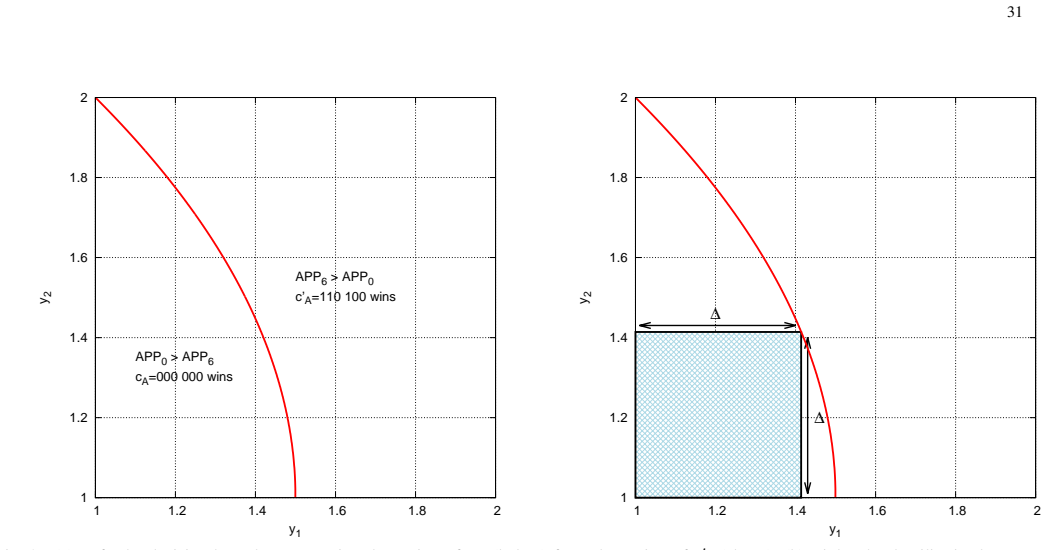
The load-bearing mechanism is the separation of TE-QKD detector errors into two asymptotic classes: single-bin jumps with probability Θ(γ^(−1/2)) and multi-bin jumps with probability O(e^(−γ/4)). A code attains infinite diversity when its decoder absorbs all configurations of single-bin jumps, leaving only exponentially rare multi-bin events. For soft-decision decoding, the central object is the maximal finite diversity (MFD) property, which records whether a non-zero codeword can be built entirely from labels that are single-bin neighbors of zero. The proof of Theorem 2 uses a demilitarized-zone (DMZ) cube of side Δ, with Δ ≥ 1/(1+√L), placed inside the correct codeword's decision region; leaving that cube costs a factor O(e^(−$Δ^{2}$ γ/4)), which is exponentially small. The same DMZ argument also shows that a full-MFD code has finite diversity, falling back to ω/2 for the offending weight ω.
What would settle it
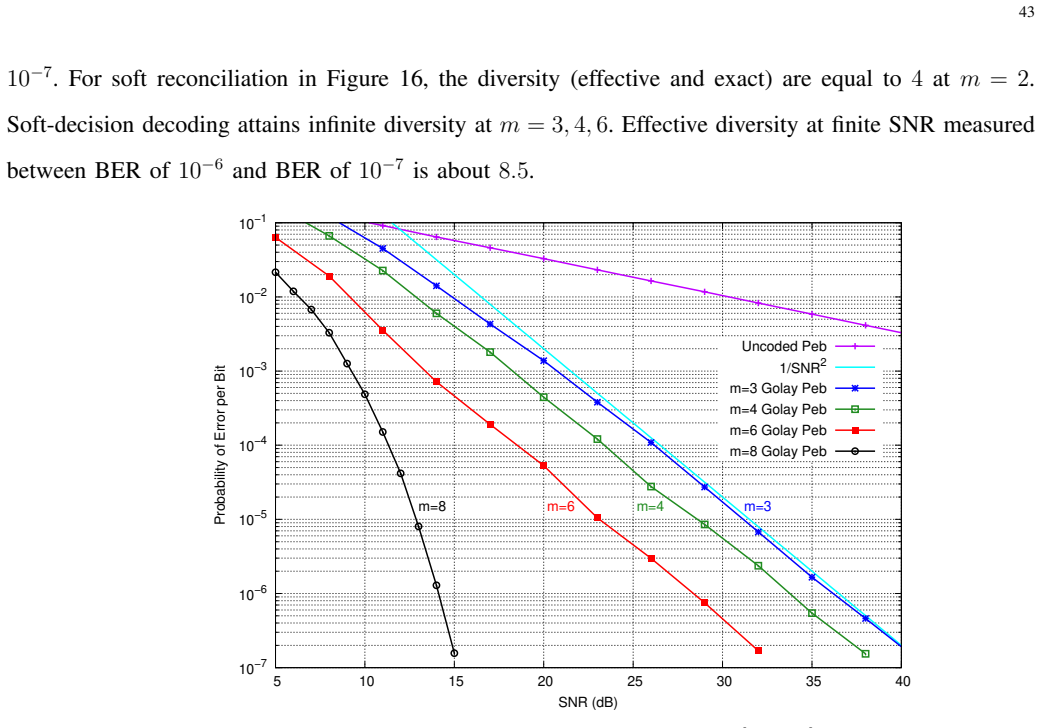
Take the [6,3,3] shortened Hamming code on N = 8 bins (m = 3) and measure the soft-decision word error rate at SNR γ = 20, 25, and 30 dB: if the log-log slope keeps steepening rather than approaching a constant, the infinite-diversity claim is supported. A sharper test uses the same code with m = 2, where the paper's Table III shows an MFD(3,3) term, so the theory predicts finite diversity 3/2 and the slope should flatten near 1.5.
Extended reading notes
Core claim
The central claim is that infinite diversity in TE-QKD reconciliation occurs precisely when the code eliminates every dominant error pattern composed of single-bin jumps. Proposition 1 splits the uncoded channel errors into two regimes: a jump to a neighboring bin has probability Θ(γ^(−1/2)), while any jump of two or more bins has probability O(e^(−γ/4)). Theorem 1 proves that a bounded-distance algebraic decoder with correction radius t achieves infinite diversity if and only if L = n log2(q)/m ≤ t, where L is the number of photons per codeword. Theorem 2 proves that soft-decision decoding achieves infinite diversity if and only if the code is MFD deficient, meaning no non-zero codeword has a binary image whose Hamming weight ω is realized entirely by ω neighboring labels of zero; a sufficient condition is L < d_Hmin(C_b). The paper also derives Singleton-type rate bounds: algebraic decoding requires R_c ≤ 1 − 2 log2(q)/m, while soft decoding only requires R_c ≤ 1 − log2(q)/m. Examples with Golay, Reed–Solomon, BCH, and Reed–Muller codes confirm the predicted finite-to-infinite transitions.
Load-bearing premise
The argument depends on the high-SNR approximations to the per-photon likelihoods being accurate enough that a small cube of Bob's soft measurements, of fixed width around the bin boundary, lies entirely inside the correct codeword's decision region; if that cube is not fully inside, the exponential error bound does not follow.
Editorial extensions
If this is right
- If the condition L ≤ t holds, bounded-distance algebraic reconciliation has error probability O(e^(−cγ)) instead of the polynomial decay typical of coded fading channels.
- If the code is MFD deficient, soft-decision reconciliation has infinite diversity; conversely, a full-MFD code forces finite diversity ω/2 for some weight ω ≥ d_Hmin(C_b).
- Soft reconciliation attains infinite diversity at rates up to R_c ≤ 1 − log2(q)/m, while algebraic reconciliation is limited to R_c ≤ 1 − 2 log2(q)/m, so the soft-decision rate penalty is half that of algebraic decoding.
- Short codes such as the [24,12,8] Golay code and [6,3,3] shortened Hamming code reach infinite diversity under soft decoding at modest frame sizes (m = 3 or more coded bits per photon), while algebraic decoding needs larger frames.
- The results imply a sudden, qualitative improvement in reconciliation error rate once the code parameters cross the threshold, an effect not observed in classical Rayleigh or Nakagami fading channels.
Reading between the lines
- Editorial extension: If the infinite-diversity condition holds at modest SNR, TE-QKD implementations could tolerate larger detector jitter or use fewer bins per frame while still keeping reconciliation errors negligible; the paper states the exponential decay but does not quantify this operational trade-off.
- Editorial extension: Because the MFD property depends on which labels are neighbors of zero, the claimed independence of the Gray-labeling version could be tested directly by comparing a standard and a centered Gray code on the same code; if the MFD classification changes, the labeling independence claim would need qualification.
- Editorial extension: The same two-scale error structure—polynomial near-boundary events and exponential far-boundary events—may appear in other timing or quantization channels, suggesting that infinite diversity could be engineered wherever a decoder can absorb all low-order boundary-crossing error patterns.
- Editorial extension: A practical verification would measure the frame error rate slope for an MFD-deficient code at multiple SNR values; if the slope continues to increase without flattening, the infinite-diversity prediction is confirmed, whereas saturation at a finite slope would indicate a missing dominant error event.
Editorial analysis
A structured set of objections, weighed in public.
Referee Report
Summary. The paper studies the diversity order of coded information reconciliation in time-entanglement QKD (TE-QKD). It derives high-SNR transition laws separating single-bin jumps (polynomial probability) from multi-bin jumps (exponential probability), and it formulates two main results: Theorem 1 gives a necessary and sufficient condition for infinite diversity under bounded-distance algebraic decoding in terms of the number of photons per codeword, while Theorem 2 claims that soft-decision decoding achieves infinite diversity if and only if the code is MFD deficient. The paper also presents rate bounds and simulation examples for Golay, Reed-Solomon, BCH, and Reed-Muller codes. The algebraic-decoding result is plausible, but the soft-decision characterization is not correct as stated.
Significance. If the main theorems were correct, the paper would report a striking phenomenon: a finite-diversity channel whose coded soft-decision decoder produces exponentially decaying error probability with finite-length codes. The split of the transition probabilities in Proposition 1 and the algebraic-decoding condition in Theorem 1 are useful and appear sound. However, the central soft-decision claim is false: the proof of Theorem 2 relies on an invalid reduction to the all-zero codeword, and an explicit counterexample shows an MFD-deficient code with finite diversity. The examples and tables based on Theorem 2 therefore do not validate the claimed theory.
major comments (4)
- [Section V-C, Theorem 2 sufficiency proof] The sufficiency proof of Theorem 2 is invalid because it assumes, 'without loss of generality and thanks to the code linearity,' that the transmitted word c_A is the all-zero word. Code linearity translates the set of competing codewords, but it does not translate the Gray-label adjacency relation: a single-bin jump from a nonzero label lands on a label that is Hamming-adjacent to that nonzero label, not necessarily to the zero label. Concretely, take m=3 with the standard reflected Gray code and the binary [6,2,2] code C=span(111111,010010). The nonzero codewords are 111111, 010010, and 101101; none uses only the zero-neighboring labels {001,100}, so C is MFD deficient by Definition 4. Yet if Alice transmits c_A=111111 and Bob's measured positions both fall in bin 6, the competing codeword 101101 has higher APP in each coordinate. This event consists of two single-bin jumps and has probability Θ(γ^{-1}), giving finite diversity at most 1. This directly contradicts Theorem 2 statement 1.
- [Theorem 2 proof, DMZ cube inclusion after Eq. (51)] Even in the zero-word case, the proof does not establish that the cube of side Δ lies entirely in the correct decision region. The derivation of Eq. (51) equates APP(c_A) and APP(c'_A) only at the single point y_ℓ = x_ℓ + 1 + Δ. The proof then asserts that this cube is included in the decision region of c_A without proving monotonicity of the APP ratio over the whole cube. This missing monotonicity argument is load-bearing for the claimed O(e^{-Δ²γ/4}) pairwise-error bound and hence for the sufficiency of MFD deficiency.
- [Lemma 6 necessary-condition proof] The necessity direction inherits the same translation problem. Lemma 6 constructs a finite-diversity lower-bound event using a full-MFD codeword whose labels are neighbors of zero, implicitly taking the transmitted word to be the all-zero word. For a nonzero transmitted word, the physical single-bin jumps are neighbors of the transmitted labels, not neighbors of zero. Thus the statement that full MFD implies finite diversity is not established for general transmissions. Both directions of the claimed equivalence in Theorem 2 are therefore unsupported.
- [Section III-B, Gray-labeling independence claim] The paper states that the results do not depend on the Gray-labeling version chosen. This is contradicted by Definition 3, which counts neighbors of the all-zero label; changing the Gray labeling changes the zero-neighboring set and can change the MFD status of a code. The RM(2,4) and RM(2,5) tables show different MFD distributions for different generator-matrix versions, illustrating the dependence. More fundamentally, a correct diversity condition must depend on the geometric adjacency of the transmitted labels, so the labeling-independence claim is not established.
minor comments (4)
- [Abstract and Introduction] The phrases 'shocking result' and 'never encountered in the literature' are overstated and are not appropriate for a technical claim that is not established by the proofs.
- [Section IV, around Lemma 3 and Proposition 1] The notation for exponential terms is inconsistent in a few places: for example, the text after Proposition 2 in [24] is quoted as O(e^{γ/4}), while the correct decaying form is O(e^{-γ/4}). Please harmonize the notation.
- [Table I and Table II] The layout of the Gray-code tables is garbled and should be redrawn so that the bin number, Gray label, and photon position are clearly aligned.
- [Lemma 5 proof, Eq. (48)] The proof says 'the calculus details are not shown' for the exact integration leading to Eq. (48). Since Lemma 5 is used in the main theorem, the intermediate steps should be included or a reference provided.
Circularity Check
No significant circularity: the infinite-diversity conditions are derived from the channel's high-SNR separation and the code's MFD property, not from fitted parameters or a self-citation chain.
full rationale
The paper's central claims are characterizations rather than disguised inputs. Theorem 1's condition L = n/m <= t follows from Proposition 1's separation of single-bin jumps (Theta(gamma^{-1/2})) from multi-bin jumps (O(e^{-gamma/4})), combined with the Gray-code fact that one single-bin jump flips one coded bit; no parameter is fitted to force the target conclusion. Theorem 2's MFD-deficiency condition is defined independently of the diversity result (Definitions 3-4, in terms of codewords, Gray labels, and the frame parameter m), and the proof attempts to show that the MAP decision region for a competing word is exponentially hard to enter unless the word is composed entirely of zero-neighboring labels; the characterization is therefore not a definitional identity, even though the proof's 'without loss of generality' reduction to the all-zero word is a correctness gap rather than a circular step. The paper does rely on the same authors' prior work [24] for the channel model, transition probabilities, and simplified APP expressions (13)-(14), but that is a published, parameter-free channel model and does not already contain the infinite-diversity theorem; it is a legitimate foundation rather than a smuggled conclusion. No fitted-input-called-prediction pattern, no uniqueness-imported-from-authors pattern, and no renaming of a known result as a new one are present. The skeptical counterexample to Theorem 2 is a substantive mathematical challenge to the validity of the WLOG/linearity step and to the Gray-label translation invariance, but a false or unproven step is not the same as circularity. Overall, the derivation chain is not equivalent to its inputs by construction.
Assumptions & free parameters
assumptions (6)
- domain assumption Detector jitter is modeled as independent additive Gaussian noise on both Alice's and Bob's measured photon positions (Eq. 1).
- domain assumption The TE-QKD channel is memoryless, with independent photon-pair realizations and independent jitters across channel uses.
- domain assumption A Gray labeling of the time bins is used, so a single-bin jump flips exactly one bit in the m-bit label.
- domain assumption The simplified high-SNR APP expressions (13)-(14) from [24] are valid approximations for the soft-decision analysis.
- domain assumption At high SNR, the exact photon position U is uniform in [0,N[ and all bins are equiprobable given valid frames (Eqs. 55, 59).
- domain assumption A t-bounded algebraic decoder corrects all error patterns of Hamming weight at most t and fails on patterns of weight greater than t.
Cite this review
Pith. "Pith review of Diversity in Coded TE-QKD Channels: Achieving Infinite Diversity out of Finite System Resources." pith.science (2026). https://pith.science/paper/4PVIABZ6
@misc{pith2026260805432,
  author       = {Pith},
  title        = {Pith review of: Diversity in Coded TE-QKD Channels: Achieving Infinite Diversity out of Finite System Resources},
  year         = {2026},
  howpublished = {\url{https://pith.science/paper/4PVIABZ6}},
  note         = {Machine review of arXiv:2608.05432}
}
read the original abstract
We establish conditions and give proofs on how an error-correcting code can attain infinite diversity in a time-entanglement quantum key distribution (TE-QKD) reconciliation. The shocking result, never encountered in the literature on coding and communication theory, is that a decoder exhibits an infinite diversity order while the channel has finite diversity and the code has a relatively short finite length. This paper studies the diversity order of coded TE-QKD reconciliation, defined by the asymptotic slope of the error probability at high signal-to-noise ratio. For bounded-distance algebraic decoding, we derive a necessary and sufficient condition in terms of the number of photons per codeword and the decoding radius. For soft-decision decoding, we introduce the maximal finite diversity (MFD) property and prove that infinite diversity is achieved if and only if the code is MFD deficient. The infinite diversity in TE-QKD has no counterpart in classical fading channels, where decoding can only multiply a finite diversity order by a finite factor. Examples of short codes based on Golay, Reed-Solomon, Bose-Chaudhuri-Hocquenghem (BCH), and Reed-Muller codes validate the analysis and illustrate how the TE-QKD system parameters and the relatively short code parameters affect the achievable diversity for both hard and soft information reconciliation.
Figures


Figures from the paper (13 more)





Reference graph
Works this paper leans on
-
[1]
Quantum cryptography: Public key distribution and coin tossing,
C. H. Bennett and G. Brassard, “Quantum cryptography: Public key distribution and coin tossing,” Theoretical Computer Science , vol. 560, pp. 7–11, 2014
work page 2014
-
[2]
Quantum cryptography based on Bell’s theorem,
A. K. Ekert, “Quantum cryptography based on Bell’s theorem,” Physical Review Letters , vol. 67, no. 6, pp. 661–663, Aug. 1991
work page 1991
-
[3]
Secure quantum key distribution with realistic devices,
F. Xu, X. Ma, Q. Zhang, H.-K. Lo, and J.-W. Pan, “Secure quantum key distribution with realistic devices,” Reviews of Modern Physics , vol. 92, no. 2, p. 025002, May 2020. doi: 10.1103/RevModPhys.92.025002
-
[4]
Advances in quantum cryptography,
S. Pirandola, U. L. Andersen, L. Banchi, M. Berta, D. Bunandar, R. Colbeck, D. Englund, T. Gehring, C. Lupo, C. Ottaviani, et al. , “Advances in quantum cryptography,” Advances in Optics and Photonics , vol. 12, no. 4, pp. 1012–1236, 2020
2020
-
[5]
Secret key reconciliation using BCH code in quantum key distribution,
W. Traisilanun, K. Sripimanwat, and O. Sangaroon, “Secret key reconciliation using BCH code in quantum key distribution,” in Proc. Int. Symp. Communications and Information Technologies (ISCIT) , Sydney, Australia, pp. 1482–1485, Oct. 2007
work page 2007
-
[6]
Efficient reconciliation protocol for discrete-variable quantum key distribution,
D. Elkouss, A. Leverrier, R. Alléaume, and J. J. Boutros, “Efficient reconciliation protocol for discrete-variable quantum key distribution,” in Proc. IEEE International Symposium on Information Theory (ISIT) , pp. 1879–1883, 2009
work page 2009
-
[7]
High performance error correction for quantum key distribution using polar codes,
P . Jouguet and S. Kunz-Jacques, “High performance error correction for quantum key distribution using polar codes,” Quantum Info. Comput., vol. 14, pp. 329–338, 2014
work page 2014
-
[8]
Improved reconciliation with polar codes in quantum key distribution,
S. Lee, J. Park, and J. Heo, “Improved reconciliation with polar codes in quantum key distribution,” Quantum Info. Comput. , vol. 18, pp. 795–813, 2018
work page 2018
Show all 42 references
-
[9]
Blind Information Reconciliation With Polar Codes for Quantum Key Distribution,
E. Kiktenko, A. O. Malyshev, and A. Fedorov, “Blind Information Reconciliation With Polar Codes for Quantum Key Distribution,” IEEE Communications Letters , vol. 25, no. 1, pp. 79–83, 2021, doi: 10.1109/LCOMM.2020.3021142
2021
-
[10]
Asymmetric Adaptive LDPC-Based Information Reconciliation for Industrial Quantum Key Distribution,
N. Borisov, I. Petrov, and A. Tayduganov, “Asymmetric Adaptive LDPC-Based Information Reconciliation for Industrial Quantum Key Distribution,” Entropy, vol. 25, 2022, doi: 10.3390/e25010031
2022 doi
-
[11]
Rateless Protograph LDPC Codes for Quantum Key Distribution,
A. Tarable, R. Paganelli, and M. Ferrari, “Rateless Protograph LDPC Codes for Quantum Key Distribution,” IEEE Transactions on Quantum Engineering , vol. 5, pp. 1–11, 2024, doi: 10.1109/TQE.2024.3361810
2024
-
[12]
Diversity and multiplexing in quantum MIMO channels,
J. ur Rehman, L. Oleynik, S. Koudia, M. Bayraktar, and S. Chatzinotas, “Diversity and multiplexing in quantum MIMO channels,” EPJ Quantum Technology , vol. 12, no. 1, Art. no. 18, 2025
2025
-
[13]
Free-space optical communication through atmospheric turbulence channels,
X. Zhu and J. M. Kahn, “Free-space optical communication through atmospheric turbulence channels,” IEEE Trans. Commun. , vol. 50, no. 8, pp. 1293–1300, Aug. 2002, doi: 10.1109/tcomm.2002.800829
2002
-
[14]
Fast adaptive optics for high-dimensional quantum communications in turbulent channels,
L. Scarfe, F. Hufnagel, M. Ferrer-Garcia, A. D’Errico, K. Heshami, and E. Karimi, “Fast adaptive optics for high-dimensional quantum communications in turbulent channels,” Communications Physics , vol. 8, 2023,
2023
-
[15]
Long-distance free- space measurement-device-independent quantum key distribution,
Y . Cao, Y . Li, K.-X. Y ang, Y .-F. Jiang, S.-L. Li, X.-L. Hu, M. Abulizi, C.-L. Li, W. Zhang, Q.-C. Sun, W. Liu, X. Jiang, S. Liao, J.-G. Ren, H. Li, L. Y ou, Z. Wang, J. Yin, C.-Y . Lu, X.-B. Wang, Q. Zhang, C.-Z. Peng, and J.-W. Pan, “Long-distance free- space measurement-...
2020 doi
-
[16]
Atmospheric effects on continuous-variable quantum key distribution,
S. Wang, P . Huang, T. Wang, and G. Zeng, “Atmospheric effects on continuous-variable quantum key distribution,” New J. Phys. , vol. 20, no. 8, Art. no. 083037, 2018, doi: 10.1088/1367-2630/aad9c4
2018 doi
-
[17]
Entanglement of Gaussian states and the applicability to quantum key distribution over fading channels,
V . C. Usenko, B. Heim, C. Peuntinger, C. Wittmann, C. Marquardt, G. Leuchs, and R. Filip, “Entanglement of Gaussian states and the applicability to quantum key distribution over fading channels,” New J. Phys. , vol. 14, no. 9, Art. no. 093048, 2012
2012
-
[18]
Quantum key distribution over combined atmospheric fading channels,
N. Hosseinidehaj and R. Malaney, “Quantum key distribution over combined atmospheric fading channels,” in Proc. IEEE Int. Conf. Commun. (ICC) , London, U.K., Jun. 2015, pp. 7413–7419,
2015
-
[19]
Limits and security of free-space quantum communications,
S. Pirandola, “Limits and security of free-space quantum communications,” Phys. Rev. Research , vol. 3, no. 1, Art. no. 013279, 2021. 54
2021
-
[20]
Spatial-mode diversity and multiplexing for continuous variables quantum communications,
S. Koudia, L. Oleynik, J. Ur Rehman, and S. Chatzinotas, “Spatial-mode diversity and multiplexing for continuous variables quantum communications,” Communications Physics , vol. 8, no. 1, p. 351, 2025
2025
-
[21]
Signal space diversity: A power- and bandwidth-efficient diversity technique for the Rayleigh fading channel,
J. Boutros and E. Viterbo, “Signal space diversity: A power- and bandwidth-efficient diversity technique for the Rayleigh fading channel,” IEEE Transactions on Information Theory , vol. 44, no. 4, pp. 1453–1467, 1998
1998
-
[22]
Coded diversity on block-fading channels,
E. Malkamäki and H. Leib, “Coded diversity on block-fading channels,” IEEE Transactions on Information Theory , vol. 45, no. 2, pp. 771–781, 2002
2002
-
[23]
Tse and P
D. Tse and P . Viswanath, Fundamentals of Wireless Communication . Cambridge University Press, 2005
2005
-
[24]
Time-Entanglement QKD: Secret Key Rates and Information Reconciliation Coding,
J.J. Boutros and E. Soljanin, “Time-Entanglement QKD: Secret Key Rates and Information Reconciliation Coding,” IEEE Trans. on Comm., vol. 71, no. 12, pp. 7174-7188, Dec. 2023
2023
-
[25]
QKD based on time-entangled photons and its key-rate promise,
L. Dolecek and E. Soljanin, “QKD based on time-entangled photons and its key-rate promise,” IEEE BITS: The Information Theory Magazine, vol. 2, no. 3, pp. 39–48, 2023
2023
-
[26]
Photon-efficient quantum key distribution using time–energy entanglement with high-dimensional encoding,
T. Zhong, H. Zhou, R. D. Horansky, C. Lee, V . B. V erma, A. E. Lita, A. Restelli, J. C. Bienfang, R. P . Mirin, T. Gerrits, S. W. Nam, F. Marsili, M. D. Shaw, Z. Zhang, L. Wang, D. Englund, G. W. Wornell, J. H. Shapiro, and F. N. C. Wong, “Photon-efficient quantum key distribu...
2015
-
[27]
Continuous-variable quantum key distribution with low-complexity information reconciliation,
X. Wang, H. Wang, C. Zhou, Z. Chen, S. Y u, and H. Guo, “Continuous-variable quantum key distribution with low-complexity information reconciliation,” Opt. Express , vol. 30, no. 17, pp. 30455–30465, Aug. 2022, doi: 10.1364/OE.461665
2022 doi
-
[28]
Reconciliation Efficiency Impact on Discrete Modulated CV -QKD Systems Key Rates,
M. Almeida, D. F. Pereira, M. Facão, A. N. Pinto, and N. Silva, “Reconciliation Efficiency Impact on Discrete Modulated CV -QKD Systems Key Rates,” J. Lightw. Technol., vol. 41, no. 18, pp. 6134–6141, Sept. 2023, doi: 10.1109/jlt.2023.3280076
2023
-
[29]
El Gamal and Y
A. El Gamal and Y . H. Kim, Network Information Theory . Cambridge University Press, 2011
2011
-
[30]
Biglieri, Coding for Wireless Channels
E. Biglieri, Coding for Wireless Channels . Springer, 2005
2005
-
[31]
Low-Density Parity-Check Codes for Nonergodic Block-Fading Channels,
J.J. Boutros, A. Guillén i Fàbregas, E. Biglieri, and G. Zémor, “Low-Density Parity-Check Codes for Nonergodic Block-Fading Channels,” IEEE Trans. on Inf. Theory , vol. 56, no. 9, pp. 4286-4300, Sept. 2010
2010
-
[32]
Effective Diversity and Coding Gain over Fluid Antenna Channels,
N. V ashakidze, J.J. Boutros, G.M. Kraidy, and I. Krikidis, “Effective Diversity and Coding Gain over Fluid Antenna Channels,” IEEE 25th Intern. Work. on Sig. Proc. Advances in Wireless Communications (SPAWC), Italy, Sept. 2024
2024
-
[33]
Proakis and M
J.G. Proakis and M. Salehi, Digital communications . McGraw-Hill, 5th edition, 2008
2008
-
[34]
On performance analysis for signaling on correlated fading channels,
V .V . V eeravalli, “On performance analysis for signaling on correlated fading channels,” IEEE Trans. Comm. , vol. 49, no. 11, pp. 1879- 1883, Nov. 2001
2001
-
[35]
MacWilliams and N.J.A
F.J. MacWilliams and N.J.A. Sloane, The Theory of Error-Correcting Codes . Amsterdam, The Netherlands: North-Holland, 1977
1977
-
[36]
M. K. Simon, and M. S. Alouini Digital communication over fading channels, John Wiley & Sons , 2004
2004
-
[37]
Performance of MRC Diversity Systems for the Detection of Signals with Nakagami Fading,
E. Al-Hussaini and A.A.M. Al-Bassiouni, "Performance of MRC Diversity Systems for the Detection of Signals with Nakagami Fading," IEEE Trans. Commun , vol. COM-33, pp. 1315-1319, Dec. 1985
1985
-
[38]
A class of binary signaling alphabets,
D. Slepian, “A class of binary signaling alphabets,” Bell System Technical Journal , vol. 35, no. 1, pp. 203234, 1956
1956
-
[39]
R. E. Blahut, Algebraic codes for data transmission . Cambridge University Press, 2003
2003
-
[40]
Improved Decoding of ReedSolomon Codes and Algebraic Geometry Codes,
V . Guruswami and M. Sudan, "Improved Decoding of ReedSolomon Codes and Algebraic Geometry Codes," IEEE Trans. Inform. Theory, vol. 45, no. 6, pp. 1757-1767, Sept. 1999
1999
-
[41]
Turbo code Design for block fading channels,
J.J. Boutros, E. Calvanese Strinati, and Guillén i Fàbregas, "Turbo code Design for block fading channels," Allertons Conference on Communication and Control , Illinois, Oct. 2004
2004
-
[42]
Analysis of coding on non-ergodic block fading channels,
J.J. Boutros, A. Guillén i Fàbregas, and E. Calvanese Strinati, "Analysis of coding on non-ergodic block fading channels," Allertons Conference on Communication and Control , Illinois, Sept. 2005
2005
Reviewed August 8, 2026 · model on record in the stance chip above.
Discussion (0). Continue with ORCID to comment.