REVIEW 3 major objections 4 minor 5 cited by
Delocalization of One-Dimensional Random Band Matrices
T0 review · 3 major / 4 minor · reviewed 2026-08-10 · deepseek-v4-flash
Pith's one-line read One-dimensional random band matrices delocalize once band width exceeds $N^{1/2+\varepsilon}$.
desk verdict A major within-field advance on delocalization for 1D band matrices at the conjectured W > N^{1/2} threshold, with a real but isolated gap in the universality theorem. read the letter →
The pith
A machine-rendered reading of the paper's core claim, the machinery that carries it, and where it could break.
The reading
What carries the argument
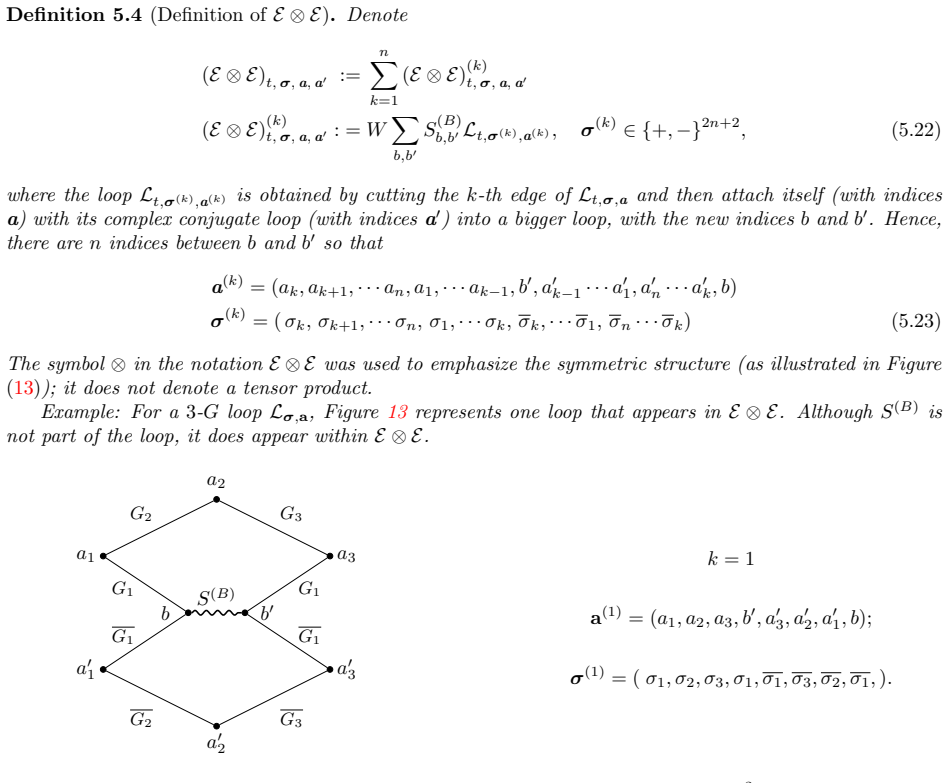
The workhorse is the family of G-loop observables $L_{t,\sigma,a}=\langle \prod_i G_t(\sigma_i)E_{a_i}\rangle$, traces of alternating resolvents and block projections. These satisfy a loop hierarchy that is not closed. The paper replaces it by the primitive hierarchy, whose solutions $K_{t,\sigma,a}$ have an explicit tree representation in terms of the block-level propagator $\Theta^{(B)}_\xi=(1-\xi S^{(B)})^{-1}$. The crucial estimate is that $L-K$ is bounded by $(W\ell_t\eta_t)^{-n}$, with the sum-zero property of the self-energy controlling the delicate near-$t=1$ behavior of the flow.
What would settle it
A numerical experiment on $W=N^{0.6}$ band matrices would settle the main claim: if any bulk eigenvalue correlation statistic at scale $1/N$ deviates from GUE, or any bulk eigenvector has a component larger than $N^{-1/2+0.01}$, the central theorems fail. A cheaper check targets the deferred estimates: for $t=N^{-1+\tau}$ and $\eta=N^{-1+2\tau}$, test whether the Ornstein-Uhlenbeck-flow resolvent obeys the asserted local law and QUE bounds.
Extended reading notes
Core claim
On its own terms, the paper's central claim is Theorems 2.2 through 2.6: for the block band matrix with $W\ge N^{1/2+c}$, uniformly in the bulk $|E|<2-\kappa$, the Green's function satisfies $\max_{x,y}|(G(z)-m(z))_{xy}|\prec (W\ell\eta)^{-1/2}$, the eigenvectors satisfy $\max_k\|\psi_k\|_\infty^2 \le N^{-1+\tau}$ with overwhelming probability, the two-point resolvent product has the quantum diffusion profile $W^{-1}(|m|^2/(1-|m|^2 S^{(B)}))_{ab}$, and the $k$-point correlation functions converge to those of GUE. The unifying bound is the loop estimate $|L_{t,\sigma,a}-K_{t,\sigma,a}|\prec(W\ell_t\eta_t)^{-n}$, where $K$ is the exact solution of a simplified hierarchy. The proof of universality depends on two short-time estimates for the Ornstein-Uhlenbeck flow that are stated in Section 2.3 and deferred to Section 7.2.
Load-bearing premise
The load-bearing premise is that the local law and quantum unique ergodicity estimates continue to hold for the Ornstein-Uhlenbeck flow at the very short times used in the universality proof; the paper asserts these follow from the main argument with only minor changes, but it does not supply the detailed derivation.
Editorial extensions
If this is right
- For every band width $W \ge N^{1/2+c}$, all bulk eigenvectors are delocalized simultaneously with overwhelming probability, ruling out sparse bulk eigenvectors (Theorem 2.2).
- The local semicircle law holds at scale $N^{-1+\varepsilon}$, the finest scale on which a density statement can be expected for this model (Theorem 2.3).
- Quantum diffusion and generalized quantum unique ergodicity hold: the resolvent has the block-level diffusion profile and local eigenvector mass equidistributes (Theorems 2.4 and 2.5).
- The bulk $k$-point correlation functions converge to GUE for every fixed $k$, while individual eigenvalue fluctuations remain on the larger order $(WN)^{-1/2}$ scale (Theorem 2.6).
- The authors state the loop-hierarchy method is expected to extend to other variance profiles, higher dimensions, and blocked random potentials.
Reading between the lines
- Because the proof controls all eigenvectors simultaneously with high probability, it automatically rules out any single bulk eigenvector concentrating on a small block; a quantitative version of these probability bounds would be a natural next step.
- The band-width threshold $N^{1/2+c}$ leaves a gap of size $N^c$ to the conjectured transition at $W\sim N^{1/2}$, and the method does not address that edge; testing whether the hierarchy degenerates as $c\to 0$ could indicate where the transition actually begins.
- The loop-hierarchy machinery as written relies on Gaussianity through the stochastic flow and integration by parts; replacing that comparison by a non-Gaussian argument would be the direct route to extending the conclusions to more general disorder models.
Editorial analysis
A structured set of objections, weighed in public.
Referee Report
Summary. The paper studies N×N Hermitian one-dimensional random band matrices in a block-band model with variance profile S = S^(B) ⊗ S_W and band width W > N^{1/2+c}. The main claims, stated in Theorems 2.2–2.6, are: local semicircle law down to scale N^{-1+ε}; simultaneous L^∞ delocalization of all bulk eigenvectors; quantum diffusion and generalized quantum unique ergodicity; and bulk GUE universality. The method introduces a stochastic flow with a time-dependent spectral parameter and analyzes a hierarchy of G-loop observables, approximating it by a 'primitive hierarchy' whose solutions K are constructed explicitly via tree representations. Theorems 2.3–2.5 are derived from loop estimates (Lemmas 2.18–2.20) through the six-step Theorem 2.21. Theorem 2.6 instead uses an Ornstein–Uhlenbeck comparison between the band matrix and GUE, relying on short-time local law and QUE estimates for the flow H_t that are deferred to Section 7.2.
Significance. If the proofs are correct, these results are a substantial advance: they establish the delocalization side of the conjectured W ≈ √N transition for the block-band model, with essentially optimal power W > N^{1/2+c}, and simultaneously give the local semicircle law, eigenvector delocalization, quantum diffusion, and bulk universality. The primitive-hierarchy/tree representation is an original and structurally explicit method: K is defined by an exact differential equation, solved in Lemma 3.4 by tree sums, and the sum-zero property of Lemma 3.10 is identified as the mechanism that converts the exponential instability of the hierarchy into polynomial bounds. There are no fitted parameters, and the main delocalization argument does not appear circular. The caveat is that the universality theorem is not on the same footing: its proof depends on a sketched flat-profile analysis in Section 7.2, and until that section is completed, Theorem 2.6 should be regarded as conditional.
major comments (3)
- [Section 7.2, Eqs. (7.27)–(7.29) and (7.39)–(7.45)] The proof of Theorem 2.6 rests on the flat-profile estimates for eS^(B) = 1/L, but these estimates are asserted rather than derived. Replacing S^(B) by the constant matrix S_GUE^(B)=1/L changes Θ_t = (1 − ξS^(B))^{-1} from an exponentially decaying kernel of scale ℓ_t to a rank-one-type kernel with no such length scale, so the ℓ_t-summation factors used in Lemmas 5.10 and 7.3 and in the derivation of (5.34)–(5.36) are no longer available. The bounds (7.39)–(7.44) are introduced with phrases such as 'similar to' or 'one can prove' without the required kernel and Ward-identity estimates, and (7.45) is not closed: the sentence 'With a continuity argument and an induction on n ≥ 2, this inequality thus implies the estimate (7.27)' is a claim, not a proof. This is load-bearing: if (7.43) or (7.45) fails, then (2.29)–(2.30) and the comparison estimate (2.23) collapse, and Theorem 2.6 is not established.
- [Section 7.2, paragraph after Eq. (7.36)] The displayed estimate 'η_u ∼ 1 − u ≥ N^{1−2τU} ≫ N^{1−τU} ∼ |t0 − t1|' is false as written: in the stated range N^{-1+2τU} ≤ η ≤ N^{-1+c/3}, the quantity η_u is of order N^{-1+O(τU)}, not N^{1−2τU}. The subsequent continuity/bootstrap argument for (7.27) depends on the ordering η_u ≫ |t0 − t1|, so the exponents must be corrected (presumably to N^{-1+2τU} and N^{-1+τU}) and the continuity argument supplied. As it stands, the step from (7.45) to (7.27) is unverifiable.
- [Section 2.3, Eqs. (2.26)–(2.27)] The proof of Theorem 2.6 assumes the weak local law (2.26) and the QUE estimate (2.27) for all 0 ≤ t ≤ t_U and for the parameter range (2.22), but Section 7.2 proves these only for t = t_U and explicitly narrows to 'only the case η = N^{-1+4τU}', whereas (2.26) is stated at η = N^{-1+2τU}. The assertions that the other cases 'can be handled similarly' or 'should also hold' are not carried out. Since (2.23) needs the full range in (2.22), this is another unproved input of the universality theorem and must be addressed before Theorem 2.6 can be accepted.
minor comments (4)
- [Abstract and Section 2.1] The abstract claims results for 'one-dimensional random band matrices', but the theorems are proved only for the block-band model S = S^(B) ⊗ S_W defined in Section 2.1. The abstract and introduction should state this block-structure restriction explicitly.
- [Section 2.1] There is a repeated word in the first sentence of Section 2.1: 'a complex complex Hermitian random band matrix'.
- [Section 1] The name 'Sooster' in the discussion of [46, 45] should be 'von Soosten'.
- [Theorem 2.5, Eq. (2.13)] The displayed sum '\sum_{x ∈ I_a} \sum_{a ∈ A}' is notationally garbled; it should presumably be '\sum_{a ∈ A} \sum_{x ∈ I_a}'.
Circularity Check
No circular reduction: delocalization is derived from a self-contained loop hierarchy; universality imports external prior theorems, with a completeness gap but no circularity.
full rationale
The main derivation for Theorems 2.3-2.5 defines G-loops L_{t,sigma,a} and primitive loops K_{t,sigma,a} as solutions of the explicit primitive hierarchy (2.48), represents K by tree graphs, proves the sum-zero properties, and bounds L-K via the integrated loop hierarchy (5.20)-(5.21). No parameter is fitted to the target delocalization or quantum diffusion statements: m(z) enters as the standard semicircle Stieltjes transform, and the propagator Theta is the explicit solution of the primitive equation, not a quantity chosen to match the theorem. The 1D delocalization proof is therefore self-contained up to the stated estimates. The universality theorem (2.6) is the only step that imports weight from prior work: Step 1 uses Theorem 2.2 of [32] (fixed-energy DBM universality), and Steps 2-3 follow the strategy and Lemmas 4.17-4.20 of [48], both by overlapping author groups. These are external theorems for Dyson Brownian motion and high-dimensional band matrices, not restatements of the present 1D result, so the citation chain constitutes independent support rather than a definitional circle. The genuine weakness is in Section 7.2: estimates (2.26)-(2.27) are deferred and then asserted via (7.27)-(7.29) and (7.45), with statements such as 'very minor changes' and 'similar' replacing a detailed derivation; if those flat-profile estimates fail, Theorem 2.6 collapses. That is a completeness and correctness risk, not a circularity. No reduction of a predicted quantity to a fitted input or to a self-citation by construction was found.
Assumptions & free parameters
assumptions (5)
- standard math Strong existence and uniqueness for the complex matrix Brownian motion SDE dH_t = sqrt(S) dB_t, and Ito's formula for resolvent entries.
- standard math Stochastic domination conventions (Definition 2.1) and Burkholder-Davis-Gundy inequality for the martingale terms.
- domain assumption The fixed energy universality theorem of Landon, Sosoe, and Yau [32] is used as a black box.
- domain assumption Proposition 4.17, Lemma 4.18, and Lemma 4.20 from Xu et al. [48] are used without proof in the universality comparison.
- domain assumption The model is the block band matrix with S(B)_{ab} = (1/3) 1_{|a-b| <= 1} and S_W = W^{-1}; theorems are proven for this model, not for general band profiles.
Cite this review
Pith. "Pith review of Delocalization of One-Dimensional Random Band Matrices." pith.science (2026). https://pith.science/paper/4PX4INNG
@misc{pith2026250101718,
  author       = {Pith},
  title        = {Pith review of: Delocalization of One-Dimensional Random Band Matrices},
  year         = {2026},
  howpublished = {\url{https://pith.science/paper/4PX4INNG}},
  note         = {Machine review of arXiv:2501.01718}
}
abstract
Consider an $ N \times N$ Hermitian one-dimensional random band matrix with band width $W > N^{1 / 2 + \frak c} $ for any $ {\frak c} > 0$. In the bulk of the spectrum and in the large $ N $ limit, we obtain the following results: (i) The semicircle law holds up to the scale $ N^{-1 + \varepsilon} $ for any $ \varepsilon > 0 $. (ii) All $ L^2 $- normalized eigenvectors are delocalized, meaning their $ L^\infty$ norms are simultaneously bounded by $ N^{-\frac{1}{2} + \varepsilon} $ with overwhelming probability, for any $ \varepsilon > 0 $. (iii) Quantum unique ergodicity holds in the sense that the local $ L^2 $ mass of eigenvectors becomes equidistributed with high probability. (iv) Universality of eigenvalue statistics holds, i.e., the local eigenvalue statistics of these band matrices are given by those of Gaussian unitary ensembles.
Figures


Figures from the paper (11 more)



Forward citations
Cited by 5 Pith papers
-
Anomalous rate of eigenstate thermalisation at singularities of the density of states
For correlated mean-field random matrices, eigenvector overlaps fluctuate at the Haar scale 1/N in the bulk and at regular edges, and at N^{-1/2} variance near cubic-root cusps, disproving the Feingold–Peres inverse-d...
-
On a Rosenzweig-Porter-type model
Uniform single- and two-resolvent local laws for arbitrary deformations of Wigner matrices yield ETH and localization profiles for all λ and H0.
-
The Zigzag Strategy for Random Band Matrices
For random band matrices with width W >> sqrt(N), the paper proves complete delocalization, Wigner-Dyson statistics, and quantum unique ergodicity for general distributions and variance profiles.
-
On Support Cardinality for the Discrete Schr\"odinger Equation
Minimal support cardinality S_d(N) of nontrivial origin-nonzero Dirichlet solutions is nondecreasing in d, so S_4(N) ≳ N²/log N, matching even-dimensional constructions up to a log factor.
-
A Reverse Black Hole Information Problem
Exact CFT states for colliding particles that form evaporating AdS black holes are constructed, and several coarse-graining maps are shown to convert the exact pure state into mixed semiclassical Hawking radiation wit...
Reference graph
Works this paper leans on
-
[1]
Localization at large disorder and at extreme energies: an elementary derivation
M. Aizenman and S. Molchanov. “Localization at large disorder and at extreme energies: an elementary derivation”. In: Communications in Mathematical Physics 157.2 (1993), pp. 245–278
work page 1993
-
[2]
Delocalization for a class of random block band matrices
Z. Bao and L. Erd˝ os. “Delocalization for a class of random block band matrices”. In: Probab. Theory Related Fields 167.3 (2017), pp. 673–776
work page 2017
-
[3]
The Eigenvector Moment Flow and Local Quantum Unique Ergodicity
P. Bourgade and H.-T. Yau. “The Eigenvector Moment Flow and Local Quantum Unique Ergodicity”. In: Communications in Mathematical Physics (2016), pp. 1–48
work page 2016
-
[4]
Random band matrices in the delocalized phase, I: Quantum unique ergodicity and universality
Paul Bourgade, Horng-Tzer Yau, and Jun Yin. “Random band matrices in the delocalized phase, I: Quantum unique ergodicity and universality”. In: Communications on Pure and Applied Mathematics 73.7 (2020), pp. 1526–1596
work page 2020
-
[5]
Random band matrices in the delocalized phase, II: Generalized resolvent esti- mates
Paul Bourgade et al. “Random band matrices in the delocalized phase, II: Generalized resolvent esti- mates”. In: Journal of Statistical Physics 174.6 (2019), pp. 1189–1221
work page 2019
-
[6]
Universality for a class of random band matrices
Paul Bourgade et al. “Universality for a class of random band matrices”. In: Advances in Theoretical and Mathematical Physics 21.3 (2017), pp. 739–800
work page 2017
-
[7]
On localization in the continuous Anderson-Bernoulli model in higher dimension
J. Bourgain and C. Kenig. “On localization in the continuous Anderson-Bernoulli model in higher dimension”. In: Inventiones mathematicae 161.2 (2005), pp. 389–426. 83
work page 2005
-
[8]
Anderson localization for Bernoulli and other singular potentials
R. Carmona, A. Klein, and F. Martinelli. “Anderson localization for Bernoulli and other singular potentials”. In: Communications in Mathematical Physics 108.1 (1987), pp. 41–66
work page 1987
Show all 49 references
-
[9]
Scaling behavior of localization in quantum chaos
G. Casati et al. “Scaling behavior of localization in quantum chaos”. In: Phys. Rev. Lett. 64 (1 Jan. 1990), pp. 5–8. doi: 10.1103/PhysRevLett.64.5 . url: https://link.aps.org/doi/10.1103/ PhysRevLett.64.5
1990 doi
-
[10]
Scaling properties of band random matrices
Giulio Casati, Luca Molinari, and Felix Izrailev. “Scaling properties of band random matrices”. In: Phys. Rev. Lett. 64 (16 Apr. 1990), pp. 1851–1854. doi: 10 . 1103 / PhysRevLett . 64 . 1851. url: https://link.aps.org/doi/10.1103/PhysRevLett.64.1851
1990 doi
- [11]
- [12]
-
[13]
Localization for one-dimensional, continuum, Bernoulli-Anderson models
D. Damanik, R. Sims, and G. Stolz. “Localization for one-dimensional, continuum, Bernoulli-Anderson models”. In: Duke Mathematical Journal 114.1 (2002), pp. 59–100
2002
-
[14]
Localization near the edge for the Anderson Bernoulli model on the two dimensional lattice
J. Ding and C. Smart. “Localization near the edge for the Anderson Bernoulli model on the two dimensional lattice”. In: Inventiones mathematicae 219.2 (2020), pp. 467–506
2020
-
[15]
Density of states for random band matrices
M. Disertori, L. Pinson, and T. Spencer. “Density of states for random band matrices”. In: Comm. Math. Phys. 232 (2002), pp. 83–124
2002
-
[16]
Quantum diffusion and delocalization in one-dimensional band ma- trices via the flow method
Sofiia Dubova and Kevin Yang. “Quantum diffusion and delocalization in one-dimensional band ma- trices via the flow method”. In: (2024). url: https://arXiv.org/abs/2412.15207v1
2024 arXiv
-
[17]
Supersymmetry in disorder and chaos
K. Efetov. “Supersymmetry in disorder and chaos”. In: Cambridge University Press (1997)
1997
-
[18]
Quantum Diffusion and Eigenfunction Delocalization in a Random Band Matrix Model
L. Erd˝ os and A. Knowles. “Quantum Diffusion and Eigenfunction Delocalization in a Random Band Matrix Model”. In: Communications in Mathematical Physics 303.2 (2011), pp. 509–554
2011
-
[19]
Averaging Fluctuations in Resolvents of Random Band Matri- ces
L. Erd˝ os, A. Knowles, and H.-T. Yau. “Averaging Fluctuations in Resolvents of Random Band Matri- ces”. In: Ann. Henri Poincar´ e14 (2013), pp. 1837–1926
2013
-
[20]
Quantum Diffusion and Delocalization for Band Matrices with General Distribution
L´ aszl´ o Erd˝ os and Antti Knowles. “Quantum Diffusion and Delocalization for Band Matrices with General Distribution”. In: Annales Henri Poincar´ e12.7 (2011), p. 1227
2011
-
[21]
L´ aszl´ o Erd˝ os and Horng-Tzer Yau.A dynamical approach to random matrix theory . Vol. 28. American Mathematical Soc., 2017
2017
-
[22]
Bulk universality for generalized Wigner matrices
L´ aszl´ o Erd˝ os, Horng-Tzer Yau, and Jun Yin. “Bulk universality for generalized Wigner matrices”. In: Probability Theory and Related Fields 154.1 (2012), pp. 341–407
2012
-
[23]
Rigidity of eigenvalues of generalized Wigner matrices
L´ aszl´ o Erd˝ os, Horng-Tzer Yau, and Jun Yin. “Rigidity of eigenvalues of generalized Wigner matrices”. In: Advances in Mathematics 229.3 (2012), pp. 1435–1515
2012
-
[24]
Delocalization and diffusion profile for random band matrices
Laszlo Erdos et al. “Delocalization and diffusion profile for random band matrices”. In: Communications in Mathematical Physics 323.1 (2013), pp. 367–416
2013
-
[25]
The local semicircle law for a general class of random matrices
L´ aszl´ o Erd˝ os et al. “The local semicircle law for a general class of random matrices”. In: Electronic Journal of Probability 18 (2013), pp. 1–58
2013
-
[26]
Spectral statistics in semiclassical random- matrix ensembles
Mario Feingold, David M. Leitner, and Michael Wilkinson. “Spectral statistics in semiclassical random- matrix ensembles”. In: Phys. Rev. Lett. 66 (8 Feb. 1991), pp. 986–989. doi: 10.1103/PhysRevLett. 66.986. url: https://link.aps.org/doi/10.1103/PhysRevLett.66.986
1991 doi
-
[27]
Absence of diffusion in the Anderson tight binding model for large disorder or low energy
J. Fr¨ ohlich and T. Spencer. “Absence of diffusion in the Anderson tight binding model for large disorder or low energy”. In: Communications in Mathematical Physics 88.2 (1983), pp. 151–184
1983
-
[28]
Constructive proof of localization in the Anderson tight binding model
J. Fr¨ ohlich et al. “Constructive proof of localization in the Anderson tight binding model”. In: Com- munications in Mathematical Physics 101.1 (1985), pp. 21–46
1985
-
[29]
Scaling properties of localization in random band ma- trices: A σ-model approach
Yan V. Fyodorov and Alexander D. Mirlin. “Scaling properties of localization in random band ma- trices: A σ-model approach”. In: Phys. Rev. Lett. 67 (18 Oct. 1991), pp. 2405–2409. doi: 10.1103/ PhysRevLett.67.2405. url: https://link.aps.org/doi/10.1103/PhysRevLett.67.2405. 84
1991 doi
-
[30]
A comprehensive proof of localization for continuous Anderson models with singular random potentials
F. Germinet and A. Klein. “A comprehensive proof of localization for continuous Anderson models with singular random potentials”. In: J. Eur. Math. Soc. 15.1 (2013), pp. 53–143
2013
-
[32]
Fixed energy universality of Dyson Brownian motion
Benjamin Landon, Philippe Sosoe, and Horng-Tzer Yau. “Fixed energy universality of Dyson Brownian motion”. In: Advances in Mathematics 346 (2019), pp. 1137–1332. issn: 0001-8708. doi: https://doi. org/10.1016/j.aim.2019.02.010. url: https://www.sciencedirect.com/science/articl...
2019 doi
-
[33]
Anderson-Bernoulli localization on the 3D lattice and discrete unique continuation principle
L. Li and L. Zhang. “Anderson-Bernoulli localization on the 3D lattice and discrete unique continuation principle”. In: arXiv:1906.04350 (2019)
2019 arXiv
-
[34]
On the Wegner Orbital Model
R. Peled et al. “On the Wegner Orbital Model”. In: International Mathematics Research Notices 2019.4 (2017), pp. 1030–1058
2017
-
[35]
The behaviour of eigenstates of arithmetic hyperbolic manifolds
Z. Rudnick and P. Sarnak. “The behaviour of eigenstates of arithmetic hyperbolic manifolds”. In: Comm. Math. Phys. 161.1 (1994), pp. 195–213
1994
-
[36]
Eigenvector localization for random band matrices with power law band width
J. Schenker. “Eigenvector localization for random band matrices with power law band width”. In: Comm. Math. Phys. 290 (2009), pp. 1065–1097
2009
-
[38]
Characteristic Polynomials for 1D Random Band Matrices from the Localization Side
M. Shcherbina and T. Shcherbina. “Characteristic Polynomials for 1D Random Band Matrices from the Localization Side”. In: Communications in Mathematical Physics 351.3 (2017), pp. 1009–1044
2017
-
[39]
Universality for 1d Random Band Matrices: Sigma-Model Approx- imation
M. Shcherbina and T. Shcherbina. “Universality for 1d Random Band Matrices: Sigma-Model Approx- imation”. In: Journal of Statistical Physics 172.2 (2018), pp. 627–664. doi: 10.1007/s10955- 018- 1969-1. url: https://doi.org/10.1007/s10955-018-1969-1
2018 doi
-
[40]
Universality for 1d Random Band Matrices
Mariya Shcherbina and Tatyana Shcherbina. “Universality for 1d Random Band Matrices”. In: Com- munications in Mathematical Physics 385.2 (2021), pp. 667–716. doi: 10.1007/s00220-021-04135-6 . url: https://doi.org/10.1007/s00220-021-04135-6
2021 doi
-
[41]
On the Second Mixed Moment of the Characteristic Polynomials of 1D Band Matrices
T. Shcherbina. “On the Second Mixed Moment of the Characteristic Polynomials of 1D Band Matrices”. In: Comm. Math. Phys. 328 (2014), pp. 45–82
2014
-
[42]
Universality of the local regime for the block band matrices with a finite number of blocks
T. Shcherbina. “Universality of the local regime for the block band matrices with a finite number of blocks”. In: J. Stat. Phys. 155 (2014), pp. 466–499
2014
-
[43]
Universality of the second mixed moment of the characteristic polynomials of the 1D band matrices: Real symmetric case
T. Shcherbina. “Universality of the second mixed moment of the characteristic polynomials of the 1D band matrices: Real symmetric case”. In: J. Math. Phys. 56 (2015)
2015
-
[44]
The spectral edge of some random band matrices
S. Sodin. “The spectral edge of some random band matrices”. In: Ann. of Math. 173.3 (2010), pp. 2223– 2251
2010
-
[45]
Non-ergodic delocalization in the Rosenzweig–Porter model
Per von Soosten and Simone Warzel. “Non-ergodic delocalization in the Rosenzweig–Porter model”. In: Letters in Mathematical Physics 109.4 (2019), pp. 905–922. doi: 10.1007/s11005-018-1131-7 . url: https://doi.org/10.1007/s11005-018-1131-7
2019 doi
-
[46]
Random characteristics for Wigner matrices
Per von Soosten and Simone Warzel. “Random characteristics for Wigner matrices”. In: Electronic Communications in Probability 24.none (2019), pp. 1 –12. doi: 10.1214/19- ECP278. url: https: //doi.org/10.1214/19-ECP278
2019 doi
-
[47]
T. Spencer. Random banded and sparse matrices (Chapter 23) . Oxford Handbook of Random Matrix Theory, edited by G. Akemann, J. Baik, and P. Di Francesco
-
[48]
Bulk universality and quantum unique ergodicity for random band matrices in high dimensions
Changji Xu et al. “Bulk universality and quantum unique ergodicity for random band matrices in high dimensions”. In: The Annals of Probability 52.3 (May 2024), pp. 765–837. doi: 10.1214/23-AOP1670. url: https://doi.org/10.1214/23-AOP1670. 85
2024 doi
-
[49]
Delocalization and quantum diffusion of random band matrices in high dimensions I: Self-energy renormalization
Fan Yang, Horng-Tzer Yau, and Jun Yin. “Delocalization and quantum diffusion of random band matrices in high dimensions I: Self-energy renormalization”. In: arXiv:2104.12048 (2021)
2021 arXiv
-
[50]
Delocalization and quantum diffusion of random band matrices in high dimensions II: T-expansion
Fan Yang, Horng-Tzer Yau, and Jun Yin. “Delocalization and quantum diffusion of random band matrices in high dimensions II: T-expansion”. In: Communications in Mathematical Physics (2022), pp. 1–96
2022
-
[51]
Random band matrices in the delocalized phase, III: Averaging fluctuations
Fan Yang and Jun Yin. “Random band matrices in the delocalized phase, III: Averaging fluctuations”. In: Probability Theory and Related Fields 179.1 (2021), pp. 451–540. 86
2021
Reviewed August 10, 2026 · model on record in the stance chip above.
Discussion (0). Continue with ORCID to comment.