REVIEW 3 major objections 5 minor 12 references
QV-PIC: Query-Aware Visual Position-Independent Caching for Efficient RAG Serving
T0 review · 3 major / 5 minor · reviewed 2026-08-16 · deepseek-v4-flash
Pith's one-line read Rendered-image caches can match or beat text-based caches in RAG serving when compiled under the model's native template and selectively upgraded to high resolution.
desk verdict Template-conditioned PIC is a solid result; the query-aware dual-resolution gain needs a random-promotion control before I'd believe the relevance ranking is doing the work. read the letter →
The pith
A machine-rendered reading of the paper's core claim, the machinery that carries it, and where it could break.
The reading
What carries the argument
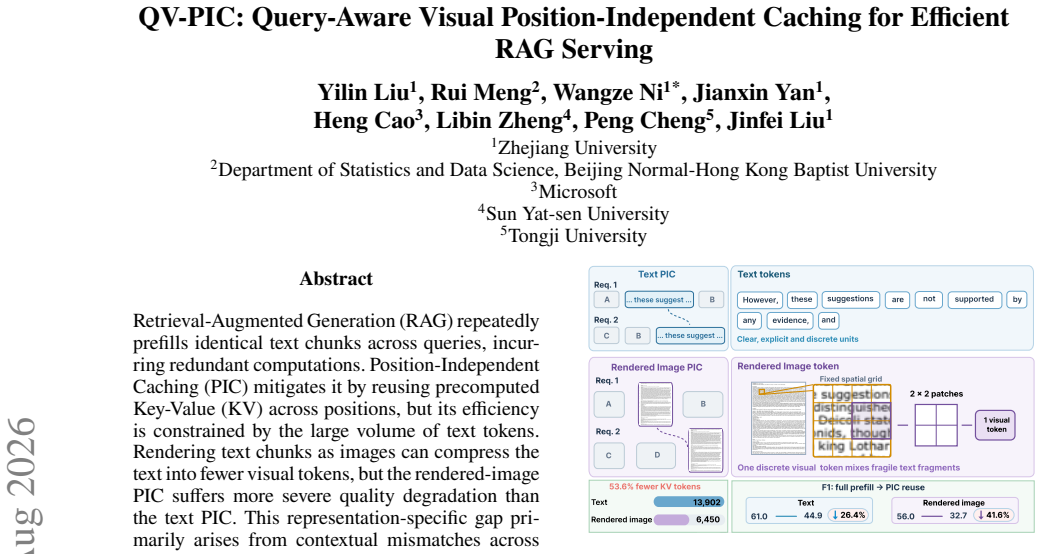
The load-bearing mechanism is a two-version cache bank plus a query-routed promotion rule. For each reusable chunk $c_i$, QV-PIC renders low- and high-resolution images and compiles both KV caches independently under the model-native chat-template prefix $h$, stripping $h$'s KV entries before storage. Online, each chunk receives the score $s_i = \max(e_q^\top e_i, 0)$ from normalized BGE-M3 embeddings of the query and the chunk's source text, and the smallest top-ranked set whose cumulative score fraction reaches $\alpha=0.65$, capped at $B=4$, is activated in its high-resolution cache while all others stay at 72 DPI. The assembled caches are stitched in retrieval order and re-anchored with M-RoPE, so only promoted images pay the extra visual-token overhead.
What would settle it
On a constructed QA set where answers sit in small numeric or tabular cells, compare QV-PIC's top-ranked promotion against random promotion of the same number of images: if random promotion matches QV-PIC within noise, the relevance ranking is not carrying the result; if an oracle that promotes the images actually containing the answer string beats QV-PIC substantially, the ranking is leaving recoverable fine detail unused.
Extended reading notes
Core claim
The central claim is that rendered-image PIC is not inherently inferior to text PIC: the reuse-quality gap is caused by two correctable conditions. Independently compiled image caches lack the model-native chat-template context in which the image is normally processed, so QV-PIC compiles each cache under that template prefix and strips only the prefix KV entries before storage, removing the mismatch without online recomputation. Uniform low resolution then discards fine-grained textual evidence, so QV-PIC precompiles 72-DPI and 120-DPI versions of every chunk and promotes to 120 DPI only the smallest top-ranked set of chunks whose cumulative positive cosine relevance reaches $\alpha=0.65$, capped at $B=4$ images. With both repairs in place, the paper claims rendered-image PIC matches and then exceeds template-conditioned text PIC in answer quality, reaching 54.3 average F1 against 51.7, while producing the first token 17.2% sooner and removing 83.8% of the online prefill work relative to full prefill.
Load-bearing premise
The reported gains depend on query-to-source-text cosine similarity being a reliable guide to which rendered images actually contain the answer-bearing fine detail, with the promotion threshold and budget tuned on the same six-task benchmark.
Editorial extensions
If this is right
- If the results hold, long-document RAG serving can replace text KV caches with rendered-image caches without giving up answer quality, shrinking the KV transfer and memory footprint.
- The online path reduces to query embedding, scoring, cache assembly, and decoding; no rendering, visual encoding, or context prefill happens at request time.
- The promotion budget $B$ and threshold $\alpha$ become serving-time knobs that trade fine visual detail against latency, without rerendering or re-encoding.
- Template conditioning transfers across VLM families: the cross-model experiments with related- and cross-family backbones retain the quality-latency benefit, though its size depends on the model.
Reading between the lines
- A visual-grounded ranker would likely use the high-resolution budget better than source-text cosine similarity on tables, digits, and dense layouts, where text embeddings can rank a chunk as relevant even though the answer-bearing pixels sit in a small detail region.
- The same dual-version cache idea extends to mixed-modality RAG, where prose pages stay as text caches and layout-heavy pages become image caches, with promotion deciding which modality a query needs.
- The sensitivity of the results to $\alpha$ and $B$ is not reported; a holdout-based sweep of those two parameters would show whether the claimed gains are robust or need per-domain retuning.
- Because the offline compilation cost is paid once per document and reused across many queries, the advantage over full prefill should grow with request traffic; single-shot use would amortize the offline work poorly.
Signed reviews
Editorial analysis
A structured set of objections, weighed in public.
Referee Report
Summary. The paper proposes QV-PIC, a caching framework for RAG serving that renders text chunks as images, compiles low- and high-resolution key-value caches offline under the model's native chat-template prefix, and at serving time promotes a bounded set of query-relevant rendered images to high resolution using BGE-M3 relevance scores. The authors report that QV-PIC improves average F1 by 21.6 points over vanilla rendered-image PIC, surpasses template-conditioned text PIC by 2.58 F1, and reduces online prefill time relative to full prefill by 83.8%, across six LongBench QA tasks and three VLMs.
Significance. If the full claims held, QV-PIC would be a meaningful step toward making rendered-image position-independent caching practical for long-document RAG, because it would show that template-conditioned offline compilation plus selective high-resolution restoration can recover most of text PIC's quality at lower latency. The paper's template-conditioning ablation is well designed, including a length-matched dummy-prefix control, and the cross-model evaluation with GLM-4.1V and LLaVA-OneVision-2 strengthens the generality of the template-conditioning result. The experiments are internally consistent and the method is clearly described. However, the query-aware component, which is central to the method's novelty, is not supported by the experiments as reported, because no control separates relevance-based allocation from a relevance-agnostic upgrade policy.
major comments (3)
- [Experiments, Q3 (Fig. 6)] The causal role of query-aware allocation is not isolated. The ablation labeled 'QV-PIC w/o template conditioning' removes template conditioning from the whole pipeline, but it does not compare, under template conditioning, QV-PIC against a relevance-agnostic policy such as promoting a random set of B=4 images, the first B images in context order, or the B images with the lowest relevance. Without such a control, the reported gain of QV-PIC (54.3 F1) over template-conditioned uniform 120-DPI PIC (52.1 F1) cannot be attributed to the BGE-M3 ranking in Eq. (6); it could be the average quality effect of upgrading any four images, the effect of removing high-resolution tokens from irrelevant images, or noise. An oracle control that promotes the chunks whose high-resolution cache actually helps would also quantify the headroom of the scoring rule.
- [Methodology Eq. (6); Experiments, Q3] The hyperparameters alpha=0.65 and B=4 are selected on the same six-task benchmark used for the headline claims, and no sensitivity analysis or variance estimate is provided. F1 is reported for one deterministic run and TTFT for three runs without error bars, so the 2.2-point F1 advantage over uniform 120-DPI PIC and the 2.58-point advantage over text PIC are compatible with selection bias or run-to-run variation. Please add a sweep over alpha (e.g., 0.3, 0.5, 0.8) and B (e.g., 2, 8, 16) and report per-task mean and variance (e.g., bootstrap or multiple independent runs).
- [Experiments, Q3 (Fig. 6)] The per-task support for the query-aware claim is not transparent. Figure 6(a) is a dense scatter/line plot and no numerical table is given; the text states that QV-PIC improves over uniform 120-DPI PIC on only four of the six tasks (HotpotQA, MuSiQue, TriviaQA, NarrativeQA). The average 2.2-point gain may therefore be concentrated in a subset of tasks, and the 'consistent quality-latency improvements' phrasing in the conclusion is stronger than the displayed evidence. A per-task table with F1 and TTFT for all compared configurations is needed.
minor comments (5)
- [Experimental Configuration] NarrativeQA's restricted DPI range (72, 96, 120) should be stated in the caption of Figure 5 and 6 so readers are not confused by missing 144/168-DPI points for that task.
- [Abstract / Conclusion] The term 'optimized text PIC' is used in the abstract and conclusion but is not formally defined in the experiments; the comparisons use 'template-conditioned text PIC,' so the terminology should be aligned.
- [Methodology Eq. (9)] The analytical routing cost is given, but the measured routing overhead as a fraction of TTFT is not reported; please include this breakdown to verify that the online query-encoding and ranking costs are negligible.
- [Figure 6(c)] The component ablation in Figure 6(c) is difficult to read in the provided rendering; the values should also be given in a table or in the text.
- [References] Several references are 2026 arXiv preprints (e.g., LLaVA-OneVision-2, DeepSeek-OCR 2, AgentOCR); please verify their publication status and arXiv identifiers.
Circularity Check
No significant circularity: QV-PIC's claims are empirical benchmark measurements, and neither template conditioning nor query-aware resolution selection reduces to the reported F1 by construction.
full rationale
The paper's central claims are empirical measurements against fixed LongBench tasks, not derivations from inputs. The mechanism equations are (1) template-conditioned compilation, which prepends the model-native chat-template prefix during offline KV construction and strips its entries, and (4)-(7) query-aware dual-resolution selection, which uses the external frozen BGE-M3 encoder to rank source-text embeddings and promotes up to B=4 chunks whose cumulative positive relevance reaches alpha=0.65. Neither construction defines the output F1 in terms of itself: template conditioning is not the answer-quality metric, and the relevance score is an independent embedding similarity used only to choose cache resolution while cache assembly follows the RAG context order. The reported gains (21.6 F1 over vanilla rendered-image PIC, +2.58 over text PIC) are measured, not algebraically forced, and the component ablation (32.5 vs 54.3 F1) isolates the template-conditioning contribution empirically. A few references to the authors' own prior work (CacheGen, CacheBlend, and the Glyph rendering model) appear as background or as the chosen test model, but the paper independently evaluates full-prefill and PIC quality across six tasks rather than importing the central claim from these citations. The choice of alpha=0.65 and B=4 on the same benchmark, and the absence of a random-promotion control, are legitimate correctness and robustness concerns, but no quoted step reduces the prediction to its inputs, so they do not constitute circularity. No self-definitional, fitted-input-as-prediction, self-citation-load-bearing, uniqueness-imported, ansatz-smuggled, or renaming pattern is present.
Assumptions & free parameters
free parameters (3)
- alpha (cumulative relevance threshold) =
0.65
- B (high-resolution budget) =
4
- DPI pair (low/high) =
72/120 DPI
assumptions (4)
- domain assumption Visual-text compression via Glyph preserves enough document information under full prefill for QA.
- domain assumption Chat-template prefix conditioning during offline compilation transfers to composed caches at serving time.
- domain assumption BGE-M3 cosine similarity ranks chunks by answer relevance for high-resolution allocation.
- standard math M-RoPE re-anchoring of independently compiled key caches correctly reconstructs positional information.
Cite this review
Pith. "Pith review of QV-PIC: Query-Aware Visual Position-Independent Caching for Efficient RAG Serving." pith.science (2026). https://pith.science/paper/4QBF6LHE
@misc{pith2026260812121,
  author       = {Pith},
  title        = {Pith review of: QV-PIC: Query-Aware Visual Position-Independent Caching for Efficient RAG Serving},
  year         = {2026},
  howpublished = {\url{https://pith.science/paper/4QBF6LHE}},
  note         = {Machine review of arXiv:2608.12121}
}
read the original abstract
Retrieval-Augmented Generation (RAG) repeatedly prefills identical text chunks across queries, incurring redundant computations. Position-Independent Caching (PIC) mitigates it by reusing precomputed Key-Value (KV) across positions, but its efficiency is constrained by the large volume of text tokens. Rendering text chunks as images can compress the text into fewer visual tokens, but the rendered-image PIC suffers more severe quality degradation than the text PIC. This representation-specific gap primarily arises from contextual mismatches across independently compiled caches and the loss of fine-grained textual evidence during visual compression. Existing PIC repair methods mainly address the former through selective recomputation, but they incur online computation and cannot recover lost textual details. We propose QV-PIC, a query-aware dual-resolution PIC reuse framework guided by model-native templates. Offline, QV-PIC compiles visual caches under the model's native chat-template prefix, improving PIC quality without online recomputation. Online, it preserves global context with low resolution and restores fine-grained textual evidence within a high-resolution budget by cumulative query relevance scores, retaining the efficiency benefit of visual compression. Across six tasks, QV-PIC improves average F1 by 21.6 points over vanilla rendered-image PIC, closes the gap to vanilla text PIC, and surpasses optimized text PIC by 2.58 F1 while reducing TTFT by 17.2\%. Relative to full prefill, it cuts TTFT by 83.8%.
Figures


Figures from the paper (2 more)


Reference graph
Works this paper leans on
-
[5]
InProceedings of the 2020 Conference on Empirical Methods in Natural Language Processing, 6769–6781
Dense Pas- sage Retrieval for Open-Domain Question Answering. InProceedings of the 2020 Conference on Empirical Methods in Natural Language Processing, 6769–6781. Association for Computational Linguistics. Kwon, W.; Li, Z.; Zhuang, S.; Sheng, Y.; Zheng, L.; Yu, C.H.;Gonzalez,J.E.;Zhang,H.;andStoica,I.2023. Ef- ficientMemoryManagementforLargeLanguageModel ...
work page 2020
-
[6]
InAdvances in Neural Information Processing Systems, volume 33, 9459–9474
Retrieval- Augmented Generation for Knowledge-Intensive NLP Tasks. InAdvances in Neural Information Processing Systems, volume 33, 9459–9474. Li,Y.;Lan,Z.;andZhou,J.2025. TextorPixels?Evalu- atingEfficiencyandUnderstandingofLLMswithVisual TextInputs. InFindingsoftheAssociationforComputa- tionalLinguistics:EMNLP2025,10564–10578.Associ- ation for Computatio...
work page 2025
-
[7]
InProceedings of the ACM SIGCOMM 2024 Conference, 38–56
CacheGen: KV Cache Compression and Streaming for Fast Large Language Model Serving. InProceedings of the ACM SIGCOMM 2024 Conference, 38–56. Sydney, NSW, Australia: Association for Computing Machinery. Lu,S.;Wang,H.;Rong,Y.;Chen,Z.;andTang,Y.2025. TurboRAG: Accelerating Retrieval-Augmented Genera- tion with Precomputed KV Caches for Chunked Text. InProcee...
arXiv 2024
-
[8]
Wang, Z.; Ma, D.; Zhong, H.; Li, J.; Zhang, W.; Wang, B.; and He, C
Qwen2-VL: Enhancing Vision- Language Model’s Perception of the World at Any Res- olution.arXiv preprint arXiv:2409.12191. Wang, Z.; Ma, D.; Zhong, H.; Li, J.; Zhang, W.; Wang, B.; and He, C
-
[9]
arXiv preprint arXiv:2602.24134
AgenticOCR: Parsing Only What YouNeedforEfficientRetrieval-AugmentedGeneration. arXiv preprint arXiv:2602.24134. Wei, H.; Sun, Y.; and Li, Y
-
[10]
DeepSeek- OCR: Contexts Optical Compression.arXiv preprint arXiv:2510.18234. Wei, H.; Sun, Y.; and Li, Y
-
[11]
Xing,L.;Wang,A.J.;Yan,R.;Shu,X.;andTang,J.2025
DeepSeek-OCR 2: Visual Causal Flow.arXiv preprint arXiv:2601.20552. Xing,L.;Wang,A.J.;Yan,R.;Shu,X.;andTang,J.2025. Vision-Centric Token Compression in Large Language Model. InAdvances in Neural Information Processing Systems, volume 38, 37239–37269. Yao,J.;Li,H.;Liu,Y.;Ray,S.;Cheng,Y.;Zhang,Q.;Du, K.; Lu, S.; and Jiang, J
arXiv 2025
-
[12]
InProceedings of the Twentieth European Conference on Computer Systems, 94–109
CacheBlend: Fast Large Language Model Serving for RAG with Cached Knowl- edge Fusion. InProceedings of the Twentieth European Conference on Computer Systems, 94–109. Association for Computing Machinery. Zhao, H.; Wang, M.; Zhu, F.; Liu, W.; Ni, B.; Zeng, F.; Meng,G.;andZhang,Z.2025a.VTCBench:CanVision- LanguageModelsUnderstandLongContextwithVision- Text C...
Show all 12 references
-
[2020]
InProceedings of the 37th International Con- ference on Machine Learning, volume 119 ofProceed- ingsofMachineLearningResearch,3929–3938.PMLR
Retrieval Augmented Language Model Pre- Training. InProceedings of the 37th International Con- ference on Machine Learning, volume 119 ofProceed- ingsofMachineLearningResearch,3929–3938.PMLR. Hu,J.;Huang,W.;Wang,W.;Wang,H.;Hu,T.;Qin,Z.; Feng,H.;Chen,X.;Shan,Y.;andXie,T.2025. E...
2025
-
[2024]
InFindings of the Association for Computational Linguistics: ACL 2024, 2318–2335
M3-Embedding: Multi-Linguality, Multi-Functionality, Multi-Granularity Text Embed- dingsThroughSelf-KnowledgeDistillation. InFindings of the Association for Computational Linguistics: ACL 2024, 2318–2335. Bangkok, Thailand: Association for Computational Linguistics. Cheng, J.;...
2024
-
[2025]
Guu, K.; Lee, K.; Tung, Z.; Pasupat, P.; and Chang, M.- W
GLM-4.1V-Thinking and GLM- 4.5V: Towards Versatile Multimodal Reasoning with Scalable Reinforcement Learning.arXiv preprint arXiv:2507.01006. Guu, K.; Lee, K.; Tung, Z.; Pasupat, P.; and Chang, M.- W
-
[2026]
Bai, Y.; Lv, X.; Zhang, J.; Lyu, H.; Tang, J.; Huang, Z.; Du, Z.; Liu, X.; Zeng, A.; Hou, L.; Dong, Y.; Tang, J.; and Li, J
LLaVA-OneVision-2: Towards Next-Generation Perceptual Intelligence.arXiv preprint arXiv:2605.25979. Bai, Y.; Lv, X.; Zhang, J.; Lyu, H.; Tang, J.; Huang, Z.; Du, Z.; Liu, X.; Zeng, A.; Hou, L.; Dong, Y.; Tang, J.; and Li, J
Reviewed August 16, 2026 · model on record in the stance chip above.
Discussion (0). Continue with ORCID to comment.