Measures of Chirality in Mixed-State Topological Phases
Pith reviewed 2026-06-26 01:42 UTC · model grok-4.3
The pith
Chirality in mixed-state topological phases cannot be diagnosed by pure-state methods and instead requires relative-entropy measures relative to a known parent state.
A machine-rendered reading of the paper's core claim, the machinery that carries it, and where it could break.
Core claim
In mixed states, the standard diagnostics for chirality in topological phases—bulk-boundary correspondence, gapless entanglement spectrum, nontrivial modular commutator, and quantized thermal Hall response—do not remain reliable. For decohered topological phases with a known error-free parent state, two relative-entropy-based measures are proposed that diagnose chirality, with one further extracting the chiral central charge. The symmetry algebra of the mixed state still provides a sharp mathematical characterization, but the physical diagnostics must be rebuilt from relative entropy.
What carries the argument
Relative-entropy-based measures of chirality, computed between the mixed state and its known pure parent state, which detect the presence of chirality and, in one case, extract the chiral central charge.
If this is right
- Standard pure-state probes cannot be trusted to detect chirality once a topological phase becomes mixed.
- Relative entropy with respect to the parent state supplies a workable replacement that also yields the chiral central charge.
- Mixed-state topological phases require intrinsically new diagnostics rather than direct analogues of pure-state ones.
- The symmetry-algebra definition of chirality remains valid, but its physical consequences must be re-derived for mixed states.
Where Pith is reading between the lines
- The same relative-entropy construction could be tested on other mixed-state topological invariants beyond chirality.
- Experimental platforms with tunable decoherence could directly measure the proposed quantities to check consistency with the parent state's known chirality.
- The breakdown of pure-state diagnostics suggests that open-system versions of bulk-boundary correspondence may need separate formulation.
Load-bearing premise
The mixed states under consideration are decohered versions of a known error-free parent topological state, which allows relative entropy to be computed relative to that parent.
What would settle it
A numerical or experimental mixed state obtained by applying known decoherence to a chiral topological parent state in which the proposed relative-entropy measures fail to register chirality or return an incorrect chiral central charge.
Figures
read the original abstract
What does it mean for a mixed-state topological phase to be chiral? Mathematically, chirality can be sharply characterized through the symmetry algebra of the mixed state. Physically, however, the question is far more subtle. In pure states, chirality in topological phase is tied to a web of familiar diagnostics, involving bulk-boundary correspondence, a gapless entanglement spectrum, a nontrivial modular commutator, and a quantized thermal Hall response. We show that none of these diagnostics remain reliable in mixed states. Instead, for decohered topological phases with a known error-free parent state, we propose two relative-entropy-based measures that can diagnose chirality, with one of them further extracting the chiral central charge. Our results emphasize how mixed-state topology demands intrinsically new diagnostics beyond direct analogues of pure-state probes.
Editorial analysis
A structured set of objections, weighed in public.
Referee Report
Summary. The paper examines what chirality means for mixed-state topological phases. It shows that standard pure-state diagnostics—bulk-boundary correspondence, gapless entanglement spectrum, nontrivial modular commutator, and quantized thermal Hall response—fail to reliably detect chirality once the state is mixed. For the restricted class of decohered topological phases that possess a known error-free pure parent state, the authors introduce two relative-entropy-based measures; one of these additionally extracts the chiral central charge. The work stresses that mixed-state topology requires intrinsically new diagnostics rather than direct analogues of pure-state probes.
Significance. If the proposed measures are shown to be robust, the paper supplies concrete, computable diagnostics for chirality in a practically relevant subclass of mixed states. The explicit restriction to decohered states with a known parent avoids overclaiming generality, and the relative-entropy construction is framed in terms of standard information-theoretic quantities. The stress-test concern about the weakest assumption does not land as an internal inconsistency because the positive claims are scoped precisely to the regime where the parent is known and relative entropy is well-defined.
minor comments (2)
- The abstract and introduction would benefit from a short explicit statement of the precise class of mixed states (decohered from a known pure parent) to which the positive results apply, so that readers immediately see the scope.
- Notation for the two relative-entropy measures should be introduced with a single displayed equation early in the results section to make subsequent comparisons easier to follow.
Simulated Author's Rebuttal
We thank the referee for their supportive review, positive assessment of the paper's scope, and recommendation for minor revision. We appreciate the recognition that our claims are appropriately limited to decohered states with a known parent.
Circularity Check
No significant circularity; proposal uses standard relative entropy on explicitly assumed parent states
full rationale
The paper scopes its positive proposal to decohered states with a known pure parent, allowing direct computation of relative entropy without deriving the parent from the measure or fitting parameters that are then renamed as predictions. The claim that pure-state diagnostics fail is presented as an explicit demonstration rather than a self-referential derivation. No load-bearing self-citations, ansatz smuggling, or uniqueness theorems imported from the authors' prior work appear in the abstract or scoped construction; the measures are framed as new relative-entropy diagnostics, not renamings of known results.
Axiom & Free-Parameter Ledger
Reference graph
Works this paper leans on
-
[1]
Example for short-range correlated chiral boundary 5
-
[2]
Modular commutators 6 V
TheE 8 state 6 C. Modular commutators 6 V. Discussions 6 Acknowledgments 7 A. Details of theZ N model 7 B. Mapping relative entropy to the Potts model 7
-
[3]
Mapping to replicated Potts model 8
-
[4]
Linear modular shear 11
The replica limit and random-bond Potts model 9 C. Linear modular shear 11
-
[5]
Wrong prediction of the transition point 12 References 14 I. INTRODUCTION Topological phases of matter have profoundly reshaped our understanding of quantum phases of matter in pure states [1–3]. They are now reappearing at the fron- tier of the subject in a new form: as phases of mixed states arising from noise, such as decoherence, dissipa- tion, measur...
Pith/arXiv arXiv 2026
-
[6]
microscopic details of the bound- ary geometry
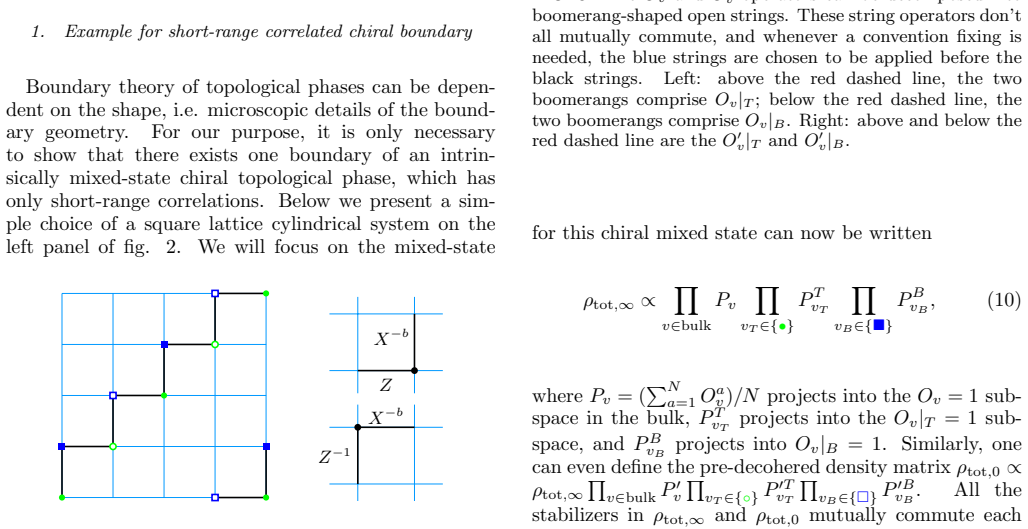
Example for short-range correlated chiral boundary Boundary theory of topological phases can be depen- dent on the shape, i.e. microscopic details of the bound- ary geometry. For our purpose, it is only necessary to show that there exists one boundary of an intrin- sically mixed-state chiral topological phase, which has only short-range correlations. Belo...
-
[7]
Therefore, it serves as a minimal example of chiral topological phase
TheE 8 state TheE 8 phase hosts no nontrivial anyons and has chi- ral central chargec − = 8 [3]. Therefore, it serves as a minimal example of chiral topological phase. Consider the pure-stateE 8 density matrixρ E8 =|ψ E8 ⟩⟨ψE8 |. The simplest local quantum channel to trivialize this mixed state is given by E=⊗ iEi,E i[ρi] = Tri(ρi)σ i (11) whereilabels a ...
-
[8]
vanish. While the calculation is done for the chiralZ 3 case, it’s easily generalizable for chiralZ N cases and we expect the same result both for these general examples and for gen- eral intrinsically chiral mixed-state topological phases. Therefore, the modular commutator is no longer a good measure for mixed-state topological phases - intuitively, this...
-
[9]
Define the local projectorsP v = (1 +O v +O 2 v)/3 andP ′ v = (1+O ′ v +O ′2 v )/3
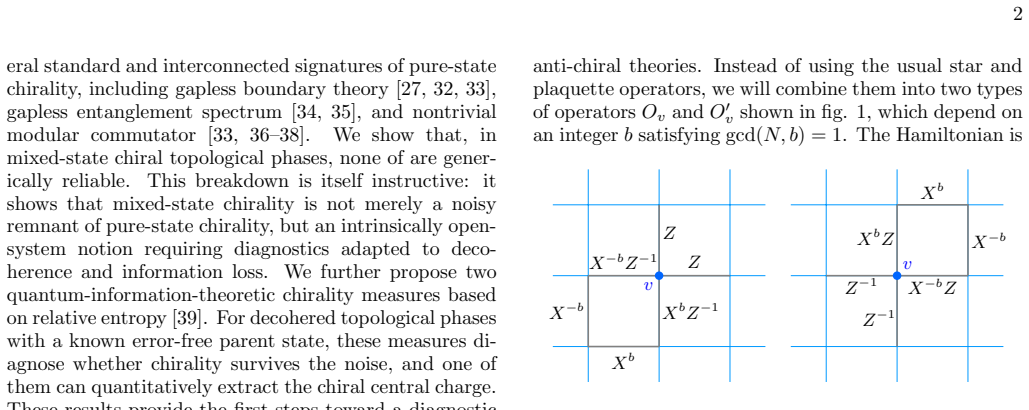
Mapping to replicated Potts model We start with defining the parent stateρ 0, which is maximally mixed in the 9 topological sectors. Define the local projectorsP v = (1 +O v +O 2 v)/3 andP ′ v = (1+O ′ v +O ′2 v )/3. On a torus, the parent state readsρ 0 = 1 9 Q v PvP ′ v.Equivalently, expanding the summations in the projectors gives a loop representation...
-
[10]
The replica limit and random-bond Potts model The analytic continuationn→1 can be obtained more directly by reorganizing the replica sum in terms of error configurations. Using the error string in the first replica copyE (1) as a reference, the error strings in the remain- ing replica copies can be reparametrized as E(r+1) =E (1) +g (r),(B20) wherer= 1,· ...
-
[11]
At fixed points We are now ready to evaluate Tr(ρ0U) whereρ 0 is sta- bilized by allO v andO ′ v operators, and is further maxi- mally mixed in theN 2 logical sectors: ρ0 = 1 N 2 2X s,s′=0 |ψs,s′⟩⟨ψs,s′|,(C2) whereW x|ψs,s′⟩=ω s|ψs,s′⟩andW ′ x|ψs,s′⟩=ω s′ |ψs,s′⟩. Using (A1), it’s straightforward to check that WxWy|ψs,s′⟩=ω s−2bWy|ψs,s′⟩, W ′ xW ′ y|ψs,s′...
-
[12]
We will focus onN= 3,b= 1 and use the channel in (B1) (B3) and fig
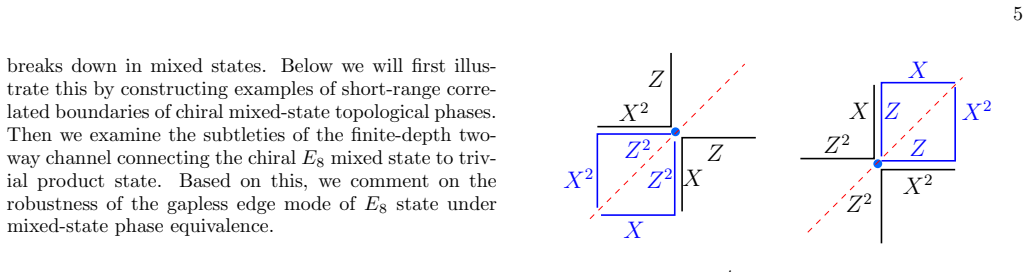
Wrong prediction of the transition point Next we examine the Tr[U ρ] calculation for general decoherence strength. We will focus onN= 3,b= 1 and use the channel in (B1) (B3) and fig. 5. Although the local boomerang operatorsSthemselves do not mutually commute, the local channelsE ℓ do commute with one another. Therefore we can write E[ρ 0] = X {al} MY j=1...
-
[13]
X. G. WEN, Topological orders in rigid states, Inter- national Journal of Modern Physics B04, 239 (1990), https://doi.org/10.1142/S0217979290000139
-
[14]
X.-G. Wen, Colloquium: Zoo of quantum-topological phases of matter, Reviews of Modern Physics89, 10.1103/revmodphys.89.041004 (2017)
-
[15]
Kitaev, Anyons in an exactly solved model and be- yond, Annals of Physics321, 2–111 (2006)
A. Kitaev, Anyons in an exactly solved model and be- yond, Annals of Physics321, 2–111 (2006)
2006
-
[16]
Z. Wang, Z. Wu, and Z. Wang, Intrinsic mixed-state topological order, PRX Quantum6, 010314 (2025)
2025
-
[17]
M. S. Zini and Z. Wang, Mixed-state tqfts (2021), arXiv:2110.13946 [math.QA]
arXiv 2021
-
[18]
Sohal and A
R. Sohal and A. Prem, Noisy approach to intrinsically mixed-state topological order, PRX Quantum6, 010313 (2025)
2025
-
[19]
T. D. Ellison and M. Cheng, Toward a classification of mixed-state topological orders in two dimensions, PRX Quantum6, 010315 (2025)
2025
-
[20]
Haah, Invertible subalgebras, Communications in Mathematical Physics403, 661–698 (2023)
J. Haah, Invertible subalgebras, Communications in Mathematical Physics403, 661–698 (2023)
2023
-
[21]
A. Kapustin and L. Spodyneiko, Thermal hall conduc- tance and a relative topological invariant of gapped two-dimensional systems, Physical Review B101, 10.1103/physrevb.101.045137 (2020)
-
[22]
Dennis, A
E. Dennis, A. Kitaev, A. Landahl, and J. Preskill, Topological quantum memory, Journal of Mathematical Physics43, 4452–4505 (2002)
2002
-
[23]
Y. Ogata, Mixed state topological order: operator alge- braic approach (2025), arXiv:2501.02398 [math-ph]
arXiv 2025
-
[24]
K. Kikuchi, K.-S. Kam, and F.-H. Huang, Anyon conden- sation in mixed-state topological order, SciPost Physics Core8, 10.21468/scipostphyscore.8.4.072 (2025)
-
[25]
R. Fan, Y. Bao, E. Altman, and A. Vishwanath, Diag- nostics of mixed-state topological order and breakdown of quantum memory, PRX Quantum5, 020343 (2024)
2024
-
[26]
Y. Bao, R. Fan, A. Vishwanath, and E. Altman, Mixed- state topological order and the errorfield double formula- tion of decoherence-induced transitions, Physical Review Letters136, 10.1103/6f98-tvb8 (2026)
-
[27]
Y.-H. Chen and T. Grover, Separability transitions in topological states induced by local decoherence, Physi- cal Review Letters132, 10.1103/physrevlett.132.170602 (2024)
-
[28]
Chen and T
Y.-H. Chen and T. Grover, Unconventional topological mixed-state transition and critical phase induced by self- dual coherent errors, Phys. Rev. B110, 125152 (2024)
2024
-
[29]
S. Lee and E.-G. Moon, Mixed-state topological order under coherent noise, PRX Quantum6, 10.1103/hchr- rqq9 (2025)
-
[30]
Q. Wang, R. Vasseur, S. Trebst, A. W. W. Ludwig, and G.-Y. Zhu, Decoherence-induced self-dual criticality in topological states of matter (2025), arXiv:2502.14034 [quant-ph]
arXiv 2025
-
[31]
D. I. Tsomokos, T. J. Osborne, and C. Castelnovo, Inter- play of topological order and spin glassiness in the toric code under random magnetic fields, Phys. Rev. B83, 075124 (2011)
2011
-
[32]
R¨ othlisberger, J
B. R¨ othlisberger, J. R. Wootton, R. M. Heath, J. K. Pachos, and D. Loss, Incoherent dynamics in the toric code subject to disorder, Phys. Rev. A85, 022313 (2012)
2012
-
[33]
Zhang, Y
C. Zhang, Y. Xu, J.-H. Zhang, C. Xu, Z. Bi, and Z.-X. Luo, Strong-to-weak spontaneous breaking of 1- form symmetry and intrinsically mixed topological order, Phys. Rev. B111, 115137 (2025)
2025
-
[35]
A.-R. Negari, S. Sahu, and T. H. Hsieh, Measurement- induced phase transitions in the toric code, Physical Re- view B109, 10.1103/physrevb.109.125148 (2024)
-
[36]
Orito, Y
T. Orito, Y. Kuno, and I. Ichinose, Measurement-only dynamical phase transition of topological and boundary order in toric code and gauge higgs models, Phys. Rev. B109, 224306 (2024)
2024
-
[37]
K. Su, Z. Yang, and C.-M. Jian, Tapestry of dualities in decohered quantum error correction codes, Physical Review B110, 10.1103/physrevb.110.085158 (2024)
-
[38]
A. Lyons, Understanding stabilizer codes under local de- coherence through a general statistical mechanics map- ping (2024), arXiv:2403.03955 [quant-ph]
arXiv 2024
-
[39]
´Alvarez-Gaum´ e and E
L. ´Alvarez-Gaum´ e and E. Witten, Gravitational anoma- lies, Nuclear Physics B234, 269 (1984)
1984
-
[40]
M. H. Freedman, M. Larsen, and Z. Wang, A modu- lar functor which is universal¶for quantum computa- tion, Communications in Mathematical Physics227, 605 (2002)
2002
-
[41]
Nayak, S
C. Nayak, S. H. Simon, A. Stern, M. Freedman, and S. Das Sarma, Non-abelian anyons and topological quan- tum computation, Rev. Mod. Phys.80, 1083 (2008)
2008
-
[42]
B. I. Halperin, Quantized hall conductance, current- carrying edge states, and the existence of extended states in a two-dimensional disordered potential, Phys. Rev. B 25, 2185 (1982)
1982
-
[43]
C. L. Kane and M. P. A. Fisher, Quantized thermal trans- port in the fractional quantum hall effect, Phys. Rev. B 55, 15832 (1997)
1997
-
[44]
S. Hellerman, D. Orlando, and M. Watanabe, Quantum information theory of the gravitational anomaly (2021), arXiv:2101.03320 [hep-th]
arXiv 2021
-
[45]
R. Fan, From entanglement generated dynamics to the gravitational anomaly and chiral central charge, Physi- cal Review Letters129, 10.1103/physrevlett.129.260403 (2022)
-
[46]
H. Li and F. D. M. Haldane, Entanglement spectrum as a generalization of entanglement entropy: Identification of topological order in non-abelian fractional quantum hall effect states, Physical Review Letters101, 10.1103/phys- revlett.101.010504 (2008)
-
[47]
X.-L. Qi, H. Katsura, and A. W. W. Ludwig, General relationship between the entanglement spectrum and the edge state spectrum of topological quantum states, Phys. Rev. Lett.108, 196402 (2012)
2012
-
[48]
I. H. Kim, B. Shi, K. Kato, and V. V. Albert, Chiral central charge from a single bulk wave function, Physi- cal Review Letters128, 10.1103/physrevlett.128.176402 (2022)
-
[49]
I. H. Kim, B. Shi, K. Kato, and V. V. Albert, Modu- lar commutator in gapped quantum many-body systems, Physical Review B106, 10.1103/physrevb.106.075147 (2022)
-
[51]
Umegaki, Conditional expectation in an operator alge- bra
H. Umegaki, Conditional expectation in an operator alge- bra. IV. Entropy and information, Kodai Mathematical Seminar Reports14, 59 (1962)
1962
-
[52]
S.-H. Ng, A. Schopieray, and Y. Wang, Higher gauss sums of modular categories, Selecta Mathematica25, 10.1007/s00029-019-0499-2 (2019)
-
[53]
S.-H. Ng, E. C. Rowell, Y. Wang, and Q. Zhang, Higher central charges and witt groups, Advances in Mathemat- ics404, 108388 (2022)
2022
-
[54]
J. Kaidi, Z. Komargodski, K. Ohmori, S. Seifnashri, and S.-H. Shao, Higher central charges and topological boundaries in 2+1-dimensional tqfts, SciPost Physics13, 10.21468/scipostphys.13.3.067 (2022)
-
[55]
T. D. Ellison, Y.-A. Chen, A. Dua, W. Shirley, N. Tan- tivasadakarn, and D. J. Williamson, Pauli stabilizer models of twisted quantum doubles, PRX Quantum3, 10.1103/prxquantum.3.010353 (2022)
-
[56]
Umegaki, Conditional expectation in an operator alge- bra, IV (entropy and information), Kodai Mathematical Seminar Reports14, 59 (1962)
H. Umegaki, Conditional expectation in an operator alge- bra, IV (entropy and information), Kodai Mathematical Seminar Reports14, 59 (1962)
1962
-
[57]
Nishimori and M
H. Nishimori and M. J. Stephen, Gauge-invariant frus- trated potts spin-glass, Phys. Rev. B27, 5644 (1983)
1983
-
[58]
J. L. Jacobsen and M. Picco, Phase diagram and critical exponents of a potts gauge glass, Physical Review E65, 10.1103/physreve.65.026113 (2002)
-
[59]
Fradkin and S
E. Fradkin and S. H. Shenker, Phase diagrams of lattice gauge theories with higgs fields, Phys. Rev. D19, 3682 (1979)
1979
-
[60]
The more na¨ ıve choice of the relative entropy between E[L a(ℓ)ρ0L† a(ℓ)] andE[L a∗(ℓ)ρ0L† a∗(ℓ)] will not be able to detect the phase transition, because in both phases, the two states are always distinguishable
-
[61]
H.-H. Tu, Y. Zhang, and X.-L. Qi, Momentum po- larization: An entanglement measure of topological spin and chiral central charge, Physical Review B88, 10.1103/physrevb.88.195412 (2013)
-
[62]
E. Plamadeala, M. Mulligan, and C. Nayak, Short-range entangled bosonic states with chiral edge modes and Tduality of heterotic strings, Physical Review B88, 10.1103/physrevB.88.045131 (2013)
-
[63]
L. Kong and X.-G. Wen, Braided fusion categories, gravitational anomalies, and the mathematical frame- work for topological orders in any dimensions (2014), arXiv:1405.5858 [cond-mat.str-el]
Pith/arXiv arXiv 2014
-
[64]
W. W. Ho, L. Cincio, H. Moradi, D. Gaiotto, and G. Vi- dal, Edge-entanglement spectrum correspondence in a nonchiral topological phase and kramers-wannier dual- ity, Physical Review B91, 10.1103/physrevb.91.125119 (2015)
-
[65]
Z.-X. Luo, B. G. Pankovich, Y. Hu, and Y.-S. Wu, Cor- respondence between bulk entanglement and boundary excitation spectra in two-dimensional gapped topologi- cal phases, Phys. Rev. B99, 205137 (2019)
2019
-
[66]
S. Vardhan, B. Shi, I. H. Kim, and Y. Zou, Chirality, magic, and quantum correlations in multipartite quan- tum states (2025), arXiv:2503.10764 [quant-ph]
arXiv 2025
-
[67]
T. D. Ellison, D. Lee, Z. Li, A. Moharramipour, Y. Panahi, and B. Yoshida, Many-body chirality of topo- logical stabilizer states (2026), arXiv:2606.20472 [quant- ph]
Pith/arXiv arXiv 2026
-
[68]
IfNis even, then these operators need to be modified to recover the full symmetry algebra ofZ N topological phase
-
[69]
F. Y. Wu, The potts model, Rev. Mod. Phys.54, 235 (1982)
1982
-
[70]
Dotsenko, J
V. Dotsenko, J. L. Jacobsen, M.-A. Lewis, and M. Picco, Coupled potts models: Self-duality and fixed point struc- ture, Nuclear Physics B546, 505–557 (1999)
1999
discussion (0)
Sign in with ORCID, Apple, or X to comment. Anyone can read and Pith papers without signing in.