REVIEW 4 major objections 4 minor 19 references
FF-INT8: Efficient Forward-Forward DNN Training on Edge Devices with INT8 Precision
T0 review · 4 major / 4 minor · reviewed 2026-08-06 · deepseek-v4-flash
Pith's one-line read FF-INT8, an 8-bit Forward-Forward training method, claims accuracy within 0.4% of FP32 backpropagation on edge-device DNNs while cutting time, energy, and memory.
desk verdict The look-ahead derivation is wrong, so the paper's main novelty is unsupported, though the FF+INT8 direction is worth watching. read the letter →
The pith
A machine-rendered reading of the paper's core claim, the machinery that carries it, and where it could break.
The reading
What carries the argument
The load-bearing machinery is the goodness function together with the look-ahead loss. Goodness is defined as $G = \|y\|^2$, the squared norm of a layer's neuron activities; positive samples should push $G$ above a threshold $\theta$ and negative samples below it, giving losses $L_{\mathrm{pos}} = \log(1 + e^{-(G-\theta)})$ and $L_{\mathrm{neg}} = \log(1 + e^{G-\theta})$. The look-ahead scheme replaces the vanilla per-layer loss with $L_{\mathrm{new}} = L_{\text{current}} + \lambda \sum_{i>\text{current}} L_i$, and because the paper assumes each layer's goodness depends only on that layer's own neuron values, it updates all layers in one forward pass using INT8 symmetric uniform quantization with stochastic rounding. This is what lets the method keep the memory and compute advantages of a forward-only pass while still nominally coupling the layers.
What would settle it
For a two-hidden-layer MLP, compute the exact derivative $\partial L_{\mathrm{final}}/\partial W_1$ by backpropagation and compare it with the gradient used by the look-ahead update. The exact derivative contains the product of intermediate-layer Jacobians; the look-ahead rule, as derived, omits that product. If the two gradients differ, the scheme is not actually delivering later-layer feedback to the first layer.
Extended reading notes
Core claim
The central claim is that the Forward-Forward algorithm's layer-by-layer greedy training is better suited to INT8 quantization than backpropagation, because each layer's gradient is computed locally from that layer's goodness function instead of being chained through the whole network. To address Forward-Forward's known weakness, namely that early layers never receive feedback from later layers or the final output, the paper redefines the per-layer loss as the current layer's loss plus a weighted sum of all later layers' losses and updates every layer from a single forward pass. Across four architectures (an MLP, MobileNet-V2, EfficientNet-B0, and ResNet-18), the method is reported to match FP32 backpropagation within 0.4% accuracy and to beat the state-of-the-art INT8 baseline GDAI8 by 0.2%, with 4.6% less training time, 8.3% less energy, and 27.0% less memory on the Jetson Orin Nano.
Load-bearing premise
The method assumes that when an early layer is updated, adding the losses of later layers to its gradient does not require passing any derivative information back through the layers in between; if that is wrong, the reported accuracy gain from the look-ahead scheme is unexplained.
Editorial extensions
If this is right
- FF-INT8 reaches accuracy within 0.4% of FP32 backpropagation and 0.2% above the GDAI8 INT8 baseline on the four tested networks.
- Compared with GDAI8, FF-INT8 uses 4.6% less training time, 8.3% less energy, and 27.0% less memory on the Jetson Orin Nano.
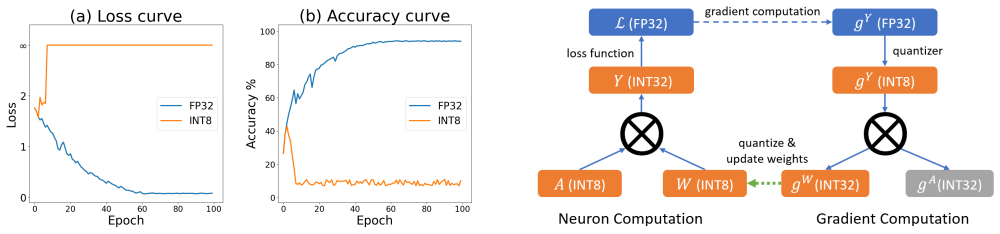
- Layer-by-layer training avoids the accuracy collapse that direct INT8 backpropagation shows as networks deepen, so the method is a candidate for INT8 training on architectures where BP-INT8 fails.
- The look-ahead scheme reduces the epochs needed for convergence, e.g. from 180 to 130 for the two-hidden-layer MLP, and stabilizes ResNet-18 training enough to reach 93.1% accuracy.
- Per mini-batch, FF-INT8 needs roughly 2.6% of the multiply-accumulate operations of backpropagation, which offsets the larger number of epochs it requires.
Reading between the lines
- Editorial inference: if the look-ahead gradient derivation is corrected to include the true chain rule, the scheme would need to store intermediate Jacobians or activations, which would erode part of the memory advantage the paper claims.
- Editorial inference: the comparison runs on a single edge device; on hardware where INT8 multiply-accumulate is not specially accelerated, or where FP32 arithmetic is comparatively cheap, the reported 4.6% time saving and 8.3% energy saving against GDAI8 could shrink or reverse.
- Editorial inference: a natural testable extension is scaling FF-INT8 to ImageNet-class models; if the accuracy gap stays within about one percentage point beyond CIFAR-10-scale networks, the layer-wise quantization-stabilization claim would be substantially strengthened.
Signed reviews
Editorial analysis
A structured set of objections, weighed in public.
Referee Report
Summary. FF-INT8 is a quantized training method that replaces backpropagation with the Forward-Forward (FF) algorithm and uses INT8 arithmetic. The paper claims that layer-wise greedy training stabilizes gradient quantization, and that a proposed 'look-ahead' scheme, which adds later-layer goodness losses to each layer's update, overcomes FF's convergence and accuracy limitations. On a Jetson Orin Nano, the authors report accuracy within 0.4% of FP32 backpropagation and 0.2% above the GDAI8 INT8 baseline, with 4.6% lower training time, 8.3% lower energy, and 27.0% lower memory footprint.
Significance. The empirical setting is appropriate: real edge hardware, multiple architectures, and INT8 engine measurements. If the claims were substantiated, the work would be a meaningful step for low-precision training on resource-constrained devices. However, the paper's central novelty, the look-ahead scheme, rests on an invalid derivative derivation, and the headline memory figure does not follow from the reported data. The contribution cannot be validated without fixing these points.
major comments (4)
- [IV-C, Eq. (3)-(4), Algorithm 1] The derivation of the look-ahead gradient is not correct. For a layer i with weights W_i and a later layer j>i, the goodness G_j = ||y_j||^2 depends on W_i through the composition y_j = f_j(W_j, ... f_{i+1}(W_{i+1}, f_i(W_i, y_{i-1}))...). Therefore ∂L_j/∂W_i cannot be obtained without applying the chain rule through the intermediate layers. The statement that 'the goodness function for each layer depends solely on its neuron values' is true but does not eliminate the dependence of those neuron values on earlier weights; it only shifts the required chain to the neuron activations. As a result, Eq. (4) either requires a backward pass that the paper explicitly claims to avoid, or, if each layer is updated only using ∂L_i/∂W_i, it does not minimize the new loss in Eq. (3). This gap is load-bearing: Figure 6(b) attributes the ResNet-18 improvement from about 60% to 93% accuracy to this scheme, and Table IV's complexity comparison does not include any cross-layer derivative cost. The paper needs either a correct derivation or an explicit statement of the approximation used, plus code or a detailed algorithm to show which is implemented.
- [Abstract and Table V] The claimed 27.0% memory savings relative to GDAI8 is not supported by the table's own numbers. The per-model memory savings in Table V are 22.9% (MLP), 24.5% (MobileNet-V2), 27.0% (EfficientNet-B0), and 23.7% (ResNet-18); the mean is 24.5%, not 27.0%. The 27.0% figure appears to be copied from the EfficientNet-B0 row. Please correct the summary statistic or explain the aggregation method.
- [V-A, Table V] The efficiency results are reported as single measurements without standard deviations, number of independent runs, or a description of how time, energy, and memory were measured (e.g., peak memory vs. allocated tensors, whether CUDA context is included). Since the reported advantages over GDAI8 are small (4.6% time, 8.3% energy), these missing details are important for assessing whether the differences are meaningful on a real embedded device.
- [IV-C, Algorithm 1] The claim that the look-ahead scheme 'maintains the computational efficiency' and keeps the total derivative computations at k×n is not justified. If the loss in Eq. (3) is minimized exactly, the gradients ∂(L_2+...+L_final)/∂W for every early layer either require a backward chain or scale as O(k^2) derivative computations. The paper's complexity table (Table IV) only counts one forward pass and does not account for this, so the per-mini-batch operation counts understate the actual cost of the proposed algorithm.
minor comments (4)
- [V-C, V-D] There are typos: 'hundres' should be 'hundreds' in Section V-C, and 'backpropation' should be 'backpropagation' in Section V-D.
- [IV-C, V-B] The text uses 'residue blocks' instead of the standard term 'residual blocks'; please correct for consistency with the referenced literature.
- [V-A, V-D] The paper does not report the number of epochs used for the runs in Table V, nor does it provide a sensitivity study for the threshold θ and the λ schedule. These hyperparameters are central to the look-ahead method, and their influence on the reported results should be documented.
- [I, II] The introduction claims this is the first work to combine FF with low-precision training, but the related-work section does not discuss other FF-based enhancements or any prior FF quantization studies. A more complete comparison, including at least one vanilla FF baseline in the experiments, would strengthen the claims.
Circularity Check
No significant circularity: FF-INT8's headline quantities are measured against external baselines, and no fitted parameter is repackaged as a prediction.
full rationale
FF-INT8's central quantitative claims (Table V) are direct measurements of accuracy, time, energy, and memory against external baselines (BP-FP32, BP-UI8, BP-GDAI8), not predictions derived from fitted constants. The hyperparameters θ=2.0 and the λ=0 with +0.001/epoch schedule are hand-set and reported as training choices; they are not fitted to the benchmark values and then relabeled as outcomes. The theoretical operation counts in Table IV are an accounting of the stated algorithm operations, not a fitted prediction. The only self-citation, Ref. [5] (Ma and Reda), appears in the introduction as a general pointer on quantization and is not load-bearing. The paper's look-ahead gradient justification in Section IV-C is unsupported—the derivative of a later-layer loss with respect to an earlier weight does require a chain through intermediate activations, despite the claim that 'constructing the backward derivative chain is unnecessary'—but this is a mathematical correctness gap, not a circular reduction: no equation is defined in terms of the result it is meant to establish, and the reported look-ahead gains are empirical rather than consequences of the flawed assertion. Similarly, the abstract's 27.0% memory saving is not the average of the per-model GDAI8 comparisons in Table V (about 24.5%), but that arithmetic inconsistency is also not a circularity. Therefore no circular step is identified and the circularity score is 0.
Assumptions & free parameters
free parameters (3)
- goodness threshold theta =
2.0
- look-ahead coefficient lambda schedule =
0 initially, increased by 0.001 per epoch
- quantization scale factors for symmetric uniform quantization =
data-dependent
assumptions (4)
- ad hoc to paper The gradient of a later layer's goodness loss with respect to an earlier layer's weights can be obtained without backpropagation, because goodness depends only on neuron values.
- domain assumption The Forward-Forward layer-wise greedy training avoids accumulation of INT8 quantization error across layers.
- domain assumption Symmetric uniform quantization with stochastic rounding adequately preserves gradient information for INT8 training.
- standard math INT8 MAC operations with INT32 accumulation on the Jetson Orin Nano behave as expected for the measured workloads.
Cite this review
Pith. "Pith review of FF-INT8: Efficient Forward-Forward DNN Training on Edge Devices with INT8 Precision." pith.science (2026). https://pith.science/paper/4RK2VZLH
@misc{pith2026250622771,
  author       = {Pith},
  title        = {Pith review of: FF-INT8: Efficient Forward-Forward DNN Training on Edge Devices with INT8 Precision},
  year         = {2026},
  howpublished = {\url{https://pith.science/paper/4RK2VZLH}},
  note         = {Machine review of arXiv:2506.22771}
}
read the original abstract
Backpropagation has been the cornerstone of neural network training for decades, yet its inefficiencies in time and energy consumption limit its suitability for resource-constrained edge devices. While low-precision neural network quantization has been extensively researched to speed up model inference, its application in training has been less explored. Recently, the Forward-Forward (FF) algorithm has emerged as a promising alternative to backpropagation, replacing the backward pass with an additional forward pass. By avoiding the need to store intermediate activations for backpropagation, FF can reduce memory footprint, making it well-suited for embedded devices. This paper presents an INT8 quantized training approach that leverages FF's layer-by-layer strategy to stabilize gradient quantization. Furthermore, we propose a novel "look-ahead" scheme to address limitations of FF and improve model accuracy. Experiments conducted on NVIDIA Jetson Orin Nano board demonstrate 4.6% faster training, 8.3% energy savings, and 27.0% reduction in memory usage, while maintaining competitive accuracy compared to the state-of-the-art.
Figures


Figures from the paper (2 more)


Reference graph
Works this paper leans on
-
[1]
Compute trends across three eras of machine learning,
J. Sevilla, L. Heim, A. Ho, T. Besiroglu, M. Hobbhahn, and P. Villalobos, “Compute trends across three eras of machine learning,” in 2022 International Joint Conference on Neural Networks (IJCNN) . IEEE, 2022, pp. 1–8
work page 2022
-
[2]
Y . You, Z. Zhang, C.-J. Hsieh, J. Demmel, and K. Keutzer, “Imagenet training in minutes,” in Proceedings of the 47th international conference on parallel processing , 2018, pp. 1–10
work page 2018
-
[3]
Training language models to follow instructions with human feedback,
L. Ouyang, J. Wu, X. Jiang, D. Almeida, C. Wainwright, P. Mishkin, C. Zhang, S. Agarwal, K. Slama, A. Ray et al. , “Training language models to follow instructions with human feedback,” Advances in neural information processing systems , vol. 35, pp. 27 730–27 744, 2022
2022
-
[4]
A comprehensive survey on tinyml,
Y . Abadade, A. Temouden, H. Bamoumen, N. Benamar, Y . Chtouki, and A. S. Hafid, “A comprehensive survey on tinyml,” IEEE Access, 2023
work page 2023
-
[5]
Wenet: Configurable neural network with dynamic weight-enabling for efficient inference,
J. Ma and S. Reda, “Wenet: Configurable neural network with dynamic weight-enabling for efficient inference,” in 2023 IEEE/ACM Interna- tional Symposium on Low Power Electronics and Design (ISLPED) . IEEE, 2023, pp. 1–6
work page 2023
-
[6]
A survey of quantization methods for efficient neural network infer- ence,
A. Gholami, S. Kim, Z. Dong, Z. Yao, M. W. Mahoney, and K. Keutzer, “A survey of quantization methods for efficient neural network infer- ence,” in Low-Power Computer Vision. Chapman and Hall/CRC, 2022, pp. 291–326
2022
-
[7]
The forward-forward algorithm: Some preliminary investi- gations,
G. Hinton, “The forward-forward algorithm: Some preliminary investi- gations,” arXiv preprint arXiv:2212.13345 , 2022
arXiv 2022
-
[8]
Ptqd: Accurate post-training quantization for diffusion models,
Y . He, L. Liu, J. Liu, W. Wu, H. Zhou, and B. Zhuang, “Ptqd: Accurate post-training quantization for diffusion models,” Advances in Neural Information Processing Systems , vol. 36, 2024
2024
Show all 19 references
-
[9]
Quantization and training of neural networks for efficient integer-arithmetic-only inference,
B. Jacob, S. Kligys, B. Chen, M. Zhu, M. Tang, A. Howard, H. Adam, and D. Kalenichenko, “Quantization and training of neural networks for efficient integer-arithmetic-only inference,” in Proceedings of the IEEE conference on computer vision and pattern recognition, 2018, pp. 2...
2018
-
[10]
Make repvgg greater again: A quantization-aware approach,
X. Chu, L. Li, and B. Zhang, “Make repvgg greater again: A quantization-aware approach,” in Proceedings of the AAAI Conference on Artificial Intelligence , vol. 38, no. 10, 2024, pp. 11 624–11 632
2024
-
[11]
Mixed precision training,
P. Micikevicius, S. Narang, J. Alben, G. Diamos, E. Elsen, D. Garcia, B. Ginsburg, M. Houston, O. Kuchaiev, G. Venkatesh et al. , “Mixed precision training,” in International Conference on Learning Represen- tations, 2018
2018
-
[12]
A block mini- float representation for training deep neural networks,
S. Fox, S. Rasoulinezhad, J. Faraone, P. Leong et al. , “A block mini- float representation for training deep neural networks,” in International Conference on Learning Representations , 2020
2020
-
[13]
Towards unified int8 training for convolutional neural network,
F. Zhu, R. Gong, F. Yu, X. Liu, Y . Wang, Z. Li, X. Yang, and J. Yan, “Towards unified int8 training for convolutional neural network,” in Proceedings of the IEEE/CVF Conference on Computer Vision and Pattern Recognition, 2020, pp. 1969–1979
2020
-
[14]
Distri- bution adaptive int8 quantization for training cnns,
K. Zhao, S. Huang, P. Pan, Y . Li, Y . Zhang, Z. Gu, and Y . Xu, “Distri- bution adaptive int8 quantization for training cnns,” in Proceedings of the AAAI Conference on Artificial Intelligence , vol. 35, no. 4, 2021, pp. 3483–3491
2021
-
[15]
Gradient distribution-aware int8 training for neural networks,
S. Wang and Y . Kang, “Gradient distribution-aware int8 training for neural networks,” Neurocomputing, vol. 541, p. 126269, 2023
2023
-
[16]
Deep learning with limited numerical precision,
S. Gupta, A. Agrawal, K. Gopalakrishnan, and P. Narayanan, “Deep learning with limited numerical precision,” in International conference on machine learning . PMLR, 2015, pp. 1737–1746
2015
-
[17]
Deep residual learning for image recognition,
K. He, X. Zhang, S. Ren, and J. Sun, “Deep residual learning for image recognition,” in Proceedings of the IEEE conference on computer vision and pattern recognition , 2016, pp. 770–778
2016
-
[18]
Mobilenetv2: Inverted residuals and linear bottlenecks,
M. Sandler, A. Howard, M. Zhu, A. Zhmoginov, and L.-C. Chen, “Mobilenetv2: Inverted residuals and linear bottlenecks,” in Proceedings of the IEEE conference on computer vision and pattern recognition , 2018, pp. 4510–4520
2018
-
[19]
Efficientnet: Rethinking model scaling for con- volutional neural networks,
M. Tan and Q. Le, “Efficientnet: Rethinking model scaling for con- volutional neural networks,” in International conference on machine learning. PMLR, 2019, pp. 6105–6114
2019
Reviewed August 6, 2026 · model on record in the stance chip above.
Discussion (0). Continue with ORCID to comment.