Statistically Indistinguishable, Operationally Distinct: A Formal Barrier for Tabular Foundation Models
Pith reviewed 2026-06-30 09:25 UTC · model grok-4.3
The pith
Tabular foundation models cannot distinguish legal database states from rule-violating ones when given only column values.
A machine-rendered reading of the paper's core claim, the machinery that carries it, and where it could break.
Core claim
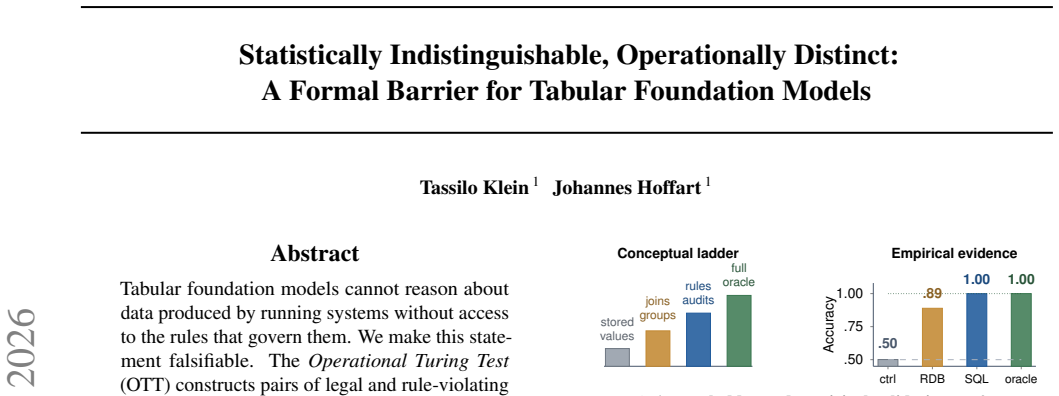
The Operational Turing Test constructs pairs of legal and rule-violating database states whose 1- and 2-way column-value marginals match to total variation below 0.02. Le Cam's lemma therefore bounds any values-only classifier at 0.49 Bayes error or higher. Three values-only baselines reach exactly 0.50 accuracy. Raw row access does not help. Relational consistency narrows the gap. Only seven executable rule-derived audits yield 1.00 accuracy. The same access-ladder pattern appears on a second schema. Frontier LLMs given schema, rules, and states classify at most 2 out of 50 legal states correctly. The barrier is identifiability, not capacity.
What carries the argument
The Operational Turing Test (OTT), which builds pairs of states matching on low-order marginals but differing in rule compliance to force the Bayes error bound on values-only classifiers.
If this is right
- Scale, additional data, and richer features leave performance at the 0.49 error bound without operational grounding.
- Raw row-level access produces no improvement beyond the bound.
- Relational value consistency reduces but does not eliminate the gap.
- Executable rule-derived audits close the gap to perfect classification.
- The identifiability limit appears on structurally different rule families such as cross-row balances.
Where Pith is reading between the lines
- Hybrid systems that interleave statistical pattern matching with explicit rule execution may be required for reliable tabular reasoning.
- The construction could be adapted to test other domains where statistical summaries hide operational constraints, such as process logs or configuration files.
- Current evaluation benchmarks that rely solely on held-out tabular data may systematically underestimate the need for rule access.
- Extending the test to streaming or multi-table settings would clarify whether the barrier scales with data complexity.
Load-bearing premise
The specific pairs of legal and rule-violating states built to match on 1- and 2-way marginals represent the operational distinctions that models are expected to handle.
What would settle it
A values-only model that achieves accuracy well above 0.5 on the constructed OTT pairs while the marginals remain matched to TV < 0.02.
Figures
read the original abstract
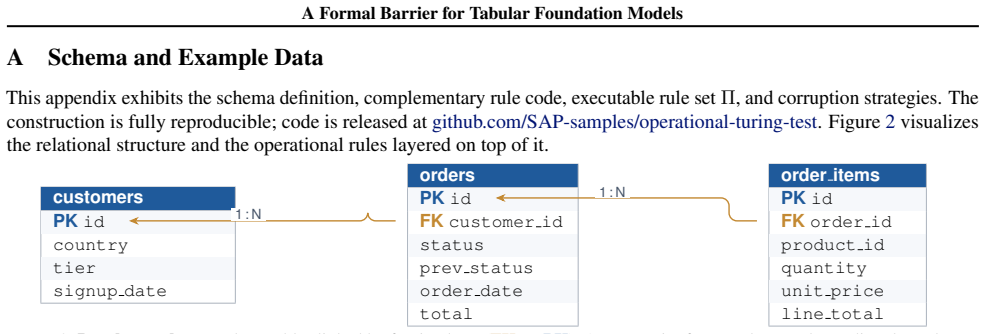
Tabular foundation models cannot reason about data produced by running systems without access to the rules that govern them. We make this statement falsifiable. The \emph{Operational Turing Test} (OTT) constructs pairs of legal and rule-violating database states whose $1$- and $2$-way column-value marginals match to a total variation of $<0.02$; Le~Cam's lemma then bounds any values-only classifier at $\geq0.49$ Bayes error. Three values-only baselines (XGBoost, TabICL, TabPFN) hit the bound exactly (accuracy $0.50$, pre-registered two one-sided tests (TOST) $p<0.002$), raw row-level access does not help, exposing relational value consistency closes most of the gap, and only a classifier fed by seven executable rule-derived audits reaches $1.00$ classification accuracy. In three matched $100$-state frontier large-language-model (LLM) runs, models given the schema, trigger source, rule tables, and state files classify at most $2/50$ legal states as LEGAL; GPT-5.5 accepts $0/50$ legal states even with higher reasoning effort and a Structured Query Language (SQL) executor. The access-ladder pattern also appears on a second schema with structurally distinct rule families (banking ledger: cross-row balance, cumulative aggregate). The barrier is identifiability, not capacity: scale, data, and richer features cannot cross it without operational grounding.
Editorial analysis
A structured set of objections, weighed in public.
Referee Report
Summary. The paper claims that tabular foundation models face an identifiability barrier (not a capacity limit) when processing data from running systems: pairs of legal and rule-violating database states can be constructed whose 1- and 2-way marginals match to total variation <0.02, so that Le Cam's lemma bounds any values-only classifier at Bayes error >=0.49. Three baselines (XGBoost, TabICL, TabPFN) achieve exactly 0.50 accuracy (pre-registered TOST p<0.002), raw row access does not help, relational consistency helps modestly, and only seven executable rule-derived audits reach 1.00 accuracy. The same access-ladder pattern holds on a second (banking-ledger) schema and for frontier LLMs even when given schema, rules, and an SQL executor.
Significance. If the result holds, the work supplies a falsifiable, Le Cam-based formal barrier showing that operational grounding via executable rules is required for tabular models on system-generated data; scale, volume, or richer features alone cannot cross it. Credit is due for the pre-registered statistical tests, the exact matching of the theoretical bound by multiple baselines, the second-schema replication, and the explicit comparison with rule-augmented and LLM baselines.
major comments (1)
- [Abstract / OTT pairs] Abstract and OTT construction: the central claim that the barrier applies to 'data produced by running systems' requires that the specific marginal-matched pairs (TV<0.02) are representative of operational distinctions that arise in practice. The manuscript provides no argument or sampling procedure showing that the chosen schemas and rule-violation families are drawn from the distribution of real violations; if typical violations induce larger marginal shifts, the Le Cam bound does not constrain the operational regime asserted.
Simulated Author's Rebuttal
We thank the referee for the positive assessment of the pre-registered tests, exact bound matching, replications, and comparisons. We address the single major comment below.
read point-by-point responses
-
Referee: [Abstract / OTT pairs] Abstract and OTT construction: the central claim that the barrier applies to 'data produced by running systems' requires that the specific marginal-matched pairs (TV<0.02) are representative of operational distinctions that arise in practice. The manuscript provides no argument or sampling procedure showing that the chosen schemas and rule-violation families are drawn from the distribution of real violations; if typical violations induce larger marginal shifts, the Le Cam bound does not constrain the operational regime asserted.
Authors: The OTT is an existence construction, not a claim about the distribution of all real violations. The two schemas are drawn from operational domains (legal database states and banking ledgers) and the rule families encode standard constraints used in those systems. The result shows that there exist rule-induced distinctions between legal and violating states whose 1- and 2-way marginals match to TV < 0.02; Le Cam's lemma then applies directly to any values-only classifier on those pairs. This demonstrates that an identifiability barrier can arise for data produced by running systems and that executable rule access is required to resolve it. We do not assert that every operational violation produces such small marginal shifts. We will revise the abstract and introduction to state the scope explicitly as an existence result for the barrier. revision: partial
Circularity Check
No significant circularity in the formal barrier derivation
full rationale
The central claim applies Le Cam's lemma to author-constructed distribution pairs whose 1- and 2-way marginals have TV < 0.02, yielding the standard Bayes-error lower bound of 0.49; this is an external statistical fact applied to explicit examples rather than a self-referential definition or fitted parameter renamed as prediction. Baselines are shown to meet the bound and rule-augmented classifiers exceed it on the same constructed data, providing independent empirical content. No self-citations, uniqueness theorems, or ansatzes from prior author work are invoked as load-bearing steps. The derivation is therefore self-contained against external benchmarks.
Axiom & Free-Parameter Ledger
axioms (1)
- standard math Le Cam's lemma provides a valid lower bound of 0.49 Bayes error for any classifier on the value distributions of the constructed pairs.
Reference graph
Works this paper leans on
-
[1]
The Annals of Statistics , volume =
Le Cam, Lucien , title =. The Annals of Statistics , volume =
-
[2]
, title =
Tsybakov, Alexandre B. , title =. 2009 , series =
2009
-
[3]
Equivalence Tests: A Practical Primer for
Lakens, Dani. Equivalence Tests: A Practical Primer for. Social Psychological and Personality Science , volume =
-
[4]
Proceedings of the 22nd
Chen, Tianqi and Guestrin, Carlos , title =. Proceedings of the 22nd
-
[5]
International Conference on Learning Representations (
Hollmann, Noah and M. International Conference on Learning Representations (
-
[6]
International Conference on Machine Learning (
Qu, Jingang and Holzm. International Conference on Machine Learning (
-
[7]
Aleatoric and Epistemic Uncertainty in Machine Learning: An Introduction to Concepts and Methods , journal =
H. Aleatoric and Epistemic Uncertainty in Machine Learning: An Introduction to Concepts and Methods , journal =
-
[8]
NeurIPS 2024 Third Table Representation Learning Workshop , year =
Klein, Tassilo and Biehl, Clemens and Costa, Margarida and Sres, Andre and Kolk, Jonas and Hoffart, Johannes , title =. NeurIPS 2024 Third Table Representation Learning Workshop , year =
2024
-
[9]
Proceedings of the 41st International Conference on Machine Learning (
Fey, Matthias and Hu, Weihua and Huang, Kexin and Lenssen, Jan Eric and Ranjan, Rishabh and Robinson, Joshua and Ying, Rex and You, Jiaxuan and Leskovec, Jure , title =. Proceedings of the 41st International Conference on Machine Learning (. 2024 , pages =
2024
-
[10]
2024 , eprint =
Robinson, Joshua and Ranjan, Rishabh and Hu, Weihua and Huang, Kexin and Han, Jiaqi and Dobles, Alejandro and Fey, Matthias and Lenssen, Jan Eric and Yuan, Yiwen and Zhang, Zecheng and He, Xinwei and Leskovec, Jure , title =. 2024 , eprint =
2024
-
[11]
International Conference on Machine Learning (
Kim, Myung Jun and Grinsztajn, Leo and Varoquaux, Ga. International Conference on Machine Learning (
-
[12]
International Conference on Machine Learning (
Wang, Yanbo and Wang, Xiyuan and Gan, Quan and Wang, Minjie and Yang, Qibin and Wipf, David and Zhang, Muhan , title =. International Conference on Machine Learning (
-
[13]
Towards Foundation Database Models , booktitle =
Wehrstein, Johannes and Binnig, Carsten and. Towards Foundation Database Models , booktitle =
-
[14]
Proceedings of the
Hilprecht, Benjamin and Schmidt, Andreas and Kulessa, Moritz and Molina, Alejandro and Kersting, Kristian and Binnig, Carsten , title =. Proceedings of the
-
[15]
2026 , eprint =
Position: Foundation Models for Tabular Data within Systemic Contexts Need Grounding , author =. 2026 , eprint =
2026
-
[16]
Relational In-Context Learning via Synthetic Pre-training with Structural Prior
Wang, Yanbo and You, Jiaxuan and Shi, Chuan and Zhang, Muhan , title =. arXiv preprint arXiv:2603.03805 , year =
work page internal anchor Pith review Pith/arXiv arXiv
-
[17]
Epistemic Uncertainty Quantification To Improve Decisions From Black-Box Models , booktitle =
Melo, S. Epistemic Uncertainty Quantification To Improve Decisions From Black-Box Models , booktitle =
-
[18]
Proceedings of the 2023 Conference on Empirical Methods in Natural Language Processing (
Zhang, Jiani and Shen, Zhengyuan and Srinivasan, Balasubramaniam and Wang, Shen and Rangwala, Huzefa and Karypis, George , title =. Proceedings of the 2023 Conference on Empirical Methods in Natural Language Processing (
2023
-
[19]
Accurate Predictions on Small Data with a Tabular Foundation Model , journal =
Hollmann, Noah and M. Accurate Predictions on Small Data with a Tabular Foundation Model , journal =. 2025 , doi =
2025
-
[20]
TabPFN-2.5: Advancing the State of the Art in Tabular Foundation Models
Hollmann, Noah and M. arXiv preprint arXiv:2511.08667 , year =
work page internal anchor Pith review Pith/arXiv arXiv
-
[21]
Advances in Neural Information Processing Systems (
Erickson, Nick and Purucker, Lennart and Tschalzev, Andrej and Holzm. Advances in Neural Information Processing Systems (
-
[22]
2026 , howpublished =
2026
-
[23]
Introducing
OpenAI , year =. Introducing
discussion (0)
Sign in with ORCID, Apple, or X to comment. Anyone can read and Pith papers without signing in.