REVIEW 4 major objections 6 minor 53 references
Quantum percolation in quasicrystals using continuous-time quantum walk
T0 review · 4 major / 6 minor · reviewed 2026-08-14 · deepseek-v4-flash
Pith's one-line read Quantum walkers on quasicrystal lattices are trapped at 32–40% edge disconnection, versus 50% on a square lattice.
desk verdict Useful numerical data on CTQW percolation on quasicrystal tilings, but the central claim is confounded by the degree-dependent diagonal term in the Laplacian Hamiltonian. read the letter →
The pith
A machine-rendered reading of the paper's core claim, the machinery that carries it, and where it could break.
The reading
What carries the argument
The engine of the calculation is the graph-Laplacian Hamiltonian $H=\gamma(D-A)$ for the continuous-time quantum walk, where $A$ is the adjacency matrix and $D$ is the diagonal matrix of vertex degrees; the walk evolves as $e^{-iHt}$. On a quasicrystal the diagonal term is not uniform, so the model carries an effective on-site potential that varies from vertex to vertex. The lattices are a fivefold-symmetric Penrose tiling built from fat and thin rhombi and an octagonal Ammann-Beenker tiling built from squares and rhombi. Disorder is introduced by randomly deleting edges, and percolation is scored by whether at least 2% of the probability has left a zone of 40 hopping steps; curves are averaged over 50 random configurations.
What would settle it
Rerun the identical percolation protocol with the graph Laplacian replaced by the adjacency Hamiltonian $H=-\gamma A$, so that no degree-dependent on-site term exists, on the same Penrose and Ammann-Beenker tilings. If the localization signatures and the 32%/40% thresholds persist, the tiling's aperiodic order is doing the work; if they move toward the square-lattice threshold, the degree term is the cause. A second decisive control is a square lattice whose vertices are assigned the same degree sequence as each quasicrystal, which should mimic the effect if degrees alone matter.
Extended reading notes
Core claim
The central claim is that the aperiodic order of quasicrystals, not merely the presence of disorder, suppresses the spread of a continuous-time quantum walk. On Penrose and Ammann-Beenker tilings the walker retains a notable fraction of probability around its initial vertex even when all edges are present, a signature the square lattice does not show. Random edge removal suppresses percolation faster on both quasicrystals than on the square lattice; percolation probability reaches zero after about 32% of edges are removed on Ammann-Beenker lattices, about 40% on Penrose lattices, and only at 50% on square lattices. The authors also report that the choice of starting vertex matters on aperiodic tilings, and that Ammann-Beenker traps the walker slightly more than Penrose. From this they conclude that quasicrystal lattices can hold a quantum state longer than rectangular lattices, which they propose as a route to longer-lived quantum storage.
Load-bearing premise
Everything about the quasicrystal effect rests on comparing the chosen lattices, but the Hamiltonian's diagonal term varies with vertex degree on aperiodic tilings, so the slowdown may come from that built-in quasiperiodic potential rather than from the tiling's long-range order; the paper does not test a periodic lattice with matched degree variations.
Editorial extensions
If this is right
- Quasicrystal lattices can serve as effective traps for a quantum state, with percolation stopping at roughly 32% broken edges on Ammann-Beenker and 40% on Penrose tilings.
- On square lattices the same walker keeps percolating until about half the edges are removed, so quasicrystal geometry, rather than disorder alone, is what accelerates localization.
- The starting vertex matters on aperiodic tilings, so experiments and applications must specify where the walker enters; some points are more trapping than others.
- Among quasicrystals, the Ammann-Beenker tiling localizes the walker more strongly than the Penrose tiling, giving a first ordering of candidate tiling geometries for quantum storage.
- The localization effect persists at nonzero disorder, supporting the idea that quasicrystal lattices could extend the time a quantum state stays available for readout.
Reading between the lines
- An alternative reading of the same numbers is that the degree-dependent diagonal of the graph Laplacian acts as a quasiperiodic on-site potential; repeating the simulations with $H=-\gamma A$ would show how much of the reported 32%/40% thresholds is due to that potential rather than to the tiling itself.
- Because the two quasicrystals differ mainly in their vertex degree statistics, the slightly stronger trapping on Ammann-Beenker could be a degree-distribution effect; comparing with a random lattice that has the same degree distribution would test this without any quasicrystalline order.
- A natural next question is whether the localization survives interactions between walkers or a continuously monitored walk; if it does, quasicrystal arrays become a concrete platform for disorder-resilient quantum memory, though the paper itself does not quantify decoherence times.
Signed reviews
Editorial analysis
A structured set of objections, weighed in public.
Referee Report
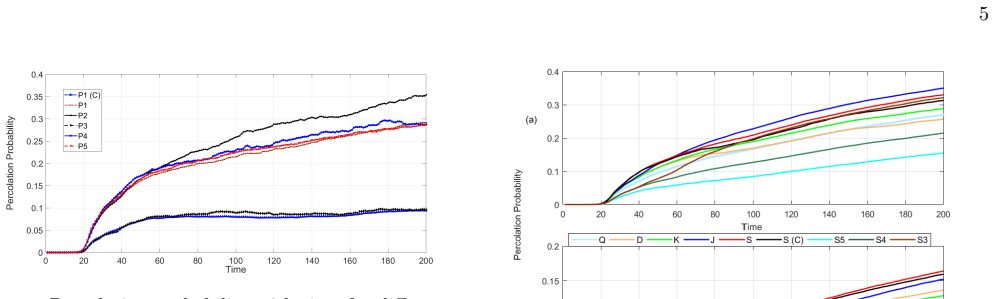
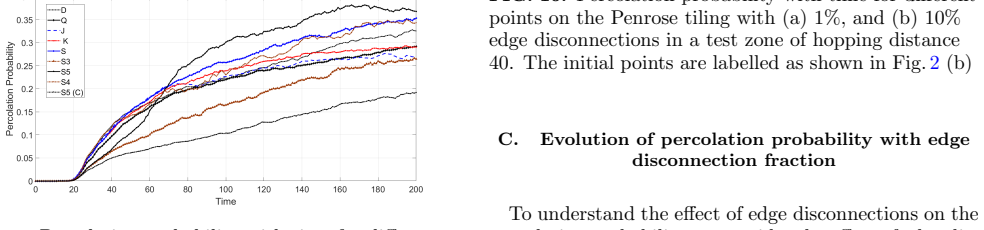
Summary. The paper studies continuous-time quantum walks (CTQW) on two-dimensional quasicrystal tilings (Penrose and Ammann-Beenker) and compares their spreading behavior with that on a square lattice. The dynamics is generated by the graph-Laplacian Hamiltonian H = γ(D − A) of Eq. (4), and disorder is modeled by randomly removing edges. Percolation is defined as the probability that at least 2% of the wavefunction lies outside a hopping zone of length 40. The paper reports that, for a 100×100 square lattice, the percolation probability vanishes after about 50% edge disconnection fraction, while for Ammann-Beenker and Penrose lattices it vanishes after about 32% and 40%, respectively (Figs. 11–13). The authors conclude that the aperiodic nature of quasicrystals slows quantum percolation and that such lattices could be used to store quantum states for longer times.
Significance. If the central conclusion held, the work would be a useful numerical contribution on quantum walks in aperiodic media, potentially relevant for designing lattices with suppressed spreading and extended coherence times. The paper is transparent about its numerical setup, explicitly states the Hamiltonian and the percolation criterion, considers multiple initial positions on each quasicrystal lattice, and compares two different quasicrystal tilings against a square-lattice baseline. These are genuine strengths. However, the central attribution of the observed suppression to aperiodicity is not yet established, because the chosen Hamiltonian introduces a degree-dependent on-site potential that is different on quasicrystals and square lattices, and because the quantitative threshold claims rest on arbitrary definitions and unquantified statistical error. The manuscript would need additional control simulations before the main conclusion can be accepted.
major comments (4)
- [Section II, Eq. (4)] The Hamiltonian H = γ(D − A) is the graph Laplacian. On a square lattice D is a constant multiple of the identity, so H is equivalent to the adjacency Hamiltonian up to a global phase. On the Penrose and Ammann-Beenker tilings the vertex degree takes several distinct values, so the diagonal term γ d_i acts as a deterministic quasiperiodic on-site potential. Such a potential can by itself slow spreading or localize the wavefunction, independently of the aperiodicity of the hopping graph. The paper never compares with the adjacency Hamiltonian H = −A, nor with a Hamiltonian having a constant on-site term, nor with a regular lattice that has the same degree distribution. Consequently, the conclusion in Section IV that the reduced percolation is due to the aperiodic nature of the tilings is not yet supported; a control calculation with the adjacency Hamiltonian is needed before the central claim can be assigned to quasicrystalline geometry.
- [Section II] The percolation criterion is defined as having at least 2% of the total probability outside a hopping zone of length 40. These two numbers are presented without justification, and the quantitative threshold fractions reported in Figs. 11–13 (about 50%, 32%, and 40% for the square, Ammann-Beenker, and Penrose lattices) are tied to these choices. The paper should either show robustness of the thresholds when the 2% probability threshold and the hopping-zone length are varied, or provide a physical argument that fixes these scales; otherwise the specific numeric threshold claims are not robust enough to be the main quantitative result.
- [Section III C, Figs. 12–13] All disorder-averaged results are stated to be averaged over 50 runs, but no error bars, standard deviations, or confidence intervals are provided. It is therefore unclear whether the differences between the three lattices, and the apparent vanishing of percolation at 32% and 40% edge disconnection, are statistically significant rather than consequences of the particular finite sample. The authors should report a measure of spread over runs and over initial positions, and they should define how 'percolation probability vanishes' is determined (for example, the value falling below a specified cutoff) instead of relying only on visual inspection of the plotted curves.
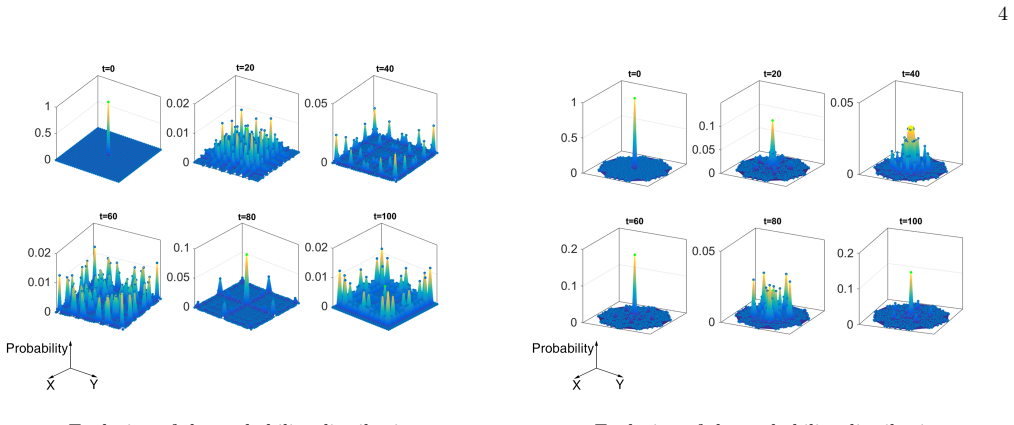
- [Section III] No finite-size analysis is included. The text says the actual calculations used a 41-iteration Ammann-Beenker tiling and a 7-iteration Penrose tiling, whereas the probability-distribution figures (Figs. 4 and 5) are captioned as three- and four-iteration tilings; the square lattice is 100×100. If the percolation thresholds in Figs. 11–13 are compared across the three systems, the linear size and boundary conditions of the three lattices need to be matched, or the dependence of the thresholds on lattice size must be checked. Without this, the differences in threshold fractions could reflect the finite sizes of the tilings rather than the intrinsic lattice geometry.
minor comments (6)
- [Section III C] There is a typo in the text: 'Amman-Beeker' should be 'Ammann-Beenker'.
- [Fig. 13 caption] The caption contains a duplicated phrase: 'edge edge disconnection fraction' should be 'edge disconnection fraction'.
- [Fig. 1 caption] The caption refers to a '15 hopping length percolation test zone', which conflicts with the hopping-zone length of 40 used throughout the text and other figures.
- [Section III, Figs. 4–5] The iteration numbers of the Ammann-Beenker and Penrose tilings in the figure captions (three and four iterations) are inconsistent with the statement in the text that the actual calculations used a 41-iteration Ammann-Beenker tiling and a 7-iteration Penrose tiling; this inconsistency should be resolved.
- [Section III B] The phrase 'the positon of dislocations may be different' should be 'the positions of the disconnections may be different', since the disorder is implemented as removed edges, not as lattice dislocations.
- [References] Reference [4] appears to have a corrupted author name ('B. Bollobs' should be 'B. Bollobás') and reference [52] has a typo in the publisher name ('Freemann' should be 'Freeman').
Circularity Check
No significant circularity: percolation thresholds are genuine outputs of the stated CTQW Hamiltonian and operational definitions, not fitted inputs or self-citation-derived claims.
full rationale
The paper's central comparison is a direct numerical simulation: CTQW dynamics are defined by Eqs. (3)-(4) with H = γ(D−A) and γ=1, and the percolation probability is an operational count of runs in which at least 2% of the probability lies outside a 40-hop zone (Section II). Every parameter is stated up front; none is fitted to the percolation probabilities later reported. The vanishing-disconnection fractions (50%, about 32%, and about 40% for square, Ammann-Beenker, and Penrose lattices) are outputs of that stated model and criterion, not reconstructions of values already used to calibrate the model. The self-citations (e.g., Refs. [14], [15], [35]) are background context on quantum walks and disorder and are not load-bearing for the present results; no uniqueness theorem or ansatz is imported from the authors' prior work. A genuine scientific caveat exists but is not circularity: because H uses the graph Laplacian, the quasicrystal lattices carry a degree-dependent diagonal term that the square lattice lacks, so the attribution of slower percolation to 'aperiodic nature' conflates aperiodic hopping with an on-site coordination potential. The paper also states in Section III B that the square-lattice result 'can be derived analytically' without giving the derivation, but that standard claim is not used to justify the quasicrystal conclusion. These are modeling and presentation concerns, not identities between prediction and input; the reported quantities follow from the stated Hamiltonian rather than by construction. No circular step meeting the quoted-reduction standard was found.
Assumptions & free parameters
free parameters (4)
- percolation probability threshold =
2%
- hopping zone length =
40
- number of disorder runs =
50
- evolution time =
200
assumptions (4)
- domain assumption The graph Laplacian H = γ(D - A) is the appropriate CTQW Hamiltonian for these lattices.
- domain assumption Finite-size quasicrystal patches are representative of infinite quasicrystals.
- standard math The Schrödinger equation governs the evolution and the norm is conserved.
- domain assumption Averaging over 50 independent edge-disconnection realizations with fixed fraction gives a converged estimate of percolation probability.
Cite this review
Pith. "Pith review of Quantum percolation in quasicrystals using continuous-time quantum walk." pith.science (2026). https://pith.science/paper/4RXQ3SYM
@misc{pith2026190803051,
  author       = {Pith},
  title        = {Pith review of: Quantum percolation in quasicrystals using continuous-time quantum walk},
  year         = {2026},
  howpublished = {\url{https://pith.science/paper/4RXQ3SYM}},
  note         = {Machine review of arXiv:1908.03051}
}
read the original abstract
We study the percolation of a quantum particle on quasicrystal lattices and compare it with the square lattice. For our study, we have considered quasicrystal lattices modelled on the pentagonally symmetric Penrose tiling and the octagonally symmetric Ammann-Beenker tiling. The dynamics of the quantum particle is modelled using continuous-time quantum walk (CTQW) formalism. We present a comparison of the behaviour of the CTQW on the two aperiodic quasicrystal lattices and the square lattice when all the vertices are connected and when disorder is introduced in the form of disconnections between the vertices. Unlike on a square lattice, we see a significant fraction of quantum state localised around the origin in quasicrystal lattice. With increase in disorder, the percolation probability of a particle on a quasicrystal lattice decreases significantly faster when compared to the square lattice. This study sheds light on the minimum fraction of disconnections allowed to see percolation of quantum particle on these quasicrystal lattices.
Figures


Figures from the paper (7 more)



Reference graph
Works this paper leans on
-
[1]
Kirkpatrick, S. Percolation and Conduction. Rev. Mod. Phys. 45, 574588 (1973)
work page 1973
-
[2]
Transport and Relaxation in Random Ma- terials [Klafter, J.,Rubin, R
Odagaki, T. Transport and Relaxation in Random Ma- terials [Klafter, J.,Rubin, R. J. & Shlesinger, M. F. (ed.)] (World Scientific, Singapore, 1986)
work page 1986
-
[3]
Stauffer, D. & Aharony, A. Introduction to Percolation Theory (CRC Press, 1994)
work page 1994
-
[4]
B. Bollobs, B. & Riordan, O. Percolation (Cambridge 7 University Press, 2006)
work page 2006
-
[5]
Sahini, M. & Sahimi, M. Applications Of Percolation Theory (CRC Press, 1994)
work page 1994
-
[6]
Kieling, K. & Eisert, J. J. Percolation in Quan- tum Computation and Communication. Quantum and Semi-classical Percolation and Breakdown in Disordered Solids, Lecture Notes in Physics 762, [287319] (Springer, Berlin, 2009)
work page 2009
-
[7]
Anderson, P. W. Absence of Diffusion in Certain Random Lattices. Phys. Rev. 109, 1492 (1958)
work page 1958
-
[8]
Lee, P. A. & Ramakrishnan, T. V. Disordered Electronic Systems. Rev. Mod. Phys. 57, 287 (1985)
work page 1985
Show all 53 references
-
[9]
& Mirlin, A
Evers, F. & Mirlin, A. D. Anderson Transitions. Rev. Mod. Phys. 80, 1355 (2008)
2008
-
[10]
W., Licciardello, D
Abrahams, E., Anderson, P. W., Licciardello, D. C. & Ramakrishnan, T. V. Scaling Theory of Localization: Absence of Quantum Diffusion in Two Dimensions. Phys. Rev. Lett. 42, 673 (1979)
1979
-
[11]
& Segev, M
Schwartz, T., Bartal, G., Fishman, S. & Segev, M. Transport and Anderson localization in disordered two- dimensional photonic lattices. Nature 446, 5255 (2007)
2007
-
[12]
Chab´ e, J. et al. Experimental Observation of the An- derson Metal-Insulator Transition with Atomic Matter Waves. Phys. Rev. Lett. 101, 255702 (2008)
2008
-
[13]
Crespi, A. et al. Anderson localization of entangled pho- tons in an integrated quantum walk. Nature Photonics 7, 322328 (2013)
2013
-
[14]
M., & Busch, Th., Quantum percola- tion and transition point of a directed discrete-time quan- tum walk, Scientific Reports 4, 6583 (2014)
Chandrashekar, C. M., & Busch, Th., Quantum percola- tion and transition point of a directed discrete-time quan- tum walk, Scientific Reports 4, 6583 (2014)
2014
-
[15]
M., Melville, S., & Busch, Th., Single photons in an imperfect array of beam-splitters: Inter- play between percolation, backscattering and transient localization, J
Chandrashekar, C. M., Melville, S., & Busch, Th., Single photons in an imperfect array of beam-splitters: Inter- play between percolation, backscattering and transient localization, J. Phys. B: At. Mol. Opt. Phys. 47, 085502 (2014)
2014
-
[16]
& Eggarter, T
Kirkpatrick, S. & Eggarter, T. P. Localized States of a Binary Alloy. Phys. Rev. B 6, 3598 (1972)
1972
-
[17]
& Brooks Harris, A
Shapir, Y., Aharony, A. & Brooks Harris, A. Localiza- tion and Quantum Percolation. Phys. Rev. Lett. 49, 486 (1982)
1982
-
[18]
& Saha, T
Mookerjee, A., Dasgupta, I. & Saha, T. Quantum Perco- lation. Int. J. Mod. Phys. B 09, 2989 (1995)
1995
-
[19]
& W¨ olfle, P
Vollhardt, D. & W¨ olfle, P. Self-consistent theory of An- derson localization. Electronic Phase Transitions [Hanke, W. & Kopaev, Yu. V. (ed.)] 178. (North Holland, Ams- terdam, 1992)
1992
-
[20]
Quantum and Semi-classical Percolation and Breakdown in Disordered Solids, Lecture Notes in Physics 762, (Springer, Berlin, 2009)
2009
-
[21]
& Fehske, H
Schubert, G. & Fehske, H. [Quantum Percolation in Dis- ordered Structures]. Quantum and Semi-classical Per- colation and Breakdown in Disordered Solids, Lecture Notes in Physics 762, [135163] (Springer, Berlin, 2009)
2009
-
[22]
Riazanov, G. V.. The Feynman path integral for the Dirac equation. Zh. Eksp. Teor. Fiz. 33, 1437 (1958), [Sov. Phys. JETP 6, 1107, 1113 (1958)]
1958
-
[23]
Feynman, R. P. Quantum mechanical computers. Found. Phys. 16, 507-531 (1986)
1986
-
[24]
Quantum random walks
Aharonov, Y., Davidovich, L., & Zagury, N. Quantum random walks. Phys. Rev. A 48, 1687-1690 (1993)
1993
-
[25]
Mayer, D. A. From quantum cellular automata to quan- tum lattice gases. J. Stat. Phys 85, 551 (1996)
1996
-
[26]
Quantum computation and decision trees
Farhi, E., & Gutmann, S. Quantum computation and decision trees. Phys. Rev. A 58, 915 (1998)
1998
-
[27]
Kempe, J., Quantum random walks: an introductory overview. Contemp. Phys 44.4, 307-327, (2003)
2003
-
[28]
Inui, N., Konno, N., & Segawa, E., One-dimensional three-state quantum walk. Phys. Rev. E 72, 056112 (2005)
2005
-
[29]
E., & Evangelou, S
Yin, Y., Katsanos, D. E., & Evangelou, S. N., Quantum walks on a random environment. Phys. Rev. A77 022302 (2008)
2008
-
[30]
S., Quantum walks: a comprehen- sive review
Venegas- Andraca, E. S., Quantum walks: a comprehen- sive review. Quantum. Info. Process 11, 1015 (2012)
2012
-
[31]
arXiv:quant-ph/0010117
Nayak, A., & Vishwanath, A., Quantum Walk on the Line. arXiv:quant-ph/0010117
-
[32]
A quantum random-walk model for tunneling diffusion in a 1D lattice
Godoy, S., & Fujita S. A quantum random-walk model for tunneling diffusion in a 1D lattice. A quantum correction to Ficks law. J. Chem. Phys. 97 5148 (1992)
1992
-
[33]
Environment-assisted quantum walks in pho- tosynthetic energy transfer
Mohseni, M., Rebentrost, P., Lloyd, S., & Aspuru- Guzik, A. Environment-assisted quantum walks in pho- tosynthetic energy transfer. J. Chem. Phys. 129 174106 (2008)
2008
-
[34]
Kitagawa, T., Rudner, M., Berg, E., & Demler, E., Exploring topological phases with quantum walk. Phys. Rev.A 82 033429 (2010)
2010
-
[35]
Chandrashekar, C. M. Disordered-quantum-walk- induced localization of a Bose-Einstein condensate. Phys. Rev. A, 83, 022320 (2011)
2011
-
[36]
Chandrashekar, C. M. Two-component Dirac-like Hamil- tonian for generating quantum walk on one-, two- and three-dimensional lattices. Scientific Reports 3, 2829(2013)
2013
-
[37]
& Chandrashekar, C
Mallick, A., Mandal, S. & Chandrashekar, C. M., Neu- trino oscillations in discrete-time quantum walk frame- work, The European Physical Journal C 77 (2), 85 (2017)
2017
-
[38]
Dynamical localization for d-dimensional ran- dom quantum walks
Joye, A. Dynamical localization for d-dimensional ran- dom quantum walks. Quantum Inf. Process. 11, 1251 (2012)
2012
-
[39]
Chandrashekar, C. M. Disorder induced localisation and enhancement of entanglement in 1D- and 2D quantum walk. arXiv:1212.5984v2 (2013)
2013 arXiv
-
[40]
The initial points are labelled as shown in Fig. 2 (b) C. Evolution of percolation probability with edge disconnection fraction To understand the effect of edge disconnections on the percolation probability we consider the effect of edge dis- connections on the percolation proba...
2014
-
[41]
M., Obuse, H., Busch, Th
Chandrashekar, C. M., Obuse, H., Busch, Th. Entangle- ment Properties of Localized States in 1D Topological Quantum Walks. arXiv:1502.00436v2 (2015)
2015 arXiv
-
[42]
A Metallic Phase with Long Ranged Orientational Order and Bro- ken Translational Symmetry
Shechtman, D., Bleeh, I., Gratias, D., et al. A Metallic Phase with Long Ranged Orientational Order and Bro- ken Translational Symmetry. Phys. Rev. Lett. 53(20), 1951-1954 (1984)
1984
-
[43]
Quasicrystals: A Primer
Janot, C. Quasicrystals: A Primer. Clarendon, Oxford (1994)
1994
-
[44]
Quasicrystals and Geometry
Senechal, M. Quasicrystals and Geometry. Cambridge University Press, Cambridge, England (1995)
1995
-
[45]
Twenty years of structure research on qua- sicrystals
Steurer, W. Twenty years of structure research on qua- sicrystals. Part I. Pentagonal, octagonal, decagonal and dodecagonal quasicrystals. Z. Kristallogr. Cryst. Mater. 219, 391 (2004)
2004
-
[46]
Barber, E. M. Aperiodic Structures in Condensed Mat- ter: Fundamentals and Applications, Condensed Matter Physics, CRC Press, Boca Raton, London (2009)
2009
-
[47]
& Grimm, U., Aperiodic Order Vol
A Mathematical Invitation, edited by Baake, M. & Grimm, U., Aperiodic Order Vol. 1. Cambridge Univer- sity Press, Cambridge, England, (2013)
2013
-
[48]
Quasicrystals: What do we know? What do we want to know? What can we know? Acta Crystallogr
Steurer, W. Quasicrystals: What do we know? What do we want to know? What can we know? Acta Crystallogr. Sect. A 74, 1 (2018)
2018
-
[49]
The role of aesthetics in pure and applied 8 mathematical research
Penrose, R. The role of aesthetics in pure and applied 8 mathematical research. Bulletin of the Institute of Math- ematics and its Applications. 10(2) 266271 (1974)
1974
-
[50]
E., Lahini, Y., Ringel, Z., Verbin, M
Kraus, Y. E., Lahini, Y., Ringel, Z., Verbin, M. & Zilber- berg, O. Topological Equivalence between the Fibonacci Quasicrystal and the Harper Model. Phys. Rev. Lett. 109, 116404 (2012)
2012
-
[51]
E., Ringel, Z
Kraus, Y. E., Ringel, Z. & Zilberberg, O. Four- Dimensional Quantum Hall Effect in a Two-Dimensional Quasicrystal. Phys. Rev. Lett. 111, 226401 (2013)
2013
-
[52]
& Duneau, M
Jagannathan, A. & Duneau, M. An eightfold optical qua- sicrystal with cold atoms, Europhys. Lett. 104, 66003 (2013)
2013
-
[53]
Freemann, NY (1986)
Gr¨ unbaum, B., & Shephard, G.C., Tilings and Patterns. Freemann, NY (1986). 9 Appendix A In this section, we have collated results from the fig- ures shown in the rest of the paper to make it easy to make a direct comparison between the values for differ- ent lattices. From the...
1986
Reviewed August 14, 2026 · model on record in the stance chip above.
Discussion (0). Continue with ORCID to comment.