REVIEW 3 major objections 5 minor 69 references
Without fine-tuning, a fixed multi-hop pattern-retrieval pipeline, MARS, achieves state-of-the-art KGQA on Wikidata benchmarks, beating an agentic baseline on QALD-10 and LC-QuAD2.0.
Reviewed by Pith at T0; open to challenge. T0 means a machine referee read the full paper against a public rubric. the ladder, T0–T4 →
T0 review · deepseek-v4-flash
2026-08-02 01:43 UTC pith:4TGS3JHW
load-bearing objection Solid empirical KGQA paper with honest error analysis and a valuable data release; the SOTA claim hinges on an unvalidated LLM swap in the strongest baseline. the 3 major comments →
MARS: Multi-hop Adaptive Retrieval and SPARQL Generation for KGQA
The pith
A machine-rendered reading of the paper's core claim, the machinery that carries it, and where it could break.
Core claim
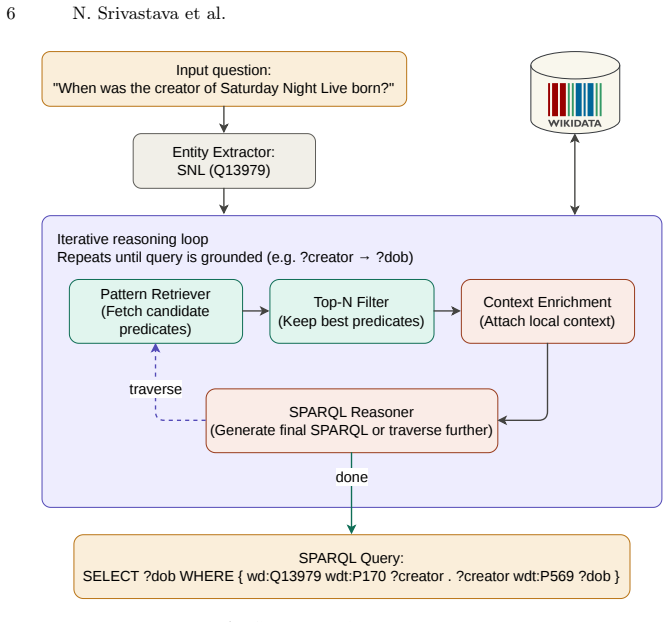
On its own terms, the central discovery is that a fixed, non-agentic pipeline achieves state-of-the-art KGQA without any model fine-tuning. MARS links the question's entities, verbalizes the candidate triple patterns touching them, ranks those patterns by dot-product similarity against the question embedding, and hands the top-N patterns—enriched with instance counts, sample labels, and predicate domain/range—to an LLM. The LLM either writes the final SPARQL query or selects patterns whose entities seed the next hop, repeating until the query is grounded or a hop limit is reached; a verification pass then checks the query. Across three Wikidata benchmarks, MARS posts the best Macro F1 on QAL
What carries the argument
The load-bearing mechanism is the iterative top-N pattern retrieval loop. Patterns are SPARQL triple patterns of the form (entity, predicate, ?var) or (?var, predicate, entity); each is verbalized into text and ranked by the dot product of its embedding with the question embedding. The top-N are enriched with the instance count, up to i concrete instance labels, and the predicate's domain and range classes, then given to an LLM 'SPARQL Reasoner.' The reasoner either emits a grounded SPARQL query or selects a subset of patterns whose entities become the seeds of the next retrieval round. This makes retrieval depth adaptive—the model decides how many hops it needs—while keeping the procedure d
Load-bearing premise
MARS can only produce a correct query if the relation it needs appears in the small set of top-ranked patterns at each step, and that ranking is done by text-similarity scores and tuned on the training set with manually supplied correct entities; for translated low-resource-language questions, nothing guarantees the needed relation makes the cut.
What would settle it
A reader could settle the central claim by rerunning MARS on QALD-10's 382 test questions with the system's own entity linker instead of gold entities and checking whether the English Macro F1 stays above the agentic baseline's 62.29; in parallel, count how often the exact relation from the reference answer appears in the top-20 pattern list per question. A predicate-recall rate well below 80% or an F1 that drops under the baseline would show the reported state-of-the-art scores depend on oracle entities and a favorable ranking.
If this is right
- If MARS's results hold, fixed planning-oriented pipelines can beat tool-using LLM agents on complex multi-hop KGQA, suggesting agentic loop designs pay a reliability cost that structured retrieval avoids.
- Fine-tuning on Question–SPARQL pairs becomes unnecessary for strong KGQA: a no-fine-tune pipeline with open-weight models reaches or exceeds fine-tuned systems, lowering the compute and data barrier.
- Releasing the exact Wikidata snapshot alongside updated datasets addresses benchmark-KG version drift, making future KGQA comparisons reproducible rather than undermined by missing triples.
- A verification pass—a second LLM read of the generated query—buys roughly 5 points of macro-F1, marking self-correction of SPARQL as a cheap, high-yield component.
- Keeping the native-language question next to a translation improves multilingual coverage; MARS's largest margins over the agentic baseline come on low-resource languages.
Where Pith is reading between the lines
- Editorial inference: the pattern-ranking bottleneck is whether the gold SPARQL predicate appears in the top-N list; on low-resource languages, where lexical overlap with the English-trained embedding index is weaker, per-language predicate recall at top-20 is the crux, and a testable extension would measure it and correlate it with F1.
- Editorial inference: the paper's own error catalogue (truncated result caps, missing COUNT/ASK projections, abstention on 'what year' questions) points to output-side repair—rule-based projection fixing after LLM generation—as the next cheap win, rather than deeper retrieval.
- Editorial inference: nothing in the mechanism is Wikidata-specific; if the pattern-retrieval recipe transfers to other knowledge graphs such as DBpedia or Freebase, it would give a graph-agnostic, no-training KGQA recipe, which the paper leaves as future work.
- Editorial inference: the ablation's finding that topn=100/mhop=1 achieves the highest train F1 but was abandoned for token cost suggests the useful trade-off surface is F1 versus tokens per query; publishing the Pareto frontier of that trade-off would let practitioners choose their own operating point.
Editorial analysis
A structured set of objections, weighed in public.
Referee Report
Summary. The paper proposes MARS, a three-stage multilingual KGQA pipeline that extracts entities, retrieves and filters top-N verbalized triple patterns, and iteratively asks an open-weight LLM to either generate a SPARQL query or select patterns for the next hop. The approach requires no fine-tuning. The authors evaluate on LC-QuAD2.0, QALD-9-plus, and QALD-10 across 10 languages, comparing against DeepPavlov, MST5, UniQ-Gen, and GRASP, and report macro F1. The central claim is that MARS achieves state-of-the-art performance without fine-tuning, in particular beating GRASP on all four QALD-10 languages and on LC-QuAD2.0, and splitting per-language wins on QALD-9-plus. The paper also contributes a released Wikidata snapshot, code, and a re-run of all baselines under a common answer-set protocol.
Significance. If the empirical claims hold, the paper makes a useful and credible contribution: a deterministic, pattern-guided retrieval loop that constrains LLM context and is more reproducible and cheaper than open-ended agentic tool use. The reproducibility package (code, Wikidata snapshot, Tentris deployment, re-run baselines) and the SSG sanity check that isolates the pipeline contribution are concrete strengths. The comparison against GRASP is the load-bearing element for the headline claim, and it is currently weakened by a baseline re-implementation that substitutes the base LLM; this is a correctness risk that must be addressed before the results can be taken at face value.
major comments (3)
- [§4.3, Table 2] The GRASP baseline is re-run with GPT-OSS instead of the GPT-4.1 used in the original GRASP paper. Since GRASP is identified as "the current state-of-the-art" and the paper's headline claim is that MARS outperforms it, this substitution is load-bearing. The cited general-benchmark comparison does not establish that the two models behave equivalently on the specific agentic KGQA workload; tool-selection and iterative SPARQL-execution agents can be substantially more sensitive to the base LLM's instruction-following and code-generation ability than MARS's constrained pattern-retrieval loop. Without a control -- e.g., GRASP with GPT-4.1, or MARS with GPT-4.1, or at minimum a seed/LLM variance analysis for GRASP+GPT-OSS -- the claim "outperforms GRASP in 8 of 14" and the §5.1 conclusion that a fixed pipeline beats a tool-using agent are not adequately supported.
- [§6.1, §6.5, Table 4] The final configuration (topn=20, mhop=10, all features) is selected using the QALD-10 train set with gold entities supplied during generation. The ablation shows topn=100/mhop=1 gives higher train F1 (72.10 vs 67.92), and the authors justify topn=20 by inference cost and expected multilingual robustness. This is a plausible model-selection choice, but the paper does not demonstrate that this configuration transfers to the test setting where entities come from MARS's own extractor rather than from gold queries. The Phase-2 finding that aug and cls individually hurt but are kept because of anticipated cross-lingual benefits further underscores that the final choice is a judgement call that can change the reported headline numbers. I ask for a sensitivity analysis on the test set (or at least reporting the two competing configurations' test F1) and for the gold-entity versus pipeline-entit
- [§5.1, Table 2] Several per-language results rest on very small test sets. In QALD-9-plus, French has 23 and Armenian 18 test questions (as the paper itself notes); the 60-point F1 gaps over GRASP on these languages could be driven by a handful of correct answers. The paper nonetheless uses the "8 of 14" head-to-head count and the statement that MARS "adapts to high- and low-resource languages" as evidence of overall superiority. Macro F1 at this sample size is highly variable, and no error bars, confidence intervals, or seed/runs are reported anywhere in the evaluation. I request bootstrap confidence intervals per language or multi-run variance for at least the MARS/GRASP comparison; without this, the QALD-9-plus conclusions are not statistically grounded.
minor comments (5)
- [Abstract vs §1] The abstract says MARS achieves "competitive performance relative to state-of-the-art methods," while §1 claims it "achieves state-of-the-art performance." These should be aligned, especially since the headline claim depends on the stronger formulation.
- [§3.4, Eq. (4)] The symbol P is used both for the set of predicates (Section 3.1) and for the set of retrieved patterns (Eq. 4). This is confusing; consider using R or Pat for pattern sets.
- [§5.2] The error-analysis paragraph states "Of the 99 answered questions in QALD-9-plus, 60 are correct; for QALD-10, 202 of 289." Please clarify the denominators relative to the filtered test sizes (127 and 382) and why some questions are unanswered.
- [Footnote 7] The footnote citing a general-benchmark comparison via artificialanalysis.ai is not a stable scholarly reference. Provide a versioned URL, date of access, and the specific benchmark numbers used to justify the GPT-OSS/GPT-4.1 substitution.
- [§6.1, Table 4] Phase 1b reports topn=500 as the top grid cell, but Eq. (7) has no upper bound and the authors note this exceeds the context window once features are added. Please state the maximum usable topn for each configuration and how the 500 value was made tractable.
Circularity Check
No significant circularity: MARS's derivation is self-contained; empirical comparisons use re-run baselines, and the SSG control isolates the pipeline's contribution beyond the LLM.
full rationale
I walked the derivation chain from the task definition (Eqs. 1-2) through entity linking (Eq. 3), pattern retrieval and filtering (Eqs. 4-7), context enrichment (Eqs. 8-9), and iterative SPARQL generation (Eqs. 10-11). Each stage is defined on the KG and the question text, and no output quantity is reintroduced as an input. The generated SPARQL is not accepted by construction: it is executed against a Wikidata snapshot and scored with GERBIL-QA against external reference answers. The central empirical claims are supported by re-running baselines under the same protocol (Section 7: 'we re-run every baseline through the same answer-set protocol rather than quoting numbers from respective papers') and by an explicit pipeline-vs-LLM control (Section 6.5: SSG, 'which asks GPT-OSS to generate SPARQL directly from the same entity and relation links,' reaches 52.34 vs. 67.92 for MARS), which isolates the pipeline's contribution. Hyperparameter selection (topn, mhop) on the QALD-10 train set with gold entities is standard model selection, not fitting-to-prediction: test evaluations use the entity-linking pipeline rather than gold entities. The paper's self-citations (e.g., [47], [57], [58], [59]) provide prior components or baselines but none is invoked as an unexamined theorem on which the result depends. I also examined the Section 4.3 baseline substitution, where GRASP is re-run with GPT-OSS instead of GPT-4.1, justified only by 'broadly comparable performance on general benchmarks.' That is an external-validity threat, not circularity: even if the comparison is unsupported, MARS's score is still measured against a re-run baseline and is not equivalent to its inputs. The self-reported limitations in Section 7 (F1 comparability, KG-version drift, high-degree nodes, benchmark coverage) are scope caveats, not evidence that a prediction is constructed from its target. No circular step meeting the quoted-reduction standard was found.
Axiom & Free-Parameter Ledger
free parameters (5)
- topn =
20 (final; swept 5–500 on QALD-10 train)
- mhop =
10 (final; swept 1–50)
- i =
10
- result_cap =
1,000
- embedding model =
sparse MoE text embedding, d=768 [35]
axioms (6)
- domain assumption The KG provides rdfs:label, rdfs:domain, and rdfs:range for every term.
- domain assumption Dot-product similarity between question text and verbalized predicates ranks the question-relevant predicates into the top-N.
- domain assumption The LLM reasoner (GPT-OSS) can decide correctly whether it has enough context and can generate valid SPARQL.
- domain assumption GRASP-based entity linking, augmented by translation, returns correct entities across languages.
- domain assumption Tentris can serve joins over an ≈11B-triple Wikidata snapshot fast enough for pattern retrieval.
- domain assumption The filtered test subsets (4624/6000, 127/136, 382/394) are representative of the full benchmarks.
Cite this review
Pith. "Pith review of MARS: Multi-hop Adaptive Retrieval and SPARQL Generation for KGQA." pith.science (2026). https://pith.science/paper/4TGS3JHW
@misc{pith2026260714561,
  author       = {Pith},
  title        = {Pith review of: MARS: Multi-hop Adaptive Retrieval and SPARQL Generation for KGQA},
  year         = {2026},
  howpublished = {\url{https://pith.science/paper/4TGS3JHW}},
  note         = {Machine review of arXiv:2607.14561}
}
read the original abstract
Large language models (LLMs) have demonstrated strong reasoning performance, but their tendency to hallucinate limits their reliability in knowledge-intensive tasks requiring up-to-date and grounded information. Combining knowledge graphs (KGs) with LLMs facilitates the use of explicit symbolic knowledge that can be continuously updated without costly fine-tuning, while benefiting from rapidly advancing LLM reasoning. We propose MARS, a scalable knowledge graph question answering (KGQA) approach that requires no model fine-tuning. Rather than relying on open-ended agentic exploration, MARS performs a structured retrieval procedure that links question entities to the KG and iteratively retrieves relevant next-hop information. At each step, MARS decides whether to continue graph traversal or to generate the final SPARQL query, allowing the model to adapt the retrieval depth to the question while keeping the overall pipeline more predictable than fully agentic approaches. We evaluate MARS on three established KGQA benchmarks across several LLMs and settings, including multilingual evaluation, and provide insights through ablation studies and error analysis. Our approach achieves competitive performance relative to state-of-the-art methods while remaining efficient and scalable. The evaluation results, code and resources are publicly available: https://github.com/dice-group/mars-kgqa.
Figures
Reference graph
Works this paper leans on
-
[1]
Claude-3 Model Card (2024),https://api.semanticscholar.org/CorpusID:268232499
Anthropic, A.: The claude 3 model family: Opus, sonnet, haiku. Claude-3 Model Card (2024),https://api.semanticscholar.org/CorpusID:268232499
2024
-
[2]
In: Proceedings of the 6th International The Semantic Web and 2nd Asian Conference on Asian Semantic Web Conference
Auer, S., Bizer, C., Kobilarov, G., Lehmann, J., Cyganiak, R., Ives, Z.: Dbpedia: a nucleus for a web of open data. In: Proceedings of the 6th International The Semantic Web and 2nd Asian Conference on Asian Semantic Web Conference. p. 722–735. ISWC’07/ASWC’07, Springer-Verlag, Berlin, Heidelberg (2007)
2007
-
[3]
In: Rogers, A., Boyd-Graber, J., Okazaki, N
Baek, J., Aji, A.F., Lehmann, J., Hwang, S.J.: Direct fact retrieval from knowledge graphs without entity linking. In: Rogers, A., Boyd-Graber, J., Okazaki, N. (eds.) Proceedings of the 61st Annual Meeting of the Association for Computational Linguistics (Volume 1: Long Papers). pp. 10038–10055. Association for Computa- tional Linguistics, Toronto, Canada...
doi:10.18653/v1/ 2023
-
[4]
In: Hruschka, E., Mitchell, T., Rahman, S., Mladenić, D., Grobelnik, M
Baek, J., Aji, A.F., Saffari, A.: Knowledge-augmented language model prompting for zero-shot knowledge graph question answering. In: Hruschka, E., Mitchell, T., Rahman, S., Mladenić, D., Grobelnik, M. (eds.) Proceedings of the First Workshop on Matching From Unstructured and Structured Data (MATCHING 2023). pp. 70–
2023
-
[5]
In: Pan, J.Z., Tamma, V., d’Amato, C., Janowicz, K., Fu, B., Polleres, A., Seneviratne, O., Kagal, L
Bigerl, A., Conrads, F., Behning, C., Sherif, M.A., Saleem, M., Ngonga Ngomo, A.C.: Tentris – a tensor-based triple store. In: Pan, J.Z., Tamma, V., d’Amato, C., Janowicz, K., Fu, B., Polleres, A., Seneviratne, O., Kagal, L. (eds.) The Semantic Web – ISWC 2020. pp. 56–73. Springer International Publishing, Cham (2020) MARS: Multi-hop Adaptive Retrieval an...
2020
-
[6]
In: Liu, F., Solorio, T
Burtsev, M., Seliverstov, A., Airapetyan, R., Arkhipov, M., Baymurzina, D., Bushkov, N., Gureenkova, O., Khakhulin, T., Kuratov, Y., Kuznetsov, D., Litinsky, A., Logacheva, V., Lymar, A., Malykh, V., Petrov, M., Polulyakh, V., Pugachev, L., Sorokin, A., Vikhreva, M., Zaynutdinov, M.: DeepPavlov: Open-source library for dialogue systems. In: Liu, F., Solor...
2018
-
[7]
Comanici, G., Bieber, E., Schaekermann, M., Pasupat, I., Sachdeva, N., Dhillon, I., Blistein, M., Ram, O., Zhang, D., Rosen, E., Marris, L., Petulla, S., Gaffney, C., Aharoni, A., Lintz, N., Pais, T.C., Jacobsson, H., Szpektor, I., Jiang, N.J., Haridasan, K., Omran, A., Saunshi, N., Bahri, D., Mishra, G., Chu, E., Boyd, T., Hekman, B., Parisi, A., Zhang, ...
Pith/arXiv arXiv 2025
-
[8]
In: Shi, W., Yu, W., Asai, A., Jiang, M., Durrett, G., Hajishirzi, H., Zettlemoyer, L
D’Abramo, J., Zugarini, A., Torroni, P.: Investigating large language models for text-to-SPARQL generation. In: Shi, W., Yu, W., Asai, A., Jiang, M., Durrett, G., Hajishirzi, H., Zettlemoyer, L. (eds.) Proceedings of the 4th International Workshop on Knowledge-Augmented Methods for Natural Language Processing. pp. 66–80. Association for Computational Ling...
-
[9]
Dasgupta, I., Lampinen, A.K., Chan, S.C.Y., Sheahan, H.R., Creswell, A., Ku- maran, D., McClelland, J.L., Hill, F.: Language models show human-like content effects on reasoning tasks (2024),https://arxiv.org/abs/2207.07051
Pith/arXiv arXiv 2024
-
[10]
DeepSeek-AI, Guo, D., Yang, D., Zhang, H., Song, J., Zhang, R., Xu, R., Zhu, Q., Ma, S., Wang, P., Bi, X., Zhang, X., Yu, X., Wu, Y., Wu, Z.F., Gou, Z., Shao, Z., Li, Z., Gao, Z., Liu, A., Xue, B., Wang, B., Wu, B., Feng, B., Lu, C., Zhao, C., Deng, C., Zhang, C., Ruan, C., Dai, D., Chen, D., Ji, D., Li, E., Lin, F., Dai, F., Luo, F., Hao, G., Chen, G., L...
Pith/arXiv arXiv 2025
-
[11]
Dubey, M., Banerjee, D., Abdelkawi, A., Lehmann, J.: Lc-quad 2.0: A large dataset forcomplexquestionansweringoverwikidataanddbpedia.In:TheSemanticWeb– ISWC2019:18thInternationalSemanticWebConference,Auckland,NewZealand, October 26–30, 2019, Proceedings, Part II. p. 69–78. Springer-Verlag, Berlin, Hei- delberg (2019).https://doi.org/10.1007/978-3-030-30796...
-
[12]
In: Alharbi, R., de Berardinis, J., Groth, P., Meroño-Peñuela, A., Simperl, E., Tamma, V
Emonet, V., Bolleman, J.T., Duvaud, S., de Farias, T.M., Sima, A.C.: Llm-based SPARQL query generation from natural language over federated knowledge graphs. In: Alharbi, R., de Berardinis, J., Groth, P., Meroño-Peñuela, A., Simperl, E., Tamma, V. (eds.) Proceedings of the Special Session on Harmonising Generative AI and Semantic Web Technologies (HGAIS 2...
2024
-
[13]
Fu, C., Wang, G., Lu, R., Tang, S.: Global discovery: A global graph-rag ap- proach for query-focused multimodal summarization across multiple pdf papers. 18 N. Srivastava et al. In: Knowledge Science, Engineering and Management: 18th International Con- ference, KSEM 2025, Macao, China, August 4–7, 2025, Proceedings, Part V. p. 1–8. Springer-Verlag, Berli...
-
[14]
In: Verma, H., Bozzon, A., Mauri, A., Yang, J
Gashkov, A., Perevalov, A., Eltsova, M., Both, A.: SPARQL query generation with llms: Measuring the impact of training data memorization and knowledge injection. In: Verma, H., Bozzon, A., Mauri, A., Yang, J. (eds.) Web Engineering. pp. 177–
-
[15]
In: Proceedings of the 25th ACM SIGKDD International Conference on Knowledge Discovery & Data Mining
Goodrich, B., Rao, V., Liu, P.J., Saleh, M.: Assessing the factual accuracy of gen- erated text. In: Proceedings of the 25th ACM SIGKDD International Conference on Knowledge Discovery & Data Mining. p. 166–175. KDD ’19, Association for Computing Machinery, New York, NY, USA (2019).https://doi.org/10.1145/ 3292500.3330955,https://doi.org/10.1145/3292500.3330955
arXiv 2019
-
[16]
Grattafiori, A., Dubey, A., Jauhri, A., Pandey, A., Kadian, A., Al-Dahle, A., Let- man, A., Mathur, A., Schelten, A., Vaughan, A., Yang, A., Fan, A., Goyal, A., Hartshorn, A., Yang, A., Mitra, A., Sravankumar, A., Korenev, A., Hinsvark, A., Rao, A., Zhang, A., Rodriguez, A., Gregerson, A., Spataru, A., Roziere, B., Biron, B., Tang, B., Chern, B., Cauchete...
Pith/arXiv arXiv 2024
-
[17]
In: Chiruzzo, L., Ritter, A., Wang, L
Hu, Y., Lei, Z., Zhang, Z., Pan, B., Ling, C., Zhao, L.: GRAG: Graph retrieval- augmented generation. In: Chiruzzo, L., Ritter, A., Wang, L. (eds.) Findings of the Association for Computational Linguistics: NAACL 2025. pp. 4145–
2025
-
[18]
Huang, L., Yu, W., Ma, W., Zhong, W., Feng, Z., Wang, H., Chen, Q., Peng, W., Feng,X.,Qin,B.,Liu,T.:Asurveyonhallucinationinlargelanguagemodels:Prin- ciples, taxonomy, challenges, and open questions. ACM Trans. Inf. Syst.43(2) (Jan 2025).https://doi.org/10.1145/3703155,https://doi.org/10.1145/3703155
doi:10.1145/3703155 2025
-
[19]
Jiang, A.Q., Sablayrolles, A., Mensch, A., Bamford, C., Chaplot, D.S., de las Casas, D., Bressand, F., Lengyel, G., Lample, G., Saulnier, L., Lavaud, L.R., Lachaux, M.A., Stock, P., Scao, T.L., Lavril, T., Wang, T., Lacroix, T., Sayed, W.E.: Mistral 7b (2023),https://arxiv.org/abs/2310.06825
Pith/arXiv arXiv 2023
-
[20]
In: Bouamor, H., Pino, J., Bali, K
Jiang, J., Zhou, K., Dong, Z., Ye, K., Zhao, X., Wen, J.R.: StructGPT: A general framework for large language model to reason over structured data. In: Bouamor, H., Pino, J., Bali, K. (eds.) Proceedings of the 2023 Conference on Empirical Methods in Natural Language Processing. pp. 9237–9251. Association for Compu- tational Linguistics, Singapore (Dec 202...
doi:10.18653/v1/2023 2023
-
[21]
In: Proceedings of the 56th Annual ACM Symposium on Theory of Computing
Kalai, A.T., Vempala, S.S.: Calibrated language models must hallucinate. In: Proceedings of the 56th Annual ACM Symposium on Theory of Computing. p. 160–171. STOC 2024, Association for Computing Machinery, New York, NY, USA(2024).https://doi.org/10.1145/3618260.3649777,https://doi.org/10. 1145/3618260.3649777
arXiv 2024
-
[22]
Ke, Z., Jiao, F., Ming, Y., Nguyen, X.P., Xu, A., Long, D.X., Li, M., Qin, C., Wang, P., Savarese, S., Xiong, C., Joty, S.: A survey of frontiers in llm reasoning: MARS: Multi-hop Adaptive Retrieval and SPARQL Generation for KGQA 19 Inference scaling, learning to reason, and agentic systems (2025),https://arxiv. org/abs/2504.09037
arXiv 2025
-
[23]
In: Pro- ceedings of Workshops at the 50th International Conference on Very Large Data Bases, VLDB 2024, Guangzhou, China, August 26-30, 2024
Khorashadizadeh, H., Amara, F.Z., Ezzabady, M.K., Ieng, F., Tiwari, S., Mihin- dukulasooriya, N., Groppe, J., Sahri, S., Benamara, F., Groppe, S.: Research trends for the interplay between large language models and knowledge graphs. In: Pro- ceedings of Workshops at the 50th International Conference on Very Large Data Bases, VLDB 2024, Guangzhou, China, A...
2024
-
[24]
In: SEMANTiCS (Posters & Demos) (2023)
Kovriguina, L., Teucher, R., Radyush, D., Mouromtsev, D.: Sparqlgen: One-shot prompt-based approach for sparql query generation. In: SEMANTiCS (Posters & Demos) (2023)
2023
-
[25]
In: Chiruzzo, L., Ritter, A., Wang, L
Krishna, S., Krishna, K., Mohananey, A., Schwarcz, S., Stambler, A., Upad- hyay, S., Faruqui, M.: Fact, fetch, and reason: A unified evaluation of retrieval- augmented generation. In: Chiruzzo, L., Ritter, A., Wang, L. (eds.) Proceedings of the 2025 Conference of the Nations of the Americas Chapter of the Association for Computational Linguistics: Human L...
2025
-
[26]
In: Proceedings of the 34th Interna- tional Conference on Neural Information Processing Systems
Lewis, P., Perez, E., Piktus, A., Petroni, F., Karpukhin, V., Goyal, N., Küttler, H., Lewis, M., Yih, W.t., Rocktäschel, T., Riedel, S., Kiela, D.: Retrieval-augmented generation for knowledge-intensive nlp tasks. In: Proceedings of the 34th Interna- tional Conference on Neural Information Processing Systems. NIPS ’20, Curran Associates Inc., Red Hook, NY...
2020
-
[27]
Li,J.,Fu,Y.,Fan,L.,Liu,J.,Shu,Y.,Qin,C.,Yang,M.,King,I.,Ying,R.:Implicit reasoning in large language models: A comprehensive survey (2025),https:// arxiv.org/abs/2509.02350
Pith/arXiv arXiv 2025
-
[28]
In: ICLR 2025 Workshop on Foundation Models in the Wild (2025),https://openreview.net/ forum?id=2NbxnNI94F
Li, M., Miao, S., Li, P.: Simple is effective: The roles of graphs and large language models in knowledge-graph-based retrieval-augmented generation. In: ICLR 2025 Workshop on Foundation Models in the Wild (2025),https://openreview.net/ forum?id=2NbxnNI94F
2025
-
[29]
In: Al-Onaizan, Y., Bansal, M., Chen, Y.N
Liu, S., Semnani, S., Triedman, H., Xu, J., Zhao, I.D., Lam, M.: SPINACH: SPARQL-based information navigation for challenging real-world questions. In: Al-Onaizan, Y., Bansal, M., Chen, Y.N. (eds.) Findings of the Association for Computational Linguistics: EMNLP 2024. pp. 15977–16001. Association for Computational Linguistics, Miami, Florida, USA (Nov 202...
-
[30]
In: Proceedings of the 2024 Annual International ACM SIGIR Conference on Research and Development in Information Retrieval in the Asia Pacific Region
Longwell, J., Ali Akbar Alavi, M., Zarrinkalam, F., Ensan, F.: Triple augmented generativelanguagemodelsforsparqlquerygenerationfromnaturallanguageques- tions. In: Proceedings of the 2024 Annual International ACM SIGIR Conference on Research and Development in Information Retrieval in the Asia Pacific Region. p. 269–273. SIGIR-AP 2024, Association for Com...
2024
-
[31]
Luo, J., Zhang, W., Yuan, Y., Zhao, Y., Yang, J., Gu, Y., Wu, B., Chen, B., Qiao, Z., Long, Q., Tu, R., Luo, X., Ju, W., Xiao, Z., Wang, Y., Xiao, M., Liu, C., Yuan, J., Zhang, S., Jin, Y., Zhang, F., Wu, X., Zhao, H., Tao, D., Yu, P.S., Zhang, M.: Large language model agent: A survey on methodology, applications and challenges (2025),https://arxiv.org/ab...
Pith/arXiv arXiv 2025
-
[32]
In: Gesese, G.A., Sack, H., Paulheim, H., Merono- 20 N
Mecharnia, T., d’Aquin, M.: Performance and limitations of fine-tuned LLMs in SPARQL query generation. In: Gesese, G.A., Sack, H., Paulheim, H., Merono- 20 N. Srivastava et al. Penuela, A., Chen, L. (eds.) Proceedings of the Workshop on Generative AI and Knowledge Graphs (GenAIK). pp. 69–77. International Committee on Computa- tional Linguistics, Abu Dhab...
2025
-
[33]
In: Zinke-Wehlmann, C., Friedrich, J
Meyer, L.P., Stadler, C., Frey, J., Radtke, N., Junghanns, K., Meissner, R., Dzi- wis, G., Bulert, K., Martin, M.: Llm-assisted knowledge graph engineering: Exper- iments with chatgpt. In: Zinke-Wehlmann, C., Friedrich, J. (eds.) First Working Conference on Artificial Intelligence Development for a Resilient and Sustainable Tomorrow. pp. 103–115. Springer...
2024
-
[34]
Transactions on Machine Learning Research (2023),https://openreview.net/forum?id=jh7wH2AzKK, sur- vey Certification
Mialon, G., Dessi, R., Lomeli, M., Nalmpantis, C., Pasunuru, R., Raileanu, R., Roziere, B., Schick, T., Dwivedi-Yu, J., Celikyilmaz, A., Grave, E., LeCun, Y., Scialom, T.: Augmented language models: a survey. Transactions on Machine Learning Research (2023),https://openreview.net/forum?id=jh7wH2AzKK, sur- vey Certification
2023
-
[35]
Nussbaum, Z., Duderstadt, B.: Training sparse mixture of experts text embedding models (2025),https://arxiv.org/abs/2502.07972
Pith/arXiv arXiv 2025
-
[36]
OpenAI, :, Agarwal, S., Ahmad, L., Ai, J., Altman, S., Applebaum, A., Arbus, E., Arora, R.K., Bai, Y., Baker, B., Bao, H., Barak, B., Bennett, A., Bertao, T., Brett, N., Brevdo, E., Brockman, G., Bubeck, S., Chang, C., Chen, K., Chen, M., Cheung, E., Clark, A., Cook, D., Dukhan, M., Dvorak, C., Fives, K., Fomenko, V., Garipov, T., Georgiev, K., Glaese, M....
Pith/arXiv arXiv 2025
-
[37]
Ouyang, L., Wu, J., Jiang, X., Almeida, D., Wainwright, C.L., Mishkin, P., Zhang, C., Agarwal, S., Slama, K., Ray, A., Schulman, J., Hilton, J., Kelton, F., Miller, L., Simens, M., Askell, A., Welinder, P., Christiano, P., Leike, J., Lowe, R.: Training language models to follow instructions with human feedback (2022),https:// arxiv.org/abs/2203.02155
Pith/arXiv arXiv 2022
-
[38]
IEEE Transactions on Knowledge and Data Engineering36(7), 3580–3599 (2024)
Pan, S., Luo, L., Wang, Y., Chen, C., Wang, J., Wu, X.: Unifying large language models and knowledge graphs: A roadmap. IEEE Transactions on Knowledge and Data Engineering36(7), 3580–3599 (2024)
2024
-
[39]
Pan, X., de Boer, V., van Ossenbruggen, J.: Firesparql: A llm-based framework for sparql query generation over scholarly knowledge graphs (2025),https://arxiv. org/abs/2508.10467
Pith/arXiv arXiv 2025
-
[40]
Peng, B., Zhu, Y., Liu, Y., Bo, X., Shi, H., Hong, C., Zhang, Y., Tang, S.: Graph retrieval-augmented generation: A survey. ACM Trans. Inf. Syst.44(2) (Dec 2025). https://doi.org/10.1145/3777378,https://doi.org/10.1145/3777378
doi:10.1145/3777378 2025
-
[41]
Perevalov, A., Both, A.: Text-to-sparql goes beyond english: Multilingual ques- tion answering over knowledge graphs through human-inspired reasoning (2025), https://arxiv.org/abs/2507.16971
Pith/arXiv arXiv 2025
-
[42]
Perevalov, A., Both, A., Diefenbach, D., Ngonga Ngomo, A.C.: Can machine translation be a reasonable alternative for multilingual question answering sys- tems over knowledge graphs? In: Proceedings of the ACM Web Conference 2022. p. 977–986. WWW ’22, Association for Computing Machinery, New York, NY, USA(2022).https://doi.org/10.1145/3485447.3511940,https...
arXiv 2022
-
[43]
In: 2022 IEEE 16th International Conference on Semantic Computing (ICSC)
Perevalov, A., Diefenbach, D., Usbeck, R., Both, A.: Qald-9-plus: A multilingual dataset for question answering over dbpedia and wikidata translated by native speakers. In: 2022 IEEE 16th International Conference on Semantic Computing (ICSC). pp. 229–234. IEEE (2022) MARS: Multi-hop Adaptive Retrieval and SPARQL Generation for KGQA 21
2022
-
[44]
Journal of Machine Learning Research21(140), 1–67 (2020), http://jmlr.org/papers/v21/20-074.html
Raffel, C., Shazeer, N., Roberts, A., Lee, K., Narang, S., Matena, M., Zhou, Y., Li, W., Liu, P.J.: Exploring the limits of transfer learning with a unified text- to-text transformer. Journal of Machine Learning Research21(140), 1–67 (2020), http://jmlr.org/papers/v21/20-074.html
2020
-
[45]
In: Roos, M., Jacobsen, A., Splendiani, A., Marshall, M.S., Waag- meester, A., Castro, L.J.G., Wolstencroft, K., Hettne, K.M., Vos, R.A
Reyes, J.C.R., de Farias, T.M., Sima, A.C., Kobayashi, N.: SPARQL generation: an analysis on fine-tuning openllama for question answering over a life science knowl- edge graph. In: Roos, M., Jacobsen, A., Splendiani, A., Marshall, M.S., Waag- meester, A., Castro, L.J.G., Wolstencroft, K., Hettne, K.M., Vos, R.A. (eds.) 15th International Conference on Sem...
2024
-
[46]
In: Hernandez Farias, D.I., Hope, T., Li, M
Savkin, M., Voznyuk, A., Ignatov, F., Korzanova, A., Karpov, D., Popov, A., Konovalov, V.: DeepPavlov 1.0: Your gateway to advanced NLP models backed by transformers and transfer learning. In: Hernandez Farias, D.I., Hope, T., Li, M. (eds.) Proceedings of the 2024 Conference on Empirical Methods in Natural Lan- guage Processing: System Demonstrations. pp....
2024
-
[47]
Srivastava, N., Ma, M., Vollmers, D., Zahera, H., Moussallem, D., Ngomo, A.C.N.: Mst5 – multilingual question answering over knowledge graphs (2024),https: //arxiv.org/abs/2407.06041
Pith/arXiv arXiv 2024
-
[48]
In: Proceedings of the 12th Knowledge Capture Conference 2023
Srivastava, N., Perevalov, A., Kuchelev, D., Moussallem, D., Ngonga Ngomo, A.C., Both, A.: Lingua franca – entity-aware machine translation approach for question answering over knowledge graphs. In: Proceedings of the 12th Knowledge Capture Conference 2023. p. 122–130. K-CAP ’23, Association for Computing Machinery, New York, NY, USA (2023).https://doi.or...
arXiv 2023
-
[49]
In: Kim, B., Yue, Y., Chaudhuri, S., Fragkiadaki, K., Khan, M., Sun, Y
Sun, J., Xu, C., Tang, L., Wang, S., Lin, C., Gong, Y., Ni, L., Shum, H.Y., Guo, J.: Think-on-graph: Deep and responsible reasoning of large language model on knowledge graph. In: Kim, B., Yue, Y., Chaudhuri, S., Fragkiadaki, K., Khan, M., Sun, Y. (eds.) International Conference on Learning Representations. vol. 2024, pp. 3868–3898 (2024),https://proceedi...
2024
-
[50]
Suzgun, M., Scales, N., Schärli, N., Gehrmann, S., Tay, Y., Chung, H.W., Chowd- hery, A., Le, Q.V., Chi, E.H., Zhou, D., Wei, J.: Challenging big-bench tasks and whether chain-of-thought can solve them (2022),https://arxiv.org/abs/2210. 09261
2022
-
[51]
In: The Semantic Web – ISWC 2023: 22nd International Se- mantic Web Conference, Athens, Greece, November 6–10, 2023, Proceedings, Part I
Tan, Y., Min, D., Li, Y., Li, W., Hu, N., Chen, Y., Qi, G.: Can chatgpt replace tra- ditional kbqa models? an in-depth analysis of the question answering performance of the gpt llm family. In: The Semantic Web – ISWC 2023: 22nd International Se- mantic Web Conference, Athens, Greece, November 6–10, 2023, Proceedings, Part I. p. 348–367. Springer-Verlag, B...
2023
-
[52]
Team, ., Zeng, A., Lv, X., Zheng, Q., Hou, Z., Chen, B., Xie, C., Wang, C., Yin, D., Zeng, H., Zhang, J., Wang, K., Zhong, L., Liu, M., Lu, R., Cao, S., Zhang, X., Huang, X., Wei, Y., Cheng, Y., An, Y., Niu, Y., Wen, Y., Bai, Y., Du, Z., Wang, Z., Zhu, Z., Zhang, B., Wen, B., Wu, B., Xu, B., Huang, C., Zhao, C., Cai, C., Yu, C., Li, C., Ge, C., Huang, C.,...
Pith/arXiv arXiv 2025
-
[53]
Team, G., Kamath, A., Ferret, J., Pathak, S., Vieillard, N., Merhej, R., Perrin, S., Matejovicova, T., Ramé, A., Rivière, M., Rouillard, L., Mesnard, T., Cideron, G., bastien Grill, J., Ramos, S., Yvinec, E., Casbon, M., Pot, E., Penchev, I., Liu, G., Visin, F., Kenealy, K., Beyer, L., Zhai, X., Tsitsulin, A., Busa-Fekete, R., Feng, A., Sachdeva, N., Cole...
Pith/arXiv arXiv 2025
-
[54]
Team, Q.: Qwen3 (April 2025),https://qwenlm.github.io/blog/qwen3/
2025
-
[55]
Semantic Web 10(2), 293–304 (2019).https://doi.org/10.3233/SW-180312
Usbeck, R., Röder, M., Hoffmann, M., Conrads, F., Huthmann, J., Ngomo, A.N., Demmler, C., Unger, C.: Benchmarking question answering systems. Semantic Web 10(2), 293–304 (2019).https://doi.org/10.3233/SW-180312
-
[56]
Semantic Web15(6), 2193–2207 (2024)
Usbeck, R., Yan, X., Perevalov, A., Jiang, L., Schulz, J., Kraft, A., Möller, C., Huang, J., Reineke, J., Ngonga Ngomo, A.C., et al.: Qald-10–the 10th challenge on question answering over linked data: Shifting from dbpedia to wikidata as a kg for kgqa. Semantic Web15(6), 2193–2207 (2024)
2024
-
[57]
In: Proceedings of the 12th Knowledge Capture Conference 2025, K-CAP 2025, The Thirteenth International Conference on Knowledge Capture, December 10 - 12, 2025, Day- ton, Ohio, USA
Vollmers, D., Speck, R., Zahera, H.M., Ngomo, A.N.: Evaluation of entity and relation linking for question answering over knowledge graphs. In: Proceedings of the 12th Knowledge Capture Conference 2025, K-CAP 2025, The Thirteenth International Conference on Knowledge Capture, December 10 - 12, 2025, Day- ton, Ohio, USA. ACM (2025),https://papers.dice-rese...
2025
-
[58]
In: Alam, M., Rospocher, M., van Erp, M., Hollink, L., Gesese, G.A
Vollmers, D., Srivastava, N., Zahera, H.M., Moussallem, D., Ngomo, A.C.N.: Uniq- gen: Unified query generation across multiple knowledge graphs. In: Alam, M., Rospocher, M., van Erp, M., Hollink, L., Gesese, G.A. (eds.) Knowledge Engineer- ing and Knowledge Management. pp. 174–189. Springer Nature Switzerland, Cham (2025)
2025
-
[59]
In: Rambow, O., Wanner, L., Apidianaki, M., Al-Khalifa, H., Eugenio, B.D., Schockaert, S
Vollmers, D., Zahera, H., Moussallem, D., Ngonga Ngomo, A.C.: Contextual aug- mentation for entity linking using large language models. In: Rambow, O., Wanner, L., Apidianaki, M., Al-Khalifa, H., Eugenio, B.D., Schockaert, S. (eds.) Proceed- ings of the 31st International Conference on Computational Linguistics. pp. 8535–
-
[60]
Com- munications of the ACM57(10), 78–85 (2014)
Vrandečić, D., Krötzsch, M.: Wikidata: a free collaborative knowledgebase. Com- munications of the ACM57(10), 78–85 (2014)
2014
-
[61]
Walter, S., Bast, H.: Grasp: Generic reasoning and sparql generation across knowl- edge graphs. In: The Semantic Web – ISWC 2025: 24th International Seman- tic Web Conference, Nara, Japan, November 2–6, 2025, Proceedings, Part I. p. 271–289. Springer-Verlag, Berlin, Heidelberg (2025).https://doi.org/10.1007/ 978-3-032-09527-5_15,https://doi.org/10.1007/97...
-
[62]
Wei, J., Tay, Y., Bommasani, R., Raffel, C., Zoph, B., Borgeaud, S., Yogatama, D., Bosma, M., Zhou, D., Metzler, D., Chi, E.H., Hashimoto, T., Vinyals, O., Liang, P., Dean, J., Fedus, W.: Emergent abilities of large language models (2022), https://arxiv.org/abs/2206.07682
Pith/arXiv arXiv 2022
-
[63]
In: The Fourteenth International Conference on Learning Representations (2026),https://openreview.net/forum?id=i9q9xDMjG7
Xiang, Z., Wu, C., Zhang, Q., Chen, S., Hong, Z., Huang, X., Su, J.: When to use graphs in RAG: A comprehensive analysis for graph retrieval-augmented gen- eration. In: The Fourteenth International Conference on Learning Representations (2026),https://openreview.net/forum?id=i9q9xDMjG7
2026
-
[64]
Yang, S., Gribovskaya, E., Kassner, N., Geva, M., Riedel, S.: Do large language models latently perform multi-hop reasoning? In: Ku, L.W., Martins, A., Sriku- mar, V. (eds.) Proceedings of the 62nd Annual Meeting of the Association for MARS: Multi-hop Adaptive Retrieval and SPARQL Generation for KGQA 23 Computational Linguistics (Volume 1: Long Papers). p...
-
[65]
Zhao, Y., Dai, C., Zhuo, W., Fu, T.C., Xiu, Y., Niyato, D., Low, J.Z., Zhuang, E.H.H., Tan, D.Z.L.: Agentict2s:robust text-to-sparql via agentic collaborative reasoning over heterogeneous knowledge graphs for the circular economy (2025), https://arxiv.org/abs/2508.01815
Pith/arXiv arXiv 2025
-
[98]
Association for Computational Linguistics, Toronto, ON, Canada (jul 2023)
2023
-
[192]
Springer Nature Switzerland, Cham (2026)
2026
-
[4157]
Association for Computational Linguistics, Albuquerque, New Mexico (Apr 2025).https://doi.org/10.18653/v1/2025.findings-naacl.232,https: //aclanthology.org/2025.findings-naacl.232/
-
[8545]
Association for Computational Linguistics, Abu Dhabi, UAE (Jan 2025), https://aclanthology.org/2025.coling-main.570/
2025
discussion (0)
Sign in with ORCID, Apple, or X to comment. Anyone can read and Pith papers without signing in.