REVIEW 4 major objections 6 minor 63 references
Irony Detection, Reasoning and Understanding in Zero-shot Learning
T0 review · 4 major / 6 minor · reviewed 2026-08-10 · deepseek-v4-flash
Pith's one-line read A prompt recipe lets GPT and Gemini detect irony without any training on ironic examples, coming close to supervised detectors and beating six zero-shot baselines.
desk verdict A useful zero-shot irony detection framework with a plausible core result, but Table XI's internally inconsistent F1 values need a fix before the headline numbers can be trusted. read the letter →
The pith
A machine-rendered reading of the paper's core claim, the machinery that carries it, and where it could break.
The reading
What carries the argument
The load-bearing object is the IDADP prompt stack: an irony-knowledge extraction stage that uses prompt patterns (persona, question refinement, recipe) to elicit definitions and procedures from the LLM, followed by a knowledge-integration stage that embeds that extracted knowledge into three distinct task prompts, and finally a best-of-three majority vote over the prompt outputs. The mechanism works by using the model's own generated knowledge as contextual bias, counteracting the prompt sensitivity and output variability that the paper identifies as weaknesses of vanilla in-context learning.
What would settle it
Take a freshly collected set of ironic and non-ironic social media posts written after both models' training cutoffs, run the same IDADP prompts, and compare the F1 gap to supervised baselines; if the advantage over zero-shot baselines largely disappears on this held-out fresh data, the framework's reported generalization would be mostly an artifact of benchmark contamination.
Extended reading notes
Core claim
The central claim is that the gap between supervised and zero-shot irony detection is mostly a prompting gap, not a capability gap. IDADP treats irony knowledge as something to be generated on the fly: the model is prompted to state what irony is, what features mark it, and what steps lead to its detection; those statements are then embedded into three differently framed prompts (a step-by-step detection procedure, a definition-and-contrast checklist, and a probabilistic classification with a threshold); and their outputs are merged by majority vote. On the iSarcasm, SemEval-2018, Gen, RQ, HYP, and Reddit datasets, the authors report that this pipeline raises micro-F1 over the strongest zero-shot baseline from roughly 0.63 to 0.71 on average, narrowing the distance to supervised models fine-tuned on 80% of each dataset. The same framework also produces reasoning text rated by human evaluators and paraphrases whose BERT cosine similarity to intended meanings clusters between 0.7 and 0.9.
Load-bearing premise
The benchmark examples used to measure 'zero-shot' performance are not part of the pretraining data of the two language models, so the numbers measure generalization to new text rather than memory of old examples.
Editorial extensions
If this is right
- Zero-shot irony detection becomes practical on platforms where no annotated training set exists, since only a prompt template and an LLM API are needed.
- The reasoning output gives NLP systems a transparent, human-readable justification for an irony label instead of an uninterpretable probability.
- The paraphrase output converts ironic statements into their intended literal meaning, which can be fed downstream to sentiment analysis or misinformation detection so irony does not invert their predictions.
- Because the framework improves both GPT and Gemini by similar margins, the benefit transfers across model families rather than being tied to one API.
Reading between the lines
- The same generate-then-vote recipe could be tested on other figurative language tasks, such as sarcasm in dialogue, hyperbole, or satire detection, where the bottleneck is also task-specific knowledge rather than raw language ability.
- The human-readable reasoning produced by IDADP could be used as synthetic training data to distill a smaller, cheaper irony detector from the LLM, a step the paper does not take.
- A direct test of the framework's robustness would be to apply IDADP to datasets annotated by a different procedure than the authors selected, such as fine-grained irony subtypes or non-English irony, to see whether the knowledge-generated prompts transfer across annotation schemes.
Editorial analysis
A structured set of objections, weighed in public.
Referee Report
Summary. The paper presents IDADP, a multi-stage prompt-engineering framework for zero-shot irony detection, reasoning, and understanding with large language models. The framework first generates irony-focused knowledge from the model using several prompt patterns, then integrates this knowledge into three task-specific prompts (one of which uses a probabilistic score with a hand-set threshold of 0.7), and finally aggregates the three outputs by majority voting. Experiments on six public irony datasets with GPT-3.5 and Gemini-1.5 compare IDADP against six zero-shot prompting baselines and three fine-tuned transformer classifiers. The paper reports that IDADP consistently outperforms the zero-shot baselines and approaches (and on RQ exceeds) the fine-tuned models, while also producing readable reasoning and non-ironic paraphrases.
Significance. If the reported results held, the paper would make a useful empirical contribution: a training-free, relatively inexpensive prompt recipe that narrows the gap to supervised irony detection across heterogeneous social-media datasets, with code released and detailed prompt templates given for reproducibility. The evaluation design goes beyond binary accuracy by including human-scored reasoning, Flesch-Kincaid readability with consistency, and BERT-cosine similarity for understanding, and the ablation isolates the contributions of voting and knowledge integration. However, because the headline quantitative comparisons currently contain arithmetic inconsistencies and lack statistical safeguards, the significance claim is not yet established.
major comments (4)
- [Section V.E.1, Table XI] Several F1 entries are inconsistent with the reported precision and recall. For IDADP-GPT on RQ, P=0.80 and R=0.73 imply F1=0.763, not the reported 0.82; similar mismatches occur for iSarcasm (0.683 vs 0.67), HYP (0.794 vs 0.76), and Reddit (0.635 vs 0.64). Because the paper's central claim that IDADP 'outperforms all fine-tuned models on the RQ dataset' restates this 0.82, the quantitative foundation of the paper is currently unverified. Please recompute all F1 values from raw predictions, release the evaluation script and per-dataset outputs, and state explicitly whether F1 is computed over all instances or over the ironic class.
- [Section V.E.1, Table XI and Section V.A] No error bars, confidence intervals, or significance tests are reported, although LLM decoding at temperature 0.3 is stochastic and many adjacent entries differ by a few F1 points. The claim that IDADP 'consistently outperforms' the zero-shot baselines requires at least multiple runs with variance reporting and a paired test such as McNemar's test on the label-level predictions.
- [Section III.A and Section V.A] The six public datasets were used without any contamination analysis. Since GPT-3.5 and Gemini-1.5 may have encountered these well-known benchmarks during pretraining, the absence of a contamination check or a temporal split means the 'zero-shot generalization' interpretation and the comparison to supervised models may be inflated. Please report a contamination analysis (for example, probing for exact or near-duplicate instances, or evaluating on a post-training-period held-out set) or qualify the claims accordingly.
- [Section V.F, Table XVI] The ablation does not support the sentence 'The IDADP framework achieves the highest performance on all datasets': on SemEval, single prompt P1 gives F1=0.66 vs full IDADP's 0.65; on Gen, P1 gives 0.78 vs 0.74; and on HYP, P3 gives 0.77 vs 0.76. Additionally, the table is internally tied to the inconsistent Table XI values (e.g., RQ 0.82). Please re-run the ablation with corrected metrics and explain why individual prompts occasionally outperform the full framework.
minor comments (6)
- [Table I] The header 'Ration' should be 'Ratio'.
- [Table VII] The prompt list has a duplicated step number '3.' and the numbering is inconsistent; the same typo appears in the prose description.
- [Table XIV] In the PS row, 'Max mVerstappen' should be 'Max Verstappen'.
- [Section VI] 'Generalisaton' is misspelled as 'Generalisaton'.
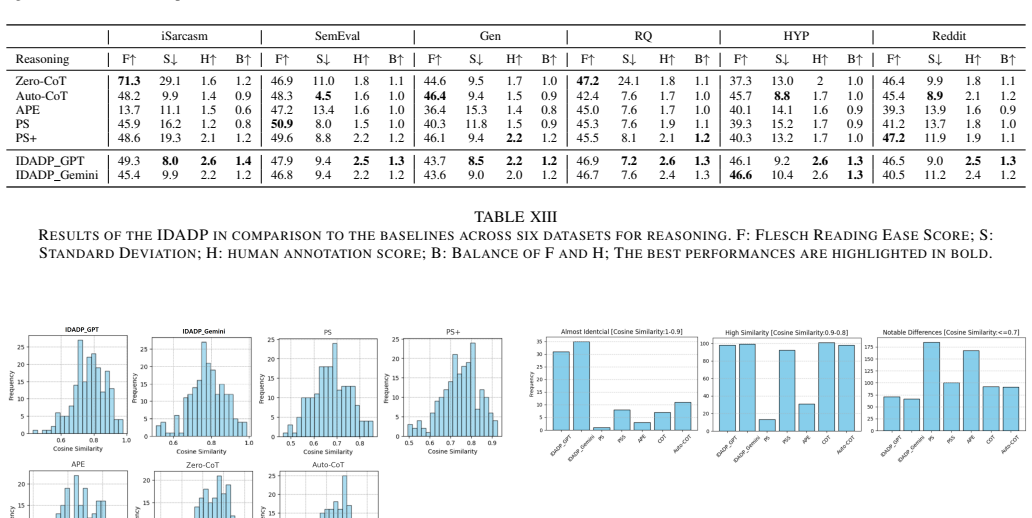
- [Section V.D.2] The text repeats the same sentence about standard deviation almost verbatim in consecutive paragraphs.
- [Section V.D.2] The B measure formula is B = Flesch/100 + Human/3, which can exceed 1; please clarify its intended scale and interpretation in the table.
Circularity Check
No significant circularity: IDADP's detection claim is evaluated against external human labels, and its knowledge-generation and voting components are not defined in terms of the target labels.
full rationale
The paper's central claim is empirical: IDADP, combining LLM-generated irony knowledge, multiple task-specific prompts, and majority voting, outperforms zero-shot baselines on six public irony datasets. The evaluation labels come from external human annotations (Section III.A, Table I), not from IDADP itself, so the detection result is not defined in terms of the framework's own outputs. The knowledge-extraction stage uses LLM-generated definitions, features, and detection-process cues, but these are prompt ingredients, not the benchmark labels; they are also grounded in external prior work on prompt patterns and generated-knowledge prompting (e.g., [18], [44], [61]). The voting mechanism aggregates three prompt outputs; no parameter is fitted to the test labels, and the 0.7 threshold in one prompt is stated as a fixed setting rather than tuned per dataset. Reasoning is scored by human evaluators and Flesch-Kincaid readability, while understanding is measured by BERT cosine similarity against author-provided intended meanings; none of these metrics is constructed from IDADP's predictions in a way that forces the claimed advantage. I find no self-citation chain, no imported uniqueness theorem, and no equation in which a predicted quantity is equal by construction to an input. The arithmetic inconsistencies in Table XI are a correctness and reproducibility concern, not a circularity concern. Therefore the derivation is self-contained with respect to circularity.
Assumptions & free parameters
free parameters (1)
- Irony detection probability threshold =
0.7
assumptions (5)
- domain assumption Public irony dataset labels are reliable ground truth for detection and intended meaning.
- domain assumption LLM-generated irony-focused knowledge is relevant and accurate enough to improve prompts.
- domain assumption Cosine similarity between BERT embeddings of a non-ironic rewrite and the author-provided intended meaning measures understanding.
- domain assumption The six public benchmark datasets were not present in LLM pretraining.
- domain assumption The one-third subset scored by three graduate students is representative and reliably annotated.
Cite this review
Pith. "Pith review of Irony Detection, Reasoning and Understanding in Zero-shot Learning." pith.science (2026). https://pith.science/paper/4TPPK3QS
@misc{pith2026250116884,
  author       = {Pith},
  title        = {Pith review of: Irony Detection, Reasoning and Understanding in Zero-shot Learning},
  year         = {2026},
  howpublished = {\url{https://pith.science/paper/4TPPK3QS}},
  note         = {Machine review of arXiv:2501.16884}
}
read the original abstract
The generalisation of irony detection faces significant challenges, leading to substantial performance deviations when detection models are applied to diverse real-world scenarios. In this study, we find that irony-focused prompts, as generated from our IDADP framework for LLMs, can not only overcome dataset-specific limitations but also generate coherent, human-readable reasoning, transforming ironic text into its intended meaning. Based on our findings and in-depth analysis, we identify several promising directions for future research aimed at enhancing LLMs' zero-shot capabilities in irony detection, reasoning, and comprehension. These include advancing contextual awareness in irony detection, exploring hybrid symbolic-neural methods, and integrating multimodal data, among others.
Figures


Figures from the paper (2 more)

Reference graph
Works this paper leans on
-
[1]
W. C. Booth,A rhetoric of irony. University of Chicago Press, 1974
work page 1974
- [2]
-
[3]
Automatic sarcasm detection: A survey,
A. Joshi, P. Bhattacharyya, and M. J. Carman, “Automatic sarcasm detection: A survey,”ACM Computing Surveys (CSUR), vol. 50, no. 5, pp. 1–22, 2017
2017
-
[4]
Situational irony: A concept of events gone awry
J. Lucariello, “Situational irony: A concept of events gone awry.”Journal of Experimental Psychology: General, vol. 123, no. 2, p. 129, 1994
work page 1994
-
[5]
From humor recognition to irony detection: The figurative language of social media,
A. Reyes, P. Rosso, and D. Buscaldi, “From humor recognition to irony detection: The figurative language of social media,”Data & Knowledge Engineering, vol. 74, pp. 1–12, 2012
2012
-
[6]
A transformer- based approach to irony and sarcasm detection,
R. A. Potamias, G. Siolas, and A.-G. Stafylopatis, “A transformer- based approach to irony and sarcasm detection,”Neural Computing and Applications, vol. 32, no. 23, pp. 17 309–17 320, 2020
work page 2020
-
[7]
Generalizable Sarcasm Detection Is Just Around The Corner, Of Course!
H. Jang and D. Frassinelli, “Generalizable sarcasm detection is just around the corner, of course!”arXiv preprint arXiv:2404.06357, 2024
work page Pith review arXiv 2024
-
[8]
We usually don’t like going to the dentist: Using common sense to detect irony on twitter,
C. Van Hee, E. Lefever, and V . Hoste, “We usually don’t like going to the dentist: Using common sense to detect irony on twitter,”Computational Linguistics, vol. 44, no. 4, pp. 793–832, 2018
work page 2018
Show all 63 references
-
[9]
Semeval-2022 task 6: isarcasmeval, intended sarcasm detection in english and arabic,
I. A. Farha, S. Oprea, S. Wilson, and W. Magdy, “Semeval-2022 task 6: isarcasmeval, intended sarcasm detection in english and arabic,” inThe 16th International Workshop on Semantic Evaluation 2022. Association for Computational Linguistics, 2022, pp. 802–814
2022
-
[10]
Semeval-2018 task 3: Irony detection in english tweets,
C. Van Hee, E. Lefever, and V . Hoste, “Semeval-2018 task 3: Irony detection in english tweets,” inProceedings of the 12th international workshop on semantic evaluation, 2018, pp. 39–50
2018
-
[11]
Harnessing the power of llms in practice: A survey on chatgpt and beyond,
J. Yang, H. Jin, R. Tang, X. Han, Q. Feng, H. Jiang, S. Zhong, B. Yin, and X. Hu, “Harnessing the power of llms in practice: A survey on chatgpt and beyond,”ACM Transactions on Knowledge Discovery from Data, vol. 18, no. 6, pp. 1–32, 2024
2024
-
[12]
Language models are few-shot learners,
T. B. Brown, “Language models are few-shot learners,”arXiv preprint arXiv:2005.14165, 2020
2005 arXiv
-
[13]
Chainlm: Empowering large language models with improved chain-of-thought prompting,
X. Cheng, J. Li, W. X. Zhao, and J.-R. Wen, “Chainlm: Empowering large language models with improved chain-of-thought prompting,” arXiv preprint arXiv:2403.14312, 2024
2024 arXiv
-
[14]
Chain-of-thought prompting elicits reasoning in large language models,
J. Wei, X. Wang, D. Schuurmans, M. Bosma, F. Xia, E. Chi, Q. V . Le, D. Zhouet al., “Chain-of-thought prompting elicits reasoning in large language models,”Advances in neural information processing systems, vol. 35, pp. 24 824–24 837, 2022
2022
-
[15]
Unlocking the potential of chatgpt: A comprehensive explo- ration of its applications, advantages, limitations, and future directions in natural language processing,
W. Hariri, “Unlocking the potential of chatgpt: A comprehensive explo- ration of its applications, advantages, limitations, and future directions in natural language processing,”arXiv preprint arXiv:2304.02017, 2023
2023 arXiv
-
[16]
Training language models to follow instructions with human feedback,
L. Ouyang, J. Wu, X. Jiang, D. Almeida, C. Wainwright, P. Mishkin, C. Zhang, S. Agarwal, K. Slama, A. Rayet al., “Training language models to follow instructions with human feedback,”Advances in neural information processing systems, vol. 35, pp. 27 730–27 744, 2022
2022
-
[17]
Chatgpt: A comprehensive review on background, applica- tions, key challenges, bias, ethics, limitations and future scope,
P. P. Ray, “Chatgpt: A comprehensive review on background, applica- tions, key challenges, bias, ethics, limitations and future scope,”Internet of Things and Cyber-Physical Systems, vol. 3, pp. 121–154, 2023
2023
-
[18]
A prompt pattern catalog to enhance prompt engineering with chatgpt,
J. White, Q. Fu, S. Hays, M. Sandborn, C. Olea, H. Gilbert, A. El- nashar, J. Spencer-Smith, and D. C. Schmidt, “A prompt pattern catalog to enhance prompt engineering with chatgpt,”arXiv preprint arXiv:2302.11382, 2023
2023 arXiv
-
[19]
Chatgpt is a remarkable tool—for experts,
A. Azaria, R. Azoulay, and S. Reches, “Chatgpt is a remarkable tool—for experts,”Data Intelligence, vol. 6, no. 1, pp. 240–296, 2024. 14
2024
-
[20]
Parsing-based sarcasm sentiment recognition in twitter data,
S. K. Bharti, K. S. Babu, and S. K. Jena, “Parsing-based sarcasm sentiment recognition in twitter data,” inProceedings of the 2015 IEEE/ACM International Conference on Advances in Social Networks Analysis and Mining 2015, 2015, pp. 1373–1380
2015
-
[21]
Sarcasm as contrast between a positive sentiment and negative situa- tion,
E. Riloff, A. Qadir, P. Surve, L. De Silva, N. Gilbert, and R. Huang, “Sarcasm as contrast between a positive sentiment and negative situa- tion,” inProceedings of the 2013 conference on empirical methods in natural language processing, 2013, pp. 704–714
2013
-
[22]
Using lexical resources for irony and sarcasm classification,
M. Mladenovi ´c, C. Krstev, J. Mitrovi´c, and R. Stankovi ´c, “Using lexical resources for irony and sarcasm classification,” inProceedings of the 8th Balkan Conference in Informatics, 2017, pp. 1–8
2017
-
[23]
Identifying sar- casm in twitter: a closer look,
R. Gonz ´alez-Ib´anez, S. Muresan, and N. Wacholder, “Identifying sar- casm in twitter: a closer look,” inProceedings of the 49th annual meet- ing of the association for computational linguistics: human language technologies, 2011, pp. 581–586
2011
-
[24]
Who cares about sarcastic tweets? investigating the impact of sarcasm on sentiment analysis,
D. G. Maynard and M. A. Greenwood, “Who cares about sarcastic tweets? investigating the impact of sarcasm on sentiment analysis,” in Lrec 2014 proceedings. ELRA, 2014
2014
-
[25]
Sar- casm and irony detection in english tweets,
J. Dimovska, M. Angelovska, D. Gjorgjevikj, and G. Madjarov, “Sar- casm and irony detection in english tweets,” inICT Innovations 2018. Engineering and Life Sciences: 10th International Conference, ICT Inno- vations 2018, Ohrid, Macedonia, September 17–19, 2018, Proceedings
2018
-
[26]
Springer, 2018, pp. 120–131
2018
-
[27]
Detecting irony and sarcasm in microblogs: The role of expressive signals and ensemble classifiers,
E. Fersini, F. A. Pozzi, and E. Messina, “Detecting irony and sarcasm in microblogs: The role of expressive signals and ensemble classifiers,” in2015 IEEE international conference on data science and advanced analytics (DSAA). IEEE, 2015, pp. 1–8
2015
-
[28]
Applying basic fea- tures from sentiment analysis for automatic irony detection,
I. Hern ´andez-Far´ıas, J.-M. Bened ´ı, and P. Rosso, “Applying basic fea- tures from sentiment analysis for automatic irony detection,” inPattern Recognition and Image Analysis: 7th Iberian Conference, IbPRIA 2015, Santiago de Compostela, Spain, June 17-19, 2015, Proceedings ...
2015
-
[29]
Towards a contextual pragmatic model to detect irony in tweets,
J. Karoui, F. Benamara, V . Moriceau, N. Aussenac-Gilles, and L. H. Belguith, “Towards a contextual pragmatic model to detect irony in tweets,” in53rd Annual Meeting of the Association for Computational Linguistics (ACL 2015), vol. 2. ACL: Association for Computational Linguis...
2015
-
[30]
Empirical study of shallow and deep learning models for sarcasm detection using context in benchmark datasets,
A. Kumar and G. Garg, “Empirical study of shallow and deep learning models for sarcasm detection using context in benchmark datasets,” Journal of ambient intelligence and humanized computing, vol. 14, no. 5, pp. 5327–5342, 2023
2023
-
[31]
Irony detection with atten- tive recurrent neural networks,
Y .-H. Huang, H.-H. Huang, and H.-H. Chen, “Irony detection with atten- tive recurrent neural networks,” inAdvances in Information Retrieval: 39th European Conference on IR Research, ECIR 2017, Aberdeen, UK, April 8-13, 2017, Proceedings 39. Springer, 2017, pp. 534–540
2017
-
[32]
Transformer-based word embedding with cnn model to detect sarcasm and irony,
R. Ahuja and S. C. Sharma, “Transformer-based word embedding with cnn model to detect sarcasm and irony,”Arabian Journal for Science and Engineering, vol. 47, no. 8, pp. 9379–9392, 2022
2022
-
[33]
Utilizing an attention-based lstm model for detecting sarcasm and irony in social media,
D. Olaniyan, R. O. Ogundokun, O. P. Bernard, J. Olaniyan, R. Maskeli ¯unas, and H. B. Akande, “Utilizing an attention-based lstm model for detecting sarcasm and irony in social media,”Computers, vol. 12, no. 11, p. 231, 2023
2023
-
[34]
Leveraging chatgpt as text annotation tool for sentiment analysis,
M. Belal, J. She, and S. Wong, “Leveraging chatgpt as text annotation tool for sentiment analysis,”arXiv preprint arXiv:2306.17177, 2023
2023 arXiv
-
[35]
On sarcasm detection with openai gpt-based models,
M. Gole, W.-P. Nwadiugwu, and A. Miranskyy, “On sarcasm detection with openai gpt-based models,”arXiv preprint arXiv:2312.04642, 2023
2023 arXiv
-
[36]
Generative pre-trained transformer (gpt) models for irony detection and classification,
M. U. Aytekin and O. A. Erdem, “Generative pre-trained transformer (gpt) models for irony detection and classification,” in2023 4th In- ternational Informatics and Software Engineering Conference (IISEC). IEEE, 2023, pp. 1–8
2023
-
[37]
Improving language understanding by generative pre- training,
A. Radford, “Improving language understanding by generative pre- training,” 2018
2018
-
[38]
Language models are unsupervised multitask learners,
A. Radford, J. Wu, R. Child, D. Luan, D. Amodei, I. Sutskeveret al., “Language models are unsupervised multitask learners,”OpenAI blog, vol. 1, no. 8, p. 9, 2019
2019
-
[39]
Large lan- guage models are zero-shot reasoners,
T. Kojima, S. S. Gu, M. Reid, Y . Matsuo, and Y . Iwasawa, “Large lan- guage models are zero-shot reasoners,”Advances in neural information processing systems, vol. 35, pp. 22 199–22 213, 2022
2022
-
[40]
Self-consistency improves chain of thought reasoning in language models,
X. Wang, J. Wei, D. Schuurmans, Q. Le, E. Chi, S. Narang, A. Chowdh- ery, and D. Zhou, “Self-consistency improves chain of thought reasoning in language models,”arXiv preprint arXiv:2203.11171, 2022
2022 arXiv
-
[41]
Automatic chain of thought prompting in large language models,
Z. Zhang, A. Zhang, M. Li, and A. Smola, “Automatic chain of thought prompting in large language models,”arXiv preprint arXiv:2210.03493, 2022
2022 arXiv
-
[42]
Tree of thoughts: Deliberate problem solving with large language models,
S. Yao, D. Yu, J. Zhao, I. Shafran, T. Griffiths, Y . Cao, and K. Narasimhan, “Tree of thoughts: Deliberate problem solving with large language models,”Advances in Neural Information Processing Systems, vol. 36, 2024
2024
-
[43]
Large language model guided tree-of-thought,
J. Long, “Large language model guided tree-of-thought,”arXiv preprint arXiv:2305.08291, 2023
2023 arXiv
-
[44]
Using tree-of-thought prompting to boost chatgpt’s reason- ing,
D. Hulbert, “Using tree-of-thought prompting to boost chatgpt’s reason- ing,” 2023
2023
-
[45]
Generated knowledge prompting for commonsense reasoning,
J. Liu, A. Liu, X. Lu, S. Welleck, P. West, R. L. Bras, Y . Choi, and H. Hajishirzi, “Generated knowledge prompting for commonsense reasoning,”arXiv preprint arXiv:2110.08387, 2021
2021 arXiv
-
[46]
Large language models as optimizers,
C. Yang, X. Wang, Y . Lu, H. Liu, Q. V . Le, D. Zhou, and X. Chen, “Large language models as optimizers,” 2023
2023
-
[47]
Promptbreeder: Self-referential self-improvement via prompt evolution,
C. Fernando, D. Banarse, H. Michalewski, S. Osindero, and T. Rockt ¨aschel, “Promptbreeder: Self-referential self-improvement via prompt evolution,”arXiv preprint arXiv:2309.16797, 2023
2023 arXiv
-
[48]
Large language models are human-level prompt engineers,
Y . Zhou, A. I. Muresanu, Z. Han, K. Paster, S. Pitis, H. Chan, and J. Ba, “Large language models are human-level prompt engineers,”arXiv preprint arXiv:2211.01910, 2022
2022 arXiv
-
[49]
Prewrite: Prompt rewriting with reinforcement learning,
W. Kong, S. A. Hombaiah, M. Zhang, Q. Mei, and M. Bendersky, “Prewrite: Prompt rewriting with reinforcement learning,”arXiv preprint arXiv:2401.08189, 2024
2024 arXiv
-
[51]
Finetuned language models are zero-shot learners,
J. Wei, M. Bosma, V . Y . Zhao, K. Guu, A. W. Yu, B. Lester, N. Du, A. M. Dai, and Q. V . Le, “Finetuned language models are zero-shot learners,”arXiv preprint arXiv:2109.01652, 2021
2021 arXiv
-
[52]
Multitask prompted training enables zero-shot task generalization,
V . Sanh, A. Webson, C. Raffel, S. H. Bach, L. Sutawika, Z. Alyafeai, A. Chaffin, A. Stiegler, T. L. Scao, A. Rajaet al., “Multitask prompted training enables zero-shot task generalization,”arXiv preprint arXiv:2110.08207, 2021
-
[53]
Creating and characterizing a diverse corpus of sarcasm in dialogue,
S. Oraby, V . Harrison, L. Reed, E. Hernandez, E. Riloff, and M. Walker, “Creating and characterizing a diverse corpus of sarcasm in dialogue,” arXiv preprint arXiv:1709.05404, 2017
2017 arXiv
-
[54]
Humans require context to infer ironic intent (so computers probably do, too),
B. C. Wallace, L. Kertz, E. Charniaket al., “Humans require context to infer ironic intent (so computers probably do, too),” inProceedings of the 52nd Annual Meeting of the Association for Computational Linguistics (Volume 2: Short Papers), 2014, pp. 512–516
2014
-
[55]
Bert: Pre-training of deep bidirectional transformers for language understanding,
J. Devlin, “Bert: Pre-training of deep bidirectional transformers for language understanding,”arXiv preprint arXiv:1810.04805, 2018
2018 arXiv
-
[56]
Roberta: A robustly optimized bert pretraining approach,
Y . Liu, “Roberta: A robustly optimized bert pretraining approach,”arXiv preprint arXiv:1907.11692, 2019
1907 arXiv
-
[57]
Mpnet: Masked and permuted pre-training for language understanding,
K. Song, X. Tan, T. Qin, J. Lu, and T.-Y . Liu, “Mpnet: Masked and permuted pre-training for language understanding,”Advances in neural information processing systems, vol. 33, pp. 16 857–16 867, 2020
2020
-
[58]
A survey in automatic irony process- ing: Linguistic, cognitive, and multi-x perspectives,
Q. Zeng and A.-R. Li, “A survey in automatic irony process- ing: Linguistic, cognitive, and multi-x perspectives,”arXiv preprint arXiv:2209.04712, 2022
2022 arXiv
-
[59]
Shalev-Shwartz and S
S. Shalev-Shwartz and S. Ben-David,Understanding machine learning: From theory to algorithms. Cambridge university press, 2014
2014
-
[60]
Machine reasoning: Technology, dilemma and future,
N. Duan, D. Tang, and M. Zhou, “Machine reasoning: Technology, dilemma and future,” inProceedings of the 2020 Conference on Em- pirical Methods in Natural Language Processing: Tutorial Abstracts, 2020, pp. 1–6
2020
-
[61]
Studying irony detection beyond ironic criticism: Let’s include ironic praise,
R. Bruntsch and W. Ruch, “Studying irony detection beyond ironic criticism: Let’s include ironic praise,”Frontiers in Psychology, vol. 8, p. 606, 2017
2017
-
[62]
Meta prompting for agi systems,
Y . Zhang, “Meta prompting for agi systems,”arXiv preprint arXiv:2311.11482, 2023
2023 arXiv
-
[63]
Plan- and-solve prompting: improving zero-shot chain-of-thought reasoning by large language models (2023),
L. Wang, W. Xu, Y . Lan, Z. Hu, Y . Lan, R. Lee, and E. Lim, “Plan- and-solve prompting: improving zero-shot chain-of-thought reasoning by large language models (2023),”arXiv preprint arXiv:2305.04091, 2024
2023 arXiv
-
[64]
Simplification of flesch reading ease formula
J. N. Farr, J. J. Jenkins, and D. G. Paterson, “Simplification of flesch reading ease formula.”Journal of applied psychology, vol. 35, no. 5, p. 333, 1951
1951
Reviewed August 10, 2026 · model on record in the stance chip above.
Discussion (0). Continue with ORCID to comment.