Different roles of quantum interference in a quantum dot photocell with two intermediate bands
Pith reviewed 2026-05-14 21:56 UTC · model grok-4.3
The pith
In a quantum dot photocell with two intermediate bands, interference from upper transitions raises conversion efficiency while interference from lower transitions lowers it by shortening carrier lifetimes.
A machine-rendered reading of the paper's core claim, the machinery that carries it, and where it could break.
Core claim
In the quantum dot photocell with two intermediate bands, the photoelectric conversion efficiency increases with quantum coherence generated by the upper transition rates owing to their robust quantum interference. In contrast, the conversion efficiency decreases with the quantum interference induced by the two lower-transition rates due to the shortened population lifetime in the intermediate bands.
What carries the argument
The two-intermediate-band quantum-dot photocell model in which upper and lower transition rates independently control the strength of quantum interference and the carrier population dynamics.
If this is right
- Raising upper transition rates produces an initial gain in efficiency that later reverses as other loss channels dominate.
- Raising lower transition rates produces a monotonic drop in efficiency through faster depopulation of the intermediate bands.
- Quantum coherence improves transport only when generated by the upper channel; the same coherence harms transport when generated by the lower channel.
- Device design can therefore target selective enhancement of upper-channel coherence to raise net conversion.
Where Pith is reading between the lines
- Prioritizing fabrication controls that strengthen upper transitions while leaving lower transitions weak could be a practical route to higher-efficiency multi-band cells.
- The result suggests analogous channel-dependent coherence effects may appear in other multi-band photovoltaic or photosynthetic systems.
- External fields or doping profiles that tune transition rates differently could serve as experimental knobs to verify the predicted efficiency curves.
Load-bearing premise
The model assumes that upper and lower transition rates can be varied independently while all other decoherence and relaxation channels remain fixed.
What would settle it
Fabricating a two-intermediate-band quantum dot photocell and measuring whether raising the upper transition rates increases efficiency while raising the lower rates decreases it would directly test the claimed opposing roles of interference.
Figures

read the original abstract
It is generally believed that quantum interference can improve the transport of photo-generated carriers in a photocell, thereby improve the photoelectric conversion efficiency. In this work, we explicitly explore different roles of quantum interferences in the photoelectric conversion efficiency in a quantum dot (QD) photocell with two intermediate bands. The increasing transition rates from different charge transport channels bring out first increasing, then decreasing, and then monotonically decreasing photoelectric conversion efficiencies. And the photoelectric conversions increase with quantum coherence generated by the upper transition rates owing to their robust quantum interference. However, the conversion efficiency decrease with the quantum interference induced by two lower-transition rates due to the shortened population lifetime in the intermediate bands. These results provide insight into different roles of quantum interferences in photoelectric conversion efficiency, and may provide some artificial strategies to achieve efficient photoelectric conversion via the adjusted quantum interferences in a QD photocell with multi-intermediate bands.
Editorial analysis
A structured set of objections, weighed in public.
Referee Report
Summary. The manuscript examines quantum interference effects in a quantum dot photocell with two intermediate bands using a density-matrix or rate-equation model. It reports that photoelectric conversion efficiency first rises then falls with increasing upper transition rates due to robust quantum interference enhancing carrier transport, while efficiency monotonically decreases with lower transition rates because the induced coherence shortens the population lifetime in the intermediate bands. The work concludes that these distinct roles of interference suggest strategies for tuning rates to optimize efficiency in multi-band QD photocells.
Significance. If the separation of upper- and lower-rate effects proves robust, the results would clarify how quantum coherence can be leveraged or mitigated in intermediate-band solar cells, providing design guidance for artificial photocells. The numerical trends on non-monotonic versus monotonic efficiency behavior constitute a concrete, falsifiable prediction that could be tested experimentally by rate tuning.
major comments (2)
- [Model and rate-equation formulation] The central claim that upper-transition rates enhance efficiency via robust QI while lower rates suppress it via shortened lifetime rests on treating these two sets of rates as independently tunable parameters in the master equation while all other Lindblad coefficients (dephasing, phonon relaxation) remain fixed. No microscopic derivation from a single electron-photon/phonon Hamiltonian is provided to justify this independence; dipole matrix elements and bath spectral densities would normally correlate the rates, undermining the separation of roles.
- [Numerical results and figures] The reported efficiency curves (first increasing then decreasing for upper rates; monotonic decrease for lower rates) are obtained by numerical variation of transition rates, yet no parameter tables, ranges, or sensitivity analysis to other decoherence channels are supplied. Without these, it is impossible to assess whether the non-monotonic behavior is generic or an artifact of specific choices.
minor comments (2)
- [Abstract] Abstract contains a grammatical error: 'the conversion efficiency decrease with' should read 'decreases with'.
- [Introduction and model] Notation for the two intermediate bands and the four transition channels should be defined explicitly with a diagram or equation set early in the text to aid readability.
Simulated Author's Rebuttal
We thank the referee for the detailed and constructive report. We address the major comments point by point below and will revise the manuscript accordingly where appropriate.
read point-by-point responses
-
Referee: [Model and rate-equation formulation] The central claim that upper-transition rates enhance efficiency via robust QI while lower rates suppress it via shortened lifetime rests on treating these two sets of rates as independently tunable parameters in the master equation while all other Lindblad coefficients (dephasing, phonon relaxation) remain fixed. No microscopic derivation from a single electron-photon/phonon Hamiltonian is provided to justify this independence; dipole matrix elements and bath spectral densities would normally correlate the rates, undermining the separation of roles.
Authors: We agree that a microscopic derivation would provide stronger justification for treating the rates as independent. Our model is phenomenological, designed to explore the distinct effects of quantum interference in upper and lower transitions by varying these rates independently while keeping other parameters fixed. This approach is common in studies of quantum coherence in photocells to highlight specific mechanisms. In the revised version, we will add a paragraph discussing the assumptions of the model, including the independence of rates, and note that in a full microscopic treatment the rates may be correlated, but the qualitative separation of roles is expected to hold under appropriate conditions. revision: partial
-
Referee: [Numerical results and figures] The reported efficiency curves (first increasing then decreasing for upper rates; monotonic decrease for lower rates) are obtained by numerical variation of transition rates, yet no parameter tables, ranges, or sensitivity analysis to other decoherence channels are supplied. Without these, it is impossible to assess whether the non-monotonic behavior is generic or an artifact of specific choices.
Authors: We thank the referee for pointing this out. In the revised manuscript, we will include a comprehensive table listing all model parameters, their values, and the ranges over which they are varied. Additionally, we will provide sensitivity analysis by showing how the efficiency curves change with variations in dephasing rates and phonon relaxation rates, to demonstrate the robustness of the observed behaviors. revision: yes
Circularity Check
No circularity: efficiency obtained by direct numerical solution of parameterized master equation
full rationale
The paper treats upper and lower transition rates as independent input parameters to a density-matrix master equation for the two-intermediate-band QD photocell. Efficiency is computed as a function of these rates, revealing opposing effects from quantum interference in upper versus lower channels. No claimed result reduces by construction to a fitted quantity, self-citation, or renamed input; the reported curves are explicit outputs of the chosen Lindblad dynamics. The modeling choice of independent rates is an assumption open to microscopic scrutiny but does not constitute circularity within the derivation chain itself.
Axiom & Free-Parameter Ledger
free parameters (2)
- upper transition rates
- lower transition rates
axioms (2)
- standard math Markovian master equation for the density matrix of the quantum dot
- domain assumption Independent control of upper and lower transition rates without cross-talk
Lean theorems connected to this paper
-
IndisputableMonolith/Cost/FunctionalEquation.leanwashburn_uniqueness_aczel unclear?
unclearRelation between the paper passage and the cited Recognition theorem.
the photoelectric conversions increase with quantum coherence generated by the upper transition rates owing to their robust quantum interference. However, the conversion efficiency decrease with the quantum interference induced by two lower-transition rates due to the shortened population lifetime
-
IndisputableMonolith/Foundation/RealityFromDistinction.leanreality_from_one_distinction unclear?
unclearRelation between the paper passage and the cited Recognition theorem.
P1 = pa1·pa2 / |pa1|·|pa2|, P2 = pb1·pb2 / |pb1|·|pb2| ... |P1|,|P2| can be used to represent the quantum interference intensity
What do these tags mean?
- matches
- The paper's claim is directly supported by a theorem in the formal canon.
- supports
- The theorem supports part of the paper's argument, but the paper may add assumptions or extra steps.
- extends
- The paper goes beyond the formal theorem; the theorem is a base layer rather than the whole result.
- uses
- The paper appears to rely on the theorem as machinery.
- contradicts
- The paper's claim conflicts with a theorem or certificate in the canon.
- unclear
- Pith found a possible connection, but the passage is too broad, indirect, or ambiguous to say the theorem truly supports the claim.
Reference graph
Works this paper leans on
-
[1]
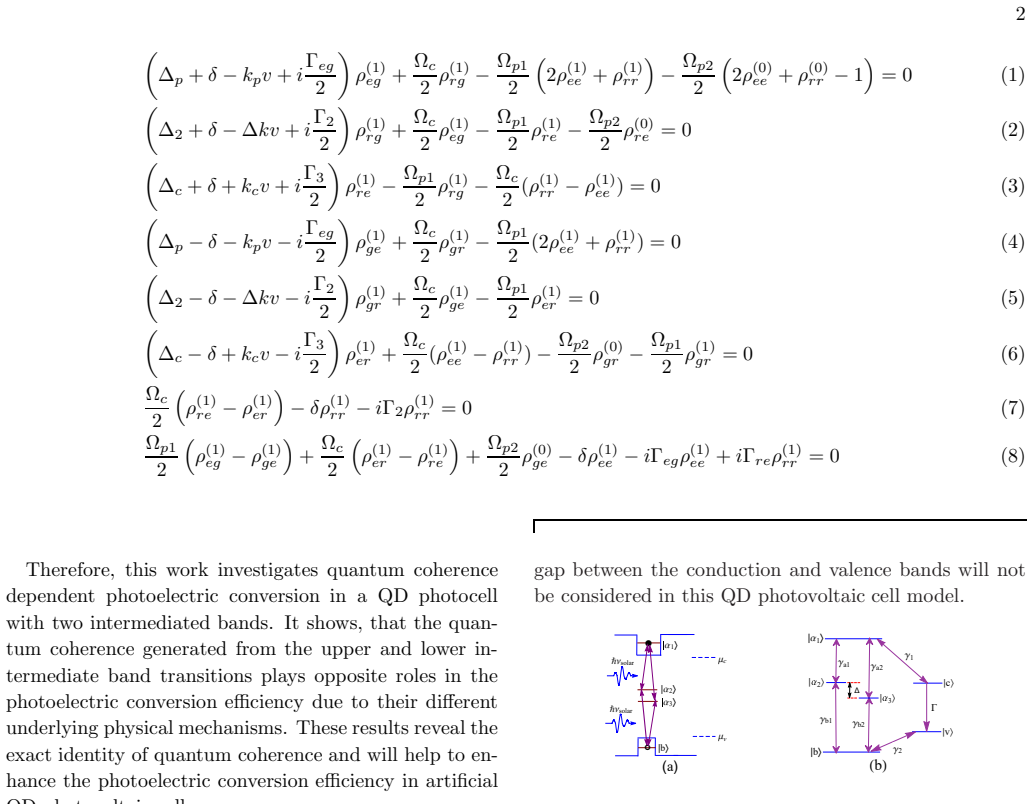
can be described by two divided Lindblad-type super-operators: Rij(k){ρ} = ∑ k=1, 2 ∑ i=a,b 2∑ j=1 γij(k) 2 [(nij(k) + 1)(2ˆσij(k) ˆρˆσ † ij(k) − ˆσ † ij(k) ˆσij(k) ˆρ − ˆρˆσ † ij(k) ˆσij(k)) + nij(k)(2ˆσ † ij(k) ˆρˆσij(k) − ˆσij(k) ˆσ † ij(k) ˆρ − ˆρˆσij(k) ˆσ † ij(k))], (11) RΓ {ρ} = Γ[(2ˆ σβα ˆρˆσ † βα − ˆσ † βα ˆσβα ˆρ − ˆρˆσ † βα ˆσβα )]. (12) Hence,...
-
[2]
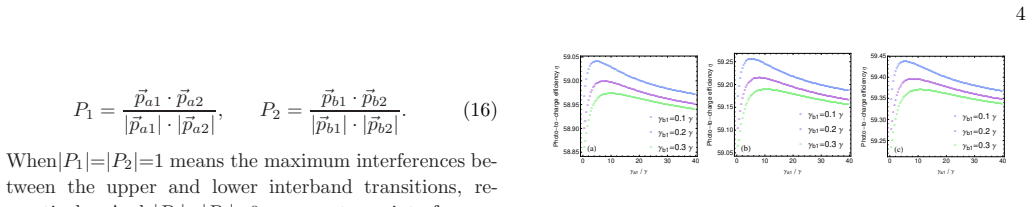
an- alytically. Considering the cumbersome expression for the photo-to-charge efficiency η, we follow the numerical quantitative approach to analyze the influence of quan- tum interference related to the intermediate transition rates on the photoelectric conversion. Absorbing more photons with energy below the bandgap is an efficient approach to enhance the ph...
-
[3]
5ev, Ta = 0 . 0259ev, p1 = 0 . 45, p2 = 0 . 35. And γ is the scale unit. ∆ with different interband transition rates in different charge transfer channels attract our research interest- ing in this proposed QD photocell model. In the fol- lowing, the efficiency η dependent transition rates with two non-degenerate intermediate bands |α 2⟩, |α 3⟩ (i. e., ∆ = 0 ...
-
[4]
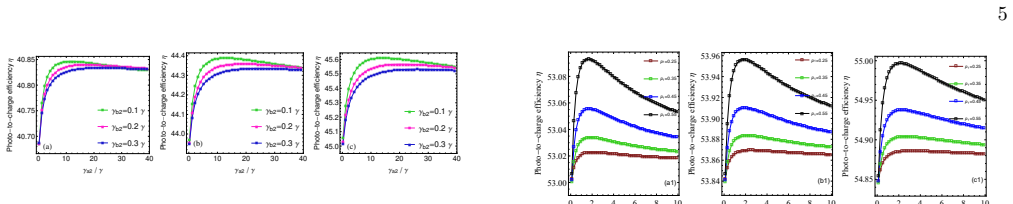
illustrates that the larger amounts of absorbed photons na2 can be achieved by a narrower gap, which is confirmed by the enhanced efficiency η with the increasing na2 in Fig. 2. Secondly, photoelectric conversion efficiency η is a func- tion of another two transition rates ( γa2, γb2) in the charge transfer channel |b⟩ ↔ | α 3⟩ ↔ | α 1⟩ plotted in Fig.3. The c...
-
[5]
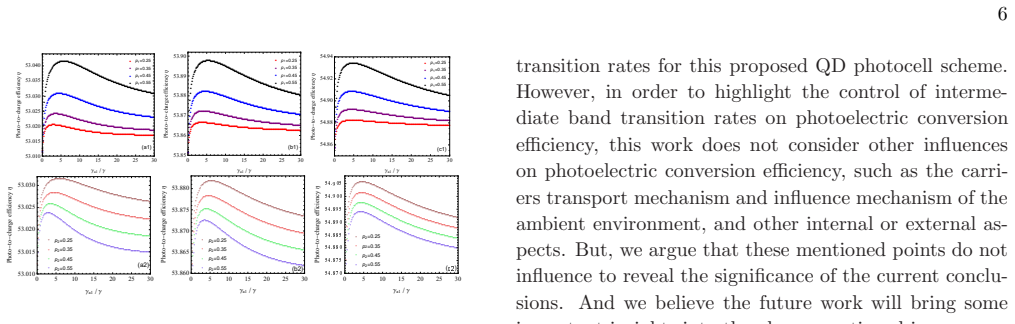
The results demonstrate that γb2 loses its influence on the ▫▫▫▫▫▫▫▫▫▫▫▫▫▫▫▫▫▫▫▫▫▫▫▫▫▫▫▫▫▫▫▫▫▫▫▫▫▫▫▫▫▫▫▫▫▫▫▫▫▫ ▫ ▫▫▫▫▫▫▫▫▫▫▫▫▫▫▫▫▫▫▫▫▫▫▫▫▫▫▫▫▫▫▫▫▫▫▫▫▫▫▫▫▫▫▫▫▫▫▫▫▫ ▫ ▫ ▫▫▫▫▫▫▫▫▫▫▫▫▫▫▫▫▫▫▫▫▫▫▫▫▫▫▫▫▫▫▫▫▫▫▫▫▫▫▫▫▫▫▫▫▫▫▫▫ ▫ ▫ ▫ ▫▫▫▫▫▫▫▫▫▫▫▫▫▫▫▫▫▫▫▫▫▫▫▫▫▫▫▫▫▫▫▫▫▫▫▫▫▫▫▫▫▫▫▫▫▫▫ ▫ p1=0.25 ▫ p1=0.35 ▫ p1=0.45 ▫ p1=0.55 0 2 4 6 8 10 53.00 53.02 53.04 53.06 53.08 γa1 /...
-
[6]
5(c1) and the minimum peak is 53.024% with na2=1.65 Fig
The maximum peak is about 54.935% with na2=3.15 in Fig. 5(c1) and the minimum peak is 53.024% with na2=1.65 Fig. 5(a2), respectively. The peak values are smaller than those in Fig. 4 under the same physi- cal condition except the band splitting ∆, it concludes that this QD photocell with small band splitting can produce slightly larger photoelectric conve...
-
[7]
W. Shockley and H. J. Queisser. Detailed balance limit of efficiency of p-n junction solar cells. Journal of Applied Physics, 32(3):510–519, 1961
work page 1961
-
[8]
R. J. Handy. Theoretical analysis of the series resistance of a solar cell. Solid State Electronics , 10(8):765–775, 1967
work page 1967
- [9]
- [10]
-
[11]
S. K. Tobler and P. Bennett. A shadow-edge contact for epitaxial nanostructures on silicon. In APS Four Corners Section Meeting Abstracts , (October) 2009
work page 2009
-
[12]
Y. Kajiyama, K. Joseph, K. Kajiyama, S. Kudo, and H. Aziz. Recent progress on the vacuum deposition of oleds with feature sizes ≤ 20 µ m using a contact shadow mask patterned in-situ by laser ablation. Sid Symposium Digest of Technical Papers , 43(1):1544–1547, 2012
work page 2012
- [13]
-
[14]
L. Tian and M. Dagenais. Non-resonant below-bandgap two-photon absorption in quantum dot solar cells. Ap- plied Physics Letters , 106(9):171101, 2015
work page 2015
-
[15]
H. Kum, Y. S. Dai, T. Aihara, M. A. Slocum, T. Taya- gaki, A. Fedorenko, S. J. Polly, Z. Bittner, T. Sugaya, and S. M. Hubbard. Two-step photon absorption in InP/InGaP quantum dot solar cells. Applied Physics Let- ters, 113(4):043902, 2018
work page 2018
-
[16]
B. S. Richards. Enhancing the performance of silicon so- lar cells via the application of passive luminescence con- version layers. Solar Energy Materials and Solar Cells , 90(15):2329–2337, 2006
work page 2006
-
[17]
G. Conibeer, R. Patterson, L. Huang, J. F. Guillemoles, D. Konig, S. Shrestha, and M. A. Green. Modelling of hot carrier solar cell absorbers. Solar Energy Materials and Solar Cells , 94(9):1516–1521, 2010
work page 2010
- [18]
-
[19]
G. Conibeer, S. Shrestha, S. J. Huang, R. Patterson, P. Aliberti, H. Xia, Y. Feng, N. Gupta, S. Smyth, and Y. Liao. Hot carrier solar cell absorbers: Superstructures , materials and mechanisms for slowed carrier cooling. In Photovoltaic Specialists Conference , 2012
work page 2012
-
[20]
F. R. Graziani. The quantum radiative transfer equation: quantum damping, kirchoff’s law, and the approach to equilibrium of photons in a quantum plasma. Journal of Quantitative Spectroscopy and Radiative Transfer , 83(3- 4):711–733, 2004
work page 2004
-
[21]
Y. Yi, A. Massuda, C. Roquescarmes, S. E. Kooi, T. Christensen, S. G. Johnson, J. D. Joannopoulos, O. D. Miller, I. Kaminer, and M. Soljai. Maximal spontaneous photon emission and energy loss from free electrons. Na- ture Physics , 2018
work page 2018
-
[22]
C. H. Henry and C. H. Henry. Limiting efficiencies of ideal single and multiple energy gap terrestrial solar cell s. Journal of Applied Physics , 51(8):4494–4500, 1980
work page 1980
-
[23]
V. I. Klimov. High-efficiency carrier multiplication in semiconductor nanocrystals: Implications for solar en- ergy conversion traditional solar cell: Ultimate efficiency . Physical Review Letters , 92(18):186601, 2004
work page 2004
-
[24]
A. Luque. Will we exceed 50% efficiency in photovoltaics ? Journal of Applied Physics , 110(3):031301, 2011
work page 2011
- [25]
-
[26]
A. Creti, V. Tasco, A. Cola, G. Montagna, I. Tarantini, A. Salhi, A. Al-Muhanna, A. Passaseo, and M. Lomas- colo. Role of charge separation on two-step two pho- ton absorption in InAs/GaAs quantum dot intermediate band solar cells. Applied Physics Letters , 108(6):063901, 2016
work page 2016
-
[27]
N. S. Beattie, P. See, G. Zoppi, P. Ushasree, M. Duchamp, I. Farrer, D. A. Ritchie, and S. Tomic. Quantum engineering of InAs/GaAs quantum dot based intermediate band solar cells. Acs Photonics, 4(11):2745– 2750, 2017
work page 2017
-
[28]
O. E. Semonin, J. M. Luther, C. Sukgeun, H. Y. Chen, J. Gao, A. J. Nozik, and M. C. Beard. Peak external photocurrent quantum efficiency exceeding 100% via meg in a quantum dot solar cell. Science, 334(6062):1530, 2011
work page 2011
-
[29]
M. O. Scully. Quantum photocell: using quantum co- herence to reduce radiative recombination and increase efficiency. Physical Review Letters, 104(20):207701, 2010
work page 2010
-
[30]
A. A. Svidzinsky, K. E. Dorfman, and M. O. Scully. En- hancing photovoltaic power by fano-induced coherence. Phys.Rev.A, 84(5):6140–6145, 2011
work page 2011
-
[31]
S. C. Zhao and J. Y. Chen. Enhanced quantum yields and efficiency in a quantum dot photocell modeled by a multi- level system. New Journal of Physics , 21(10):103015, 2019. 8
work page 2019
-
[32]
M. Daryani, A. Rostami, G. Darvish, and M. K. M. Farshi. High efficiency solar cells using quantum inter- ferences. Optical and Quantum Electronics , 49(7):255, 2017
work page 2017
- [33]
-
[34]
S. Ithurria, M. D. Tessier, B. Mahler, R. P. S. M Lobo, B. Dubertret, and A. L. Efros. Colloidal nanoplatelets with two-dimensional electronic structure. Nature Mate- rials, 10(12):936–41, 2011
work page 2011
-
[35]
A. W. Achtstein, A Schliwa, A Prudnikau, M Hardzei, M. V. Artemyev, C Thomsen, and U. Woggon. Elec- tronic structure and exciton-phonon interaction in two- dimensional colloidal CdSe nanosheets. Nano Letters , 12(6):3151–3157, 2012
work page 2012
-
[36]
P. Tighineanu, R. S. Daveau, T. B. Lehmann, H. E. Beere, Da. A. Ritchie, P. Lodahl, and S. Stobbe. Single- photon superradiance from a quantum dot. Physical Re- view Letters, 116(16):163604, 2016
work page 2016
-
[37]
M. Yoshida, N. J. Ekins-Daukes, D. J. Farrell, and C. C. Phillips. Photon ratchet intermediate band solar cells. Applied Physics Letters , 100(26):510–135, 2012
work page 2012
-
[38]
Konstantin E. Dorfman, Anatoly A. Svidzinsky, and Mar- lan O. Scully. Increasing photovoltaic power by noise in- duced coherence between intermediate band states. Co- herent Optical Phenomena , 1:42–49, 2013
work page 2013
-
[39]
S. C. Zhao and Q. X. Wu. High quantum yields generated by a multi-band quantum dot photocell. Superlattices and Microstructures, 137:106329, 2020
work page 2020
-
[40]
V. Popescu, G. Bester, M. C. Hanna, A. G. Norman, and A. Zunger. Theoretical and experimental examina- tion of the intermediate-band concept for strain-balanced (In,Ga)As/Ga(As,P) quantum dot solar cells. Physical Review B , 78(78):2599–2604, 2008
work page 2008
discussion (0)
Sign in with ORCID, Apple, or X to comment. Anyone can read and Pith papers without signing in.