REVIEW 3 major objections 4 minor 24 references
PASS3D: Precise and Accelerated Semantic Segmentation for 3D Point Cloud
T0 review · 3 major / 4 minor · reviewed 2026-08-14 · deepseek-v4-flash
Pith's one-line read PASS3D claims that splitting LiDAR semantic segmentation into a 5 ms geometric proposal stage and a PointNet++ classification stage reaches 52.8% average IoU on KITTI raw, 7.9 points above SqueezeSegv2.
desk verdict PASS3D is a competent two-stage LiDAR segmentation pipeline with modest but real novelties, internally consistent numbers, and a valid but not fully verified head-to-head claim against SqueezeSegv2 due to split and label-mapping ambiguity. read the letter →
The pith
A machine-rendered reading of the paper's core claim, the machinery that carries it, and where it could break.
The reading
What carries the argument
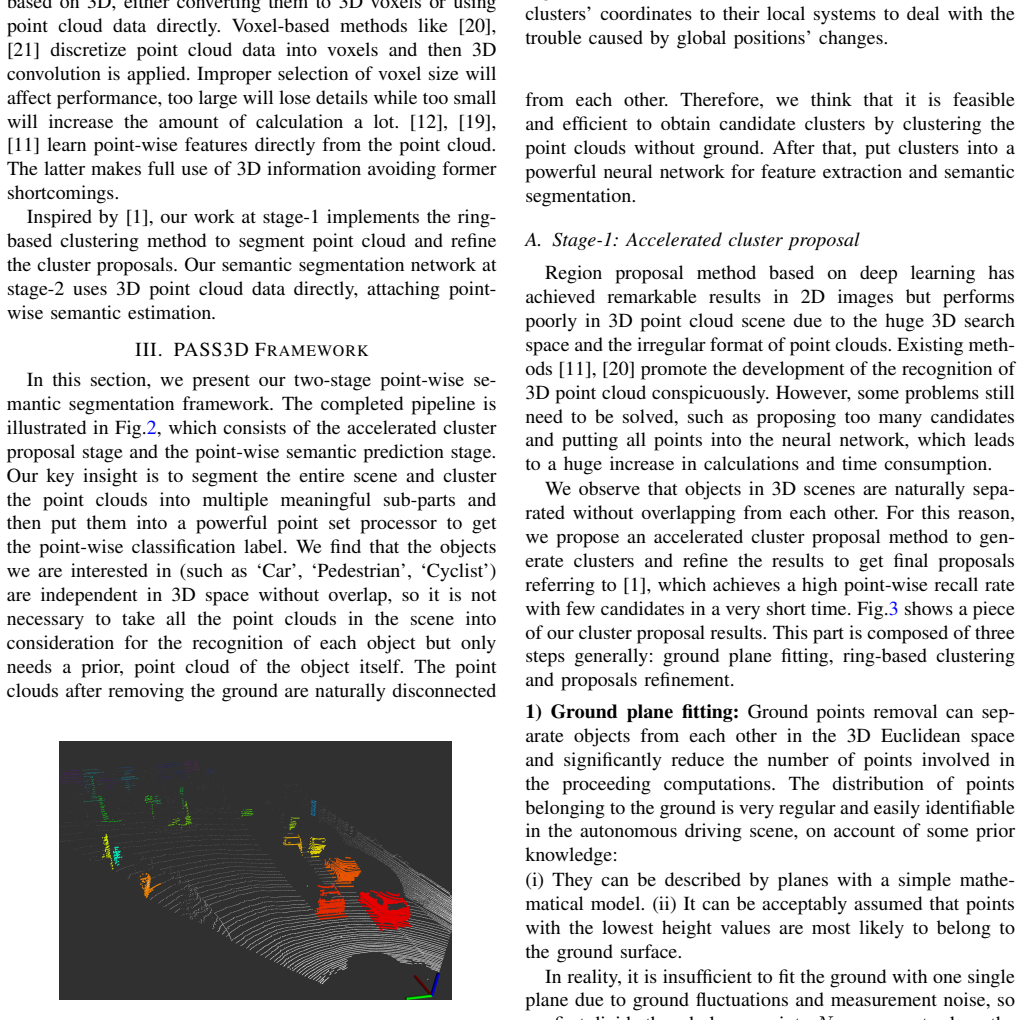
The central mechanism is the accelerated cluster proposal stage. It segments the ground by fitting local plane models, exploits the ordered 64-ring structure of the Velodyne HDL-64E to cluster non-ground points by Euclidean distance thresholds, and refines proposals with adaptive point-count thresholds and enlarged oriented bounding boxes. This turns scene-level segmentation into about 30 local classification problems. The second load-bearing mechanism is stage-2 data preparation: canonical transformation to a local coordinate frame and an eight-way rotation/mirror augmentation that makes the PointNet++ classifier robust to viewpoint and coordinate bias, together with a relative-point-count feature that encodes how many points were sampled away.
What would settle it
A concrete falsifier is a KITTI sequence with pedestrians standing close to cars or cyclists passing beside trees: if stage-1 point-wise recall on those touching-object frames falls well below 89.5% and final IoU drops accordingly, the separated-objects premise fails, and the paper's own report that clustering cars with trees degrades car IoU shows this is measurable.
Extended reading notes
Core claim
PASS3D claims that a two-stage design, geometric proposal generation followed by learned per-point classification, can beat whole-scene and projection-based networks on KITTI raw semantic segmentation. The stage-1 algorithm removes ground, clusters the remaining points with a ring-based method, and refines the clusters into about 30 proposals per frame in 5 ms with 89.5% point-wise recall. Stage-2 transforms each proposal to a local coordinate frame and passes it through a PointNet++-style network with an eight-fold rotation/mirror augmentation and a relative-point-count feature. On the KITTI raw test split the full model reaches 52.8% average IoU, exceeding SqueezeSegv2 by 7.9 mean IoU, with the largest gains on pedestrians (44.3% versus 27.8%) and cyclists (50.8% versus 33.6%); the car IoU is lower than SqueezeSegv2, which the authors trace to stage-1 merging cars with nearby trees.
Load-bearing premise
The central assumption is that after ground removal the objects of interest are spatially separate in 3D, so bottom-up Euclidean clustering groups points of one semantic category together.
Editorial extensions
If this is right
- If stage-1 can generate high-recall proposals in 5 ms, the same proposal mechanism can be reused by other 3D perception tasks such as object detection and tracking, which also need compact object hypotheses.
- The local-coordinate, eight-fold rotation/mirror augmentation is a portable recipe for any LiDAR proposal-based network, since it removes viewpoint bias without synthesizing unrealistic global scenes.
- Because stage-2 consumes only about 5k points per frame instead of the roughly 30k in the full scene, the framework reduces downstream computation by a factor that grows with scene density.
- The large gains on pedestrians and cyclists from augmentation and the relative-point-count feature indicate that hard categories are limited by pose variability and sample sparsity rather than by network capacity.
- The authors' claim that stage-2 remains robust to imperfect proposals implies that even coarser or cheaper proposal generators could be swapped in without retraining the whole system.
Reading between the lines
- Inference: The 7.9 mean-IoU advantage over SqueezeSegv2 may partly reflect the test split and the decision to treat vans, trucks, and trams as background, so a head-to-head on a denser public benchmark would separate architecture gains from evaluation protocol.
- Inference: The reported car/tree merging failure suggests the separated-objects premise is the bottleneck, and a learned or curvature-aware grouping criterion could plausibly raise car IoU above SqueezeSegv2 while preserving the speed of the proposal stage.
- Inference: The eight-fold augmentation should transfer to other non-rigid object classes and other sensor geometries; a direct test would be fine-tuning the same pipeline on data containing motorcycles or animals.
- Inference: Because stage-2 consumes only clusters, the proposal generator is an interchangeable module, so future faster or higher-recall proposal algorithms could be slotted into PASS3D without changing the network.
Signed reviews
Editorial analysis
A structured set of objections, weighed in public.
Referee Report
Summary. The paper proposes PASS3D, a two-stage semantic segmentation framework for LiDAR point clouds. Stage 1 removes ground via piecewise plane fitting, performs ring-based Euclidean clustering, and refines cluster proposals using point-count and bounding-box filters. Stage 2 transforms each proposal into a local coordinate system, applies rotation/reflection data augmentation, samples a fixed number of points, and feeds a PointNet++-style network with features (x, y, z, intensity, relative point count) for per-point classification. Experiments on KITTI raw report 52.8% mean IoU over Car/Pedestrian/Cyclist, beating SqueezeSegv2's 44.9% by 7.9 points, and stage-1 is claimed to produce about 30 proposals per frame at 89.5% point-wise foreground recall in 5 ms.
Significance. If the evaluation were conducted under an identical protocol, the 7.9-point mean-IoU gain over a real-time projection baseline and the large gains on pedestrian and cyclist categories would be practically significant. The local-coordinate data augmentation for non-rigid objects is a simple, plausible contribution, and the stage-1 speed/recall trade-off is attractive. The paper's arithmetic is internally consistent, and Table I gives a clear ablation view. However, the central comparison is weakened by an unreleased and underspecified test split, by single-run results without error bars, and by the absence of any 3D point-based or voxel baseline. These issues must be fixed before the state-of-the-art claim is adequately supported.
major comments (3)
- [IV-A1 / Table I] The mean-IoU comparison in Table I is not apples-to-apples. Section IV-A1 states that the split is 'similar to SqueezeSeg' and that the training/testing split 'will be released,' but it never identifies the KITTI raw sequences or frame indices used for training and testing, nor does it specify how 'DontCare,' 'Van,' 'Truck,' and other labels are mapped to background and how unlabeled points are treated in evaluation. SqueezeSeg and SqueezeSegv2 results were obtained on their own splits and label conventions, so the 7.9-point gap may reflect test-set composition or label mapping rather than a method improvement. The authors should release the exact frame list and evaluation code, or better, retrain and re-evaluate all baselines on the same split.
- [IV-A3 / Table I] The headline numbers are single runs with no error bars. Section IV-A3 says that background samples are randomly discarded during training, and the network sampling step randomly selects or repeats N points; no random seed is reported. Without repeated runs or variance estimates, one cannot distinguish a genuine improvement from run-to-run noise, especially for the smaller Pedestrian and Cyclist classes. Report mean and standard deviation over at least three independent training runs with fixed seeds for all random components.
- [III / IV-C1] The paper's motivating assumption that objects are independent and non-overlapping after ground removal is load-bearing for the stage-1 proposal claim of 89.5% recall with about 30 clusters per frame. Section IV-C1 admits that adjacent cars and trees are clustered into one proposal, which degrades car IoU, showing that this assumption is frequently violated. Please quantify the fraction of mixed-class proposals, report stage-1 precision/recall on the released test split, and analyze how proposal impurity affects the end-to-end result; otherwise the stage-1 advantage over alternative proposal mechanisms is not established.
minor comments (4)
- [IV-C2] The stage-1 evaluation reports only point-wise recall and number of proposals; precision and the hardware used for the 5 ms timing are not specified. Report precision, per-frame timing on the same platform, and variability across frames.
- [II / Table I] Table I compares only against 2D-projection baselines. The paper should either scope the 'state-of-the-art' claim to projection-based real-time road-object segmentation or include a 3D point-based or voxel baseline such as PointNet++ or a voxel network to support the broader claim.
- [IV-A1 / IV-B] The evaluation metric is mean IoU over only Car, Pedestrian, and Cyclist, with background excluded. The paper should state explicitly whether background IoU is intentionally omitted and how points falling in the 'DontCare' or unlabeled regions are handled when computing the reported IoU values.
- [Abstract / VI] The source code and split are promised to be open-sourced, but the manuscript contains no repository link or release details. Provide a URL and, ideally, trained model checkpoints to support reproducibility.
Circularity Check
No significant circularity: headline IoUs are external KITTI raw benchmark measurements; the only self-citation (PoseConvGRU for augmentation inspiration) is not load-bearing.
full rationale
PASS3D's central claims are empirical evaluations on the KITTI raw dataset. The stage-1 recall (89.5% point-wise recall in 5 ms with about 30 proposals) and the stage-2 IoU numbers in Table I are measured outcomes on a held-out split, not quantities derived from the method's own definitions or fitted to the reported values. The 'independent in 3D space without overlap' assumption in Sec. III is a design premise, and the authors explicitly acknowledge its failure mode (car/tree proposals degrading car IoU, Sec. IV-C1); acknowledging a limitation is not circular. The only self-citation is reference [22] (PoseConvGRU), cited as one inspiration for data augmentation; the augmentation method itself is described and tested independently, so this citation is not load-bearing. The skeptic concern about the comparison protocol (unspecified test frames and label mapping relative to SqueezeSegv2) is a correctness and reproducibility risk, not a circularity, because the scores are not constructed from the comparison targets. No equation in the paper defines a prediction in terms of the target it is supposed to predict, and no fitted parameter is renamed as a prediction.
Assumptions & free parameters
free parameters (7)
- Ground-fitting thresholds (Thdist, Thseeds) =
0.3 m, 0.4 m
- Ground-fitting counts (Nseg, Niter, NLPR) =
3, 3, 20
- Ring clustering thresholds (Thring, Thprop) =
0.5 m, 1 m
- Proposal filter Thnum =
30 (adaptive with distance)
- Bounding-box enlargement =
0.1 m x/y, 0.4 m z
- Sampled points N per cluster =
Not stated
- Focal loss weights (alpha, gamma) =
0.25, 2
assumptions (4)
- domain assumption Ground is well approximated by piecewise planes.
- domain assumption Foreground objects are disjoint in Euclidean space after ground removal.
- domain assumption Points are ordered in 64 rings from Velodyne HDL-64E.
- domain assumption Deep-network features trained on augmented local-coordinate clusters transfer to new clusters.
Cite this review
Pith. "Pith review of PASS3D: Precise and Accelerated Semantic Segmentation for 3D Point Cloud." pith.science (2026). https://pith.science/paper/4U4EZUOS
@misc{pith2026190901643,
  author       = {Pith},
  title        = {Pith review of: PASS3D: Precise and Accelerated Semantic Segmentation for 3D Point Cloud},
  year         = {2026},
  howpublished = {\url{https://pith.science/paper/4U4EZUOS}},
  note         = {Machine review of arXiv:1909.01643}
}
read the original abstract
In this paper, we propose PASS3D to achieve point-wise semantic segmentation for 3D point cloud. Our framework combines the efficiency of traditional geometric methods with robustness of deep learning methods, consisting of two stages: At stage-1, our accelerated cluster proposal algorithm will generate refined cluster proposals by segmenting point clouds without ground, capable of generating less redundant proposals with higher recall in an extremely short time; stage-2 we will amplify and further process these proposals by a neural network to estimate semantic label for each point and meanwhile propose a novel data augmentation method to enhance the network's recognition capability for all categories especially for non-rigid objects. Evaluated on KITTI raw dataset, PASS3D stands out against the state-of-the-art on some results, making itself competent to 3D perception in autonomous driving system. Our source code will be open-sourced. A video demonstration is available at https://www.youtube.com/watch?v=cukEqDuP_Qw.
Figures


Figures from the paper (3 more)


Reference graph
Works this paper leans on
-
[1]
Fast segmentation of 3d point clouds: A paradigm on lidar data for autonomous vehicle applications,
D. Zermas, I. Izzat, and N. Papanikolopoulos, “Fast segmentation of 3d point clouds: A paradigm on lidar data for autonomous vehicle applications,” in 2017 IEEE International Conference on Robotics and Automation (ICRA) , pp. 5067–5073, IEEE, 2017
work page 2017
-
[2]
Efficient online segmentation for sparse 3d laser scans,
I. Bogoslavskyi and C. Stachniss, “Efficient online segmentation for sparse 3d laser scans,” PFG – Journal of Photogrammetry, Remote Sensing and Geoinformation Science , pp. 1–12, 2017
work page 2017
-
[3]
Pixor: Real-time 3d object detection from point clouds,
B. Yang, W. Luo, and R. Urtasun, “Pixor: Real-time 3d object detection from point clouds,” in Proceedings of the IEEE Conference on Computer Vision and Pattern Recognition , pp. 7652–7660, 2018
work page 2018
-
[4]
Deep continuous fusion for multi-sensor 3d object detection,
M. Liang, B. Yang, S. Wang, and R. Urtasun, “Deep continuous fusion for multi-sensor 3d object detection,” in Proceedings of the European Conference on Computer Vision (ECCV) , pp. 641–656, 2018
work page 2018
-
[5]
B. Wu, A. Wan, X. Yue, and K. Keutzer, “Squeezeseg: Convolutional neural nets with recurrent crf for real-time road-object segmentation from 3d lidar point cloud,” in 2018 IEEE International Conference on Robotics and Automation (ICRA) , pp. 1887–1893, IEEE, 2018
work page 2018
-
[6]
B. Wu, X. Zhou, S. Zhao, X. Yue, and K. Keutzer, “Squeezesegv2: Improved model structure and unsupervised domain adaptation for road-object segmentation from a lidar point cloud,” arXiv preprint arXiv:1809.08495, 2018
arXiv 2018
-
[7]
Pointseg: Real-time semantic segmentation based on 3d lidar point cloud,
Y . Wang, T. Shi, P. Yun, L. Tai, and M. Liu, “Pointseg: Real-time semantic segmentation based on 3d lidar point cloud,” arXiv preprint arXiv:1807.06288, 2018
arXiv 2018
-
[8]
Frustum pointnets for 3d object detection from rgb-d data,
C. R. Qi, W. Liu, C. Wu, H. Su, and L. J. Guibas, “Frustum pointnets for 3d object detection from rgb-d data,” in Proceedings of the IEEE Conference on Computer Vision and Pattern Recognition , pp. 918– 927, 2018
work page 2018
Show all 24 references
-
[9]
Pointfusion: Deep sensor fusion for 3d bounding box estimation,
D. Xu, D. Anguelov, and A. Jain, “Pointfusion: Deep sensor fusion for 3d bounding box estimation,” in Proceedings of the IEEE Conference on Computer Vision and Pattern Recognition , pp. 244–253, 2018
2018
-
[10]
Joint 3d proposal generation and object detection from view aggregation,
J. Ku, M. Mozifian, J. Lee, A. Harakeh, and S. L. Waslander, “Joint 3d proposal generation and object detection from view aggregation,” in 2018 IEEE/RSJ International Conference on Intelligent Robots and Systems (IROS), pp. 1–8, IEEE, 2018
2018
-
[11]
Pointrcnn: 3d object proposal generation and detection from point cloud,
S. Shi, X. Wang, and H. Li, “Pointrcnn: 3d object proposal generation and detection from point cloud,” arXiv preprint arXiv:1812.04244 , 2018
2018 arXiv
-
[12]
Pointnet: Deep learning on point sets for 3d classification and segmentation,
C. R. Qi, H. Su, K. Mo, and L. J. Guibas, “Pointnet: Deep learning on point sets for 3d classification and segmentation,” in Proceedings of the IEEE Conference on Computer Vision and Pattern Recognition , pp. 652–660, 2017
2017
-
[13]
Vision meets robotics: The kitti dataset,
A. Geiger, P. Lenz, C. Stiller, and R. Urtasun, “Vision meets robotics: The kitti dataset,” International Journal of Robotics Research (IJRR) , 2013
2013
-
[14]
On the segmentation of 3d lidar point clouds,
B. Douillard, J. Underwood, N. Kuntz, V . Vlaskine, A. Quadros, P. Morton, and A. Frenkel, “On the segmentation of 3d lidar point clouds,” in 2011 IEEE International Conference on Robotics and Automation, pp. 2798–2805, IEEE, 2011
2011
-
[15]
Segmentation of 3d lidar data in non-flat urban environments using a local convexity criterion,
F. Moosmann, O. Pink, and C. Stiller, “Segmentation of 3d lidar data in non-flat urban environments using a local convexity criterion,” in 2009 IEEE Intelligent V ehicles Symposium, pp. 215–220, IEEE, 2009
2009
-
[16]
Real-time and accurate segmentation of 3-d point clouds based on gaussian process regression,
M.-O. Shin, G.-M. Oh, S.-W. Kim, and S.-W. Seo, “Real-time and accurate segmentation of 3-d point clouds based on gaussian process regression,” IEEE Transactions on Intelligent Transportation Systems , vol. 18, no. 12, pp. 3363–3377, 2017
2017
-
[17]
What could move? finding cars, pedestrians and bicyclists in 3d laser data,
D. Z. Wang, I. Posner, and P. Newman, “What could move? finding cars, pedestrians and bicyclists in 3d laser data,” in 2012 IEEE International Conference on Robotics and Automation , pp. 4038–4044, IEEE, 2012
2012
-
[18]
Multi-view 3d object de- tection network for autonomous driving,
X. Chen, H. Ma, J. Wan, B. Li, and T. Xia, “Multi-view 3d object de- tection network for autonomous driving,” in Proceedings of the IEEE Conference on Computer Vision and Pattern Recognition , pp. 1907– 1915, 2017
1907
-
[19]
Pointnet++: Deep hierar- chical feature learning on point sets in a metric space,
C. R. Qi, L. Yi, H. Su, and L. J. Guibas, “Pointnet++: Deep hierar- chical feature learning on point sets in a metric space,” in Advances in Neural Information Processing Systems , pp. 5099–5108, 2017
2017
-
[20]
Second: Sparsely embedded convolutional detection,
Y . Yan, Y . Mao, and B. Li, “Second: Sparsely embedded convolutional detection,” Sensors, vol. 18, no. 10, p. 3337, 2018
2018
-
[21]
V oxelnet: End-to-end learning for point cloud based 3d object detection,
Y . Zhou and O. Tuzel, “V oxelnet: End-to-end learning for point cloud based 3d object detection,” in Proceedings of the IEEE Conference on Computer Vision and Pattern Recognition , pp. 4490–4499, 2018
2018
-
[22]
Poseconvgru: A monocular approach for visual ego-motion estimation by learning,
G. Zhai, L. Liu, L. Zhang, and Y . Liu, “Poseconvgru: A monocular approach for visual ego-motion estimation by learning,” arXiv preprint arXiv:1906.08095, 2019
1906 arXiv
-
[23]
Focal loss for dense object detection,
T.-Y . Lin, P. Goyal, R. Girshick, K. He, and P. Doll ´ar, “Focal loss for dense object detection,” in Proceedings of the IEEE international conference on computer vision , pp. 2980–2988, 2017
2017
-
[24]
Faster r-cnn: Towards real- time object detection with region proposal networks,
S. Ren, K. He, R. Girshick, and J. Sun, “Faster r-cnn: Towards real- time object detection with region proposal networks,” in Advances in neural information processing systems , pp. 91–99, 2015
2015
Reviewed August 14, 2026 · model on record in the stance chip above.
Discussion (0). Continue with ORCID to comment.