REVIEW 2 major objections 5 minor 1 cited by
Operator-on-F complements value-equivalence: a planning-time diagnostic for latent world models
T0 review · 2 major / 5 minor · reviewed 2026-08-02 · deepseek-v4-flash
Pith's one-line read Reward checks miss the failure that kills planning
desk verdict A genuinely new planning-time diagnostic that deserves a serious look, but the headline size-sweep correlation rests on a probe-faithfulness assumption the authors flag yet never actually verify on the size axis. read the letter →
The pith
A machine-rendered reading of the paper's core claim, the machinery that carries it, and where it could break.
The reading
What carries the argument
Operator-on-F estimates, per anchor (state, action sequence, true next state), the error |φ(ẑ_{t+k}) − φ(z′_{t+k})| normalized by the across-anchor standard deviation of the true pushforward φ(z′), then aggregates by RMS over functionals φ in a chosen observable set F and over anchors. F can be the value slice {r, V} using the model's own reward and value heads, or full-F which adds a held-out, singular-value-whitened PCA basis fit on the encoded next-state geometry; a probe—ridge regression with λ grid search, or a one-hidden-layer MLP as a control—maps the model's latent space onto F. The comparison runs at each model's native planning horizon, k = 5, with the model's own nonlinear latent
What would settle it
Re-run the size sweep using an alternative readout of F that is hand-designed or trained only on low-dimensional latents: if the 317M operator error falls into the 0.28–0.36 cluster, the -0.90 rank correlation collapses. Alternatively, sweep the MLP-probe width over the cross-architecture comparison: if the LeWM/TD-MPC2 ordering inverts at some width, the disjoint confidence intervals are probe-family artifacts.
Extended reading notes
Core claim
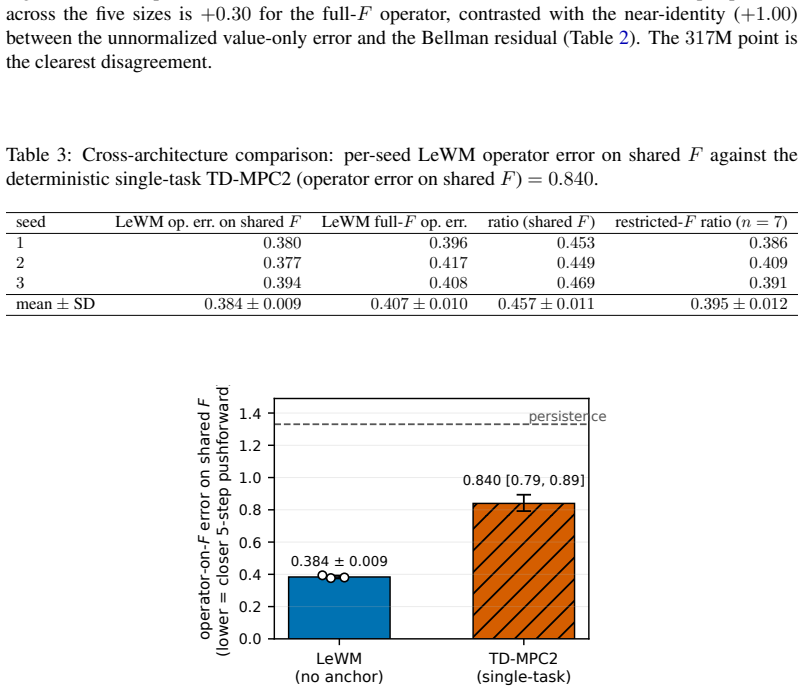
On the released TD-MPC2 mt80 size sweep over cheetah-run, the conventional value-equivalence proxies—unnormalized reward-prediction error and Bellman residual—do not order the five models by return (Spearman -0.30 and -0.10), while the full-F operator-on-F error tracks return loss with Spearman -0.90. The 317M checkpoint is the decisive case: its operator error is 2.62, an order of magnitude above the 0.28–0.36 cluster, and its planning return collapses to 0.9, even though its reward-prediction error (0.091) stays within the same narrow [0.028, 0.091] range as the rest of the sweep. The diagnostic also returns disjoint 95% confidence intervals when comparing a pure-SSL latent world model (0.
Load-bearing premise
The probe reads a shared observable subset F comparably under different latent geometries; if probe capacity or regularization interacts with latent dimensionality, the operator-error gaps and the cross-architecture ordering could be probe artifacts rather than differences in dynamics quality.
Editorial extensions
If this is right
- Reward-prediction error alone can falsely reassure a planner: the 317M model has reward error within the sweep's normal range while its operator error is an order of magnitude worse and its return collapses.
- Reporting both value-equivalence proxies and operator-on-F gives a more complete picture of world-model quality for model selection and for deciding when a latent model is safe to plan with.
- The per-functional normalization by pushforward spread is load-bearing: unnormalized value error is numerically near-identical to the Bellman residual (Spearman +1.00), while the normalized value slice tracks return at Spearman -1.00.
- Operator-on-F extends naturally to models without reward or value heads, such as purely self-supervised latent world models, by comparing on a shared observation-level F.
- The diagnostic's ranking is stable to single-point removal (leave-one-out Spearman ≥ -0.80), so the -0.90 correlation is not carried by any one model size.
Reading between the lines
- If the probe confound is properly controlled, operator-on-F could be used as an online planning-time monitor: recalculated on recent transitions, it might flag latent-model drift or task shift while reward head error remains flat.
- The same pushforward-on-observable-subset idea could be directed at task-relevant or safety-relevant features rather than reward and value, catching planning failures specific to those dimensions.
- The cross-architecture gap, if it generalizes, suggests that architectures trained purely with self-supervised objectives may develop latent rollouts that are closer to the environment's encoded next states on this task—but a two-point, single-environment comparison is too narrow to infer a general trend.
- A natural next test is to run the diagnostic on a reconstruction-anchored architecture as an intermediate point in the architecture spectrum, which would separate the probe effect from the latent-geometry effect more sharply.
Editorial analysis
A structured set of objections, weighed in public.
Referee Report
Summary. The paper proposes a new diagnostic, operator-on-F, for evaluating latent world models in model-based RL. The diagnostic compares the model's k-step latent pushforward to the environment's encoded next-state on a chosen observable subset F, normalizing per-functional errors by the across-anchor spread of the true pushforward. On five released TD-MPC2 mt80 checkpoints on cheetah-run, the paper reports that reward-prediction error varies only ~3× (0.028 to 0.091), while full-F operator error spans 0.28 to 2.62, with the 317M model showing the largest operator error and a planning-return collapse to 0.9. The rank correlation between operator error and return is -0.90 (anchor-bootstrap 95% CI [-0.90, -0.70]; leave-one-out ≥ -0.80). The diagnostic is also applied to a cross-architecture comparison between TD-MPC2 and a pure-SSL LeWM, where LeWM shows lower operator error with disjoint 95% CIs, and this ordering survives a 1-hidden-layer MLP-probe ablation. The paper positions the diagnostic as complementary to value-equivalence, not a replacement, and explicitly limits the claims to the studied environment and checkpoints.
Significance. If the diagnostic is sound, it addresses a real gap in world-model evaluation: reward-prediction and Bellman-residual checks, as conventionally reported, can be insensitive to planning-relevant latent rollout errors. The paper's strengths include measuring against external ground truth (encoded real next states), using each model's own planning-time predictor, reporting bootstrap and leave-one-out analyses, comparing against a persistence baseline, and providing a probe-family ablation for the cross-architecture result. The size-sweep result is intriguing but rests on n=5 in a single environment; the paper is appropriately cautious about this. The main weakness is that the central size-sweep correlation depends on probe faithfulness across different latent geometries, and the promised per-observable probe R² values are not reported for the size sweep, so the probe confound is not fully addressed for the headline result.
major comments (2)
- [§2.2 / Appendix B / Table 2] The paper promises per-observable probe R² alongside every operator-on-F number (§2.2, Appendix B), but Table 2 reports no R² for any of the five TD-MPC2 sizes. This is load-bearing: the size-sweep correlation (Spearman -0.90) and the 317M extreme (2.62 vs. 0.28–0.36) require comparable probe faithfulness across latent geometries. The restricted-F and MLP-probe controls in §4.3/Appendix B cover only the two-architecture comparison. Please report per-observable R² for each size and add a probe-family or restricted-F control for the five-size sweep; otherwise probe asymmetry across latent dimensions (e.g., 768-dim 19M vs. other sizes) could manufacture part of the operator-error spread.
- [§4.1 / Appendix C] Appendix C states that the resolution gap between operator-on-F and the value-equivalence proxies is 'largely a normalization effect' and that the normalized value slice tracks return at Spearman -1.00, but Table 2 does not give per-size values for the normalized value/reward slices. These slices use the model's own reward and value heads and do not require a learned probe, so their per-size numbers would directly test whether the 317M collapse and the size ordering are artifacts of the PCA probe in full-F. Please include those rows in Table 2 or in an appendix table.
minor comments (5)
- [§4.2] The 'kernel-divergence operator' is mentioned without definition or reference. Define it or cite a source so the reader can interpret the Spearman +0.10 comparison.
- [§D] The 'persistence baseline' (1.33 for LeWM, 1.40 for TD-MPC2) is not defined. State how it is computed (e.g., predicting the current state/observation as the next state under the same actions).
- [§2.1] The phrase 'per-anchor PCA basis' is confusing, as the PCA is fit once on a held-out half of the anchor pool (Appendix A). Reword to clarify that the basis is dataset-wide but fit on a held-out split.
- [Abstract / throughout] Minor spacing issues: 'operator-on-Fcomplements', 'oncheetah-run' should be 'operator-on-F complements' and 'on cheetah-run'. Also, 'an order of magnitude above the 0.28–0.36 cluster' is not literally an order of magnitude (2.62/0.28 ≈ 9.4); rephrase to 'roughly an order of magnitude' or '7–9×'.
- [§2.1] The value slice F={r, V} uses the model's own reward and value heads as fixed functionals, but the general definition of the probe φ_F suggests a learned map. Clarify that for reward/value heads the functional is fixed, not learned, so the probe confound applies only to the PCA and observation-level F.
Circularity Check
No significant circularity; the diagnostic is an external measurement against encoded ground-truth next states and executed return, with acknowledged probe and normalization confounds.
full rationale
This is an empirical measurement paper, not a derivation. The operator-on-F error compares each model's own k-step latent pushforward to encoded ground-truth next states on an observable subset F (Appendix A), and the headline correlations are against externally measured episode return. The PCA readout basis is fit on a held-out half of the anchor pool and evaluated on the other half, so it cannot adapt to operator error; no parameter is fitted to return, Bellman residual, or the architecture ordering, and the probe is trained only to map latents to observables. The paper explicitly discloses the main threats to its contribution: Section 5 states 'The probe is a confound, since a shared F across different latent geometries must be read out through a probe,' and Appendix C states 'the resolution gap between operator-on-F and the value-equivalence proxies is thus largely a normalization effect.' Both are measurement/interpretation limitations, not circular reductions: normalized reward/value slices are compared independently and are not used to construct the operator. There is no load-bearing self-citation; TD-MPC2 and LeWM are external released checkpoints, and no uniqueness or ansatz is imported from the author's prior work. The missing per-observable R2 rows in Table 2 (promised in Section 2.2) and the small n=5 are correctness/robustness concerns, not circularity. The central empirical claim remains an external comparison, so the score is 0.
Assumptions & free parameters
free parameters (4)
- Probe regularization λ (ridge) / weight decay α (MLP) =
grid-searched on held-out sub-split; per-model values in released configs
- PCA basis dimension D=16 =
16
- Horizon k=5 =
5
- LeWM training protocol choices (100 epochs, SIGReg active) =
100 epochs, SIGReg
assumptions (4)
- domain assumption The environment's encoded next state enc(s_{t+k}) is a valid ground-truth target for the model's latent pushforward.
- domain assumption A linear (ridge) probe, or the MLP variant, can faithfully read out the observable subset F from different latent geometries.
- domain assumption The released TD-MPC2 mt80 checkpoints and the trained LeWM checkpoints are representative; the measured returns are stable.
- ad hoc to paper Normalizing each functional by the across-anchor spread of the true pushforward is an appropriate scale-free comparison.
Cite this review
Pith. "Pith review of Operator-on-F complements value-equivalence: a planning-time diagnostic for latent world models." pith.science (2026). https://pith.science/paper/4UMRKCWS
@misc{pith2026260704464,
  author       = {Pith},
  title        = {Pith review of: Operator-on-F complements value-equivalence: a planning-time diagnostic for latent world models},
  year         = {2026},
  howpublished = {\url{https://pith.science/paper/4UMRKCWS}},
  note         = {Machine review of arXiv:2607.04464}
}
read the original abstract
World-model evaluation for model-based reinforcement learning typically asks whether the learned model predicts reward and value well, which can leave planning-relevant errors in the model's latent rollouts unmeasured. We introduce a complementary diagnostic, operator-on-F, that compares a model's k-step latent pushforward to the environment's on an observable subset F, using the model's own predictor. On a TD-MPC2 size sweep over cheetah-run, reward-prediction error stays within [0.028, 0.091] for every model size - only about 3x variation - so an unnormalized reward-fit check has narrow resolution to distinguish them; the (unnormalized) Bellman residual and reward error themselves have weak relationships with return (Spearman -0.10 and -0.30). Operator error spans 0.28 to 2.62 over the same sizes. At 317M the operator error is 2.62 - an order of magnitude above the 0.28-0.36 cluster - and the planning return collapses to 0.9, while reward-prediction error (0.091) is the highest of the five but stays within the same small [0.028, 0.091] range as the rest of the sweep. The rank correlation between operator error and return loss is -0.90 (anchor-bootstrap 95% CI [-0.90, -0.70] at n=5 sizes; leave-one-out removal of any single size leaves it at -0.80 or stronger). The operator also returns informative, architecture-discriminating estimates in a cross-architecture comparison between TD-MPC2 and a pure-SSL latent world model. The operator diagnostic complements value-equivalence rather than replacing it.
Figures


Figures from the paper (2 more)

Forward citations
Cited by 1 Pith paper
-
The Rank-One Corner: How Much Value Equivalence Does a Task Need from a World Model?
Objective dimensionality sets the rank of task closure installed in a world-model latent; single-reward value equivalence is the rank-one corner of that law.
Reference graph
Works this paper leans on
-
[1]
Understanding intermediate layers using linear classifier probes
Guillaume Alain and Yoshua Bengio. Understanding intermediate layers using linear classifier probes. In International Conference on Learning Representations Workshop ( ICLR Workshop ) , 2017
2017
-
[2]
LeJEPA : Provable and scalable self-supervised learning without the heuristics, 2025
Randall Balestriero and Yann LeCun. LeJEPA : Provable and scalable self-supervised learning without the heuristics, 2025
2025
-
[3]
The value equivalence principle for model-based reinforcement learning
Christopher Grimm, Andr\'e Barreto, Satinder Singh, and David Silver. The value equivalence principle for model-based reinforcement learning. In Advances in Neural Information Processing Systems, 2020
2020
-
[4]
Proper value equivalence
Christopher Grimm, Andr\'e Barreto, Gregory Farquhar, David Silver, and Satinder Singh. Proper value equivalence. In Advances in Neural Information Processing Systems, 2021
2021
-
[5]
Mastering diverse domains through world models
Danijar Hafner, Jurgis Pasukonis, Jimmy Ba, and Timothy Lillicrap. Mastering diverse domains through world models. arXiv preprint arXiv:2301.04104, 2023
arXiv 2023
-
[6]
TD-MPC2 : Scalable, robust world models for continuous control
Nicklas Hansen, Hao Su, and Xiaolong Wang. TD-MPC2 : Scalable, robust world models for continuous control. In International Conference on Learning Representations, 2024
2024
-
[7]
Designing and interpreting probes with control tasks
John Hewitt and Percy Liang. Designing and interpreting probes with control tasks. In Kentaro Inui, Jing Jiang, Vincent Ng, and Xiaojun Wan (eds.), Proceedings of the 2019 Conference on Empirical Methods in Natural Language Processing and the 9th International Joint Conference on Natural Language Processing (EMNLP-IJCNLP), pp.\ 2733--2743, Hong Kong, Chin...
-
[8]
Linear predictors for nonlinear dynamical systems: K oopman operator meets model predictive control
Milan Korda and Igor Mezi \'c . Linear predictors for nonlinear dynamical systems: K oopman operator meets model predictive control. Automatica, 93: 0 149--160, 2018
2018
Show all 16 references
-
[9]
Task-oriented K oopman-based control with contrastive encoder
Xubo Lyu, Hanyang Hu, Seth Siriya, Ye Pu, and Mo Chen. Task-oriented K oopman-based control with contrastive encoder. In Conference on Robot Learning ( CoRL ) , 2023
2023
-
[10]
LeWorldModel : Stable end-to-end joint-embedding predictive architecture from pixels, 2026
Lucas Maes, Quentin Le Lidec, Damien Scieur, Yann LeCun, and Randall Balestriero. LeWorldModel : Stable end-to-end joint-embedding predictive architecture from pixels, 2026
2026
-
[11]
Spectral properties of dynamical systems, model reduction and decompositions
Igor Mezi \'c . Spectral properties of dynamical systems, model reduction and decompositions. Nonlinear Dynamics, 41 0 (1-3): 0 309--325, 2005
2005
-
[12]
K oopman operator, geometry, and learning of dynamical systems
Igor Mezi \'c . K oopman operator, geometry, and learning of dynamical systems. Notices of the American Mathematical Society, 68 0 (7): 0 1087--1105, 2021. Fully referenced version: arXiv:2010.05377
2021 arXiv
-
[13]
Koopman invariants as drivers of emergent time-series clustering in joint-embedding predictive architectures, 2025
Pablo Ruiz-Morales, Dries Vanoost, Davy Pissoort, and Mathias Verbeke. Koopman invariants as drivers of emergent time-series clustering in joint-embedding predictive architectures, 2025
2025
-
[14]
The predictron: End-to-end learning and planning
David Silver, Hado van Hasselt, Matteo Hessel, Tom Schaul, Arthur Guez, Tim Harley, Gabriel Dulac-Arnold, David Reichert, Neil Rabinowitz, Andr\'e Barreto, and Thomas Degris. The predictron: End-to-end learning and planning. In International Conference on Machine Learning, 2017
2017
-
[15]
DeepMind control suite, 2018
Yuval Tassa, Yotam Doron, Alistair Muldal, Tom Erez, Yazhe Li, Diego de Las Casas, David Budden, Abbas Abdolmaleki, Josh Merel, Andrew Lefrancq, Timothy Lillicrap, and Martin Riedmiller. DeepMind control suite, 2018. arXiv:1801.00690
2018 arXiv
-
[16]
Williams, Ioannis G
Matthew O. Williams, Ioannis G. Kevrekidis, and Clarence W. Rowley. A data-driven approximation of the K oopman operator: Extending dynamic mode decomposition. Journal of Nonlinear Science, 25 0 (6): 0 1307--1346, 2015
2015
Reviewed August 2, 2026 · model on record in the stance chip above.
Discussion (0). Continue with ORCID to comment.