REVIEW 4 major objections 7 minor 45 references
Combating Semantic Contamination in Learning with Label Noise
T0 review · 4 major / 7 minor · reviewed 2026-08-11 · deepseek-v4-flash
Pith's one-line read The paper claims that label refurbishment methods fail because they align logits instead of embeddings, and that its proposed Collaborative Cross Learning method, which learns semantic associations contrastively across views and models…
desk verdict Useful diagnostic framing and solid empirical method, but the 'outperforms SOTA' claim is contradicted by its own Table 1, and the theory covers a simplified loss, not the one actually run. read the letter →
The pith
A machine-rendered reading of the paper's core claim, the machinery that carries it, and where it could break.
The reading
What carries the argument
The load-bearing object is the contrastive embedding distribution $q^{s\to w}$—the distribution over weak-augmentation embeddings given a strong-augmentation anchor—which carries semantic associations without invoking logits. Cross-view learning (CVL) combines a confident-learning prediction term $L_{PG}$ (cross-entropy only when the top predicted probability exceeds threshold $c$), an augmentation-wise contrastive loss $L_{ACL}$ that aligns strong and weak views of the same sample, and a view-wise mimicry KL $L_{VM}$ that makes the two directional contrastive distributions agree. Cross-model learning (CML) adds Collaborative Contrastive Learning on Refurbished Labels (CCLRL), whose positive pairs are samples sharing a refurbished label $y'$ obtained by mixing the noisy label with the peer model's prediction, and a model-wise mimicry KL $L_{MM}$. The theoretical anchor is the inequality $I(f_{\theta_m}(x), f_{\theta_{1-m}}(x)) \geq \log(N) - \mathbb{E}[L_{CCLRL}]$, which connects the practical loss to mutual information between the two models' embeddings.
What would settle it
Train the exact CCLRL loss (same-class positives) on CIFAR-10 with 80% symmetric noise, then compute the empirical mutual information $I(f_0(x), f_1(x))$ over a held-out split; if the inequality $I \geq \log(N) - \mathbb{E}[L_{CCLRL}]$ fails by a large margin, the theoretical grounding does not describe the deployed objective. Alternatively, a baseline that aligns logits but adds heavy embedding regularization would test whether the benefit comes specifically from decoupling semantic learning from logit alignment.
Extended reading notes
Core claim
The central claim is that the logits used in label refurbishment are the wrong carrier of semantic information: aligning logits across views over-concentrates confidence in some classes (semantic imbalance), and aligning logits across models does not produce consistent embedding relationships (semantic inconsistency). Collaborative Cross Learning therefore keeps the refurbished-label supervision for the predicted class—gated by a confidence threshold—but routes all semantic information through contrastive learning on embeddings. Cross-view, it uses an augmentation-wise contrastive loss and a view-wise mimicry KL term; cross-model, it uses Collaborative Contrastive Learning on Refurbished Labels (CCLRL), where positive pairs are same-class samples according to labels refurbished by the peer model, plus a model-wise mimicry term. The paper proves that minimizing CCLRL maximizes a lower bound on the mutual information between the two models' embeddings, and shows empirically that the method outperforms prior art on synthetic and real-world noise benchmarks and achieves better semantic consistency by embedding- and taxonomy-based metrics.
Load-bearing premise
The theoretical guarantee that CCLRL raises mutual information between the two models is proven only for the simplified case where the positive pair is the same image seen by both models, but the deployed loss treats every same-class sample in the batch as a positive pair; if that simplification does not carry over, the mutual-information bound does not apply to the actual objective.
Editorial extensions
If this is right
- If the claim holds, label refurbishment methods should abandon direct logit alignment and instead mine semantic associations in embedding space to avoid Semantic Contamination.
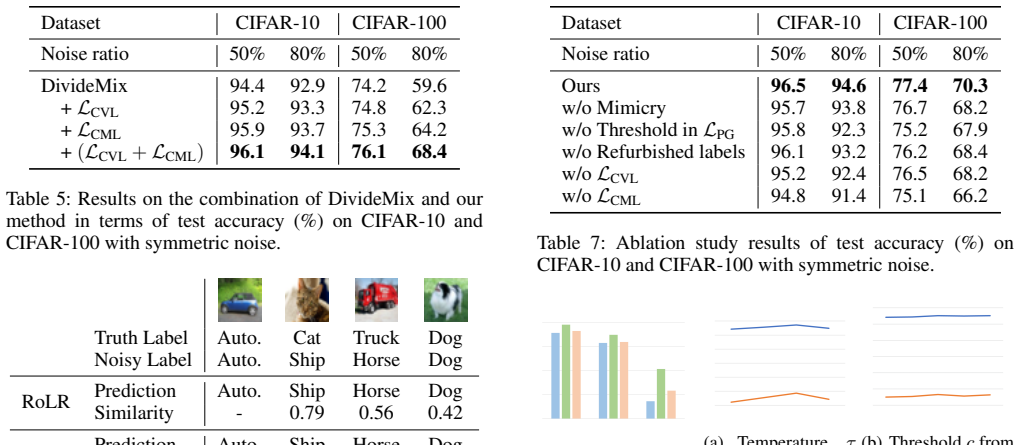
- The CCLR losses can be attached to existing SSL-based LwNL methods such as DivideMix and yield consistent accuracy gains, as shown in the paper's combination experiments.
- The mutual-information lower bound provides a principled justification for using peer-refurbished labels in cross-model contrastive learning.
- The method reports state-of-the-art accuracy under extreme symmetric noise (80% on CIFAR-100, reaching 70.3%) and on several real-world noise benchmarks, suggesting robustness to high noise rates.
Reading between the lines
- Semantic Contamination may be more general than the noisy-label setting: any training signal that aligns outputs without aligning latent spaces, such as distillation or ensemble agreement, could produce similar corrupted semantic ordering; the embedding-based decoupling proposed here is a candidate remedy.
- The CCLRL mutual-information bound is derived for individual positive pairs; whether it holds for the same-class positive loss actually minimized is an open question that could be tested by measuring $I(f_{\theta_m}, f_{\theta_{1-m}})$ directly on a trained model.
- The contrastive distribution mimicry (KL between $q^{s\to w}$ and $q^{w\to s}$) could serve as a generic regularizer for representation learning beyond noise-robust classification.
Signed reviews
Editorial analysis
A structured set of objections, weighed in public.
Referee Report
Summary. The paper introduces a failure mode it calls Semantic Contamination (SC) in label refurbishment methods for learning with noisy labels: refurbishing with view logits is said to produce class-imbalanced semantic structure, while refurbishing with model logits fails to maintain semantic consistency across models. After analyzing RoLR as a representative method, the authors propose Collaborative Cross Learning, composed of Semantic-wise Decoupling with Confident Learning (SDCL) for cross-view learning and Embedding-based Interactive Alignment (EIA) with Collaborative Contrastive Learning on Refurbished Labels (CCLRL) for cross-model learning. A mutual-information lower bound is claimed for CCLRL. Experiments cover CIFAR-10/100 with synthetic symmetric, pair, and instance-dependent noise, plus CIFAR-N, Animal-10N, and WebVision, together with ablations and sensitivity analyses. The paper claims state-of-the-art results on synthetic and real-world noisy datasets.
Significance. If the claimed results held with the reported breadth, the paper would be a useful contribution: the SC concept gives a plausible explanation for a known failure mode of label refurbishment, and the decomposition into prediction guidance versus semantic smoothing, and view alignment versus model alignment, is informative. The empirical study is broad, and the appendix's use of the external class-taxonomy metric LCA is a step toward non-circular validation of the semantic-contamination claim. The paper is also candid about the simplifications in its proof. However, the central empirical claim is stated more strongly than the paper's own Table 1 supports, and the proof of Eq. (11) covers a simplified setting rather than the loss actually optimized in Eq. (9). Both issues need to be repaired before the claimed results can be accepted.
major comments (4)
- [Section 5.2, Table 1] The sentence in Section 5.2 stating that the method 'outperforms the state-of-the-art models across all noisy levels on CIFAR-10/100' is contradicted by Table 1: CrossSplit reports 95.4 versus Ours 94.6 on CIFAR-10 with 80% symmetric noise, CrossSplit reports 79.9 versus 79.5 on CIFAR-100 with 20% symmetric noise, and RankMatch reports 77.6 versus 77.4 on CIFAR-100 with 50% symmetric noise. The Abstract's 'outperforms existing approaches' is therefore too strong as written. Because the paper's central claim is empirical superiority, the authors should replace blanket superiority statements with per-benchmark claims and explicitly acknowledge the cells in which the method is not the best.
- [Tables 1-4; Appendix Implementation Details] None of the tables reports standard deviations or confidence intervals, although the appendix says that results are averaged over 3 trials. Many of the margins over the strongest baselines are 0.1-0.4 percentage points (e.g., 97.0 vs. 96.9 on CIFAR-10 with 20% symmetric noise, and 96.5 vs. 96.3 on CIFAR-10 with 50% symmetric noise), which is within typical run-to-run variation for these benchmarks; conversely, the losses identified in Major Comment 1 may also be within noise. Please report per-seed results and mean +/- std for all numbers produced by the authors, and clearly distinguish numbers copied from published papers from numbers reproduced by the authors, since Table 1 mixes both sources.
- [Appendix, Proof of maximizing the lower bound of the mutual information; Eq. (9)] The proof leading to Eq. (11) assumes a single positive pair consisting of the same input sample under the two models, and the appendix explicitly states that it 'exclusively focus[es] on individual positive sample pairs' and ignores view differences. However, the loss in Eq. (9) that is actually minimized treats all same-class samples in the batch as positives and uses strong augmentations from one model against weak augmentations from the other. The claimed bound I(f\theta_m(x), f\theta_{1-m}(x)) >= log(N) - E[L_CCLRL] therefore does not apply to the deployed objective in any straightforward way. Either the proof needs to be extended to same-class positive pairs and cross-view pairs, or the mutual-information statement should be reframed as motivation rather than as a theorem for CCLRL.
- [Table 6; Appendix Table 8] The main-text evidence that the method reduces Semantic Contamination (Table 6) is partly self-confirming: the reported cosine similarities come from embeddings produced by a model whose training objective is explicitly designed to shape the embedding geometry through the contrastive terms in Eqs. (5), (8), and (9), so favorable geometry is in part a direct optimization outcome rather than an independent measurement. The LCA metric in Table 8 is more independent because it uses an external class taxonomy; please move that analysis (with error bars and more samples) to the main text and present Table 6 as an illustrative example rather than as standalone validation.
minor comments (7)
- [Abstract and Section 5.2] There are several typos in the text ('Aniaml-10N', 'Emebdding-based', 'Pesudo-code', 'shwon'); please proofread the manuscript carefully.
- [Eq. (11)] The subscript q in f\theta_q is undefined; it should presumably be v, i.e., 1-m, matching the notation used elsewhere.
- [Appendix Details of our method; Implementation Details] The appendix says 'For CIFAR-like datasets, we consider the first 30 epochs as warm-up', but the Implementation Details say 'warm-up epoch is 10 epochs for CIFAR-10 and 30 epochs for CIFAR-100'; please reconcile this inconsistency.
- [Experimental Setup] The experimental setup says synthetic noise rates tau_0 in {0.2, 0.4, 0.5, 0.8}, but Table 1 reports only 20%, 50%, and 80% for symmetric and pair noise and 40% for instance-dependent noise; please clarify the exact protocol.
- [Figure 6] The caption says 'variance of hyperparameters' but appears to mean sensitivity to hyperparameter values, and the y-axis of the plots is not labeled.
- [Table 6] Table 6 reports a single illustrative example without error bars or a description of how many samples or batches were used; please add this information or move the example to the appendix.
- [Reproducibility] No code release is mentioned; making the code available would substantiate the reproducibility of the averaged results.
Circularity Check
No significant circularity: the central empirical claims rest on held-out benchmarks and an external taxonomy-based metric, and the theoretical bound is a standard InfoNCE argument, not a restatement of the paper's own inputs.
full rationale
The claimed derivation chain consists of (i) an analysis of why RoLR suffers semantic contamination, (ii) new losses LACL, LVM, LPG, CCLRL, and LMM combined into Eq. (15), and (iii) empirical verification. That verification is against held-out test sets (Tables 1-4), real-world noisy datasets, and the externally defined LCA metric of Shi et al. (2024) in Table 8; none of these accuracies are functions of the fitted parameters or of the new losses by construction. Table 6 is a diagnostic built from training-set embedding similarities, and it is aligned with the contrastive objective, but the paper does not use it as the sole or load-bearing proof of superiority; it is illustrative support for the semantic-contamination mechanism. The theoretical claim (Eq. 11) is a standard InfoNCE mutual-information lower bound whose proof in the Appendix follows Tian et al. (2020) and Yang et al. (2022); it is not derived from the paper's own conclusion. The appendix explicitly restricts the proof to individual positive pairs: 'For the sake of simplicity in the proof, we exclusively focus on individual positive sample pairs, where the same sample is depicted by different models,' while Eq. (9) is optimized over same-class positives. This is a genuine proof-to-loss gap and therefore a correctness risk, but it is not a circular reduction: the bound does not assume the target result, and the deployed objective is not shown to equal the proved objective. No load-bearing self-citation, no fitted-input-called-prediction, and no renamed-known-result step was found. Under the required evidentiary standard, no circular step can be exhibited.
Assumptions & free parameters
free parameters (3)
- confidence threshold c =
0.95
- temperature tau in contrastive losses =
not explicitly stated in main text; sensitivity range 0.05 to 0.9
- sharpen temperature T =
0.5
assumptions (5)
- domain assumption Deep networks learn clean samples before noisy ones (small-loss trick)
- domain assumption Two-component GMM on per-sample cross-entropy separates clean and noisy samples
- ad hoc to paper The contrastive positive pairs in Eq. (9) can be treated as same-sample pairs for the mutual information proof
- domain assumption Synthetic noise is class-conditional with known transition matrix
- standard math Bayes rule and InfoNCE mutual information bound
Cite this review
Pith. "Pith review of Combating Semantic Contamination in Learning with Label Noise." pith.science (2026). https://pith.science/paper/4V7X2Z2X
@misc{pith2026241211620,
  author       = {Pith},
  title        = {Pith review of: Combating Semantic Contamination in Learning with Label Noise},
  year         = {2026},
  howpublished = {\url{https://pith.science/paper/4V7X2Z2X}},
  note         = {Machine review of arXiv:2412.11620}
}
read the original abstract
Noisy labels can negatively impact the performance of deep neural networks. One common solution is label refurbishment, which involves reconstructing noisy labels through predictions and distributions. However, these methods may introduce problematic semantic associations, a phenomenon that we identify as Semantic Contamination. Through an analysis of Robust LR, a representative label refurbishment method, we found that utilizing the logits of views for refurbishment does not adequately balance the semantic information of individual classes. Conversely, using the logits of models fails to maintain consistent semantic relationships across models, which explains why label refurbishment methods frequently encounter issues related to Semantic Contamination. To address this issue, we propose a novel method called Collaborative Cross Learning, which utilizes semi-supervised learning on refurbished labels to extract appropriate semantic associations from embeddings across views and models. Experimental results show that our method outperforms existing approaches on both synthetic and real-world noisy datasets, effectively mitigating the impact of label noise and Semantic Contamination.
Figures


Figures from the paper (3 more)


Reference graph
Works this paper leans on
-
[1]
, " * write output.state after.block = add.period write newline
ENTRY address archivePrefix author booktitle chapter edition editor eid eprint howpublished institution isbn journal key month note number organization pages publisher school series title type volume year label extra.label sort.label short.list INTEGERS output.state before.all mid.sentence after.sentence after.block FUNCTION init.state.consts #0 'before.a...
-
[2]
write newline
" write newline "" before.all 'output.state := FUNCTION n.dashify 't := "" t empty not t #1 #1 substring "-" = t #1 #2 substring "--" = not "--" * t #2 global.max substring 't := t #1 #1 substring "-" = "-" * t #2 global.max substring 't := while if t #1 #1 substring * t #2 global.max substring 't := if while FUNCTION word.in bbl.in capitalize " " * FUNCT...
-
[3]
S.; Maharaj, T.; Fischer, A.; Courville, A
Arpit, D.; Jastrzebski, S.; Ballas, N.; Krueger, D.; Bengio, E.; Kanwal, M. S.; Maharaj, T.; Fischer, A.; Courville, A. C.; Bengio, Y.; and Lacoste - Julien, S. 2017. A Closer Look at Memorization in Deep Networks. 70: 233--242
work page 2017
-
[4]
J.; Papernot, N.; Oliver, A.; and Raffel, C
Berthelot, D.; Carlini, N.; Goodfellow, I. J.; Papernot, N.; Oliver, A.; and Raffel, C. 2019. MixMatch: A Holistic Approach to Semi-Supervised Learning. In Wallach, H. M.; Larochelle, H.; Beygelzimer, A.; d'Alch \' e - Buc, F.; Fox, E. B.; and Garnett, R., eds., Advances in Neural Information Processing Systems 32: Annual Conference on Neural Information ...
work page 2019
-
[5]
Blum, A.; and Mitchell, T. M. 1998. Combining Labeled and Unlabeled Data with Co-Training. In Bartlett, P. L.; and Mansour, Y., eds., Proceedings of the Eleventh Annual Conference on Computational Learning Theory, COLT 1998, Madison, Wisconsin, USA, July 24-26, 1998 , 92--100. ACM
work page 1998
-
[6]
Bochkovskiy, A.; Wang, C.; and Liao, H. M. 2020. YOLOv4: Optimal Speed and Accuracy of Object Detection. CoRR, abs/2004.10934
arXiv 2020
-
[7]
Chen, M.; Cheng, H.; Du, Y.; Xu, M.; Jiang, W.; and Wang, C. 2023. Two Wrongs Don't Make a Right: Combating Confirmation Bias in Learning with Label Noise. In Williams, B.; Chen, Y.; and Neville, J., eds., Thirty-Seventh AAAI Conference on Artificial Intelligence, AAAI 2023, Thirty-Fifth Conference on Innovative Applications of Artificial Intelligence, IA...
work page 2023
-
[8]
Chen, P.; Ye, J.; Chen, G.; Zhao, J.; and Heng, P.-A. 2020. Beyond Class-Conditional Assumption: A Primary Attempt to Combat Instance-Dependent Label Noise. In AAAI Conference on Artificial Intelligence
work page 2020
Show all 45 references
-
[9]
Cheng, D.; Ning, Y.; Wang, N.; Gao, X.; Yang, H.; Du, Y.; Han, B.; and Liu, T. 2022. Class-Dependent Label-Noise Learning with Cycle-Consistency Regularization. In Neural Information Processing Systems
2022
-
[10]
D.; Zoph, B.; Shlens, J.; and Le, Q
Cubuk, E. D.; Zoph, B.; Shlens, J.; and Le, Q. 2020. RandAugment: Practical Automated Data Augmentation with a Reduced Search Space. In Larochelle, H.; Ranzato, M.; Hadsell, R.; Balcan, M.; and Lin, H., eds., Advances in Neural Information Processing Systems 33: Annual Confere...
2020
-
[11]
Deng, J.; Dong, W.; Socher, R.; Li, L.; Li, K.; and Fei - Fei, L. 2009. ImageNet: A large-scale hierarchical image database. In 2009 IEEE Computer Society Conference on Computer Vision and Pattern Recognition (CVPR 2009), 20-25 June 2009, Miami, Florida, USA , 248--255. IEEE C...
2009
-
[12]
Devries, T.; and Taylor, G. W. 2017. Improved Regularization of Convolutional Neural Networks with Cutout. CoRR, abs/1708.04552
2017 arXiv
-
[13]
W.; and Sugiyama, M
Han, B.; Yao, Q.; Yu, X.; Niu, G.; Xu, M.; Hu, W.; Tsang, I. W.; and Sugiyama, M. 2018. Co-teaching: Robust training of deep neural networks with extremely noisy labels . Advances in Neural Information Processing Systems, 2018-Decem(NeurIPS): 8527--8537
2018
-
[14]
He, K.; Zhang, X.; Ren, S.; and Sun, J. 2016. Deep Residual Learning for Image Recognition. In Proceedings of the IEEE Conference on Computer Vision and Pattern Recognition (CVPR)
2016
-
[15]
J.; and Fei-Fei, L
Jiang, L.; Zhou, Z.; Leung, T.; Li, L. J.; and Fei-Fei, L. 2018. Mentornet: Learning data-driven curriculum for very deep neural networks on corrupted labels . 35th International Conference on Machine Learning, ICML 2018, 5(6): 3601--3620
2018
-
[16]
N.; Rahnavard, N.; Mian, A.; and Shah, M
Karim, N.; Rizve, M. N.; Rahnavard, N.; Mian, A.; and Shah, M. 2022. UNICON: Combating Label Noise Through Uniform Selection and Contrastive Learning. In IEEE/CVF Conference on Computer Vision and Pattern Recognition, CVPR 2022, New Orleans, LA, USA, June 18-24, 2022 , 9666--9...
2022
-
[17]
Kim, J.; Baratin, A.; Zhang, Y.; and Lacoste - Julien, S. 2023. CrossSplit: Mitigating Label Noise Memorization through Data Splitting. In Krause, A.; Brunskill, E.; Cho, K.; Engelhardt, B.; Sabato, S.; and Scarlett, J., eds., International Conference on Machine Learning, ICML...
2023
-
[18]
Krizhevsky, A.; Hinton, G.; et al. 2009. Learning multiple layers of features from tiny images
2009
-
[19]
Li, J.; Socher, R.; and Hoi, S. C. H. 2020. DivideMix: Learning with Noisy Labels as Semi-supervised Learning. In 8th International Conference on Learning Representations, ICLR 2020, Addis Ababa, Ethiopia, April 26-30, 2020 . OpenReview.net
2020
-
[20]
Li, S.; Xia, X.; Ge, S.; and Liu, T. 2022. Selective-Supervised Contrastive Learning with Noisy Labels. In IEEE/CVF Conference on Computer Vision and Pattern Recognition, CVPR 2022, New Orleans, LA, USA, June 18-24, 2022 , 316--325. IEEE
2022
-
[21]
Li, W.; Wang, L.; Li, W.; Agustsson, E.; and Gool, L. V. 2017. WebVision Database: Visual Learning and Understanding from Web Data. CoRR, abs/1708.02862
2017 arXiv
-
[22]
Li, Y.; Han, H.; Shan, S.; and Chen, X. 2023. DISC: Learning from Noisy Labels via Dynamic Instance-Specific Selection and Correction. In IEEE/CVF Conference on Computer Vision and Pattern Recognition, CVPR 2023, Vancouver, BC, Canada, June 17-24, 2023 , 24070--24079. IEEE
2023
-
[23]
Lu, Y.; and He, W. 2022. SELC: Self-Ensemble Label Correction Improves Learning with Noisy Labels. In International Joint Conference on Artificial Intelligence
2022
-
[24]
M.; and Bailey, J
Ma, X.; Huang, H.; Wang, Y.; Romano, S.; Erfani, S. M.; and Bailey, J. 2020. Normalized Loss Functions for Deep Learning with Noisy Labels. In Proceedings of the 37th International Conference on Machine Learning, ICML 2020, 13-18 July 2020, Virtual Event , volume 119 of Procee...
2020
-
[25]
when to update
Malach, E.; and Shalev-Shwartz, S. 2017. Decoupling "when to update" from "how to update" . Advances in Neural Information Processing Systems, 2017-Decem: 961--971
2017
-
[26]
T.; Romdhani, S.; and Chen, L
Marriott, R. T.; Romdhani, S.; and Chen, L. 2021. A 3D GAN for Improved Large-Pose Facial Recognition. In IEEE Conference on Computer Vision and Pattern Recognition, CVPR 2021, virtual, June 19-25, 2021 , 13445--13455. Computer Vision Foundation / IEEE
2021
-
[27]
Mikolov, T.; Chen, K.; Corrado, G.; and Dean, J. 2013. Efficient Estimation of Word Representations in Vector Space. In Bengio, Y.; and LeCun, Y., eds., 1st International Conference on Learning Representations, ICLR 2013, Scottsdale, Arizona, USA, May 2-4, 2013, Workshop Track...
2013
-
[28]
R.; Tian, J.; Chai, S.; Lin, Z.; Vasudevan, A
Shi, J.; Gare, G. R.; Tian, J.; Chai, S.; Lin, Z.; Vasudevan, A. B.; Feng, D.; Ferroni, F.; and Kong, S. 2024. LCA-on-the-Line: Benchmarking Out of Distribution Generalization with Class Taxonomies. In Forty-first International Conference on Machine Learning, ICML 2024, Vienna...
2024
-
[29]
D.; Kurakin, A.; and Li, C
Sohn, K.; Berthelot, D.; Carlini, N.; Zhang, Z.; Zhang, H.; Raffel, C.; Cubuk, E. D.; Kurakin, A.; and Li, C. 2020. FixMatch: Simplifying Semi-Supervised Learning with Consistency and Confidence. In Larochelle, H.; Ranzato, M.; Hadsell, R.; Balcan, M.; and Lin, H., eds., Advan...
2020
-
[30]
Song, H.; Kim, M.; and Lee, J. 2019. SELFIE: Refurbishing Unclean Samples for Robust Deep Learning. volume 97 of Proceedings of Machine Learning Research, 5907--5915. PMLR
2019
-
[31]
Song, H.; Kim, M.; Park, D.; and Lee, J. 2020. Learning from Noisy Labels with Deep Neural Networks: A Survey. CoRR, abs/2007.08199
2020 arXiv
-
[32]
Tan, C.; Xia, J.; Wu, L.; and Li, S. Z. 2021. Co-learning: Learning from Noisy Labels with Self-supervision. In Shen, H. T.; Zhuang, Y.; Smith, J. R.; Yang, Y.; Cesar, P.; Metze, F.; and Prabhakaran, B., eds., MM '21: ACM Multimedia Conference, Virtual Event, China, October 20...
2021
-
[33]
Tarvainen, A.; and Valpola, H. 2017. Mean teachers are better role models: Weight-averaged consistency targets improve semi-supervised deep learning results. In Guyon, I.; von Luxburg, U.; Bengio, S.; Wallach, H. M.; Fergus, R.; Vishwanathan, S. V. N.; and Garnett, R., eds., A...
2017
-
[34]
Tian, Y.; Krishnan, D.; and Isola, P. 2020. Contrastive Multiview Coding. In Vedaldi, A.; Bischof, H.; Brox, T.; and Frahm, J., eds., Computer Vision - ECCV 2020 - 16th European Conference, Glasgow, UK, August 23-28, 2020, Proceedings, Part XI , volume 12356 of Lecture Notes i...
2020
-
[35]
Tu, Y.; Zhang, B.; Li, Y.; Liu, L.; Li, J.; Wang, Y.; Wang, C.; and Zhao, C. 2023. Learning from Noisy Labels with Decoupled Meta Label Purifier. In IEEE/CVF Conference on Computer Vision and Pattern Recognition, CVPR 2023, Vancouver, BC, Canada, June 17-24, 2023 , 19934--19943. IEEE
2023
-
[36]
Wang, Y.; Ma, X.; Chen, Z.; Luo, Y.; Yi, J.; and Bailey, J. 2019. Symmetric Cross Entropy for Robust Learning With Noisy Labels. In ICCV 2019, Seoul, Korea (South), October 27 - November 2, 2019 , 322--330. IEEE
2019
-
[37]
Wei, H.; Feng, L.; Chen, X.; and An, B. 2020. Combating Noisy Labels by Agreement: A Joint Training Method with Co-Regularization. In CVPR 2020, Seattle, WA, USA, June 13-19, 2020 , 13723--13732. Computer Vision Foundation / IEEE
2020
-
[38]
Wei, H.; Zhuang, H.; Xie, R.; Feng, L.; Niu, G.; An, B.; and Li, Y. 2023. Mitigating Memorization of Noisy Labels by Clipping the Model Prediction. In ICML 2023
2023
-
[39]
Wei, J.; Zhu, Z.; Cheng, H.; Liu, T.; Niu, G.; and Liu, Y. 2022. Learning with Noisy Labels Revisited: A Study Using Real-World Human Annotations. In ICLR 2022 . OpenReview.net
2022
-
[40]
Wu, Z.; Wei, T.; Jiang, J.; Mao, C.; Tang, M.; and Li, Y. 2021. NGC: A Unified Framework for Learning with Open-World Noisy Data. In 2021 IEEE/CVF International Conference on Computer Vision, ICCV 2021, Montreal, QC, Canada, October 10-17, 2021 , 62--71. IEEE
2021
-
[41]
Yang, C.; An, Z.; Cai, L.; and Xu, Y. 2022. Mutual Contrastive Learning for Visual Representation Learning. In Thirty-Sixth AAAI Conference on Artificial Intelligence, AAAI 2022, Thirty-Fourth Conference on Innovative Applications of Artificial Intelligence, IAAI 2022, The Twe...
2022
-
[42]
W.; and Sugiyama, M
Yu, X.; Han, B.; Yao, J.; Niu, G.; Tsang, I. W.; and Sugiyama, M. 2019. How does disagreement help generalization against label corruption? 36th International Conference on Machine Learning, ICML 2019, 2019-June: 12407--12417
2019
-
[43]
Zhang, C.; Bengio, S.; Hardt, M.; Recht, B.; and Vinyals, O. 2017. Understanding deep learning requires rethinking generalization. In ICLR 2017 . OpenReview.net
2017
-
[44]
Zhang, Z.; Chen, W.; Fang, C.; Li, Z.; Chen, L.; Lin, L.; and Li, G. 2023. RankMatch: Fostering Confidence and Consistency in Learning with Noisy Labels. In IEEE/CVF International Conference on Computer Vision, ICCV 2023, Paris, France, October 1-6, 2023 , 1644--1654. IEEE
2023
-
[45]
Zhang, Z.; and Sabuncu, M. R. 2018. Generalized Cross Entropy Loss for Training Deep Neural Networks with Noisy Labels. In Bengio, S.; Wallach, H. M.; Larochelle, H.; Grauman, K.; Cesa - Bianchi, N.; and Garnett, R., eds., NeurIPS 2018, December 3-8, 2018, Montr \' e al, Canad...
2018
Reviewed August 11, 2026 · model on record in the stance chip above.
Discussion (0). Continue with ORCID to comment.