NeuroAlign: Hierarchical Multimodal Fusion of Dynamic and Structural Neuroimaging for MCI Analysis
Pith reviewed 2026-06-28 17:03 UTC · model grok-4.3
The pith
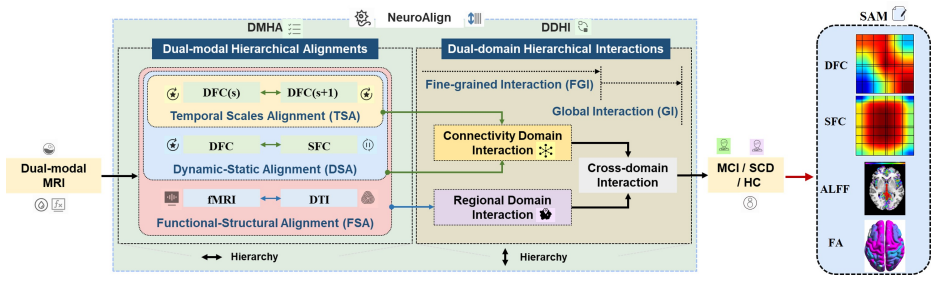
NeuroAlign fuses dynamic fMRI connectivity with static DTI measures via hierarchical alignment and interaction modules to detect mild cognitive impairment.
A machine-rendered reading of the paper's core claim, the machinery that carries it, and where it could break.
Core claim
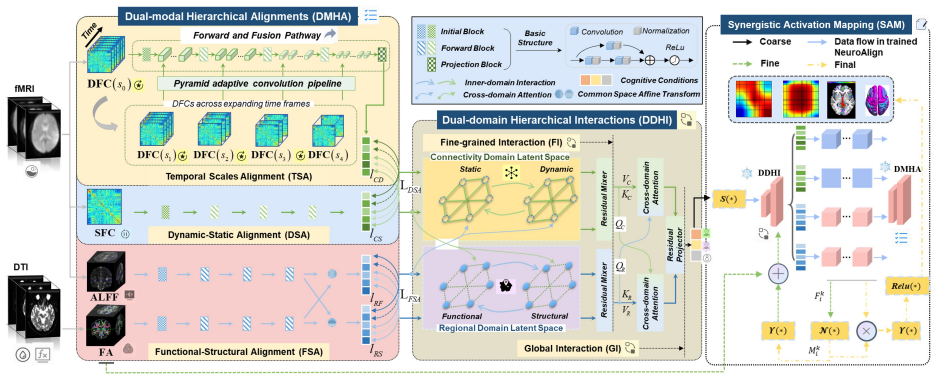
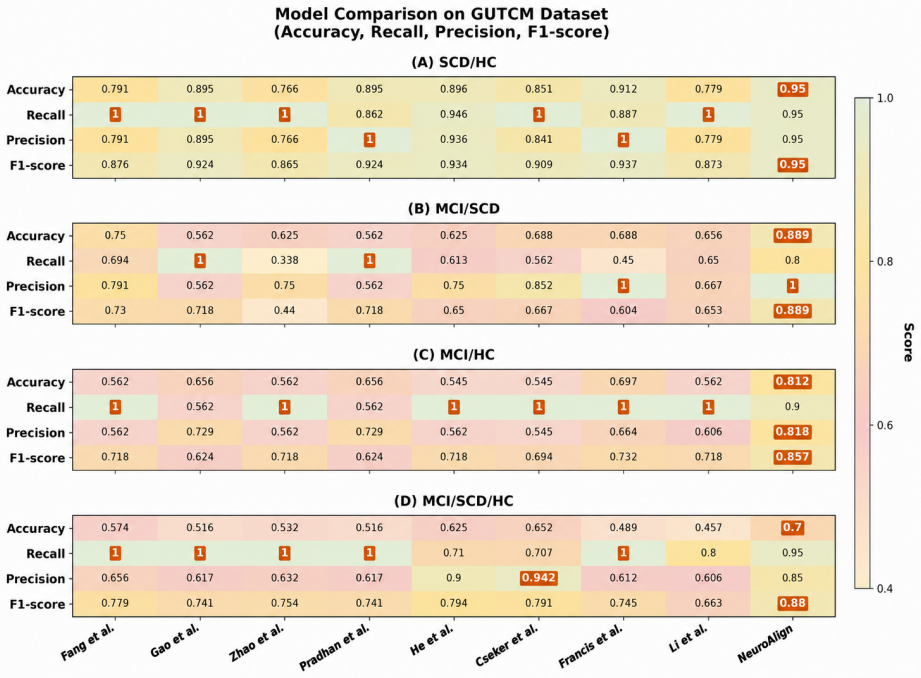
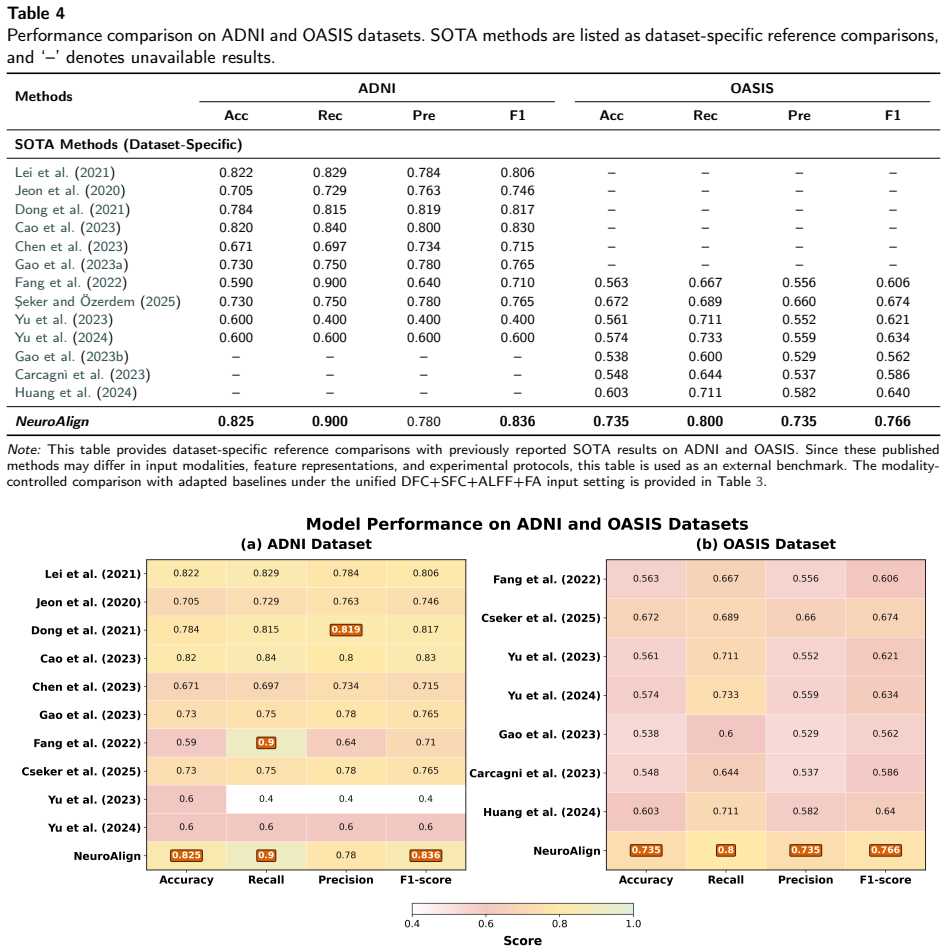
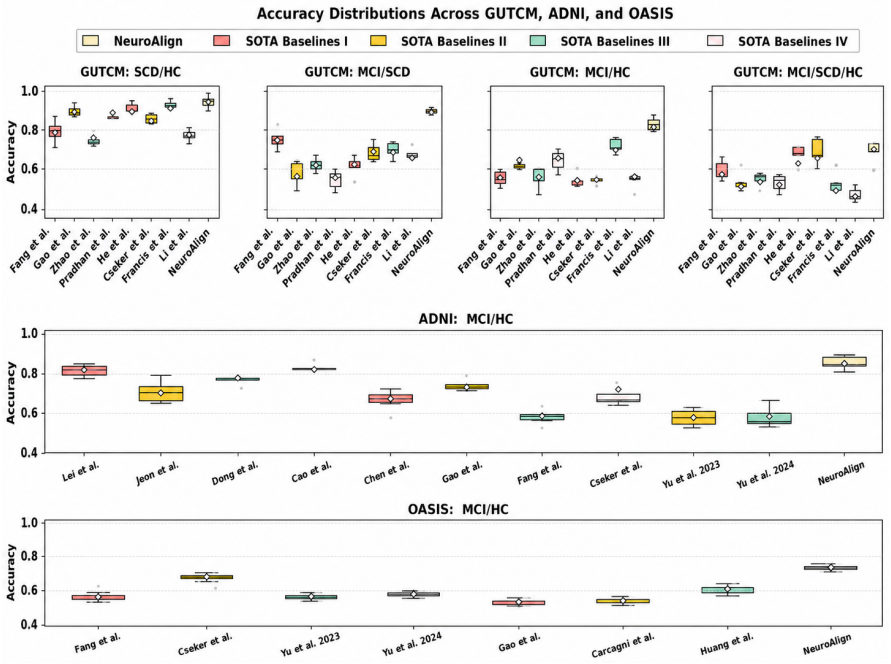
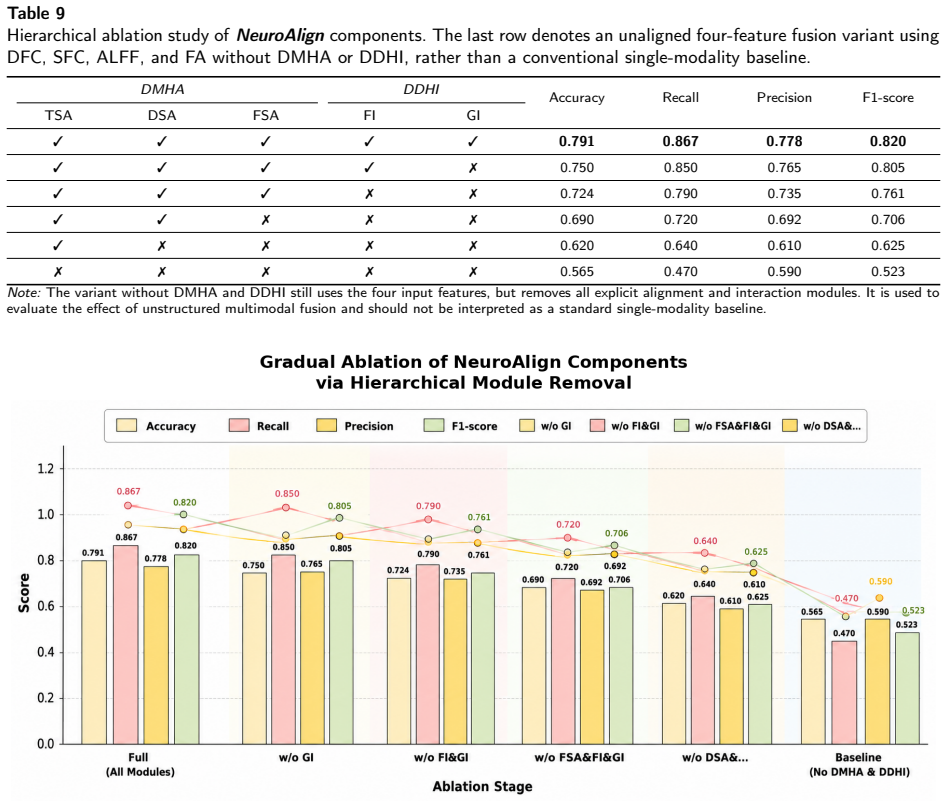
NeuroAlign is a hierarchical framework for structured multimodal fusion of fMRI and DTI that introduces DMHA to align multi-scale dynamic connectivity with static structural embeddings and DDHI to enable fine-grained modulation and global interaction between connectivity- and region-level features, achieving competitive MCI/SCD detection and preliminary cross-dataset transferability on GUTCM, ADNI, and OASIS under five-fold validation while SAM supplies modality-specific attribution.
What carries the argument
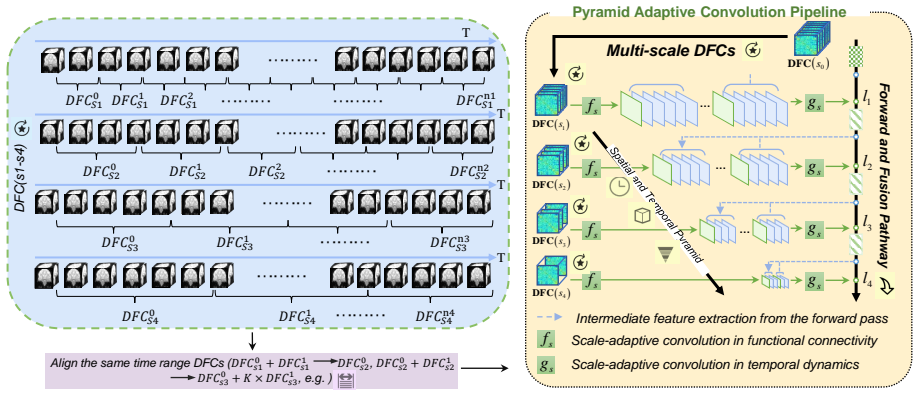
The Dual-Modal Hierarchical Alignment (DMHA) and Dual-Domain Hierarchical Interaction (DDHI) modules that align and interact dynamic functional and static structural neuroimaging features at multiple scales.
If this is right
- Competitive MCI/SCD detection performance under five-fold validation on three datasets.
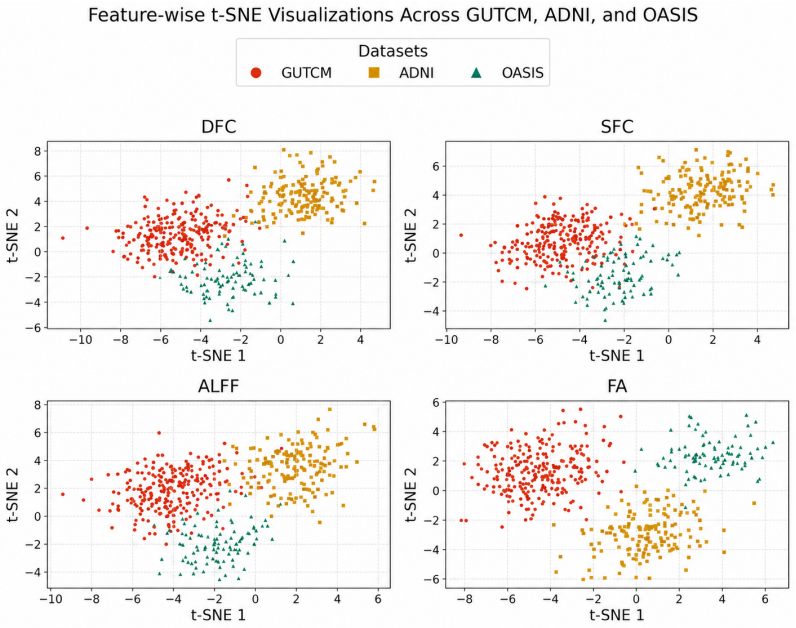
- Preliminary ability to transfer across GUTCM, ADNI, and OASIS.
- Modality-specific and partially consistent brain patterns identified by attribution analysis.
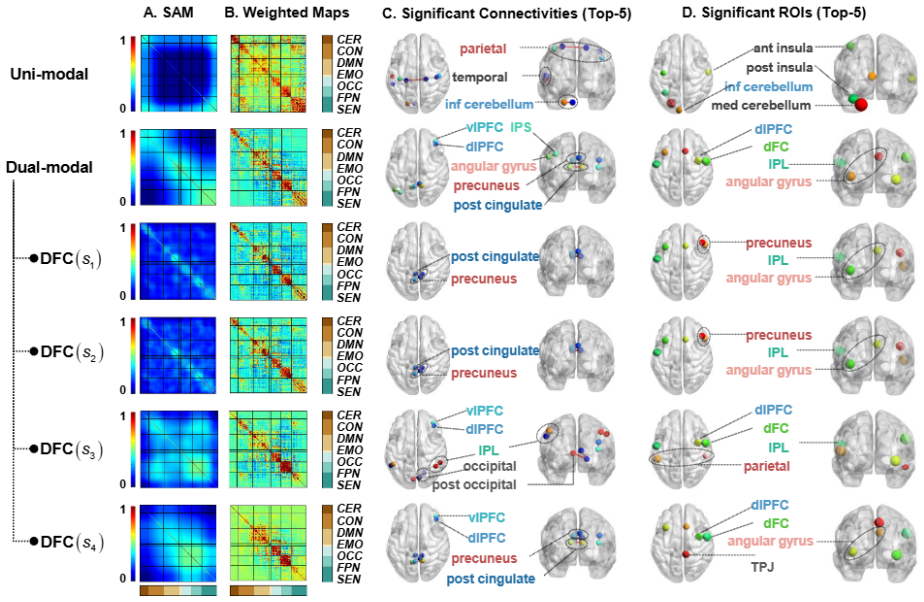
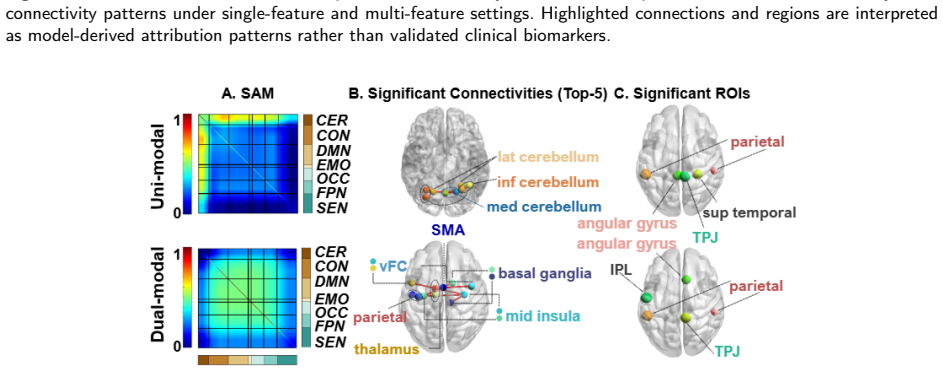
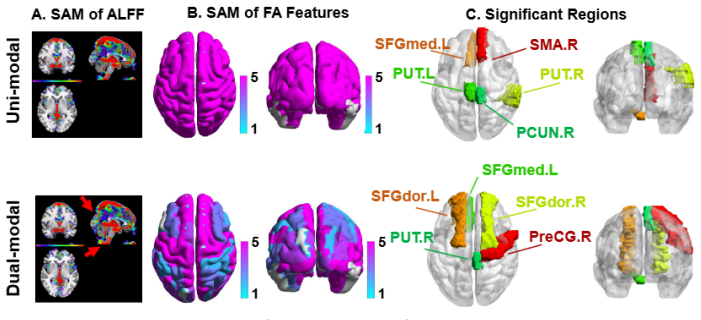
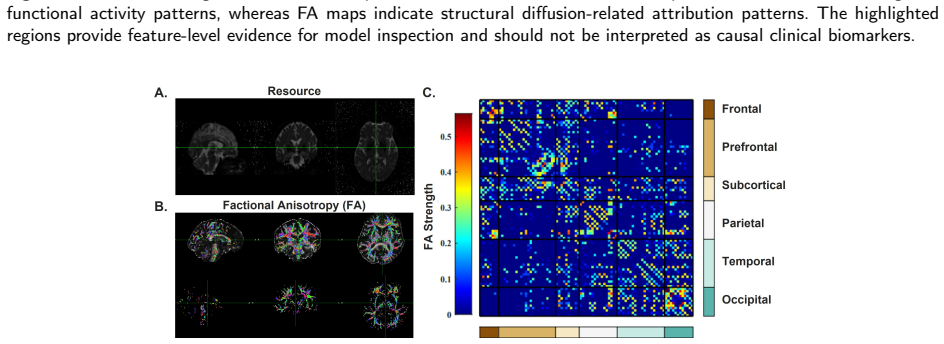
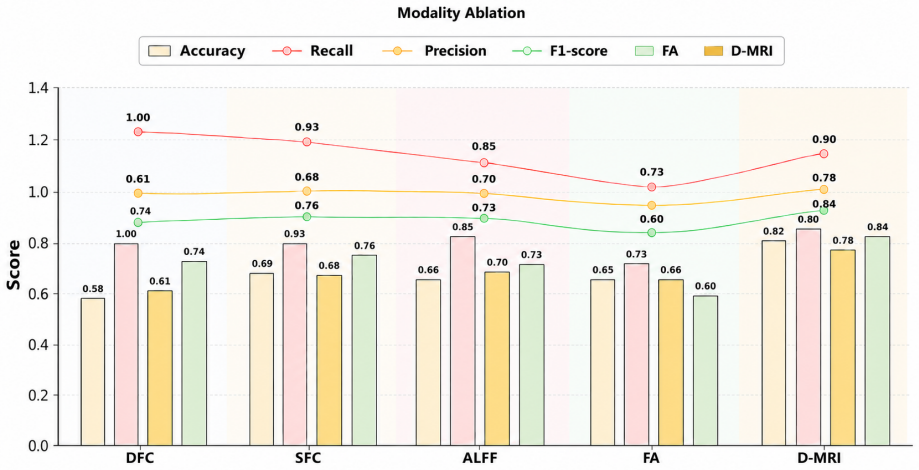
- Feature-level inspection enabled by the gradient-free SAM method for DFC, SFC, ALFF, and FA.
Where Pith is reading between the lines
- Successful alignment without diagnostic loss would support routine clinical use of combined fMRI-DTI protocols for early cognitive-impairment screening.
- The hierarchical structure could be tested on other connectivity-related disorders such as epilepsy or depression.
- Cross-dataset transfer results suggest the modules may reduce site-specific biases in larger multi-center studies.
- SAM attributions could be compared against established lesion studies to check whether identified regions align with known pathology.
Load-bearing premise
The heterogeneous feature spaces of dynamic fMRI connectivity and static DTI structural measures can be effectively aligned and interacted via the DMHA and DDHI modules without loss of diagnostic information.
What would settle it
A head-to-head test in which single-modality baselines exceed NeuroAlign accuracy on MCI detection or in which cross-dataset accuracy falls substantially below within-dataset accuracy would falsify the central claim.
Figures
read the original abstract
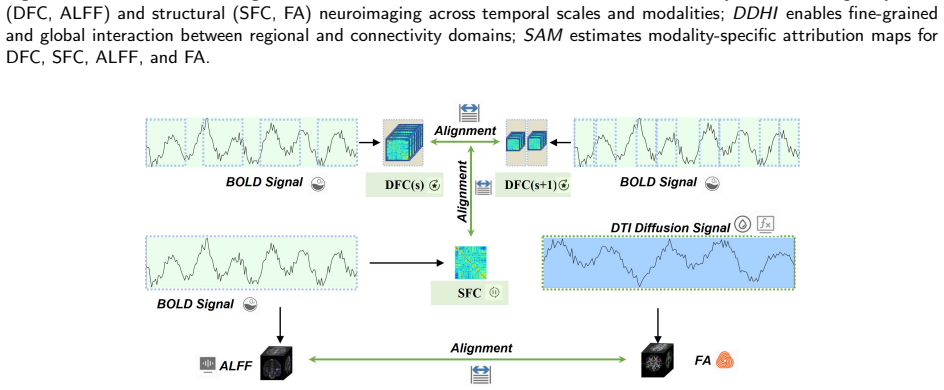
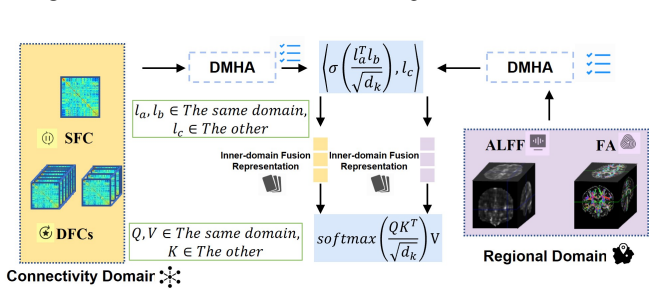
Multimodal neuroimaging fusion of functional MRI (fMRI) and diffusion tensor imaging (DTI) provides complementary information for cognitive impairment analysis, but remains challenged by heterogeneous feature spaces and misaligned representations. We propose \textit{NeuroAlign}, a hierarchical framework for structured multimodal fusion. It introduces (1) \textit{Dual-Modal Hierarchical Alignment} (DMHA), which models multi-scale dynamic connectivity and aligns dynamic-static and functional-structural embeddings; and (2) \textit{Dual-Domain Hierarchical Interaction} (DDHI), which enables fine-grained modulation and global interaction between connectivity- and region-level features. To support feature-level inspection, we design \textit{Synergistic Activation Mapping} (SAM), a gradient-free, marker-oriented attribution method for DFC, SFC, ALFF, and FA. Evaluated on GUTCM, ADNI, and OASIS under five-fold validation, NeuroAlign achieves competitive MCI/SCD detection and preliminary cross-dataset transferability. Attribution analyses reveal modality-specific and partially consistent brain patterns, providing model-derived evidence for multimodal representation analysis.
Editorial analysis
A structured set of objections, weighed in public.
Referee Report
Summary. The paper proposes NeuroAlign, a hierarchical multimodal fusion framework for analyzing mild cognitive impairment (MCI) and subjective cognitive decline (SCD) using dynamic functional MRI (fMRI) connectivity and static diffusion tensor imaging (DTI) structural measures. It introduces Dual-Modal Hierarchical Alignment (DMHA) to model multi-scale dynamic connectivity and align dynamic-static and functional-structural embeddings, Dual-Domain Hierarchical Interaction (DDHI) for fine-grained modulation and global interaction between connectivity- and region-level features, and Synergistic Activation Mapping (SAM) as a gradient-free attribution method for DFC, SFC, ALFF, and FA. The framework is evaluated on the GUTCM, ADNI, and OASIS datasets under five-fold cross-validation, with claims of competitive detection performance and preliminary cross-dataset transferability, plus modality-specific brain pattern insights from attribution analyses.
Significance. If the empirical results and alignment claims hold with proper validation, the work could advance multimodal neuroimaging fusion by addressing heterogeneous feature spaces in fMRI-DTI integration for cognitive impairment analysis. The hierarchical design and gradient-free attribution method offer potential for improved interpretability, though the absence of quantitative benchmarks limits assessment of practical impact.
major comments (1)
- [Abstract] Abstract: The central claim of achieving 'competitive MCI/SCD detection and preliminary cross-dataset transferability' under five-fold validation is unsupported by any quantitative metrics, tables, error bars, ablation studies, or baseline comparisons. This absence prevents evaluation of the DMHA and DDHI modules' effectiveness in aligning heterogeneous spaces without diagnostic information loss.
Simulated Author's Rebuttal
We thank the referee for their detailed feedback. We agree that the abstract would benefit from explicit quantitative support for the stated claims and will revise it accordingly to include key metrics, variability measures, and references to supporting analyses from the full manuscript.
read point-by-point responses
-
Referee: [Abstract] Abstract: The central claim of achieving 'competitive MCI/SCD detection and preliminary cross-dataset transferability' under five-fold validation is unsupported by any quantitative metrics, tables, error bars, ablation studies, or baseline comparisons. This absence prevents evaluation of the DMHA and DDHI modules' effectiveness in aligning heterogeneous spaces without diagnostic information loss.
Authors: The full manuscript reports all requested elements in Sections 4.1–4.3 and Tables 1–4: five-fold cross-validation results with means and standard deviations, direct baseline comparisons, and ablation studies isolating DMHA and DDHI. These experiments demonstrate that the modules improve detection performance on heterogeneous fMRI-DTI features relative to unimodal and alternative multimodal approaches, indicating preservation of diagnostic information. Nevertheless, we acknowledge that the abstract itself does not contain these specifics. We will revise the abstract to state representative quantitative outcomes (accuracy/AUC with standard deviations), note the ablation evidence for module effectiveness, and reference the cross-dataset transfer results. This change will make the claims immediately verifiable from the abstract. revision: yes
Circularity Check
No significant circularity; derivation chain not inspectable from abstract
full rationale
The provided text consists solely of the abstract, which describes the NeuroAlign framework, DMHA and DDHI modules, SAM attribution, and empirical results on GUTCM/ADNI/OASIS without any equations, derivations, parameter-fitting details, or self-citations. No load-bearing steps can be identified that reduce to inputs by construction, as no technical content exists to analyze for self-definitional mappings, fitted predictions, or imported uniqueness claims. The derivation is therefore self-contained by default in the absence of inspectable material.
Axiom & Free-Parameter Ledger
Reference graph
Works this paper leans on
-
[1]
IEEE Transactions on Knowledge and Data Engineering , volume=
Rdgt: enhancing group cognitive diagnosis with relation-guided dual-side graph transformer , author=. IEEE Transactions on Knowledge and Data Engineering , volume=. 2024 , publisher=
2024
-
[2]
Communication, Simulation, and Intelligent Agents: Implications of Personal Intelligent Machines for Medical Education
Clancey, William J. Communication, Simulation, and Intelligent Agents: Implications of Personal Intelligent Machines for Medical Education. Proceedings of the Eighth International Joint Conference on Artificial Intelligence (IJCAI-83)
-
[3]
Classification Problem Solving
Clancey, William J. Classification Problem Solving. Proceedings of the Fourth National Conference on Artificial Intelligence
-
[4]
Biomedical Signal Processing and Control , volume=
Investigating convolutional and transformer-based models for classifying Mild Cognitive Impairment using 2D spectral images of resting-state EEG , author=. Biomedical Signal Processing and Control , volume=. 2025 , publisher=
2025
-
[5]
IEEE Journal of Biomedical and Health Informatics , volume=
A hybrid multi-scale attention convolution and aging transformer network for Alzheimer's disease diagnosis , author=. IEEE Journal of Biomedical and Health Informatics , volume=. 2023 , publisher=
2023
-
[6]
Multimedia Tools and Applications , volume=
Re-transfer learning and multi-modal learning assisted early diagnosis of Alzheimer’s disease , author=. Multimedia Tools and Applications , volume=. 2022 , publisher=
2022
-
[7]
International Forum on Digital TV and Wireless Multimedia Communications , pages=
Depression Recognition Based on Pre-trained ResNet-18 Model and Brain Effective Connectivity Network , author=. International Forum on Digital TV and Wireless Multimedia Communications , pages=. 2023 , organization=
2023
-
[8]
SN Computer Science , volume=
Advance Convolutional Network Architecture for MRI Data Investigation for Alzheimer's Disease Early Diagnosis , author=. SN Computer Science , volume=. 2024 , publisher=
2024
-
[9]
Computers in Biology and Medicine , volume=
Transformer attention-based neural network for cognitive score estimation from sMRI data , author=. Computers in Biology and Medicine , volume=. 2025 , publisher=
2025
-
[10]
Computers in Biology and Medicine , volume=
A spatiotemporal graph transformer approach for Alzheimer’s disease diagnosis with rs-fMRI , author=. Computers in Biology and Medicine , volume=. 2024 , publisher=
2024
-
[11]
Frontiers in Neuroinformatics , volume=
Deep CNN ResNet-18 based model with attention and transfer learning for Alzheimer's disease detection , author=. Frontiers in Neuroinformatics , volume=. 2025 , publisher=
2025
-
[12]
Cerebral Cortex , volume=
Default mode network scaffolds immature frontoparietal network in cognitive development , author=. Cerebral Cortex , volume=. 2023 , publisher=
2023
-
[13]
IEEE Journal of Biomedical and Health Informatics , volume=
Multi-graph attention networks with bilinear convolution for diagnosis of schizophrenia , author=. IEEE Journal of Biomedical and Health Informatics , volume=. 2023 , publisher=
2023
-
[14]
IEEE Journal of Biomedical and Health Informatics , year=
Ensemble Vision Transformer for Dementia Diagnosis , author=. IEEE Journal of Biomedical and Health Informatics , year=
-
[15]
Sensors , volume=
Convolution neural networks and self-attention learners for Alzheimer dementia diagnosis from brain MRI , author=. Sensors , volume=. 2023 , publisher=
2023
-
[16]
Computerized Medical Imaging and Graphics , volume=
Multimodal transformer network for incomplete image generation and diagnosis of Alzheimer’s disease , author=. Computerized Medical Imaging and Graphics , volume=. 2023 , publisher=
2023
-
[17]
Proceedings of the European conference on computer vision (ECCV) , pages=
Cbam: Convolutional block attention module , author=. Proceedings of the European conference on computer vision (ECCV) , pages=
-
[18]
Proceedings of the AAAI conference on artificial intelligence , volume=
Inception-v4, inception-resnet and the impact of residual connections on learning , author=. Proceedings of the AAAI conference on artificial intelligence , volume=
-
[19]
Frontiers in human neuroscience , volume=
PANDA: a pipeline toolbox for analyzing brain diffusion images , author=. Frontiers in human neuroscience , volume=. 2013 , publisher=
2013
-
[20]
pipeline
DPARSF: a MATLAB toolbox for" pipeline" data analysis of resting-state fMRI , author=. Frontiers in systems neuroscience , volume=. 2010 , publisher=
2010
-
[21]
Neuroimage , volume=
Automated anatomical labeling of activations in SPM using a macroscopic anatomical parcellation of the MNI MRI single-subject brain , author=. Neuroimage , volume=. 2002 , publisher=
2002
-
[22]
Neurology , volume=
Alzheimer's disease Neuroimaging Initiative (ADNI) clinical characterization , author=. Neurology , volume=. 2010 , publisher=
2010
-
[23]
Proceedings of the IEEE/CVF conference on computer vision and pattern recognition workshops , pages=
Score-CAM: Score-weighted visual explanations for convolutional neural networks , author=. Proceedings of the IEEE/CVF conference on computer vision and pattern recognition workshops , pages=
-
[24]
Proceedings of the IEEE/CVF conference on computer vision and pattern recognition , pages=
Multi-modality cross attention network for image and sentence matching , author=. Proceedings of the IEEE/CVF conference on computer vision and pattern recognition , pages=
-
[25]
Advances in neural information processing systems , volume=
Attention is all you need , author=. Advances in neural information processing systems , volume=
-
[26]
Proceedings of the IEEE/CVF conference on computer vision and pattern recognition , pages=
What makes training multi-modal classification networks hard? , author=. Proceedings of the IEEE/CVF conference on computer vision and pattern recognition , pages=
-
[27]
IEEE Transactions on Medical Imaging , volume=
MuRCL: Multi-instance reinforcement contrastive learning for whole slide image classification , author=. IEEE Transactions on Medical Imaging , volume=. 2022 , publisher=
2022
-
[28]
Neuroimage , volume=
Dynamic functional connectivity: promise, issues, and interpretations , author=. Neuroimage , volume=. 2013 , publisher=
2013
-
[29]
IEEE Transactions on Medical Imaging , volume=
Multi-scale pathological fluid segmentation in OCT with a novel curvature loss in convolutional neural network , author=. IEEE Transactions on Medical Imaging , volume=. 2022 , publisher=
2022
-
[30]
IEEE Transactions on Medical Imaging , volume=
Multi-organ segmentation over partially labeled datasets with multi-scale feature abstraction , author=. IEEE Transactions on Medical Imaging , volume=. 2020 , publisher=
2020
-
[31]
Neuroimage , volume=
Single-scale time-dependent window-sizes in sliding-window dynamic functional connectivity analysis: a validation study , author=. Neuroimage , volume=. 2020 , publisher=
2020
-
[32]
Journal of neuroscience methods , volume=
Weighted average of shared trajectory: A new estimator for dynamic functional connectivity efficiently estimates both rapid and slow changes over time , author=. Journal of neuroscience methods , volume=. 2020 , publisher=
2020
-
[33]
Proceedings of the IEEE international conference on computer vision , pages=
Grad-cam: Visual explanations from deep networks via gradient-based localization , author=. Proceedings of the IEEE international conference on computer vision , pages=
-
[34]
Information Sciences , volume=
PCG-CAM: Enhanced class activation map using principal components of gradients and its applications in brain MRI , author=. Information Sciences , volume=. 2025 , publisher=
2025
-
[35]
Alzheimer's research & therapy , volume=
Dynamic functional connectivity patterns associated with dementia risk , author=. Alzheimer's research & therapy , volume=. 2022 , publisher=
2022
-
[36]
Frontiers in Aging Neuroscience , volume=
Disrupted dynamic functional connectivity in distinguishing subjective cognitive decline and amnestic mild cognitive impairment based on the triple-network model , author=. Frontiers in Aging Neuroscience , volume=. 2021 , publisher=
2021
-
[37]
Alzheimer's & Dementia , volume=
Differences in functional connectivity amongst older adults with mild cognitive impairment, subjective cognitive decline or normal cognition , author=. Alzheimer's & Dementia , volume=. 2021 , publisher=
2021
-
[38]
Frontiers in neuroscience , volume=
Gradual disturbances of the amplitude of low-frequency fluctuations (ALFF) and fractional ALFF in Alzheimer spectrum , author=. Frontiers in neuroscience , volume=. 2018 , publisher=
2018
-
[39]
Human brain mapping , volume=
Cognitive functions correlate with white matter architecture in a normal pediatric population: a diffusion tensor MRI study , author=. Human brain mapping , volume=. 2005 , publisher=
2005
-
[40]
Medical Image Analysis , volume=
Orthogonal latent space learning with feature weighting and graph learning for multimodal Alzheimer’s disease diagnosis , author=. Medical Image Analysis , volume=. 2023 , publisher=
2023
-
[41]
IEEE transactions on medical imaging , volume=
Multi-class ASD classification based on functional connectivity and functional correlation tensor via multi-source domain adaptation and multi-view sparse representation , author=. IEEE transactions on medical imaging , volume=. 2020 , publisher=
2020
-
[42]
IEEE Transactions on Biomedical Engineering , volume=
A novel approach analysing the dynamic brain functional connectivity for improved MCI detection , author=. IEEE Transactions on Biomedical Engineering , volume=. 2023 , publisher=
2023
-
[43]
Machine Learning in Medical Imaging: 12th International Workshop, MLMI 2021, Held in Conjunction with MICCAI 2021, Strasbourg, France, September 27, 2021, Proceedings 12 , pages=
Integration of handcrafted and embedded features from functional connectivity network with rs-fmri forbrain disease classification , author=. Machine Learning in Medical Imaging: 12th International Workshop, MLMI 2021, Held in Conjunction with MICCAI 2021, Strasbourg, France, September 27, 2021, Proceedings 12 , pages=. 2021 , organization=
2021
-
[44]
Medical Image Computing and Computer Assisted Intervention--MICCAI 2020: 23rd International Conference, Lima, Peru, October 4--8, 2020, Proceedings, Part VII 23 , pages=
Enriched representation learning in resting-state fMRI for early MCI diagnosis , author=. Medical Image Computing and Computer Assisted Intervention--MICCAI 2020: 23rd International Conference, Lima, Peru, October 4--8, 2020, Proceedings, Part VII 23 , pages=. 2020 , organization=
2020
-
[45]
Scientific Reports , volume=
Automated detection of Alzheimer’s disease: a multi-modal approach with 3D MRI and amyloid PET , author=. Scientific Reports , volume=. 2024 , publisher=
2024
-
[46]
Frontiers in Aging Neuroscience , volume=
Functional connectivity dynamics altered of the resting brain in subjective cognitive decline , author=. Frontiers in Aging Neuroscience , volume=. 2022 , publisher=
2022
-
[47]
Medical Image Analysis , volume=
Auto-weighted centralised multi-task learning via integrating functional and structural connectivity for subjective cognitive decline diagnosis , author=. Medical Image Analysis , volume=. 2021 , publisher=
2021
-
[48]
Computerized Medical Imaging and Graphics , volume=
Self-attentional microvessel segmentation via squeeze-excitation transformer Unet , author=. Computerized Medical Imaging and Graphics , volume=. 2022 , publisher=
2022
-
[49]
IEEE Transactions on Biomedical Engineering , volume=
Biomarkers for Alzheimer's disease defined by a novel brain functional network measure , author=. IEEE Transactions on Biomedical Engineering , volume=. 2018 , publisher=
2018
-
[50]
Human brain mapping , volume=
Test--retest reliability of dynamic functional connectivity in naturalistic paradigm functional magnetic resonance imaging , author=. Human brain mapping , volume=. 2022 , publisher=
2022
-
[51]
Human Brain Mapping , volume=
Validating dynamicity in resting state fMRI with activation-informed temporal segmentation , author=. Human Brain Mapping , volume=. 2021 , publisher=
2021
-
[52]
Aberrant static and dynamic functional patterns of frontoparietal control network in antipsychotic-na
Briend, Frederic and Armstrong, William P and Kraguljac, Nina V and Keilhloz, Shella D and Lahti, Adrienne C , journal=. Aberrant static and dynamic functional patterns of frontoparietal control network in antipsychotic-na. 2020 , publisher=
2020
-
[53]
IEEE transactions on medical imaging , volume=
Deep learning of static and dynamic brain functional networks for early MCI detection , author=. IEEE transactions on medical imaging , volume=. 2019 , publisher=
2019
-
[54]
Cerebral Cortex , volume=
White matter functional connectivity in resting-state fMRI: robustness, reliability, and relationships to gray matter , author=. Cerebral Cortex , volume=. 2022 , publisher=
2022
-
[55]
CNS Neuroscience & Therapeutics , volume=
Shared and specific dynamics of brain activity and connectivity in amnestic and nonamnestic mild cognitive impairment , author=. CNS Neuroscience & Therapeutics , volume=. 2022 , publisher=
2022
-
[56]
Frontiers in psychology , volume=
Brain structural and functional changes in cognitive impairment due to Alzheimer’s disease , author=. Frontiers in psychology , volume=. 2022 , publisher=
2022
-
[57]
Brain Imaging and Behavior , volume=
Different patterns of functional and structural alterations of hippocampal sub-regions in subcortical vascular mild cognitive impairment with and without depression symptoms , author=. Brain Imaging and Behavior , volume=. 2021 , publisher=
2021
-
[58]
Alzheimer's Research & Therapy , volume=
Static and dynamic functional connectivity variability of the anterior-posterior hippocampus with subjective cognitive decline , author=. Alzheimer's Research & Therapy , volume=. 2022 , publisher=
2022
-
[59]
Network Neuroscience , volume=
Static and dynamic functional connectome reveals reconfiguration profiles of whole-brain network across cognitive states , author=. Network Neuroscience , volume=. 2023 , publisher=
2023
-
[60]
Alzheimer's Research & Therapy , volume=
Recurrent and concurrent patterns of regional BOLD dynamics and functional connectivity dynamics in cognitive decline , author=. Alzheimer's Research & Therapy , volume=. 2021 , publisher=
2021
-
[61]
Human Brain Mapping , volume=
Alterations of voxel-wise spontaneous activity and corresponding brain functional networks in multiple system atrophy patients with mild cognitive impairment , author=. Human Brain Mapping , volume=. 2023 , publisher=
2023
-
[62]
IEEE Transactions on Medical Imaging , volume=
Deep multi-modal discriminative and interpretability network for alzheimer’s disease diagnosis , author=. IEEE Transactions on Medical Imaging , volume=. 2022 , publisher=
2022
-
[63]
Information Fusion , volume=
A multiview-slice feature fusion network for early diagnosis of Alzheimer’s disease with structural MRI images , author=. Information Fusion , volume=. 2025 , publisher=
2025
-
[64]
Nature communications , volume=
Multimodal deep learning for Alzheimer’s disease dementia assessment , author=. Nature communications , volume=. 2022 , publisher=
2022
-
[65]
Alzheimer's & Dementia , volume=
Memory complaints are associated with impaired working memory and reduced frontal cortical thickness in mid-life surgically menopausal women: Neuropsychology/Early detection of cognitive decline with neuropsychological tests , author=. Alzheimer's & Dementia , volume=. 2020 , publisher=
2020
-
[66]
Alzheimer's & dementia: translational research & clinical interventions , volume=
Alzheimer's disease drug development pipeline: 2020 , author=. Alzheimer's & dementia: translational research & clinical interventions , volume=. 2020 , publisher=
2020
-
[67]
Nature medicine , volume=
Plasma P-tau181 in Alzheimer’s disease: relationship to other biomarkers, differential diagnosis, neuropathology and longitudinal progression to Alzheimer’s dementia , author=. Nature medicine , volume=. 2020 , publisher=
2020
-
[68]
IEEE Transactions on Pattern Analysis and Machine Intelligence , volume=
Learn-explain-reinforce: counterfactual reasoning and its guidance to reinforce an Alzheimer's Disease diagnosis model , author=. IEEE Transactions on Pattern Analysis and Machine Intelligence , volume=. 2022 , publisher=
2022
discussion (0)
Sign in with ORCID, Apple, or X to comment. Anyone can read and Pith papers without signing in.