REVIEW 3 major objections 4 minor 95 references
Pion properties in isospin-asymmetric nuclear matter using in-medium chiral perturbation theory
T0 review · 3 major / 4 minor · reviewed 2026-08-06 · deepseek-v4-flash
Pith's one-line read Neutron-rich nuclear matter makes the negative pion heavier and the positive pion lighter, while the neutral pion stays nearly put.
desk verdict Solid extension of in-medium ChPT to asymmetric matter; mass splitting reliable, but Z and f* rest on a prescription for dropping infrared-singular terms. read the letter →
The pith
A machine-rendered reading of the paper's core claim, the machinery that carries it, and where it could break.
The reading
What carries the argument
The machinery is the correlation-function approach in the physical pion basis combined with in-medium chiral perturbation theory at two loops. Nuclear matter is modeled as two non-interacting Fermi seas with separate Fermi momenta $k^p_F$ and $k^n_F$; pion masses, wave function renormalizations, and decay constants are read from the poles and residues of pseudoscalar and axial-vector correlators: $m^*_\pi$ comes from the self-consistent mass equation, $Z_\pi$ from the $p_0$-derivative of the self-energy at the pole, and $f^*_\pi = \sqrt{Z_\pi}\,\hat f_\pi$ from the axial vertex correction. The key bookkeeping step is the expansion of the generating functional in Fermi-sea insertions, keeping diagrams with up to two in-medium nucleon propagators and one free propagator while dropping all $O(k_F^6) = O(\rho^2)$ terms, where nucleon–nucleon correlations would enter. The generalized GOR relation (Eq. 43) is a PCAC-derived sum rule over pion states whose right-hand side is the in-medium quark condensate, and whose lowest-state truncation is justified by an $O(m_q^2)$ counting argument.
What would settle it
Measure the $\pi^-$ and $\pi^+$ mass shifts separately in neutron-rich nuclei at $\rho \approx \rho_0$ and $r \approx 1.5$, for instance through pionic-atom level shifts: the paper predicts $\pi^-$ heavier by 2 to 7% and $\pi^+$ lighter by 4 to 8%. Observing the opposite ordering, or no splitting at all, would falsify the central claim. A direct calculational check would retain the dropped $O(\rho^2)$ and singular two-loop terms and see whether the reported asymmetry pattern survives.
Extended reading notes
Core claim
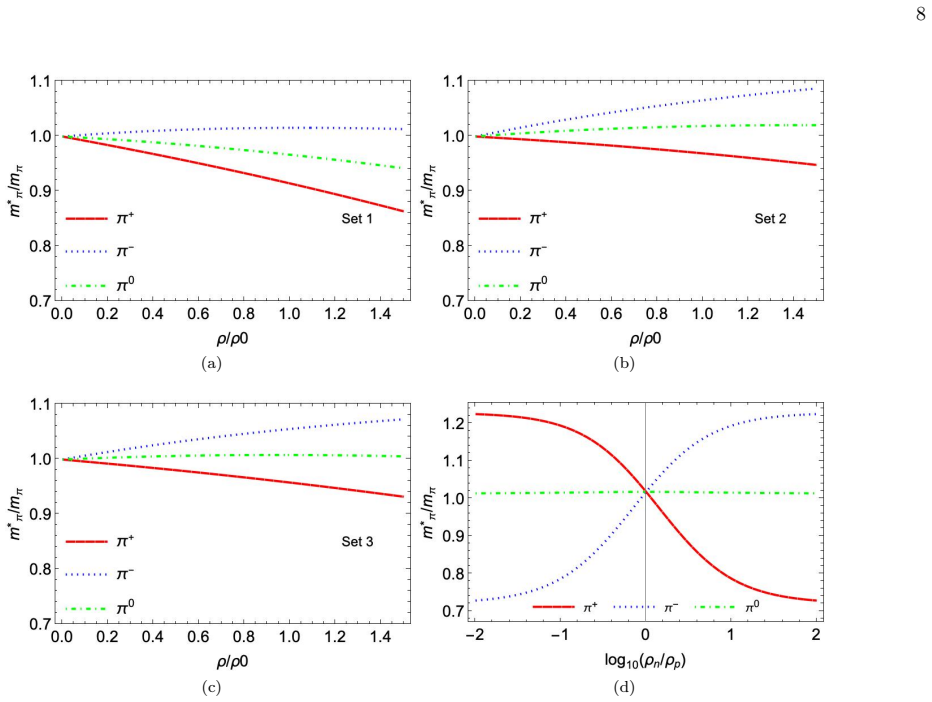
The central claim is that isospin asymmetry of the medium splits the pion triplet in a specific, calculable pattern. In the physical pion basis, the proton and neutron Fermi seas have different Fermi momenta, so the in-medium self-energies $\Sigma_{\pi^\pm, \pi^0}$ differ; at $\rho = \rho_0$ and $r = 1.5$, the paper obtains $m^*_{\pi^-}/m_\pi = 1.02$–$1.07$, $m^*_{\pi^0}/m_\pi = 0.97$–$1.02$, and $m^*_{\pi^+}/m_\pi = 0.92$–$0.97$, depending on the low-energy constant set. The wave function renormalization $Z_\pi$ increases for all three pions, by 47 to 68% for $\pi^+$ and by 77 to 101% for $\pi^-$, and the decay constants all decrease, at $\rho = 0.6\rho_0$ and $r = 1.4$, by 9 to 21%. The paper further derives an in-medium GOR sum rule (Eq. 43) valid for asymmetric matter and checks it with ground-state pions, finding $C_{\mathrm{ch}}/C_{\mathrm{ne}} = 1.00$ and $C_{\mathrm{ch}}/C_{qq} = C_{\mathrm{ne}}/C_{qq} = 0.77$ at $\rho = 0.6\rho_0$ and $r = 1.4$; the pattern is symmetric about $r = 1$, with $\pi^0$ unchanged under $r \leftrightarrow 1/r$ and $\pi^\pm$ exchanging roles.
Load-bearing premise
The load-bearing premise is that nuclear matter at the densities considered is well described by two independent Fermi seas, so all $O(\rho^2)$ nucleon–nucleon correlation diagrams can be dropped, and that singular two-loop terms in the wave function renormalization cancel in physical S-matrix elements as assumed.
Editorial extensions
If this is right
- In neutron-rich matter, the $\pi^-$ becomes heavier while the $\pi^+$ becomes lighter by a comparable percentage, and the roles reverse in proton-rich matter; pionic-atom level shifts should show this charge asymmetry at normal nuclear density.
- All in-medium pion decay constants fall, with $\pi^-$ suppressed most in neutron-rich matter; through the relation $b_1/b_1^* = (f^*_\pi/f_\pi)^2$ this connects to the s-wave pion–nucleus optical potential.
- Wave function renormalization grows by tens of percent, so any extraction of in-medium couplings that ignores $Z_\pi$ will overestimate the vertex corrections.
- The generalized GOR sum rule turns a measurement of in-medium pion masses and decay constants into an estimate of the in-medium quark condensate, here about a 23% reduction at $\rho = 0.6\rho_0$ and $r = 1.4$.
- At symmetric density the three pions remain degenerate, so the splitting is controlled entirely by the neutron-to-proton ratio and disappears as $r \to 1$.
Reading between the lines
- The near-constancy of the $\pi^0$ mass is the most fragile numerical prediction: at $r = 1.5$ it can move by $-3\%$ to $+2\%$ depending on the low-energy constant set, so a future calculation that keeps $O(\rho^2)$ nucleon–nucleon correlations could plausibly flip its sign.
- The same two-Fermi-sea formalism could be applied to kaons or other mesons carrying strangeness, where the isospin asymmetry of the medium enters through different $u$- and $d$-quark densities.
- A direct experimental discriminator would be to measure the ratio of $\pi^-$ to $\pi^+$ decay constants in neutron-rich nuclei; the paper's ordering $f^*_{\pi^-} < f^*_{\pi^0} < f^*_{\pi^+}$ at $r > 1$ is a concrete, testable pattern.
- The singular two-loop terms dropped in the wave function renormalization are assumed to cancel against real-emission diagrams; a calculation that retains and explicitly checks that cancellation would confirm the reported $Z_\pi$ and $f^*_\pi$ values, which are the least protected numbers in the paper.
Editorial analysis
A structured set of objections, weighed in public.
Referee Report
Summary. This manuscript extends the in-medium chiral perturbation theory calculation of pion self-energies from isospin-symmetric matter to isospin-asymmetric nuclear matter. For each pion charge state the authors compute the in-medium mass from Eq. (22), the wave-function renormalization from Eq. (25), and the decay constant from Eq. (37), using two-loop self-energies and vertex corrections evaluated in a non-interacting proton/neutron Fermi sea with density-dependent Fermi momenta. They also derive a generalized in-medium Gell-Mann–Oakes–Renner relation (Eq. (43)) and test it with their calculated ground-state masses and decay constants. The main reported results are a density- and r=rho_n/rho_p-dependent splitting of the three pion masses, large increases in Z_pi (47–101% at rho0 for r=1.5), and decreases in f*_pi (9–21% at 0.6 rho0 for r=1.4), with the GOR combination Cch/Cqq=0.77 at the test point.
Significance. The paper addresses a relevant question—how isospin asymmetry of the medium breaks the degeneracy of pion properties—and provides a systematic two-loop in-medium ChPT framework with explicit integral expressions for the self-energies and vertex corrections in Appendix E, which is a reproducible asset. The derivation of the in-medium GOR sum rule with separate charged and neutral relations is internally consistent, and the comparison with pionic-atom data and with FRG/NJL results gives the work practical context. The main significance currently hinges on the wave-function renormalization and decay-constant results; those are the least secure outputs because their extraction relies on an unvalidated subtraction of divergent two-loop terms (Appendix F). If that subtraction can be justified or the claims appropriately qualified, the paper would be a useful contribution; in its present form, the quantitative Z and f* numbers are not yet scheme-independent.
major comments (3)
- [Sec. V.C and Appendix F] The wave-function renormalization is computed from Eq. (25), which differentiates the self-energy with respect to p0 at the pole. Appendix F shows that the two-loop integrals, e.g. Eq. (F3), diverge at q0=m_pi and states that the singular parts are 'abandoned' because they are expected to cancel in physical S-matrix elements. However, Z_pi is a residue of a two-point correlation function, not an S-matrix element, and no explicit cancellation is demonstrated for this residue. Since the discarded term is divergent rather than small, the 47–101% increases in Table III and the 9–21% decreases in Table IV are prescription-dependent. Please either provide a direct cancellation argument for the pole residue, or present Z and f* only after a regularization-independent definition is shown.
- [Sec. V.B and Table II] The quoted percentages for the mass splitting (2–7% increase for pi-, 4–8% decrease for pi+) are based on the perturbative scheme Eq. (55). The partially perturbative scheme based on Eq. (22) gives substantially different values: for set 1, m*_pi+/m_pi changes from 0.92 to 0.84, a relative difference of about 9%. Because the text itself states that the partially perturbative results are closer to previous references, the choice of scheme is not innocuous. The paper should specify which scheme is the prediction and report the other scheme consistently for all charge states, or give a systematic argument that one scheme is preferred at the working order.
- [Sec. IV.A, after Eq. (47)] The calculation deliberately drops all diagrams of order O(k_F^6)=O(rho^2) because nucleon-nucleon correlations enter at that order. This is acknowledged, but the numerical results are presented up to rho=1.5 rho0 and compared with data at rho0. Since rho^2 effects need not be small at normal nuclear density, the quantitative predictions should be labeled as linear-density estimates, and the paper should estimate or bound the omitted NN-correlation contribution, for example by comparing with a calculation that includes a fitted NN contact term.
minor comments (4)
- [Sec. III, after Eq. (43)] The statement that excited pion states contribute only at O(m_q^2) is asserted without proof or reference; please add a short argument or explicitly list this as an assumption.
- [Table I] The entries for c2 in sets 1 and 2 appear with a space ('3 .30'); please fix the formatting.
- [Figs. 1–3] The captions do not state the line styles or marker conventions used for pi+, pi-, and pi0; please add a legend or explicit description.
- [Appendix E] The numerical integrals are said to be evaluated numerically, but no numerical uncertainty or integration tolerance is reported; please state a representative precision or quote error estimates for the tabulated results.
Circularity Check
Wave-function renormalization and decay-constant results rest on dropping divergent two-loop terms via a self-citation; the mass-splitting central claim is independent.
-
self citation load bearing
[Sec. VC (before Fig. 2) and Appendix F (Eq. F3); feeds Tables III and IV]
"Note that we get some divergence terms in the wave function renormalizations from two-loop contributions in the limit q0 → mπ, which must be canceled in physical S-matrix elements. Thus, we drop these divergence terms. The detailed argument is given in Appendix F. ... This singularity is analogous to infrared singularities in quantum field theory, and it is expected that those singular parts in the corrections are canceled by additional real emission diagrams when obtaining relevant scattering cross-sections."
Zπ is defined by Eq. (25) through the derivative ∂Σ/∂p0 at the pole, and the two-loop self-energy integrals generate the singular form of Eq. (F3), which diverges as p→0 when q0→mπ. The paper does not exhibit a cancellation in the two-point correlation function; it drops the singular parts because they are “expected” to cancel in S-matrix elements and cites Ref. [46]—a paper by one of the present authors—for details. Since f*π = sqrt(Zπ) f̂π (Eq. 37), the headline wave-function renormalization (Table III) and decay-constant (Table IV) results inherit this prescription. The mass results are not affected because m*π uses Σ(q0=mπ) rather than its q0-derivative, so the central mass-splitting claim remains independent.
full rationale
The core calculation is not circular in the fitting sense: no parameter is adjusted to the in-medium pion quantities; the LEC sets in Table I come from independent sources (Refs. [46,83,84]), and the results are compared against external theoretical and experimental values. The generalized in-medium GOR relation (Eq. 43) is derived from PCAC and is used as a consistency check, not as an input to m*, Z, or f*. The one load-bearing self-citation is the treatment of infrared-singular two-loop contributions to ∂Σ/∂p0: the paper drops them on the expectation of S-matrix cancellations and refers to Ref. [46], which shares an author with the present work, for the detailed argument. Because Eqs. (25) and (37) make Z and f* depend on exactly that derivative, the reported 47–101% Z increases and 9–21% f* decreases are prescription-dependent unless the cancellation is explicitly verified. The mass splittings and the general asymmetry pattern do not rely on this step, so the overall construction is only partially self-citation-dependent rather than circular by definition.
Assumptions & free parameters
free parameters (3)
- c1 =
Set1: -0.90e-3 MeV^-1; Set2: -0.59e-3; Set3: -0.61e-3
- c2 =
Set1: 3.30e-3 MeV^-1; Set2: 3.30e-3; Set3: 2.97e-3
- c3 =
Set1: -4.70e-3 MeV^-1; Set2: -4.43e-3; Set3: -4.05e-3
assumptions (6)
- domain assumption The nuclear matter ground state is a non-interacting Fermi sea of protons and neutrons, Eq. (44).
- domain assumption Proton and neutron Fermi momenta are set independently by k_{p,n}^F = (3 pi^2 rho_{p,n})^{1/3}, Eq. (45).
- domain assumption Chiral perturbation theory up to second order, with LECs taken from external fits, describes pion-nucleon interactions in the medium.
- standard math PCAC relation d_mu A^mu = m_q P holds for the in-medium operators, Sec. III.
- ad hoc to paper Excited pion states contribute at O(m_q^2) to the GOR sum rule, so only the lowest pion states are retained, Sec. III.
- ad hoc to paper Singular parts of two-loop Z corrections cancel in physical S-matrix elements, justifying their removal, Appendix F.
Cite this review
Pith. "Pith review of Pion properties in isospin-asymmetric nuclear matter using in-medium chiral perturbation theory." pith.science (2026). https://pith.science/paper/4VHBTOFM
@misc{pith2026250701398,
  author       = {Pith},
  title        = {Pith review of: Pion properties in isospin-asymmetric nuclear matter using in-medium chiral perturbation theory},
  year         = {2026},
  howpublished = {\url{https://pith.science/paper/4VHBTOFM}},
  note         = {Machine review of arXiv:2507.01398}
}
abstract
We compute the density dependence of in-medium pion properties, such as mass, wave function renormalization, and decay constant in the correlation function approach, and how they change under the influence of isospin-asymmetric nuclear matter. To this end, we use in-medium chiral perturbation theory to compute the relevant Feynman diagrams up to two-loop diagrams. Our results show that the isospin asymmetry of the nuclear matter splits these quantities into three separate values, corresponding to the three pions. Consequently, the tendency of each in-medium pion mass, wave function renormalization, and decay constant is dependent on the density and the neutron-to-proton ratio $\rho_n/\rho_p$ of nuclear matter. We also derive an in-medium Gell-Mann--Oakes--Renner relation which is valid for isospin-asymmetric nuclear matter and investigate to what extent it holds within our calculations.
Figures


Reference graph
Works this paper leans on
-
[1]
+ q3 0g2 A(1 − r)ρ 2f 2(1 + r)(4m2 N − q2
-
[2]
+ [4c1m2 π − 2q2 0(c2 + c3)]ρ f 2 + q0(1 − r)ρ 2f 2(1 + r) , (E1a) 18 Σ− 1-loop(q0) = Z d|p| p2 4π2p0f 2 2q0g2 A(q0p0 + 2p2) q0 + 2p0 Θp p − 2q0g2 A(q0p0 − 2p2) q0 − 2p0 Θn p +4mN 4c1m2 π − 2c2 m2 N q2 0p2 0 − 2c3q2 0 (Θp p + Θn p) − 2q0p0(Θp p − Θn p) ≈ q2 0g2 AmN ρ f 2(4m2 N − q2
-
[3]
− q3 0g2 A(1 − r)ρ 2f 2(1 + r)(4m2 N − q2
-
[4]
+ [4c1m2 π − 2q2 0(c2 + c3)]ρ f 2 − q0(1 − r)ρ 2f 2(1 + r) , (E1b) Σ0 1-loop(q0) = Z d|p| p2 8π2p0f 2 2q0g2 A(q0p0 + 2p2) q0 + 2p0 (Θp p + Θn p) − 2q0g2 A(q0p0 − 2p2) q0 − 2p0 (Θn p + Θp p) +8mN 4c1m2 π − 2c2 m2 N q2 0p2 0 − 2c3q2 0 (Θp p + Θn p) ≈ q2 0g2 AmN ρ f 2(4m2 N − q2
-
[5]
(E1c) where we abbreviate the neutron-to-proton ratior ≡ ρn/ρp and the total density asρ = ρn + ρp
+ [4c1m2 π − 2q2 0(c2 + c3)]ρ f 2 . (E1c) where we abbreviate the neutron-to-proton ratior ≡ ρn/ρp and the total density asρ = ρn + ρp. We represent linear contributions of the nuclear density for the one-loop contributions of each pion, which are shown on the right-hand side of ≈. The two-loop contributions are given by Σ+ 2-loop(q0) = m2 N g2 A 10(2πf )...
-
[6]
ρ + g2 Aq0(r − 1) 2f (1 + r)(4m2 N − q2
-
[7]
ρ + r − 1 2f q0(r + 1)ρ + 2(c2 + c3) f ρ, (E2a) ˆf − 1-loop(q0) = − Z d|p| g2 Ap2 2π2f q0p0 q0p0 + 2p2 2p0 + q0 Θp p + q0p0 − 2p2 2p0 − q0 Θn p + Z d|p| p2 2π2f q0 (Θp p − Θn p) + Z d|p| p2 π2p0f 2c2 mN p2 0 + 2mN c3 (Θp p + Θn p) ≈ − mN g2 A f (4m2 N − q2
-
[8]
ρ + g2 Aq0(1 − r) 2f (1 + r)(4m2 N − q2
Show all 95 references
-
[9]
ρ + 1 − r 2f q0(1 + r) ρ + 2(c2 + c3) f ρ, (E2b) 20 ˆf 0 1-loop(q0) = − Z d|p| g2 Ap2 4π2f q0p0 4p2 0q0 − 4p2q0 4p2 0 − q2 0 (Θp p + Θn p) + Z d|p| 2mN p2 π2p0f c2 p2 0 m2 N + c3 (Θp p + Θn p) ≈ − mN g2 A f (4m2 N − q2
-
[10]
Again, we show the linear contributions of nuclear den- sity for the one-loop corrections on the right-hand side of ≈
ρ + 2(c2 + c3) f ρ, (E2c) ˆf + 2-loop(q0) = g2 Am2 N 5(2π)4f 3q0 Z d|p| d|k| d cosθ p2k2 p0k0 p0k0 − |p||k| cos θ − m2 N (2m2 N − 2p0k0 + 2|p||k| cos θ − m2π)2 × (−2q0 + 10p0 − 10k0)Θp kΘn p + (−2q0 − 10p0 + 10k0)Θp pΘn k − 3q0(Θp pΘp k + Θn pΘn k) + g2 Am2 N 4(2π)4f 3q0 Z d|p...
-
[11]
Suzuki, M
K. Suzuki, M. Fujita, H. Geissel, H. Gilg, A. Gillitzer, R. S. Hayano, S. Hirenzaki, K. Itahashi, M. Iwasaki, P. Kienle, M. Matos, G. Münzenberg, T. Ohtsubo, M. Sato, M. Shindo, T. Suzuki, H. Weick, M. Winkler, T. Yamazaki, and T. Yoneyama, Phys. Rev. Lett.92, 072302 (2004), a...
2004 arXiv
-
[12]
Friedman, M
E. Friedman, M. Bauer, J. Breitschopf, H. Clement, H. Denz, E. Doroshkevich, A. Erhardt, G. J. Hofman, R. Meier, G. J. Wagner, and G. Yaari, Phys. Rev. Lett. 93, 122302 (2004), arXiv:nucl-ex/0404031
2004 arXiv
-
[13]
Nishi, K
T. Nishi, K. Itahashi, D. Ahn, G. P. Berg, M. Dozono, D. Etoh, H. Fujioka, N. Fukuda, N. Fukunishi, H. Geissel, et al., Nature Physics19, 788 (2023)
2023
-
[14]
Friedman, M
E. Friedman, M. Bauer, J. Breitschopf, H. Clement, H. Denz, E. Doroshkevich, A. Erhardt, G. J. Hofman, S. Kritchman, R. Meier, G. J. Wagner, and G. Yaari, Phys. Rev. C72, 034609 (2005), arXiv:nucl-ex/0507008
2005 arXiv
-
[15]
Nishi, K
T. Nishi, K. Itahashi, G. Berg, H. Fujioka, N. Fukuda, 22 N. Fukunishi, H. Geissel, R. Hayano, S. Hirenzaki, K. Ichikawa,et al., Physical review letters120, 152505 (2018)
2018
-
[16]
Geissel, H
H. Geissel, H. Gilg, A. Gillitzer, R. Hayano, S. Hiren- zaki, K. Itahashi, M. Iwasaki, P. Kienle, M. Münch, G. Münzenberg,et al., Physical review letters88, 122301 (2002)
2002
-
[17]
Itahashiet al., Phys
K. Itahashiet al., Phys. Rev. C62, 025202 (2000)
2000
-
[18]
Yamazaki, R
T. Yamazaki, R. Hayano, K. Itahashi, K. Oyama, A. Gillitzer, H. Gilg, M. Knülle, M. Münch, P. Kienle, W. Schott,et al., Physics Letters B418, 246 (1998)
1998
-
[19]
Friedman, Physics Letters B524, 87 (2002)
E. Friedman, Physics Letters B524, 87 (2002)
2002
-
[20]
Grion, M
N. Grion, M. Bregant, P. Camerini, E. Fragiacomo, S. Pi- ano, R. Rui, E. Gibson, G. Hofman, E. Mathie, R. Meier, et al., Nuclear Physics A763, 80 (2005)
2005
-
[21]
Palmese, W
A. Palmese, W. Cassing, E. Seifert, T. Steinert, P. Moreau, and E. Bratkovskaya, Physical Review C94, 044912 (2016)
2016
-
[22]
Shimizu and T
H. Shimizu and T. Matsumura, Progress of Theoretical Physics Supplement149, 112 (2003)
2003
-
[23]
Larionov and L
A. Larionov and L. Von Smekal, Physical Review C105, 034914 (2022)
2022
-
[24]
Friedman, arXiv preprint nucl-th/0107050 (2001)
E. Friedman, arXiv preprint nucl-th/0107050 (2001)
2001 arXiv
-
[25]
Suzuki, M
K. Suzuki, M. Fujita, H. Geissel, H. Gilg, A. Gillitzer, R. Hayano, S. Hirenzaki, K. Itahashi, M. Iwasaki, P. Kienle, et al., Progress of Theoretical Physics Sup- plement 149, 32 (2003)
2003
-
[26]
Sorge, E
H. Sorge, E. Shuryak, and I. Zahed, Physical review let- ters 79, 2775 (1997)
1997
-
[27]
Ejima, P
R. Ejima, P. Gubler, C. Sasaki, and K. Shigaki, Physical Review C111, 055201 (2025)
2025
-
[28]
Moreau, A
P. Moreau, A. Palmese, W. Cassing, E. Seifert, T. Stein- ert, and E. L. Bratkovskaya, Nuclear Physics A967, 836 (2017)
2017
-
[29]
H. Sung, S. Cho, C. M. Ko, S. H. Lee, and S. Lim, Phys- ical Review C109, 044911 (2024)
2024
-
[30]
Ikeno, R
N. Ikeno, R. Kimura, J. Yamagata-Sekihara, H. Na- gahiro, D.Jido, K.Itahashi, L.S.Geng,andS.Hirenzaki, Progress of Theoretical Physics126, 483 (2011)
2011
-
[31]
Ikeno, T
N. Ikeno, T. Nishi, K. Itahashi, N. Nose-Togawa, A. Tani, andS.Hirenzaki,ProgressofTheoreticalandExperimen- tal Physics2023, 033D03 (2023)
2023
-
[32]
A. Tani, N. Ikeno, D. Jido, H. Nagahiro, H. Fujioka, K. Itahashi, and S. Hirenzaki, Progress of Theoretical and Experimental Physics2021, 033D02 (2021)
2021
-
[33]
E. E. Kolomeitsev, N. Kaiser, and W. Weise, Phys. Rev. Lett. 90, 092501 (2003), arXiv:nucl-th/0207090
2003 arXiv
-
[34]
D. Jido, T. Hatsuda, and T. Kunihiro, Phys. Lett. B670, 109 (2008), arXiv:0805.4453 [nucl-th]
2008 arXiv
-
[35]
M. C. Birse, Journal of Physics G: Nuclear and Particle Physics 20, 1537 (1994)
1994
-
[36]
Hatsuda, T
T. Hatsuda, T. Kunihiro, and H. Shimizu, Physical Re- view Letters82, 2840 (1999)
1999
-
[37]
Celenza, A
L. Celenza, A. Pantziris, C. Shakin, and W. D. Sun, Physical Review C45, 2015 (1992)
1992
-
[38]
M. C. Birse, Physical Review C49, 2212 (1994)
1994
-
[39]
D. Jido, T. Hatsuda, and T. Kunihiro, Progress of The- oretical Physics Supplement168, 478 (2007)
2007
-
[40]
Marczenko, K
M. Marczenko, K. Redlich, and C. Sasaki, Physical Re- view D105, 103009 (2022)
2022
-
[41]
D. Jido, S. Sakai, H. Nagahiro, S. Hirenzaki, and N. Ikeno, Nuclear Physics A914, 354 (2013)
2013
-
[42]
Hirenzaki, H
S. Hirenzaki, H. Toki, and T. Yamazaki, Physical Review C 44, 2472 (1991)
1991
-
[43]
H. Toki, S. Hirenzaki, T. Yamazaki, and R. Hayano, Nu- clear Physics A501, 653 (1989)
1989
-
[44]
R. M. Galain, G. Ripka, M. Jaminon, and P. Stassart, Europhysics Letters14, 7 (1991)
1991
-
[45]
Fernández-Fraile, A
D. Fernández-Fraile, A. G. Nicola, and E. Herruzo, Phys- ical Review D—Particles, Fields, Gravitation, and Cos- mology 76, 085020 (2007)
2007
-
[46]
Suzuki, P
K. Suzuki, P. Gubler, and M. Oka, Physical Review C 93, 045209 (2016)
2016
-
[47]
Garcıa-Recio, J
C. Garcıa-Recio, J. Nieves, and E. Oset, Physics Letters B 541, 64 (2002)
2002
-
[48]
Gubler, T
P. Gubler, T. Kunihiro, and S. H. Lee, Physics Letters B 767, 336 (2017)
2017
-
[49]
Chanfray, M
G. Chanfray, M. Ericson, and P. A. Guichon, Physical Review C68, 035209 (2003)
2003
-
[50]
Jin, C.-J
H.-M. Jin, C.-J. Xia, T.-T. Sun, and G.-X. Peng, Physics Letters B829, 137121 (2022)
2022
-
[51]
Bernard, T
C. Bernard, T. Blum, C. DeTar, S. Gottlieb, U. M. Heller, J. E. Hetrick, K. Rummukainen, R. Sugar, D. Toussaint, and M. Wingate, Physical Review Letters 78, 598 (1997)
1997
-
[52]
Narayanan and H
R. Narayanan and H. Neuberger, Physics Letters B638, 546 (2006)
2006
-
[53]
P. N. Meisinger and M. C. Ogilvie, Physics Letters B 379, 163 (1996)
1996
-
[54]
L. Y. Glozman, A. Nefediev, and R. Wagenbrunn, Physics Letters B854, 138707 (2024)
2024
-
[55]
J. T. Lenaghan, D. H. Rischke, and J. Schaffner-Bielich, Physical Review D62, 085008 (2000)
2000
-
[56]
Goda and D
S. Goda and D. Jido, Prog. Theor. Exp. Phys. 2014, 033D03 (2014), arXiv:1312.0832 [nucl-th]
2014 arXiv
-
[57]
J. A. Oller, Phys. Rev. C65, 025204 (2002), arXiv:hep- ph/0101204
2002
-
[58]
Meißner, J
U.-G. Meißner, J. A. Oller, and A. Wirzba, Annals of Physics 297, 27 (2002), arXiv:nucl-th/0109026
2002 arXiv
-
[59]
Chanfray, M
G. Chanfray, M. Ericson, and M. Oertel, Physics Letters B 563, 61 (2003), arXiv:nucl-th/0211035
2003 arXiv
-
[60]
Kaiser and W
N. Kaiser and W. Weise, Physics Letters B 512, 283 (2001), arXiv:nucl-th/0102062
2001 arXiv
-
[61]
Drews and W
M. Drews and W. Weise, Phys. Rev. C91, 035802 (2015), arXiv:1412.7655 [nucl-th]
2015 arXiv
-
[62]
M.DrewsandW.Weise,ProgressinParticleandNuclear Physics 93, 69 (2017), arXiv:1610.07568 [nucl-th]
2017 arXiv
-
[63]
Lacour, J
A. Lacour, J. A. Oller, and U.-G. Meißner, Journal of Physics G: Nuclear and Particle Physics37, 125002 (2010), arXiv:1007.2574 [nucl-th]
2010 arXiv
-
[64]
P. T. P. Hutauruk, Y. Oh, and K. Tsushima, Phys. Rev. C 99, 015202 (2019), arXiv:1810.08874 [nucl-th]
2019 arXiv
-
[65]
Itahashi, K
K. Itahashi, K. Oyama, R. S. Hayano, H. Gilg, A. Gillitzer, M. Knülle, M. Münch, W. Schott, P. Kienle, H. Geissel, N. Iwasa, G. Münzenberg, S. Hirenzaki, H. Toki, and T. Yamazaki, Phys. Rev. C 62, 025202 (2000)
2000
-
[66]
Kienle and T
P. Kienle and T. Yamazaki, Progress in Particle and Nu- clear Physics52, 85 (2004)
2004
-
[67]
Khunjua, K
T. Khunjua, K. Klimenko, and R. Zhokhov, EPJ Web of Conferences 191, 05015 (2018), arXiv:1901.03049 [hep- ph]
2018 arXiv
-
[68]
T. G. Khunjua, K. Klimenko, and R. N. Zhokhov- Larionov, EPJ Web of Conferences191, 05016 (2018), arXiv:1812.01860 [hep-ph]
2018 arXiv
-
[69]
T. G. Khunjua, V. C. Zhukovsky, K. G. Klimenko, and R. N. Zhokhov, International Journal of Modern Physics: Conference Series47, 1860093 (2018), arXiv:1808.05162 23 [hep-ph]
2018 arXiv
-
[70]
T. G. Khunjua, K. G. Klimenko, and R. N. Zhokhov, Physical Review D 100, 10.1103/physrevd.100.034009 (2019), arXiv:1907.04151 [hep-ph]
2019 arXiv
-
[71]
Buballa, Physics Reports407, 205 (2005)
M. Buballa, Physics Reports407, 205 (2005)
2005
-
[72]
Xia, Physical Review D110, 014022 (2024)
C.-J. Xia, Physical Review D110, 014022 (2024)
2024
-
[73]
X. Wang, M. Wei, Z. Li, and M. Huang, Physical Review D 99, 016018 (2019)
2019
-
[74]
Ratti, Europhysics Letters61, 314 (2003)
C. Ratti, Europhysics Letters61, 314 (2003)
2003
-
[75]
Alaverdyan, Astrophysics65, 278 (2022)
G. Alaverdyan, Astrophysics65, 278 (2022)
2022
-
[76]
Mishra, The European Physical Journal Special Top- ics 231, 103 (2022)
H. Mishra, The European Physical Journal Special Top- ics 231, 103 (2022)
2022
-
[77]
H. Liu, J. Xu, L.-W. Chen, and K.-J. Sun, Physical Re- view D94, 065032 (2016)
2016
-
[78]
Q. Wang, T. Zhao, and H. Zong, Modern Physics Letters A 35, 2050321 (2020)
2020
-
[79]
Khunjua, K
T. Khunjua, K. Klimenko, and R. Zhokhov, The Euro- pean Physical Journal C79, 1 (2019)
2019
-
[80]
Mammarella, EPJ Web of Conferences 126, 04029 (2016), arXiv:1509.06887 [hep-ph]
A. Mammarella, EPJ Web of Conferences 126, 04029 (2016), arXiv:1509.06887 [hep-ph]
2016 arXiv
-
[81]
Mammarella and M
A. Mammarella and M. Mannarelli, Journal of Physics: Conference Series861, 012017 (2017), arXiv:1705.02169 [hep-ph]
2017 arXiv
-
[82]
Li and Z
Q. Li and Z. Li, The density- and isospin- dependent ∆-formation cross section and its decay width (2017), arXiv:1712.02062 [nucl-th]
2017 arXiv
-
[83]
Kovensky and A
N. Kovensky and A. Schmitt, Isospin asymmetry in holo- graphic baryonic matter (2021), arXiv:2105.03218 [hep- ph]
2021 arXiv
- [84]
-
[85]
Hübsch and D
S. Hübsch and D. Jido, Phys. Rev. C104, 015202 (2021), arXiv:2103.08823 [nucl-th]
2021 arXiv
-
[86]
Gell-Mann, R
M. Gell-Mann, R. J. Oakes, and B. Renner, Phys. Rev. 175, 2195 (1968)
1968
-
[87]
Hübsch and D
S. Hübsch and D. Jido, Phys. Rev. C104, 015202 (2021)
2021
-
[88]
Watanabe and H
H. Watanabe and H. Murayama, Physical Review Letters 108, 251602 (2012)
2012
-
[89]
Hidaka, Physical Review Letters110, 091601 (2013)
Y. Hidaka, Physical Review Letters110, 091601 (2013)
2013
-
[90]
J. M. Charap, Phys. Rev. D2, 1554 (1970)
1970
-
[91]
J. M. Charap, Phys. Rev. D3, 1998 (1971)
1971
-
[92]
I. S. Gerstein, R. Jackiw, B. W. Lee, and S. Weinberg, Phys. Rev. D3, 2486 (1971)
1971
-
[93]
Scherer and M
S. Scherer and M. R. Schindler, A primer for chiral perturbation theory, Lecture Notes in Physics No. 830 (Springer, 2012)
2012
-
[94]
Aoki, In-medium modification of Nambu–Goldstone boson properties induced by wavefunction renormalization under partial restoration of chiral symmetry, Ph.D
K. Aoki, In-medium modification of Nambu–Goldstone boson properties induced by wavefunction renormalization under partial restoration of chiral symmetry, Ph.D. the- sis, Tokyo Metropolitan University (2019)
2019
-
[95]
Wirzba and V
A. Wirzba and V. Thorsson, Preprint (1995), arXiv:hep- ph/9502314
1995
Reviewed August 6, 2026 · model on record in the stance chip above.
Discussion (0). Sign in to comment.