Quantum ring all-reduce: communication and privacy advantages for distributed learning
Pith reviewed 2026-06-26 17:14 UTC · model grok-4.3
The pith
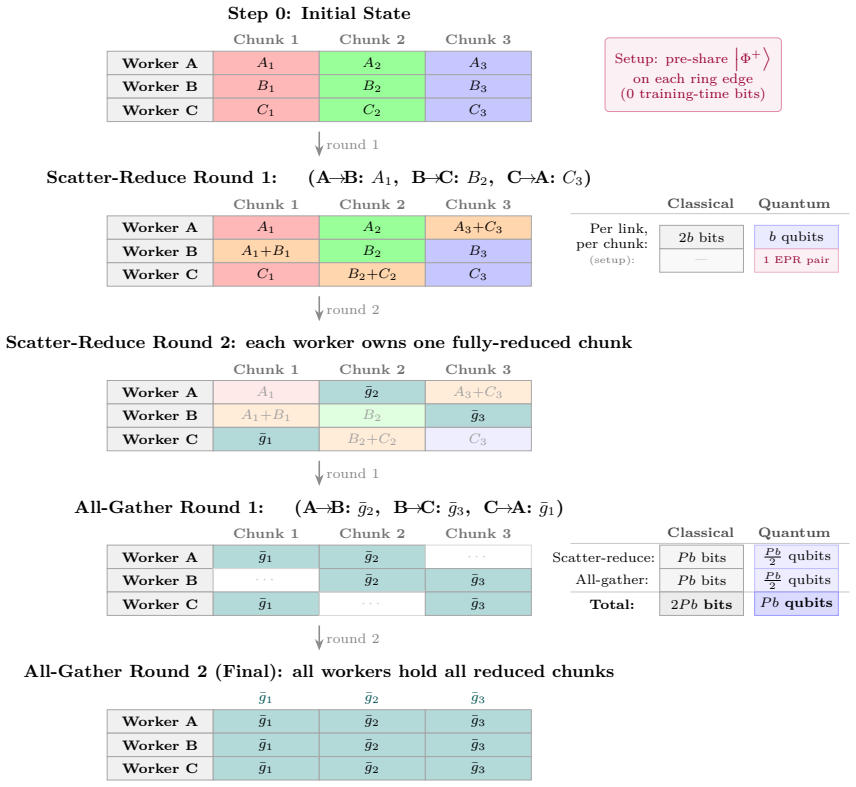
A quantum ring all-reduce halves per-link communication in distributed training and adds information-theoretic privacy via entanglement.
A machine-rendered reading of the paper's core claim, the machinery that carries it, and where it could break.
Core claim
The quantum ring all-reduce reduces per-link online communication by a provably optimal factor of two using pre-shared entanglement and superdense coding, without requiring changes to the learning model or gradient computation, and enables composable ε-secure aggregation via verified entanglement at a 2x overhead in GHZ copies.
What carries the argument
Quantum ring all-reduce that applies superdense coding over pre-shared entanglement to compress the all-reduce exchanges.
If this is right
- The communication halving applies unchanged to both classical and quantum learning models.
- The privacy guarantee is information-theoretically secure and composable.
- Gradient conflict detection admits a quadratic quantum advantage for margin-based tests and an exponential advantage for sign-consistency tests.
Where Pith is reading between the lines
- The same entanglement-assisted structure could be applied to other collective communication patterns beyond all-reduce.
- Once entanglement distribution is routine, the privacy property may set a new baseline for secure aggregation in federated settings.
- The bandwidth-constrained client broadcast results suggest quantum methods could help when full gradient sharing is impossible.
Load-bearing premise
Pre-shared entanglement can be reliably established, maintained, and verified between the distributed devices without prohibitive extra cost or error.
What would settle it
An experiment on a quantum network that fails to achieve a measured communication reduction of two or that shows classical protocols can match the stated privacy level.
Figures
read the original abstract
Machine learning models have scaled to unprecedented sizes, making training across distributed devices the de facto standard in the field. In this work, we explore how quantum communications can make distributed training both more communication-efficient and information-theoretically private, for both classical and quantum learning models. Ring all-reduce is the foundational communication primitive for large-scale distributed training. We present a quantum version that reduces per-link online communication by a provably optimal factor of two using pre-shared entanglement and superdense coding, without requiring the learning model or gradient computation to change. Beyond bandwidth, the primitive enables privacy guarantees that are information-theoretically impossible for any classical protocol, achieving composable {\epsilon}-secure aggregation, via verified entanglement, at a 2x overhead in GHZ copies. Our hybrid quantum-classical communication architecture yields simultaneous communication and security advantages for large scale distributed training, regardless of whether the learning itself is quantum or classical. Finally, we characterise quantum advantages in gradient conflict detection for server-to-client communication under bandwidth constraints, a setting that arises after ring all-reduce is completed, when full gradient broadcast to external clients is infeasible. Two variants of the problem admit different separations. For margin-based alignment testing (\textsc{GapIP}_{\tau}), the quantum advantage is quadratic in the margin parameter: \widetilde{O}({\tau}^{-1}\log P) qubits versus \widetilde{O}(\min(\{\tau}^{-2},P)) bits. For sign-consistency auditing against a private parameter matching (\textsc{TieAudit}_{\epsilon}), the advantage represents an exponential separation in communication complexity: \Omega(\sqrt{P}) bits whereas O({\epsilon}^{-2}\log P) qubits suffice.
Editorial analysis
A structured set of objections, weighed in public.
Referee Report
Summary. The manuscript introduces a quantum ring all-reduce protocol for distributed machine learning that uses pre-shared entanglement and superdense coding to reduce per-link online communication by a factor of two relative to classical ring all-reduce. It further claims that verified GHZ states enable composable ε-secure aggregation at a 2× overhead in GHZ copies, and derives quantum communication-complexity advantages for two gradient conflict detection problems (quadratic in the margin parameter for GapIP_τ and an exponential separation for TieAudit_ε). The architecture is presented as hybrid quantum-classical and applicable to both classical and quantum learning models without altering the underlying gradient computation.
Significance. If the derivations hold and the entanglement precondition can be met without erasing the online savings, the work would supply a concrete hybrid protocol that simultaneously improves bandwidth and provides information-theoretic privacy guarantees unavailable classically. The explicit asymptotic separations for the two conflict-detection tasks constitute falsifiable predictions. No machine-checked proofs or open reproducible code are referenced in the provided text.
major comments (3)
- [Abstract / protocol description] Abstract and protocol section: the claimed factor-of-two reduction in per-link online communication is stated to be 'provably optimal' via superdense coding on pre-shared EPR pairs, yet the manuscript treats entanglement distribution, maintenance, and verification as an offline, zero-cost primitive. Any finite-fidelity or repeater overhead incurred online would directly reduce or eliminate the stated saving; this precondition is load-bearing for both the communication and the composable-security claims.
- [Security / composability section] Security analysis: the composable ε-secure aggregation is asserted to follow from verified entanglement at 2× GHZ overhead, but the verification procedure, its failure probability, and the precise composition theorem that converts the verification cost into the final ε bound are not shown to preserve the information-theoretic guarantee once realistic channel noise is included.
- [Gradient conflict detection] Communication-complexity section: the quadratic and exponential separations for GapIP_τ and TieAudit_ε are presented as concrete advantages, yet the lower-bound arguments and the precise model of the quantum channel (e.g., whether entanglement is free or must be generated on demand) are not cross-referenced to the ring-all-reduce analysis, leaving open whether the same entanglement resource can be reused without additional online cost.
minor comments (2)
- Notation for the number of parties P and the security parameter ε is introduced without an explicit table of symbols; a short notation table would improve readability.
- The abstract states 'without requiring the learning model or gradient computation to change,' but the manuscript does not include a short pseudocode comparison of the classical and quantum ring-all-reduce steps to make this invariance explicit.
Simulated Author's Rebuttal
We thank the referee for the careful reading and constructive comments on our manuscript. Below we respond point by point to the major comments.
read point-by-point responses
-
Referee: [Abstract / protocol description] Abstract and protocol section: the claimed factor-of-two reduction in per-link online communication is stated to be 'provably optimal' via superdense coding on pre-shared EPR pairs, yet the manuscript treats entanglement distribution, maintenance, and verification as an offline, zero-cost primitive. Any finite-fidelity or repeater overhead incurred online would directly reduce or eliminate the stated saving; this precondition is load-bearing for both the communication and the composable-security claims.
Authors: The protocol is defined in the standard quantum communication model that separates offline entanglement distribution from online communication rounds. The factor-of-two reduction and optimality claim via superdense coding apply strictly to the online per-link cost once EPR pairs are available. This modeling choice is explicit in the protocol description. We agree that practical overheads for entanglement generation should be noted and will add a clarifying paragraph in the revised introduction and protocol section stating the offline/online distinction and the scope of the optimality claim. revision: partial
-
Referee: [Security / composability section] Security analysis: the composable ε-secure aggregation is asserted to follow from verified entanglement at 2× GHZ overhead, but the verification procedure, its failure probability, and the precise composition theorem that converts the verification cost into the final ε bound are not shown to preserve the information-theoretic guarantee once realistic channel noise is included.
Authors: The security claim is presented at a high level relying on verified GHZ states. We acknowledge that the full verification protocol, failure probabilities under noise, and the explicit composition argument yielding the ε bound are only outlined rather than derived in detail. In the revision we will expand the security section to include the verification procedure (drawing on standard GHZ verification techniques), its overhead and error bounds, and the relevant composition theorems to make the information-theoretic ε guarantee explicit under the verified-entanglement assumption. revision: yes
-
Referee: [Gradient conflict detection] Communication-complexity section: the quadratic and exponential separations for GapIP_τ and TieAudit_ε are presented as concrete advantages, yet the lower-bound arguments and the precise model of the quantum channel (e.g., whether entanglement is free or must be generated on demand) are not cross-referenced to the ring-all-reduce analysis, leaving open whether the same entanglement resource can be reused without additional online cost.
Authors: The conflict-detection tasks are analyzed in a separate post-all-reduce server-to-client setting. The communication-complexity results employ the standard quantum model (pre-shared entanglement permitted for upper bounds; lower bounds typically independent of this). The entanglement resources for these tasks are independent of those used in the ring all-reduce phase. We will insert explicit cross-references in the revised manuscript to clarify the model consistency and the absence of additional online cost beyond the per-task analysis. revision: partial
Circularity Check
No circularity: protocol claims rest on standard quantum primitives and stated assumptions
full rationale
The paper presents a new hybrid quantum-classical ring all-reduce protocol whose claimed factor-of-two communication reduction follows from applying superdense coding to pre-shared EPR pairs (a standard, externally verified quantum information fact) and whose privacy claim follows from verified GHZ states. No equations or steps in the provided text reduce a derived quantity to a fitted parameter or to a self-citation whose content is itself the target result. The central claims are conditional on the offline availability of entanglement, but that precondition is explicitly stated rather than smuggled in via definition or renaming. The derivation chain is therefore self-contained against external benchmarks and receives the default non-circularity finding.
Axiom & Free-Parameter Ledger
Reference graph
Works this paper leans on
-
[1]
Common randomness in information theory and cryptog- raphy
Rudolf Ahlswede and Imre Csisz´ ar. Common randomness in information theory and cryptog- raphy. i. secret sharing.IEEE Transactions on Information Theory, 39(4):1121–1132, 1993
1993
-
[2]
Ziv Bar-Yossef, T. S. Jayram, and Iordanis Kerenidis. Exponential separation of quantum and classical one-way communication complexity. InProceedings of the 36th Annual ACM Symposium on Theory of Computing (STOC), pages 128–137, 2004
2004
-
[3]
Demystifying parallel and distributed deep learning: An in-depth concurrency analysis.ACM Comput
Tal Ben-Nun and Torsten Hoefler. Demystifying parallel and distributed deep learning: An in-depth concurrency analysis.ACM Comput. Surv., 52(4), August 2019
2019
-
[4]
Entanglement- assisted capacity of a quantum channel and the reverse shannon theorem.IEEE transactions on Information Theory, 48(10):2637–2655, 2002
Charles H Bennett, Peter W Shor, John A Smolin, and Ashish V Thapliyal. Entanglement- assisted capacity of a quantum channel and the reverse shannon theorem.IEEE transactions on Information Theory, 48(10):2637–2655, 2002
2002
-
[5]
Communication via one-and two-particle operators on einstein-podolsky-rosen states.Physical review letters, 69(20):2881, 1992
Charles H Bennett and Stephen J Wiesner. Communication via one-and two-particle operators on einstein-podolsky-rosen states.Physical review letters, 69(20):2881, 1992
1992
-
[6]
signSGD: Compressed optimisation for non-convex problems
Jeremy Bernstein, Yu-Xiang Wang, Kamyar Azizzadenesheli, and Animashree Anandkumar. signSGD: Compressed optimisation for non-convex problems. InProceedings of the 35th In- ternational Conference on Machine Learning, volume 80 ofProceedings of Machine Learning Research, pages 560–569. PMLR, 2018
2018
-
[7]
signSGD with majority vote is communication efficient and fault tolerant
Jeremy Bernstein, Jiawei Zhao, Kamyar Azizzadenesheli, and Animashree Anandkumar. signSGD with majority vote is communication efficient and fault tolerant. InInternational Conference on Learning Representations (ICLR), 2019. arXiv:1810.05291
Pith/arXiv arXiv 2019
-
[8]
Practical secure aggregation for privacy-preserving machine learning
Keith Bonawitz, Vladimir Ivanov, Ben Kreuter, Antonio Marcedone, H Brendan McMahan, Sarvar Patel, Daniel Ramage, Aaron Segal, and Karn Seth. Practical secure aggregation for privacy-preserving machine learning. Inproceedings of the 2017 ACM SIGSAC Conference on Computer and Communications Security, pages 1175–1191, 2017
2017
-
[9]
Sampling in a quantum population, and applications
Niek J Bouman and Serge Fehr. Sampling in a quantum population, and applications. In Annual Cryptology Conference, pages 724–741. Springer, 2010
2010
-
[10]
Quantum amplitude amplifi- cation and estimation
Gilles Brassard, Peter Høyer, Michele Mosca, and Alain Tapp. Quantum amplitude amplifi- cation and estimation. InQuantum Computation and Quantum Information: A Millennium Volume, volume 305 ofAMS Contemporary Mathematics, pages 53–74. American Mathemat- ical Society, 2002. arXiv:quant-ph/0005055
Pith/arXiv arXiv 2002
-
[11]
Statistical distance and the geometry of quantum states.Physical Review Letters, 72(22):3439, 1994
Samuel L Braunstein and Carlton M Caves. Statistical distance and the geometry of quantum states.Physical Review Letters, 72(22):3439, 1994
1994
-
[12]
An optimal lower bound on the communication complex- ity of Gap-Hamming-Distance.SIAM Journal on Computing, 41(5):1299–1317, 2012
Amit Chakrabarti and Oded Regev. An optimal lower bound on the communication complex- ity of Gap-Hamming-Distance.SIAM Journal on Computing, 41(5):1299–1317, 2012
2012
-
[13]
An elementary proof of a theorem of johnson and lindenstrauss.Random Structures & Algorithms, 22(1):60–65, 2003
Sanjoy Dasgupta and Anupam Gupta. An elementary proof of a theorem of johnson and lindenstrauss.Random Structures & Algorithms, 22(1):60–65, 2003
2003
-
[14]
Mina Doosti, Ryan Sweke, and Chirag Wadhwa. Distributed quantum property testing with communication constraints.arXiv preprint arXiv:2604.05962, 2026
Pith/arXiv arXiv 2026
-
[15]
Calibrating noise to sensitivity in private data analysis
Cynthia Dwork, Frank McSherry, Kobbi Nissim, and Adam Smith. Calibrating noise to sensitivity in private data analysis. InTheory of Cryptography Conference (TCC), volume 3876 ofLecture Notes in Computer Science, pages 265–284. Springer, 2006. 17
2006
-
[16]
Ex- ponential separations for one-way quantum communication complexity, with applications to cryptography.SIAM Journal on Computing, 38(5):1695–1708, 2008
Dmitry Gavinsky, Julia Kempe, Iordanis Kerenidis, Ran Raz, and Ronald de Wolf. Ex- ponential separations for one-way quantum communication complexity, with applications to cryptography.SIAM Journal on Computing, 38(5):1695–1708, 2008. Earlier version in STOC 2007, pp. 516–525
2008
-
[17]
Dar Gilboa, Hagay Michaeli, Daniel Soudry, and Jarrod R. McClean. Exponential quan- tum communication advantage in distributed inference and learning. InAdvances in Neural Information Processing Systems, volume 37, pages 30425–30473, 2024. arXiv:2310.07136
arXiv 2024
-
[18]
The distributed discrete gaussian mechanism for federated learning with secure aggregation
Peter Kairouz, Ziyu Liu, and Thomas Steinke. The distributed discrete gaussian mechanism for federated learning with secure aggregation. InInternational conference on machine learning, pages 5201–5212. PMLR, 2021
2021
-
[19]
SCAFFOLD: Stochastic controlled averaging for federated learning
Sai Praneeth Karimireddy, Satyen Kale, Mehryar Mohri, Sashank Reddi, Sebastian Stich, and Ananda Theertha Suresh. SCAFFOLD: Stochastic controlled averaging for federated learning. InProceedings of the 37th International Conference on Machine Learning, volume 119 ofProceedings of Machine Learning Research, 2020
2020
-
[20]
Kitaev, Alexander H
Alexei Yu. Kitaev, Alexander H. Shen, and Mikhail N. Vyalyi.Classical and Quantum Com- putation, volume 47 ofGraduate Studies in Mathematics. American Mathematical Society, Providence, Rhode Island, 2002
2002
-
[21]
Changhao Li, Niraj Kumar, Zhixin Song, Shouvanik Chakrabarti, and Marco Pistoia. Privacy- preserving quantum federated learning via gradient hiding.Quantum Science and Technology, 9(3):035028, 2024. arXiv:2312.04447
arXiv 2024
-
[22]
Blind quantum machine learning with quantum bipartite correlator
Changhao Li, Boning Li, Omar Amer, Ruslan Shaydulin, Shouvanik Chakrabarti, Guoqing Wang, Haowei Xu, Hao Tang, Isabel Schoch, Niraj Kumar, Charles Lim, Ju Li, Paola Cappel- laro, and Marco Pistoia. Blind quantum machine learning with quantum bipartite correlator. Physical Review Letters, 133(12):120602, 2024. arXiv:2310.12893
arXiv 2024
-
[23]
PyTorch distributed: Experiences on accelerating data parallel training.Proceedings of the VLDB Endowment, 13(12):3005–3018, 2020
Shen Li, Yanli Zhao, Rohan Varma, Omkar Salpekar, Pieter Noordhuis, Teng Li, Adam Paszke, Jeff Smith, Brian Vaughan, Pritam Luo, and Soumith Chintala. PyTorch distributed: Experiences on accelerating data parallel training.Proceedings of the VLDB Endowment, 13(12):3005–3018, 2020
2020
-
[24]
Secret key agreement by public discussion from common information.IEEE transactions on information theory, 39(3):733–742, 1993
Ueli M Maurer. Secret key agreement by public discussion from common information.IEEE transactions on information theory, 39(3):733–742, 1993
1993
-
[25]
Composability in quantum cryptography.New Jour- nal of Physics, 11(8):085006, 2009
J¨ orn M¨ uller-Quade and Renato Renner. Composability in quantum cryptography.New Jour- nal of Physics, 11(8):085006, 2009
2009
-
[26]
Arnab Nath and Harsh Kasyap. CQSA: Byzantine-robust clustered quantum secure aggrega- tion in federated learning.arXiv preprint arXiv:2602.22269, 2026. FL-AsiaCCS 2026
arXiv 2026
-
[27]
Bandwidth optimal all-reduce algorithms for clusters of workstations.Journal of Parallel and Distributed Computing, 69(2):117–124, 2009
Pitch Patarasuk and Xin Yuan. Bandwidth optimal all-reduce algorithms for clusters of workstations.Journal of Parallel and Distributed Computing, 69(2):117–124, 2009
2009
-
[28]
An invitation to distributed quantum neural networks.Quan- tum Machine Intelligence, 5(2):23, 2023
Lirand¨ e Pira and Chris Ferrie. An invitation to distributed quantum neural networks.Quan- tum Machine Intelligence, 5(2):23, 2023
2023
-
[29]
Alexander A. Razborov. Quantum communication complexity of symmetric predicates. Izvestiya: Mathematics, 67(1):145–159, 2003. arXiv:quant-ph/0204025
Pith/arXiv arXiv 2003
-
[30]
Security of quantum key distribution.International Journal of Quantum Information, 6(01):1–127, 2008
Renato Renner. Security of quantum key distribution.International Journal of Quantum Information, 6(01):1–127, 2008
2008
-
[31]
Horovod: fast and easy distributed deep learning in TensorFlow.arXiv preprint arXiv:1802.05799, 2018
Alexander Sergeev and Mike Del Balso. Horovod: fast and easy distributed deep learning in TensorFlow.arXiv preprint arXiv:1802.05799, 2018
Pith/arXiv arXiv 2018
-
[32]
Uncertainty relation for smooth entropies.Physical review letters, 106(11):110506, 2011
Marco Tomamichel and Renato Renner. Uncertainty relation for smooth entropies.Physical review letters, 106(11):110506, 2011
2011
-
[33]
Wootters and Wojciech H
William K. Wootters and Wojciech H. Zurek. A single quantum cannot be cloned.Nature, 299(5886):802–803, 1982
1982
-
[34]
Gradient surgery for multi-task learning
Tianhe Yu, Saurabh Kumar, Abhishek Gupta, Sergey Levine, Karol Hausman, and Chelsea Finn. Gradient surgery for multi-task learning. InAdvances in Neural Information Processing Systems, volume 33, 2020. arXiv:2001.06782. 18
arXiv 2020
-
[35]
Yichi Zhang, Chao Zhang, Cai Zhang, Lixin Fan, Bei Zeng, and Qiang Yang. Federated learning with quantum secure aggregation.arXiv preprint arXiv:2207.07444, 2022. Appendix A Superdense coding primer Superdense coding [5] is the protocol underlying the factor-of-two bandwidth saving of Section 3. It is the mirror image of teleportation: teleportation spend...
arXiv 2022
-
[36]
Only communication is counted; the local cost ofU j (up toO(P)gates) is not charged
The augmentation does two things: ⟨ˆu,ˆv⟩=1 2 ( 1 +⟨gj,gk⟩ ) ∈[0,1]is nonnegative, hence amonotonefunction of the signed inner product (overlap estimation natively returns the unsigned angle, and the offset restores the sign), and it sends the decision threshold⟨gj,gk⟩=±τto⟨ˆu,ˆv⟩=1 2(1±τ), in the interior of[0,1]where arccosis well-conditioned. Only comm...
discussion (0)
Sign in with ORCID, Apple, or X to comment. Anyone can read and Pith papers without signing in.