Gravitational wave interactions with matter: beyond quadrupolar perturbations
Pith reviewed 2026-06-29 20:48 UTC · model grok-4.3
The pith
Extending gravitational wave interactions with matter to arbitrary multipoles yields enhanced damping and heating for higher ℓ.
A machine-rendered reading of the paper's core claim, the machinery that carries it, and where it could break.
Core claim
The linearized Bondi-Sachs formalism is extended from quadrupolar to general ℓ, producing formulas for GW damping and heating on a Minkowski background that are enhanced relative to the ℓ=2 case and therefore imply that higher-ℓ modes are unlikely to appear in observed post-merger signals from binary neutron star mergers or core-collapse supernovae.
What carries the argument
The Bondi-Sachs formalism for linearized gravitational waves on a Minkowski background, now applied at arbitrary spherical-harmonic degree ℓ ≥ 2 to compute interaction-induced damping and heating.
If this is right
- Damping and heating rates increase for ℓ > 2 compared with the quadrupolar case.
- Higher-ℓ modes become progressively less likely to survive propagation through matter.
- Post-merger signals from binary neutron star mergers are expected to be dominated by the quadrupolar component.
- Core-collapse supernova gravitational-wave signals are likewise expected to lack detectable higher multipoles.
Where Pith is reading between the lines
- Detection strategies for these sources can safely prioritize ℓ=2 templates.
- Energy deposition into surrounding matter may be larger than quadrupolar estimates suggested.
- The enhancement pattern could be checked by repeating the calculation on a curved background to see whether curvature terms reverse the trend.
Load-bearing premise
The linearized Bondi-Sachs equations on flat space continue to describe the interaction correctly for any ℓ without extra nonlinear or curvature corrections that would change the scaling.
What would settle it
A clear detection of an ℓ > 2 gravitational-wave mode in the post-merger phase of a binary neutron star merger or in a core-collapse supernova signal would show that the enhanced damping does not prevent such modes from being observed.
Figures
read the original abstract
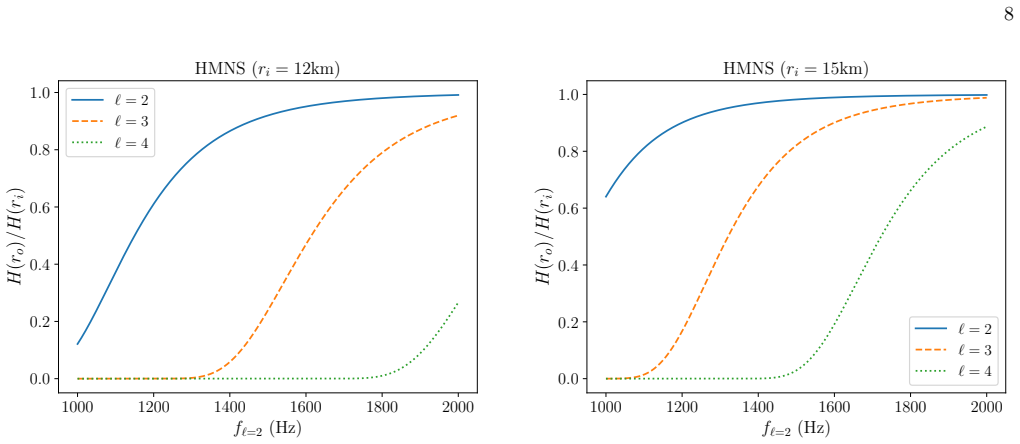
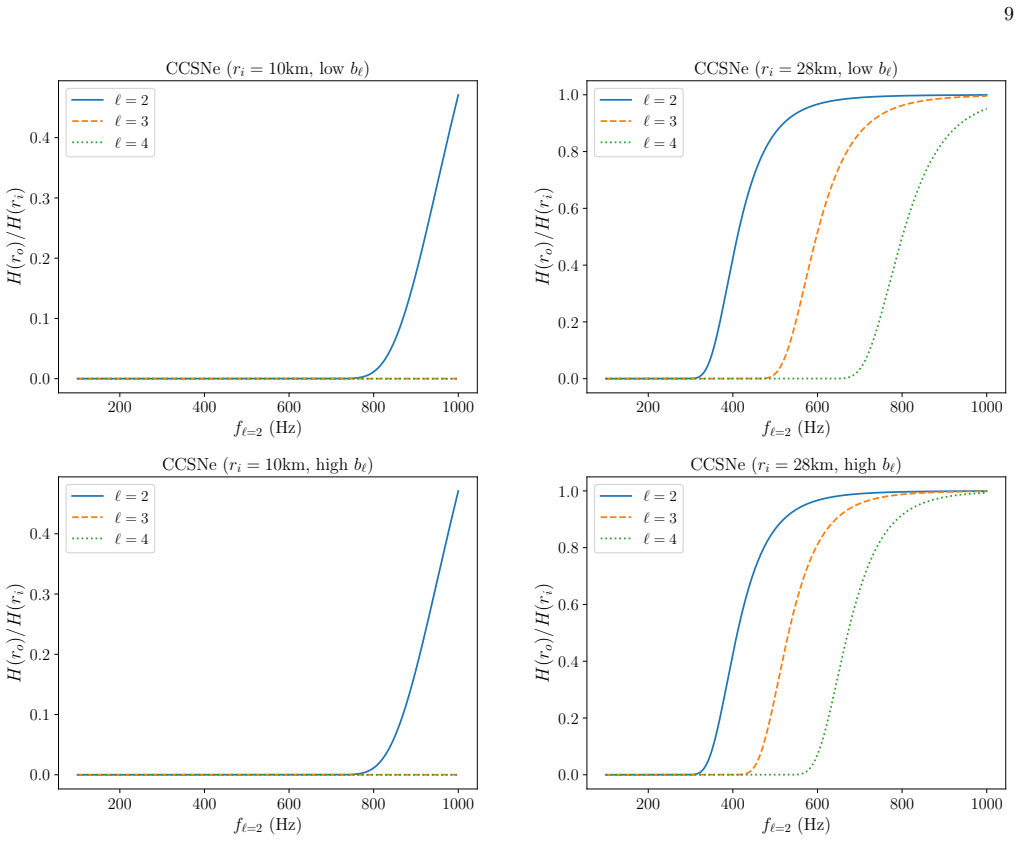
Previous work has developed the theory of linearized gravitational wave (GW) interactions with matter using the Bondi-Sachs formalism, but with the perturbations restricted to be quadrupolar, i.e., the angular dependence is spherical harmonic with $\ell=2$. Here, the theory is extended to the case of GWs on a Minkowski background with general $\ell$. Formulas for the GW damping and heating effects are obtained for arbitrary $\ell\ge 2$. It is found that the effects are, generally, enhanced, and this suggests that it is unlikely that higher $\ell$-modes will be seen in GW observations of the post-merger signal of a binary neutron star merger, or of a core collapse supernova.
Editorial analysis
A structured set of objections, weighed in public.
Referee Report
Summary. The manuscript extends previous work on linearized gravitational wave interactions with matter using the Bondi-Sachs formalism from quadrupolar (ℓ=2) perturbations to general ℓ ≥ 2 on a Minkowski background. It derives formulas for the GW damping and heating effects for arbitrary ℓ and finds that these effects are generally enhanced, suggesting that higher ℓ-modes are unlikely to be observed in post-merger signals of binary neutron star mergers or core collapse supernovae.
Significance. If the enhancement of damping and heating with ℓ holds under the stated assumptions, the result would offer a theoretical explanation for the suppression of higher multipoles in specific astrophysical sources, with potential implications for interpreting gravitational wave data. The work is credited for extending the formalism to general ℓ and obtaining explicit formulas beyond the quadrupolar case.
major comments (1)
- [The extension to general ℓ (main derivation and discussion of observational implications)] The central claim that higher ℓ-modes are unlikely to be seen rests on the enhancement of damping/heating found in the linearized Bondi-Sachs treatment on a Minkowski background. The manuscript does not show that this ℓ-dependent scaling remains representative once background curvature and possible nonlinear corrections from realistic neutron-star remnant or collapsing-core geometries are restored, which could alter the damping for high ℓ.
minor comments (1)
- [Abstract] The abstract could explicitly note the flat-background and linearized assumptions when stating the observational suggestion.
Simulated Author's Rebuttal
We thank the referee for their thoughtful review and for highlighting an important limitation of the present analysis. We address the major comment below.
read point-by-point responses
-
Referee: [The extension to general ℓ (main derivation and discussion of observational implications)] The central claim that higher ℓ-modes are unlikely to be seen rests on the enhancement of damping/heating found in the linearized Bondi-Sachs treatment on a Minkowski background. The manuscript does not show that this ℓ-dependent scaling remains representative once background curvature and possible nonlinear corrections from realistic neutron-star remnant or collapsing-core geometries are restored, which could alter the damping for high ℓ.
Authors: We agree that the derivation and the reported enhancement of damping and heating are obtained strictly within the linearized Bondi-Sachs framework on a Minkowski background. The manuscript explicitly restricts itself to this setting in order to obtain closed-form expressions for arbitrary ℓ ≥ 2. Consequently, we do not claim, and have not demonstrated, that the same ℓ-dependent scaling persists once background curvature or nonlinear corrections appropriate to a neutron-star remnant or collapsing core are included. Such extensions would require a different background metric and a more general perturbation scheme, both of which lie outside the scope of the present work. The flat-space result nevertheless supplies a concrete baseline: the damping and heating rates increase with ℓ already in the simplest consistent treatment. Whether curvature or nonlinearity ultimately weakens or strengthens this trend remains an open question that we flag for future investigation. revision: partial
Circularity Check
No circularity: mathematical extension of linearized formalism yields independent formulas for higher ℓ
full rationale
The derivation chain begins from the linearized Bondi-Sachs equations on Minkowski background (already established in prior work) and extends the angular dependence from ℓ=2 to arbitrary ℓ≥2 via direct substitution of spherical harmonics. The resulting damping and heating expressions are obtained algebraically from the perturbed metric and stress-energy terms without parameter fitting, self-referential definitions, or renaming of known results. The observational suggestion follows from comparing the new ℓ-dependent scalings; it does not reduce to the input assumptions by construction. Self-citation of the ℓ=2 case supplies the base formalism but is not load-bearing for the new general-ℓ results, which remain falsifiable against external benchmarks.
Axiom & Free-Parameter Ledger
axioms (2)
- domain assumption Linearized gravitational perturbations on Minkowski background remain valid for arbitrary ℓ
- domain assumption Bondi-Sachs formalism can be extended mode-by-mode without additional gauge or coordinate artifacts
Reference graph
Works this paper leans on
-
[1]
We emphasize that the expressions for the rescaled GW magnitude given in Eq
The expressions given here reflect these corrections. We emphasize that the expressions for the rescaled GW magnitude given in Eq. (27) matches the one given in [4]. For the news and the rate of energy that is output as GWs, we have N2,2 = √ 6ν3ℜ −iC40eiνu 2Z2,2 ,⟨ ˙EGW⟩ℓ=2 = 3|C40|2ν6 4π ,(C11) which have been reported previously [4]. 2.ℓ= 3 The metric v...
-
[2]
B. P. Abbottet al.(LIGO Scientific, Virgo), Observation of gravitational waves from a binary black hole merger, Phys. Rev. Lett.116, 061102 (2016), arXiv:1602.03837 [gr-qc]
work page internal anchor Pith review Pith/arXiv arXiv 2016
- [3]
- [4]
- [5]
- [6]
- [7]
-
[8]
Bondi, M
H. Bondi, M. G. J. van der Burg, and A. W. K. Metzner, Gravitational waves in general relativity. 7. Waves from axisymmetric isolated systems, Proc. Roy. Soc. Lond. A269, 21 (1962)
1962
-
[9]
R. K. Sachs, Gravitational waves in general relativity. 8. Waves in asymptotically flat space-times, Proc. Roy. Soc. Lond. A270, 103 (1962)
1962
-
[10]
E. T. Newman and R. Penrose, Note on the Bondi-Metzner-Sachs group, J. Math. Phys.7, 863 (1966)
1966
-
[11]
Penrose and W
R. Penrose and W. Rindler,Spinors and Space-Time, Cambridge Monographs on Mathematical Physics (Cambridge Univ. Press, Cambridge, UK, 2011)
2011
-
[12]
N. T. Bishop, Linearized solutions of the Einstein equations within a Bondi-Sachs framework, and implications for boundary conditions in numerical simulations, Class. Quant. Grav.22, 2393 (2005), arXiv:gr-qc/0412006
work page internal anchor Pith review Pith/arXiv arXiv 2005
- [13]
- [14]
-
[15]
Numerical relativity with characteristic evolution, using six angular patches
C. Reisswig, N. T. Bishop, C. W. Lai, J. Thornburg, and B. Szilagyi, Numerical relativity with characteristic evolution, using six angular patches, Class. Quant. Grav.24, S327 (2007), arXiv:gr-qc/0610019. 15
work page internal anchor Pith review Pith/arXiv arXiv 2007
-
[16]
N. T. Bishop and L. Rezzolla, Extraction of gravitational waves in numerical relativity, Living Rev. Rel.19, 2 (2016), arXiv:1606.02532 [gr-qc]
work page internal anchor Pith review Pith/arXiv arXiv 2016
-
[17]
Einstein, Die Feldgleichungen der Gravitation, Sitzungsber
A. Einstein, Die Feldgleichungen der Gravitation, Sitzungsber. Preuß. Akad. Wiss. Berlin (Math. Phys.)1915, 844 (1915)
1915
-
[18]
R. M. Wald,General Relativity(Chicago Univ. Pr., Chicago, USA, 1984)
1984
-
[19]
T. W. Baumgarte and S. L. Shapiro,Numerical Relativity: Solving Einstein ’s Equations on the Computer(Cambridge University Press, 2010)
2010
-
[20]
Chandrasekhar and S
S. Chandrasekhar and S. L. Detweiler, The quasi-normal modes of the Schwarzschild black hole, Proc. Roy. Soc. Lond. A 344, 441 (1975)
1975
-
[21]
F. J. Zerilli, Gravitational field of a particle falling in a Schwarzschild geometry analyzed in tensor harmonics, Phys. Rev. D2, 2141 (1970)
1970
- [22]
-
[23]
Black-hole hair loss: learning about binary progenitors from ringdown signals
I. Kamaretsos, M. Hannam, S. Husa, and B. S. Sathyaprakash, Black-hole hair loss: learning about binary progenitors from ringdown signals, Phys. Rev. D85, 024018 (2012), arXiv:1107.0854 [gr-qc]
work page internal anchor Pith review Pith/arXiv arXiv 2012
-
[24]
T. G. Cowling, The non-radial oscillations of polytropic stars, Mon. Not. Roy. Astron. Soc.101, 367 (1941)
1941
-
[25]
Thomson,Mathematical and Physical Papers, Vol
W. Thomson,Mathematical and Physical Papers, Vol. 3 (Cambridge Univ. Pr., Cambridge, UK, 1890)
-
[26]
Meurer, C
A. Meurer, C. P. Smith, M. Paprocki, O. ˇCert´ ık, S. B. Kirpichev, M. Rocklin, A. Kumar, S. Ivanov, J. K. Moore, S. Singh, T. Rathnayake, S. Vig, B. E. Granger, R. P. Muller, F. Bonazzi, H. Gupta, S. Vats, F. Johansson, F. Pedregosa, M. J. Curry, A. R. Terrel,ˇS. Rouˇ cka, A. Saboo, I. Fernando, S. Kulal, R. Cimrman, and A. Scopatz, Sympy: symbolic compu...
2017
-
[27]
C. R. Harris, K. J. Millman, S. J. van der Walt, R. Gommers, P. Virtanen, D. Cournapeau, E. Wieser, J. Taylor, S. Berg, N. J. Smith, R. Kern, M. Picus, S. Hoyer, M. H. van Kerkwijk, M. Brett, A. Haldane, J. F. del R´ ıo, M. Wiebe, P. Peterson, P. G´ erard-Marchant, K. Sheppard, T. Reddy, W. Weckesser, H. Abbasi, C. Gohlke, and T. E. Oliphant, Array progra...
2020
-
[28]
J. D. Hunter, Matplotlib: A 2D graphics environment, Computing in Science & Engineering9, 90 (2007)
2007
discussion (0)
Sign in with ORCID, Apple, or X to comment. Anyone can read and Pith papers without signing in.