REVIEW 5 major objections 5 minor 99 references
Electronic correlations and flattened band in magnetic Weyl semimetal candidate Co3Sn2S2
T0 review · 5 major / 5 minor · reviewed 2026-08-14 · deepseek-v4-flash
Pith's one-line read In ferromagnetic Co3Sn2S2, the band connecting the two Weyl cones is flattened by electronic correlations with U ≈ 4 eV, and the resulting interband transitions explain a sharp 36 meV peak in the optical conductivity that single-particle…
desk verdict Solid kinetic-energy evidence for intermediate correlations; the flat-band claim is plausible but needs stronger evidence than a static QP Hamiltonian. read the letter →
The pith
A machine-rendered reading of the paper's core claim, the machinery that carries it, and where it could break.
The reading
What carries the argument
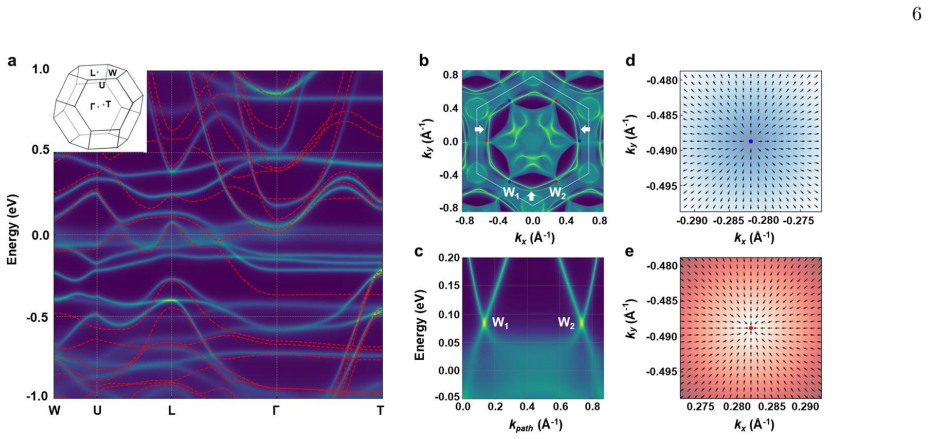
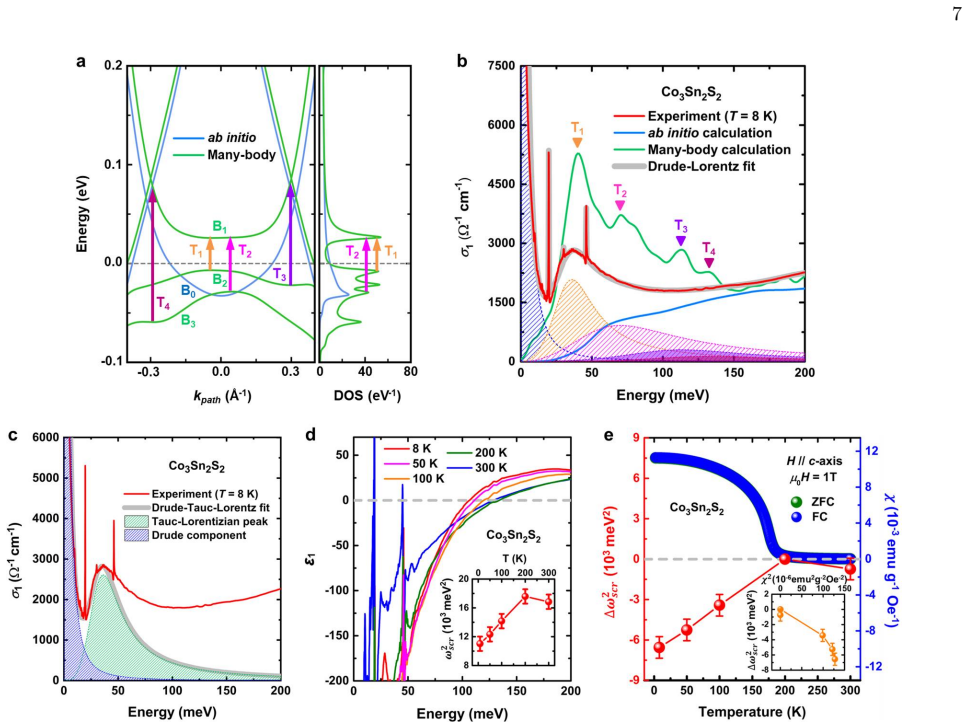
The argument is carried by three linked tools. Equation (1) converts the integrated Drude spectral weight into an electronic kinetic energy, making the measured-versus-calculated kinetic-energy ratio a direct correlation diagnostic. A Drude-Lorentz fit decomposes the asymmetric 36 meV feature into four Lorentzian peaks whose energies are compared with four DFT+DMFT interband transitions (T1–T4); this decomposition is the bridge from theory to the measured spectrum. The quasiparticle Hamiltonian of Eq. (5), built from density functional theory plus dynamical mean-field theory, provides the renormalization factors used to estimate $U \approx 4$ eV and the momentum-resolved bands showing the flattened B1: it is the object in which the Weyl cones survive while the connecting band loses its dispersion. The same many-body calculation produces the Fermi arcs and Berry-curvature texture that certify the Weyl state.
What would settle it
Look for the flattened band directly: angle-resolved photoemission along the W1–W2 direction in the ferromagnetic state should show a nearly dispersionless B1 band near the Fermi energy, not the steep linearly dispersing band of the single-particle calculation. As an optical test, a clean sample measured across the ferromagnetic transition should show the 36 meV peak only in the magnetic Weyl state; if the peak persists above the transition temperature, or if a differently constrained fit needs no four-Lorentzian decomposition, the flat-band assignment is falsified.
Extended reading notes
Core claim
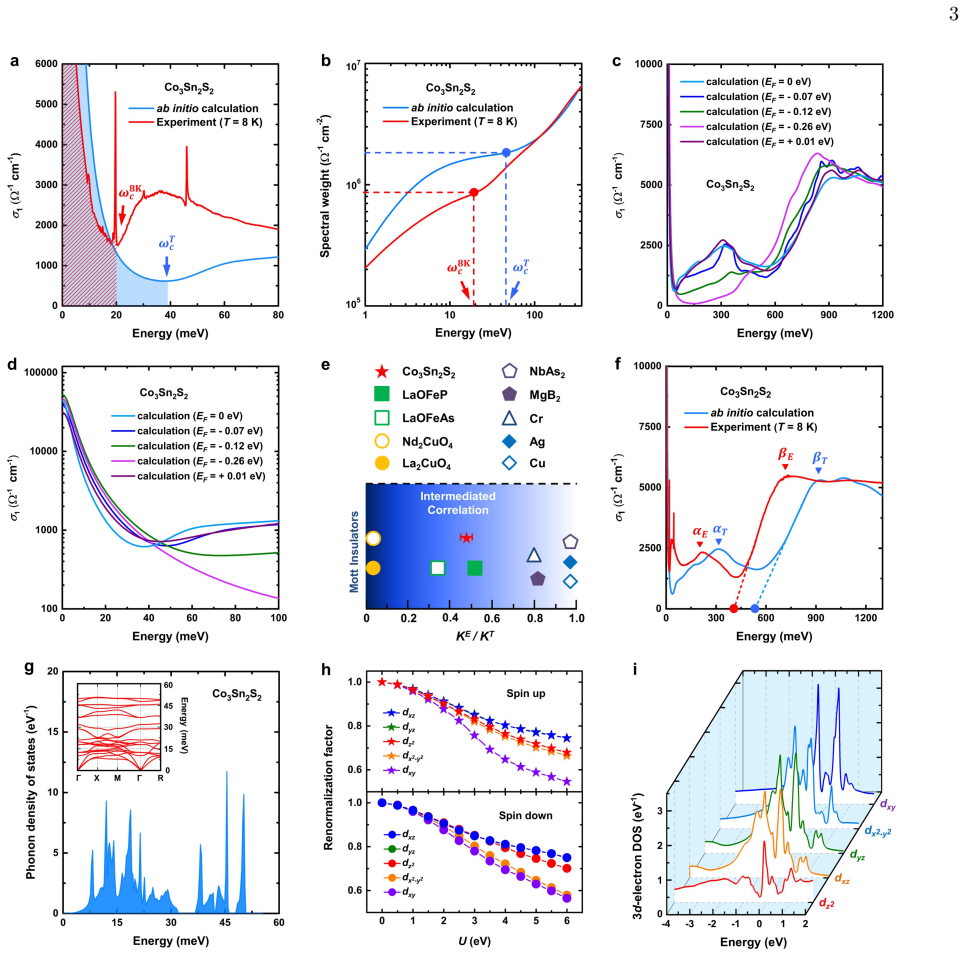
The paper's central claim is that intermediate-strength electronic correlations flatten a band that connects the two bulk Weyl cones of ferromagnetic Co3Sn2S2, and that this flat band can be seen in optics. The kinetic energy obtained by integrating the measured Drude spectral weight is $K^E_{8K}/K^T \approx 0.47 \pm 0.04$, and the square-ratio of plasma frequencies gives $0.46 \pm 0.02$; the experimental $\alpha$ and $\beta$ interband peaks sit at about 217 and 708 meV versus about 320 and 932 meV in theory. Matching these ratios to DFT+DMFT band-narrowing factors yields $U \approx 4$ eV. At this $U$, the quasiparticle band structure retains bulk Weyl cones and surface Fermi arcs, while band B1 along the W1–W2 direction flattens near the Fermi energy. Four interband transitions involving B1 and the dispersionless parts of bands B2 and B3 produce calculated peaks near 39, 70, 113, and 131 meV, and the experimental low-energy feature around 36 meV decomposes into Lorentzians at those positions, whereas the single-particle spectrum has no peak there. The paper concludes that the 36 meV peak is spectroscopic evidence for the correlation-flattened band B1 connecting the Weyl cones.
Load-bearing premise
The paper's conclusion rests on treating the measured 36 meV asymmetric peak as four interband transitions whose energies are predicted by a quasiparticle Hamiltonian that the authors say cannot fully capture correlation effects (it misses part of the Drude spectral weight); if the Lorentzian decomposition or that Hamiltonian is inaccurate, the 36 meV peak could have a different origin and the flat-band claim would not follow.
Editorial extensions
If this is right
- Co3Sn2S2 becomes a concrete example where a Weyl semimetal state and a correlation-flattened band coexist, so flat-band-enhanced correlation effects can be studied in a topological semimetal.
- The measured $U \approx 4$ eV and kinetic-energy ratio $K^E/K^T \approx 0.47$ give quantitative benchmarks for modeling correlated kagome magnets.
- The 36 meV peak and its four-Lorentzian decomposition become a spectroscopic fingerprint that can be looked for in other magnetic Weyl candidates.
- Because the flat band connects Weyl points of opposite chirality, it sits near energies where anomalous Hall and transport effects have been observed, implying those effects can be reexamined with correlation-renormalized bands.
Reading between the lines
- If the flat band B1 is as close to the Fermi energy as claimed, its divergent density of states should enhance the tendency toward magnetic instabilities or pairing near the Weyl points; measuring the 36 meV peak under magnetic field and doping would probe this directly.
- The same kinetic-energy-ratio and interband-peak-ratio analysis could be applied to other shandite and kagome magnets to see whether correlation-flattened Weyl bands are common across the family.
- A useful independent test would be high-resolution photoemission along the W1–W2 direction: a clear dispersionless B1 band would confirm the optical assignment, while its absence would force a different explanation for the 36 meV feature.
Signed reviews
Editorial analysis
A structured set of objections, weighed in public.
Referee Report
Summary. This paper combines optical reflectance spectroscopy (8-6000 meV) on single-crystal Co3Sn2S2 with single-particle DFT and DFT+DMFT calculations. The authors report that the Drude spectral weight (and hence kinetic energy) at 8 K is about 47% of the single-particle value, with a consistent estimate from the plasma frequency, indicating intermediate-strength electronic correlations. They further compare the energies and side slopes of high-energy interband peaks with DMFT bandwidth-renormalization factors to estimate U ≈ 4 eV. With this U, their DFT+DMFT calculations yield bulk Weyl cones, surface Fermi arcs, and a quasiparticle band B1 that is flattened along the direction connecting the Weyl points; four calculated optical transitions involving B1 and the dispersionless parts of B2/B3 produce peaks near 38, 70, 113, and 131 meV. Since an asymmetric experimental peak near 36 meV can be fit by four Lorentzians at these positions and is absent in single-particle spectra, the paper claims this feature provides spectroscopic evidence for the correlation-flattened band.
Significance. The strength of the paper is the combined experimental-theoretical approach. The kinetic-energy reduction is supported by two independent estimates, and the discussion carefully rules out several mundane origins (Fermi-level shifts, ordered spin correlations, polarons, electron-phonon coupling). The paper also presents explicit DFT+DMFT calculations of the WSM state and ties the low-energy optical feature to a specific band-structure effect. If the flat-band assignment survives scrutiny, this is an important observation of correlation-induced flattening in a magnetic WSM. The main caveats are that the flat-band assignment is made through a static quasiparticle Hamiltonian whose own limitations the authors concede, that the WSM starting point appears sensitive to the DFT functional, and that the four-Lorentzian decomposition is not uniquely constrained. The result is therefore promising but needs stronger validation before 'spectroscopic evidence' is warranted.
major comments (5)
- [Methods, many-body calculations (Eq. 5)] The identification of the ~36 meV peak with transitions involving flat band B1 is built on H_QP = H0 - mu + Re Sigma~(0). The authors state that this Hamiltonian 'cannot totally capture the effect of electronic correlations--the reduction of its Drude spectral weight.' Because sigma_QP(omega) is computed by Kubo-Greenwood from the QP bands, it omits Im Sigma(omega), the frequency dependence of Re Sigma(omega), and vertex corrections. With the kinetic energy reduced by roughly a factor of 0.47, those omitted terms cannot be assumed small; they can shift interband thresholds, broaden or suppress sharp joint-DOS peaks, and move weight into incoherent sidebands. The 36/70/113/131 meV agreement is thus a postdiction of an approximation whose own limitation is conceded, not an independent confirmation. A full-frequency DMFT optical conductivity (or an ARPES map of the flat band) is needed to validate the assignment; alternatively, the 'spectroscopic evidence' claim should be weakened.
- [Methods, single-particle ab initio calculations] The Methods state that HSE06 and mBJ band structures 'do not exhibit band inversions near the Fermi energy' (Supplementary Note 3). The Weyl points underlying the paper's central narrative come from the single-particle calculations used throughout. This functional sensitivity suggests that the WSM state may depend on the chosen approximation, and it undermines the premise that band B0 connects two Weyl cones. The main text should reconcile this discrepancy: for example, by showing that DFT+DMFT with U ≈ 4 eV yields Weyl points even when starting from a non-inverted HSE/mBJ band structure, or by explaining why the HSE/mBJ results are not reliable for this material. Without this, the 'persistence of a WSM state' claim is conditional on the starting functional.
- [Flat band connecting the two Weyl cones (Fig. 4b)] The experimental asymmetric peak is decomposed into four Lorentzians at 36, 70, 113, and 131 meV, with widths of 37, 98, 108, and 108 meV. The fit is consistent with the DMFT peak positions, but it is not unique: the envelope could also be described by fewer broad oscillators plus a different background or Tauc-Lorentzian contribution. Please provide fit residuals, confidence bounds on the oscillator parameters, and a quantitative comparison against a simpler model (e.g., two Lorentzians plus a smooth background) to support the four-component decomposition.
- [Flat band connecting the two Weyl cones] The disappearance of the 36 meV feature above TC is used as evidence tying it to the WSM/flat-band state. However, magnetic excitations (magnons or spin fluctuations), which also vanish above TC, can appear at similar energies and are not excluded by the double-exchange scaling test, which only rules out one exchange-splitting mechanism via the Delta(omega_scr^2) vs chi^2 linearity. A magnon calculation, magnetic-field dependence of the peak, or a comparison with the full DMFT optical response is needed to rule out this alternative origin.
- [Narrowness of the electronic bandwidth (Fig. 2h)] The value U ≈ 4 eV is obtained by matching experimental peak-energy and slope ratios to band-width renormalization factors computed within the same DFT+DMFT framework, with J/U fixed to 0.2 and U varied. The subsequent DMFT spectra and the flat band are therefore generated with a parameter fitted to the same data set. This is a reasonable calibration strategy, but it means the low-energy peak agreement is a postdiction; the paper should state this explicitly and, if possible, support U with an independent probe (e.g., photoemission satellite structure or constrained RPA).
minor comments (5)
- [Fig. 3d/e caption] The caption appears to read 'around the Weyl points W1 (d) and W1 (e)'; the second label should presumably be W2.
- [Section 'Narrowness of the electronic bandwidth'] The text uses S both for the spectral weight in Eq. (1) and for the slope ratio S(beta_T)/S(beta_E); rename the slope variable to avoid confusion.
- [Table 2] The four Lorentzian terms have very large widths (Gamma_2 = 98, Gamma_3 = 108, Gamma_4 = 108 meV) with nearest-neighbor separations of only 18-43 meV; a separate figure showing the components and the fit residual would make the decomposition more transparent.
- [Abstract and main text] The abstract uses 'side-slope ratios' while the main text defines the relevant slope only later; the terminology should be unified and defined at first use.
- [Methods, single-particle ab initio calculations] The HSE06/mBJ statement is important enough to warrant a one-sentence main-text summary rather than being deferred to Supplementary Note 3, since it appears to contradict the central WSM assumption.
Circularity Check
U~4 eV is calibrated to the high-energy α/β interband peaks; the 36 meV flat-band peak is an independent, out-of-sample check, so no circularity is present.
full rationale
The derivation chain is non-circular. The kinetic-energy reduction K_E/K_T ≈ 0.47 is an independent comparison of Drude spectral weights/plasma frequencies with DFT, and the paper checks that Fermi-level shifts cannot explain it. The Coulomb U is then estimated by matching the high-energy interband peaks (E(αE)/E(αT) ≈ 0.68, E(βE)/E(βT) ≈ 0.76, slope ratio ≈ 0.74) to DFT+DMFT bandwidth renormalization factors; none of these calibration inputs is the low-energy 36 meV feature. The DFT+DMFT run with U≈4 eV then produces the quasiparticle bands, including the flat band B1, and optical-conductivity peaks T1–T4 at ~38/70/113/131 meV. The experimental asymmetric 36 meV peak is decomposed into four Lorentzians at 36/70/113/131 meV, so the agreement is an out-of-sample consistency check rather than a fitted-input prediction. The authors' concession that the quasiparticle Hamiltonian 'cannot totally capture the effect of electronic correlations—the reduction of its Drude spectral weight' is a stated model limitation and a correctness risk, not a circular step. Citations to prior work on Co3Sn2S2 as a WSM candidate are background; the correlated WSM state and the flat band are computed in this paper and do not reduce to those citations by construction. The non-uniqueness of the four-Lorentzian decomposition is a fitting ambiguity, not circularity.
Assumptions & free parameters
free parameters (2)
- U (Hubbard Coulomb interaction) =
~4 eV
- J (Hund's coupling) =
~0.8 eV (J/U = 0.2)
assumptions (4)
- domain assumption DFT+DMFT with the fully localized double-counting scheme and density-density interactions describes the correlated electronic structure of Co3Sn2S2.
- domain assumption The low-energy quasiparticle Hamiltonian H_QP = H0 - mu + Re Sigma(0) (Eq. 5), which omits the Drude spectral weight reduction, is sufficient to determine Fermi arcs, Weyl cones, and the flat band.
- domain assumption The experimental 36 meV optical peak originates from interband transitions involving the flat band rather than from phonons or magnons.
- standard math Kramers-Kronig transformation and Kubo-Greenwood formula are valid for extracting sigma1(omega) and sigma_QP(omega).
invented entities (1)
-
Correlation-flattened band B1 connecting the two Weyl cones
independent evidence
Cite this review
Pith. "Pith review of Electronic correlations and flattened band in magnetic Weyl semimetal candidate Co3Sn2S2." pith.science (2026). https://pith.science/paper/4YPUPAQT
@misc{pith2026190804561,
  author       = {Pith},
  title        = {Pith review of: Electronic correlations and flattened band in magnetic Weyl semimetal candidate Co3Sn2S2},
  year         = {2026},
  howpublished = {\url{https://pith.science/paper/4YPUPAQT}},
  note         = {Machine review of arXiv:1908.04561}
}
read the original abstract
The interplay between electronic correlations and topological protection may offer a rich avenue for discovering emergent quantum phenomena in condensed matter. However, electronic correlations have so far been little investigated in Weyl semimetals (WSMs) by experiments. Here, we report a combined optical spectroscopy and theoretical calculation study on the strength of electronic correlations in a kagome magnet Co3Sn2S2 and the influence of electronic correlations on its WSM state expected within a single-particle picture. The electronic kinetic energy estimated from our optical data is about half of that obtained from single-particle ab initio calculations, which indicates intermediate-strength electronic correlations in this system. Furthermore, comparing the energy ratios between the interband-transition peaks at high energies in the experimental and single-particle-ab-initio-calculation derived optical conductivity spectra with the electronic bandwidth renormalization factors obtained by many-body calculations enables us to estimate the Coulomb-interaction strength (U ~ 4 eV) of electronic correlations in Co3Sn2S2. Our many-body calculations with U ~ 4 eV show that a WSM state, which is characterized by bulk Weyl cones and surface Fermi arcs, survives in this correlated electron system. Besides, a sharp experimental optical conductivity peak at low energy, which is absent in the single-particle-ab-initio-calculation-derived optical conductivity spectrum but is consistent with the optical conductivity peaks obtained by many-body calculations, indicates that an electronic band connecting the two Weyl cones is flattened by electronic correlations and emerges near the Fermi energy in Co3Sn2S2. Our work paves the way for exploring flat-band-generated quantum phenomena in WSMs.
Figures

Figures from the paper (1 more)
Reference graph
Works this paper leans on
-
[1]
Bednorz, J. G. & M¨ uller, K. A. Possible highTc supercon- ductivity in the Ba-La-Cu-O system. Z. Phys. B: Con- dens. Matter 64, 189 (1986)
1986
-
[2]
& Hosono, H
Kamihara, Y., Watanabe, T., Hirano, M. & Hosono, H. Iron-based layered superconductor La[O1−xFx]FeAs (x = 0.05−0.12) with T c = 26 K. J. Am. Chem. Soc. 130, 3296-3297 (2008)
2008
-
[3]
Stewart, G. R. Heavy-fermion systems. Rev. Mod. Phys 56, 755 (1984)
1984
-
[4]
& Wirth, S
Steglich, F. & Wirth, S. Foundations of heavy-fermion su- perconductivity: lattice Kondo effect and Mott physics. Rep. Prog. Phys. 79, 8 (2016)
2016
-
[5]
& Tokura, Y
Imada, M., Fujimori, A. & Tokura, Y. Metal-insulator transitions. Rev. Mod. Phys. 70, 1039 (1998)
1998
-
[6]
& Vollhardt, D
Kotliar, G. & Vollhardt, D. Strongly correlated materials: insights from dynamical mean-field theory. Phys. Today 57, 53 (2004)
2004
-
[7]
A., Nagaosa, N
Lee, P. A., Nagaosa, N. & Wen, X.-G. Doping a Mott in- sulator: Physics of high-temperature superconductivity. Rev. Mod. Phys 78, 17 (2006)
2006
-
[8]
Morosan, E., Natelson, D., Nevidomskyy, A. H. & Si, Q. Strongly correlated materials. Adv. Mater. 24, 4896-4923 (2012)
2012
Show all 99 references
-
[9]
& Zhang, S.- C
Raghu, S., Qi, X.-L., Honerkamp, C. & Zhang, S.- C. Topological Mott insulators. Phys. Rev. Lett. 100, 156401 (2008)
2008
-
[10]
& Balents, L
Pesin, D. & Balents, L. Mott physics and band topology in materials with strong spin-orbit interaction.Nat. Phys. 6, 376 (2010)
2010
-
[11]
& Coleman, P
Dzero, M., Sun, K., Galitski, V. & Coleman, P. Topo- logical Kondo insulators. Phys. Rev. Lett. 104, 106408 (2010)
2010
-
[12]
M., Vishwanath, A
Wan, X., Turner, A. M., Vishwanath, A. & Savrasov, S. Y. Topological semimetal and Fermi-arc surface states in the electronic structure of pyrochlore iridates. Phys. Rev. B 83, 205101 (2011)
2011
-
[13]
Burkov, A. A. & Balents, L. Weyl semimetal in a topo- logical insulator multilayer. Phys. Rev. Lett. 107, 127205 (2011)
2011
-
[14]
M., Wang, Z
Xu, G., Weng, H. M., Wang, Z. J., Dai, X. & Fang, Z. Chern semimetal and the quantized anomalous Hall effect in HgCr2Se4. Phys. Rev. Lett. 107, 186806 (2011)
2011
-
[15]
Huang, S.-M. et al. A Weyl fermion semimetal with sur- face Fermi arcs in the transition metal monopnictide TaAs class. Nat. Commun. 6, 7373 (2015)
2015
-
[16]
Weng, H., Fang, C., Fang, Z., Bernevig, B. A. & Dai, X. Weyl semimetal phase in noncentrosymmetric transition- metal monophosphides. Phys. Rev. X 5, 011029 (2015)
2015
-
[17]
Soluyanov, A. A. et al. Type-II Weyl semimetals. Nature 527, 495-498 (2015)
2015
-
[18]
Xu, S.-Y. et al. Discovery of a Weyl fermion semimetal and topological Fermi arcs. Science 349, 613-617 (2015)
2015
-
[19]
Lv, B. Q. et al. Observation of Weyl nodes in TaAs. Nat. Phys. 11, 724-727 (2015)
2015
-
[20]
Shekhar, C. et al. Extremely large magnetoresistance and ultrahigh mobility in the topological Weyl semimetal can- didate NbP. Nat. Phys. 11, 645-649 (2015)
2015
-
[21]
Yang, L. X. et al. Weyl semimetal phase in the non- centrosymmetric compound TaAs. Nat. Phys. 11, 728- 732 (2015)
2015
-
[22]
Liu, Z. K. et al. Evolution of the Fermi surface of Weyl semimetals in the transition metal pnictide family. Nat. Mater. 15, 27-31 (2016)
2016
-
[23]
& Aji, V
Wei, H., Chao, S.-P. & Aji, V. Excitonic phases from Weyl semimetals. Phys. Rev. Lett. 109, 196403 (2012)
2012
-
[24]
S., Park, K
Go, A., Witczak-Krempa, W., Jeon, G. S., Park, K. & Kim, Y. B. Correlation effects on 3D topological phases: From bulk to boundary. Phys. Rev. Lett. 109, 066401 (2012)
2012
-
[25]
& Zhang, S.-C
Wang, Z. & Zhang, S.-C. Chiral anomaly, charge density waves, and axion strings from Weyl semimetals. Phys. Rev. B 87, 161107(R) (2013)
2013
-
[26]
& Abanin, D
Witczak-Krempa, W., Knap, M. & Abanin, D. Interact- ing Weyl semimetals: characterization via the topologi- cal hamiltonian and its breakdown. Phys. Rev. Lett. 113, 136402 (2014)
2014
-
[27]
& Nomura, K
Sekine, A. & Nomura, K. Weyl semimetal in the strong Coulomb interaction limit. J. Phys. Soc. Jpn. 83, 094710 (2014)
2014
-
[28]
& Wang, Z
Bi, R. & Wang, Z. Unidirectional transport in electronic and photonic Weyl materials by Dirac mass engineering. Phys. Rev. B 92, 241109(R) (2015)
2015
-
[29]
& Yao, H
Jian, S.-K., Jiang, Y.-F. & Yao, H. Emergent spacetime supersymmetry in 3D Weyl semimetals and 2D Dirac semimetals. Phys. Rev. Lett. 114, 237001 (2015)
2015
-
[30]
& Nagaosa, N
Morimoto, T. & Nagaosa, N. Weyl Mott insulator. Sci. Rep. 6, 19853 (2015)
2015
-
[31]
& Peng, Y
Wang, Y. & Peng, Y. Topological density-wave states in a particle-hole symmetric Weyl metal. Phys. Rev. B 94, 075115 (2016)
2016
-
[32]
C., Thomale, R., Neupert, T
Platt, M. C., Thomale, R., Neupert, T. & Rache, S. Den- sity wave instabilities and surface state evolution in in- teracting Weyl semimetals. Phys. Rev. B 94, 241102(R) (2016)
2016
-
[33]
& Juri˘ ci´ c, V
Roy, B., Goswami, P. & Juri˘ ci´ c, V. Interacting Weyl fermions: phases, phase transitions, and global phase di- agram. Phys. Rev. B 95, 201102(R) (2017)
2017
-
[34]
Hirschberger, M. et al. The chiral anomaly and ther- 12 mopower of Weyl fermions in the half-Heusler GdPtBi. Nat. Mater. 15, 1161-1165 (2016)
2016
-
[35]
Kuroda, K. et al. Evidence for magnetic Weyl fermions in a correlated metal. Nat. Mater. 16, 1090-1095 (2017)
2017
-
[36]
& Dai, X
Xu, Y., Yue, C., Weng, H. & Dai, X. Heavy Weyl fermion state in CeRu 4Sn6. Phys. Rev. X 7, 011027 (2017)
2017
-
[37]
E., Paschen, S
Lai, H.-H., Grefe, S. E., Paschen, S. & Si. Q. Weyl-Kondo semimetal in heavy-fermion systems. Proc. Natl. Acad. Sci. U.S.A. 115, 93-97 (2018)
2018
-
[38]
Guo, C. Y. et al. Evidence for Weyl fermions in a canon- ical heavy-fermion semimetal YbPtBi. Nat. Commun. 9, 4622 (2018)
2018
-
[39]
Lin, Z. et al. Flatbands and emergent ferromagnetic or- dering in Fe 3Sn2 kagome lattices. Phys. Rev. Lett. 121, 096401 (2018)
2018
-
[40]
Yin, J.-X. et al. Negative flatband magnetism in a spin- orbit coupled kagome magnet. Nat. Phys. 15, 443–448 (2019)
2019
-
[41]
Chen, R. Y. & Wang, N. L. Infrared properties of heavy fermions: evolution from weak to strong hybridizations. Rep. Prog. Phys. 79, 6 (2016)
2016
-
[42]
& Kohno, M
Imada, M. & Kohno, M. Superconductivity from flat dis- persion designed in doped Mott insulators. Phys. Rev. Lett. 84, 143 (2018)
2018
-
[43]
& T¨ orm¨ a, P
Peotta, S. & T¨ orm¨ a, P. Superfluidity in topologically nontrivial flat bands. Nat. Commun. 6, 8944 (2015)
2015
-
[44]
Ferromagnetic ground states for the Hubbard model on line graghs
Mielke, A. Ferromagnetic ground states for the Hubbard model on line graghs. J. Phys. A 24, L73 (1991)
1991
-
[45]
Ferromagnetism in the Hubbard models with degenerate single-electron ground states
Tasaki, H. Ferromagnetism in the Hubbard models with degenerate single-electron ground states. Phys. Rev. Lett. 69, 1608 (1992)
1992
-
[46]
& Wen X.-G., High-temperature fractional quantum Hall states
Tang, E., Mei, J.-W. & Wen X.-G., High-temperature fractional quantum Hall states. Phys. Rev. Lett. 106, 236802 (2011)
2011
-
[47]
& Das Sarma, S
Sun, K., Gu, Z., Katsura, H. & Das Sarma, S. Nearly flatbands with nontrivial topology. Phys. Rev. Lett. 106, 236803 (2011)
2011
-
[48]
& Mudry, C
Neupert, T., Santos, L., Chamon, C. & Mudry, C. Frac- tional quantum Hall states at zero magnetic field. Phys. Rev. Lett. 106, 236804 (2011)
2011
-
[49]
& Sheng, D
Wang, Y.-F., Gu, Z.-C., Gong, C.-D. & Sheng, D. N. Fractional quantum Hall effect of hard-core bosons in topological flat bands. Phys. Rev. Lett. 107, 146803 (2011)
2011
-
[50]
Liu, E. et al. Giant anomalous Hall effect in a ferromag- netic kagome-lattice semimetal.Nat. Phys. 14, 1125-1131 (2018)
2018
-
[51]
Xu, Q. et al. Topological surface Fermi arcs in the magnetic Weyl semimetal Co 3Sn2S2. Phys. Rev. B 97, 235416 (2018)
2018
-
[52]
Wang, Q. et al. Large intrinsic anomalous Hall effect in half-metallic ferromagnet Co 3Sn2S2 with magnetic Weyl fermions. Nat. Commun. 9, 3681 (2018)
2018
-
[53]
Yang, H. et al. Topological Weyl semimetals in the chiral antiferromagnetic materials Mn 3Ge and Mn 3Sn. New J. Phys. 19, 015008 (2017)
2017
-
[54]
& Zabel, M
Weihrich, R., Anusca, I. & Zabel, M. Half- antiperovskites: Structure and type-antitype relations of Shandites M3/2AS (M = Co, Ni; A = In, Sn). Z. Anorg. Allg. Chem. 631, 1463-1470 (2005)
2005
-
[55]
& Anusca, I
Weihrich, R. & Anusca, I. Half antiperovskites. III- Crystallographic and electronic structure effects in Sn2−xInxCo3S2. Z. Anorg. Allg. Chem. 632, 1531-1537 (2006)
2006
-
[56]
& Sobany, G
Vaqueiro, P. & Sobany, G. G. A powder neutron diffrac- tion study of the metallic ferromagnet. Solid State Sci. 11, 513-518 (2009)
2009
-
[57]
Schnelle, W. et al. Ferromagnetic ordering and half- metallic state of Sn2Co3S2 with the Shandite-type struc- ture. Phys. Rev. B 88, 144404 (2013)
2013
-
[58]
Yang, H. et al. Giant anomalous Nernst effect in the mag- netic Weyl semimetal Co 3Sn2S2. Phys. Rev. Mater. 4, 024202 (2020)
2020
-
[59]
Guin, S. N. et al. Zero-field Nernst effect in a ferro- magnetic kagome-lattice Weyl-semimetal Co3Sn2S2. Adv. Mater. 31, 1806622 (2019)
2019
-
[60]
Jiao, L. et al. Signatures for half-metallicity and nontriv- ial surface states in the kagome lattice Weyl semimetal Co3Sn2S2. Phys. Rev. B 99, 245158 (2019)
2019
-
[61]
Morali, N. et al. Fermi-arc diversity on surface termina- tions of the magnetic Weyl semimetal Co3Sn2S2. Science 365, 1286 (2019)
2019
-
[62]
Guguchia, Z. et al. Tunable Berry curvature through magnetic phase competition in a topological kagome magnet. Nat. Commun. 11, 559 (2020)
2020
-
[63]
Liu, D. F. et al. Magnetic Weyl semimetal phase in a Kagom´ e crystal.Science 365, 1282 (2019)
2019
-
[64]
Howlader, S. et al. Spin-orbit driven spin depolarization in the ferromagnetic Weyl semimetal Co3Sn2S2. Preprint at <https://arxiv.org/abs/1906.06557> (2019)
2019 arXiv
-
[65]
Basov, D. N. & Timusk, T. Electrodynamics of high- T c superconductors. Rev. Mod. Phys. 77, 721 (2005)
2005
-
[66]
N., Averitt, R
Basov, D. N., Averitt, R. D., van der Marel, D., Dressel, M. & Haule, K. Electrodynamics of correlated electron materials. Rev. Mod. Phys. 83, 471 (2011)
2011
-
[67]
Qazilbash, M. M. et al. Electronic correlations in the iron pnictides. Nat. Phys. 5, 647-650 (2009)
2009
-
[68]
Electrons on the verge
Si, Q. Electrons on the verge. Nat. Phys. 5, 629-630 (2009)
2009
-
[69]
G., Yuan, R
Chen, Z. G., Yuan, R. H., Dong, T. & Wang, N. L. Op- tical spectroscopy of single-crystalline LaFeAsO. Phys. Rev. B 81, 100502(R) (2010)
2010
-
[70]
& Gr¨ uner, G.Electrodynamics of Solids: Op- tical Properties of Electrons in Matter (Cambridge Uni- versity, Cambridge, England, 2002)
Dressel, M. & Gr¨ uner, G.Electrodynamics of Solids: Op- tical Properties of Electrons in Matter (Cambridge Uni- versity, Cambridge, England, 2002)
2002
-
[71]
Shao, Y. et al. Optical signatures of Dirac nodal lines in NbAs2. Proc. Natl. Acad. Sci. U.S.A. 116, 1168-1173 (2019)
2019
-
[72]
L., Carbone, F
Romaniello, P., de Boeij, P. L., Carbone, F. & van der Marel, D. Optical properties of bcc transition metals in the range 0-40 eV. Phys. Rev. B 73, 075115 (2006)
2006
-
[73]
& de Boeij, P
Romaniello, P. & de Boeij, P. L. Time-dependent current- density-functional theory for the metallic response of solids. Phys. Rev. B 71, 155108 (2005)
2005
-
[74]
Magnetism in Condensed Matter (Oxford University, New York, United States, 2001)
Blundell, S. Magnetism in Condensed Matter (Oxford University, New York, United States, 2001)
2001
-
[75]
in Magnetism (edited by Rado, G
Herring, C. in Magnetism (edited by Rado, G. T. & Suhl, H.) (Academic, New York, 1966)
1966
-
[76]
Stoner, E. C. Proc. R. Soc. London Ser. A 165, 372 (1938)
1938
-
[77]
Introduction to Solid State Physics (John Wi- ley & Sons, New York, United States, 2005)
Kittel, C. Introduction to Solid State Physics (John Wi- ley & Sons, New York, United States, 2005)
2005
-
[78]
Guritanu, V. et al. Anisotropic optical conductivity and two colors of MgB 2. Phys. Rev. B 73, 104509 (2006)
2006
-
[79]
Millis, A. J. in Strong Interactions in Low Dimen- sions (edited by Baeriswyl, D. & Degiorgi, L.) (Kluwer- Academic, 2004)
2004
-
[80]
& Rozenberg, M
Georges, A., Kotliar, G., Krauth, W. & Rozenberg, M. 13 J. Dynamical mean-field theory of strongly correlated fermion systems and the limit of infinite dimensions. Rev. Mod. Phys. 68, 13 (1996)
1996
-
[81]
Kotliar, G. et al. Electronic structure calculations with dynamical mean-field theory. Rev. Mod. Phys. 78, 865 (2006)
2006
-
[82]
Jellison, G. E. & Modine, F. A. Parameterization of the optical functions of amorphous materials in the interband region. Appl. Phys. Lett. 69, 371 (1996)
1996
-
[83]
J., Kawakami, R., Awschalom, D
Singley, E. J., Kawakami, R., Awschalom, D. D. & Basov, D. N. Infrared probe of itinerant ferromagnetism in Ga1−xMnxAs. Phys. Rev. Lett. 89, 097203 (2002)
2002
-
[84]
Transport Properties of the Kondo Lattice Model in the Limit S =∞ and D =∞
Furukawa, N. Transport Properties of the Kondo Lattice Model in the Limit S =∞ and D =∞. J. Phys. Soc. Jpn. 63, 3214 (1994)
1994
-
[85]
& Tokura, Y
Okimoto, Y., Katsufuji, T., Ishikawa, T., Arima, T. & Tokura, Y. Variation of electronic structure in La1−xSrxMnO3 (0 ⩽ x ⩽ 0.3) as investigated by opti- cal conductivity spectra. Phys. Rev. B 55, 4206 (1997)
1997
-
[86]
Kim, K. H. et al. Scaling behavior of spec- tral weight changes in perovskite manganites in Pr0.7−ySryCa0.3MnO3. Phys. Rev. Lett. 81, 4983 (1998)
1998
-
[87]
& Tokura, Y
Ishikawa, T., Kimura, T., Katsufuji, T. & Tokura, Y. Op- tical probe of anisotropic and incoherent charge dynamics in a layered ferromagnet: La 1.2Sr1.8Mn2O7. Phys. Rev. B 57, R8079 (1998)
1998
-
[88]
Blaha, P., Schwarz, K., Madsen, G. K. H., Kvasnicka, D. & Luitz, J. WIEN2K, An Augmented Plane Wave + Lo- cal Orbitals Program for Calculating Crystal Properties. (Karlheinz Schwarz, Techn. Universit¨ at Wien, Austria, 2001)
2001
-
[89]
First principles phonon calculations in materials science
Togo, A & Tanaka, I. First principles phonon calculations in materials science. Scr. Mater. 108, 1 (2015)
2015
-
[90]
& Furthm¨ uller, J
Kresse, G. & Furthm¨ uller, J. Phys. Rev. B 54, 11169 (1996)
1996
-
[91]
Arash A. et al. An updated version of wannier90: A tool for obtaining maximally-localised Wannier func- tions. Computer Phys. Commun. 185, 2309 (2014)
2014
-
[92]
Gull, E. et al. Continuous-time Monte Carlo methods for quantum impurity models. Rev. Mod. Phys. 83, 349 (2011)
2011
-
[93]
Li, H. et al. iQIST: An open source continuous-time quantum Monte Carlo impurity solver toolkit. Comupter Phy. Commun. 195, 140 (2015)
2015
-
[94]
and Schef- fler, M
Jiang, H., Gomez-Abal, Ricardo I., Rinke, P. and Schef- fler, M. First-principles modeling of localized d states with the GW@LDA+ U approach. Phys. Rev. B 82, 045108 (2010)
2010
-
[95]
Pratt, G. W. & Coelho, R. Optical Absorption of CoO and MnO above and below the N´ eel Temperature.Phys. Rev. 116, 281 (1959)
1959
-
[96]
& Khaliullin, G
Liu, H. & Khaliullin, G. Pseudospin exchange interac- tions in d7 cobalt compounds: Possible realization of the Kitaev model. Phys. Rev. B 97, 014407 (2018)
2018
-
[97]
& Kim, K
Haule, K., Yee, C. & Kim, K. Dynamical mean-field the- ory within the full-potential methods: Electronic struc- ture of CeIrIn 5, CeCoIn 5, and CeRhIn 5. Phys. Rev. B 81, 195107 (2010)
2010
-
[98]
Sancho, L. M. P., Sancho, J. M. L. & Rubio, J. Highly convergent schemes for the calculation of bulk and sur- face Green functions. J. Phys. F: Met. Phys. 15, 851 (1985)
1985
-
[99]
S., Zhang, S
Wu, Q. S., Zhang, S. N., Song, H. F., Troyer, M. & Soluyanov, A. A. Novel topological materials, topologi- cal number, surface state, tight-binding model.Computer Phys. Commun. 224, 405 (2018). Acknowledgements We thank Xi Dai, Hongming Weng, Rui Yu, Quan- sheng Wu and Xiaoyu ...
2018
Reviewed August 14, 2026 · model on record in the stance chip above.
Discussion (0). Continue with ORCID to comment.