Polymer quantum mechanics on compact configuration spaces
Pith reviewed 2026-06-28 00:42 UTC · model grok-4.3
The pith
Polymer quantization on compact spaces produces a Hilbert space supported on a finite graph of points, with exact solutions for ring and box systems that recover standard quantum mechanics as the graph is refined.
A machine-rendered reading of the paper's core claim, the machinery that carries it, and where it could break.
Core claim
The central claim is that the polymer quantization construction applied to a compact configuration space yields a Hilbert space whose states live on a finite graph of points. For the particle on a ring and the particle in a box, the energy eigenvalues and eigenfunctions can be found exactly on this discrete structure; they differ from the standard Schrödinger results in their dependence on the discretization but recover those results when the graph is refined toward the continuum.
What carries the argument
The standard polymer state construction on a compact configuration space, which endows the space with a discrete topology and thereby produces a Hilbert space of states supported on a finite graph of points.
If this is right
- Exact energy eigenvalues and eigenfunctions exist for the particle on a ring and particle in a box on the finite graph without needing approximation methods.
- The spectra and wavefunctions differ from those of Schrödinger quantum mechanics due to the discrete topology but become indistinguishable in the continuum limit.
- The position-representation eigenfunctions converge pointwise to their continuum counterparts as the graph is refined.
- The construction preserves the distinct representation of the canonical commutation relations while still recovering ordinary quantum mechanics on compact spaces.
Where Pith is reading between the lines
- The finite dimensionality of the graph may allow exact diagonalization or other algebraic methods for systems with periodic or bounded degrees of freedom that are otherwise treated numerically.
- Similar finite-graph structures could be examined for other compact manifolds or for time-dependent Hamiltonians on the same discrete spaces.
- The explicit convergence demonstrated here supplies a controlled setting in which to test whether other observables or expectation values also recover their continuum values.
Load-bearing premise
The polymer quantization construction, which gives the configuration space a discrete topology, is taken as given and directly produces a finite graph of states when the classical configuration space is compact.
What would settle it
A calculation in which the position-representation eigenfunctions on the finite graph fail to approach the standard continuum eigenfunctions as the number of points is increased would show that the claimed continuum limit does not hold.
Figures
read the original abstract
"Polymer quantum mechanics" is the name given to a quantization scheme inspired by loop quantum gravity in which the configuration space of the theory is chosen to have a discrete topology. Polymer quantization yields a representation of the canonical commutation relations that is genuinely distinct from the conventional "Schr\"odinger" representation. In this paper, we summarize the main features of polymer quantum mechanics and investigate in detail the polymer quantization of systems with configuration spaces that are classically compact. We show explicitly how using the standard construction of polymer states leads to a Hilbert space of states defined on a finite graph of points. By way of example, we find the exact energy eigenvalues and eigenfunctions for a particle on a ring and a particle in a box defined on such lattices, and discuss similarities and differences from standard Schr\"odinger quantum mechanics. We also explore the continuum limit of states in these systems, and demonstrate in detail how the exact eigenfunctions in the position representation approach their continuum counterparts.
Editorial analysis
A structured set of objections, weighed in public.
Referee Report
Summary. The paper applies polymer quantization—with its discrete topology on configuration space—to classically compact manifolds. It shows that the standard polymer state construction yields a finite-dimensional Hilbert space whose states live on a finite graph whose points are the chosen discretization of the compact space. Exact energy eigenvalues and eigenfunctions are computed for a particle on a ring (periodic shifts) and a particle in a box (with boundary handling), compared with the corresponding Schrödinger results, and the continuum limit is taken explicitly, demonstrating recovery of the usual trigonometric or sinusoidal eigenfunctions in the position representation.
Significance. If the explicit constructions and limit calculations hold, the work supplies concrete, fully worked examples of polymer quantization on compact spaces together with exact spectra and a detailed continuum-limit check. These features—direct finite-graph construction, closed-form solutions, and explicit recovery of standard QM—are genuine strengths that make the differences between the two representations transparent and falsifiable in a controlled setting.
minor comments (2)
- The description of how boundary conditions are imposed for the particle-in-a-box graph (mentioned in the abstract) would benefit from an explicit statement of the inner-product definition at the endpoints.
- In the continuum-limit section, state whether the number of graph points is held fixed while the spacing a→0 or whether both are taken to infinity; the current wording leaves this ambiguous.
Simulated Author's Rebuttal
We thank the referee for the positive summary and significance assessment of our work on polymer quantization of compact configuration spaces. The recommendation for minor revision is noted; however, the report lists no specific major comments requiring response. We therefore have no point-by-point rebuttals to provide and stand ready to implement any minor editorial changes requested by the editor.
Circularity Check
No significant circularity
full rationale
The derivation applies the standard polymer quantization (discrete topology on configuration space) to compact manifolds, directly yielding a finite graph Hilbert space whose dimension is set by the number of chosen points. Exact spectra for the ring and box are obtained by solving finite-dimensional eigenvalue problems on this graph; the continuum limit is recovered by explicit calculation of position-representation eigenfunctions as lattice spacing vanishes. No equation reduces to a fitted parameter renamed as prediction, no self-citation supplies a uniqueness theorem that forces the result, and the construction is self-contained against the external benchmark of ordinary Schrödinger QM on the same spaces. The finite dimensionality is an immediate, expected consequence of compactness, not an artifact of redefinition.
Axiom & Free-Parameter Ledger
axioms (1)
- domain assumption Configuration space is equipped with a discrete topology under the polymer quantization scheme.
Reference graph
Works this paper leans on
-
[1]
Polymer quantum mechanics
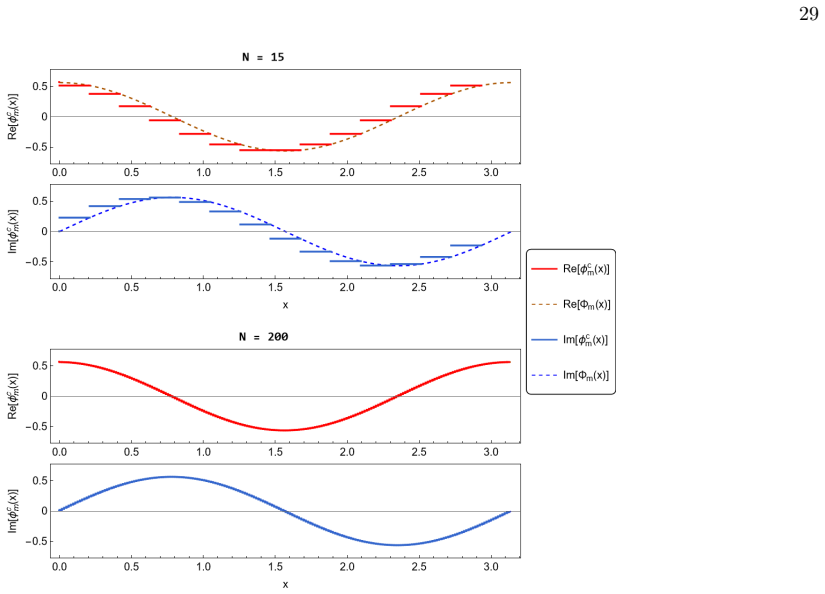
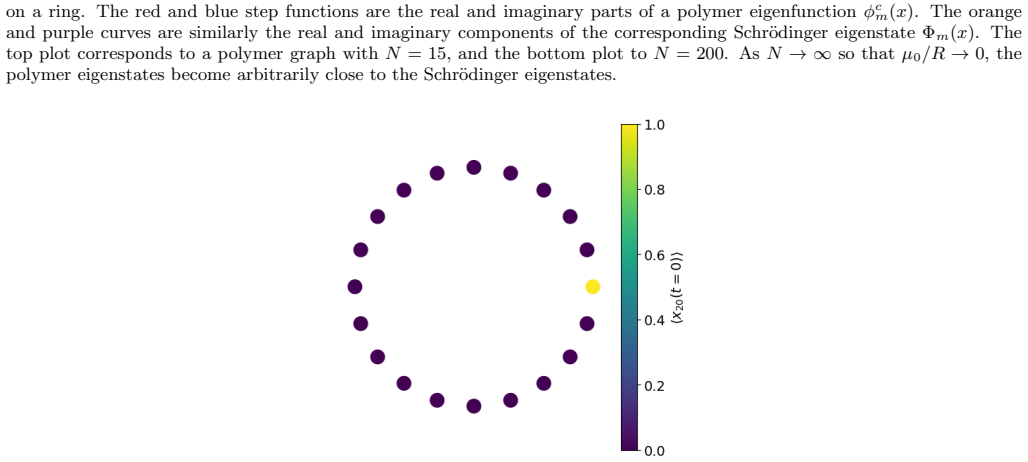
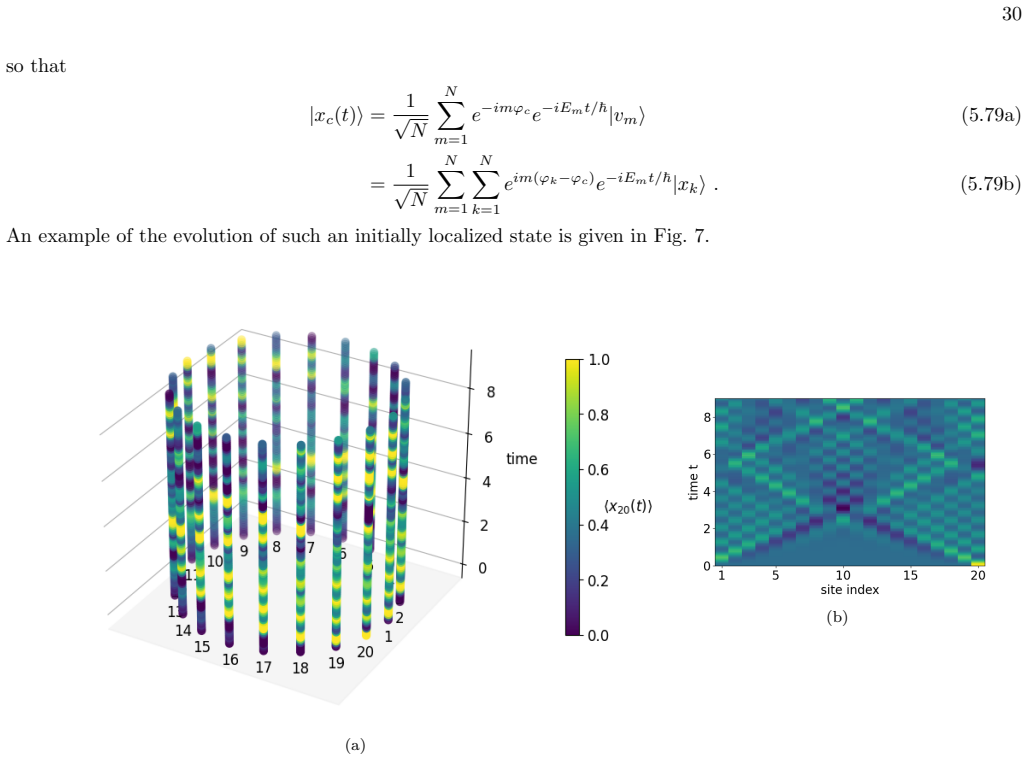
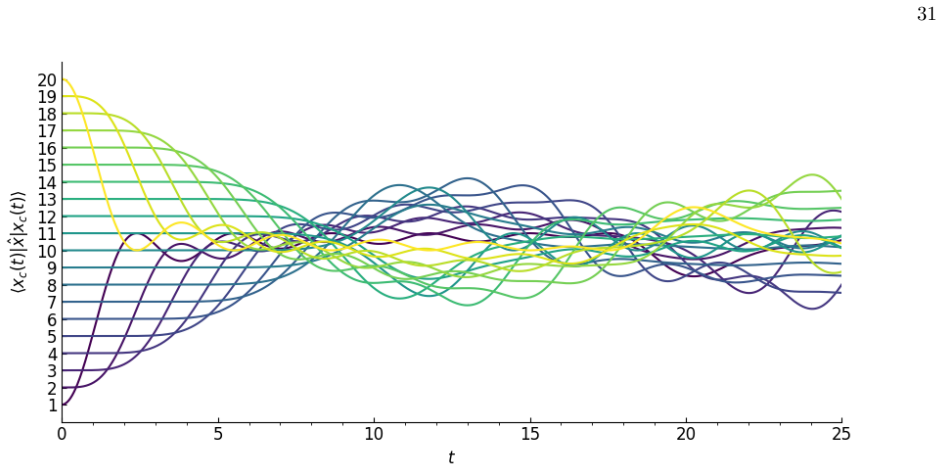
Dispersion of a localized state To illustrate this discrete dynamics, we will investigate the dispersion of a localized state around the ring and briefly compare the results to the results of Schr¨ odinger-quantization. 29 FIG. 5. Convergence of polymer energy eigenfunctions to their Schr¨ odinger-quantized counterparts for the polymer particle on a ring....
-
[2]
bras”⟨φ| ∈ H ∗ that map “kets
Bohr compactification There are two alternative characterizations of the Bohr compactification that shed light on different aspects of the underlying idea, one from the perspective of harmonic analysis, and the other from that ofC∗-algebras. We begin with harmonic analysis. Atopological groupis a group endowed with a topology on its elements in which the ...
-
[3]
almost periodic
AC ∗-algebra is a ∗-algebra that is complete in a norm∥ · ∥onAthat satisfies∥A ∗∥=∥A∥and∥A ∗A∥=∥A∥ 2 [43, 44, 47]. The space of finite linear combinations of characters ofR, f(x) = NX n=1 cneiknx ,(A4) wherec n ∈C,k n ∈R, andNis finite, constitute the spaceAP(R) ofalmost periodicfunctions onRwhen closed under the sup (or uniform) norm, ∥f(x)∥sup = sup x∈R...
-
[4]
standard
Dual Group of a Discrete Space Given this understanding of the Bohr compactification of the real numbers, let us investigate the general situa- tion concerning the quantum momentum space (that is, the set of translation eigenfunctions) dual to a discretized configuration space, and what this implies for compact configuration spaces such as the particle on...
-
[5]
Quantum Momentum Space To close this appendix, let us review the perspective we have taken on the role of the dual group to a configuration space as the space of momentum eigenfunctions over that configuration space. The physics embodied in the identifi- cation of the Pontryagin dual of a discrete configuration space with the translation (momentum) eigenf...
-
[6]
Solution by recurrence Here we analyze the particle in a box using a recurrence method equivalent to the solution presented in [64]; we include it here to emphasize the similarity to the recurrence solution for the particle on the ring given in Sec. V E. We begin with a polymer particle on a line described by states in the graph Hilbert spaceH γµ0 defined...
-
[7]
Operator solution We now consider an alternative analysis of the polymerized infinite well, a direct solution of the time-independent Schr¨ odinger equation considered as an operator (matrix) equation. In contrast to the polymer particle on a ring, however, this system is not translation invariant, and we must take ˆV(µ 0)|xN ⟩= 0 and ˆV(−µ 0)|x1⟩= 0 in p...
-
[8]
We have chosen a graph γµ0 withNlattice sites inside the well, so thatL=µ 0(N+1), and the walls of the well are atx= 0 andx= (N+1)µ 0
Continuum limit Finally, we may show that in a manner entirely parallel to the polymer particle on a ring that in the limit that µ0/L→0, the polymer eigenvalues and eigenstates approach that of the Schr¨ odinger theory. We have chosen a graph γµ0 withNlattice sites inside the well, so thatL=µ 0(N+1), and the walls of the well are atx= 0 andx= (N+1)µ 0. 40...
-
[9]
Bojowald, Loop quantum cosmology, Living Rev
M. Bojowald, Loop quantum cosmology, Living Rev. Rel.11, 4 (2008)
2008
-
[10]
A. Ashtekar and P. Singh, Loop quantum cosmology: a status report, Class. Quantum Grav.28, 213001 (2011), arXiv:1108.0893 [gr-qc]
Pith/arXiv arXiv 2011
-
[11]
Ashtekar, T
A. Ashtekar, T. Pawlowski, and P. Singh, Quantum nature of the big bang: An analytical and numerical investigation, Phys. Rev. D73, 124038 (2006)
2006
-
[12]
A. Ashtekar, T. Pawlowski, and P. Singh, Quantum Nature of the Big Bang: Improved dynamics, Phys. Rev. D74, 084003 (2006), arXiv:gr-qc/0607039
Pith/arXiv arXiv 2006
-
[13]
D. A. Craig and P. Singh, Consistent Probabilities in Wheeler-DeWitt Quantum Cosmology, Phys. Rev. D82, 123526 (2010), arXiv:1006.3837 [gr-qc]
Pith/arXiv arXiv 2010
-
[14]
D. A. Craig, Dynamical eigenfunctions and critical density in loop quantum cosmology, Class. Quantum Grav.30, 035010 (2013), arXiv:1207.5601 [gr-qc]
Pith/arXiv arXiv 2013
-
[15]
Ashtekar, S
A. Ashtekar, S. Fairhurst, and J. L. Willis, Quantum gravity, shadow states and quantum mechanics, Class. Quantum Grav.20, 1031 (2003)
2003
-
[16]
Corichi, T
A. Corichi, T. Vukaˇ sinac, and J. A. Zapata, Hamiltonian and physical Hilbert space in polymer quantum mechanics, Class. Quantum Grav.24, 1495 (2007). 41
2007
-
[17]
A. Corichi, T. Vukasinac, and J. A. Zapata, Polymer Quantum Mechanics and its Continuum Limit, Phys. Rev. D76, 044016 (2007), arXiv:0704.0007 [gr-qc]
Pith/arXiv arXiv 2007
-
[18]
J. M. Velhinho, Comments on the kinematical structure of loop quantum cosmology, Class. Quant. Grav.21, L109 (2004), arXiv:gr-qc/0406008
Pith/arXiv arXiv 2004
-
[19]
J. M. Velhinho, The Quantum configuration space of loop quantum cosmology, Class. Quant. Grav.24, 3745 (2007), arXiv:0704.2397 [gr-qc]
Pith/arXiv arXiv 2007
-
[20]
A. Ashtekar, M. Bojowald, and J. Lewandowski, Mathematical structure of loop quantum cosmology, Adv. Theor. Math. Phys.7, 233 (2003), arXiv:gr-qc/0304074 [gr-qc]
Pith/arXiv arXiv 2003
-
[21]
Bojowald, Mathematical structure of loop quantum cosmology: homogeneous models, SIGMA9, 082 (2013)
M. Bojowald, Mathematical structure of loop quantum cosmology: homogeneous models, SIGMA9, 082 (2013)
2013
-
[22]
Thiemann,Modern Canonical Quantum General Relativity(Cambridge University Press, 2007)
T. Thiemann,Modern Canonical Quantum General Relativity(Cambridge University Press, 2007)
2007
-
[23]
G. M. Hossain, V. Husain, and S. S. Seahra, The Propagator in polymer quantum field theory, Phys. Rev. D82, 124032 (2010), arXiv:1007.5500 [gr-qc]
Pith/arXiv arXiv 2010
-
[24]
A. Kreienbuehl and T. Paw lowski, Singularity resolution from polymer quantum matter, Phys. Rev. D88, 043504 (2013), arXiv:1302.6566 [gr-qc]
Pith/arXiv arXiv 2013
-
[25]
A. Zulfiqar and S. M. Hassan, Polymer cosmology with polymer matter: effective dynamics, JCAP09, 018, arXiv:2502.04875 [gr-qc]
-
[26]
Amadei, A
L. Amadei, A. Perez, and S. Ribisi, Landscape of polymer quantum cosmology, Phys. Rev. D107, 086007 (2023)
2023
-
[27]
G. Chacon-Acosta, E. Manrique, L. Dagdug, and H. A. Morales-Tecotl, Statistical thermodynamics of polymer quantum systems, SIGMA7, 110 (2011), arXiv:1109.0803 [gr-qc]
Pith/arXiv arXiv 2011
-
[28]
D. J. Stargen, S. Shankaranarayanan, and S. Das, Polymer quantization and advanced gravitational wave detector, Phys. Rev. D100, 10.1103/physrevd.100.086007 (2019)
-
[29]
A. Garcia-Chung, M. F. Carney, J. B. Mertens, A. Parvizi, S. Rastgoo, and Y. Tavakoli, What do gravitational wave detectors say about polymer quantum effects?, JCAP11, 054, arXiv:2208.09739 [gr-qc]
- [30]
-
[31]
Kiefer,Quantum Gravity, 4th ed
C. Kiefer,Quantum Gravity, 4th ed. (Oxford University Press, 2025)
2025
-
[32]
C. Rovelli and F. Vidotto, Compact phase space, cosmological constant, and discrete time, Phys. Rev.D91, 084037 (2015), arXiv:1502.00278 [gr-qc]
Pith/arXiv arXiv 2015
-
[33]
D. H. McIntyre,Quantum Mechanics: A Paradigms Approach(Cambridge University Press, 2023)
2023
-
[34]
K. G. Wilson, Confinement of Quarks, Phys. Rev. D10, 2445 (1974)
1974
-
[35]
ˇSˇtov´ ıˇ cek and J
P. ˇSˇtov´ ıˇ cek and J. Tolar, Quantum mechanics in a discrete space-time, Reports on Mathematical Physics20, 157 (1984)
1984
-
[36]
Lorente, Quantum mechanics on discrete space and time, inNew Developments on Fundamental Problems in Quantum Physics(Springer, 1997) pp
M. Lorente, Quantum mechanics on discrete space and time, inNew Developments on Fundamental Problems in Quantum Physics(Springer, 1997) pp. 213–224
1997
-
[37]
A. C. de la Torre and D. Goyeneche, Quantum mechanics in finite dimensional Hilbert space, Am. J. Phys.71, 49 (2003), arXiv:quant-ph/0205159
Pith/arXiv arXiv 2003
-
[38]
Vourdas, Quantum systems with finite Hilbert space, Rep
A. Vourdas, Quantum systems with finite Hilbert space, Rep. Prog. Phys.67, 267 (2004)
2004
-
[39]
S. M. Carroll, Completely discretized, finite quantum mechanics, Foundations of Physics53, 90 (2023)
2023
-
[40]
Szekeres,A Course in Modern Mathematical Physics: Groups, Hilbert Space and Differential Geometry(Cambridge University Press, Cambridge, 2004)
P. Szekeres,A Course in Modern Mathematical Physics: Groups, Hilbert Space and Differential Geometry(Cambridge University Press, Cambridge, 2004)
2004
-
[41]
P. B. Pal,A Physicist’s Introduction to Algebraic Structures(Cambridge University Press, 2019)
2019
-
[42]
B. C. Hall,Quantum Theory for Mathematicians(Springer, 2013)
2013
-
[43]
T. M. Helliwell and V. V. Sahakian,Modern Classical Mechanics(Cambridge University Press, 2021)
2021
-
[44]
B. F. Schutz,Geometrical Methods of Mathematical Physics(Cambridge University Press, 1980)
1980
-
[45]
Dirac,Principles of Quantum Mechanics, 4th ed
P. Dirac,Principles of Quantum Mechanics, 4th ed. (Oxford University Press, 1958)
1958
-
[46]
Stone and P
M. Stone and P. Goldbart,Mathematics for Physics, A Guided Tour for Graduate Students(Cambridge University Press, 2009)
2009
-
[47]
S. van Enk and D. A. Steck, All Hilbert spaces are the same: consequences for generalized coordinates and momenta (2025), arXiv:2502.08494 [quant-ph]
Pith/arXiv arXiv 2025
-
[48]
J. J. Sakurai and J. Napolitano,Modern Quantum Mechanics, 3rd ed., Quantum physics, quantum information and quantum computation (Cambridge University Press, 2020)
2020
-
[49]
B. C. Hall,Lie Groups, Lie Algebras, and Representations, 2nd ed. (Springer, 2015)
2015
-
[50]
Zachos,Crib notes on Campbell-Baker-Hausdorff expansions, Tech
C. Zachos,Crib notes on Campbell-Baker-Hausdorff expansions, Tech. Rep. (Argonne National Laboratory, 1999)
1999
-
[51]
Moretti,Spectral Theory and Quantum Mechanics, 2nd ed
V. Moretti,Spectral Theory and Quantum Mechanics, 2nd ed. (Springer, 2017)
2017
-
[52]
R. M. Wald,Quantum Field Theory in Curved Spacetime and Black Hole Thermodynamics(University of Chicago Press, 1994)
1994
-
[53]
Reed and B
M. Reed and B. Simon,Methods of Modern Mathematical Physics I: Functional Analysis, revised and enlarged ed., Vol. I (Academic Press, 1980)
1980
-
[54]
Prugoveˇ cki,Quantum Mechanics in Hilbert Space, 2nd ed
E. Prugoveˇ cki,Quantum Mechanics in Hilbert Space, 2nd ed. (Academic Press, 1981)
1981
-
[55]
Blank, P
J. Blank, P. Exner, and M. Havliˇ cek,Hilbert Space Operators in Quantum Physics, 2nd ed. (Springer, 2008)
2008
-
[56]
Katznelson,An Introduction to Harmonic Analysis, 3rd ed
Y. Katznelson,An Introduction to Harmonic Analysis, 3rd ed. (Cambridge University Press, 2004)
2004
-
[57]
Rudin,Fourier Analysis on Groups(Interscience, 1970)
W. Rudin,Fourier Analysis on Groups(Interscience, 1970)
1970
-
[58]
Diestel and A
J. Diestel and A. Spalsbury,The Joys of Haar Measure, Graduate Studies in Mathematics, Vol. 150 (American Mathe- matical Society, 2014)
2014
-
[59]
Hewitt and K
E. Hewitt and K. A. Ross,Abstract Harmonic Analysis, 2nd ed., Vol. I (Springer-Verlag, 1979). 42
1979
-
[60]
M. A. Armstrong,Basic Topology(Springer, 1983)
1983
-
[61]
Bojowald,Canonical gravity and applications: cosmology, black holes, and quantum gravity(Cambridge University Press, 2010)
M. Bojowald,Canonical gravity and applications: cosmology, black holes, and quantum gravity(Cambridge University Press, 2010)
2010
-
[62]
M. F. (https://math.stackexchange.com/users/6608/mike f), What is the Haar measure on the Bohr compactificationbZ of the integers?, Mathematics Stack Exchange (2025), (version: 2025-10-14), https://math.stackexchange.com/q/5101741
arXiv 2025
-
[63]
W. S. Chung, I. Haouam, and H. Hassanabadi, Quantum mechanics on a circle with a finite number ofα-uniformly distributed points, Phys. Lett. A485, 129098 (2023), arXiv:2304.03176 [quant-ph]
arXiv 2023
-
[64]
S. N. Elaydi,An Introduction to Difference Equations(Springer, New York, 1996)
1996
-
[65]
Abbott,Understanding Analysis, 2nd ed
S. Abbott,Understanding Analysis, 2nd ed. (Springer, 2015)
2015
-
[66]
S. M. Barnett and J. A. Vaccaro, eds.,The quantum phase operator: A review(Taylor and Francis, 2007)
2007
-
[67]
A. Ashtekar, A. Corichi, and P. Singh, Robustness of key features of loop quantum cosmology, Phys. Rev. D77, 024046 (2008), arXiv:0710.3565 [gr-qc]
Pith/arXiv arXiv 2008
-
[68]
D. A. Craig and P. Singh, Consistent probabilities in loop quantum cosmology, Class. Quantum Grav.30, 205008 (2013), arXiv:1306.6142 [gr-qc]
Pith/arXiv arXiv 2013
-
[69]
J. B. Conway,A Course in Functional Analysis, 2nd ed. (Springer-Verlag, 1990)
1990
-
[70]
Staten, Bohr compactifications,https://math.osu.edu/sites/math.osu.edu/files/whatis_bohr.pdf(2009), ac- cessed: 2025-08-16
C. Staten, Bohr compactifications,https://math.osu.edu/sites/math.osu.edu/files/whatis_bohr.pdf(2009), ac- cessed: 2025-08-16
2009
-
[71]
Flores-Gonz´ alez, H
E. Flores-Gonz´ alez, H. A. Morales-T´ ecotl, and J. D. Reyes, Propagators in polymer quantum mechanics, Ann. Phys.336, 394 (2013)
2013
-
[72]
G. Chac´ on-Acosta, E. Manrique, L. Dagdug, and H. A. Morales-T´ ecotl, Statistical thermodynamics of polymer quantum systems, Symmetry, Integrability, and Geometry: Methods and Applications7, 10.3842/SIGMA.2011.110 (2011)
-
[73]
D. Popov, Free particle trapped in an infinite quantum well examined through the discrete calculus model (2023), arXiv:2303.08212 [quant-ph]
arXiv 2023
-
[74]
T. B. Boykin and G. Klimack, The discretized schr¨ odinger equation and simple models for semiconductor quantum wells, Euro. J. Phys.25, 10.1088/0143-0807/25/4/006 (2004)
-
[75]
G. Bonneau, J. Faraut, and G. Valent, Selfadjoint extensions of operators and the teaching of quantum mechanics, Am. J. Phys.69, 322 (2001), arXiv:quant-ph/0103153
Pith/arXiv arXiv 2001
-
[76]
Gover, The eigenproblem of a tridiagonal 2-Toeplitz matrix, Linear Algebra and its Applications197–198, 63 (1994)
M. Gover, The eigenproblem of a tridiagonal 2-Toeplitz matrix, Linear Algebra and its Applications197–198, 63 (1994)
1994
-
[77]
Noschese, L
S. Noschese, L. Pasquini, and L. Reichel, Tridiagonal Toeplitz matrices: Properties and novel applications, Numerical Linear Algebra with Applications20, 302 (2012)
2012
discussion (0)
Sign in with ORCID, Apple, or X to comment. Anyone can read and Pith papers without signing in.