REVIEW 4 major objections 5 minor 46 references
Objectomaly: Objectness-Aware Refinement for OoD Segmentation with Structural Consistency and Boundary Precision
T0 review · 4 major / 5 minor · reviewed 2026-08-06 · deepseek-v4-flash
Pith's one-line read Objectomaly claims a training-free, three-stage refinement — averaging anomaly scores inside SAM masks, then sharpening contours with Laplacian and Gaussian filtering — reaches state-of-the-art OoD segmentation on SMIYC and RoadAnomaly.
desk verdict Plausible OASC idea but the MBP equation as written turns the output into a zero-filled edge map, contradicting the reported results; not ready for review. read the letter →
The pith
A machine-rendered reading of the paper's core claim, the machinery that carries it, and where it could break.
The reading
What carries the argument
The load-bearing mechanism is objectness-aware score calibration. Precisely, SAM (Segment Anything Model, a class-agnostic promptable segmenter) produces overlapping instance masks $S_k$; Objectomaly sorts them by area, computes $\alpha_k = \frac{1}{|S'_k|} \sum_{x \in S'_k} A_{\mathrm{init}}(x)$, and sets $A_{\mathrm{score}}(x) = \alpha_k$ for $x$ inside the mask while leaving outside pixels unchanged. This replacement removes within-object score variance and suppresses background noise, under the premise that SAM's masks delineate true anomaly objects. The second mechanism, MBP, computes the absolute Laplacian of the calibrated score map and smooths it with a Gaussian $G_\sigma$, sharpening object borders without committing to a hard binary threshold.
What would settle it
An experiment that would settle the claim: take the SMIYC ObstacleTrack images, measure Objectomaly's component-level F1, then rerun the OASC stage with artificially corrupted SAM masks — for example, deleting 20% of each ground-truth anomaly mask before computing $\alpha_k$, or unioning each anomaly mask with an equally sized road patch. If F1 collapses, the gain depends on SAM's mask completeness as assumed; if F1 survives, the boundary stage and not the mean-replacement assumption is carrying the improvement.
Extended reading notes
Core claim
The central discovery, as the authors state it, is that object structure is the missing axis in OoD segmentation: spatial consistency, not stronger pixel confidence, is what separates clean anomaly masks from noisy ones. In equations (9)-(10), each SAM mask $S'_k$ is assigned a single representative anomaly score $\alpha_k$, the average of the coarse map over the mask, and all pixels inside the mask take that value; this is what turns scattered high-confidence blobs and internally inconsistent objects into whole, uniformly scored regions. The Meticulous Boundary Precision stage then applies a Laplacian operator to the calibrated score map and convolves the result with a Gaussian kernel, keeping the map soft while aligning contours with image gradients. The paper argues that the two stages are synergistic: OASC supplies structural coherence and MBP supplies boundary precision, so their combined effect is larger than the sum of the individual ablation gains.
Load-bearing premise
The approach assumes that every anomaly is a coherent object that SAM segments completely and without background contamination, because Eq. (10) replaces every pixel in a mask with the mask mean; if SAM splits an anomaly or merges it with the road, that replacement either spreads nonzero scores into background or fragments the object, and the method inherits SAM's mistakes.
Editorial extensions
If this is right
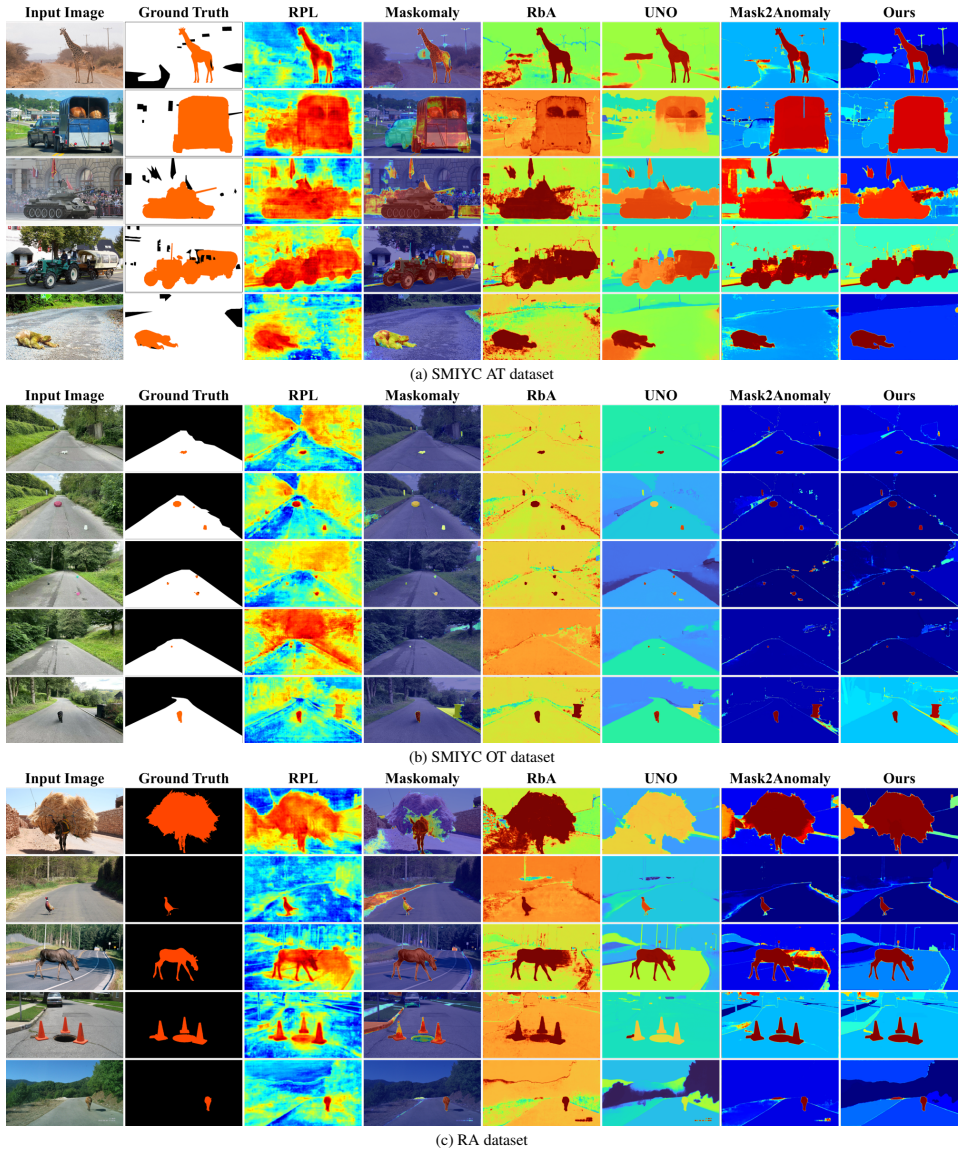
- Post-hoc deployment: any existing OoD detector that outputs a pixel score map can receive the refinement without retraining; the paper demonstrates this by swapping the CAS backbone across RPL, Maskomaly, RbA, UNO, and Mask2Anomaly.
- Runtime flexibility: substituting SAM2, FastSAM, or MobileSAM inside OASC preserves most of the gain while drastically changing inference speed, which makes the pipeline tunable for embedded driving systems.
- Safety metrics improve at the object level: component-level PPV and F1 gains imply autonomous planners receive whole anomaly objects rather than fragmented score blobs, reducing both missed obstacles and false alarms.
- Near-zero FPR95 on ObstacleTrack implies the pipeline suppresses false positives from road texture and shadows, which is the failure mode that most limits the practical use of pixel-level anomaly scores.
Reading between the lines
- As an editorial extension, the method's ceiling is bounded by the coarse anomaly map: OASC only renormalizes scores that CAS already emitted, so an anomaly entirely missed by the backbone cannot be recovered by mask averaging; a natural test is to run CAS with several backbones and feed the union of their score maps into OASC.
- Because the calibration step is agnostic to semantics, the same objectness-aware score normalization could transfer to open-vocabulary segmentation or panoptic-anomaly setups that already produce instance masks, where the coarse score could come from a text-prompt or prototype distance rather than a softmax.
- The mean is a crude representative statistic; replacing it with a max, quantile, or boundary-weighted statistic would change the precision-recall trade-off, and the ablation table suggests the choice interacts strongly with the dataset (SMIYC OT versus RA).
Editorial analysis
A structured set of objections, weighed in public.
Referee Report
Summary. The paper proposes Objectomaly, a training-free post-hoc refinement framework for out-of-distribution (OoD) segmentation. It uses an existing OoD backbone (Mask2Anomaly) as the Coarse Anomaly Scoring (CAS) stage, calibrates pixel-level scores by replacing them with the mean score inside SAM-generated masks (Objectness-Aware Score Calibration, OASC), and then applies a Laplacian magnitude followed by Gaussian smoothing (Meticulous Boundary Precision, MBP). The authors report state-of-the-art pixel-level and component-level results on SMIYC AnomalyTrack, ObstacleTrack, and RoadAnomaly, along with ablations on stage contributions, SAM variants, and real-world dashcam footage.
Significance. The modular, training-free design is attractive, and the paper evaluates on standard benchmarks with a clear pipeline. I found no circular derivation or parameter fitting to the target metrics: the method relies on external components (Mask2Anomaly and SAM) rather than tuning a parameter to the reported outputs. However, the reported numbers cannot be reproduced from the algorithm as written in Eqs. (11)-(12), and several main-text claims are directly contradicted by the paper's own tables. Because these issues concern the core method definition and the validity of the headline results, the manuscript does not currently establish its central claims. The framework may be salvageable after a correct algorithm specification and a full audit of the experimental tables.
major comments (4)
- [3.2.3, Eqs. (11)-(12)] The final anomaly map is defined as G_sigma * |∂²Ascore/∂x² + ∂²Ascore/∂y²|. After Eq. (10), Ascore is piecewise constant inside each SAM mask and in unmodified regions, so the Laplacian is zero throughout object interiors and nonzero only on narrow boundary rings; Gaussian smoothing cannot reconstruct interior scores. Pixel-level AuPRC/FPR95 and component-level F1 values therefore cannot follow from this map. No residual term, rescaling, or normalization is specified. This is an internal inconsistency between the stated algorithm and the reported results.
- [4.2.2 / Table 2] The text states that Objectomaly "outperforms all competing methods across all three metrics" on SMIYC AT, but Table 2 reports sIoU 43.70 for Objectomaly versus 68.01 for UNO and 49.77 for RPL. The sIoU gap is large, and the claim as written is false. The component-level superiority claim must be restated or the experiments re-run.
- [4.2.1 / Table 1] The text claims the lowest FPR95 across all evaluated datasets, but on RoadAnomaly Table 1 gives Objectomaly FPR95=9.92 while UNO achieves 9.20. The RA result is therefore not state-of-the-art on FPR95, and the stated generalization claim is contradicted by the paper's own table.
- [4.3.2 / Table 4] The FastSAM row reports AuPRC=11.75 and FPR95=92.65 for SMIYC OT, which is inconsistent with the claim that FastSAM performs competitively and with every other row in the table. If these entries are swapped or erroneous, corrected numbers are needed before the model-flexibility conclusion can be evaluated.
minor comments (5)
- [3.1.1] The sentence "The mask-level anomaly score is computed as [26]:" is duplicated immediately before Eq. (3); remove the second occurrence.
- [3.2.2 / Fig. 3] The text and Eq. (8) state that masks are processed in descending size order, but the Figure 3 caption says refinement proceeds from smaller objects to larger ones; please make the ordering consistent.
- [Table 1] In the Maskomaly row for SMIYC OT, the values "0.96 96.14" are the only occurrence of AuPRC below 1 in the table; please verify the column alignment or provide a reference for these "actual results".
- [Abstract] The abstract reports AuPRC 96.99 and FPR95 0.07 without specifying that these are SMIYC ObstacleTrack numbers; please qualify them by dataset.
- [OASC, Eq. (10)] The robustness of the OASC stage to imperfect SAM masks (over-segmentation or merging with background) is not analyzed; a quantitative failure-mode analysis would strengthen the generalization claims.
Circularity Check
No circular derivation: the refinement pipeline is empirical post-processing over external components, with no fitted parameter renamed as a prediction.
full rationale
The paper's central claim is that a three-stage post-processing pipeline (CAS, OASC, MBP) improves OoD segmentation. The pipeline takes a coarse anomaly map from Mask2Anomaly, calibrates it with SAM masks via Eq. (9)-(10), and refines boundaries via Eq. (11)-(12). None of these steps fits a parameter to the benchmark labels, nor does any equation define the output in terms of the final metric. The only self-citations (refs [16], [24], [25]) are introductory citations to the authors' prior work on semantic segmentation applications and are not load-bearing for the method or the results. The reported gains are externally evaluated against SMIYC and RoadAnomaly datasets, and the ablation study compares stages against a CAS-only baseline. The skeptic's concern about MBP—that Eqs. (11)-(12) output a blurred Laplacian edge magnitude rather than a refined anomaly score field—is a genuine correctness/reproducibility question about whether the stated algorithm can produce the claimed numbers, but it is not circularity: the output is not equivalent to the input by definition, nor is any fitted value being presented as a prediction. Therefore the circularity score is 0.
Assumptions & free parameters
free parameters (1)
- Gaussian smoothing sigma and kernel size =
not reported
assumptions (3)
- domain assumption OoD anomalies are coherent objects that SAM can segment into complete, contiguous masks.
- domain assumption Test-time use of a high-capacity external segmenter does not violate the benchmark protocol.
- ad hoc to paper Laplacian magnitude followed by Gaussian smoothing preserves or improves an anomaly score field.
Cite this review
Pith. "Pith review of Objectomaly: Objectness-Aware Refinement for OoD Segmentation with Structural Consistency and Boundary Precision." pith.science (2026). https://pith.science/paper/526MJK4F
@misc{pith2026250707460,
  author       = {Pith},
  title        = {Pith review of: Objectomaly: Objectness-Aware Refinement for OoD Segmentation with Structural Consistency and Boundary Precision},
  year         = {2026},
  howpublished = {\url{https://pith.science/paper/526MJK4F}},
  note         = {Machine review of arXiv:2507.07460}
}
abstract
Out-of-Distribution (OoD) segmentation is critical for safety-sensitive applications like autonomous driving. However, existing mask-based methods often suffer from boundary imprecision, inconsistent anomaly scores within objects, and false positives from background noise. We propose \textbf{\textit{Objectomaly}}, an objectness-aware refinement framework that incorporates object-level priors. Objectomaly consists of three stages: (1) Coarse Anomaly Scoring (CAS) using an existing OoD backbone, (2) Objectness-Aware Score Calibration (OASC) leveraging SAM-generated instance masks for object-level score normalization, and (3) Meticulous Boundary Precision (MBP) applying Laplacian filtering and Gaussian smoothing for contour refinement. Objectomaly achieves state-of-the-art performance on key OoD segmentation benchmarks, including SMIYC AnomalyTrack/ObstacleTrack and RoadAnomaly, improving both pixel-level (AuPRC up to 96.99, FPR$_{95}$ down to 0.07) and component-level (F1$-$score up to 83.44) metrics. Ablation studies and qualitative results on real-world driving videos further validate the robustness and generalizability of our method. Code will be released upon publication.
Figures


Figures from the paper (2 more)

Reference graph
Works this paper leans on
-
[1]
Maskomaly: Zero-shot mask anomaly segmentation
Jan Ackermann, Christos Sakaridis, and Fisher Yu. Maskomaly: Zero-shot mask anomaly segmentation. In 34th British Machine Vision Conference 2023, BMVC 2023, Aberdeen, UK, November 20-24, 2023 . BMV A, 2023. 1, 2, 5, 6
work page 2023
-
[2]
Anomaly detection in autonomous driving: A survey
Daniel Bogdoll, Maximilian Nitsche, and J Marius Z¨ollner. Anomaly detection in autonomous driving: A survey. In Proceedings of the IEEE/CVF conference on computer vision and pattern recognition , pages 4488–4499, 2022. 1
work page 2022
-
[3]
Seg- mentmeifyoucan: A benchmark for anomaly segmen- tation
Robin Chan, Krzysztof Lis, Svenja Uhlemeyer, Her- mann Blum, Sina Honari, Roland Siegwart, Pascal Fua, Mathieu Salzmann, and Matthias Rottmann. Seg- mentmeifyoucan: A benchmark for anomaly segmen- tation. In Thirty-fifth Conference on Neural Infor- mation Processing Systems Datasets and Benchmarks Track (Round 2), 2021. 1, 5
work page 2021
-
[4]
Encoder-decoder with atrous separable convolution for semantic image segmentation
Liang-Chieh Chen, Yukun Zhu, George Papandreou, Florian Schroff, and Hartwig Adam. Encoder-decoder with atrous separable convolution for semantic image segmentation. In Proceedings of the European con- ference on computer vision (ECCV) , pages 801–818,
-
[5]
Ting Chen, Lala Li, Saurabh Saxena, Geoffrey Hin- ton, and David J. Fleet. A generalist framework for panoptic segmentation of images and videos. In Pro- ceedings of the IEEE/CVF International Conference on Computer Vision (ICCV), pages 909–919, 2023. 2
work page 2023
-
[6]
Per-pixel classification is not all you need for seman- tic segmentation
Bowen Cheng, Alex Schwing, and Alexander Kirillov. Per-pixel classification is not all you need for seman- tic segmentation. Advances in neural information pro- cessing systems, 34:17864–17875, 2021. 2
work page 2021
-
[7]
Masked- attention mask transformer for universal image seg- mentation
Bowen Cheng, Ishan Misra, Alexander G Schwing, Alexander Kirillov, and Rohit Girdhar. Masked- attention mask transformer for universal image seg- mentation. In Proceedings of the IEEE/CVF con- ference on computer vision and pattern recognition , pages 1290–1299, 2022. 2
work page 2022
-
[8]
Outlier detection by ensembling uncertainty with negative ob- jectness
Anja Deli ´c, Matej Grcic, and Sini ˇsa ˇSegvi´c. Outlier detection by ensembling uncertainty with negative ob- jectness. In 35th British Machine Vision Conference 2024, BMVC 2024, Glasgow, UK, November 25-28,
work page 2024
Show all 46 references
-
[9]
Imagenet: A large-scale hierarchi- cal image database
Jia Deng, Wei Dong, Richard Socher, Li-Jia Li, Kai Li, and Li Fei-Fei. Imagenet: A large-scale hierarchi- cal image database. In 2009 IEEE conference on com- puter vision and pattern recognition , pages 248–255. Ieee, 2009. 5
2009
-
[10]
Exploring the limits of out-of-distribution detection
Stanislav Fort, Jie Ren, and Balaji Lakshminarayanan. Exploring the limits of out-of-distribution detection. Advances in neural information processing systems , 34:7068–7081, 2021. 2
2021
-
[11]
Generalize or detect? towards ro- bust semantic segmentation under multiple distribu- tion shifts
Zhitong Gao, Bingnan Li, Mathieu Salzmann, and Xuming He. Generalize or detect? towards ro- bust semantic segmentation under multiple distribu- tion shifts. Advances in Neural Information Process- ing Systems, 37:52014–52039, 2024. 2
2024
-
[12]
Densehybrid: Hybrid anomaly detection for dense open-set recognition
Matej Grci ´c, Petra Bevandi ´c, and Sini ˇsa ˇSegvi´c. Densehybrid: Hybrid anomaly detection for dense open-set recognition. In European Conference on Computer Vision, pages 500–517. Springer, 2022. 1
2022
-
[13]
Deep residual learning for image recognition
Kaiming He, Xiangyu Zhang, Shaoqing Ren, and Jian Sun. Deep residual learning for image recognition. In Proceedings of the IEEE conference on computer vision and pattern recognition, pages 770–778, 2016. 5
2016
-
[14]
Unleashing multispectral video’s po- tential in semantic segmentation: A semi-supervised viewpoint and new UA V-view benchmark
Wei Ji, Jingjing Li, Wenbo Li, Yilin Shen, Li cheng, and Hongxia Jin. Unleashing multispectral video’s po- tential in semantic segmentation: A semi-supervised viewpoint and new UA V-view benchmark. In The Thirty-eighth Annual Conference on Neural Informa- tion Processing Syste...
2024
-
[15]
Segment anything
Alexander Kirillov, Eric Mintun, Nikhila Ravi, Hanzi Mao, Chloe Rolland, Laura Gustafson, Tete Xiao, Spencer Whitehead, Alexander C Berg, Wan-Yen Lo, et al. Segment anything. In Proceedings of the IEEE/CVF international conference on computer vi- sion, pages 4015–4026, 2023. 2, 4
2023
-
[16]
Saliencymix+: Noise-minimized image mixing method with saliency map in data aug- mentation
Hajeong Lee, Zhixiong Jin, Jiyoung Woo, and Byeongjoon Noh. Saliencymix+: Noise-minimized image mixing method with saliency map in data aug- mentation. IEEE Access, 2025. 1
2025
-
[17]
Open-set semantic seg- mentation for point clouds via adversarial prototype framework
Jianan Li and Qiulei Dong. Open-set semantic seg- mentation for point clouds via adversarial prototype framework. In Proceedings of the IEEE/CVF Con- ference on Computer Vision and Pattern Recognition, pages 9425–9434, 2023. 2
2023
-
[18]
Shiyu Liang, Yixuan Li, and R. Srikant. Enhancing the reliability of out-of-distribution image detection in neural networks. In International Conference on Learning Representations, 2018. 2
2018
-
[19]
Detecting the unexpected via image resynthesis
Krzysztof Lis, Krishna Nakka, Pascal Fua, and Math- ieu Salzmann. Detecting the unexpected via image resynthesis. In Proceedings of the IEEE/CVF Interna- tional Conference on Computer Vision , pages 2152– 2161, 2019. 1, 5
2019
-
[20]
Residual pattern learning for pixel-wise out- of-distribution detection in semantic segmentation
Yuyuan Liu, Choubo Ding, Yu Tian, Guansong Pang, Vasileios Belagiannis, Ian Reid, and Gustavo Carneiro. Residual pattern learning for pixel-wise out- of-distribution detection in semantic segmentation. In Proceedings of the IEEE/CVF International Confer- ence on Computer Visio...
2023
-
[21]
Swin 9 transformer: Hierarchical vision transformer using shifted windows
Ze Liu, Yutong Lin, Yue Cao, Han Hu, Yixuan Wei, Zheng Zhang, Stephen Lin, and Baining Guo. Swin 9 transformer: Hierarchical vision transformer using shifted windows. In Proceedings of the IEEE/CVF international conference on computer vision , pages 10012–10022, 2021. 2
2021
-
[22]
Towards ac- curate unified anomaly segmentation
Wenxin Ma, Qingsong Yao, Xiang Zhang, Zhelong Huang, Zihang Jiang, and S.Kevin Zhou. Towards ac- curate unified anomaly segmentation. In Proceedings of the Winter Conference on Applications of Computer Vision (WACV), pages 1342–1352, 2025. 1
2025
-
[23]
Rba: Segmenting unknown regions re- jected by all
Nazir Nayal, Misra Yavuz, Joao F Henriques, and Fatma G¨uney. Rba: Segmenting unknown regions re- jected by all. In Proceedings of the IEEE/CVF Inter- national Conference on Computer Vision, pages 711– 722, 2023. 1, 2, 5, 6
2023
-
[24]
A novel method of predictive collision risk area estimation for proac- tive pedestrian accident prevention system in urban surveillance infrastructure
Byeongjoon Noh and Hwasoo Yeo. A novel method of predictive collision risk area estimation for proac- tive pedestrian accident prevention system in urban surveillance infrastructure. Transportation research part C: emerging technologies, 137:103570, 2022. 1
2022
-
[25]
Vision-based potential pedestrian risk analysis on unsignalized crosswalk using data mining techniques
Byeongjoon Noh, Wonjun No, Jaehong Lee, and David Lee. Vision-based potential pedestrian risk analysis on unsignalized crosswalk using data mining techniques. Applied Sciences, 10(3):1057, 2020. 1
2020
-
[26]
Unmasking anomalies in road-scene segmentation
Shyam Nandan Rai, Fabio Cermelli, Dario Fontanel, Carlo Masone, and Barbara Caputo. Unmasking anomalies in road-scene segmentation. InProceedings of the IEEE/CVF International Conference on Com- puter Vision, pages 4037–4046, 2023. 1, 2, 3, 5, 6
2023
-
[27]
SAM 2: Segment anything in images and videos
Nikhila Ravi, Valentin Gabeur, Yuan-Ting Hu, Ronghang Hu, Chaitanya Ryali, Tengyu Ma, Haitham Khedr, Roman R ¨adle, Chloe Rolland, Laura Gustafson, Eric Mintun, Junting Pan, Kalyan Va- sudev Alwala, Nicolas Carion, Chao-Yuan Wu, Ross Girshick, Piotr Dollar, and Christoph Feich...
2025
-
[28]
U-net: Convolutional networks for biomedical im- age segmentation
Olaf Ronneberger, Philipp Fischer, and Thomas Brox. U-net: Convolutional networks for biomedical im- age segmentation. In Medical image computing and computer-assisted intervention–MICCAI 2015: 18th international conference, Munich, Germany, October 5-9, 2015, proceedings, par...
2015
-
[29]
Quantification of uncertainty with adversarial models
Kajetan Schweighofer, Lukas Aichberger, Mykyta Ielanskyi, G ¨unter Klambauer, and Sepp Hochreiter. Quantification of uncertainty with adversarial models. Advances in Neural Information Processing Systems , 36:19446–19484, 2023. 1
2023
-
[30]
Open-world semantic segmentation including class similarity
Matteo Sodano, Federico Magistri, Lucas Nunes, Jens Behley, and Cyrill Stachniss. Open-world semantic segmentation including class similarity. In Proceed- ings of the IEEE/CVF Conference on Computer Vision and Pattern Recognition, pages 3184–3194, 2024. 1
2024
-
[31]
Drive&segment: Unsupervised semantic segmentation of urban scenes via cross-modal distil- lation
Antonin V obecky, David Hurych, Oriane Sim ´eoni, Spyros Gidaris, Andrei Bursuc, Patrick P ´erez, and Josef Sivic. Drive&segment: Unsupervised semantic segmentation of urban scenes via cross-modal distil- lation. In European Conference on Computer Vision, pages 478–495. Spring...
2022
-
[32]
Pixood: Pixel-level out-of-distribution detection
Tom ´aˇs V oj´ıˇr, Jan ˇSochman, and Ji ˇr´ı Matas. Pixood: Pixel-level out-of-distribution detection. In Euro- pean Conference on Computer Vision, pages 93–109. Springer, 2024. 1
2024
-
[33]
Semflow: Bind- ing semantic segmentation and image synthesis via rectified flow
Chaoyang Wang, Xiangtai Li, Lu Qi, Henghui Ding, Yunhai Tong, and Ming-Hsuan Yang. Semflow: Bind- ing semantic segmentation and image synthesis via rectified flow. Advances in Neural Information Pro- cessing Systems, 37:138981–139001, 2025. 1
2025
-
[34]
Segrefiner: Towards model-agnostic segmentation refinement with discrete diffusion process
Mengyu Wang, Henghui Ding, Jun Hao Liew, Jiajun Liu, Yao Zhao, and Yunchao Wei. Segrefiner: Towards model-agnostic segmentation refinement with discrete diffusion process. In Thirty-seventh Conference on Neural Information Processing Systems, 2023. 2
2023
-
[35]
Toward real ultra image segmentation: Leveraging surround- ing context to cultivate general segmentation model
Sai Wang, Yutian Lin, Yu Wu, and Bo Du. Toward real ultra image segmentation: Leveraging surround- ing context to cultivate general segmentation model. Advances in Neural Information Processing Systems , 37:129227–129249, 2025. 1
2025
-
[36]
Conditional boundary loss for semantic segmentation
Dongyue Wu, Zilin Guo, Aoyan Li, Changqian Yu, Changxin Gao, and Nong Sang. Conditional boundary loss for semantic segmentation. IEEE Transactions on Image Processing, 32:3717–3731, 2023. 1
2023
-
[37]
3d open-vocabulary panoptic segmen- tation with 2d-3d vision-language distillation
Zihao Xiao, Longlong Jing, Shangxuan Wu, Alex Zi- hao Zhu, Jingwei Ji, Chiyu Max Jiang, Wei-Chih Hung, Thomas Funkhouser, Weicheng Kuo, Anelia Angelova, et al. 3d open-vocabulary panoptic segmen- tation with 2d-3d vision-language distillation. In Eu- ropean Conference on Compu...
2024
-
[38]
Barlow twins: Self-supervised learn- ing via redundancy reduction
Jure Zbontar, Li Jing, Ishan Misra, Yann LeCun, and St´ephane Deny. Barlow twins: Self-supervised learn- ing via redundancy reduction. In International con- ference on machine learning , pages 12310–12320. PMLR, 2021. 5
2021
-
[39]
Faster segment anything: Towards lightweight sam for mobile applications, 2023
Chaoning Zhang, Dongshen Han, Yu Qiao, Jung Uk Kim, Sung-Ho Bae, Seungkyu Lee, and Choong Seon Hong. Faster segment anything: Towards lightweight sam for mobile applications, 2023. 8
2023
-
[40]
Csl: Class-agnostic structure- constrained learning for segmentation including the unseen
Hao Zhang, Fang Li, Lu Qi, Ming-Hsuan Yang, and Narendra Ahuja. Csl: Class-agnostic structure- constrained learning for segmentation including the unseen. In Proceedings of the AAAI Conference on Artificial Intelligence, pages 7078–7086, 2024. 2 10
2024
-
[41]
Pyramid scene parsing network
Hengshuang Zhao, Jianping Shi, Xiaojuan Qi, Xiao- gang Wang, and Jiaya Jia. Pyramid scene parsing network. In Proceedings of the IEEE conference on computer vision and pattern recognition, pages 2881– 2890, 2017. 2
2017
-
[42]
Segment every out-of-distribution object
Wenjie Zhao, Jia Li, Xin Dong, Yu Xiang, and Yun- hui Guo. Segment every out-of-distribution object. In Proceedings of the IEEE/CVF Conference on Com- puter Vision and Pattern Recognition , pages 3910– 3920, 2024. 1
2024
-
[43]
Fast segment anything
Xu Zhao, Wenchao Ding, Yongqi An, Yinglong Du, Tao Yu, Min Li, Ming Tang, and Jinqiao Wang. Fast segment anything. arXiv preprint arXiv:2306.12156,
-
[44]
Rethinking semantic segmentation from a sequence-to-sequence perspective with transformers
Sixiao Zheng, Jiachen Lu, Hengshuang Zhao, Xiatian Zhu, Zekun Luo, Yabiao Wang, Yanwei Fu, Jianfeng Feng, Tao Xiang, Philip HS Torr, et al. Rethinking semantic segmentation from a sequence-to-sequence perspective with transformers. In Proceedings of the IEEE/CVF conference on ...
2021
-
[45]
Deformable {detr}: De- formable transformers for end-to-end object detection
Xizhou Zhu, Weijie Su, Lewei Lu, Bin Li, Xiao- gang Wang, and Jifeng Dai. Deformable {detr}: De- formable transformers for end-to-end object detection. In International Conference on Learning Representa- tions, 2021. 5 11
2021
-
[2024]
BMV A, 2024. 2, 5, 6
2024
Reviewed August 6, 2026 · model on record in the stance chip above.
Discussion (0). Sign in to comment.