Data augmented bootstrap: Unifying confidence interval construction by approximate invariance
Pith reviewed 2026-06-27 15:55 UTC · model grok-4.3
The pith
Data augmented bootstrap constructs confidence intervals from approximately invariant data transformations without requiring exact group symmetries.
A machine-rendered reading of the paper's core claim, the machinery that carries it, and where it could break.
Core claim
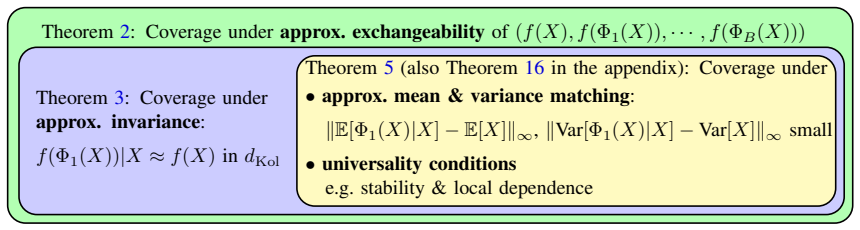
The data augmented bootstrap framework constructs confidence intervals from approximately invariant transformations of the data. It recovers conformal prediction, wild bootstrap for MMD U-statistics, SymmPI, and the classical bootstrap as special cases. Theoretical coverage results hold without assuming a group structure and interpolate between finite-sample exactness and asymptotic validity according to the strength of the invariance, with the strength measured in Kolmogorov distance and reducing to conditional mean and variance matching under Gaussian universality.
What carries the argument
Data augmented bootstrap framework that generates confidence intervals from data transformations whose approximate invariance is quantified by Kolmogorov distance.
If this is right
- DAB recovers methods that rely on exact group symmetries as special cases when invariance is perfect.
- Coverage guarantees interpolate between finite-sample and asymptotic regimes as the measured invariance strength varies.
- Data augmentation steps can be inserted into bootstrap, wild bootstrap, and conformal prediction while retaining the interpolated coverage results.
- The same framework applies to simulated, image, language, and scientific datasets without needing a group structure on the transformations.
Where Pith is reading between the lines
- The interpolation result may allow practitioners to trade off computational cost of stronger augmentations against the tightness of the resulting intervals.
- Because no group structure is required, the approach could extend to transformations that are only locally invariant, such as small rotations or crops in image data.
- The reduction to mean-variance matching under Gaussian universality suggests that DAB could be combined with existing asymptotic expansions for other statistics.
Load-bearing premise
The strength of the approximate invariance can be quantified accurately enough by Kolmogorov distance or by mean-variance matching to control the coverage error.
What would settle it
A simulation or real-data experiment in which the Kolmogorov distance between the original and transformed distributions is small yet the resulting intervals fail to achieve the nominal coverage rate, or the distance is large yet coverage still holds at the nominal rate.
Figures

read the original abstract
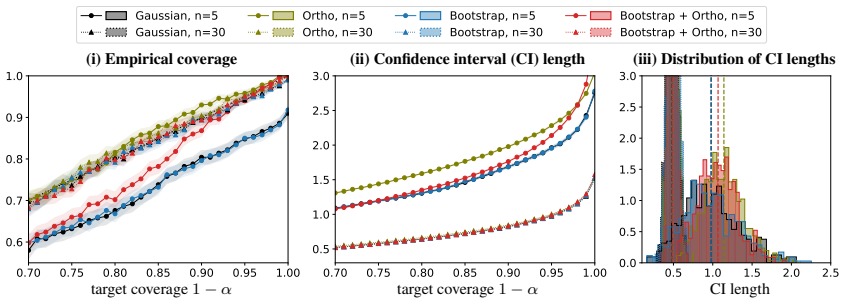
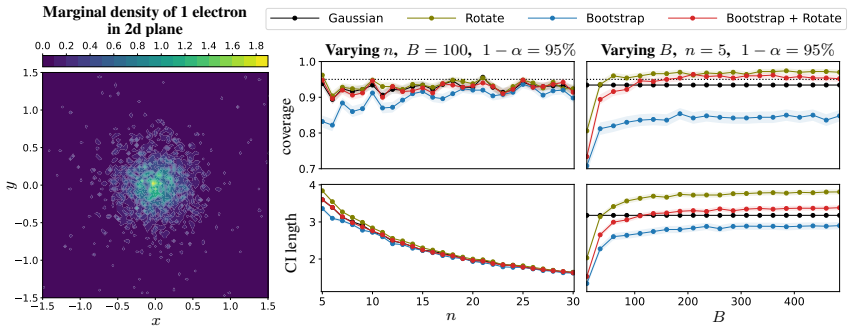
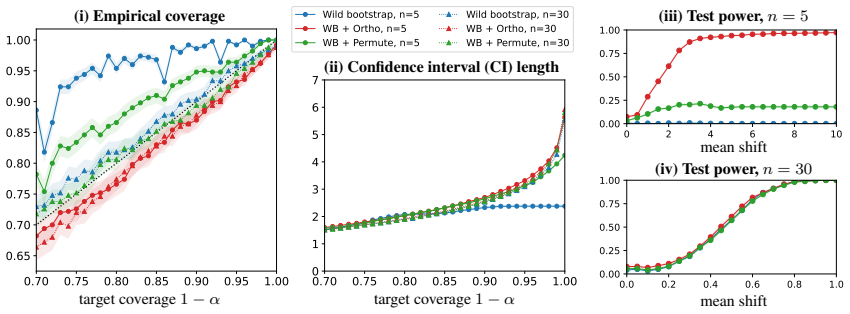
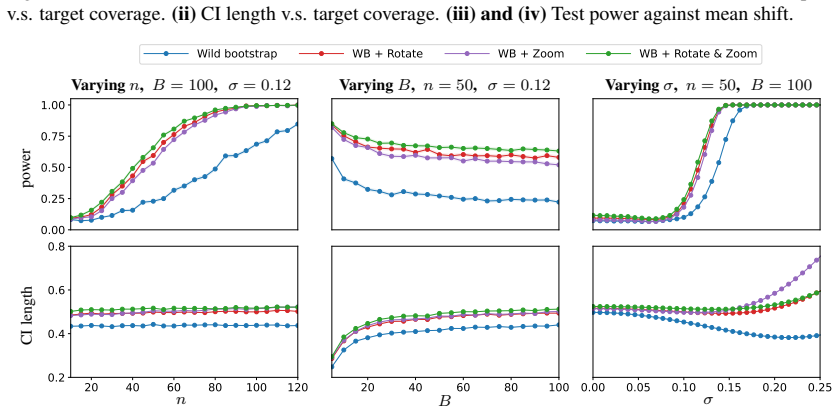
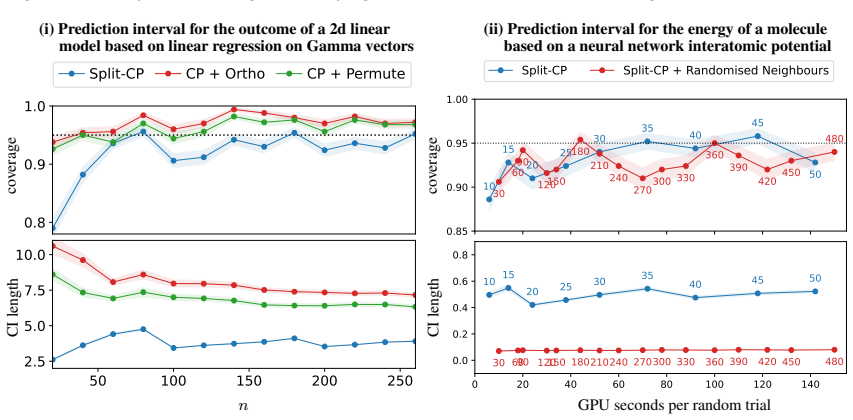
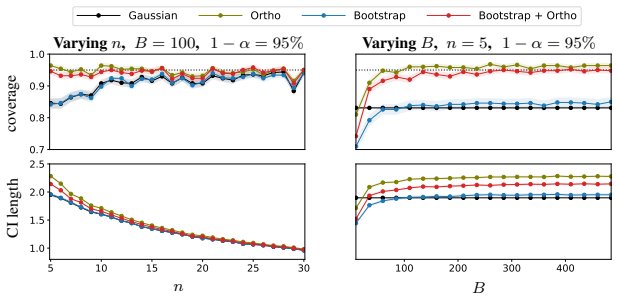
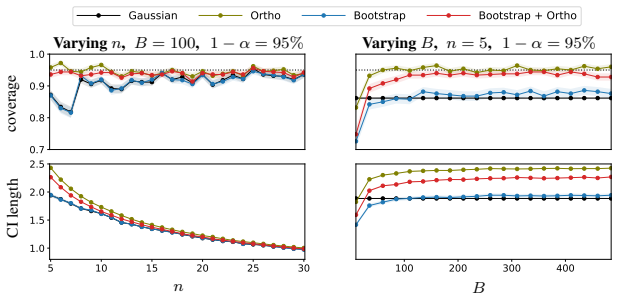
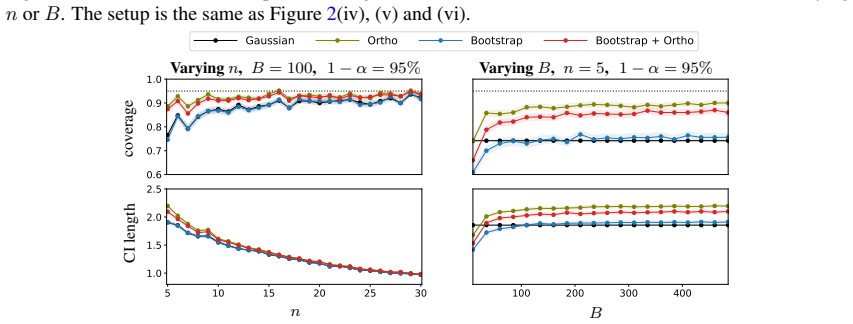
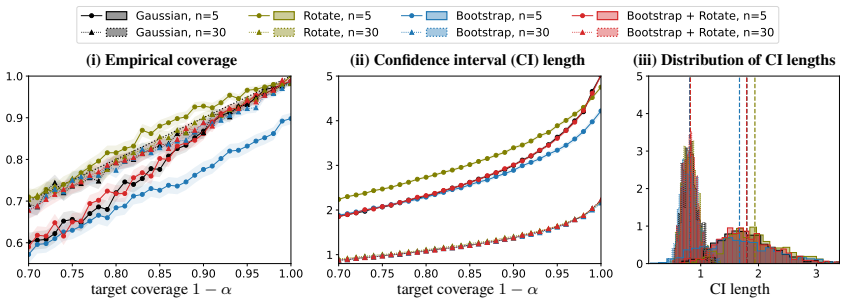
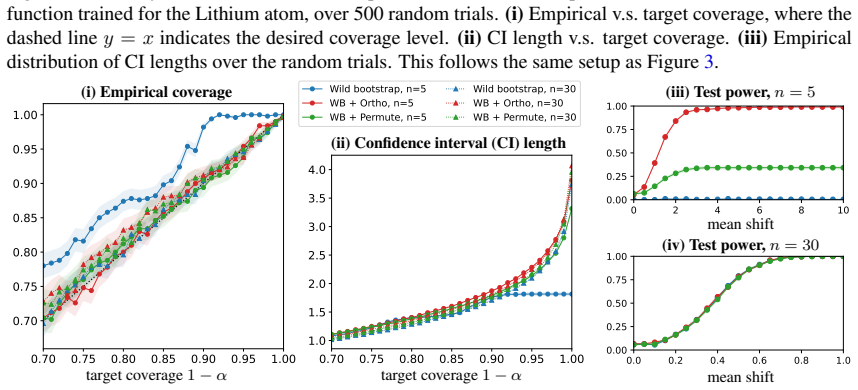
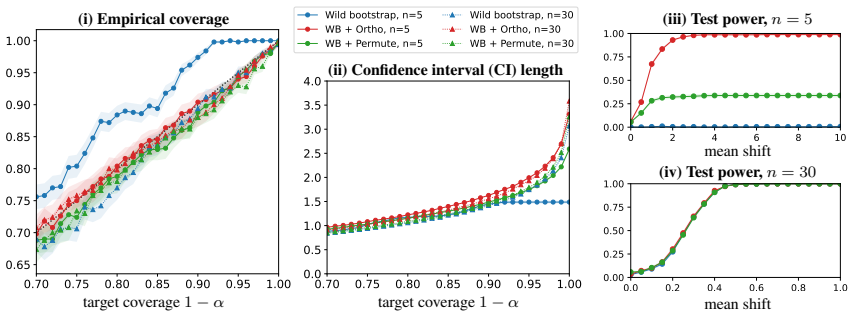
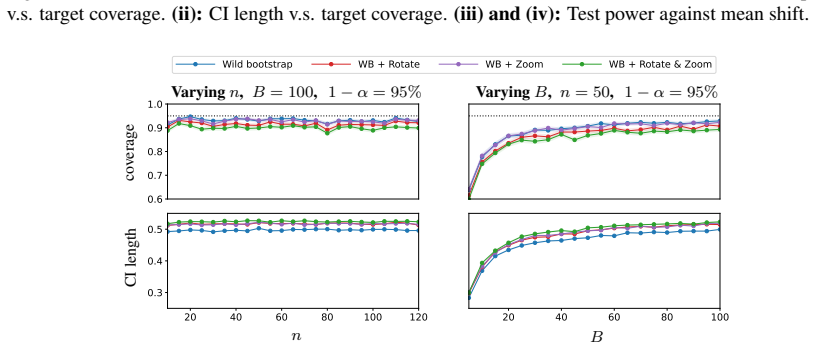
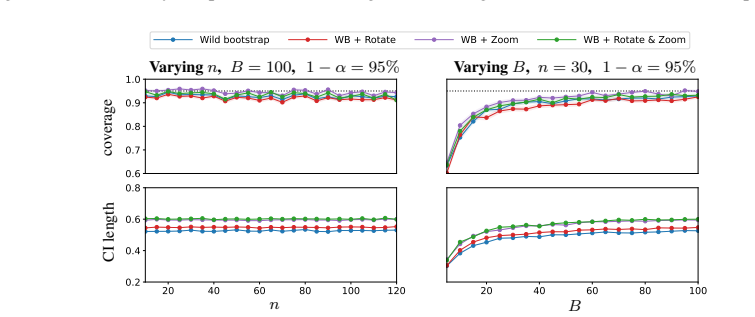
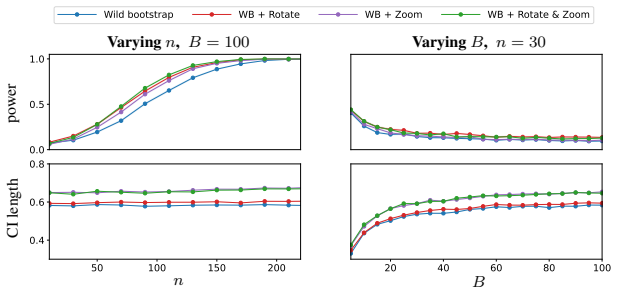
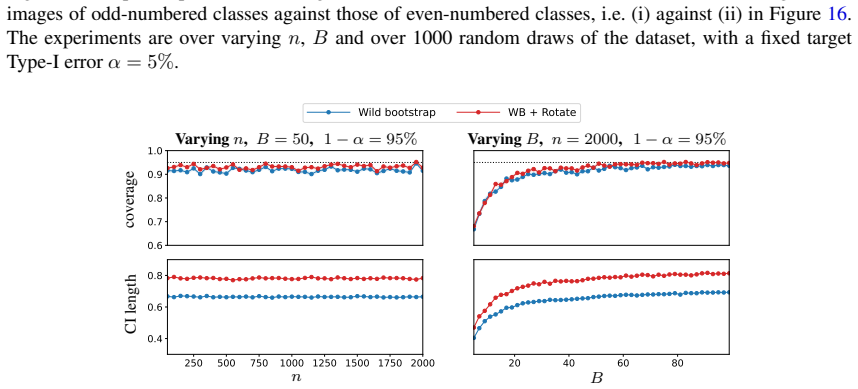
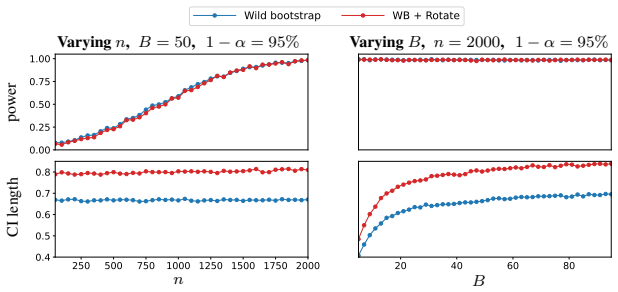
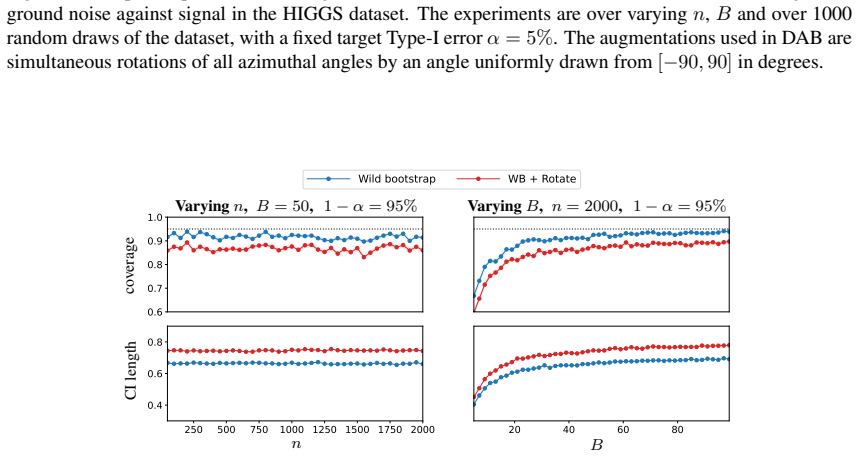
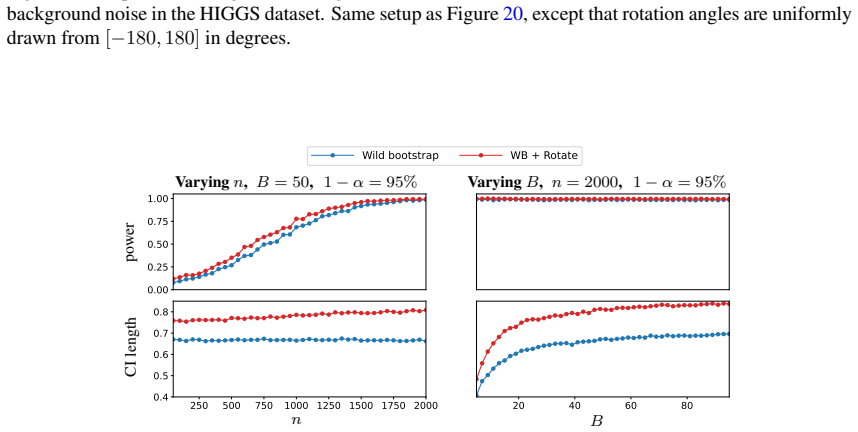
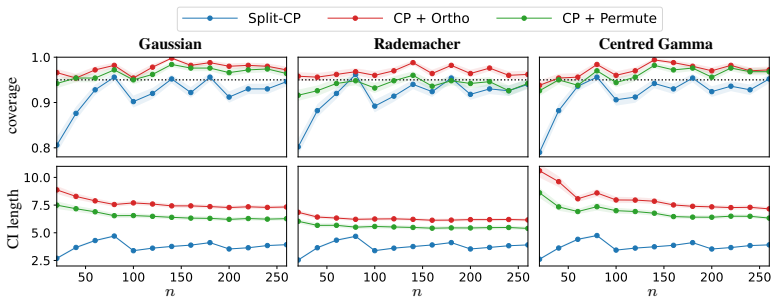
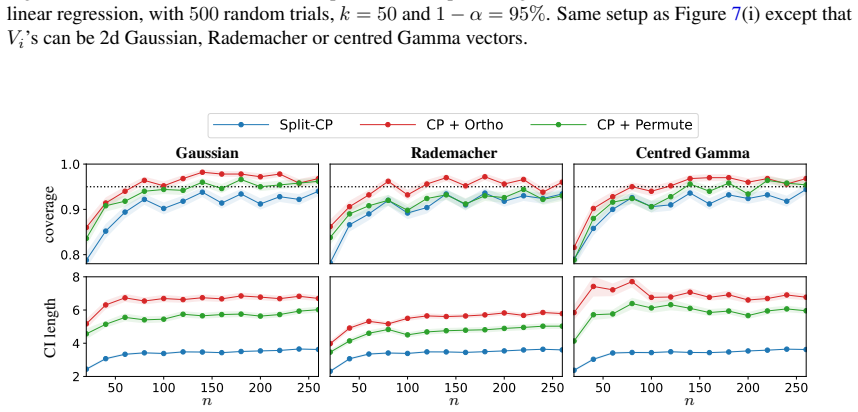
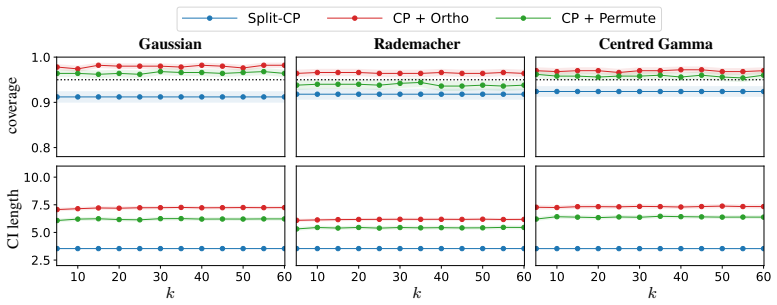
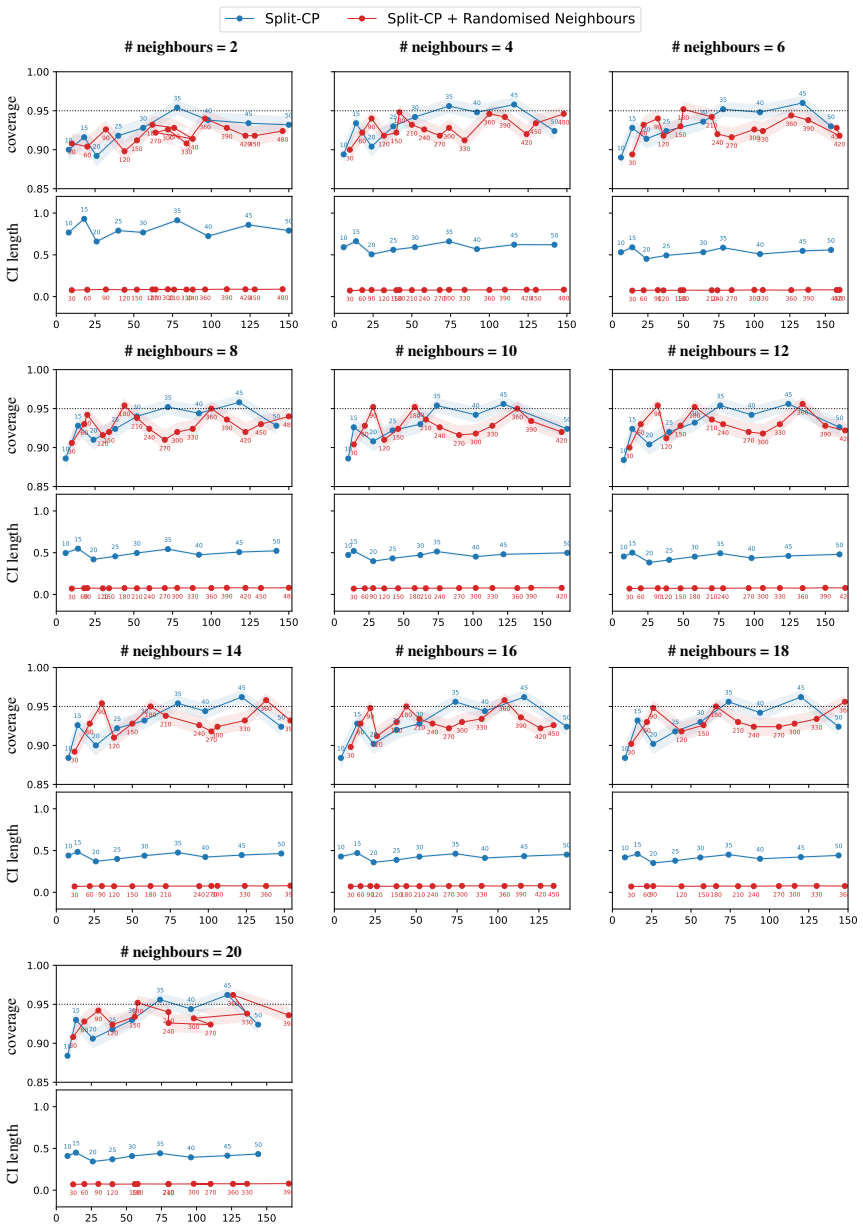
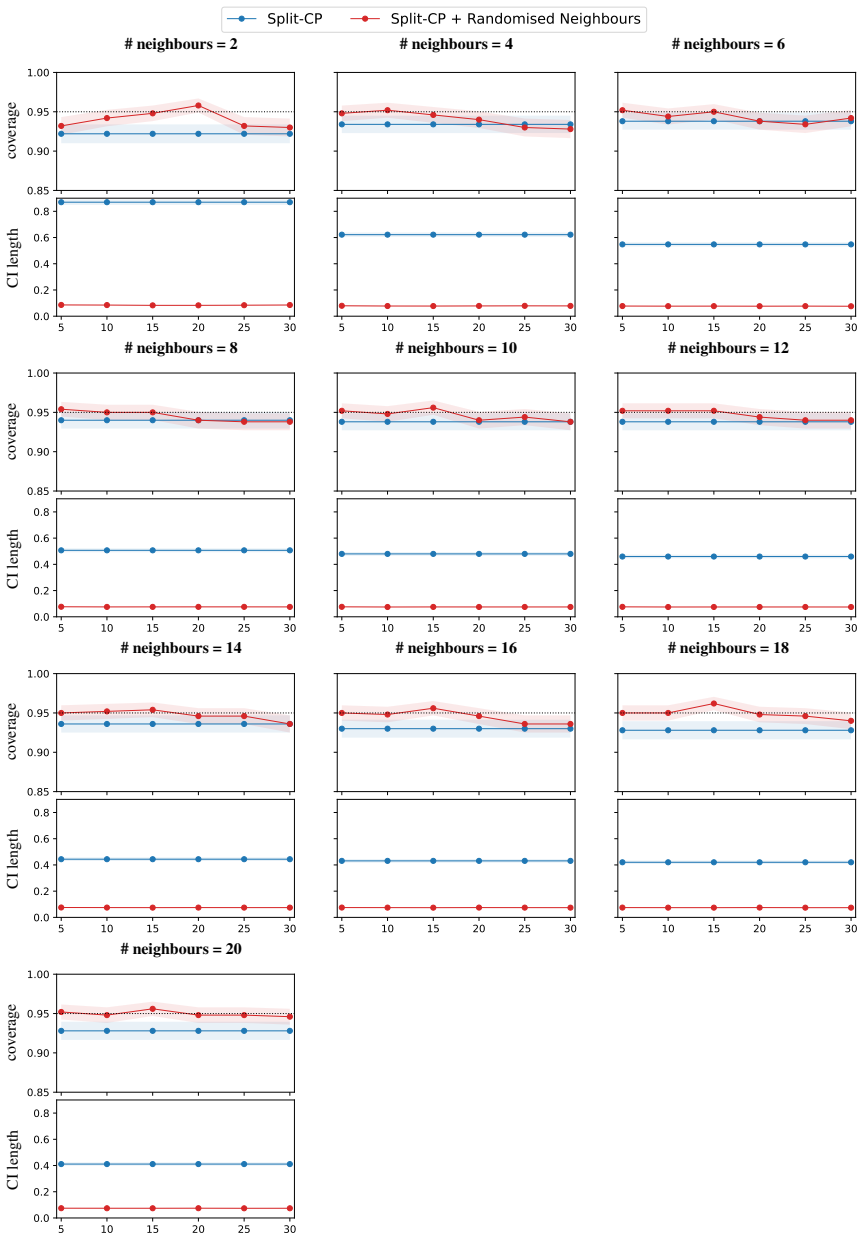
We propose the data augmented bootstrap (DAB), a framework for constructing confidence intervals from approximately invariant transformations of the data. As special cases, DAB recovers popular methods that rely on exact group symmetries, such as conformal prediction, wild bootstrap for Maximum Mean Discrepancy U-statistics and the recently proposed SymmPI. Meanwhile, DAB also recovers the classical bootstrap method, which exploits the dataset's approximate invariance under uniform sampling of data indices as the dataset size grows. For all DAB methods, we establish theoretical coverage results that interpolate between finite-sample and asymptotic guarantees according to the strength of the invariance, and without assuming a group structure. The approximate invariance is measured in the Kolmogorov distance and, for statistics that satisfy Gaussian universality, reduces to conditional mean and variance matching. This allows us to incorporate data augmentation (DA), a widely used machine learning heuristic based on approximate invariances, into known statistical methods. We empirically test the performance of incorporating DA into bootstrap, wild bootstrap and conformal prediction for simulated settings as well as for image, language and scientific data.
Editorial analysis
A structured set of objections, weighed in public.
Referee Report
Summary. The paper proposes the data augmented bootstrap (DAB) as a framework for confidence interval construction based on approximately invariant data transformations, with invariance quantified via Kolmogorov distance. It recovers conformal prediction, wild bootstrap for MMD U-statistics, SymmPI, and the classical bootstrap as special cases. Theoretical coverage guarantees are claimed to interpolate between finite-sample exactness and asymptotic validity according to the degree of invariance, without requiring a group structure. For statistics obeying Gaussian universality the invariance condition reduces to conditional mean and variance matching, permitting data-augmentation heuristics to be folded into bootstrap and conformal procedures. The claims are supported by empirical experiments on simulated data as well as image, language, and scientific datasets.
Significance. If the interpolation result holds, DAB supplies a single, group-structure-free lens that unifies exact finite-sample methods with asymptotic bootstrap procedures and legitimizes the use of machine-learning-style data augmentation inside classical inferential pipelines. The explicit reduction to mean/variance matching under Gaussian universality and the recovery of several well-known procedures as boundary cases are concrete strengths. The empirical scope across modalities is also useful for assessing practical performance.
minor comments (3)
- The abstract states that coverage results 'interpolate between finite-sample and asymptotic guarantees according to the strength of the invariance,' yet provides no explicit statement of the functional dependence of the coverage error on the Kolmogorov distance; a short clarifying sentence or reference to the relevant theorem would help readers locate the precise interpolation statement.
- The reduction of Kolmogorov-distance invariance to conditional mean and variance matching is scoped to 'statistics that satisfy Gaussian universality.' The manuscript should state the precise definition or reference used for Gaussian universality and indicate whether this assumption is verified or merely invoked in the empirical sections.
- The empirical section reports performance on image, language, and scientific data, but the abstract does not specify the sample sizes, number of Monte Carlo replications, or the exact DAB variants tested; adding these details would improve reproducibility.
Simulated Author's Rebuttal
We thank the referee for the positive assessment of the manuscript, the clear summary of its contributions, and the recommendation for minor revision. No specific major comments were raised.
Circularity Check
No significant circularity identified
full rationale
The paper defines the DAB framework directly from an externally measured approximate invariance (Kolmogorov distance on transformations of the data), without any equation or definition that reduces the coverage result to a fitted quantity defined from the same data. Special cases (conformal prediction, wild bootstrap, classical bootstrap) are recovered by specializing the invariance strength, which is an input rather than an output of the procedure. The interpolation between finite-sample and asymptotic guarantees is stated to follow from the strength of this external invariance measure, and the reduction to conditional mean/variance matching is explicitly scoped to statistics obeying Gaussian universality. No self-citation is load-bearing for the central claim, and no ansatz or uniqueness theorem is smuggled in. The derivation chain is therefore self-contained against external benchmarks.
Axiom & Free-Parameter Ledger
axioms (2)
- domain assumption Relevant statistics satisfy Gaussian universality, allowing approximate invariance measured by Kolmogorov distance to reduce to conditional mean and variance matching.
- domain assumption Approximate invariance can be quantified without requiring an underlying group structure.
Reference graph
Works this paper leans on
-
[1]
Advances in Neural Information Processing Systems , volume=
A wild bootstrap for degenerate kernel tests , author=. Advances in Neural Information Processing Systems , volume=
-
[2]
Advances in Neural Information Processing Systems , pages =
Asymptotics of the Bootstrap via Stability with Applications to Inference with Model Selection , author=. Advances in Neural Information Processing Systems , pages =
-
[3]
Sankhya A , pages=
Permutation tests using arbitrary permutation distributions , author=. Sankhya A , pages=. 2023 , publisher=
2023
-
[4]
NeurIPS 2023 AI for Science Workshop , year=
Hypothesis tests for distributional group symmetry with applications to particle physics , author=. NeurIPS 2023 AI for Science Workshop , year=
2023
-
[5]
A survey on image data augmentation for deep learning , author=. J. Big Data , volume=. 2019 , publisher=
2019
-
[6]
Journal of big Data , volume=
Text data augmentation for deep learning , author=. Journal of big Data , volume=. 2021 , publisher=
2021
-
[7]
Gaussian and Non-Gaussian Universality of Data Augmentation , author=. Ann. Statist. (forthcoming) , year=
-
[8]
Dependent wild bootstrap for degenerate U-and V-statistics , author=. J. Multivariate Anal. , volume=. 2013 , publisher=
2013
-
[9]
Asian conference on machine learning , pages=
Conditional validity of inductive conformal predictors , author=. Asian conference on machine learning , pages=. 2012 , organization=
2012
-
[10]
Distribution-free prediction bands for non-parametric regression , author=. J. Roy. Statist. Soc. Ser. B , volume=. 2014 , publisher=
2014
-
[11]
The limits of distribution-free conditional predictive inference , author=. Inf. Inference , volume=. 2021 , publisher=
2021
-
[12]
2005 , publisher=
Algorithmic learning in a random world , author=. 2005 , publisher=
2005
-
[13]
A high-dimensional convergence theorem for
Huang, Kevin H and Liu, Xing and Duncan, Andrew and Gandy, Axel , booktitle=. A high-dimensional convergence theorem for. 2023 , organization=
2023
-
[14]
Proceedings of Thirty Eighth Conference on Learning Theory , pages=
Universality of High-Dimensional Logistic Regression and a Novel CGMT under Dependence with Applications to Data Augmentation , author=. Proceedings of Thirty Eighth Conference on Learning Theory , pages=. 2025 , organization=
2025
-
[15]
Gaussian universality for approximately polynomial functions of high-dimensional data , author=
-
[16]
Dobriban, Edgar and Yu, Mengxin , title =. J. Roy. Statist. Soc. Ser. B , volume =. 2025 , month =
2025
-
[17]
2011 , publisher=
Chen, Louis HY and Goldstein, Larry and Shao, Qi-Man , volume=. 2011 , publisher=
2011
-
[18]
IEEE Trans
Applications of the Lindeberg principle in communications and statistical learning , author=. IEEE Trans. Inf. Theory , volume=. 2011 , publisher=
2011
-
[19]
Conference on Learning Theory , pages=
Universality of empirical risk minimization , author=. Conference on Learning Theory , pages=. 2022 , organization=
2022
-
[20]
Predictive inference with the jackknife+ , author=. Ann. Statist. , volume=. 2021 , publisher=
2021
-
[21]
A group-theoretic framework for data augmentation , author=. J. Mach. Learn. Res , volume=
-
[22]
arXiv preprint arXiv:2502.20579 , year=
Characterizing the Training-Conditional Coverage of Full Conformal Inference in High Dimensions , author=. arXiv preprint arXiv:2502.20579 , year=
-
[23]
Conformal prediction beyond exchangeability , author=. Ann. Statist. , volume=. 2023 , publisher=
2023
-
[24]
Breakthroughs in statistics: Methodology and distribution , pages=
Bootstrap methods: another look at the jackknife , author=. Breakthroughs in statistics: Methodology and distribution , pages=. 1992 , publisher=
1992
-
[25]
1992 , publisher=
The bootstrap and Edgeworth expansion , author=. 1992 , publisher=
1992
-
[26]
Random quadratic forms and the bootstrap for U-statistics , author=. J. Multivariate Anal. , volume=. 1994 , publisher=
1994
-
[27]
Conditional predictive inference for stable algorithms , author=. Ann. Statist. , volume=. 2023 , publisher=
2023
-
[28]
Advances in Neural Information Processing Systems , volume=
Universality laws for gaussian mixtures in generalized linear models , author=. Advances in Neural Information Processing Systems , volume=
-
[29]
The generalization error of max-margin linear classifiers: Benign overfitting and high dimensional asymptotics in the overparametrized regime , author=. Ann. Statist. , volume=. 2025 , publisher=
2025
-
[30]
IEEE Trans
Universality laws for high-dimensional learning with random features , author=. IEEE Trans. Inf. Theory , volume=. 2022 , publisher=
2022
-
[31]
, author=
A tutorial on conformal prediction. , author=. J. Mach. Learn. Res , volume=
-
[32]
Conformal prediction: A gentle introduction , author=. Found. Trends Mach. Learn. , volume=. 2023 , publisher=
2023
-
[33]
Bernoulli , volume=
Conformal prediction: a unified review of theory and new challenges , author=. Bernoulli , volume=. 2023 , publisher=
2023
-
[34]
2005 , publisher=
Permutation, parametric and bootstrap tests of hypotheses , author=. 2005 , publisher=
2005
-
[35]
MMD aggregated two-sample test , author=. J. Mach. Learn. Res , volume=
-
[36]
46th Annual IEEE Symposium on Foundations of Computer Science (FOCS'05) , pages=
Noise stability of functions with low influences: invariance and optimality , author=. 46th Annual IEEE Symposium on Foundations of Computer Science (FOCS'05) , pages=. 2005 , organization=
2005
-
[37]
A generalization of the
Chatterjee, Sourav , journal=. A generalization of the. 2006 , publisher=
2006
-
[38]
Gaussian universality of perceptrons with random labels , author=. Phys. Rev. E , volume=. 2024 , publisher=
2024
-
[39]
Universality of regularized regression estimators in high dimensions , author=. Ann. Statist. , volume=. 2023 , publisher=
2023
-
[40]
Advances in Neural Information Processing Systems , volume=
Conformalized quantile regression , author=. Advances in Neural Information Processing Systems , volume=
-
[41]
Distribution-free predictive inference for regression , author=. J. Amer. Statist. Assoc. , volume=. 2018 , publisher=
2018
-
[42]
Least ambiguous set-valued classifiers with bounded error levels , author=. J. Amer. Statist. Assoc. , volume=. 2019 , publisher=
2019
-
[43]
The journal of machine learning research , volume=
A kernel two-sample test , author=. The journal of machine learning research , volume=. 2012 , publisher=
2012
-
[44]
The two-sample problem for poisson processes: Adaptive tests with a nonasymptotic wild bootstrap approach , author=
-
[45]
Weighted bootstrapping of U-statistics , author=. J. Statist. Plann. Inference , volume=. 1994 , publisher=
1994
-
[46]
Distributional and L^q norm inequalities for polynomials over convex bodies in
Carbery, Anthony and Wright, James , journal=. Distributional and L^q norm inequalities for polynomials over convex bodies in. 2001 , publisher=
2001
-
[47]
The existence of regular conditional probabilities: necessary and sufficient conditions , author=. Ann. Probab. , pages=. 1985 , publisher=
1985
-
[48]
Theory Probab
An estimate for concentration functions , author=. Theory Probab. Appl. , volume=. 1961 , publisher=
1961
-
[49]
Comparison and anti-concentration bounds for maxima of Gaussian random vectors , author=. Probab. Theory Related Fields , volume=. 2015 , publisher=
2015
-
[50]
Bernoulli (forthcoming) , year=
Sharp Anti-Concentration Inequalities for Extremum Statistics via Copulas , author=. Bernoulli (forthcoming) , year=
-
[51]
Matrix concentration inequalities via the method of exchangeable pairs , author=
-
[52]
2018 , publisher=
High-dimensional probability: An introduction with applications in data science , author=. 2018 , publisher=
2018
-
[53]
Stochastic Process
Moment bounds for dependent sequences in smooth Banach spaces , author=. Stochastic Process. Appl. , volume=. 2015 , publisher=
2015
-
[54]
Probability and moment inequalities for additive functionals of geometrically ergodic Markov chains , author=. J. Theoret. Probab. , volume=. 2024 , publisher=
2024
-
[55]
arXiv preprint arXiv:2409.05202 (2024)
A survey on mixup augmentations and beyond , author=. arXiv preprint arXiv:2409.05202 , year=
-
[56]
Deep learning for population size history inference: Design, comparison and combination with approximate Bayesian computation , author=. Mol. Ecol. Resour. , volume=. 2021 , publisher=
2021
-
[57]
Deep learning suggests that gene expression is encoded in all parts of a co-evolving interacting gene regulatory structure , author=. Nat. Commun. , volume=. 2020 , publisher=
2020
-
[58]
International Conference on Learning Representations , year=
mixup: Beyond Empirical Risk Minimization , author=. International Conference on Learning Representations , year=
-
[59]
Proceedings of the 58th annual meeting of the association for computational linguistics , pages=
Mixtext: Linguistically-informed interpolation of hidden space for semi-supervised text classification , author=. Proceedings of the 58th annual meeting of the association for computational linguistics , pages=
-
[60]
ICASSP 2021-2021 IEEE International Conference on Acoustics, Speech and Signal Processing (ICASSP) , pages=
Mixspeech: Data augmentation for low-resource automatic speech recognition , author=. ICASSP 2021-2021 IEEE International Conference on Acoustics, Speech and Signal Processing (ICASSP) , pages=. 2021 , organization=
2021
-
[61]
Findings of the Association for Computational Linguistics: ACL-IJCNLP 2021 , pages=
Ssmix: Saliency-based span mixup for text classification , author=. Findings of the Association for Computational Linguistics: ACL-IJCNLP 2021 , pages=
2021
-
[62]
Advances in Neural Information Processing Systems , volume=
Contrast and mix: Temporal contrastive video domain adaptation with background mixing , author=. Advances in Neural Information Processing Systems , volume=
-
[63]
Advances in Neural Information Processing Systems , volume=
Conformal prediction under covariate shift , author=. Advances in Neural Information Processing Systems , volume=
-
[64]
On the bootstrap of U and V statistics , author=. Ann. Statist. , pages=. 1992 , publisher=
1992
-
[65]
Mercer’s theorem on general domains: On the interaction between measures, kernels, and RKHSs , author=. Constr. Approx. , volume=. 2012 , publisher=
2012
-
[66]
Advances in Neural Information Processing Systems , volume=
Debiased machine learning without sample-splitting for stable estimators , author=. Advances in Neural Information Processing Systems , volume=
-
[67]
International Conference on Artificial Intelligence and Statistics , pages=
Posterior uncertainty quantification in neural networks using data augmentation , author=. International Conference on Artificial Intelligence and Statistics , pages=. 2024 , organization=
2024
-
[68]
Ab initio calculation of real solids via neural network ansatz , author=. Nat. Commun. , volume=. 2022 , publisher=
2022
-
[69]
Proceedings of the 42nd International Conference on Machine Learning , pages =
Diagonal Symmetrization of Neural Network Solvers for the Many-Electron Schrödinger Equation , author=. Proceedings of the 42nd International Conference on Machine Learning , pages =. 2025 , volume =
2025
-
[70]
Ab initio solution of the many-electron Schr
Pfau, David and Spencer, James S and Matthews, Alexander GDG and Foulkes, W Matthew C , journal=. Ab initio solution of the many-electron Schr. 2020 , publisher=
2020
-
[71]
Science , volume=
Solving the quantum many-body problem with artificial neural networks , author=. Science , volume=. 2017 , publisher=
2017
-
[72]
Deep-neural-network solution of the electronic Schr
Hermann, Jan and Sch. Deep-neural-network solution of the electronic Schr. Nat. Chem. , volume=. 2020 , publisher=
2020
-
[73]
QM-sym, a symmetrized quantum chemistry database of 135 kilo molecules , author=. Sci. Data , volume=. 2019 , publisher=
2019
-
[74]
Robust and scalable uncertainty estimation with conformal prediction for machine-learned interatomic potentials , author=. Mach. Learn.: Sci. Technol. , volume=. 2022 , publisher=
2022
-
[75]
ICML 2023 Neural Conversational AI Workshop , year =
Conformal prediction with large language models for multi-choice question answering , author=. ICML 2023 Neural Conversational AI Workshop , year =
2023
-
[76]
International Conference on Learning Representations , year=
Measuring Massive Multitask Language Understanding , author=. International Conference on Learning Representations , year=
-
[77]
Proceedings of the Twelfth Symposium on Conformal and Probabilistic Prediction with Applications , pages =
A Review of Nonconformity Measures for Conformal Prediction in Regression , author =. Proceedings of the Twelfth Symposium on Conformal and Probabilistic Prediction with Applications , pages =. 2023 , editor =
2023
-
[78]
Advances in Neural Information Processing Systems , volume=
Classification with valid and adaptive coverage , author=. Advances in Neural Information Processing Systems , volume=
-
[79]
Proceedings of the 41st International Conference on Machine Learning , pages =
Conformal Validity Guarantees Exist for Any Data Distribution (and How to Find Them) , author =. Proceedings of the 41st International Conference on Machine Learning , pages =. 2024 , volume =
2024
-
[80]
The Thirteenth International Conference on Learning Representations , year=
Wasserstein-Regularized Conformal Prediction under General Distribution Shift , author=. The Thirteenth International Conference on Learning Representations , year=
discussion (0)
Sign in with ORCID, Apple, or X to comment. Anyone can read and Pith papers without signing in.