Learning to Approximate Directional Fields Defined over 2D Planes
Pith reviewed 2026-05-25 12:17 UTC · model grok-4.3
The pith
Deep networks can learn to reconstruct directional fields over 2D planes and transfer across geometry tasks.
A machine-rendered reading of the paper's core claim, the machinery that carries it, and where it could break.
Core claim
The paper claims that a deep learning-based approach reconstructs directional fields defined over 2D planes, exhibits sufficient expressive power to represent varied field configurations, and demonstrates generalization ability that allows the same model to serve multiple geometry-processing applications without architectural changes or retraining.
What carries the argument
A deep neural network trained end-to-end to predict directional values at points on 2D planes.
If this is right
- The same network can replace separate optimization routines in image tracing.
- The network can be used for extraction of 3D geometric features.
- The network can compute principal surface directions.
- No per-task redesign or retraining is required once the model is trained.
Where Pith is reading between the lines
- The learned approximator might tolerate input noise or partial observations more gracefully than classical optimizers.
- Synthetic training fields could be generated to cover the range of real-world directional patterns encountered in practice.
- Embedding the network inside existing geometry pipelines could reduce per-instance compute time.
Load-bearing premise
The distribution of directional fields seen during training is representative enough for the model to succeed on new tasks without retraining.
What would settle it
Apply the trained model to a directional-field task whose field statistics lie outside the training distribution and measure whether reconstruction error remains comparable to task-specific optimization.
Figures
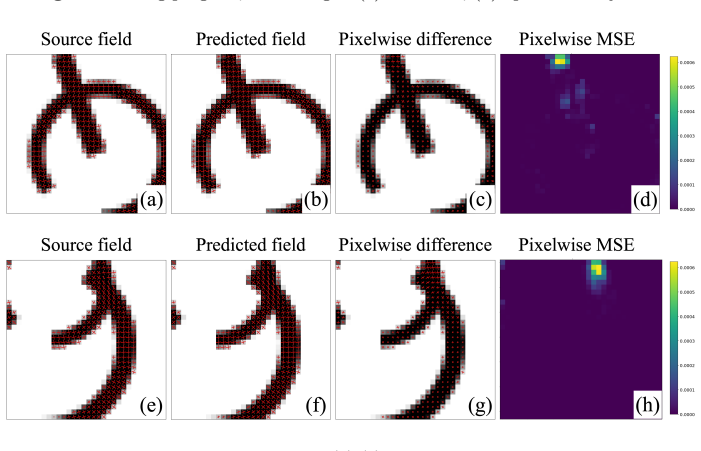
read the original abstract
Reconstruction of directional fields is a need in many geometry processing tasks, such as image tracing, extraction of 3D geometric features, and finding principal surface directions. A common approach to the construction of directional fields from data relies on complex optimization procedures, which are usually poorly formalizable, require a considerable computational effort, and do not transfer across applications. In this work, we propose a deep learning-based approach and study the expressive power and generalization ability.
Editorial analysis
A structured set of objections, weighed in public.
Referee Report
Summary. The manuscript proposes a deep learning-based approach to reconstruct directional fields defined over 2D planes as an alternative to complex optimization procedures. It studies the expressive power and generalization ability of the learned model across geometry-processing tasks including image tracing, extraction of 3D geometric features, and computation of principal surface directions.
Significance. If the generalization claim holds with a single model, the work would supply a transferable approximation method that reduces per-application computational effort in multiple geometry-processing pipelines.
major comments (1)
- [Abstract] Abstract: the central claim that a single learned model exhibits generalization across applications without retraining or architectural changes rests on the training distribution of directional fields being representative of the variations arising in image tracing, 3D feature extraction, and principal surface directions simultaneously; the abstract supplies no description of the training set construction, diversity validation, or cross-task experiments that would support this assumption.
Simulated Author's Rebuttal
We thank the referee for their review. We address the single major comment below.
read point-by-point responses
-
Referee: [Abstract] Abstract: the central claim that a single learned model exhibits generalization across applications without retraining or architectural changes rests on the training distribution of directional fields being representative of the variations arising in image tracing, 3D feature extraction, and principal surface directions simultaneously; the abstract supplies no description of the training set construction, diversity validation, or cross-task experiments that would support this assumption.
Authors: We agree that the abstract would be strengthened by briefly describing the training distribution and cross-task experiments. The manuscript body (Sections 3–4) details training on a diverse collection of directional fields drawn from synthetic and real sources chosen to span the variations in the three target applications, together with explicit cross-application transfer experiments. In revision we will add one sentence to the abstract summarizing this construction and the observed generalization without retraining. revision: yes
Circularity Check
No circularity: data-driven approximation with no derivation chain or self-referential fitting
full rationale
The paper proposes a deep learning approach to approximate directional fields and studies its expressive power and generalization empirically. No mathematical derivation, uniqueness theorem, ansatz, or fitted parameter is described that reduces by construction to its own inputs. The central claims rest on training and evaluation rather than any self-definitional or self-citation load-bearing step. This is the expected outcome for an empirical ML paper whose results are externally falsifiable via held-out test data.
Axiom & Free-Parameter Ledger
Reference graph
Works this paper leans on
-
[1]
Monocular 3D Object Detection via Geometric Reasoning on Keypoints
Barabanau, I., Artemov, A., Murashkin, V., Burnaev, E.: Monocular 3d object detection via geometric reasoning on keypoints. arXiv preprint arXiv:1905.05618 (2019)
work page internal anchor Pith review Pith/arXiv arXiv 1905
-
[2]
ACM Transactions on Graphics (TOG) 38(1), 9 (2019)
Bessmeltsev, M., Solomon, J.: Vectorization of line drawings via polyvector fields. ACM Transactions on Graphics (TOG) 38(1), 9 (2019)
work page 2019
-
[3]
Bokhovkin, A., Burnaev, E.: Boundary loss for remote sensing imagery semantic segmentation. In: Proceedings of ISNN, LNCS. Springer (2019)
work page 2019
-
[4]
Bommes, D., L´ evy, B., Pietroni, N., Puppo, E., Silva, C., Tarini, M., Zorin, D.: Quad-mesh generation and processing: A survey. In: Computer Graphics Forum. vol. 32, pp. 51–76. Wiley Online Library (2013)
work page 2013
-
[5]
Burnaev, E., Cichocki, A., Osin, V.: Fast multispectral deep fusion networks. arXiv preprint Bull. Pol. Ac.: Tech. 66(4), 875–880 (2018)
work page 2018
-
[6]
Diamanti, O., Vaxman, A., Panozzo, D., Sorkine-Hornung, O.: Designing n- polyvector fields with complex polynomials. In: Computer Graphics Forum. vol. 33, pp. 1–11. Wiley Online Library (2014)
work page 2014
-
[7]
de Goes, F., Desbrun, M., Tong, Y.: Vector field processing on triangle meshes. In: ACM SIGGRAPH 2016 Courses. p. 27. ACM (2016)
work page 2016
-
[8]
Neural networks 2(5), 359–366 (1989)
Hornik, K., Stinchcombe, M., White, H.: Multilayer feedforward networks are uni- versal approximators. Neural networks 2(5), 359–366 (1989)
work page 1989
- [9]
-
[10]
In: Proceedings of the IEEE Conference on Computer Vision and Pattern Recognition
Koch, S., Matveev, A., Jiang, Z., Williams, F., Artemov, A., Burnaev, E., Alexa, M., Zorin, D., Panozzo, D.: Abc: A big cad model dataset for geometric deep learning. In: Proceedings of the IEEE Conference on Computer Vision and Pattern Recognition. pp. 9601–9611 (2019)
work page 2019
-
[11]
Kolos, M., Marin, A., Artemov, A., Burnaev, E.: Procedural synthesis of remote sensing images for robust change detection with neural networks. In: Proceedings of ISNN, LNCS. Springer (2019)
work page 2019
-
[12]
shallow networks: An approximation theory perspective
Mhaskar, H.N., Poggio, T.: Deep vs. shallow networks: An approximation theory perspective. Analysis and Applications 14(06), 829–848 (2016)
work page 2016
-
[13]
In: International Conference on Analysis of Im- ages, Social Networks and Texts
Notchenko, A., Kapushev, Y., Burnaev, E.: Large-scale shape retrieval with sparse 3d convolutional neural networks. In: International Conference on Analysis of Im- ages, Social Networks and Texts. pp. 245–254. Springer (2017)
work page 2017
- [14]
-
[15]
Paszke, A., Gross, S., Chintala, S., Chanan, G., Yang, E., DeVito, Z., Lin, Z., Desmaison, A., Antiga, L., Lerer, A.: Automatic differentiation in pytorch (2017)
work page 2017
-
[16]
Ray, N., Nivoliers, V., Lefebvre, S., L´ evy, B.: Invisible seams. In: Computer Graph- ics Forum. vol. 29, pp. 1489–1496. Wiley Online Library (2010)
work page 2010
-
[17]
In: International Conference on Medical image computing and computer-assisted intervention
Ronneberger, O., Fischer, P., Brox, T.: U-net: Convolutional networks for biomedi- cal image segmentation. In: International Conference on Medical image computing and computer-assisted intervention. pp. 234–241. Springer (2015)
work page 2015
-
[18]
Vaxman, A., Campen, M., Diamanti, O., Panozzo, D., Bommes, D., Hildebrandt, K., Ben-Chen, M.: Directional field synthesis, design, and processing. In: Computer Graphics Forum. vol. 35, pp. 545–572. Wiley Online Library (2016)
work page 2016
-
[19]
arXiv preprint arXiv:1812.09874 (2018)
Voinov, O., Artemov, A., Egiazarian, V., Notchenko, A., Bobrovskikh, G., Zorin, D., Burnaev, E.: Perceptual deep depth super-resolution. arXiv preprint arXiv:1812.09874 (2018)
discussion (0)
Sign in with ORCID, Apple, or X to comment. Anyone can read and Pith papers without signing in.