REVIEW 4 major objections 4 minor 57 references
Toward Deployable Bangla Sign Language Recognition with Expert-Validated Data and a Lightweight Attention-Based Model
T0 review · 4 major / 4 minor · reviewed 2026-08-07 · deepseek-v4-flash
Pith's one-line read A 298,470-parameter network trained from scratch reaches 96.37% on a new expert-validated 38-class Bangla sign dataset, within 1.08 points of nine ImageNet-pretrained backbones, and runs on a phone at 3.98 ms per image.
desk verdict Solid, unusually careful applied paper; the new dataset and honest signer-independent evaluation are the real contributions, with single-expert validation as the main caveat. read the letter →
The pith
A machine-rendered reading of the paper's core claim, the machinery that carries it, and where it could break.
The reading
What carries the argument
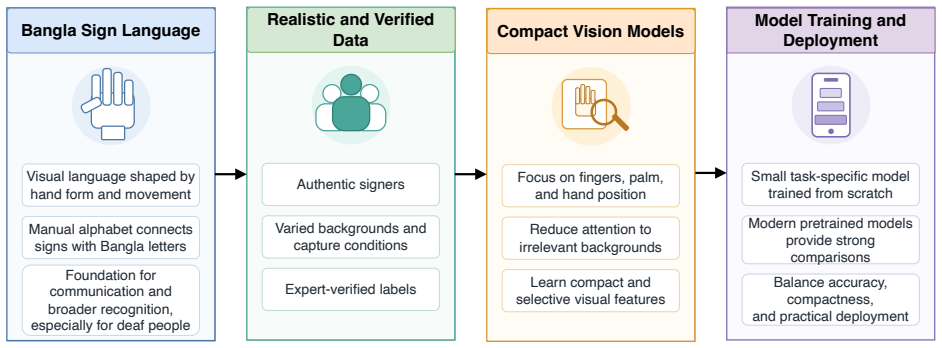
The argument is carried by a four-stage convolutional architecture in which every stage pairs two grouped bottleneck residual blocks with a multi-scale depthwise hand-feature block. Each residual block compresses the channel count by half, applies a grouped $3\times3$ convolution (group count rising from 2 to 16 across the stages), re-expands, and gates the result with CBAM-style channel-then-spatial attention, the channel gate being a shared two-layer MLP over average- and max-pooled descriptors and the spatial gate a single $7\times7$ convolution producing a 0–1 map. The hand-feature block concatenates parallel $3\times3$ and $5\times5$ depthwise (per-channel) branches to represent finger-level and palm-level structure for only $34C_i$ weights per stage, and the dual-pooling head concatenates global average and global max descriptors so that both diffuse and point-local evidence reach the classifier. The second carrier is RSBdSL38 itself: 10,874 images from 36 signers (21 deaf and hard-of-hearing pupils aged 8–15 at three special-needs schools, 15 adult volunteers), screened by the research team and then fully label-validated by one senior BdSL teacher, partitioned 8,794/977/1,103 with participant identity recorded, which is what makes signer-independent evaluation possible.
What would settle it
Have two or more independent BdSL experts, ideally native deaf signers, re-validate the 38 class folders of RSBdSL38 with labels hidden and measure inter-annotator agreement: if agreement is materially below near-perfect, or if re-labelling shifts a substantial fraction of the 10,874 images, the label noise propagates through every reported accuracy and the dataset's claimed advantage over volunteer corpora disappears.
Extended reading notes
Core claim
The paper's central claim is that accuracy and deployability need not be traded off in Bangla Sign Language recognition. On RSBdSL38, a 38-class dataset of 10,874 expert-validated images of real signers' hands captured in uncontrolled school environments, a from-scratch network of 298,470 parameters (1.14 MB, 132.7 million multiply–accumulate operations) built from grouped bottleneck residual attention blocks and a multi-scale depthwise hand-feature block reaches 96.37% accuracy, within 1.08 points of MobileNetV4-Hybrid-M, the best of nine ImageNet-pretrained baselines, at roughly one thirty-third of that model's parameters. The architecture transfers without modification to six public BdSL benchmarks (92.95–98.33%) and to a merged four-dataset corpus (97.04%), and its RSBdSL38-trained weights classify BdSL-38 at 76.25% zero-shot. The paper further argues that RSBdSL38 is a genuinely harder benchmark: the same architecture that scores 96.37% under class-stratified splitting falls to 85.18% when retrained with six of the 36 signers held out entirely, quantifying an 11.19-point optimism that the stratified protocol standard in the field silently carries, and the corpus is label-validated by one senior BdSL teacher rather than by volunteer self-labelling. Finally, on commodity smartphone hardware the INT8-quantized 0.48 MB model runs at 3.98 ms per image, and attribution checks confirm predictions follow the signing hand, making the measured accuracy a deployed one rather than a hypothetical one.
Load-bearing premise
Every headline number rests on a single data-quality bet: the 10,874 class labels were checked by one senior Bangla sign language teacher, with no second annotator and no agreement statistic, so if her judgments are idiosyncratic or non-canonical articulations slipped through, every reported accuracy, generalization, and zero-shot figure inherits that label noise.
Editorial extensions
If this is right
- A 0.48 MB quantized model classifying in 3.98 ms per image means real-time static fingerspelling recognition fits inside the memory and battery budget of commodity phones and low-cost embedded boards, with no cloud dependency.
- The measured 11.19-point drop from stratified (96.37%) to signer-independent (85.18%) accuracy means existing stratified-split results across the BdSL literature carry a comparable, usually unreported optimism, and signer-holdout reporting should become the default for any deployment claim.
- Retraining the identical architecture on six public benchmarks (92.95–98.33%) and on a merged corpus (97.04%) shows the design is not tuned to its own dataset and that adding signer and environment diversity improves rather than degrades it.
- Zero-shot transfer of 76.25% from RSBdSL38 to BdSL-38, with 34 of 38 classes above 0.60 F1, indicates substantially signer- and source-agnostic representations and gives a concrete lower bound on deployed performance before any adaptation.
- The ablation hierarchy, in which removing any architectural stage costs 7.61 to 89.30 points while removing augmentation, dropout, or Swish costs at most 3.17 points, implies that sub-megabyte compression should come from post-training quantization rather than from pruning stages.
Reading between the lines
- Editorial inference: the paper's own signer-independent figure is still slightly optimistic as a deployment estimate, because checkpoint selection used validation images from the same six held-out signers; a strictly isolated protocol that froze the checkpoint on training-signer validation would likely measure a little below 85.18%.
- Editorial inference: since the nine pretrained baselines were not re-evaluated under the signer-independent protocol, it is unknown whether the narrow 95–97% accuracy band they share with the from-scratch model persists for unseen signers; running the baselines on that split would test whether the lightweight model's robustness to new signers is architectural or shared.
- Editorial inference: the same architecture should transfer to other low-resource static fingerspelling alphabets whose statistics differ sharply from ImageNet; retraining the unchanged network on another sign language's static hand-sign corpus and comparing with pretrained backbones would test the generality of the design.
- Editorial inference: the 18.32-point gap between zero-shot (76.25%) and retrained (94.57%) on BdSL-38 leaves the intermediate regime unmeasured; a few-shot fine-tuning curve would show how much target-domain adaptation is required to recover the gap, which is the practical question for deploying on a new corpus.
Editorial analysis
A structured set of objections, weighed in public.
Referee Report
Summary. The manuscript introduces RSBdSL38, a 10,874-image, 38-class Bangla sign language fingerspelling dataset collected at three special-needs schools and reviewed by one sign language teacher, together with a 298,470-parameter attention-based CNN trained from scratch. On RSBdSL38 the model reports 96.37% test accuracy (95.72% ± 0.54% over five seeds), within 1.08 percentage points of the best of nine ImageNet-pretrained efficient backbones while using 8.5 to 68x fewer parameters and 1.3 to 21.7x fewer MACs. The same architecture is reported to reach 92.95% to 98.33% on six public BdSL benchmarks, 97.04% on a merged corpus, 76.25% zero-shot on BdSL-38, and 85.18% under a signer-independent split. Deployment is characterized by a 0.48 MB INT8 TFLite model with 3.98 ms mean latency on a commodity smartphone. The paper also reports a complete 14-configuration stage ablation, parameter-matched component controls, and Grad-CAM/Grad-CAM++ analyses with deletion, insertion, and weight-randomization checks.
Significance. If the results hold, this is a useful contribution: the released dataset with a permanent DOI, the from-scratch sub-megabyte model, the five-seed stability analysis, the full stage-removal ablation, the signer-independent evaluation, the measured on-device latency, and the faithfulness checks go beyond what is typical in the BdSL literature. The cross-dataset and zero-shot evaluations are genuine holdouts rather than circular derivations, and the efficiency-accuracy trade-off is reported concretely. The main risk is not the architecture but the data-validation premise: RSBdSL38's labels rest on a single folder-level expert review, so the headline accuracies inherit any label noise that this review failed to remove.
major comments (4)
- [Section 4(iv), Table 4] The claim that RSBdSL38 is 'expert-validated' rests on a single folder-level review: one senior sign language teacher examined images grouped into 38 class folders and confirmed or corrected the grouped labels. This is not an independent per-image annotation pass, and no inter-annotator agreement is reported. Because the 15 adult volunteers are not described as deaf or fluent signers, non-canonical articulations could survive the group-level check and propagate into every reported accuracy, including the 96.37% on RSBdSL38, the 1.08-point gap in Table 6, the 92.95-98.33% cross-dataset numbers, and the 76.25% zero-shot figure. Please provide a second independent per-image validation (or a documented subsample with an agreement measure), or soften the 'expert-validated' claim and analyze how much label noise the reported accuracies could tolerate.
- [Section 6.5, Table 7] The cross-dataset generalization claim is not reproducible as reported because the split protocol for each public benchmark is not given. The paper does not state how many images were used for training, validation, and test, whether the splits were class-stratified or signer-disjoint, how the class inventories were mapped to the 38 classes, or which preprocessing was applied to each corpus. Without this information, the 92.95-98.33% and 97.04% merged-corpus numbers cannot be independently checked or compared with the originally published results. Please supply the exact partition, mapping, and preprocessing details for each dataset.
- [Section 6.1, Table 6] The comparison labeled 'identical protocol' is not fully identical: the proposed model is trained from scratch with SGD and Nesterov momentum, while the nine pretrained baselines are fine-tuned with AdamW. Additionally, each baseline is a single run, so the headline 'within 1.08 percentage points' is a difference between one proposed-model run and one run of each baseline, with no estimate of baseline seed variability. Please report multiple seeds for the baselines (or confidence intervals) and discuss whether the ranking and the accuracy-per-cost conclusion survive the optimizer/schedule difference. This is load-bearing for RQ1.
- [Section 6.11, RQ4] The claim that RSBdSL38 is 'a more challenging and ecologically valid benchmark than existing volunteer-collected datasets' is not fully established by the evidence. The narrow 95.33-97.45% band in Table 6 shows only that the evaluated models do not saturate RSBdSL38; it does not compare those same models on the other datasets under the same protocol. The previously published near-99% results on BDSL49, KU-BdSL, and related corpora are not directly comparable because the splits, signer pools, and protocols differ. To support RQ4, run the same nine baselines on at least one or two public benchmarks under the identical protocol, or restrict the claim to 'difficult for the models evaluated here'.
minor comments (4)
- [Section 4(iv)] The signed validation statement is described as 'available on request'; please include it in the released dataset artifacts so that reviewers and future users can inspect exactly which images were flagged or corrected.
- [Section 5] The sentence 'Every symbol used in this paper are defined and summarized in Appendix A' has a subject-verb agreement issue; it should read 'Every symbol used in this paper is defined and summarized in Appendix A.'
- [Section 6.3] The signer-independent protocol uses held-out signers for both validation and test, so early stopping and checkpoint selection are exposed to those signers. The paper notes this makes the figure 'conservative-leaning but not fully isolated'; please also report the accuracy of the checkpoint selected on training loss only, or state clearly why that was not used.
- [Section 6.6] The zero-shot transfer result relies on a 'verified one-to-one' label mapping between RSBdSL38 and BdSL-38, but the verification process is not described. Please provide the mapping table and state whether the mapping was checked by the same expert or by an independent annotator.
Circularity Check
No significant circularity: all headline results are standard held-out evaluations against frozen splits, and the only self-citation is a data-release reference.
full rationale
The paper's central claims—96.37% test accuracy on RSBdSL38, 92.95–98.33% on six public benchmarks, 97.04% on a merged corpus, 76.25% zero-shot transfer, and 85.18% signer-independent accuracy—are all obtained by training or fine-tuning models on one split and evaluating on disjoint held-out data, with the same frozen partition used for the proposed model and all baselines. The ablations compare architectural variants under an identical protocol, and the efficiency numbers follow directly from parameter and MAC counts. The only self-citation is reference [2], the dataset release itself, which is cited as the source of RSBdSL38 and is not load-bearing for the model or evaluation claims. The expert-validation process described in Section 4(iv) is a data-collection premise rather than a derived result; concerns about single-annotator label noise are data-quality risks, not circular reasoning. No equation in the paper defines a prediction in terms of a fitted input, and no argument imports a uniqueness theorem or ansatz from the authors' prior work. The derivation chain is therefore self-contained with respect to the stated claims.
Assumptions & free parameters
free parameters (8)
- stage widths =
[32, 64, 96, 128]
- group counts =
[2, 4, 8, 16]
- CBAM reduction ratio r =
16
- spatial dropout rates =
[0.05, 0.10, 0.15, 0.20]
- head dropout p =
0.3
- L2 weight decay =
1e-5
- initial learning rate =
1e-2
- augmentation ranges =
rotation +-15 deg, zoom/translation +-10%, brightness +-0.08, contrast/saturation +-10%, hue +-0.08
assumptions (5)
- domain assumption A single sign language expert's label review is sufficient to make RSBdSL38 expert-validated.
- domain assumption The 38-class sign-to-letter mapping and the one-to-one class mapping to BdSL-38 are correct.
- domain assumption Manual quality screening does not bias the class or signer distribution.
- domain assumption Adult volunteers' articulations, after expert correction, are representative of natural BdSL.
- domain assumption Grad-CAM deletion/insertion and weight-randomization checks faithfully measure the evidence the network uses.
Cite this review
Pith. "Pith review of Toward Deployable Bangla Sign Language Recognition with Expert-Validated Data and a Lightweight Attention-Based Model." pith.science (2026). https://pith.science/paper/53MKSQRK
@misc{pith2026260806252,
  author       = {Pith},
  title        = {Pith review of: Toward Deployable Bangla Sign Language Recognition with Expert-Validated Data and a Lightweight Attention-Based Model},
  year         = {2026},
  howpublished = {\url{https://pith.science/paper/53MKSQRK}},
  note         = {Machine review of arXiv:2608.06252}
}
read the original abstract
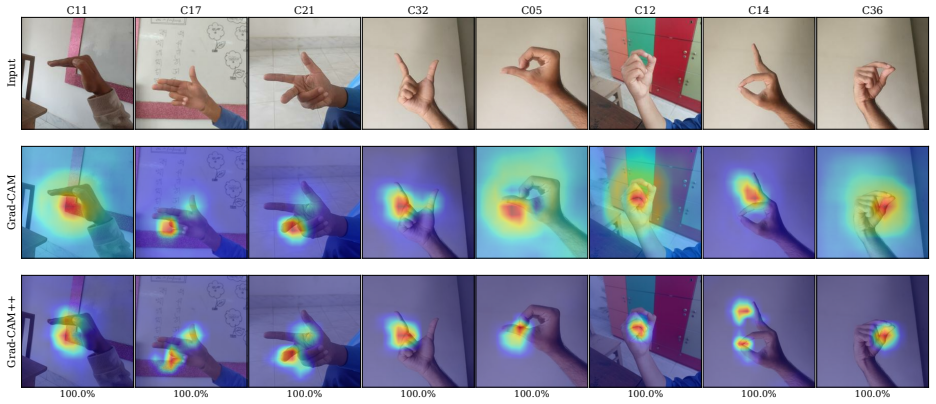
Deaf and hard-of-hearing people in Bangladesh communicate mainly through Bangla Sign Language (BdSL). Automatic BdSL recognition on personal devices could widen access to education and services. Existing systems use controlled-setting datasets without expert verification and heavyweight pretrained backbones unsuited to on-device use. We introduce RSBdSL38, 10,874 expert-validated images spanning all 38 BdSL hand signs, representing the 51 letters of the Bangla alphabet, recorded from real signers at three special-needs schools across Bangladesh. We propose a lightweight attention based convolutional network of 298,470 parameters, built from grouped bottleneck residual blocks, channel and spatial attention, a multi-scale depthwise hand-feature block, dual pooling, and Swish activations. Trained from scratch, it attains 96.37% accuracy (95.72% +- 0.54% over five seeds), within 1.08 percentage points of the best of nine ImageNet-pretrained efficient architectures under an identical protocol, using 8.5 to 68x fewer parameters and 1.3 to 21.7x fewer MACs. Retrained, it reaches 92.95 to 98.33% on six public BdSL benchmarks, 97.04% on a merged corpus, and 76.25% zero-shot on BdSL-38. Removing any architectural stage costs 7.61 to 89.30 points, against at most 3.17 for the training recipe. Grad-CAM with deletion-insertion and weight-randomization checks confirms that predictions follow the signing hand. A signer-independent split holding out 6 of 36 signers yields 85.18%. Quantized to 0.48 MB, it runs at 3.98 ms per image within a 15.5 MB footprint on a commodity smartphone. Together, RSBdSL38 and our from-scratch model turn benchmark accuracy into deployable accessibility at a fraction of pretrained-backbone cost; dataset, code, and models are released.
Figures


Figures from the paper (16 more)




Reference graph
Works this paper leans on
-
[1]
Sanity checks for saliency maps, in: Advances in Neural Information Processing Systems (NeurIPS), pp
Adebayo, J., Gilmer, J., Muelly, M., Goodfellow, I., Hardt, M., Kim, B., 2018. Sanity checks for saliency maps, in: Advances in Neural Information Processing Systems (NeurIPS), pp. 9505–9515
work page 2018
-
[2]
Ahmed, S., Syfullah, M.K., 2026. RSBdSL38-v1. URL: https://doi.org/10.17632/tgvmb2jsdb.1, doi:10.17632/tgvmb2jsdb.1
-
[3]
Deep learning for sign language recognition: Current techniques, benchmarks, and open issues
Al-Qurishi, M., Khalid, T., Souissi, R., 2021. Deep learning for sign language recognition: Current techniques, benchmarks, and open issues. IEEE Access 9, 126917–126951
work page 2021
-
[4]
Alam, M.S., Tanvir, M., Saha, D.K., Das, S.K., 2021. Two dimensional convolutional neural network approach for real-time bangla sign language characters recognition and translation. SN Computer Science 2, 387
work page 2021
-
[5]
Billah, A.R., Fahad, F.I., Raaz, S.R., Saha, A., Eity, Q.N., 2022. Recognition of bangla sign language characters and digits using cnn, in: 2022 International Conference on Innovations in Science, Engineering and Technology (ICISET), IEEE. pp. 239–244
work page 2022
-
[6]
Chattopadhay, A., Sarkar, A., Howlader, P., Balasubramanian, V.N., 2018. Grad-cam++: Generalized gradient-based visual explanations for deep convolutional networks, in: IEEE Winter Conference on Applications of Computer Vision (W ACV), IEEE. pp. 839–847
work page 2018
-
[7]
Chollet, F., 2017. Xception: Deep learning with depthwise separable convolutions, in: Proceedings of the IEEE Conference on Computer Vision and Pattern Recognition (CVPR), pp. 1251–1258
work page 2017
-
[8]
Das, S., Imtiaz, M.S., Neom, N.H., Siddique, N., Wang, H., 2023. A hybrid approach for bangla sign language recognition using deep transfer learning model with random forest classifier. Expert Systems with Applications 213, 118914
work page 2023
Show all 57 references
-
[9]
Imagenet: A large-scale hierarchical image database, in: Proceedings of the IEEE Conference on Computer Vision and Pattern Recognition (CVPR), pp
Deng, J., Dong, W., Socher, R., Li, L.J., Li, K., Fei-Fei, L., 2009. Imagenet: A large-scale hierarchical image database, in: Proceedings of the IEEE Conference on Computer Vision and Pattern Recognition (CVPR), pp. 248–255
2009
-
[10]
Explainable federated learning for privacy-preserving bangla sign language detection
Diba, B.S., Plabon, J.D., Rahman, M.M., Mistry, D., Saha, A.K., Mridha, M.F., 2024. Explainable federated learning for privacy-preserving bangla sign language detection. Engineering Applications of Artificial Intelligence 134, 108657
2024
-
[11]
Emon, S.H., Chowdhury, A.R., Siddique, M.A.I., Hassan, M.M., Hossen, A., Sade, M.S., 2025. Real-time detection and translation of bangla sign language characters using deep learning, in: 2025 International Conference on Quantum Photonics, Artificial Intelligence, and Networkin...
2025
-
[12]
Baust lipi: A bdsl dataset with deep learning based bangla sign language recognition, in: Proceedings of the 3rd International Conference on Computing Advancements, pp
Hadiuzzaman, M., Ali, M., Miah, A.S., Raj Shafi, A., Shin, J., 2024. Baust lipi: A bdsl dataset with deep learning based bangla sign language recognition, in: Proceedings of the 3rd International Conference on Computing Advancements, pp. 280–285. 35
2024
-
[13]
Recognition of bangladeshi sign language (bdsl) words using deep convolutional neural networks (dcnns)
Haque, A., Pulok, R.A., Rahman, M.M., Akter, S., Khan, N., Haque, S., 2023. Recognition of bangladeshi sign language (bdsl) words using deep convolutional neural networks (dcnns). Emerging Science Journal 7, 2183–2201
2023
-
[14]
Hasan, S.N., Hasan, M.J., Alam, K.S., 2021. Shongket: A comprehensive and multipurpose dataset for bangla sign language detection, in: 2021 International Conference on Electronics, Communications and Information Technology (ICECIT), IEEE. pp. 1–4
2021
-
[15]
Bdsl 49: A comprehensive dataset of bangla sign language
Hasib, A., Eva, J.F., Khan, S.S., Khatun, M.N., Haque, A., Shahrin, N., Rahman, R., Murad, H., Islam, M.R., Hussein, M.R., 2023. Bdsl 49: A comprehensive dataset of bangla sign language. Data in Brief 49, 109329
2023
-
[16]
Deep residual learning for image recognition, in: Proceedings of the IEEE Conference on Computer Vision and Pattern Recognition (CVPR), pp
He, K., Zhang, X., Ren, S., Sun, J., 2016. Deep residual learning for image recognition, in: Proceedings of the IEEE Conference on Computer Vision and Pattern Recognition (CVPR), pp. 770–778
2016
-
[17]
Bdsl36: A dataset for bangladeshi sign letters recognition, in: Proceedings of the Asian Conference on Computer Vision (ACCV) Workshops
Hoque, O.B., Jubair, M.I., Akash, A.F., Islam, S., 2020. Bdsl36: A dataset for bangladeshi sign letters recognition, in: Proceedings of the Asian Conference on Computer Vision (ACCV) Workshops
2020
-
[18]
Squeeze-and-excitation networks, in: Proceedings of the IEEE Confer- ence on Computer Vision and Pattern Recognition (CVPR), pp
Hu, J., Shen, L., Sun, G., 2018. Squeeze-and-excitation networks, in: Proceedings of the IEEE Confer- ence on Computer Vision and Pattern Recognition (CVPR), pp. 7132–7141
2018
-
[19]
Batch normalization: Accelerating deep network training by reducing internal covariate shift, in: International Conference on Machine Learning (ICML), pp
Ioffe, S., Szegedy, C., 2015. Batch normalization: Accelerating deep network training by reducing internal covariate shift, in: International Conference on Machine Learning (ICML), pp. 448–456
2015
-
[20]
Sign language recognition for bangla alphabets using deep learning methods, in: 2022 4th International Conference on Sustainable Technologies for Industry 4.0 (STI), IEEE
Islam, M.S., Das, D., Das, S., Ullah, M.N., 2022. Sign language recognition for bangla alphabets using deep learning methods, in: 2022 4th International Conference on Sustainable Technologies for Industry 4.0 (STI), IEEE. pp. 1–6
2022
-
[21]
Ku-bdsl: An open dataset for bengali sign language recognition
Jim, A.A.J., Rafi, I., Akon, M.Z., Biswas, U., Nahid, A.A., 2023. Ku-bdsl: An open dataset for bengali sign language recognition. Data in Brief 51, 109797
2023
-
[22]
Combining state-of-the-art pre-trained deep learning models: A novel approach for bangla sign language recognition using max voting ensemble
Kabir, M.H., Miah, A.S.M., Hadiuzzaman, M., Shin, J., 2025. Combining state-of-the-art pre-trained deep learning models: A novel approach for bangla sign language recognition using max voting ensemble. Systems and Soft Computing 7, 200230
2025
-
[23]
Karim, M.B., Nabi, M., Zim, F., Srizon, A.Y., 2025. Empowering the deaf community through a vision- based approach to bangla sign language numerals recognition, in: 2025 International Conference on Electrical, Computer and Communication Engineering (ECCE), IEEE. pp. 1–6
2025
-
[24]
Imagenet classification with deep convolutional neural networks
Krizhevsky, A., Sutskever, I., Hinton, G.E., 2012. Imagenet classification with deep convolutional neural networks. Advances in Neural Information Processing Systems 25
2012
-
[25]
Rethink- ing vision transformers for mobilenet size and speed, in: Proceedings of the IEEE/CVF International Conference on Computer Vision (ICCV), pp
Li, Y., Hu, J., Wen, Y., Evangelidis, G., Salahi, K., Wang, Y., Tulyakov, S., Ren, J., 2023. Rethink- ing vision transformers for mobilenet size and speed, in: Proceedings of the IEEE/CVF International Conference on Computer Vision (ICCV), pp. 16889–16900
2023
-
[26]
Decoupled weight decay regularization, in: International Conference on Learning Representations (ICLR)
Loshchilov, I., Hutter, F., 2019. Decoupled weight decay regularization, in: International Conference on Learning Representations (ICLR). ArXiv:1711.05101
2019 arXiv
-
[27]
A unified approach to interpreting model predictions
Lundberg, S.M., Lee, S.I., 2017. A unified approach to interpreting model predictions. Advances in Neural Information Processing Systems 30
2017
-
[28]
Mobilevit: Light-weight, general-purpose, and mobile-friendly vision transformer, in: International Conference on Learning Representations (ICLR)
Mehta, S., Rastegari, M., 2022a. Mobilevit: Light-weight, general-purpose, and mobile-friendly vision transformer, in: International Conference on Learning Representations (ICLR). ArXiv:2110.02178
-
[29]
Separable self-attention for mobile vision transformers
Mehta, S., Rastegari, M., 2022b. Separable self-attention for mobile vision transformers. arXiv preprint arXiv:2206.02680
-
[30]
Bangla sign alphabet recognition with zero-shot and transfer learning
Nihal, R.A., Rahman, S., Broti, N.M., Deowan, S.A., 2021. Bangla sign alphabet recognition with zero-shot and transfer learning. Pattern Recognition Letters 150, 84–93. 36
2021
-
[31]
Dinov2: Learning robust visual features without supervision
Oquab, M., Darcet, T., Moutakanni, T., Vo, H., Szafraniec, M., Khalidov, V., Fernandez, P., Haziza, D., Massa, F., El-Nouby, A., et al., 2023. Dinov2: Learning robust visual features without supervision. arXiv preprint arXiv:2304.07193
2023 arXiv
-
[32]
Deafness and hearing loss
Organization, W.H., 2023. Deafness and hearing loss. URL: https://www.who.int/news-room/ fact-sheets/detail/deafness-and-hearing-loss . accessed: 2023-03-27
2023
-
[33]
Rise: Randomized input sampling for explanation of black-box models, in: British Machine Vision Conference (BMVC)
Petsiuk, V., Das, A., Saenko, K., 2018. Rise: Randomized input sampling for explanation of black-box models, in: British Machine Vision Conference (BMVC). ArXiv:1806.07421
2018 arXiv
-
[34]
Bangla sign language (bdsl) alphabets and numerals classification using a deep learning model
Podder, K.K., Chowdhury, M.E., Tahir, A.M., Mahbub, Z.B., Khandakar, A., Hossain, M.S., Kadir, M.A., 2022. Bangla sign language (bdsl) alphabets and numerals classification using a deep learning model. Sensors 22, 574
2022
-
[35]
Mobilenetv4: Universal models for the mobile ecosystem, in: European Conference on Computer Vision (ECCV), pp
Qin, D., Leichner, C., Delakis, M., Fornoni, M., Luo, S., Yang, F., Wang, W., Banbury, C., Ye, C., Akin, B., et al., 2024. Mobilenetv4: Universal models for the mobile ecosystem, in: European Conference on Computer Vision (ECCV), pp. 78–96
2024
-
[36]
Bengali-sign: A machine learning-based bengali sign language interpretation for deaf and non-verbal people
Raihan, M.J., Labib, M.I., Jim, A.A.J., Tiang, J.J., Biswas, U., Nahid, A.A., 2024. Bengali-sign: A machine learning-based bengali sign language interpretation for deaf and non-verbal people. Sensors 24, 5351
2024
-
[37]
Searching for activation functions
Ramachandran, P., Zoph, B., Le, Q.V., 2017. Searching for activation functions. arXiv preprint arXiv:1710.05941
2017 arXiv
-
[38]
Sign language recognition: A deep survey
Rastgoo, R., Kiani, K., Escalera, S., 2021. Sign language recognition: A deep survey. Expert systems with applications 164, 113794
2021
-
[39]
Bdsl47: A complete depth-based bangla sign alphabet and digit dataset
Rayeed, S., Tuba, S.T., Mahmud, H., Md, M.H.U.M., Md, S.H.M., Md, K.H., 2023. Bdsl47: A complete depth-based bangla sign alphabet and digit dataset. Data in Brief 51, 109799
2023
-
[40]
Sign language: a systematic review on classification and recognition
Renjith, S., Manazhy, R., 2024. Sign language: a systematic review on classification and recognition. Multimedia Tools and Applications 83, 77077–77127
2024
-
[41]
Grad-cam: Visual explanations from deep networks via gradient-based localization, in: Proceedings of the IEEE Interna- tional Conference on Computer Vision (ICCV), pp
Selvaraju, R.R., Cogswell, M., Das, A., Vedantam, R., Parikh, D., Batra, D., 2017. Grad-cam: Visual explanations from deep networks via gradient-based localization, in: Proceedings of the IEEE Interna- tional Conference on Computer Vision (ICCV), pp. 618–626
2017
-
[42]
Multimodal ensemble approach leveraging spatial, skeletal, and edge features for enhanced bangla sign language recognition
Shams, K.A., Reaz, M.R., Rafi, M.R.U., Islam, S., Rahman, M.S., Rahman, R., Reza, M.T., Parvez, M.Z., Chakraborty, S., Pradhan, B., et al., 2024. Multimodal ensemble approach leveraging spatial, skeletal, and edge features for enhanced bangla sign language recognition. IEEE Ac...
2024
-
[43]
Deep learning-based bangla sign language detection with an edge device
Siddique, S., Islam, S., Neon, E., Sabbir, T., Naheen, I., Khan, R., 2023. Deep learning-based bangla sign language detection with an edge device. intelligent systems with applications, 18, 200224
2023
-
[44]
Real-time bangla sign language recognition using transfer learn- ing model, in: 2024 International Conference on Innovations in Science, Engineering and Technology (ICISET), IEEE
Sraboni, S.A., Sultana, A., 2024. Real-time bangla sign language recognition using transfer learn- ing model, in: 2024 International Conference on Innovations in Science, Engineering and Technology (ICISET), IEEE. pp. 1–5
2024
-
[45]
Dropout: A simple way to prevent neural networks from overfitting
Srivastava, N., Hinton, G., Krizhevsky, A., Sutskever, I., Salakhutdinov, R., 2014. Dropout: A simple way to prevent neural networks from overfitting. Journal of Machine Learning Research 15, 1929–1958
2014
-
[46]
On the importance of initialization and momen- tum in deep learning, in: International Conference on Machine Learning (ICML), pp
Sutskever, I., Martens, J., Dahl, G., Hinton, G., 2013. On the importance of initialization and momen- tum in deep learning, in: International Conference on Machine Learning (ICML), pp. 1139–1147
2013
-
[47]
The linguistics of British Sign Language: an introduction
Sutton-Spence, R., Woll, B., 1999. The linguistics of British Sign Language: an introduction. Cambridge University Press
1999
-
[48]
Efficientnetv2: Smaller models and faster training, in: International Conference on Machine Learning (ICML), pp
Tan, M., Le, Q., 2021. Efficientnetv2: Smaller models and faster training, in: International Conference on Machine Learning (ICML), pp. 10096–10106. 37
2021
-
[49]
Ghostnetv2: Enhance cheap operation with long-range attention
Tang, Y., Han, K., Guo, J., Xu, C., Xu, C., Wang, Y., 2022. Ghostnetv2: Enhance cheap operation with long-range attention. Advances in Neural Information Processing Systems 35, 9969–9982
2022
-
[50]
Tanvir, M., Alam, M.S., Saha, D.K., Hasib, S.A., Islam, S., 2021. Real-time recognition of bangla sign language characters: A computer vision based approach using convolutional neural network, in: 2021 3rd International Conference on Electrical & Electronic Engineering (ICEEE)...
2021
-
[51]
Tapu, T.K., Faiaz, F., Sikder, A.R., 2025. Lightweight convolutional neural network with self-attention mechanism for bangla sign language recognition, in: 2025 International Conference on Electrical, Com- puter and Communication Engineering (ECCE), pp. 1–6. doi: 10.1109/ECCE6...
2025
-
[52]
Disabling hearing impairment in the bangladeshi population
Tarafder, K., Akhtar, N., Zaman, M., Rasel, M., Bhuiyan, M., Datta, P., 2015. Disabling hearing impairment in the bangladeshi population. The Journal of Laryngology & Otology 129, 126–135
2015
-
[53]
A vision transformer-based fine-tuned dinov2 model for bangla sign language recognition
Tasnim, S.A., Mahmud, R., Ahmed, T., Karmaker, D., 2026. A vision transformer-based fine-tuned dinov2 model for bangla sign language recognition. Multimedia Tools and Applications 85, 163
2026
-
[54]
Efficient object localization using convolutional networks, in: Proceedings of the IEEE Conference on Computer Vision and Pattern Recognition (CVPR), pp
Tompson, J., Goroshin, R., Jain, A., LeCun, Y., Bregler, C., 2015. Efficient object localization using convolutional networks, in: Proceedings of the IEEE Conference on Computer Vision and Pattern Recognition (CVPR), pp. 648–656
2015
-
[55]
Linguistics of American sign language: An introduction
Valli, C., Lucas, C., 2000. Linguistics of American sign language: An introduction. Gallaudet University Press
2000
-
[56]
Cbam: Convolutional block attention module, in: Proceedings of the European Conference on Computer Vision (ECCV), pp
Woo, S., Park, J., Lee, J.Y., Kweon, I.S., 2018. Cbam: Convolutional block attention module, in: Proceedings of the European Conference on Computer Vision (ECCV), pp. 3–19
2018
-
[57]
Aggregated residual transformations for deep neural networks, in: Proceedings of the IEEE Conference on Computer Vision and Pattern Recognition (CVPR), pp
Xie, S., Girshick, R., Dollár, P., Tu, Z., He, K., 2017. Aggregated residual transformations for deep neural networks, in: Proceedings of the IEEE Conference on Computer Vision and Pattern Recognition (CVPR), pp. 1492–1500. 38
2017
Reviewed August 7, 2026 · model on record in the stance chip above.
Discussion (0). Sign in to comment.