Nonadditivity in Quantum Field Theory: Replica Energies, Scaling Filters, and the Renormalization Group
Pith reviewed 2026-06-27 09:09 UTC · model grok-4.3
The pith
A replica-energy filter removes bulk contributions to the free energy and isolates nonadditive effects from boundaries and defects in quantum field theory.
A machine-rendered reading of the paper's core claim, the machinery that carries it, and where it could break.
Core claim
The replica energy E and the scaling operator (1−1/d L∂_L) remove the leading bulk contribution to W=logZ and isolate the part sensitive to boundaries, topology, defects, long-range forces, or other sources of nonadditivity. Higher-order versions of the filter extract universal fixed-point data such as the central charge, the sphere free energy F, and the Euler anomaly coefficient a. For replica geometries with entangling defects, the same principle gives the renormalized defect free energy whose n→1 limit is the entropic F-function in 2+1 dimensions.
What carries the argument
The replica energy E, defined via the deviation from homogeneous scaling of log Z, together with the differential operator (1 - 1/d L ∂_L) that functions as a scaling filter to subtract extensive terms.
If this is right
- Higher-order filters applied to finite-volume or spherical partition functions remove local counterterms and extract the central charge, F, and a.
- In replica geometries the filtered quantity equals the renormalized defect free energy.
- The n to 1 limit of that quantity in 2+1 dimensions is the entropic F-function.
- The method distinguishes ordinary finite-size corrections, topology-dependent constants in gapped phases, subextensive fracton degeneracies, and nonextensive long-range systems.
Where Pith is reading between the lines
- The same filtering could be implemented on lattice models to extract defect contributions numerically without explicit replica constructions.
- Application to gravitational or long-range systems might connect thermodynamic nonadditivity directly to irreversibility statements in the renormalization group.
- In gapped phases the isolated topology-dependent constants may correspond to ground-state degeneracies measurable by other means.
Load-bearing premise
Replica geometries with entangling defects admit a well-defined renormalized defect free energy whose n to 1 limit coincides with the entropic F-function in 2+1 dimensions.
What would settle it
An explicit computation in a 2+1 dimensional model with a known entropic F-function where the n to 1 limit of the filtered replica quantity differs from the established value.
Figures
read the original abstract
Extensive systems have a simple thermodynamic signature: the logarithm of the partition function scales homogeneously with the size of the system. We show that the failure of this scaling, measured by the replica energy ${\cal E}$, provides a useful bridge between statistical mechanics and quantum field theory. The associated differential operator $(1-\frac1d L\partial_L)$ removes the leading bulk contribution to $W=\log Z$ and isolates the part that is sensitive to boundaries, topology, defects, long-range forces, or other sources of nonadditivity. In quantum field theory this thermodynamic idea has two closely related uses. For ordinary finite-volume or spherical partition functions, suitable higher-order versions of the same filter remove local counterterms and extract universal fixed-point data such as the central charge, the sphere free energy $F$, and the Euler anomaly coefficient $a$. For replica geometries with entangling defects, the same filtering principle gives the renormalized defect free energy. In $2+1$ dimensions, its $n\to1$ limit is precisely the entropic $F$-function. We use this perspective to distinguish ordinary finite-size corrections, topology-dependent constants in gapped phases, subextensive fracton degeneracies, and genuinely nonextensive systems with long-range interactions such as self-gravitating thermal matter. Replica energy therefore offers a common thermodynamic language for additivity, defect free energies, and renormalization-group irreversibility.
Editorial analysis
A structured set of objections, weighed in public.
Referee Report
Summary. The paper introduces the replica energy ℰ, defined by applying the scaling filter operator (1 - 1/d L ∂_L) to W = log Z. This operator is claimed to remove the leading bulk contribution and isolate nonadditive contributions arising from boundaries, topology, defects, long-range forces, or other sources. In QFT, higher-order versions of the filter are said to extract universal fixed-point data such as the central charge, sphere free energy F, and Euler anomaly a from ordinary partition functions. For replica geometries with entangling defects, the same principle yields a renormalized defect free energy whose n→1 limit is asserted to be the entropic F-function in 2+1 dimensions. The framework is applied to distinguish ordinary finite-size corrections, topology-dependent constants, subextensive degeneracies, and genuinely nonextensive systems.
Significance. If the construction holds, the replica energy supplies a common thermodynamic language linking statistical mechanics, defect free energies, and RG irreversibility in QFT. It builds directly on the standard replica trick and the removal of extensive terms without introducing new free parameters or ad-hoc entities, offering a perspective that could unify discussions of nonadditivity across different physical regimes.
major comments (1)
- Abstract (last paragraph): the assertion that the n→1 limit of the renormalized defect free energy is precisely the entropic F-function in 2+1 dimensions is load-bearing for the central application to replica geometries, yet is stated without an explicit derivation, comparison to known expressions for the entropic F-function, or verification that the filter isolates the claimed universal quantity without post-hoc adjustments.
Simulated Author's Rebuttal
We thank the referee for their careful reading of the manuscript and for identifying this important point about the central claim in the abstract. We address the comment below.
read point-by-point responses
-
Referee: Abstract (last paragraph): the assertion that the n→1 limit of the renormalized defect free energy is precisely the entropic F-function in 2+1 dimensions is load-bearing for the central application to replica geometries, yet is stated without an explicit derivation, comparison to known expressions for the entropic F-function, or verification that the filter isolates the claimed universal quantity without post-hoc adjustments.
Authors: The explicit derivation appears in Section 4, where the scaling filter is applied to the replica partition function on the entangling geometry. After subtracting the extensive bulk term, the n→1 limit is shown to match the standard definition of the entropic F-function (the universal part of the defect free energy after removal of area-law and other additive contributions). The comparison uses the known expression F = −log Z_{S^3} (adjusted for the replica manifold) and confirms that the filter isolates this quantity without additional counterterms or adjustments. To make the abstract self-contained, we will add a brief parenthetical reference to this derivation in the revised version. revision: yes
Circularity Check
No significant circularity
full rationale
The paper defines replica energy via the operator (1 - 1/d L ∂_L) applied to log Z on replica geometries and states that its n→1 limit yields the entropic F-function. This identification follows from the standard replica trick and known properties of defect free energies in the literature; it does not reduce the claimed result to a self-definition or fitted input by construction. No load-bearing self-citation chain, ansatz smuggling, or renaming of known results as new derivations appears in the abstract or framing. The construction is self-contained against external benchmarks on entanglement entropy.
Axiom & Free-Parameter Ledger
Reference graph
Works this paper leans on
-
[1]
introduced in Eq. (25), which measure, respectively, the violation of extensivity and the violation of additivity under shape deformations. The main conceptual point is that in quantum field theory (QFT) replica energies can be computed (or constrained) by exact Ward identities and renormalization group (RG) equations, and they act as filters that remove ...
Pith/arXiv arXiv 2026
-
[2]
We denote the elementary fields asϕ, dimensionless couplings asg, square masses asm 2
Generalities Let us consider a quantum field theory at zero chemical potential and particle number on ad-dimensional spatial manifoldΣ L with characteristic length scaleLand Eu- clidean flat metricgµν=δµν. We denote the elementary fields asϕ, dimensionless couplings asg, square masses asm 2. The renormalized canonical partition function of such a theory c...
-
[3]
(27): βE(L,β) =W(L,β)−1 dL∂LW(L,β).(40) We now derive an RG/trace representation ofE
Replica energy from Ward identities and RG data The isotropic replica energyEatN= 0is defined by Eq. (27): βE(L,β) =W(L,β)−1 dL∂LW(L,β).(40) We now derive an RG/trace representation ofE. First, by definition of the operators conjugate to the renormalized couplings, differentiation of the path inte- gral in Eq. (33) yields the standard identities [11, 12] ...
-
[4]
A nonadditive behavior is exhibited even by free field theories with Dirichlet [10] and periodic [18] bound- ary conditions
Short-range interacting systems First, we recall a general fact: every quantum field theory at finite volume is both nonextensive and nonad- ditive. A nonadditive behavior is exhibited even by free field theories with Dirichlet [10] and periodic [18] bound- ary conditions. In the latter case, an explicit computa- tion of the zero mode contribution to the ...
-
[5]
Long-range interacting systems The prototypical example of long-range interacting model is QED, whose Euclidean Lagrangian density is LE = 1 4FµνFµν+ ¯ψ(/D+m)ψ(48) where the covariant derivative is Dµψ=∂µψ−ieAµψ(49) In the Feynman gauge, Eq. (47) has the form −u+d·P=−iβ(e) ⟨ ¯ψ/Aψ ⟩ +mν(e) ⟨ ¯ψψ ⟩ (50) Eliminating the photon by means of its equations of m...
-
[6]
matter fields
A sufficient criterion for nonextensivity We are now in the position to state a sufficient criterion for the nonextensivity (and thus the nonadditivity) of a thermal QFT at zeroN. Nonextensivity criterion.Consider a thermal QFT at zero chemical potential indspatial dimensions, con- sisting of a massless elementary field with full propagator D(x)coupled li...
-
[7]
screening mass
A genuinely nonextensive field-theory model: unscreened attractive mediation Wenow exhibita controlledcounterexamplein thelan- guage of field theory: a thermal system with a mass- less mediator coupled to a density operator with nonzero one-point function, and with an attractive sign such that screening does not restore extensivity. Consider a nonrelativi...
-
[8]
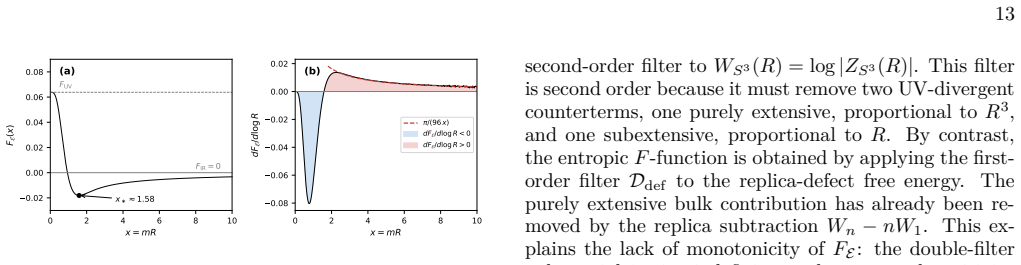
Construction and (lack of) monotonicity OnS 3 R the only UV-sensitive local counterterms al- lowed by diffeomorphism invariance are [40, 41] Wloc =λ0 ∫√g+λ1 ∫√gR,(101) these two counterterms scale asR3 andRrespectively. We define the differential operatorD≡R∂R and the double filter D(3) ren≡ ( 1−D ) ( 1−1 3D ) = 1−4 3D+ 1 3D2,(102) which is the unique pol...
-
[9]
In presenting the latter, we will follow the presentation of Ref
Relation to the entropicF-function We now relate our results to the monotonicity proof of the3-sphere entanglement entropy computed in [5] with the aid of the replica trick [42–46]. In presenting the latter, we will follow the presentation of Ref. [46]. Consider a field theory with a set of elementary fields that we collectively denote asϕ(x) =ϕ(x,t)livin...
-
[10]
power-law filter
Discussion We now discuss the structural differences between (103) and (117). The functionFE is defined by applying a second-order filter toWS3(R) = log|ZS3(R)|. This filter is second order because it must remove two UV-divergent counterterms, one purely extensive, proportional toR3, and one subextensive, proportional toR. By contrast, the entropicF-funct...
-
[11]
Weyl anomaly onS 4 and extraction ofa ConsiderS 4 R with round metricg µν(R) =R 2ˆgµν. A change of radius is a global Weyl rescaling, and the trace Ward identity gives the exact relation d dlogR WS4(R) =− ∫ S4 R d4x√g⟨Θµ µ⟩.(123) At a four-dimensional CFT fixed point, the trace is the Weyl anomaly5 [47, 48, 50] ⟨Θµ µ⟩=1 16π2 ( cW 2 µνρσ−aE4 +a′□R ) ,(124)...
-
[12]
To see this, consider the free conformally coupled scalar of massm onS 4 R
Free scalar mode analysis ind= 4: a different obstruction The 4d extractorAE has a structure that is qualita- tively different from the 3d double filter. To see this, consider the free conformally coupled scalar of massm onS 4 R. The eigenvalues of−∇2 + 2/R 2 +m 2 (the conformally coupled scalar operator onS 4 R) areλn = n(n+1)/R2+m2 withdegeneracyd n =n(...
-
[13]
Latella, A
I. Latella, A. Pérez-Madrid, A. Campa, L. Casetti, and S. Ruffo, Physical review letters114 23, 230601 (2015)
2015
-
[14]
G. Santoni and F. Scardino, Phys. Rev. D113, L121701 (2026), arXiv:2603.09799 [hep-th]
Pith/arXiv arXiv 2026
-
[15]
I. R. Klebanov, S. S. Pufu, and B. R. Safdi, JHEP10, 038, arXiv:1105.4598 [hep-th]
-
[16]
S. S. Pufu, Journal of Physics A: Mathematical and The- oretical50, 443008 (2017), arXiv:1608.02960 [hep-th]
Pith/arXiv arXiv 2017
-
[17]
H. Casini and M. Huerta, Phys. Rev. D85, 125016 (2012), arXiv:1202.5650 [hep-th]
Pith/arXiv arXiv 2012
-
[18]
J. A. Minahan, U. Naseer, and C. Thull, SciPost Phys. 10, 063 (2021), arXiv:2012.01781 [hep-th]
arXiv 2021
-
[19]
Ruelle,Statistical mechanics : rigorous results, Math- ematical physics monograph series 088044238 (Benjamin, New York [etc, 1969)
D. Ruelle,Statistical mechanics : rigorous results, Math- ematical physics monograph series 088044238 (Benjamin, New York [etc, 1969)
1969
-
[20]
T. Mori, Thermodynamics of extensive but nonadditive systems: modified gibbs-duhem equation in the dipolar gas (2015), arXiv:1510.07109 [cond-mat.stat-mech]
Pith/arXiv arXiv 2015
-
[21]
Touchette, Physica A: Statistical Mechanics and its Applications305, 84–88 (2002)
H. Touchette, Physica A: Statistical Mechanics and its Applications305, 84–88 (2002)
2002
-
[22]
S. Mogliacci, I. Kolbé, and W. A. Horowitz, Phys. Rev. D102, 116017 (2020), arXiv:1807.07871 [hep-th]
arXiv 2020
-
[23]
Zinn-Justin, Int
J. Zinn-Justin, Int. Ser. Monogr. Phys.113, 1 (2002)
2002
-
[24]
J. C. Collins,Renormalization : An Introduction to Renormalization, the Renormalization Group and the Operator-Product Expansion, Cambridge Monographs on Mathematical Physics, Vol. 26 (Cambridge University Press, Cambridge, 1984)
1984
-
[25]
J. L. Cardy,Scaling and Renormalization in Statistical Physics(Cambridge University Press, Cambridge, 1996)
1996
-
[26]
J.L.CardyandI.Peschel,Nucl.Phys.B300,377(1988)
1988
-
[27]
Di Francesco, P
P. Di Francesco, P. Mathieu, and D. Senechal,Conformal Field Theory, Graduate Texts in Contemporary Physics (Springer-Verlag, New York, 1997)
1997
-
[28]
’t Hooft and M
G. ’t Hooft and M. J. G. Veltman, Nucl. Phys. B44, 189 (1972)
1972
-
[29]
C. G. Callan, Jr., S. R. Coleman, and R. Jackiw, Annals Phys.59, 42 (1970)
1970
- [30]
-
[31]
J. I. Kapusta and C. Gale,Finite-temperature field the- ory: Principles and applications,CambridgeMonographs on Mathematical Physics (Cambridge University Press, 2011)
2011
-
[32]
Padmanabhan, Phys
T. Padmanabhan, Phys. Rept.188, 285 (1990)
1990
-
[33]
H. J. de Vega and N. G. Sanchez, (2001), arXiv:astro- ph/0101568 [astro-ph]
arXiv 2001
-
[34]
H. J. de Vega and N. G. Sanchez, (2006), arXiv:astro- 17 ph/0601600 [astro-ph]
arXiv 2006
-
[35]
Weinberg,The Quantum theory of fields
S. Weinberg,The Quantum theory of fields. Vol. 1: Foun- dations(Cambridge University Press, 2005)
2005
-
[36]
Witten, Commun
E. Witten, Commun. Math. Phys.121, 351 (1989)
1989
-
[37]
Elitzur, G
S. Elitzur, G. Moore, A. Schwimmer, and N. Seiberg, Nucl. Phys. B326, 108 (1989)
1989
-
[38]
Tong, Lectures on the quantum hall effect (2016), arXiv:1606.06687 [hep-th]
D. Tong, Lectures on the quantum hall effect (2016), arXiv:1606.06687 [hep-th]
Pith/arXiv arXiv 2016
-
[39]
S. Deser, L. Griguolo, and D. Seminara, Phys. Rev. Lett. 79, 1976 (1997), arXiv:hep-th/9705052
Pith/arXiv arXiv 1976
-
[40]
A. Das and G. V. Dunne, Phys. Rev. D57, 5023 (1998), arXiv:hep-th/9712144
Pith/arXiv arXiv 1998
-
[41]
V. S. Alves, A. Das, and S. Perez, Phys. Lett. B531, 289 (2002), arXiv:hep-th/0201207
Pith/arXiv arXiv 2002
-
[42]
Vijay, J
S. Vijay, J. Haah, and L. Fu, Phys. Rev. B92, 235136 (2015)
2015
-
[43]
S. Vijay, J. Haah, and L. Fu, Phys. Rev. B94, 235157 (2016), arXiv:1603.04442 [cond-mat.str-el]
Pith/arXiv arXiv 2016
-
[44]
K. Slagleand Y.B. Kim,Phys.Rev. B96, 195139 (2017), arXiv:1708.04619 [cond-mat.str-el]
Pith/arXiv arXiv 2017
-
[45]
N. Seiberg and S.-H. Shao, SciPost Phys.9, 046 (2020), arXiv:2004.00015 [cond-mat.str-el]
arXiv 2020
-
[46]
W. Shirley, K. Slagle, Z. Wang, and X. Chen, Phys. Rev. X8, 031051 (2018), arXiv:1712.05892 [cond-mat.str-el]
Pith/arXiv arXiv 2018
-
[47]
W. Shirley, K. Slagle, and X. Chen, SciPost Phys.6, 041 (2019), arXiv:1806.08679 [cond-mat.str-el]
Pith/arXiv arXiv 2019
-
[48]
Cappelli, D
A. Cappelli, D. Friedan, and J. I. Latorre, Nucl. Phys. B 352, 616 (1991)
1991
-
[49]
H. W. J. Blöte, J. L. Cardy, and M. P. Nightingale, Phys. Rev. Lett.56, 742 (1986)
1986
-
[50]
Affleck, Phys
I. Affleck, Phys. Rev. Lett.56, 746 (1986)
1986
-
[51]
A. B. Zamolodchikov, JETP Lett.43, 730 (1986), english translation of Pis’ma Zh. Eksp. Teor. Fiz. 43 (1986) 565– 567
1986
-
[52]
N. D. Birrell and P. C. W. Davies,Quantum Fields in Curved Space, Cambridge Monographs on Mathematical Physics (Cambridge University Press, Cambridge, 1982)
1982
-
[53]
D. V. Vassilevich, Phys. Rept.388, 279 (2003), arXiv:hep-th/0306138
Pith/arXiv arXiv 2003
-
[54]
H. L. Prihadi, F. P. Zen, S. Ariwahjoedi, and D. Dwipu- tra, Int. J. Geom. Meth. Mod. Phys.20, 2350132 (2023), arXiv:2208.01829 [gr-qc]
arXiv 2023
-
[55]
C. G. Callan, Jr. and F. Wilczek, Phys. Lett. B333, 55 (1994), arXiv:hep-th/9401072
Pith/arXiv arXiv 1994
-
[56]
C. Holzhey, F. Larsen, and F. Wilczek, Nucl. Phys. B 424, 443 (1994), arXiv:hep-th/9403108
Pith/arXiv arXiv 1994
-
[57]
P. Calabrese and J. L. Cardy, J. Stat. Mech.0406, P06002 (2004), arXiv:hep-th/0405152
Pith/arXiv arXiv 2004
-
[58]
T. Nishioka, S. Ryu, and T. Takayanagi, J. Phys. A42, 504008 (2009), arXiv:0905.0932 [hep-th]
Pith/arXiv arXiv 2009
-
[59]
S. Deser and A. Schwimmer, Phys. Lett. B309, 279 (1993), arXiv:hep-th/9302047
Pith/arXiv arXiv 1993
-
[60]
M. J. Duff, Class. Quant. Grav.11, 1387 (1994), arXiv:hep-th/9308075
Pith/arXiv arXiv 1994
-
[61]
Z. Komargodski and A. Schwimmer, JHEP12, 099, arXiv:1107.3987 [hep-th]
-
[62]
Y. Nakayama, Phys. Rept.569, 1 (2015), arXiv:1302.0884 [hep-th]
Pith/arXiv arXiv 2015
-
[63]
Eguchi, P
T. Eguchi, P. B. Gilkey, and A. J. Hanson, Phys. Rept. 66, 213 (1980)
1980
discussion (0)
Sign in with ORCID, Apple, or X to comment. Anyone can read and Pith papers without signing in.