REVIEW 2 major objections 2 minor 37 references
Partially trainable tensor decompositions let RGB-pretrained convolutional filters adapt to hyperspectral images by replacing only the spectral component while retaining spatial patterns.
Reviewed by Pith at T0; open to challenge. T0 means a machine referee read the full paper against a public rubric. the ladder, T0–T4 →
T0 review · grok-4.3
2026-06-29 13:29 UTC pith:53YJHGVO
load-bearing objection The core idea of decomposing RGB conv filters into fixed spatial and trainable spectral parts is a reasonable engineering move for hyperspectral transfer, but the abstract gives almost no math or controls so the accuracy claim is hard to evaluate. the 2 major comments →
Transfer learning RGB models to hyperspectral images with trainable tensor decompositions
The pith
A machine-rendered reading of the paper's core claim, the machinery that carries it, and where it could break.
Core claim
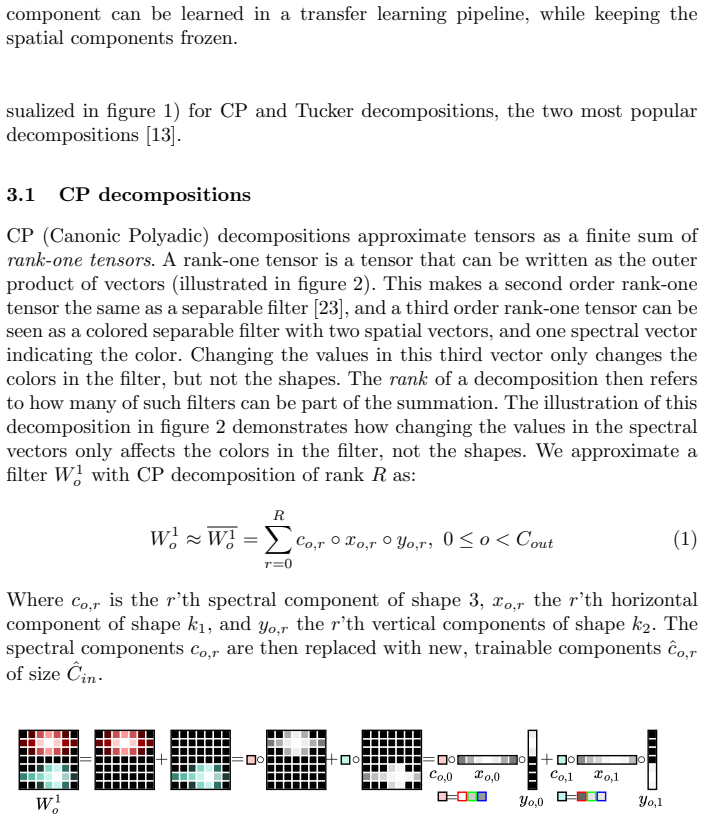
The method creates hyperspectral filters by forming partially trainable tensor decompositions of pretrained RGB convolutional filters, separating each filter into its spatial and spectral components, then substituting the spectral component with a trainable tensor of matching higher dimensionality; the resulting filters retain the spatial patterns of the original RGB filters while allowing specialization to hyperspectral data.
What carries the argument
Partially trainable tensor decompositions that split convolutional filters into fixed spatial components and trainable spectral components of higher channel count.
Load-bearing premise
The spatial patterns learned by RGB-pretrained filters stay useful after the spectral part is replaced and retrained on hyperspectral data.
What would settle it
A head-to-head accuracy comparison on a held-out hyperspectral dataset in which a model using the tensor-decomposition transfer underperforms a baseline that simply expands input channels or fine-tunes the full network without decomposition.
If this is right
- Large RGB-pretrained networks become directly usable on hyperspectral imagery without discarding spatial information or model capacity.
- The spectral components can be retrained independently on new hyperspectral datasets while spatial knowledge remains frozen.
- The same decomposition can be applied to any convolutional layer, enabling layer-wise transfer across an entire network.
- Robustness gains appear across varied hyperspectral datasets, suggesting the retained spatial patterns generalize beyond the original RGB domain.
Where Pith is reading between the lines
- The approach could extend to other high-dimensional inputs such as video or 3-D medical volumes by treating an additional dimension as the trainable component.
- If the spatial patterns prove domain-invariant, the method might reduce the need for large hyperspectral training sets by leveraging existing RGB corpora.
- Hardware implementations could cache the fixed spatial kernels and only compute the trainable spectral part, lowering memory for hyperspectral inference.
Editorial analysis
A structured set of objections, weighed in public.
Referee Report
Summary. The manuscript proposes a transfer learning technique for hyperspectral images that decomposes pretrained RGB convolutional filters via partially trainable tensor decompositions into spatial and spectral components. The spectral components are replaced by trainable higher-dimensional tensors to match the input channel count, while the spatial components are retained to preserve patterns learned from RGB data. Experiments on multiple hyperspectral datasets are reported to show higher accuracy and robustness than prior hyperspectral transfer learning methods.
Significance. If the central empirical claims hold after addressing the decomposition validity, the work could provide a practical route for leveraging large-scale RGB models in data-scarce hyperspectral domains such as remote sensing without discarding either spectral information or model capacity. The approach is presented as an engineering contribution with empirical validation across datasets; no parameter-free derivations or machine-checked proofs are claimed.
major comments (2)
- [Method (decomposition and filter construction)] The load-bearing assumption that the spatial component isolated by the tensor decomposition preserves transferable behavior when the spectral component is retrained on hyperspectral inputs is not yet substantiated. If the decomposition (CP/Tucker or similar) is approximate or if the original 3-channel kernels entangle spatial and spectral factors, the performance gains may derive primarily from added capacity in the new spectral weights rather than retained RGB patterns. This requires explicit validation, such as feature-map similarity metrics or an ablation isolating the spatial reuse effect.
- [Experiments and results] The abstract states that experiments demonstrate superior accuracy and robustness, yet the provided text supplies no equations, implementation details, error bars, dataset descriptions, or quantitative tables. Without these, it is impossible to determine whether the reported improvements are statistically significant, reproducible, or attributable to the proposed decomposition rather than hyperparameter choices or extra parameters.
minor comments (2)
- Clarify the exact tensor decomposition employed and any rank or factorization hyperparameters in the method description.
- Add standard reproducibility elements such as code release statement, exact dataset splits, and training protocol details.
Simulated Author's Rebuttal
We thank the referee for the constructive comments on our manuscript. We address each major point below and will revise the manuscript to incorporate additional validation and details as outlined.
read point-by-point responses
-
Referee: [Method (decomposition and filter construction)] The load-bearing assumption that the spatial component isolated by the tensor decomposition preserves transferable behavior when the spectral component is retrained on hyperspectral inputs is not yet substantiated. If the decomposition (CP/Tucker or similar) is approximate or if the original 3-channel kernels entangle spatial and spectral factors, the performance gains may derive primarily from added capacity in the new spectral weights rather than retained RGB patterns. This requires explicit validation, such as feature-map similarity metrics or an ablation isolating the spatial reuse effect.
Authors: The comparative results across hyperspectral datasets indicate that retaining the spatial components yields measurable gains over baselines that do not preserve RGB-derived spatial patterns. Nevertheless, we agree that direct evidence isolating this effect would strengthen the central claim. In the revised manuscript we will add an ablation that randomizes or retrains the spatial factors while keeping the trainable spectral components, together with cosine similarity measurements between feature maps produced by the original RGB filters and the adapted hyperspectral versions. revision: yes
-
Referee: [Experiments and results] The abstract states that experiments demonstrate superior accuracy and robustness, yet the provided text supplies no equations, implementation details, error bars, dataset descriptions, or quantitative tables. Without these, it is impossible to determine whether the reported improvements are statistically significant, reproducible, or attributable to the proposed decomposition rather than hyperparameter choices or extra parameters.
Authors: The full manuscript contains the tensor decomposition equations, dataset descriptions, and quantitative tables. To improve reproducibility and address the concern about statistical rigor, the revised version will expand the experimental section with error bars from multiple random seeds, full hyperparameter specifications, and significance testing of the accuracy differences. revision: yes
Circularity Check
No circularity: empirical method with independent experimental validation
full rationale
The paper describes an engineering method that decomposes pretrained RGB convolutional filters into spatial and spectral factors via tensor decomposition, replaces the spectral factors with trainable higher-dimensional weights, and evaluates the resulting model on hyperspectral datasets through direct accuracy and robustness comparisons against baselines. No derivation chain exists that reduces a claimed result to its own fitted parameters or inputs by construction; performance is measured externally on held-out data rather than being a statistical consequence of the decomposition itself. No self-citation load-bearing steps, uniqueness theorems, or ansatzes imported from prior author work appear in the load-bearing claims. The contribution is self-contained against external benchmarks.
Axiom & Free-Parameter Ledger
read the original abstract
Transfer learning makes it possible to use large vision networks on a variety of domains, by specializing their models' general filters to new tasks. However, these networks assume the input images to have 3 input channels, making them incompatible with multi- or hyperspectral images. Current approaches that mitigate this incompatibility sacrifice information in either the image, or the model. This work proposes a novel approach that preserves the image and spatial information present in the model by using partially trainable tensor decompositions. We create such decompositions of pretrained convolutional filters, separating the filters into spatial and spectral components. The spectral components are then replaced with trainable components of higher channel dimensionality. This creates hyperspectral filters that can specialize to new datasets, while retaining the spatial patterns of the original filter. Experiments on a variety of hyperspectral datasets show that our approach is more accurate and robust than other hyperspectral transfer learning methods.
Figures



Reference graph
Works this paper leans on
-
[1]
In: Proceedings of the IEEE conference on computer vision and pattern recognition
Chollet, F.: Xception: Deep learning with depthwise separable convolutions. In: Proceedings of the IEEE conference on computer vision and pattern recognition. pp. 1251–1258 (2017)
2017
-
[2]
In: Proceedings of the IEEE/CVF Conference on Computer Vision and Pattern Recognition
Corley, I., Robinson, C., Dodhia, R., Ferres, J.M.L., Najafirad, P.: Revisiting pre- trained remote sensing model benchmarks: resizing and normalization matters. In: Proceedings of the IEEE/CVF Conference on Computer Vision and Pattern Recognition. pp. 3162–3172 (2024)
2024
-
[3]
In: 2009 IEEE conference on computer vision and pattern recognition
Deng, J., Dong, W., Socher, R., Li, L.J., Li, K., Fei-Fei, L.: Imagenet: A large- scale hierarchical image database. In: 2009 IEEE conference on computer vision and pattern recognition. pp. 248–255. Ieee (2009)
2009
-
[4]
Advances in neural information processing systems27(2014)
Denton, E.L., Zaremba, W., Bruna, J., LeCun, Y., Fergus, R.: Exploiting linear structure within convolutional networks for efficient evaluation. Advances in neural information processing systems27(2014)
2014
-
[5]
In: 2022 IEEE 4th International Conference on Cybernetics, Cognition and Machine Learning Applications (ICCCMLA)
Giri, R.N., Janghel, R.R., Govil, H., Pandey, S.K.: Spatial feature extraction using pretrained convolutional neural network for hyperspectral image classification. In: 2022 IEEE 4th International Conference on Cybernetics, Cognition and Machine Learning Applications (ICCCMLA). pp. 386–389. IEEE (2022)
2022
-
[6]
Gra˜ na, M., Veganzones, M.A., Ayerdi, B.: Hyperspectral remote sens- ing scenes.https://www.ehu.eus/ccwintco/index.php/Hyperspectral_Remote_ Sensing_Scenes(1996), accessed on November 4 2025
1996
-
[7]
In: Proceedings of the IEEE conference on computer vision and pattern recognition
He, K., Zhang, X., Ren, S., Sun, J.: Deep residual learning for image recognition. In: Proceedings of the IEEE conference on computer vision and pattern recognition. pp. 770–778 (2016)
2016
-
[8]
ICLR1(2), 3 (2022)
Hu, E.J., Shen, Y., Wallis, P., Allen-Zhu, Z., Li, Y., Wang, S., Wang, L., Chen, W., et al.: Lora: Low-rank adaptation of large language models. ICLR1(2), 3 (2022)
2022
-
[9]
In: Proceedings of the IEEE conference on computer vision and pattern recognition
Hu, J., Shen, L., Sun, G.: Squeeze-and-excitation networks. In: Proceedings of the IEEE conference on computer vision and pattern recognition. pp. 7132–7141 (2018)
2018
-
[10]
In: Proceedings of the IEEE conference on computer vision and pattern recognition
Huang, G., Liu, Z., Van Der Maaten, L., Weinberger, K.Q.: Densely connected convolutional networks. In: Proceedings of the IEEE conference on computer vision and pattern recognition. pp. 4700–4708 (2017)
2017
-
[11]
In: Proceedings of the British Machine Vision Conference 2014
Jaderberg, M., Vedaldi, A., Zisserman, A.: Speeding up convolutional neural net- works with low rank expansions. In: Proceedings of the British Machine Vision Conference 2014. pp. 88–1. British Machine Vision Association (2014)
2014
-
[12]
Compression of Deep Convolutional Neural Networks for Fast and Low Power Mobile Applications
Kim, Y.D., Park, E., Yoo, S., Choi, T., Yang, L., Shin, D.: Compression of deep convolutional neural networks for fast and low power mobile applications. arXiv preprint arXiv:1511.06530 (2015)
work page internal anchor Pith review Pith/arXiv arXiv 2015
-
[13]
SIAM review 51(3), 455–500 (2009)
Kolda, T.G., Bader, B.W.: Tensor decompositions and applications. SIAM review 51(3), 455–500 (2009)
2009
-
[14]
Journal of Machine Learning Research20(26), 1–6 (2019)
Kossaifi, J., Panagakis, Y., Anandkumar, A., Pantic, M.: Tensorly: Tensor learning in python. Journal of Machine Learning Research20(26), 1–6 (2019)
2019
-
[15]
One weird trick for parallelizing convolutional neural networks
Krizhevsky, A.: One weird trick for parallelizing convolutional neural networks. arXiv preprint arXiv:1404.5997 (2014)
work page internal anchor Pith review Pith/arXiv arXiv 2014
-
[16]
In: Proceedings of the IEEE/CVF Conference on Computer Vision and Pattern Recognition
Laprade, W.M., Pieta, P., Kutuzova, S., Westergaard, J.C., Nielsen, M., Chris- tensen, S., Dahl, A.B.: Hyperleaf2024-a hyperspectral imaging dataset for classifi- cation and regression of wheat leaves. In: Proceedings of the IEEE/CVF Conference on Computer Vision and Pattern Recognition. pp. 1234–1243 (2024)
2024
-
[17]
In: 3rd Inter- national Conference on Learning Representations, ICLR 2015-Conference Track Proceedings (2015)
Lebedev, V., Ganin, Y., Rakhuba, M., Oseledets, I., Lempitsky, V.: Speeding-up convolutional neural networks using fine-tuned cp-decomposition. In: 3rd Inter- national Conference on Learning Representations, ICLR 2015-Conference Track Proceedings (2015)
2015
-
[18]
Journal of biomedical optics19(1), 010901–010901 (2014)
Lu, G., Fei, B.: Medical hyperspectral imaging: a review. Journal of biomedical optics19(1), 010901–010901 (2014)
2014
-
[19]
Postharvest Biology and Technology170, 111318 (2020)
Lu, Y., Saeys, W., Kim, M., Peng, Y., Lu, R.: Hyperspectral imaging technology for quality and safety evaluation of horticultural products: A review and celebration of the past 20-year progress. Postharvest Biology and Technology170, 111318 (2020)
2020
-
[20]
In: Proceedings of the 18th ACM international conference on Multimedia
Marcel, S., Rodriguez, Y.: Torchvision the machine-vision package of torch. In: Proceedings of the 18th ACM international conference on Multimedia. pp. 1485– 1488 (2010)
2010
-
[21]
Proceedings of the IEEE109(5), 863–890 (2021)
Panagakis, Y., Kossaifi, J., Chrysos, G.G., Oldfield, J., Nicolaou, M.A., Anand- kumar, A., Zafeiriou, S.: Tensor methods in computer vision and deep learning. Proceedings of the IEEE109(5), 863–890 (2021)
2021
-
[22]
In: European Conference on Com- puter Vision
Phan, A.H., Sobolev, K., Sozykin, K., Ermilov, D., Gusak, J., Tichavsk` y, P., Glukhov, V., Oseledets, I., Cichocki, A.: Stable low-rank tensor decomposition for compression of convolutional neural network. In: European Conference on Com- puter Vision. pp. 522–539. Springer (2020)
2020
-
[23]
In: Pro- ceedings of the IEEE conference on computer vision and pattern recognition
Rigamonti, R., Sironi, A., Lepetit, V., Fua, P.: Learning separable filters. In: Pro- ceedings of the IEEE conference on computer vision and pattern recognition. pp. 2754–2761 (2013)
2013
-
[24]
Scientific Data 10(1), 743 (2023)
Ryckewaert, M., H´ eran, D., Trani, J.P., Mas-Garcia, S., Feilhes, C., Prezman, F., Serrano, E., Bendoula, R.: Hyperspectral images of grapevine leaves includ- ing healthy leaves and leaves with biotic and abiotic symptoms. Scientific Data 10(1), 743 (2023)
2023
-
[25]
IEEE transactions on neural networks and learning systems26(5), 1019–1034 (2014)
Shao, L., Zhu, F., Li, X.: Transfer learning for visual categorization: A survey. IEEE transactions on neural networks and learning systems26(5), 1019–1034 (2014)
2014
-
[26]
MIT Press (2024)
Torralba, A., Isola, P., Freeman, W.T.: Foundations of computer vision. MIT Press (2024)
2024
-
[27]
In: 6th International Conference on Optical Character- ization of Materials, OCM
Varga, L.A., Frank, H., Zell, A.: Self-supervised pretraining for hyperspectral clas- sification of fruit ripeness. In: 6th International Conference on Optical Character- ization of Materials, OCM. pp. 97–108 (2023)
2023
-
[28]
In: 2021 International Joint Conference on Neural Networks (IJCNN)
Varga, L.A., Makowski, J., Zell, A.: Measuring the ripeness of fruit with hyperspec- tral imaging and deep learning. In: 2021 International Joint Conference on Neural Networks (IJCNN). pp. 1–8. IEEE (2021)
2021
-
[29]
In: Proceedings of the IEEE/CVF Winter Con- ference on Applications of Computer Vision
Varga, L.A., Messmer, M., Benbarka, N., Zell, A.: Wavelength-aware 2d convolu- tions for hyperspectral imaging. In: Proceedings of the IEEE/CVF Winter Con- ference on Applications of Computer Vision. pp. 3788–3797 (2023)
2023
-
[30]
IEEE Transactions on Geoscience and Remote Sensing61, 1–20 (2022)
Wang, D., Zhang, J., Du, B., Xia, G.S., Tao, D.: An empirical study of remote sensing pretraining. IEEE Transactions on Geoscience and Remote Sensing61, 1–20 (2022)
2022
-
[31]
IEEE Transactions on Geoscience and Remote Sensing56(5), 2798–2810 (2018)
Windrim, L., Melkumyan, A., Murphy, R.J., Chlingaryan, A., Ramakrishnan, R.: Pretraining for hyperspectral convolutional neural network classification. IEEE Transactions on Geoscience and Remote Sensing56(5), 2798–2810 (2018)
2018
-
[32]
In: Proceedings of the European conference on computer vision (ECCV)
Woo, S., Park, J., Lee, J.Y., Kweon, I.S.: Cbam: Convolutional block attention module. In: Proceedings of the European conference on computer vision (ECCV). pp. 3–19 (2018)
2018
-
[33]
The Twelfth International Conference on Learning Representations (2024)
Wu, X., Huang, S., Wei, F.: Mixture of lora experts. The Twelfth International Conference on Learning Representations (2024)
2024
-
[34]
In: Proceedings of the IEEE/CVF Conference on Computer Vision and Pattern Recognition
Yin, M., Sui, Y., Liao, S., Yuan, B.: Towards efficient tensor decomposition- based dnn model compression with optimization framework. In: Proceedings of the IEEE/CVF Conference on Computer Vision and Pattern Recognition. pp. 10674– 10683 (2021)
2021
-
[35]
In: European conference on computer vision
Zeiler, M.D., Fergus, R.: Visualizing and understanding convolutional networks. In: European conference on computer vision. pp. 818–833. Springer (2014)
2014
-
[36]
IEEE Transactions on Geoscience and Remote Sensing57(8), 5813–5828 (2019)
Zhang, H., Li, Y., Jiang, Y., Wang, P., Shen, Q., Shen, C.: Hyperspectral classifi- cation based on lightweight 3-d-cnn with transfer learning. IEEE Transactions on Geoscience and Remote Sensing57(8), 5813–5828 (2019)
2019
-
[37]
Zhu, X.X., Tuia, D., Mou, L., Xia, G.S., Zhang, L., Xu, F., Fraundorfer, F.: Deep learning in remote sensing: A comprehensive review and list of resources. IEEE geoscience and remote sensing magazine5(4), 8–36 (2017) A Loss curves 1 2Loss lr:0.0001, batch_size:4, 1 2 lr:0.001, batch_size:4, 1 2 lr:0.01, batch_size:4, 1 2Loss lr:0.0001, batch_size:8, 1 2 l...
2017
discussion (0)
Sign in with ORCID, Apple, or X to comment. Anyone can read and Pith papers without signing in.