REVIEW 3 major objections 5 minor 24 references
Boundary-Driven Table-Filling with Cross-Granularity Contrastive Learning for Aspect Sentiment Triplet Extraction
T0 review · 3 major / 5 minor · reviewed 2026-08-09 · deepseek-v4-flash
Pith's one-line read BTF-CCL sets new F1 records on all four ASTE benchmarks
desk verdict Incremental but coherent ASTE extension; the reported gains are plausible yet rest on cross-paper baselines and single runs, so the SOTA claim needs reproducibility evidence before being taken at face value. read the letter →
The pith
A machine-rendered reading of the paper's core claim, the machinery that carries it, and where it could break.
The reading
What carries the argument
The central object is a two-dimensional relation table in which each cell represents the interaction between two words, and each aspect-opinion-sentiment triplet is a rectangular region delimited by boundary tags 'S' for the upper-left corner and 'E' for the lower-right corner. The argument is carried by two additions to the boundary-driven framework: a cross-granularity contrastive loss that aligns the sentence-level representation with the mean-pooled table representation, and an MMCNN block with multiple kernel sizes and dilation rates that refines the table before region detection and sentiment classification. Together they force the model to keep global sentence context aligned with local word-pair details.
What would settle it
Re-run BTF-CCL and all baselines from Table II in a single codebase with identical preprocessing, batch size, seeds, and ten-epoch validation-based early stopping. If re-implemented baselines equal or surpass the reported BTF-CCL F1 scores on any dataset, the claimed state-of-the-art result would not be reproduced as a real improvement.
Extended reading notes
Core claim
The central claim is that table-filling methods for ASTE attend only to word-level interactions and therefore mis-handle multi-word aspects and opinions in complex sentences. BTF-CCL takes the boundary-driven table-filling framework and adds two components: cross-granularity contrastive learning, in which the sentence-level [CLS] representation serves as an anchor, the mean-pooled table output serves as the positive sample, and pooled tables from other batch sentences serve as negatives, optimized by a margin-based ranking loss; and a multi-scale multi-granularity convolution block that applies 1x1, 3x3, and 5x5 kernels with dilations 1, 2, and 3 to the relation table to enrich local and long-range features. The paper reports consistent F1 gains over the strongest baselines on all four datasets, with the largest improvements on 16Res and 15Res (1.53 and 1.56 points), and its ablation study shows that removing either component lowers F1 on every dataset.
Load-bearing premise
The assumption that the previously published F1 numbers of the baselines can be compared directly to the authors' own evaluation pipeline, since the baselines were not re-run under the same preprocessing, seeds, and decoding settings.
Editorial extensions
If this is right
- If the reported numbers hold, the method outperforms all compared baselines on 14Res, 14Lap, 15Res, and 16Res, improving F1 by 0.7 to 1.56 points over the previous best.
- The ablation study implies that both the contrastive loss and the multi-scale convolution contribute; removing the contrastive loss drops F1 to as low as 62.01 on 14Lap, and removing the convolution block also lowers every score.
- The approach requires no additional annotated data, since negative samples are drawn from other sentences in the same batch.
- The reported gains come with a precision-recall trade-off: on 14Res and 14Lap the method has higher precision but lower recall than the span-based contrastive baseline.
Reading between the lines
- The comparison relies on published F1 numbers for baselines rather than re-running them under identical conditions; a same-code re-run could shrink the reported 0.7 to 1.6 point margins.
- The cross-granularity loss uses one pooled positive per sentence; alternative pooling that weights boundary cells or region interiors might align global context more tightly and is a natural next test.
- The datasets are English restaurant and laptop reviews; whether sentence-level alignment helps in other domains or languages is left open.
- The same contrastive loss could be applied to span-based or generative ASTE models, which would test whether the mechanism generalizes beyond table filling.
Editorial analysis
A structured set of objections, weighed in public.
Referee Report
Summary. The paper proposes BTF-CCL, a boundary-driven table-filling model for aspect sentiment triplet extraction (ASTE). The main contributions are a cross-granularity contrastive learning (CCL) module that aligns a sentence-level representation (CLS) with word/table-level representations, and a multi-scale multi-granularity convolution (MMCNN) module applied to the 2D relation table. The model is evaluated on the four standard ASTE benchmarks (14Res, 14Lap, 15Res, 16Res) and reported to achieve state-of-the-art F1 scores (75.88, 63.29, 67.68, 73.80 respectively). The paper also includes an ablation study removing CCL and MMCNN. The central claim is that the combined architecture yields consistent improvements over existing methods, with gains of 0.70–1.56 F1 points over the best prior baselines.
Significance. If the reported results are robust, the paper makes a modest but useful contribution to the ASTE literature by showing that explicitly aligning sentence-level and word-level representations can improve table-filling models, and that multi-scale convolutions over the 2D relation table help capture local and long-range dependencies. The architecture is coherent and the proposed components are clearly motivated. The use of public benchmarks and comparisons to established baselines is appropriate. However, the significance is limited by the empirical validation: the state-of-the-art claim rests on cross-paper comparisons without re-run baselines, single-seed runs, and no variance or significance testing. The gains are small enough that run-to-run variability or differences in evaluation pipelines could change the ranking. The paper would be significantly strengthened by a rigorous reproducible evaluation protocol, including multiple seeds and ideally re-implemented baselines.
major comments (3)
- [Table II and §III-C] The central state-of-the-art claim in the abstract is supported only by cross-paper comparisons: the caption of Table II states that the first four baseline rows are copied from [19] and the remaining data are sourced from the respective papers, and no baseline is re-run under the authors' own pipeline. Because the reported margins over the best baseline are only 0.70–1.56 F1 points, differences in BERT checkpoint, preprocessing, decoding, random seeds, or validation selection across papers could plausibly account for the gains. The authors should either re-run all baselines in their own framework under identical conditions or provide a convincing argument, with additional evidence, that the published numbers are directly comparable. Without this, the abstract's "state-of-the-art" claim is not robustly established.
- [§III-B and Table III] The paper reports a single run, trains for 10 epochs, and selects parameters based on the highest validation F1 before reporting test scores. No standard deviations, confidence intervals, or significance tests are provided. In the ablation study (Table III), the text in §III-E says the declines are "significant," but without multiple seeds or statistical testing this is an unsupported claim. Given the small F1 differences involved (e.g., 0.45–1.28 points in the ablations), the authors should report mean and standard deviation over at least five independent runs and, if possible, paired significance tests for both the main results and the ablations.
- [§II-B.3 and Eq. (8)] The negative sampling procedure for the cross-granularity contrastive loss is underspecified. The text says "we adopt the local representations hneg from different sentences in the same batch," but it is not clear whether hneg is a single randomly chosen negative per anchor, an expectation over all negatives, or something else. Equation (8) shows only one negative in the margin-based ranking loss, but in a typical batch there would be many possible negatives. The number and selection strategy of negatives directly affect the learned representation, so this ambiguity is a reproducibility concern. Please specify exactly how negatives are sampled, whether the loss is summed or averaged over negatives, and how the margin m interacts with the batch composition.
minor comments (5)
- [§II-B.1 heading] The subsection heading "Representation Leanrning" contains a typo; it should be "Representation Learning."
- [Table II caption] The caption "The first four results are from [19], and the remaining data are sourced from the respective papers" is ambiguous because the table contains seven baseline rows plus the proposed method. Clarify which rows refer to which source, and identify whether "remaining data" includes the BTF-CCL row.
- [§II-B.1 and Eq. (1)] The variables cij and tij in Eq. (1) are introduced but not defined. Please define the context representation and the tensor-based interaction operation, or give a citation where these are specified, so that the model is fully reproducible.
- [§II-B.3 and Eq. (8)] The choice of Euclidean distance in a margin-based ranking loss is unusual for cross-granularity alignment; a brief justification or comparison to other contrastive objectives (e.g., InfoNCE) would help readers understand why this formulation is preferred.
- [General] The paper does not mention code availability or a reproducibility statement. Including a link to released code or, at minimum, a detailed description of hyperparameters and implementation would substantially improve reproducibility.
Circularity Check
No significant circularity: the paper is an empirical architecture/evaluation study whose claims rest on public benchmark numbers, not on a derivation that reduces to its inputs.
full rationale
The central claim is an empirical one: BTF-CCL achieves the highest F1 among compared methods on four public ASTE benchmarks. There is no claimed derivation from first principles that could be equivalent to its inputs. The loss function (Eq. 15) combines contrastive, boundary, and classification terms, and the reported gains are measured against externally published baseline results in Table II; none of the reported scores is a fitted parameter renamed as a prediction. The only self-citation is to Span ASTE (POS&CL) [17], the authors' prior work, and it appears solely as one of the baseline rows in Table II and in the related-work paragraph. That citation is not load-bearing for the architecture or for the equation-level content; the boundary-driven table-filling base itself is attributed to the external work [19], and the contrastive and convolutional components are described within the paper with their own equations and ablations. The ablation study (Table III) compares the full model against variants in the same pipeline, so its internal comparisons are self-contained. The concern that cross-paper F1 numbers may not be perfectly comparable, that no variance or significance test is reported, and that a single run underlies the SOTA claim is a legitimate experimental-robustness or correctness-risk issue, but it is not a circularity issue under the criteria used here: no equation or definition from the paper reduces to an earlier equation or to a fitted value.
Assumptions & free parameters
free parameters (4)
- Contrastive loss margin m =
1.0
- MMCNN kernel sizes and dilation rates =
3x3 and 5x5 kernels; dilations 1, 2, 3
- Contrastive loss weight =
1.0 (implicit)
- Number of training epochs =
10
assumptions (4)
- domain assumption The BERT final-layer hidden states contain sufficient context to initialize word-pair relation representations in Eq. (1).
- domain assumption Each aspect-opinion-sentiment triplet can be represented as a rectangular region in a 2D table with boundary tags S and E.
- domain assumption Cross-granularity contrastive learning with Euclidean distance and a fixed margin improves downstream region classification.
- domain assumption Reported baseline F1 numbers from prior papers are directly comparable to the authors' runs.
Cite this review
Pith. "Pith review of Boundary-Driven Table-Filling with Cross-Granularity Contrastive Learning for Aspect Sentiment Triplet Extraction." pith.science (2026). https://pith.science/paper/56P4BBXT
@misc{pith2026250201942,
  author       = {Pith},
  title        = {Pith review of: Boundary-Driven Table-Filling with Cross-Granularity Contrastive Learning for Aspect Sentiment Triplet Extraction},
  year         = {2026},
  howpublished = {\url{https://pith.science/paper/56P4BBXT}},
  note         = {Machine review of arXiv:2502.01942}
}
read the original abstract
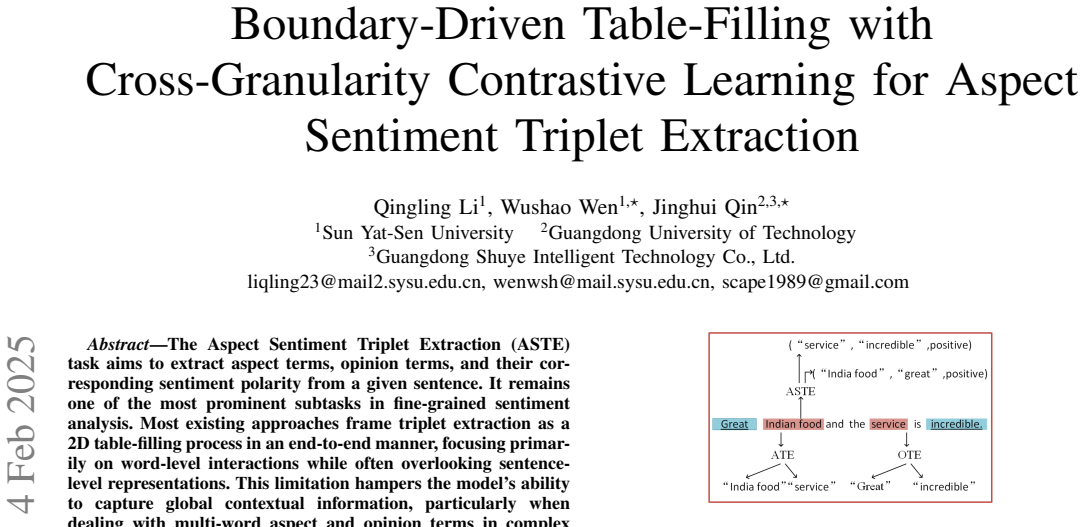
The Aspect Sentiment Triplet Extraction (ASTE) task aims to extract aspect terms, opinion terms, and their corresponding sentiment polarity from a given sentence. It remains one of the most prominent subtasks in fine-grained sentiment analysis. Most existing approaches frame triplet extraction as a 2D table-filling process in an end-to-end manner, focusing primarily on word-level interactions while often overlooking sentence-level representations. This limitation hampers the model's ability to capture global contextual information, particularly when dealing with multi-word aspect and opinion terms in complex sentences. To address these issues, we propose boundary-driven table-filling with cross-granularity contrastive learning (BTF-CCL) to enhance the semantic consistency between sentence-level representations and word-level representations. By constructing positive and negative sample pairs, the model is forced to learn the associations at both the sentence level and the word level. Additionally, a multi-scale, multi-granularity convolutional method is proposed to capture rich semantic information better. Our approach can capture sentence-level contextual information more effectively while maintaining sensitivity to local details. Experimental results show that the proposed method achieves state-of-the-art performance on public benchmarks according to the F1 score.
Figures


Reference graph
Works this paper leans on
-
[17]
Q. Li, W. Wen, and J. Qin, “Improving span-based aspect sentiment triplet extraction with part-of-speech filtering and contrastive learning,” Neural Networks, vol. 177, p. 106381, 2024
work page 2024
-
[20]
Rethinking ASTE: A Minimalist Tagging Scheme Alongside Contrastive Learning
Q. Sun, L. Yang, M. Ma, N. Ye, and Q. Gu, “Rethinking aste: A min- imalist tagging scheme alongside contrastive learning,” arXiv preprint arXiv:2403.07342, 2024
work page Pith review arXiv 2024
-
[19]
Boundary-driven table-filling for aspect sentiment triplet extrac- tion,
Y . Zhang, Y . Yang, Y . Li, B. Liang, S. Chen, Y . Dang, M. Yang, and R. Xu, “Boundary-driven table-filling for aspect sentiment triplet extrac- tion,” in Proceedings of the 2022 Conference on Empirical Methods in Natural Language Processing, 2022, pp. 6485–6498
work page 2022
-
[1]
SemEval-2014 task 4: Aspect based sentiment analysis,
M. Pontiki, D. Galanis, J. Pavlopoulos, H. Papageorgiou, I. Androutsopoulos, and S. Manandhar, “SemEval-2014 task 4: Aspect based sentiment analysis,” in Proceedings of the 8th International Workshop on Semantic Evaluation (SemEval 2014) , P. Nakov and T. Zesch, Eds. Dublin, Ireland: Association for Computational Linguistics, Aug. 2014, pp. 27–35. [Online...
work page 2014
-
[2]
SemEval-2015 task 12: Aspect based sentiment analysis,
M. Pontiki, D. Galanis, H. Papageorgiou, S. Manandhar, and I. Androutsopoulos, “SemEval-2015 task 12: Aspect based sentiment analysis,” in Proceedings of the 9th International Workshop on Semantic Evaluation (SemEval 2015) , P. Nakov, T. Zesch, D. Cer, and D. Jurgens, Eds. Denver, Colorado: Association for Computational Linguistics, Jun. 2015, pp. 486–495...
work page 2015
-
[3]
Semeval-2016 task 5: Aspect based sentiment analysis,
M. Pontiki, D. Galanis, H. Papageorgiou, I. Androutsopoulos, S. Man- andhar, M. Al-Smadi, M. Al-Ayyoub, Y . Zhao, B. Qin, O. De Clercq et al. , “Semeval-2016 task 5: Aspect based sentiment analysis,” in International workshop on semantic evaluation , 2016, pp. 19–30
2016
-
[4]
A. S. Manek, P. D. Shenoy, and M. C. Mohan, “Aspect term extraction for sentiment analysis in large movie reviews using gini index feature selection method and svm classifier,” World wide web, vol. 20, pp. 135– 154, 2017
work page 2017
-
[5]
Aspect Term Extraction with History Attention and Selective Transformation
X. Li, L. Bing, P. Li, W. Lam, and Z. Yang, “Aspect term extraction with history attention and selective transformation,” arXiv preprint arXiv:1805.00760, 2018
work page Pith review arXiv 2018
Show all 24 references
-
[6]
Exploring sequence-to- sequence learning in aspect term extraction,
D. Ma, S. Li, F. Wu, X. Xie, and H. Wang, “Exploring sequence-to- sequence learning in aspect term extraction,” in Proceedings of the 57th annual meeting of the association for computational linguistics , 2019, pp. 3538–3547
2019
-
[7]
Multi-task learning for aspect term extraction and aspect sentiment classification,
M. S. Akhtar, T. Garg, and A. Ekbal, “Multi-task learning for aspect term extraction and aspect sentiment classification,” Neurocomputing, vol. 398, pp. 247–256, 2020
2020
-
[8]
Transferable interactive memory network for domain adaptation in fine-grained opinion extraction,
W. Wang and S. J. Pan, “Transferable interactive memory network for domain adaptation in fine-grained opinion extraction,” in Proceedings of the aaai conference on artificial intelligence , vol. 33, no. 01, 2019, pp. 7192–7199
2019
-
[9]
Deep weighted maxsat for aspect- based opinion extraction,
M. Wu, W. Wang, and S. J. Pan, “Deep weighted maxsat for aspect- based opinion extraction,” in Proceedings of the 2020 conference on empirical methods in natural language processing (EMNLP) , 2020, pp. 5618–5628
2020
-
[10]
Reasoning over multiplex heterogeneous graph for target-oriented opinion words extraction,
Y . Dai, P. Wang, and X. Zhu, “Reasoning over multiplex heterogeneous graph for target-oriented opinion words extraction,” Knowledge-Based Systems, vol. 236, p. 107723, 2022
2022
-
[11]
Target-specified sequence labeling with multi-head self-attention for target-oriented opin- ion words extraction,
Y . Feng, Y . Rao, Y . Tang, N. Wang, and H. Liu, “Target-specified sequence labeling with multi-head self-attention for target-oriented opin- ion words extraction,” in Proceedings of the 2021 conference of the north american chapter of the association for computational lingui...
2021
-
[12]
Knowing what, how and why: A near complete solution for aspect-based sentiment anal- ysis,
H. Peng, L. Xu, L. Bing, F. Huang, W. Lu, and L. Si, “Knowing what, how and why: A near complete solution for aspect-based sentiment anal- ysis,” in Proceedings of the AAAI conference on artificial intelligence , vol. 34, no. 05, 2020, pp. 8600–8607
2020
-
[13]
Position-aware tagging for aspect sentiment triplet extraction,
L. Xu, H. Li, W. Lu, and L. Bing, “Position-aware tagging for aspect sentiment triplet extraction,” arXiv preprint arXiv:2010.02609 , 2020
2010 arXiv
-
[14]
A multi-task learning frame- work for opinion triplet extraction,
C. Zhang, Q. Li, D. Song, and B. Wang, “A multi-task learning frame- work for opinion triplet extraction,” arXiv preprint arXiv:2010.01512 , 2020
2010 arXiv
-
[15]
Learning span-level interactions for aspect sentiment triplet extraction,
L. Xu, Y . K. Chia, and L. Bing, “Learning span-level interactions for aspect sentiment triplet extraction,” arXiv preprint arXiv:2107.12214 , 2021
2021 arXiv
-
[16]
Grid tag- ging scheme for aspect-oriented fine-grained opinion extraction,
Z. Wu, C. Ying, F. Zhao, Z. Fan, X. Dai, and R. Xia, “Grid tag- ging scheme for aspect-oriented fine-grained opinion extraction,” arXiv preprint arXiv:2010.04640, 2020
2010 arXiv
-
[18]
Seeking common but distinguish- ing difference, a joint aspect-based sentiment analysis model,
H. Jing, Z. Li, H. Zhao, and S. Jiang, “Seeking common but distinguish- ing difference, a joint aspect-based sentiment analysis model,” arXiv preprint arXiv:2111.09634, 2021
2021 arXiv
-
[21]
Bert: Pre-training of deep bidirectional transformers for language understanding,
J. Devlin, “Bert: Pre-training of deep bidirectional transformers for language understanding,” arXiv preprint arXiv:1810.04805 , 2018
2018 arXiv
-
[22]
Enhanced multi-channel graph convolutional network for aspect sentiment triplet extraction,
H. Chen, Z. Zhai, F. Feng, R. Li, and X. Wang, “Enhanced multi-channel graph convolutional network for aspect sentiment triplet extraction,” in Proceedings of the 60th Annual Meeting of the Association for Computational Linguistics (Volume 1: Long Papers) , 2022, pp. 2974– 2985
2022
-
[23]
Bidirectional machine reading comprehension for aspect sentiment triplet extraction,
S. Chen, Y . Wang, J. Liu, and Y . Wang, “Bidirectional machine reading comprehension for aspect sentiment triplet extraction,” in Proceedings of the AAAI conference on artificial intelligence , vol. 35, no. 14, 2021, pp. 12 666–12 674
2021
-
[24]
A unified generative framework for aspect-based sentiment analysis,
H. Yan, J. Dai, X. Qiu, Z. Zhang et al., “A unified generative framework for aspect-based sentiment analysis,” arXiv preprint arXiv:2106.04300 , 2021
2021 arXiv
Reviewed August 9, 2026 · model on record in the stance chip above.
Discussion (0). Continue with ORCID to comment.