REVIEW 3 major objections 5 minor 25 references
Integrating Generative AI into Cybersecurity Education: A Study of OCR and Multimodal LLM-assisted Instruction
T0 review · 3 major / 5 minor · reviewed 2026-08-05 · deepseek-v4-flash
Pith's one-line read The paper claims a lightweight OCR-to-text LLM pipeline delivers instruction comparable to vision-language models on text-centric slides at a fraction of the cost.
desk verdict Real system integration, but the cost claim is reversed by the model choice and the pedagogical claim is under-evidenced. read the letter →
The pith
A machine-rendered reading of the paper's core claim, the machinery that carries it, and where it could break.
The reading
What carries the argument
The central mechanism is the OCR-to-LLM instruction pipeline: a Tesseract OCR layer extracts slide text, and the raw, unprocessed text is sent with a fixed prompt to a general-purpose LLM (GPT-4) in a zero-shot setting — no fine-tuning, no preprocessing — with the response returned through the CLaaS web interface. The load-bearing comparison is against a multimodal LLM (GPT-4o-mini) that receives the slide image directly, with the token-count sources the paper cites (392 vs. 1,105 tokens in the worked example) carrying the cost argument. The pipeline is triggered by an "Instruction Simplification" button in the slide front end, and student ratings on a 1–10 scale are collected through the sa
What would settle it
A controlled classroom experiment would settle it: for a text-centric lab slide, split students into two conditions — one receiving OCR-LLM simplified instructions, one receiving multimodal-LLM instructions (and a third receiving neither) — then measure task-completion accuracy or a short comprehension quiz. If the OCR-LLM group performs measurably worse on text-centric material, the comparable-pedagogical-value claim is refuted. A cheaper computational check: replicate the token-cost comparison across the full slide deck rather than the single worked example, and verify the roughly three-to-o
Extended reading notes
Core claim
On the paper's own terms, the discovery is that a zero-shot OCR-LLM pipeline is good enough to act as a real-time instructional assistant in a legacy lab platform, and that its quality gap versus multimodal models is narrow and content-dependent. On text-dominant slides (definitions, command instructions, terminal outputs), the two pipelines produced near-identical simplified instructions; where meaning is carried by annotated screenshots or dense visual layouts, the multimodal model was clearly better. The quantitative anchors are student feedback (42 ratings, mean 7.83/10) and a worked token-cost comparison: 392 tokens for the OCR route versus 1,105 for the image route on the same slide. T
Load-bearing premise
The claim of comparable pedagogical value rests on two soft proxies: the authors' own qualitative reading of generated outputs and student self-reported usefulness ratings (7.83/10), with no measured learning outcome, no control group, and no statistical test; if perceived usefulness does not track actual comprehension, the parity conclusion does not follow.
Editorial extensions
If this is right
- Legacy platforms like CLaaS can gain responsive LLM tutoring through a single button and an API call, without replacing infrastructure or retraining models.
- For text-centric slide content, institutions can avoid paying for vision-language models and still give students useful on-demand explanations; the worked example shows a roughly three-to-one token saving.
- The quality boundary is content-shaped: slides whose meaning is in the text belong to the cheap pipeline; slides whose meaning is in annotated visuals still call for multimodal models.
- The zero-shot design means the assistant can be dropped into other slide-based lab courses with no domain-specific tuning, and the collected ratings can later drive prompt personalization, a direction the authors name as future work.
- Student-perceived usefulness has preliminary support (7.83/10), which the authors treat as evidence that the assistant helps comprehension during experiential learning.
Reading between the lines
- I would extend the paper's cost argument into a routing rule the authors do not state: a trivial content classifier could decide per slide whether to pay for the multimodal path or use the OCR path, giving near-parity quality at fleet level with only occasional vision-model spend.
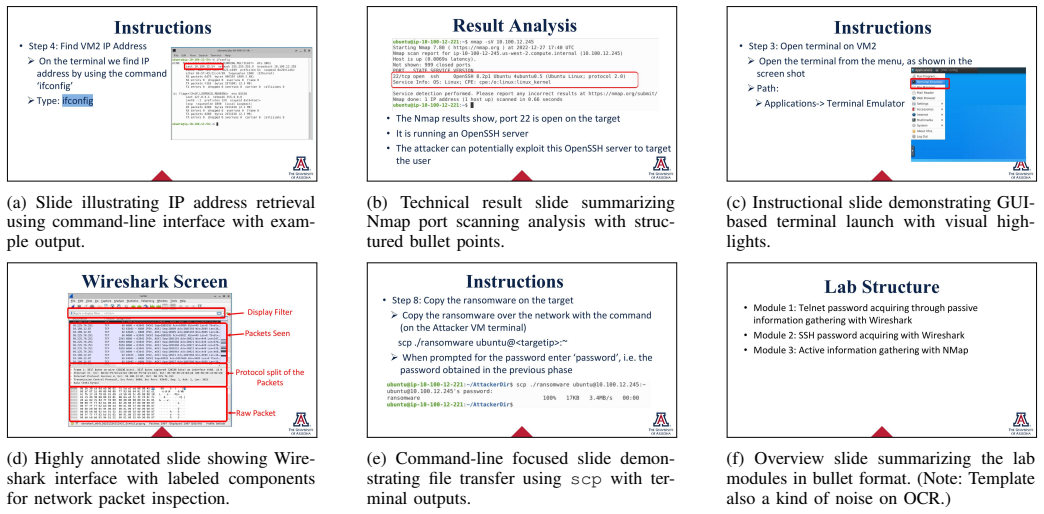
- The parity finding is most plausible for procedural lab instructions (type this command, look for "inet"), where the information is almost entirely lexical; whether it survives on conceptual slides with equations, diagrams, or code snippets is untested here — a natural next benchmark.
- The 7.83/10 rating measures perceived usefulness, not learning; the paper's claim of "pedagogical value" would be put to its real test by measuring task completion or quiz scores with and without the assistant, which the authors did not do.
- The LLM's ability to recover from garbled OCR (the paper notes it compensates via domain knowledge) suggests the robustness boundary is set more by the LLM than by OCR quality; a systematic perturbation study of OCR noise levels would map where that boundary sits.
Editorial analysis
A structured set of objections, weighed in public.
Referee Report
Summary. The paper describes the integration of a generative-AI instructional assistant into the CLaaS virtual cybersecurity lab platform. Slide images are processed with Tesseract OCR and the extracted text is sent zero-shot to GPT-4, which generates simplified instructions. A parallel comparison uses the multimodal model GPT-4o-mini on the slide images directly. The system was deployed in a university course, and 42 student ratings yielded an average of 7.83/10. The paper's central claim is that the OCR-LLM pipeline provides pedagogical value comparable to multimodal LLMs on text-centric slides, at much lower computational overhead and cost.
Significance. If the claims were established, the paper would offer a practical, low-friction way to add LLM-based assistance to legacy educational platforms. The system is genuinely deployed in a live course, uses a zero-shot approach, and requires no fine-tuning or heavy integration, which are real engineering strengths. However, the cost claim is contradicted by the actual models used, and the pedagogical-equivalence claim rests on qualitative inspection and self-reported usefulness rather than a controlled comparison. As written, the headline claims are not supported, so the study's significance is currently more as an integration case study than as a validated comparative evaluation.
major comments (3)
- [§IV-A and §IV-C, Table I] The cost comparison is invalid. Section IV-A states that the OCR pipeline uses gpt-4, while the multimodal pipeline uses gpt-4o-mini. Section IV-C/Table I compares 392 tokens vs. 1105 tokens and concludes that the OCR-based method is more cost-effective. Token counts do not determine cost; at public OpenAI pricing, gpt-4 input is roughly $30/1M tokens and gpt-4o-mini is $0.15/1M tokens. For the Table I example, the OCR pipeline would cost about $0.0118 vs. $0.00017 for the multimodal pipeline, i.e., roughly 70 times more expensive. Thus the 'much lower operational costs' claim is not only unsupported but contradicted by the presented evidence. The comparison must be redone using actual price schedules or, better, by holding the model fixed and varying only the input modality.
- [§IV-C] The assertion of 'comparable pedagogical value' is not supported by the evidence. The comparison is a qualitative inspection of outputs by the authors, with no rubric, no blind rating, no inter-rater reliability, and no quantitative measure of output quality. The tables in the appendix are illustrative, not a systematic evaluation. Student feedback in §IV-B measures perceived usefulness of the OCR pipeline only; it does not compare the two pipelines. A claim of equivalence requires an appropriate test, e.g., independent blind ratings by multiple evaluators with reported agreement, or a learning-outcome measure with a control condition. As it stands, the central comparative claim is an opinion.
- [§IV-B] The reported average feedback score of 7.83/10 from n=42 responses is presented as evidence of 'strong perceived usefulness,' but no standard deviation, response-rate information, or statistical test is given. It is unclear how many students provided how many ratings, whether ratings are per-student or per-slide, and whether the mean is meaningfully different from a neutral baseline. At minimum, descriptive statistics and a breakdown by slide/experiment are needed before this can be interpreted as a validation of the system.
minor comments (5)
- [Abstract] Typos: 'assits' and 'simplied' should be corrected; 'significantly lower overhead and operational costs' is repeated in the abstract and body.
- [§IV-C, Table I caption] The sentence 'Although the OCR result contains a lot of noise... However, LLM showed good anti-interference ability...' is duplicated verbatim in the table caption.
- [§IV-A] The dashed list item for Experiment 2 is incomplete: 'Phase 1 — Information Gathering' appears with no description, unlike Phase 2 and Phase 3.
- [§IV-C] The term 'computational overhead' is used but never measured; if overhead is to be claimed, please report latency, memory, or API throughput, not just token counts.
- [References] Reference [24] cites a web page of unknown provenance ('Ultimate GPT Calculator') as the source for image token counts; please use a primary or citable source (e.g., OpenAI documentation) for this calculation.
Circularity Check
No circular derivation; the study is an empirical deployment with weak but non-circular evidence.
full rationale
The paper does not derive its conclusions from its premises by definition. It builds a pipeline (Tesseract OCR + GPT) on the existing CLaaS platform, gathers student feedback, and qualitatively compares LLM outputs with a multimodal model. The central 'comparable pedagogical value' claim rests on self-reported ratings and the authors' qualitative inspection of LLM outputs, not on a fitted parameter or an equation; this is weak evidence but not circularity. The cost comparison in §IV-C is invalid in a different way: it compares token counts (392 vs 1105) across two different models (gpt-4 vs gpt-4o-mini) and concludes 'more cost-effective' without applying per-token prices, so the conclusion does not follow from the data. That is an evidential/logical error, not a circular reduction. Self-citations to CLaaS and prior author work provide the platform and motivation but are not load-bearing for the comparative claim; the claim would stand or fall on the new evaluation regardless of those citations. No step in the paper assumes the target result as an input, so there is no significant circularity.
Assumptions & free parameters
assumptions (3)
- domain assumption Student self-reported feedback ratings reflect pedagogical value.
- domain assumption Tesseract OCR output, despite noise, provides sufficient input for an LLM to generate helpful instructions.
- domain assumption gpt-4 and gpt-4o-mini are representative of LLM and multimodal LLM capabilities.
Cite this review
Pith. "Pith review of Integrating Generative AI into Cybersecurity Education: A Study of OCR and Multimodal LLM-assisted Instruction." pith.science (2026). https://pith.science/paper/56PJXSC3
@misc{pith2026250902998,
  author       = {Pith},
  title        = {Pith review of: Integrating Generative AI into Cybersecurity Education: A Study of OCR and Multimodal LLM-assisted Instruction},
  year         = {2026},
  howpublished = {\url{https://pith.science/paper/56PJXSC3}},
  note         = {Machine review of arXiv:2509.02998}
}
read the original abstract
This full paper describes an LLM-assisted instruction integrated with a virtual cybersecurity lab platform. The digital transformation of Fourth Industrial Revolution (4IR) systems is reshaping workforce needs, widening skill gaps, especially among older workers. With rising emphasis on robotics, automation, AI, and security, re-skilling and up-skilling are essential. Generative AI can help build this workforce by acting as an instructional assistant to support skill acquisition during experiential learning. We present a generative AI instructional assistant integrated into a prior experiential learning platform. The assistant employs a zero-shot OCR-LLM pipeline within the legacy Cybersecurity Labs-as-a-Service (CLaaS) platform (2015). Text is extracted from slide images using Tesseract OCR, then simplified instructions are generated via a general-purpose LLM, enabling real-time instructional support with minimal infrastructure. The system was evaluated in a live university course where student feedback (n=42) averaged 7.83/10, indicating strong perceived usefulness. A comparative study with multimodal LLMs that directly interpret slide images showed higher performance on visually dense slides, but the OCR-LLM pipeline provided comparable pedagogical value on text-centric slides with much lower computational overhead and cost. This work demonstrates that a lightweight, easily integrable pipeline can effectively extend legacy platforms with modern generative AI, offering scalable enhancements for student comprehension in technical education.
Figures


Reference graph
Works this paper leans on
-
[1]
DDD-GenDT: Dynamic Data-driven Generative Digital Twin Framework
Y .-Z. Lin, Q. Shi, Z. Yang, B. S. Latibari, S. Shao, S. Salehi, and P. Satam, “Ddd-gendt: Dynamic data-driven generative digital twin framework,” arXiv preprint arXiv:2501.00051 , 2024
work page Pith review arXiv 2024
-
[2]
Dt4i4- secure: Digital twin framework for industry 4.0 systems security,
Y .-Z. Lin, S. Shao, M. H. Rahman, M. Shafae, and P. Satam, “Dt4i4- secure: Digital twin framework for industry 4.0 systems security,” in 2023 IEEE 14th Annual Ubiquitous Computing, Electronics & Mobile Communication Conference (UEMCON). IEEE, 2023, pp. 0200–0209
work page 2023
-
[3]
The future of jobs report 2020,
World Economic Forum, “The future of jobs report 2020,” https://www3.weforum.org/docs/WEF Future of Jobs 2020.pdf, 2020
work page 2020
-
[4]
Reskilling and upskilling the future-ready workforce for industry 4.0 and beyond,
L. Li, “Reskilling and upskilling the future-ready workforce for industry 4.0 and beyond,”Information Systems Frontiers, vol. 26, no. 5, pp. 1697– 1712, 2024
work page 2024
-
[5]
National Science Board, “Vision 2030,” https://nsf-gov- resources.nsf.gov/nsb/publications/2020/nsb202015.pdf, 2020
-
[6]
E. Du Plooy, D. Casteleijn, and D. Franzsen, “Personalized adaptive learning in higher education: A scoping review of key characteristics and impact on academic performance and engagement,”Heliyon, vol. 10, no. 21, 2024
work page 2024
-
[7]
Y .-Z. Lin, K. Petal, A. H. Alhamadah, S. Ghimire, M. W. Redondo, D. R. V . Corona, J. Pacheco, S. Salehi, and P. Satam, “Personalized education with generative ai and digital twins: Vr, rag, and zero- shot sentiment analysis for industry 4.0 workforce development,” arXiv preprint arXiv:2502.14080, 2025
-
[8]
Claas: Cybersecurity lab as a service–design, analysis, and evaluation,
C. Tunc, S. Hariri, F. D. L. P. Montero, F. Fargo, and P. Satam, “Claas: Cybersecurity lab as a service–design, analysis, and evaluation,” in 2015 International Conference on Cloud and Autonomic Computing . IEEE, 2015, pp. 224–227
work page 2015
Show all 25 references
-
[9]
Cps-tr: An online training platform to address fourth industrial revolution workforce needs,
P. Satam, C. Philipp, S. Shao, and S. Salehi, “Cps-tr: An online training platform to address fourth industrial revolution workforce needs,” in 2023 IEEE Integrated STEM Education Conference (ISEC) . IEEE, 2023, pp. 271–276
2023
-
[10]
Generative ai,
S. Feuerriegel, J. Hartmann, C. Janiesch, and P. Zschech, “Generative ai,” Business & Information Systems Engineering , vol. 66, no. 1, pp. 111–126, 2024
2024
-
[11]
Generative ai and chatgpt: Applications, challenges, and ai-human collaboration,
F. Fui-Hoon Nah, R. Zheng, J. Cai, K. Siau, and L. Chen, “Generative ai and chatgpt: Applications, challenges, and ai-human collaboration,” pp. 277–304, 2023
2023
-
[12]
Chatgpt for good? on opportunities and challenges of large language models for education,
E. Kasneci, K. Seßler, S. K ¨uchemann, M. Bannert, D. Dementieva, F. Fischer, U. Gasser, G. Groh, S. G ¨unnemann, E. H ¨ullermeier et al. , “Chatgpt for good? on opportunities and challenges of large language models for education,” Learning and individual differences , vol. 10...
2023
-
[13]
Board 45: Generative artificial intelligence (gai)-assisted learning: Pushing the boundaries of engineering education
I. S. Osunbunmi, S. Cutler, V . Dansu, Y . Brijmohan, B. R. Bamidele, A. N. Udosen, L. C. Arinze, A. V . Oje, D. Moyaki, M. J. Hicks et al., “Board 45: Generative artificial intelligence (gai)-assisted learning: Pushing the boundaries of engineering education.” in 2024 ASEE An...
2024
-
[14]
Simulating classroom education with llm-empowered agents,
Z. Zhang, D. Zhang-Li, J. Yu, L. Gong, J. Zhou, Z. Hao, J. Jiang, J. Cao, H. Liu, Z. Liu et al. , “Simulating classroom education with llm-empowered agents,” arXiv preprint arXiv:2406.19226 , 2024
2024 arXiv
-
[15]
Can large language models be an alterna- tive to human evaluations?
C.-H. Chiang and H.-y. Lee, “Can large language models be an alterna- tive to human evaluations?” arXiv preprint arXiv:2305.01937 , 2023
2023 arXiv
-
[16]
Exploring the use of large language models (llms) in chemical engineering education: Building core course problem models with chat-gpt,
M.-L. Tsai, C. W. Ong, and C.-L. Chen, “Exploring the use of large language models (llms) in chemical engineering education: Building core course problem models with chat-gpt,” Education for Chemical Engineers, vol. 44, pp. 71–95, 2023
2023
-
[17]
Prism: A personalized, rapid, and immersive skill mastery framework for personalizing experiential learning through generative ai,
Y .-Z. Lin, K. Patel, A. H. J. Alhamadah, B. P.-J. Shih, M. W. Redondo, D. R. V . Corona, B. S. Latibari, J. Pacheco, S. Salehi, and P. Satam, “Prism: A personalized, rapid, and immersive skill mastery framework for personalizing experiential learning through generative ai,” J...
2024 doi
-
[18]
Photogrammetry for digital twin- ning industry 4.0 (i4) systems,
A. Alhamadah, M. Mamun, H. Harms, M. Redondo, Y .-Z. Lin, J. Pacheco, S. Salehi, and P. Satam, “Photogrammetry for digital twin- ning industry 4.0 (i4) systems,” in 2024 IEEE/ACS 21st International Conference on Computer Systems and Applications (AICCSA) . IEEE, 2024, pp. 1–6
2024
-
[19]
“chatgpt can make mistakes. check im- portant info
M. Urban, C. Brom, J. Lukavsk ´y, F. D ˇechtˇerenko, V . Hein, F. Svacha, P. Kmon´ıˇckov´a, and K. Urban, ““chatgpt can make mistakes. check im- portant info.” epistemic beliefs and metacognitive accuracy in students’ integration of chatgpt content into academic writing,” Brit...
2025 doi
-
[20]
Enhancing self- regulated learning and learning experience in generative ai environments: The critical role of metacognitive support,
X. Xu, L. Qiao, N. Cheng, H. Liu, and W. Zhao, “Enhancing self- regulated learning and learning experience in generative ai environments: The critical role of metacognitive support,” British Journal of Educa- tional Technology, 2025, doi:10.1111/bjet.13599
2025 doi
-
[21]
An overview of the tesseract ocr engine,
R. Smith, “An overview of the tesseract ocr engine,” in Ninth interna- tional conference on document analysis and recognition (ICDAR 2007) , vol. 2. IEEE, 2007, pp. 629–633
2007
-
[22]
The dawn of lmms: Preliminary explorations with gpt-4v (ision),
Z. Yang, L. Li, K. Lin, J. Wang, C.-C. Lin, Z. Liu, and L. Wang, “The dawn of lmms: Preliminary explorations with gpt-4v (ision),” arXiv preprint arXiv:2309.17421, vol. 9, no. 1, p. 1, 2023
2023 arXiv
-
[23]
Openai’s tokenizer platform,
OpenAI, “Openai’s tokenizer platform,” https://platform.openai.com/tokenizer, 2025, accessed: 2025-04-14
2025
-
[24]
Ultimate gpt calculator,
paxhumana.io, “Ultimate gpt calculator,” https://ultimategptcalculator.com/vision, 2025, accessed: 2025-04- 14
2025
-
[25]
Openrag: Open-source retrieval-augmented generation archi- tecture for personalized learning,
R. Shan, “Openrag: Open-source retrieval-augmented generation archi- tecture for personalized learning,” in 2024 4th International Confer- ence on Artificial Intelligence, Robotics, and Communication (ICAIRC) . IEEE, 2024, pp. 212–216. APPENDIX A LLM- ASSISTED INSTRUCTION RESU...
2024
Reviewed August 5, 2026 · model on record in the stance chip above.
Discussion (0). Sign in to comment.