Improving the Predictive Capability of the Fission Reaction Event Yield Algorithm (mathtt{FREYA})
Pith reviewed 2026-06-27 20:07 UTC · model grok-4.3
The pith
Genetic algorithm optimization determines better FREYA parameters for thermal neutron-induced fission of U and Pu isotopes.
A machine-rendered reading of the paper's core claim, the machinery that carries it, and where it could break.
Core claim
The central claim is that a genetic algorithm can systematically improve the parameters of the FREYA complete-event fission model. The authors first revisit and improve prior parameter values for spontaneous fission, then apply the same optimization to thermal neutron-induced fission of the listed isotopes, replacing empirical choices. The resulting parameter sets are used to predict observables outside the fit data, as the first step toward studying fission as a function of incident neutron energy and capturing energy-dependent trends in the physics-based parameters.
What carries the argument
The genetic algorithm that tunes the physics-based parameters of the FREYA complete event fission model.
If this is right
- Predictions for spontaneous and thermal neutron-induced fission observables not included in the fits become available with the tuned parameters.
- The same optimization procedure can be repeated for fission at higher incident neutron energies.
- Energy-dependent trends in the FREYA parameters can be identified and incorporated.
- Overall performance of the model improves for the studied isotopes.
Where Pith is reading between the lines
- The approach could be tested on other isotopes or fission modes to check whether the genetic algorithm consistently finds transferable parameters.
- If the parameters show clear energy dependence in later work, that dependence might be parameterized explicitly rather than re-optimized for each energy.
- Comparison with independent fission models could reveal whether the improvements are specific to FREYA or reflect broader features of fission physics.
Load-bearing premise
The optimized parameters remain valid when transferred from spontaneous fission to thermal neutron-induced fission and generalize to observables not used in the fits.
What would settle it
An experimental measurement of one of the unfitted fission observables that deviates significantly from the prediction obtained with the optimized FREYA parameters.
Figures
read the original abstract
We determine the optimal parameters for thermal neutron-induced fission of $^{233,235}$U and $^{239,241}$Pu in the complete event fission model $\mathtt{FREYA}$. First, we revisit and, in most cases, improve the prior values determined for spontaneous fission using a genetic algorithm. Our optimization procedure is then applied to thermal neutron-induced fission, replacing the empirically-chosen parameters previously employed in $\mathtt{FREYA}$. Finally, the optimized parameter values are used to make predictions for spontaneous and thermal neutron-induced fission observables not included in the fits. This work represents the first step in a broader program to study neutron-induced fission as a function of incident neutron energy, to systematically improve the performance of $\mathtt{FREYA}$, capturing any energy-dependent trends of the physics-based $\mathtt{FREYA}$ parameters.
Editorial analysis
A structured set of objections, weighed in public.
Referee Report
Summary. The paper uses a genetic algorithm to revisit and improve FREYA parameters for spontaneous fission, then applies the same optimization procedure to determine new parameters for thermal neutron-induced fission of 233,235U and 239,241Pu. The resulting parameter sets are used to generate predictions for spontaneous and thermal-neutron-induced fission observables that were not included in the fits; the work is positioned as the first step toward an energy-dependent study of neutron-induced fission.
Significance. If the optimization procedure is robust and the out-of-sample predictions are demonstrably independent, the work would provide a systematic, reproducible route to improved FREYA parameters and could strengthen the model's utility for fission-yield calculations in applications. The explicit use of a genetic algorithm and the separation of fit and prediction observables are positive features that would support reproducibility if fully documented.
major comments (2)
- [Abstract] Abstract: the central claim that optimized parameters are used for predictions on observables 'not included in the fits' rests on unshown optimization results; no information is given on convergence criteria, the fitness function, uncertainty quantification, or sensitivity to the choice of fitted data, all of which are required to evaluate whether the predictions are independent and generalizable.
- [Abstract] Abstract: the transfer of physics-based FREYA parameters from spontaneous fission to thermal neutron-induced fission is assumed without shown validation or discussion of possible energy-dependent trends; this assumption is load-bearing for the claim that the same parameter set can be applied across the two regimes.
minor comments (2)
- [Abstract] The abstract states that prior spontaneous-fission values are 'in most cases' improved but provides no quantitative measure of improvement or comparison table.
- Notation for the nuclei (^{233,235}U and ^{239,241}Pu) is clear, but the manuscript should ensure consistent use of the exttt{FREYA} font throughout.
Simulated Author's Rebuttal
We thank the referee for the constructive report and the recommendation for major revision. The comments focus on the need for greater transparency in the abstract regarding the optimization details and the handling of parameter applicability across fission regimes. We respond to each point below and have revised the manuscript to incorporate additional information and discussion.
read point-by-point responses
-
Referee: [Abstract] Abstract: the central claim that optimized parameters are used for predictions on observables 'not included in the fits' rests on unshown optimization results; no information is given on convergence criteria, the fitness function, uncertainty quantification, or sensitivity to the choice of fitted data, all of which are required to evaluate whether the predictions are independent and generalizable.
Authors: The abstract is necessarily concise, but the full manuscript (Sections 2 and 3) details the genetic algorithm, the fitness function (a chi-squared metric combining multiple fission observables with appropriate weights), convergence criteria (stabilization of the best fitness value across successive generations with a patience threshold), and the specific data sets used for fitting versus prediction. To make these elements more immediately accessible and to directly address concerns about generalizability, we have expanded the abstract with a brief clause on the optimization framework and added a dedicated paragraph in the methods section describing uncertainty quantification through parameter ensemble variations and sensitivity tests to the inclusion/exclusion of individual fitted observables. These additions confirm that the held-out predictions remain independent of the fit data. revision: yes
-
Referee: [Abstract] Abstract: the transfer of physics-based FREYA parameters from spontaneous fission to thermal neutron-induced fission is assumed without shown validation or discussion of possible energy-dependent trends; this assumption is load-bearing for the claim that the same parameter set can be applied across the two regimes.
Authors: The manuscript does not transfer parameters from spontaneous fission to the thermal-neutron-induced cases. Instead, the genetic algorithm is applied independently to determine new parameter sets for thermal neutron-induced fission of each isotope, replacing the prior empirically chosen values; the spontaneous-fission re-optimization serves only to benchmark the algorithm against established results. The physics-based nature of the FREYA parameters motivates the expectation of limited energy dependence near thermal energies, but we agree that explicit discussion strengthens the presentation. The revised manuscript includes a new subsection addressing this point, noting consistency checks between spontaneous and thermal predictions on overlapping observables and outlining the planned extension to incident-energy dependence. revision: partial
Circularity Check
No significant circularity
full rationale
The described procedure optimizes FREYA parameters via genetic algorithm on a set of spontaneous fission observables, transfers the values to thermal neutron-induced cases, and then generates predictions exclusively for observables explicitly stated as not included in the fits. This is a standard calibration-plus-held-out-validation workflow with no equations or steps that reduce by construction to the inputs (no self-definitional relations, no fitted quantities renamed as predictions, and no load-bearing self-citations or uniqueness theorems invoked). The central claim rests on external data and out-of-sample testing rather than internal tautology, making the derivation self-contained against benchmarks.
Axiom & Free-Parameter Ledger
free parameters (1)
- FREYA physics-based parameters
axioms (1)
- domain assumption FREYA model structure correctly captures fission physics
Reference graph
Works this paper leans on
-
[1]
Based on this hypothesis, Bohr and Wheeler [47] formulated the the- ory of nuclear fission employing the liquid drop model of the nucleus
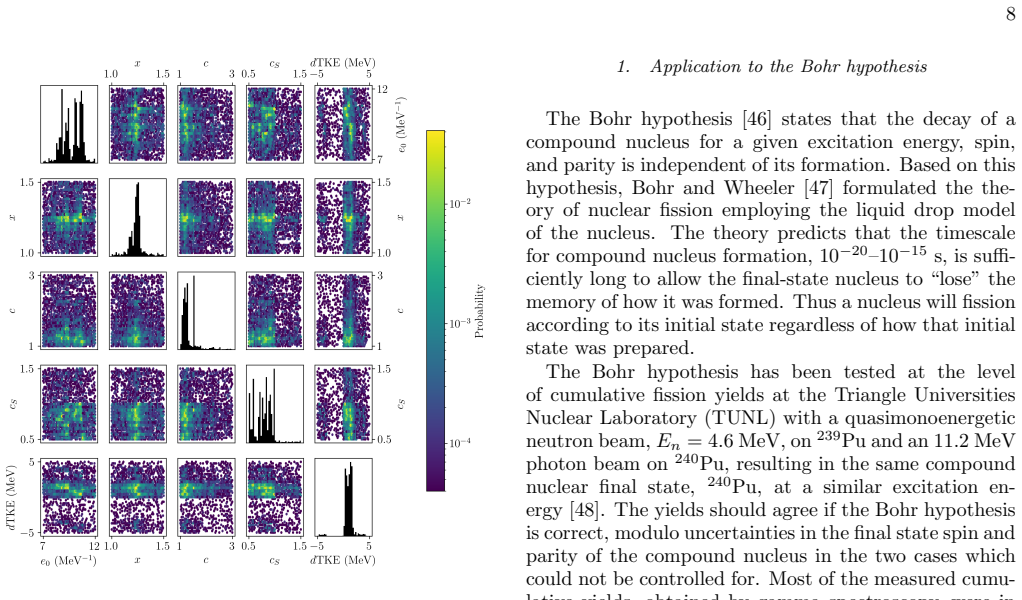
Application to the Bohr hypothesis The Bohr hypothesis [46] states that the decay of a compound nucleus for a given excitation energy, spin, and parity is independent of its formation. Based on this hypothesis, Bohr and Wheeler [47] formulated the the- ory of nuclear fission employing the liquid drop model of the nucleus. The theory predicts that the time...
-
[2]
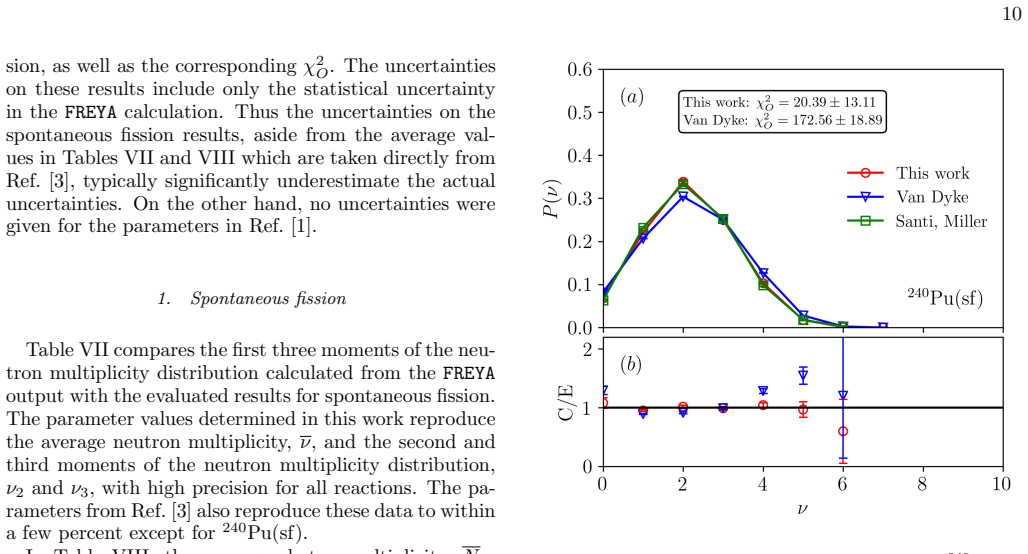
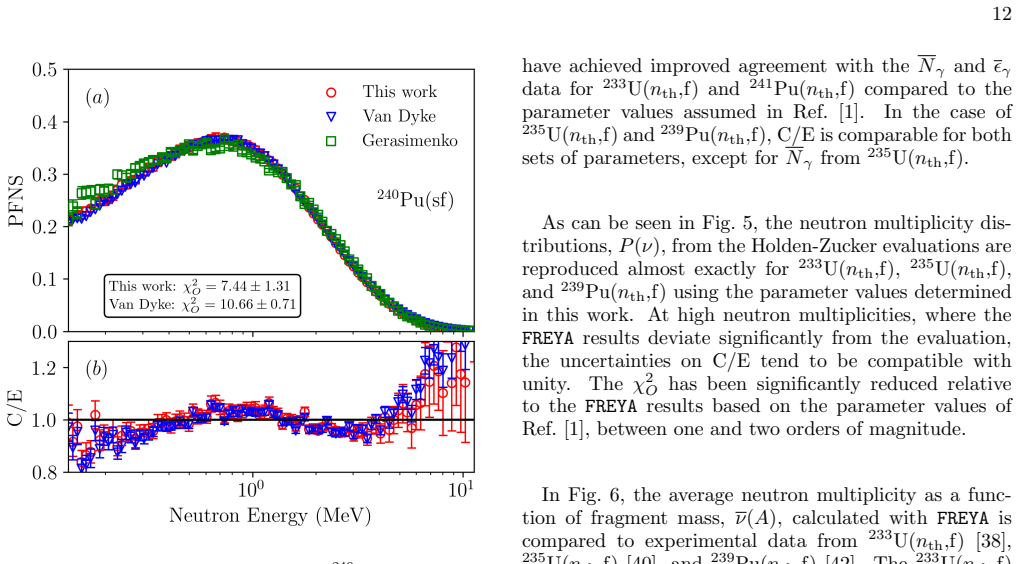
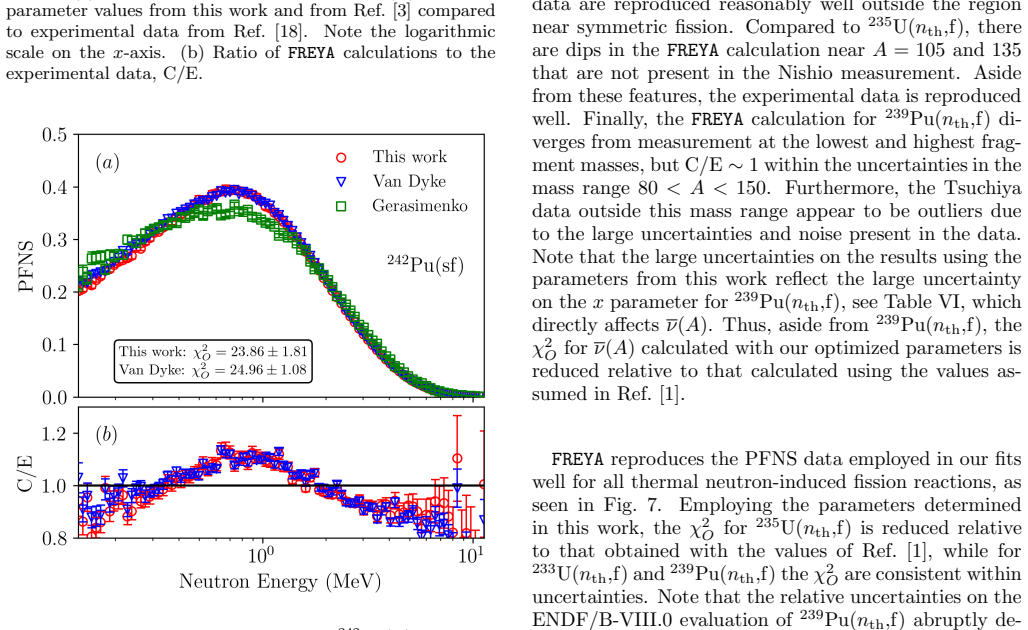
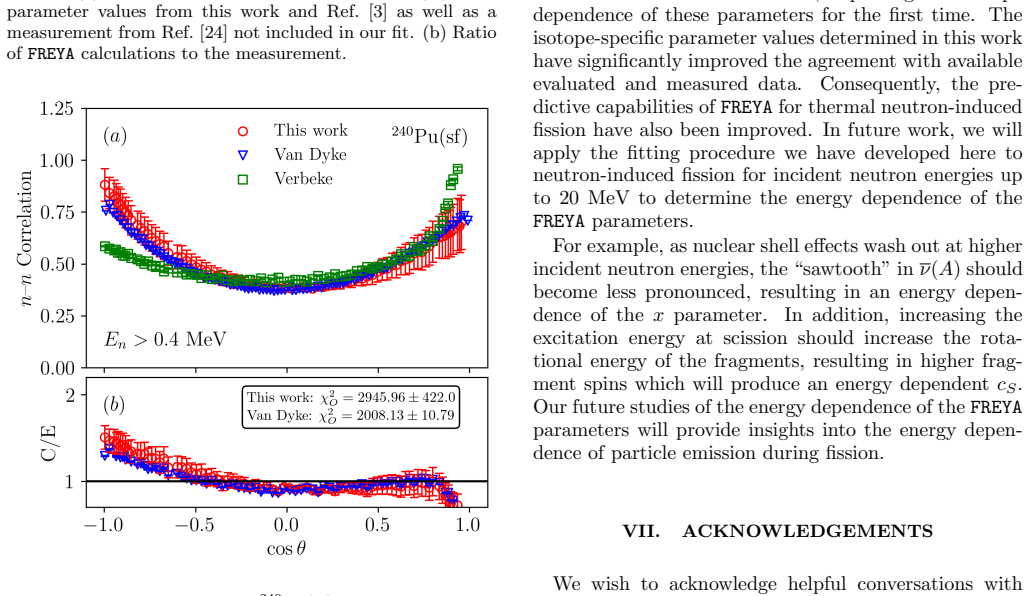
Spontaneous fission Table VII compares the first three moments of the neu- tron multiplicity distribution calculated from theFREYA output with the evaluated results for spontaneous fission. The parameter values determined in this work reproduce the average neutron multiplicity, ν, and the second and third moments of the neutron multiplicity distribution, ...
-
[3]
sawtooth
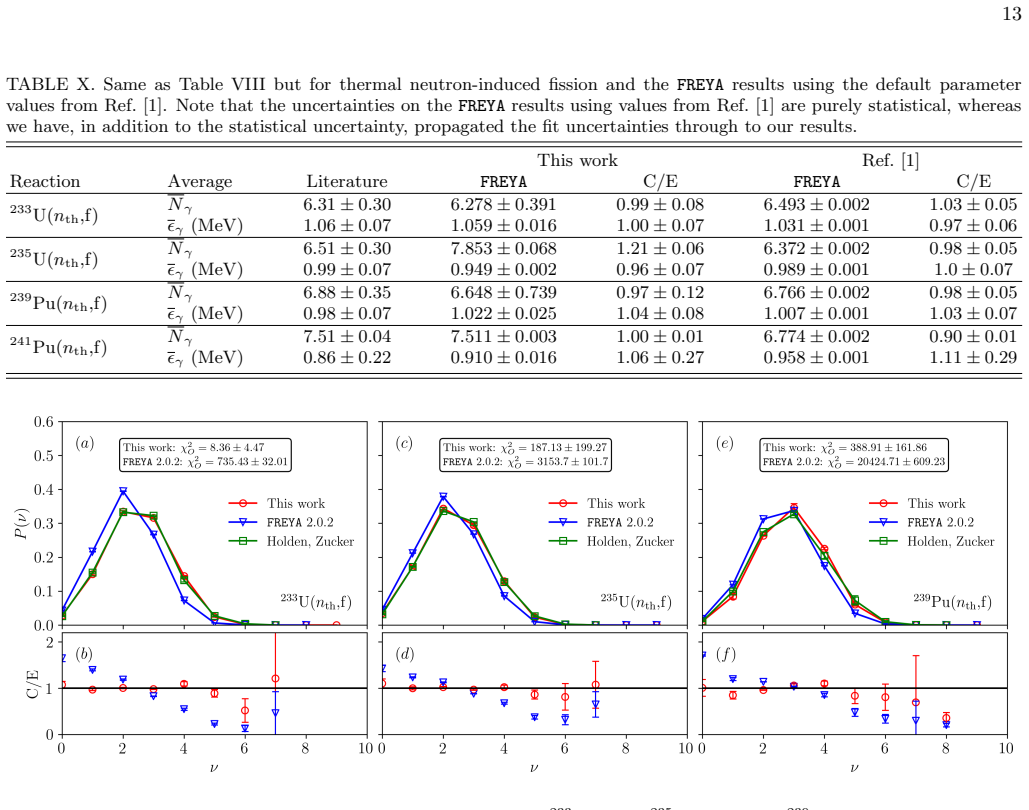
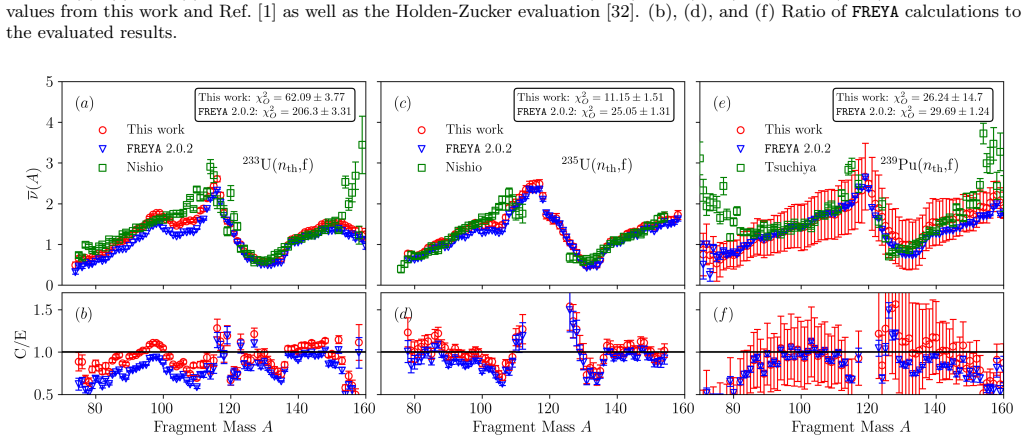
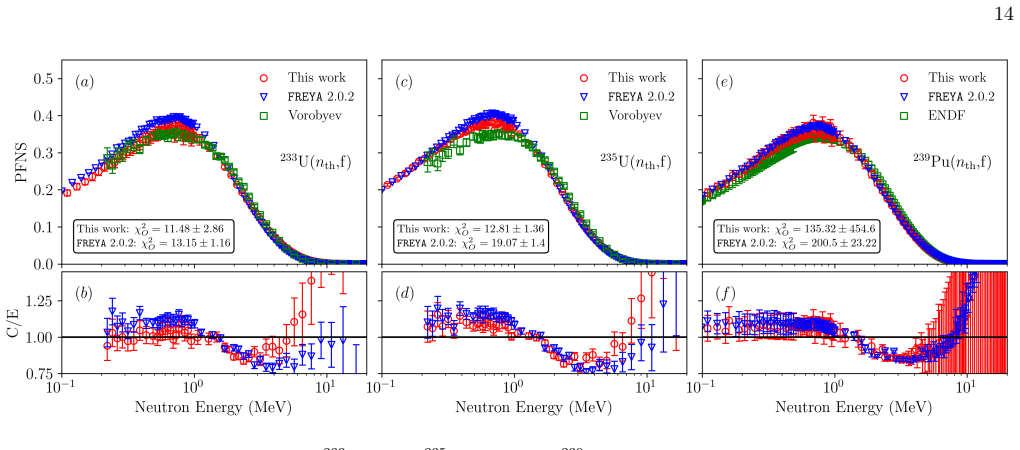
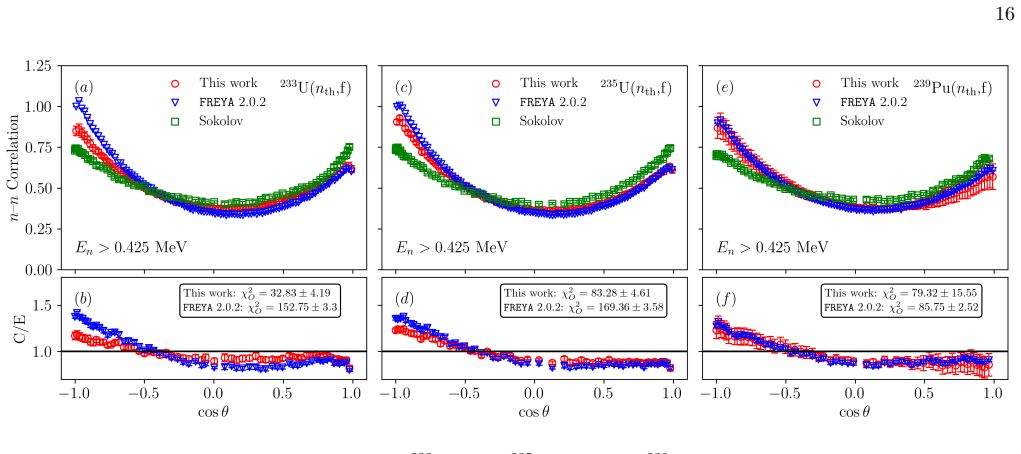
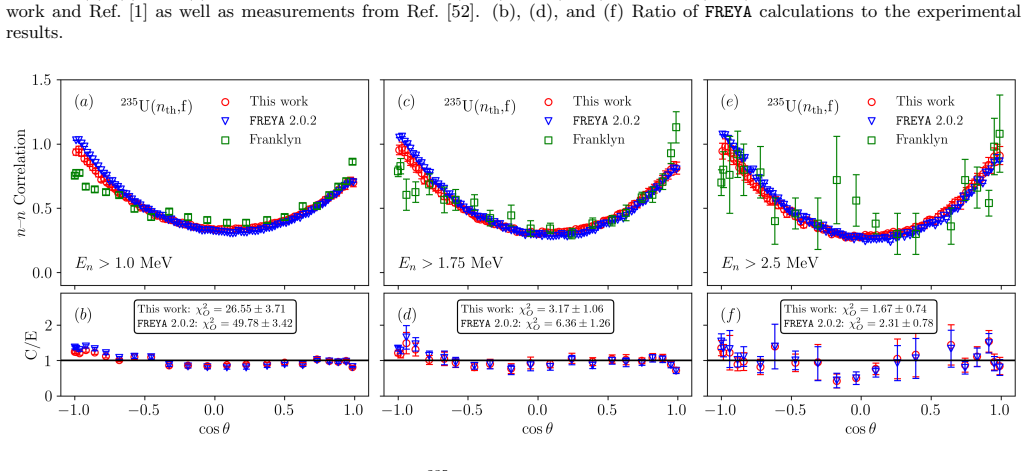
Thermal neutron-induced fission We now turn to thermal neutron-induced fission of 233,235U and 239,241Pu, the primary new results of this work. Table IX compares the first three moments of the neutron multiplicity distribution calculated from the FREYAoutput with evaluated and experimental results, where applicable, for thermal neutron-induced fission. Th...
-
[4]
J. M. Verbeke, J. Randrup, and R. Vogt, Fission reaction event yield algorithmFREYA2.0.2, Comp. Phys. Comm. 222, 263 (2018)
2018
-
[5]
Talouet al., Correlated Prompt Fission Data in Transport Simulations, Eur
P. Talouet al., Correlated Prompt Fission Data in Transport Simulations, Eur. Phys. J. A54, 9 (2018), arXiv:1710.00107 [nucl-th]
Pith/arXiv arXiv 2018
-
[6]
Van Dyke, L
J. Van Dyke, L. Bernstein, and R. Vogt, Parameter op- timization and uncertainty analysis ofFREYAfor sponta- neous fission, Nucl. Instrum. Meth. A922, 36 (2019)
2019
-
[7]
Kirkpatrick, C
S. Kirkpatrick, C. D. Gelatt, and M. P. Vecchi, Optimiza- tion by simulated annealing, Science220, 671 (1983)
1983
-
[8]
A. Bjelˇ c´ ıc, N. Schunck, and M. Verriere, Excitation en- 21 TABLE B.1. The optimizedFREYAparameters and their correspondingχ 2 for 252Cf(sf) using different sets of genetic algorithm hyperparameters. (p, k, c, m, Dmin, g)e 0 (MeV−1)x c c S dTKE (MeV)χ 2 (50,3,0.80,1/f,0.20f,50) 10.430±0.496 1.260±0.006 1.185±0.021 0.890±0.064 0.508±0.293 483.05±24.63 (...
arXiv 2026
-
[9]
R. Vogt, J. Randrup, D. A. Brown, M. A. Descalle, and W. E. Ormand, Event-by-event evaluation of the prompt fission neutron spectrum from 239Pu(n,f), Phys. Rev. C 85, 024608 (2012), arXiv:1105.4655 [nucl-th]
Pith/arXiv arXiv 2012
-
[10]
Bohr and B
A. Bohr and B. R. Mottelson,Nuclear Structure, vol. 1 (Benjamin, NY, USA, 1969)
1969
-
[11]
Sepiani and M
M. Sepiani and M. N. Nasrabadi, Evidence on the high energy behavior of nuclear level density parameter, Phys. Scr.99, 015302 (2023)
2023
-
[12]
Randrup and R
J. Randrup and R. Vogt, Refined treatment of angular momentum in the event-by-event fission modelFREYA, Phys. Rev. C89, 044601 (2014)
2014
-
[13]
Randrup, T
J. Randrup, T. Døssing, and R. Vogt, Probing fission fragment angular momenta by photon measurements, Phys. Rev. C106, 014609 (2022)
2022
-
[14]
Nishio, Y
K. Nishio, Y. Nakagome, H. Yamamoto, and I. Kimura, Multiplicity and energy of neutrons from 235U(nth,f) fis- sion fragments, Nucl. Phys. A632, 540 (1998), [Erratum: Nucl. Phys. A637, 601 (1998)]
1998
-
[15]
A. S. Vorobyev, V. N. Dushin, F. Hambsch, V. A. Jakovlev, V. A. Kalinin, A. B. Laptev, B. F. Petrov, and O. A. Shcherbakov, Distribution of prompt neutron emis- sion probability for fission fragments in spontaneous fis- sion of 252Cf and 244,248Cm, AIP Conference Proceedings 769, 613 (2005), https://pubs.aip.org/aip/acp/article- pdf/769/1/613/11897884/613...
2005
-
[16]
R. Vogt and J. Randrup, Improved modeling of photon observables with the event-by-event fission modelFREYA, Phys. Rev. C96, 064620 (2017), arXiv:1708.07312 [nucl- th]
Pith/arXiv arXiv 2017
-
[17]
D. E. Goldberg,Genetic Algorithms in Search, Optimiza- tion, and Machine Learning(Addison–Wesley Longman Publishing Co., Inc., Boston, MA, USA, 1989)
1989
-
[18]
Santi and M
P. Santi and M. Miller, Reevaluation of prompt neutron emission multiplicity distributions for spontaneous fis- sion, Nucl. Sci. Eng.160, 190 (2008)
2008
-
[19]
Chyzh, C
A. Chyzh, C. Y. Wu, E. Kwan, R. A. Henderson, J. M. Gostic, T. A. Bredeweg, R. C. Haight, A. C. Hayes- Sterbenz, M. Jandel, J. M. O’Donnell, and J. L. Ullmann, Evidence for the stochastic aspect of promptγemission in spontaneous fission, Phys. Rev. C85, 021601 (2012)
2012
-
[20]
Oberstedt, A
S. Oberstedt, A. Oberstedt, A. Gatera, A. G¨ o¨ ok, F.- J. Hambsch, A. Moens, G. Sibbens, D. Vanleeuw, and M. Vidali, Prompt fissionγ-ray spectrum characteristics from 240Pu(sf) and 242Pu(sf), Phys. Rev. C93, 054603 (2016)
2016
-
[21]
Gerasimenko, L
B. Gerasimenko, L. Drapchinsky, O. Kostochkin, T. Kuzmina, N. Skovorodkin, and V. Trenkin, Precision measurements of prompt neutron spectra in 240Pu and 242Pu spontaneous fission, J. Nucl. Sci. Tech.39, 362 (2002)
2002
-
[22]
Schmidt and H
R. Schmidt and H. Henschel, Comparison of the sponta- neous fission of 244Cm and 252Cf: (II). Prompt neutron emission, Nuclear Physics A395, 29 (1983)
1983
-
[23]
Boykov, B
G. Boykov, B. Gerasimenko, V. Dmitriev, L. Drapchin- sky, O. Kostochkin, K. Petrzhak, B. Shiryaev, and V. Trenkin, Precision prompt neutron spectrum measure- ments of minor actinides for transmutation problem, in Conference Proceedings-Italian Physical Society, Vol. 59 (Editrice Compositori, 1997) pp. 1310–1312
1997
-
[24]
Dushin, F.-J
V. Dushin, F.-J. Hambsch, V. Jakovlev, V. Kalinin, I. Kraev, A. Laptev, D. Nikolaev, B. Petrov, G. Petrov, V. Petrova, Y. Pleva, O. Shcherbakov, V. Shpakov, V. Sokolov, A. Vorobyev, and T. Zavarukhina, Facility for neutron multiplicity measurements in fission, Nucl. Instrum. Meth. A516, 539 (2004)
2004
-
[25]
Budtz-Jørgensen and H.-H
C. Budtz-Jørgensen and H.-H. Knitter, Simultaneous in- vestigation of fission fragments and neutrons in252Cf(sf), Nuclear Physics A490, 307 (1988)
1988
-
[26]
Mannhart, Evaluation of the 252Cf fission neutron spectrum between 0 MeV and 20 MeV, Properties of Neutron Sources (Proc
W. Mannhart, Evaluation of the 252Cf fission neutron spectrum between 0 MeV and 20 MeV, Properties of Neutron Sources (Proc. Advisory Group Mtg. Neutron Sources, IAEA-TECDOC-410) , p. 158–171. (1987)
1987
-
[27]
A. M. Gagarski, I. S. Guseva, V. E. Sokolov, G. V. Val’ski, G. A. Petrov, D. O. Krinitsin, D. V. Nikolaev, T. A. Zavarukhina, and V. I. Petrova, Neutron-neutron angular correlations in spontaneous fission of 252Cf, Bul- letin of the Russian Academy of Sciences: Physics72, 773 (2008)
2008
-
[28]
J. M. Verbeke, L. F. Nakae, and R. Vogt, Neutron- neutron angular correlations in spontaneous fission of 252Cf and 240Pu, Phys. Rev. C97, 044601 (2018)
2018
-
[29]
Hambsch and S
F.-J. Hambsch and S. Oberstedt, Investigation of the far asymmetric region in 252Cf(sf), Nuclear Physics A617, 347 (1997)
1997
-
[30]
Schmidt and H
R. Schmidt and H. Henschel, Comparison of the sponta- neous fission of 244Cm and 252Cf: (I). Fragment masses and kinetic energies, Nuclear Physics A395, 15 (1983)
1983
-
[31]
T. R. England and B. F. Rider,Evaluation and Compi- lation of Fission Product Yields, Tech. Rep. LA-UR-94- 3106 (Los Alamos National Laboratory, 1985)
1985
-
[32]
Schillebeeckx, C
P. Schillebeeckx, C. Wagemans, A. J. Deruytter, and R. Barth´ el´ emy, Comparative study of the fragments’ mass and energy characteristics in the spontaneous fus- sion of 238Pu, 240Pu and 242Pu and in the thermal- neutron-induced fission of 239Pu, Nucl. Phys. A545, 623 (1992). 22
1992
-
[33]
Ivanov, G
M. Ivanov, G. Ter-Akopian, B. Fefilov, and A. Voronin, Study of 238U spontaneous fission using a double ioniza- tion chamber, Nucl. Instrum. Meth. A234, 152 (1985)
1985
-
[34]
K. H. Schmidtet al., GEF 2024/1.1, OECD Nuclear En- ergy Agency,https://www.khschmidts-nuclear-web. eu/GEF.html(2025)
2024
-
[35]
N. E. Holden and M. S. Zucker, Prompt neutron emis- sion multiplicity distribution and average values (nubar) at 2200 m/s for the fissile nuclides, Nuclear Science and Engineering98, 174 (1988)
1988
-
[36]
O. A. Akindele, B. S. Alan, J. T. Harke, R. J. Casper- son, R. O. Hughes, J. D. Koglin, K. Kolos, E. B. Norman, S. Ota, and A. Saastamoinen, Expansion of the surrogate method to measure the prompt fission neutron multiplic- ity for 241Pu, Phys. Rev. C99, 054601 (2019)
2019
-
[37]
Pleasonton, Promptγ-rays emitted in the thermal- neutron induced fission of 233U and 239Pu, Nucl
F. Pleasonton, Promptγ-rays emitted in the thermal- neutron induced fission of 233U and 239Pu, Nucl. Phys. A213, 413 (1973)
1973
-
[38]
Pleasonton, R
F. Pleasonton, R. L. Ferguson, and H. W. Schmitt, Prompt gamma rays emitted in the thermal-neutron- induced fission of 235U, Phys. Rev. C6, 1023 (1972)
1972
-
[39]
Chyzh, C
A. Chyzh, C. Y. Wu, E. Kwan, R. A. Henderson, T. A. Bredeweg, R. C. Haight, A. C. Hayes-Sterbenz, H. Y. Lee, J. M. O’Donnell, and J. L. Ullmann, Total prompt γ-ray emission in fission of 235U, 239,241Pu, and 252Cf, Phys. Rev. C90, 014602 (2014)
2014
-
[40]
Capote, Y.-J
R. Capote, Y.-J. Chen, F.-J. Hambsch, N. Kornilov, J. Lestone, O. Litaize, B. Morillon, D. Neudecker, S. Oberstedt, T. Ohsawa, N. Otuka, V. Pronyaev, A. Sax- ena, O. Serot, O. Shcherbakov, N.-C. Shu, D. Smith, P. Talou, A. Trkov, A. Tudora, R. Vogt, and A. Vorobyev, Prompt fission neutron spectra of actinides, Nuclear Data Sheets131, 1 (2016), Special Iss...
2016
-
[41]
Nishio, M
K. Nishio, M. Nakashima, I. Kimura, and Y. Nakagome, Multi-parametric measurement of prompt neutrons and fission fragments for 233U(nth, f), J. Nucl. Sci. Tech.35, 631 (1998)
1998
-
[42]
Oberstedt, T
A. Oberstedt, T. Belgya, R. Billnert, R. Borcea, T. Bry´ s, W. Geerts, A. G¨ o¨ ok, F.-J. Hambsch, Z. Kis, T. Martinez, S. Oberstedt, L. Szentmiklosi, K. Tak` acs, and M. Vidali, Improved values for the characteristics of prompt-fission γ-ray spectra from the reaction 235U(nth,f), Phys. Rev. C87, 051602 (2013)
2013
-
[43]
Nishio, Y
K. Nishio, Y. Nakagome, H. Yamamoto, and I. Kimura, Multiplicity and energy of neutrons from 235U(nth,f) fis- sion fragments, Nucl. Phys. A632, 540 (1998)
1998
-
[44]
A. S. Vorobyev, O. A. Shcherbakov, Y. S. Pleva, A. M. Gagarski, G. V. Val’ski, G. A. Petrov, V. I. Petrova, and T. A. Zavarukhina, Measurements of angular and energy distributions of prompt neutrons from thermal neutron- induced fission, Nucl. Instrum. Meth. A598, 795 (2009)
2009
-
[45]
Tsuchiya, Y
C. Tsuchiya, Y. Nakagome, H. Yamana, H. Moriyama, K. Nishio, I. Kanno, K. Shin, and I. Kimura, Simulta- neous measurement of prompt neutrons and fission frag- ments for 239Pu(nth,f), J. Nucl. Sci.Tech.37, 941 (2000)
2000
-
[46]
D. A. Brownet al., ENDF/B-VIII.0: The 8th major re- lease of the nuclear reaction data library with CIELO project cross sections, new standards and thermal scat- tering data, Nucl. Data Sheets148, 1 (2018), Special Issue on Nuclear Reaction Data
2018
-
[47]
Nishio, Y
K. Nishio, Y. Nakagome, I. Kanno, and I. Kimura, Mea- surement of fragment mass dependent kinetic energy and neutron multiplicity for thermal neutron induced fission of 239Pu, J. Nucl. Sci. Tech.32, 404 (1995)
1995
-
[48]
V. F. Apalin, Y. N. Gritsyuk, I. E. Kutikov, V. I. Lebe- dev, and L. A. Mikaelian, Neutron emission from 233U, 235U and 239Pu fission fragments, Nucl. Phys.71, 553 (1965)
1965
-
[49]
Bohr, Neutron Capture and Nuclear Constitution, Na- ture137, 344 (1936)
N. Bohr, Neutron Capture and Nuclear Constitution, Na- ture137, 344 (1936)
1936
-
[50]
Bohr and J
N. Bohr and J. A. Wheeler, The Mechanism of nuclear fission, Phys. Rev.56, 426 (1939)
1939
-
[51]
Silano, A
J. Silano, A. Tonchev, R. Henderson, N. Schunck, W. Tornow, C. Howell, Krishichayan, and S. Finch, Val- idating the Bohr hypothesis: Comparing fission-product yields from photon-induced fission of 240Pu and neutron- induced fission of Pu, EPJ Web Conf.239, 03004 (2020)
2020
-
[52]
J. M. Muelleret al., Prompt neutron polarization asym- metries in photofission of 232Th, 233,235,238U, 237Np, and 239,240Pu, Phys. Rev. C89, 034615 (2014)
2014
-
[53]
S. D. Clarkeet al., Measurement of the energy and mul- tiplicity distributions of neutrons from the photofission of 235U, Phys. Rev. C95, 064612 (2017)
2017
-
[54]
Gjestvanget al., Excitation energy dependence of prompt fissionγ-ray emission from 241Pu∗, Phys
D. Gjestvanget al., Excitation energy dependence of prompt fissionγ-ray emission from 241Pu∗, Phys. Rev. C103, 034609 (2021)
2021
-
[55]
V. Sokolovet al., Investigations of the angular depen- dences of neutron-neutron coincidences from 252Cf, 235U, 233U and 239Pu fission in search of scission neutrons, in XVIII International Seminar on Interaction of Neutrons with Nuclei(2010) p. 108
2010
-
[56]
Vogt and J
R. Vogt and J. Randrup, Neutron angular correlations in spontaneous and neutron-induced fission, Phys. Rev. C 90, 064623 (2014)
2014
-
[57]
Franklyn, C
C. Franklyn, C. Hofmeyer, and D. Mingay, Angular cor- relation of neutrons from thermal-neutron fission of 235U, Physics Letters B78, 564 (1978)
1978
-
[58]
J. N. Wilsonet al., Angular momentum generation in nuclear fission, Nature590, 566 (2021)
2021
-
[59]
J. Randrup and R. Vogt, Generation of Fragment Angu- lar Momentum in Fission, Phys. Rev. Lett.127, 062502 (2021), arXiv:2103.14778 [nucl-th]
arXiv 2021
-
[60]
Albertsson, B
M. Albertsson, B. G. Carlsson, T. Døssing, P. M¨ oller, J. Randrup, and S. ˚Aberg, Excitation energy partition in fission, Phys. Lett. B803, 135276 (2020)
2020
-
[61]
M. Sipper, W. Fu, K. Ahuja, and J. Moore, Investigating the parameter space of evolutionary algorithms, BioData Mining11, 10.1186/s13040-018-0164-x (2018)
discussion (0)
Sign in with ORCID, Apple, or X to comment. Anyone can read and Pith papers without signing in.