REVIEW 2 major objections 4 minor 34 references
Under MCAR, a flow-matching model trained by averaging losses over fresh draws from the true completion conditional has exactly the same population objective as if the data were complete; all missing-data difficulty relocates to the complet
Reviewed by Pith at T0; open to challenge. T0 means a machine referee read the full paper against a public rubric. the ladder, T0–T4 →
Resampling missing coordinates and averaging the flow-matching loss reproduces the complete-data objective exactly under MCAR with oracle completions; one completion per example is optimal for a fixed budget.
T0 review reviewed 2026-08-03 challenge →
load-bearing objection Oracle equivalence is a tower-property observation, but the finite-sample variance results are genuinely new and useful; the real soft spot is the learned-completion premise, which the paper flags but never verifies. the 2 major comments →
Flow Matching with Missing Data
The pith
A machine-rendered reading of the paper's core claim, the machinery that carries it, and where it could break.
The reading
Core claim
The central claim is Theorem 4.2: for every parameter theta, under MCAR and a mild regularity condition, the oracle missing-data objective LMDFM(theta) equals the complete-data objective LFM(theta). Here LMDFM averages the standard flow-matching per-sample loss over the observed pattern, the observed coordinates, completions drawn from the true conditional p*(.|X_Lambda), base points, and times. Because equal functions have equal derivatives, the expected gradients agree wherever both are differentiable. The correction is therefore exact, not an approximation or a consistency statement: missingness merely relocates the hard problem to estimating the conditional completion law. The paper also
What carries the argument
The central object is the oracle missing-data flow-matching objective LMDFM(theta) = E_Lambda E_X_Lambda E_{X_-Lambda ~ p*(.|X_Lambda)} E_{X0,T} ell_theta(X0, (X_Lambda, X_-Lambda), T). The load-bearing identities are the tower property, which collapses the inner completion average to E[g_theta(X)|X_lambda] and then to LFM(theta) under MCAR; the law of total variance, which splits the estimator variance into between-observation, base-Monte-Carlo, and completion terms and yields the transfer identity; and Kantorovich-Rubinstein duality, which converts the learned-completion bias into a Wasserstein-1 distance. Together they show that the incomplete-data loss is the same function of theta as th
Load-bearing premise
The load-bearing premise is that the completion model q_phi is close to the true conditional law of missing coordinates given observed ones; if it is not, the exact equivalence degrades by at most L_g times the expected conditional Wasserstein distance, and under MNAR the required posterior is generally not identifiable from observed data at all.
What would settle it
On MCAR Gaussian data with closed-form conditionals, train MDFM with a deliberately shifted completion model, such as a conditional mean plus a fixed non-zero vector, and measure |L_phi - L_FM| at a frozen theta. If the gap does not stay below L_g times the expected W1 distance between q_phi and p*, or if deterministic conditional-mean imputation does not collapse generated conditional variance toward zero, the paper's proposed mechanism is not what is actually driving the results.
If this is right
- Under MCAR with oracle completions, the population objective and expected gradients of flow matching are unchanged by missingness, so the learning target is exactly what it would be with complete data.
- Missingness transfers estimator variance into the completion-averaging term rather than adding total variance; one completion per example already matches the complete-data one-sample variance.
- Under a fixed evaluation budget measured in loss evaluations, K=1 is optimal; additional completions help only when the number of incomplete examples is held fixed.
- A learned completion model contributes one irreducible bias, bounded by L_g times its expected conditional Wasserstein distance to the true completion law; beyond a moderate sample size, only a better completion model reduces the error.
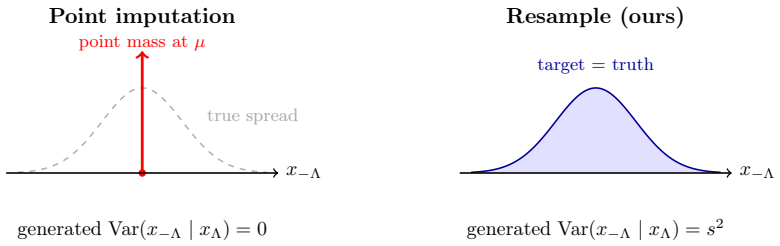
- Deterministic imputation collapses the generated conditional spread, while any stochastic completion strategy, fresh or frozen, preserves it.
Where Pith is reading between the lines
- Because the correction is an equality of objectives rather than a consistency argument, the same resampling construction should extend to any endpoint-based generative training whose regression target becomes explicit once the endpoint is completed, such as rectified-flow variants, without new approximation error.
- The bias bound singles out conditional calibration rather than marginal accuracy as the quantity that matters for the final generative objective; a natural testable extension is to train the completion model with a strictly proper scoring rule and check whether the population objective gap follows the predicted Wasserstein scaling.
- The paper's appendix shows that under MNAR the naive objective is a reweighted complete-data objective with weight w(x)=sum_lambda pi_bar_lambda(x_lambda); this suggests a concrete extension: model the missingness mechanism explicitly and feed the tilted posterior r*_Lambda into the same loss, which should remove the observed gap if the mechanism model is correct.
- The fixed-budget variance formula implies that in data-rich regimes the design choice is always K=1, so the practical bottleneck for applying MDFM is the cost and calibration of the completion model, not the flow-matching training loop itself.
Editorial analysis
A structured set of objections, weighed in public.
Referee Report
Summary. The paper proposes Missing-Data Flow Matching (MDFM): when training flow matching on incomplete data under MCAR, the missing coordinates of each endpoint are treated as latent variables and are drawn from a completion model before the standard flow-matching loss is evaluated. The main theoretical results are: (i) with oracle completions drawn from the true conditional, the incomplete-data population objective equals the complete-data objective (Theorem 4.2), and the same holds for MAR; (ii) a finite-sample variance decomposition showing that missingness transfers rather than adds variance, that one oracle completion per example matches complete-data variance, and that under a fixed evaluation budget K=1 is optimal (Theorem 5.1, Corollary 5.2); (iii) a worst-case bound on the completion-variance term in terms of the expected missing fraction (Theorem 5.5); (iv) Bernstein-type concentration for the estimator (Theorem 5.6); and (v) a bound on the bias of a learned completion model in terms of its expected conditional Wasserstein distance to the true posterior (Lemma 5.7). The paper also reports synthetic and real-data experiments. The theory is explicitly scoped to fixed-θ loss estimation, and the authors state that a guarantee connecting loss estimation to trained-field quality remains open.
Significance. If the results stand, the paper makes a clean and useful contribution: it shows exact rather than asymptotic correction of the flow-matching objective under MCAR, gives design rules for the number of completions, and quantifies the cost of an imperfect imputer through a transport bound. The proofs are elementary and correct, and the paper is unusually honest about scope, explicitly limiting the theory to fixed-θ scalar loss estimators and noting the open problem of trained-field guarantees. The variance decomposition is checked by two independent estimation routes, and the looseness of the worst-case bound is reported rather than hidden. The main weakness is that the practical learned-completion pipeline is bridged to the oracle theory by an assumption that self-supervised masking trains qφ to the needed conditionals; this is asserted but not proved, and the identifiability condition offered is not verified in the real-data experiments.
major comments (2)
- [§4.3, §5.3, App. D.7] The learned-completion construction is the bridge from the oracle theorems to the method actually run, but no statement in the paper guarantees that self-supervised masking trains qφ to the conditionals needed at evaluation. Lemma 5.7 bounds the bias by L_g E_O W1(qφ, r⋆), and if qφ is far from r⋆ the bound is vacuous. The only identifiability condition offered is P(Λ=[d])>0 (Sec. 5.3), and App. D.7 gives no concrete weaker conditions for the model classes used. The real-data masking is repaired only so that no row and no column is fully missing; whether fully observed rows are present at each missing rate is not reported, and at high ρ finite samples can contain none. Without full observations, marginal pattern laws need not identify the joint law, so the practical 'exact correction' is not supported. Please either prove identifiability/consistency for the mask-conditioned completion mo
- [§5.4 vs. Abstract] The abstract and introduction state that 'missingness changes nothing about what flow matching learns', which a reader will naturally read as a guarantee about the trained vector field. Section 5.4 explicitly limits all theoretical results to fixed-θ scalar loss estimators and says a guarantee connecting loss estimation to the generated distribution remains open. The abstract should be amended to include that limitation, otherwise the central claim is over-stated.
minor comments (4)
- [Cor. 5.2, Eq. (4)] If τ²_θ=0, the variance is independent of K; the claim 'one completion is optimal' should be phrased as 'at least as good as any K', not strictly optimal.
- [App. E.1] The phrase 'no row and no column is fully missing' is ambiguous between 'no row is all-missing' and 'no row is fully observed'. Please clarify and report the number of fully observed rows per dataset and missing rate, since the identifiability condition in Sec. 5.3 depends on this.
- [Table 1] The real-data ranking would be stronger with standard errors or a significance test; with five seeds and seven datasets, 'best on covariance preservation' is plausible but not statistically established.
- [Theorem 5.6 / App. C.7] The bounded-loss assumption (Assumption C.1) is introduced only in the appendix; a one-sentence statement in the main text near Theorem 5.6 would avoid surprising readers who use a Gaussian base.
Circularity Check
No significant circularity: the oracle equivalence and variance claims follow from probability identities, and the experimental checks use independently estimated quantities.
full rationale
The paper's central equivalence (Theorem 4.2) is a direct mathematical consequence of the definitions: LMDFM is the expectation of the flow-matching loss with the missing part drawn from the true conditional, and under MCAR averaging that conditional over the observed pattern reconstructs the complete-data law p⋆, so the tower property gives equality with LFM. No parameter is fitted to make the equality hold, and the proof does not assume the conclusion. The finite-sample variance decomposition (Theorem 5.1, Corollary 5.2) is derived from the law of total variance, with the K=1 identity following from the fact that a single fresh oracle completion is marginally a complete-data draw; this is structural rather than circular. The learned-completion bias bound (Lemma 5.7) is an application of Kantorovich–Rubinstein duality and does not presuppose that qφ is close to the true posterior. The paper also explicitly flags the genuine load-bearing limitation of the learned pipeline: exactness for the learned objective requires observed-pattern marginals to identify the joint law, and the stated sufficient condition P(Λ=[d])>0 is not met in the real-data runs where no row is fully observed (Sec. 5.3, App. D.7). That is an unproven identifiability premise, not a circularity. The experiments take care to estimate variance components and the estimator variance by independent routes (App. E.4), so their agreement is a real check rather than a restatement. There are no load-bearing self-citations, imported uniqueness theorems, or fitted predictions disguised as derivations. Overall, the derivation chain is self-contained and no claim reduces to its own input.
Axiom & Free-Parameter Ledger
free parameters (1)
- L_g (Lipschitz constant of g_theta) =
estimated from sampled pairs in Appendix E.6
axioms (8)
- domain assumption MCAR: M is independent of X, and each pattern Lambda has positive probability; observed part follows the true marginal.
- standard math Assumption 4.1: regular conditional distributions exist, p0 and p* have finite second moment, v_theta is measurable and square integrable.
- domain assumption Assumption 5.3: every coordinate lies in [-R, R].
- domain assumption Assumption 5.4: endpoint loss g_theta is L_g-Lipschitz on a convex set containing all relevant endpoint supports.
- ad hoc to paper Assumption C.1: 0 <= ell_theta <= B almost surely; in practice a compactly supported base distribution.
- domain assumption Learned completion model q_phi is fitted on an independent auxiliary sample and frozen before flow training.
- domain assumption Identifiability: observed-pattern marginals identify the joint law within the chosen model class (e.g., P(Lambda=[d]) > 0).
- standard math Standard probabilistic tools: tower property, law of total variance, Popoviciu's inequality, Bernstein's inequality, Kantorovich-Rubinstein duality, McShane extension.
Cite this review
Pith. "Pith review of Flow Matching with Missing Data." pith.science (2026). https://pith.science/paper/57UAEOJI
@misc{pith2026260728698,
  author       = {Pith},
  title        = {Pith review of: Flow Matching with Missing Data},
  year         = {2026},
  howpublished = {\url{https://pith.science/paper/57UAEOJI}},
  note         = {Machine review of arXiv:2607.28698}
}
read the original abstract
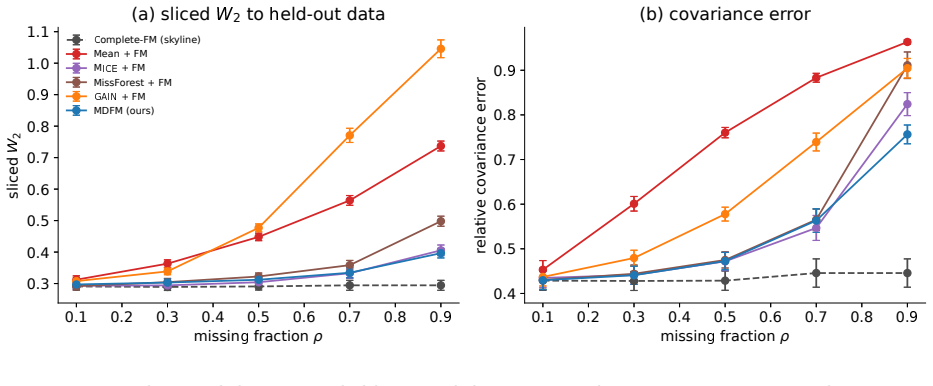
Flow matching assumes fully observed training data, which many real-world applications rarely provide. We propose Missing-Data Flow Matching, which treats the missing coordinates of training samples as latent variables and averages the flow matching loss over the values they could take. We first prove the correction is exact rather than approximate. Under missing completely at random with true completions, the incomplete-data objective equals the complete-data objective, so missingness changes nothing about what flow matching learns and the entire difficulty relocates to the completion model. Our finite-sample analysis then answers design questions that the algorithm leaves open, and the answers are not the ones intuition suggests. Missingness transfers estimator variance rather than adding it, one completion per example already matches complete-data variance exactly, and under a fixed evaluation budget one completion is optimal. A learned completion model contributes a single irreducible bias, which we bound by its expected conditional Wasserstein distance to the true completion law. Experiments numerically validate the theoretical predictions, show that deterministic rather than frozen imputation is what collapses the generated distribution, and place our method alongside strong classical and deep imputation baselines on real tabular data.
Figures


Reference graph
Works this paper leans on
-
[1]
The Eleventh International Conference on Learning Representations , year=
Flow Matching for Generative Modeling , author=. The Eleventh International Conference on Learning Representations , year=
-
[2]
Transactions on Machine Learning Research , year=
Improving and generalizing flow-based generative models with minibatch optimal transport , author=. Transactions on Machine Learning Research , year=
-
[3]
Biometrika , volume=
Inference and missing data , author=. Biometrika , volume=. 1976 , publisher=
1976
-
[4]
International Conference on Machine Learning , pages=
Score Matching with Missing Data , author=. International Conference on Machine Learning , pages=. 2025 , organization=
2025
-
[5]
2013 , publisher=
Concentration Inequalities: A Nonasymptotic Theory of Independence , author=. 2013 , publisher=
2013
-
[6]
Popoviciu, Tiberiu , journal=. Sur les
-
[7]
arXiv preprint arXiv:2506.09258 , year=
Cfmi: Flow matching for missing data imputation , author=. arXiv preprint arXiv:2506.09258 , year=
-
[8]
Advances in neural information processing systems , volume=
Neural ordinary differential equations , author=. Advances in neural information processing systems , volume=
-
[9]
The Eleventh International Conference on Learning Representations , year=
Flow Straight and Fast: Learning to Generate and Transfer Data with Rectified Flow , author=. The Eleventh International Conference on Learning Representations , year=
-
[10]
The Eleventh International Conference on Learning Representations , year=
Building Normalizing Flows with Stochastic Interpolants , author=. The Eleventh International Conference on Learning Representations , year=
-
[11]
2009 , publisher=
Optimal transport: old and new , author=. 2009 , publisher=
2009
-
[12]
Journal of the American statistical Association , volume=
Strictly proper scoring rules, prediction, and estimation , author=. Journal of the American statistical Association , volume=. 2007 , publisher=
2007
-
[13]
arXiv preprint arXiv:1412.6980 , year=
Adam: A method for stochastic optimization , author=. arXiv preprint arXiv:1412.6980 , year=
-
[14]
Journal of the royal statistical society: series B (methodological) , volume=
Maximum likelihood from incomplete data via the EM algorithm , author=. Journal of the royal statistical society: series B (methodological) , volume=. 1977 , publisher=
1977
-
[15]
Advances in neural information processing systems , volume=
Denoising diffusion probabilistic models , author=. Advances in neural information processing systems , volume=
-
[16]
International Conference on Learning Representations , year=
Score-Based Generative Modeling through Stochastic Differential Equations , author=. International Conference on Learning Representations , year=
-
[17]
Journal of statistical software , volume=
mice: Multivariate imputation by chained equations in R , author=. Journal of statistical software , volume=
-
[18]
Bioinformatics , volume=
MissForest—non-parametric missing value imputation for mixed-type data , author=. Bioinformatics , volume=. 2012 , publisher=
2012
-
[19]
International conference on machine learning , pages=
MIWAE: Deep generative modelling and imputation of incomplete data sets , author=. International conference on machine learning , pages=. 2019 , organization=
2019
-
[20]
International conference on machine learning , pages=
Gain: Missing data imputation using generative adversarial nets , author=. International conference on machine learning , pages=. 2018 , organization=
2018
-
[21]
Advances in neural information processing systems , volume=
Csdi: Conditional score-based diffusion models for probabilistic time series imputation , author=. Advances in neural information processing systems , volume=
-
[22]
International conference on artificial intelligence and statistics , pages=
Generating and imputing tabular data via diffusion and flow-based gradient-boosted trees , author=. International conference on artificial intelligence and statistics , pages=. 2024 , organization=
2024
-
[23]
7th International Conference on Learning Representations, ICLR 2019 , year=
Variational autoencoder with arbitrary conditioning , author=. 7th International Conference on Learning Representations, ICLR 2019 , year=
2019
-
[24]
International Conference on Learning Representations , year=
Misgan: Learning from incomplete data with generative adversarial networks , author=. International Conference on Learning Representations , year=
-
[25]
International Conference on Machine Learning , pages=
Acflow: Flow models for arbitrary conditional likelihoods , author=. International Conference on Machine Learning , pages=. 2020 , organization=
2020
-
[26]
2019 , publisher=
Statistical analysis with missing data , author=. 2019 , publisher=
2019
-
[27]
, author=
Estimation of non-normalized statistical models by score matching. , author=. Journal of Machine Learning Research , volume=
-
[28]
2007 , publisher=
UCI machine learning repository , author=. 2007 , publisher=
2007
-
[29]
arXiv preprint arXiv:2307.00467 , year=
Missdiff: Training diffusion models on tabular data with missing values , author=. arXiv preprint arXiv:2307.00467 , year=
-
[30]
Advances in Neural Information Processing Systems , volume=
Ambient diffusion: Learning clean distributions from corrupted data , author=. Advances in Neural Information Processing Systems , volume=
-
[31]
International conference on learning representations , year=
AmbientGAN: Generative models from lossy measurements , author=. International conference on learning representations , year=
-
[32]
International Conference on Machine Learning , pages=
Hyperimpute: Generalized iterative imputation with automatic model selection , author=. International Conference on Machine Learning , pages=. 2022 , organization=
2022
-
[33]
1987 , publisher=
Multiple Imputation for Nonresponse in Surveys , author=. 1987 , publisher=
1987
-
[34]
arXiv preprint arXiv:2006.12871 , year=
not-MIWAE: Deep generative modelling with missing not at random data , author=. arXiv preprint arXiv:2006.12871 , year=
Pith/arXiv arXiv 2006
This paper was first reviewed by deepseek-v4-flash on August 3, 2026.
discussion (0)
Sign in with ORCID, Apple, or X to comment. Anyone can read and Pith papers without signing in.