REVIEW 4 major objections 5 minor 37 references
Thermally activated magnetization reversal in a FeCoB nanomagnet. High-precision measurement method of coercive field, delta, retention time and size of nucleation domain
T0 review · 4 major / 5 minor · reviewed 2026-08-14 · deepseek-v4-flash
Pith's one-line read The paper claims that the logarithm of the magnetization switching time is a straight-line function of the applied perpendicular field, and that fitting this line yields coercive field, retention time, thermal-stability factor $\Delta$…
desk verdict Useful high-precision switching-time method for single nanomagnets, but the nucleation-domain-size inference leans on an unverified field-independent attempt frequency and a circular confirmation plot. read the letter →
The pith
A machine-rendered reading of the paper's core claim, the machinery that carries it, and where it could break.
The reading
What carries the argument
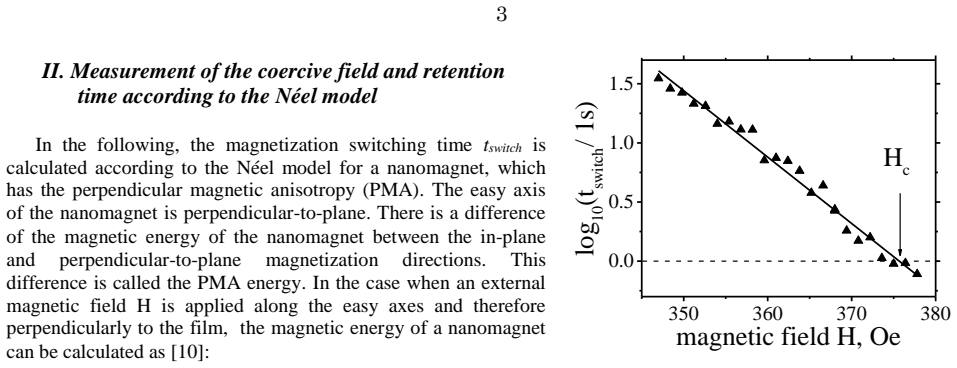
The central object is the Arrhenius relation written as a straight line: $\log_{10}(t_{\mathrm{switch}})=\log_{10}(\tau_{\mathrm{retention}})-(M/kT)H$. The slope $M/kT$ converts a measured waiting-time curve into the magnetic moment of the nucleating region; the intercept is the zero-field retention time; the point where the line crosses the $t_{\mathrm{switch}}=1$ s level is the coercive field; and the thermal-stability factor $\Delta$ is obtained by combining the slope with the anisotropy field $H_{\mathrm{anis}}$ measured in a separate magnetostatic experiment. This one identity carries all four extracted parameters, so the measurement reduces to fitting two numbers.
What would settle it
Directly image the nucleation domain in the same FeCoB nanomagnet by time-resolved XMCD while measuring $t_{\mathrm{switch}}(H)$, and compare the imaged domain volume with the value from Eq. (17); agreement to within the claimed 3 nm would support the slope-to-moment conversion, while a mismatch would show that the slope is not set by the Zeeman energy of that domain alone. Similarly, measuring $t_{\mathrm{switch}}(H)$ over a much wider field range would expose any field-dependent prefactor as curvature in $\log t_{\mathrm{switch}}$.
Extended reading notes
Core claim
The core discovery is that for the measured FeCoB/FeB nanomagnets, the average switching time obeys $\log_{10}(t_{\mathrm{switch}})=\log_{10}(\tau_{\mathrm{retention}})-(M/kT)H$ over the studied range, with $M$ the moment of the region that nucleates reversal. From the linear fit, the field-axis intercept at $t_{\mathrm{switch}}=1$ s defines the coercive field $H_c$; the time-axis intercept defines the retention time $\tau_{\mathrm{retention}}$; the slope gives $M$, from which the nucleation-domain volume is obtained using the independently measured saturation magnetization; and the thermal-stability factor $\Delta$ follows from the same slope together with the anisotropy field $H_{\mathrm{anis}}$. The paper reports fitted precisions of about 0.6 Oe for $H_c$, 2% for $\Delta$, and 3 nm for the effective nucleation-domain size, and shows that the extracted parameters change linearly with gate voltage (the VCMA effect) and with bias-current polarity and magnitude (the SOT effect). It concludes that the classical N\'eel model, with only two free parameters, fully describes non-resonance thermally activated switching.
Load-bearing premise
The extracted nucleation-domain size assumes that the slope of the switching-time plot is exactly the magnetic moment of one unchanging nucleation region divided by $kT$, with the attempt frequency and prefactor unaffected by the field; the paper gives no independent check of that separation.
Editorial extensions
If this is right
- A single waiting-time-versus-field scan per nanomagnet determines $H_c$, $\tau_{\mathrm{retention}}$, $\Delta$, and nucleation-domain size at once, with no ramp-rate correction.
- Because only two parameters define the line, the N\'eel model's two-parameter description can be tested directly: data that stay linear support it, while curvature would signal resonance-type or non-Arrhenius behavior.
- For VCMA studies, a voltage scan changes the intercept but not the slope, indicating that the gate voltage leaves the nucleation-domain size unchanged while shifting the coercive field and retention time.
- For SOT studies, reversing the bias-current polarity changes the slope, so the extracted nucleation-domain size itself becomes current-dependent.
- The method can distinguish single-domain from nucleation-domain reversal when the extracted domain size approaches the nanomagnet size, identifying the critical size where the reversal mechanism changes.
Reading between the lines
- If the slope-to-moment identification survives an independent check, the method turns any setup that can time single switching events into a domain-size probe without direct magnetic imaging.
- The same straight-line analysis could be applied to current- or voltage-induced switching by replacing the perpendicular field with the effective field from the current or voltage, provided that field enters only through the Zeeman term.
- The observed sample-to-sample spread in nucleation-domain size (about 20 to 90 nm) suggests that defects set the nucleation site; if that is causal, controlled defect patterning could stabilize or shrink domain sizes, a prediction this measurement could test directly.
Editorial analysis
A structured set of objections, weighed in public.
Referee Report
Summary. The paper proposes a measurement method for thermally activated magnetization switching in FeCoB nanomagnets. For each applied perpendicular field, the switching time is measured repeatedly, and the logarithm of the mean switching time is fitted as a linear function of field. From the fitted slope and intercept the authors extract the coercive field (at a 1 s convention), the retention time, the thermal-stability parameter Δ, and the size of the assumed nucleation domain. The method is demonstrated on Hall-probe devices, and the extracted parameters are studied as functions of gate voltage (VCMA) and bias current (SOT). The paper argues that the observed linearity confirms the classical Néel model with two free parameters.
Significance. If the central extraction is valid, the method is attractively simple: it avoids the systematic timing errors of pulsed or ramped-field methods and gives access to a nucleation-domain volume without imaging. The extraction of Hc and retention time from the linear fit is structurally sound under the stated small-field approximation, and the independent measurement of Hanis for Δ is a good practice. However, the paper's most distinctive quantitative claim — the 3 nm precision of the nucleation-domain size — depends on an unverified identification of the fitted slope with the Zeeman moment of the nucleation region, and the Fig. 5 'confirmation' is partly circular. The precision claims are also not backed by an error budget. The contribution is therefore promising but needs substantial strengthening before the domain-size and model-validation conclusions can be accepted.
major comments (4)
- [§IV, Eq. (17)] The conversion of the fitted slope S = d log10(tswitch)/dH into a nucleation-domain volume assumes that the attempt frequency f0 in Eq. (11) is strictly field-independent and that the field enters the switching rate only through the Zeeman energy of the nucleation region. A prefactor of the form f0(H) = A exp(αH) would change the observed slope to S = M_domain/(kT ln10) − α without breaking the linearity of Fig. 2, so the reported linear fits cannot discriminate the constant-prefactor Arrhenius model from a model with a field-dependent prefactor. Since Eq. (17) is the sole basis for the reported 3 nm precision and for the current-dependence of the domain size in Fig. 7, this is a load-bearing assumption. Please provide an independent check, for example by verifying that S scales as 1/T over a range of temperatures, by estimating the field dependence of f0 from micromagnetic or Néel–Brown calculations, or by directly measuring the prefactor; alternatively, re-state the claim as an effective magnetic moment rather than a geometric volume.
- [§IV, Fig. 5] The apparent linear relation between Δ and the nucleation-domain size is not an independent confirmation of the model. Equation (19) defines Δ ∝ slope, and Eq. (17) defines V_domain ∝ slope, so both plotted axes are functions of the same fitted slope; the positive correlation is largely built into the construction. The statement that 'the data of Fig. 5 confirms such dependence' therefore overstates the evidential value. Please show the relation using independently measured Hanis and M_s values, or present a residual analysis that isolates the scatter not forced by the common slope.
- [§II–III] The precision statements (0.6 Oe for Hc, 2% for Δ, and 3 nm for the domain size) are stated without an error budget, confidence intervals, or any error bars in Figs. 2, 6, or 7. Because tswitch depends exponentially on the field, small systematic errors in field calibration, temperature drift, or timing could dominate the statistical spread. Please provide a propagation-of-uncertainties analysis that includes the 200-repetition statistics, field-sensor accuracy, temperature stability, and the covariance of the fitted slope and intercept, and add confidence intervals to the figures.
- [§IV, Eqs. (7)–(10) and (19)] The derivation of Δ from Eq. (19) treats the zero-field barrier as (1/2) Hanis M_domain, i.e., the barrier of a coherently rotating single-domain particle of the nucleation-domain volume. For a nucleation-mediated reversal the zero-field barrier generally includes domain-wall and magnetostatic contributions that do not scale with Hanis M_domain in this simple way. The paper should state this as an explicit modeling assumption and justify it, or restrict the Δ interpretation to the single-domain case.
minor comments (5)
- [§II] The sentence 'the magnetic field H was applied opposite to the magnetization direction and H reset' is unclear; please rephrase to specify the direction of H relative to the reset field.
- [§IV, Eq. (17)] The numerical conversion factor 51717 in Eq. (17) is not derived; please include a worked example with explicit units for slope and M_ferro/V so that readers can reproduce the domain-size values.
- [Appendix 2] The arguments of the error functions in Eq. (A2.5) appear to mix dimensionless combinations and field quantities; please check the dimensional consistency of this equation.
- [Appendix 3] The phrase 'There are n’t no any facts or experimental evidences' contains a double negative and should be rewritten.
- [§IV, Fig. 4] The conclusion that the nucleation-domain size is nearly independent of nanomagnet size for effective sizes above 200 nm should be qualified by the absence of error bars and by possible sample-to-sample variations in material parameters.
Circularity Check
Fig. 5's Δ-vs-nucleation-domain-size 'confirmation' is forced by construction because both plotted quantities are the same fitted slope divided by material constants.
-
self definitional
[Section IV, Fig. 5 paragraph; Eqs. (17)–(19)]
"Figure 5 shows the dependence of Δ, which was evaluated from Eq.(19), on the size of nucleation domain, which was evaluated from Eq.(17). ... From Eq.(18), Δ should be linearly proportional to the magnetization of the nucleation domain M and therefore the volume of the nucleation domain. The data of Fig.5 confirms such dependence."
Eq. (17) defines V_domain as slope multiplied by (kT)/(M_ferro/V), and Eq. (19) defines Δ as slope multiplied by 0.5 Hanis, where 'slope' is the single fitted slope of log10(tswitch) vs H from Fig. 2. Eliminating the fitted slope gives Δ = (Hanis M_ferro/(2kT)) V_domain, a deterministic algebraic identity. Thus plotting Δ against V_domain and reporting that the data 'confirm' the linear proportionality is not an empirical test: the line is put in by definition when both axes are computed from the same fit. The only scatter comes from separately measured Hanis and M_ferro values, which the paper itself attributes to 'variation of EPMA (or Hanis)', not to any independent confirmation of the Néel-model relation.
full rationale
The paper's main measurement claims for Hc, retention time, and Δ are largely self-contained: they follow from a straightforward linear fit to the measured log-switching-time-vs-field line, with Hanis measured independently. The central model test, linearity of log tswitch in H, is an independent experimental check and is not circular. The circularity is localized to Fig. 5: because Eq. (17) and Eq. (19) both multiply the same fitted slope by material constants, the claimed Δ ∝ V_domain relation is an algebraic consequence of the definitions rather than a confirmed prediction. The separate assumption that the prefactor f0 is field-independent, so that the whole slope can be attributed to the Zeeman moment of the nucleation domain, is a substantive correctness risk for the absolute domain-size numbers, but it is not a circularity and is not counted in the score beyond the forced Fig. 5 relation. Self-citations in the VCMA section are not load-bearing for the present derivation. Overall: partial circularity, one demonstration figure reduces by construction, while the principal Hc/retention-time extraction remains independent.
Assumptions & free parameters
free parameters (2)
- Slope of log10(tswitch) versus H =
Sample dependent; not tabulated in the paper
- Intercept log10(tau_retention) =
Reported range from minutes to about 10^17 seconds across samples
assumptions (5)
- domain assumption Boltzmann distribution of thermal fluctuations; reversal occurs when a spin-carrying particle with energy above the barrier interacts with the nanomagnet.
- domain assumption For non-resonant switching, the simpler Néel model with a single energy barrier and two free parameters is sufficient; Néel-Brown dynamics need not be used.
- ad hoc to paper The measured slope of log10(tswitch) versus H equals M_domain/(kT), i.e., the field dependence of the switching rate is solely the Zeeman energy of the nucleating region.
- domain assumption The nanomagnets have no static domains, so the rectangular hysteresis loop indicates single-domain or nucleation-domain reversal, and the AHE signal tracks the magnetization direction.
- domain assumption Measured switching fields are much smaller than Hanis (H/Hanis about 1-3%), so the barrier can be linearized as E_barrier approximately E_PMA minus M times H.
Cite this review
Pith. "Pith review of Thermally activated magnetization reversal in a FeCoB nanomagnet. High-precision measurement method of coercive field, delta, retention time and size of nucleation domain." pith.science (2026). https://pith.science/paper/5ARIBCQZ
@misc{pith2026190808435,
  author       = {Pith},
  title        = {Pith review of: Thermally activated magnetization reversal in a FeCoB nanomagnet. High-precision measurement method of coercive field, delta, retention time and size of nucleation domain},
  year         = {2026},
  howpublished = {\url{https://pith.science/paper/5ARIBCQZ}},
  note         = {Machine review of arXiv:1908.08435}
}
read the original abstract
Features of thermally-activated magnetization switching have been studied in a FeCoB nanomagnet using the N\'eel model. A method of a high-precision measurement of the coercive field, retention time, {\Delta} and the size of the switching nucleation domain has been proposed and experimentally demonstrated using a Hall-probe setup. A high measurement precision, repeatability and reliability are the features of the proposed method. The dependency of the parameters of thermally-activated magnetization switching on the gate voltage and the bias current were studied.
Figures


Reference graph
Works this paper leans on
-
[1]
J.J. Park, M. Reddy, B.J.H. Stadler, A.B. Flatau, Hysteresis measurement of individual multilayered Fe-Ga/Cu nanowires using magnetic force microscopy, in: J. Appl. Phys., 2013. https://doi.org/10.1063/1.4795818
-
[2]
N. Speetzen, B.J.H. Stadler, E. Yuan, R.H. Victora, X. Qi, J.H. Judy, N. Supper, T. Pohkil, Co/Pd multilayers for perpendicular magnetic recording media, in: J. Magn. Magn. Mater., 2005: pp. 181–187. https://doi.org/10.1016/j.jmmm.2004.10.030
-
[3]
S. Madhukar Reddy, J. Jin Park, M.M. Maqableh, A.B. Flatau, B.J.H. Stadler, Magnetization reversal mechanisms in 35-nm diameter Fe 1-xGa x/Cu multilayered nanowires, in: J. Appl. Phys., 2012. https://doi.org/10.1063/1.3673823
-
[4]
M. Sharrock, J. McKinney, Kinetic effects in coercivity measurements, IEEE Trans. Magn. 17 (1981) 3020–3022. https://doi.org/10.1109/TMAG.1981.1061755
arXiv 1981
-
[5]
W. Wernsdorfer, Classical and quantum magnetization reversal studied in nanometer-sized particles and clusters, Adv. Chem. Phys. 118 (2001) 99–190. https://doi.org/10.1007/1-4020-7984-2_3
-
[6]
Néel, Some theoretical aspects of rock-magnetism, Adv
L. Néel, Some theoretical aspects of rock-magnetism, Adv. Phys. 4 (1955) 191–243. https://doi.org/10.1080/00018735500101204
-
[7]
Brown, Thermal fluctuations of a single-domain particle, Phys
W.F. Brown, Thermal fluctuations of a single-domain particle, Phys. Rev. 130 (1963) 1677–1686. https://doi.org/10.1103/PhysRev.130.1677
-
[8]
W.T. Coffey, Y.P. Kalmykov, Thermal fluctuations of magnetic nanoparticles: Fifty years after Brown, J. Appl. Phys. 112 (2012) 121301. https://doi.org/10.1063/1.4754272
Show all 37 references
-
[9]
Kalmykov, Reversal time of the magnetization of single-domain ferromagnetic particles with cubic anisotropy in the 10 presence of a uniform magnetic field, J
Y.P. Kalmykov, Reversal time of the magnetization of single-domain ferromagnetic particles with cubic anisotropy in the 10 presence of a uniform magnetic field, J. Appl. Phys. 101 (2007) 093909. https://doi.org/10.1063/1.2728783
2007 doi
-
[10]
Johnson, P.J.H
M.T. Johnson, P.J.H. Bloemen, F.J.A. Den Broeder, J.J. De Vries, Magnetic anisotropy in metallic multilayers, Reports Prog. Phys. 59 (1996) 1409–1458. https://doi.org/10.1088/0034-4885/59/11/002
1996 doi
-
[11]
Baumgartner, K
M. Baumgartner, K. Garello, J. Mendil, C.O. Avci, E. Grimaldi, C. Murer, J. Feng, M. Gabureac, C. Stamm, Y. Acremann, S. Finizio, S. Wintz, J. Raabe, P. Gambardella, Spatially and time-resolved magnetization dynamics driven by spin-orbit torques, Nat. Nanotechnol. 12 (2017) 98...
2017 doi
-
[12]
W.G. Wang, M. Li, S. Hageman, C.L. Chien, Electric-field-assisted switching in magnetic tunnel junctions, Nat. Mater. 11 (2012) 64–68. https://doi.org/10.1038/nmat3171
2012 doi
-
[13]
M. Endo, S. Kanai, S. Ikeda, F. Matsukura, H. Ohno, Electric-field effects on thickness dependent magnetic anisotropy of sputtered MgO/Co40Fe40B20/Ta structures, Appl. Phys. Lett. 96 (2010) 10–13. https://doi.org/10.1063/1.3429592
2010 doi
-
[14]
Shiota, T
Y. Shiota, T. Maruyama, T. Nozaki, T. Shinjo, M. Shiraishi, Y. Suzuki, Voltage-assisted magnetization switching in ultrathin Fe80Co20alloy layers, Appl. Phys. Express. 2 (2009) 8–11. https://doi.org/10.1143/APEX.2.063001
2009 doi
-
[15]
Z. Wen, H. Sukegawa, T. Seki, T. Kubota, K. Takanashi, S. Mitani, Voltage control of magnetic anisotropy in epitaxial Ru/Co2FeAl/MgO heterostructures, Sci. Rep. 7 (2017) 45026. https://doi.org/10.1038/srep45026
2017 doi
-
[16]
Bonell, S
F. Bonell, S. Murakami, Y. Shiota, T. Nozaki, T. Shinjo, Y. Suzuki, Large change in perpendicular magnetic anisotropy induced by an electric field in FePd ultrathin films, Appl. Phys. Lett. 98 (2011) 96–99. https://doi.org/10.1063/1.3599492
2011 doi
-
[17]
Meng, V.B
H. Meng, V.B. Naik, R. Liu, G. Han, Electric field control of spin re-orientation in perpendicular magnetic tunnel junctions— CoFeB and MgO thickness dependence, Appl. Phys. Lett. 105 (2014) 042410. https://doi.org/10.1063/1.4891843
2014 doi
-
[18]
Chiba, S
D. Chiba, S. Fukami, K. Shimamura, N. Ishiwata, K. Kobayashi, T. Ono, Electrical control of the ferromagnetic phase transition in cobalt at room temperature, Nat. Mater. 10 (2011) 853–856. https://doi.org/10.1038/nmat3130
2011 doi
-
[19]
Nakazawa, A
S. Nakazawa, A. Obinata, D. Chiba, K. Ueno, Electric field control of magnetic anisotropy in a Co/Pt bilayer deposited on a high-κ SrTiO3, Appl. Phys. Lett. 110 (2017) 062406. https://doi.org/10.1063/1.4976028
2017 doi
-
[20]
Zayets, T
V. Zayets, T. Nozaki, H. Saito, A. Fukushima, S. Yuasa, Symmetry and polarity of the voltage-controlled magnetic anisotropy studied by the Anomalous Hall effect, ArXiv:1812.07077. (2018). http://arxiv.org/abs/1812.07077 (accessed February 5, 2019)
2018 arXiv
-
[21]
Kozioł-Rachwał, T
A. Kozioł-Rachwał, T. Nozaki, V. Zayets, H. Kubota, A. Fukushima, S. Yuasa, Y. Suzuki, The effect of the MgO buffer layer thickness on magnetic anisotropy in MgO/Fe/Cr/MgO buffer/MgO(001), J. Appl. Phys. 120 (2016). https://doi.org/10.1063/1.4961203
2016 doi
-
[22]
Nozaki, A
T. Nozaki, A. Kozioł-Rachwał, W. Skowroński, V. Zayets, Y. Shiota, S. Tamaru, H. Kubota, A. Fukushima, S. Yuasa, Y. Suzuki, Large Voltage-Induced Changes in the Perpendicular Magnetic Anisotropy of an MgO-Based Tunnel Junction with an Ultrathin Fe Layer, Phys. Rev. Appl. 5 (20...
2016 doi
-
[23]
Zayets, Measurements of spin polarization of FeB and FeCoB nanomagnets by the Anomalous Hall effect, Arxiv
V. Zayets, Measurements of spin polarization of FeB and FeCoB nanomagnets by the Anomalous Hall effect, Arxiv. 1902.06451 (2019). http://arxiv.org/abs/1902.06451 (accessed February 19, 2019)
2019 arXiv
-
[24]
Zayets, Spin rotation after a spin-independent scattering
V. Zayets, Spin rotation after a spin-independent scattering. Spin properties of an electron gas in a solid, J. Magn. Magn. Mater. 356 (2014) 52–67. https://doi.org/10.1016/j.jmmm.2013.12.046
2014 doi
-
[25]
Zayets, Spin transport of electrons and holes in a metal and in a semiconductor, J
V. Zayets, Spin transport of electrons and holes in a metal and in a semiconductor, J. Magn. Magn. Mater. 445 (2018) 53–65. https://doi.org/10.1016/j.jmmm.2017.08.072
2018 doi
-
[26]
Garello, C.O
K. Garello, C.O. Avci, I.M. Miron, M. Baumgartner, A. Ghosh, S. Auffret, O. Boulle, G. Gaudin, P. Gambardella, Ultrafast magnetization switching by spin-orbit torques, Appl. Phys. Lett. 105 (2014) 212402. https://doi.org/10.1063/1.4902443
2014 doi
-
[27]
G. Yu, P. Upadhyaya, Y. Fan, J.G. Alzate, W. Jiang, K.L. Wong, S. Takei, S.A. Bender, L. Te Chang, Y. Jiang, M. Lang, J. Tang, Y. Wang, Y. Tserkovnyak, P.K. Amiri, K.L. Wang, Switching of perpendicular magnetization by spin-orbit torques in the absence of external magnetic fie...
2014 doi
-
[28]
Miron, K
I.M. Miron, K. Garello, G. Gaudin, P.J. Zermatten, M. V. Costache, S. Auffret, S. Bandiera, B. Rodmacq, A. Schuhl, P. Gambardella, Perpendicular switching of a single ferromagnetic layer induced by in-plane current injection, Nature. 476 (2011) 189–193. https://doi.org/10.1038...
2011 doi
-
[29]
Cubukcu, O
M. Cubukcu, O. Boulle, N. Mikuszeit, C. Hamelin, T. Bracher, N. Lamard, M.C. Cyrille, L. Buda-Prejbeanu, K. Garello, I.M. Miron, O. Klein, G. De Loubens, V. V. Naletov, J. Langer, B. Ocker, P. Gambardella, G. Gaudin, Ultra-Fast Perpendicular Spin-Orbit Torque MRAM, IEEE Trans....
2018
-
[30]
Manchon, J
A. Manchon, J. Železný, I.M. Miron, T. Jungwirth, J. Sinova, A. Thiaville, K. Garello, P. Gambardella, Current-induced spin- orbit torques in ferromagnetic and antiferromagnetic systems, Rev. Mod. Phys. 91 (2019). https://doi.org/10.1103/RevModPhys.91.035004
2019 doi
-
[31]
Y.C. Lau, D. Betto, K. Rode, J.M.D. Coey, P. Stamenov, Spin-orbit torque switching without an external field using interlayer exchange coupling, Nat. Nanotechnol. 11 (2016) 758–762. https://doi.org/10.1038/nnano.2016.84
2016 doi
-
[32]
Van Beek, K
S. Van Beek, K. Martens, P. Roussel, Y.C. Wu, W. Kim, S. Rao, J. Swerts, D. Crotti, D. Linten, G.S. Kar, G. Groeseneken, Thermal stability analysis and modelling of advanced perpendicular magnetic tunnel junctions, AIP Adv. 8 (2018) 055909. https://doi.org/10.1063/1.5007690
2018 doi
-
[33]
Feng, P.B
X. Feng, P.B. Visscher, Sweep-rate-dependent coercivity simulation of FePt particle arrays, J. Appl. Phys. 95 (2004) 7043–
2004
-
[34]
Tillie, E
L. Tillie, E. Nowak, R.C. Sousa, M.C. Cyrille, B. Delaet, T. Magis, A. Persico, J. Langer, B. Ocker, I.L. Prejbeanu, L. Perniola, Data retention extraction methodology for perpendicular STT-MRAM, Tech. Dig. - Int. Electron Devices Meet. IEDM. (2017) 27.3.1-27.3.4. https://doi....
2017
-
[35]
Chaves-O’Flynn, G
G.D. Chaves-O’Flynn, G. Wolf, J.Z. Sun, A.D. Kent, Thermal Stability of Magnetic States in Circular Thin-Film Nanomagnets with Large Perpendicular Magnetic Anisotropy, Phys. Rev. Appl. 4 (2015) 1–6. https://doi.org/10.1103/PhysRevApplied.4.024010
2015 doi
-
[36]
non-zero-spin
H. Sato, M. Yamanouchi, S. Ikeda, S. Fukami, F. Matsukura, H. Ohno, Perpendicular-anisotropy CoFeB-MgO magnetic tunnel junctions with a MgO/CoFeB/Ta/CoFeB/MgO recording structure, Appl. Phys. Lett. 101 (2012) 022414. https://doi.org/10.1063/1.4736727. Appendix 1 In the followi...
2012 doi
-
[7045]
https://doi.org/10.1063/1.1667808
Reviewed August 14, 2026 · model on record in the stance chip above.
Discussion (0). Continue with ORCID to comment.